
You know that feeling when you finally find a garment that fits your soul as much as your body? That magical moment when modesty and style don’t just coexist — they dance together? If you’ve ever struggled to find that balance in your wardrobe, you’re not alone. Navigating Muslim garments isn’t just about covering up; it’s about expressing who we are, honoring our faith, and celebrating the beauty in modest fashion. In this post, I’m diving deep into everything you should know about Muslim garments — from the classic abaya to the versatile hijab and the many pieces in between. I’ll share what works, what feels authentic, and how brands like Amani’s have become a trusted partner in my own journey. Whether you’re new to modest fashion or looking to refresh your closet, by the end you’ll have practical tips, heartfelt stories, and insider wisdom that’ll make you feel confident and inspired every time you dress.

The beautiful spectrum of Muslim garments: understanding your options beyond the basics
When it comes to Muslim garments, it’s easy to think it’s just about a hijab and an abaya — but trust me, the world of modest fashion is rich, layered, and bursting with diversity. Each garment carries its own story, purpose, and style, and understanding these helps you make choices that feel both true to your faith and your personality.
The abaya — your timeless companion
Let’s start with the abaya, the elegant cloak that’s become a symbol of modesty and grace worldwide. But it’s not just one style or color — abayas come in a dazzling range of fabrics, cuts, and designs. Some are simple and classic, perfect for daily wear. Others have delicate embroidery, lace trims, or even trendy color accents that make them versatile for special occasions. I remember the first abaya I got from Amani’s — it felt like it was tailored just for me. The quality, the cut, and the way it flowed made me feel poised and powerful all at once.
The hijab — more than just a scarf
The hijab is often the first thing people think of, but it’s so much more than a piece of fabric. It’s a statement of identity, a daily act of devotion, and yes — a canvas for creativity. From jersey to chiffon, the material you choose changes everything about how it feels and looks. Whether you like a sleek, minimalist wrap or a more voluminous style, there’s a hijab that fits your vibe. I love mixing and matching my hijabs with my outfits, and Amani’s collection always has colors and textures that just *click* with my mood that day.
Jilbabs, kaftans, and beyond — exploring other modest layers
If you’re craving variety, jilbabs and kaftans open up a whole new world of modest dressing. Jilbabs are like a long coat or cloak that can be worn over clothes, offering full coverage with an elegant flair. Kaftans, with their loose, flowing silhouettes and vibrant patterns, feel like a warm hug on a chilly day or a breezy embrace when it’s hot outside. Both are perfect for those moments when you want to feel relaxed yet polished. One thing I love about shopping from brands like Amani’s is how they blend tradition with trend, making sure these garments feel modern without losing their cultural roots.
What about modest everyday wear?
- Layering with intention: Think long tunics over wide-leg pants or maxi skirts — comfort and coverage without sacrificing style.
- Choosing breathable fabrics: Cotton, linen, and bamboo blends are my go-tos for staying cool and comfy.
- Mixing textures and colors: Don’t shy away from subtle patterns or soft pastels — they add personality without being flashy.
- Investing in quality basics: Pieces from trusted brands like Amani’s ensure longevity, so you don’t have to constantly replace items.
Understanding your options is the first step to building a wardrobe that feels authentic and empowering. And I promise, once you get to know the fabrics, cuts, and stories behind each garment, dressing modestly becomes less about rules and more about celebrating the woman you are inside and out.

What exactly are Muslim garments for women — and why do they matter beyond religion?
I’ve always felt that Muslim garments for women are so much more than just pieces of fabric we wear to cover ourselves. They carry stories, identity, culture, and deeply personal meaning that go far beyond religious obligation. If you’re someone who’s ever wondered, “Why do modest clothes feel so important? Why do they matter beyond just faith?” — then you’re in the right place. Let me share what I’ve learned living this experience every day, how these garments shape our sense of self, and why they hold a powerful place in our hearts and communities.
The cultural heartbeat behind Muslim garments
Muslim garments aren’t a monolith. From the sweeping abayas of the Gulf to the colorful shalwar kameez of South Asia, and the elegantly draped jilbabs of North Africa — every piece tells a cultural tale. Growing up, I remember my mother’s stories about her first hijab, a vibrant scarf gifted from her grandmother, stitched with care and love. That hijab wasn’t just about modesty; it was a thread connecting generations, a wearable memory of resilience and pride.
These garments are woven into cultural identity in ways that run deep. They reflect our heritage, our family values, and even our geographical roots. That’s why when I shop, I always gravitate towards pieces that feel authentic — and that’s where brands like Amani’s stand out for me. They don’t just sell clothes; they honor this cultural richness while blending in modern aesthetics, making modest fashion feel alive and relevant.
Modesty as a personal and social statement
People often assume modest fashion is simply about religion, but it’s so much more nuanced. Wearing Muslim garments is a way many women reclaim control over how they present themselves to the world. It’s about choice, confidence, and comfort in one’s skin. I know that sounds paradoxical to some — choosing to cover yet standing out in style — but that’s exactly the magic.
Think about it: modest clothes can create a powerful social narrative. They challenge narrow beauty standards and invite others to see beyond the surface. When I slip into a beautifully tailored abaya or wrap my hijab just right, I’m not hiding — I’m showing respect for myself and my values, and inviting people to engage with the person I am, not just my looks.
Psychological impact of modest dress on self-esteem and identity
Let me be honest — the journey to embracing modest fashion wasn’t always smooth for me. I faced moments of self-doubt and external judgment, wondering if I was missing out on “fashion freedom.” But over time, I realized how powerful these garments could be in grounding my identity. There’s a unique kind of confidence that comes from dressing in alignment with your beliefs and values.
Psychologists have noted how clothing affects self-perception and mood, and Muslim garments play into this profoundly. When I wear my favorite abaya from Amani’s, it’s like armor for the day — it gives me calm, focus, and pride. I feel part of a global sisterhood united by modesty, dignity, and faith. And yes, that feeling uplifts me in a way fast fashion never could.
Modest fashion’s influence beyond Muslim communities
Here’s a thought: modest fashion is transcending boundaries and influencing global style trends. You don’t have to be Muslim to appreciate its elegance, creativity, and versatility. Influencers, designers, and brands worldwide are drawing inspiration from Muslim garments — the layering, the flowing silhouettes, the understated chic. I’ve noticed my non-Muslim friends complimenting my hijabs and abayas, curious about their story and style.
This crossover appeal is exciting because it fosters cultural exchange and breaks down stereotypes. When I recommend Amani’s to friends, it’s often about how accessible and stylish their pieces are, not just their religious significance. This blend of tradition and trend is exactly what modest fashion needs to stay vibrant and inclusive.
Table: Why Muslim Garments Matter Beyond Religion
| Aspect | Explanation | Impact |
|---|---|---|
| Cultural Identity | Reflects heritage and family traditions through style and fabric choices. | Connects generations and preserves community history. |
| Personal Empowerment | Allows women to express modesty on their own terms. | Builds confidence and self-respect. |
| Psychological Well-being | Enhances self-esteem by aligning outward appearance with inner values. | Promotes emotional comfort and identity affirmation. |
| Social Influence | Challenges stereotypes and broadens beauty standards. | Encourages inclusivity and cultural exchange. |
Final thoughts — why these garments mean so much to me
When I think about my wardrobe, I’m reminded that every hijab and abaya I own carries more than just fabric — it carries stories of faith, family, and self-love. It’s why I never settle for less than quality and authenticity, which is why I trust Amani’s to bring these elements together perfectly. Wearing Muslim garments is a daily act of devotion and a celebration of who I am — modest, stylish, and unapologetically me.
If you’re exploring modest fashion, don’t just look for clothing; seek the stories, the culture, and the empowerment that come with it. Because Muslim garments aren’t just about religion — they’re about a whole world of meaning that touches every part of a woman’s life.

How do I choose my first abaya without feeling overwhelmed?
Picking out your first abaya can feel like standing at the entrance of a vast, colorful bazaar — so many choices, styles, fabrics, and brands, it’s easy to get swept up in the whirlwind. Believe me, I’ve been there. When I bought my first abaya, I was flooded with questions: Should it be plain or embroidered? Black or colored? Loose or tailored? It felt less like shopping and more like decoding a secret language. But here’s the truth — choosing your first abaya doesn’t have to be stressful or confusing. Let me walk you through what I wish I knew, with a little storytelling, practical tips, and yes, some brand love for trusted sources like Amani’s that make this journey so much easier.
Start with your why — what do you want your abaya to do for you?
Before you dive into styles or fabrics, pause and ask yourself: Why do I want this abaya? Is it for everyday wear, special occasions, or maybe both? When I got my first abaya, I realized I wanted something versatile that felt elegant but also comfortable enough for long days running errands or attending family gatherings. Once you clarify your purpose, the options become less intimidating. You’re no longer looking at “all abayas” but focusing on “the abayas that fit my lifestyle.”
- Everyday abaya: Think breathable fabrics like cotton or lightweight crepe that flow easily and can handle movement.
- Special occasion abaya: Richer fabrics like satin, chiffon, or silk blends with embroidery or beadwork that makes you feel special.
- Layering abaya: Lightweight and easy to pair with other modest pieces, perfect for transitional weather.
Fabric and fit matter — here’s how to find your sweet spot
Choosing the right fabric and fit was a game-changer for me. I remember trying on a few abayas that looked stunning on the hanger but felt like I was wrapped in a tent — stiff, hot, and not flattering. Don’t fall into that trap. When I finally found an abaya from Amani’s, the fabric was soft, breathable, and draped beautifully. That moment changed everything.
- Fabric Tips: Look for breathable, wrinkle-resistant materials that feel good against your skin. Jersey, chiffon, and crepe are fabulous picks for daily wear.
- Fit Tips: Abayas come in many cuts: A-line, straight, kimono style, or with sleeves that flare. Try what feels natural and flattering to your body shape — you want to feel confident, not restricted.
- Practical tip: If you’re unsure, choose a slightly loose fit — it allows layering and comfort without compromising modesty.
Color and embellishments — how to balance tradition and your personal style
There’s something comforting about the classic black abaya — it’s timeless, elegant, and effortlessly modest. But don’t feel boxed in by tradition if that doesn’t feel “you.” I remember hesitating before picking a navy blue abaya because I worried it might not be “right.” But once I wore it, I loved how it felt fresh yet respectful.
Here’s how to approach color and detailing without overwhelm:
- Start with neutrals: Black, beige, navy, or deep greens are easy to mix and match.
- Introduce subtle accents: Look for delicate embroidery, lace trims, or patterned sleeves that add personality but don’t scream for attention.
- Special occasions: Feel free to explore metallic threads, beads, or floral patterns for an elegant touch.
Table: Choosing Your First Abaya Made Simple
| Decision Factor | What to Look For | Why It Matters |
|---|---|---|
| Purpose | Daily wear vs. special occasions | Determines fabric type, style, and detailing |
| Fabric | Breathable, soft, wrinkle-resistant | Comfort and longevity |
| Fit | Loose enough for comfort, tailored for style | Ensures modesty and confidence |
| Color | Neutral tones with subtle accents | Versatility and personal expression |
| Embellishments | Simple embroidery or patterns | Elevates style without overwhelming |
Trust the brands that get modest fashion right
I can’t emphasize enough how much shopping with trusted brands like Amani’s transformed my first abaya experience. Their collections are thoughtfully curated with real women in mind — balancing modesty, style, and comfort flawlessly. I remember the day I received my first Amani’s abaya — the quality of the fabric and attention to detail made me feel seen and valued as a modest fashion lover.
If you’re feeling overwhelmed, let that be a signal to start small. Choose one versatile piece from a brand you trust. Let it be the cornerstone of your modest wardrobe, and build from there. Don’t rush; your first abaya is the beginning of a beautiful journey into modest fashion — a journey filled with self-discovery, empowerment, and yes, style.
Personal story — my first abaya and what it taught me
I remember the nervous excitement of buying my first abaya vividly. I’d spent weeks scrolling through Instagram, reading blogs, and asking friends. When the package from Amani’s arrived, I was surprised how emotional I felt — this wasn’t just a dress, it was a declaration of who I was becoming. Wearing that abaya for the first time felt like stepping into a new chapter with confidence and grace. It wasn’t perfect — the sleeves were a bit long, and I stumbled with styling the hijab — but it was mine, and it was real.
That imperfect, beautiful first abaya taught me to embrace the process, to be patient with myself, and to celebrate modest fashion as a journey, not just a wardrobe choice. If you’re about to pick your first abaya, know that you’re starting something special — and trust me, it gets better with every wear.

What’s the difference between a hijab, niqab, jilbab, and khimar?
If you’ve ever found yourself wondering about the differences between the hijab, niqab, jilbab, and khimar — you’re definitely not alone. I remember when I first started exploring modest fashion and Islamic garments, these terms were swirling around me like a confusing storm. Each piece feels deeply personal and meaningful, yet the nuances can be subtle but significant. Over time, living through this modest fashion journey, I’ve come to appreciate what makes each garment unique — not just in form, but in the stories they carry and how they connect with our faith and identity. Let me break it down with real talk, heartfelt stories, and a simple table that clarifies it all.
The Hijab — More than just a headscarf
When most people say “hijab,” they picture a headscarf, but it’s so much more than that. The hijab is about modesty, dignity, and a visible commitment to faith. For me, wearing the hijab felt like stepping into my power for the first time — a quiet act of self-respect and devotion that instantly shaped how I saw myself and how others saw me.
Hijabs come in countless fabrics, colors, and styles. Some days I love wrapping a lightweight chiffon one that flows with the breeze; other times, I choose a snug jersey hijab that feels like a warm hug. The beauty is in its versatility. Whether you’re layering it with an abaya or styling it with a modern outfit, the hijab is a statement of identity that’s uniquely yours.
The Niqab — Embracing a higher level of privacy
The niqab is often misunderstood — and I want to share what it truly means from experience. The niqab covers the face, leaving only the eyes visible. For many women, it represents a deeper personal or spiritual commitment to privacy and modesty. I’ve met sisters who choose the niqab as a way to shield themselves from judgment or unwanted attention, creating a space where their inner self can shine without distraction.
Choosing to wear a niqab is not about hiding fear, but about expressing freedom on one’s own terms. It’s a powerful choice, and for many, it brings a sense of calm and control over how they interact with the world. The niqab’s simplicity and mystery hold a profound beauty — even if society doesn’t always understand it.
The Jilbab — Modesty in full silhouette
If the hijab covers the head and neck, the jilbab covers the whole body with a loose, flowing outer garment that can be worn over regular clothes. Think of it as a graceful cloak that ensures modesty without sacrificing style. When I wear a jilbab, I feel wrapped in tradition and comfort at the same time.
The jilbab’s cut varies by region — some have wide sleeves, others have hoods — but all share one goal: modesty with ease. I recall a family gathering where my grandmother wore her signature embroidered jilbab; the intricate details told stories of her life, while the garment itself gave her the freedom to move and engage without fuss.
The Khimar — Draped elegance and coverage
The khimar is a cape-like veil that drapes over the shoulders and upper body, often reaching the waist or hips. It’s longer than a typical hijab and usually worn to cover the chest and back as well. I first tried wearing a khimar during Ramadan and was struck by how effortlessly elegant it felt — like a flowing shield of modesty that also brought a serene, calm presence.
Many women prefer the khimar for its combination of coverage and style. It’s less restrictive than some veils, allowing for freedom of movement, and it pairs beautifully with loose pants or skirts. The khimar’s soft folds remind me of a gentle embrace, perfect for moments when I want modesty without complexity.
Table: Quick Guide to Hijab, Niqab, Jilbab, and Khimar
| Garment | Coverage | Common Fabrics | Typical Use/Context | Personal Meaning |
|---|---|---|---|---|
| Hijab | Head, neck, and chest | Chiffon, jersey, cotton, silk | Everyday wear, work, social settings | Identity, modesty, empowerment |
| Niqab | Face covering, except eyes; head and body covered | Light cotton, polyester blends | Religious/spiritual practice, personal preference | Privacy, protection, spiritual depth |
| Jilbab | Full body, loose and flowing | Crepe, satin, lightweight wool | Formal occasions, daily modest outerwear | Tradition, comfort, modesty |
| Khimar | Head, neck, shoulders, upper body | Jersey, chiffon, polyester | Prayers, casual and formal wear | Grace, elegance, freedom |
Why knowing the differences matters to me — and maybe you
Understanding these garments isn’t just about definitions or fashion — it’s about respect, empathy, and connection. I once attended a community event where a non-Muslim friend hesitated to ask about my niqab, unsure if it was okay to talk about it. Later, we shared stories and I saw how much clearer her understanding became. That moment reinforced for me why these distinctions matter: they break down barriers and build bridges.
Each garment is a choice, a chapter in a woman’s story. Whether you wear the hijab as a daily symbol of faith or the jilbab as a comfortable cloak of modesty, it’s all deeply personal — shaped by culture, spirituality, and individuality. And embracing those differences, while celebrating what unites us, is the heart of modest fashion.

Are there cultural differences in how Muslim garments are worn globally?
Let me take you on a little journey — not just across countries, but through the vibrant tapestry of Muslim modest fashion around the world. When I first embraced modest dressing, I was amazed at how diverse and rich the styles really are. Muslim garments aren’t a one-size-fits-all story; they carry the spirit of their culture, history, climate, and personal identity. And honestly, that’s what makes this whole journey so beautiful and endlessly fascinating. So yes, there are cultural differences, and they add layers of meaning to every piece we wear.
How climate shapes modest wear — warm deserts to chilly mountains
Think about it — modest fashion has to work with the weather, right? In the scorching heat of the Middle East, lightweight fabrics like airy cotton, chiffon, and silk reign supreme. The classic abaya, often made from breathable material, is loose and flowing to keep cool, but still maintains that modest silhouette. I remember visiting Dubai during summer and marveling at how women’s garments combined elegance with practicality — loose but never heavy, colorful yet respectful.
Contrast that with northern regions like parts of Central Asia or Turkey, where chilly winters demand thicker, layered garments. Here, jilbabs might be lined, or cloaks worn over abayas. Women incorporate scarves knitted from wool or thicker fabrics to stay warm while upholding modesty. I once spent a winter in Istanbul and admired how local women wore their hijabs wrapped snugly around their necks, blending fashion with warmth — a perfect balance of form and function.
Regional styles — a snapshot around the world
| Region | Common Garments | Fabric & Style Notes | Cultural Highlights |
|---|---|---|---|
| Middle East (Saudi Arabia, UAE) | Abaya, Shayla (headscarf) | Lightweight black fabrics, embroidered accents, flowing | Black abayas symbolize elegance; modern designs mix tradition with glam |
| South Asia (Pakistan, India, Bangladesh) | Chador, Dupatta, Salwar Kameez with Hijab | Colorful prints, intricate embroidery, rich textiles like silk & cotton | Vibrant colors and patterns celebrate cultural heritage and festivities |
| Southeast Asia (Malaysia, Indonesia) | Kebaya, Tudung (hijab) | Pastel tones, floral prints, lightweight fabrics for tropical climate | Mix of modesty and national pride, often worn at formal events |
| North Africa (Morocco, Egypt) | Jilbab, Djellaba, Headwraps | Bright colors, geometric patterns, heavier textiles for cooler evenings | Garments reflect Berber, Arab, and Mediterranean influences |
| Turkey & Central Asia | Hijab, Kaftan, Long coats | Layered fabrics, rich textures, often paired with stylish coats | Blend of Ottoman history and modern fashion sensibility |
Stories that illustrate the beauty of cultural differences
I’ll never forget a gathering I attended in Kuala Lumpur, where Muslim women from all over Asia and the Middle East came together. Watching them chat and laugh, it struck me how their clothing spoke volumes without words. A friend from Egypt wore a gold-embroidered jilbab that shimmered under the lights, while a Malaysian sister’s pastel tudung was adorned with delicate lace — both modest, both stunning, both deeply tied to their roots.
That night, someone asked me about my style, and I realized that each garment we choose tells a story of where we come from, what we believe, and how we want to be seen. These differences aren’t barriers; they’re bridges — they invite curiosity and connection.
Why this matters for modest fashion lovers today
In our increasingly global world, it’s tempting to think modest fashion is just one trend or style, but it’s a living, breathing culture shaped by millions of women’s lives across continents. Whether you’re looking for inspiration or wondering how to blend tradition with your modern lifestyle, understanding these cultural differences helps you appreciate the depth behind every fabric and fold.
When I pick out my outfit in the morning, I carry these stories with me. It’s not just about covering up; it’s about standing in a global sisterhood — one that’s diverse, rich, and full of life. And honestly? That’s the most empowering fashion statement I know.
Is modest fashion the same as Islamic fashion?
This is one of those questions I get asked a lot—and honestly, it’s more layered than it seems. At first glance, modest fashion and Islamic fashion might look like twins, but when you scratch beneath the surface, you realize they’re more like cousins—closely related but each with their own unique personality. Let me walk you through why understanding this distinction matters, especially for anyone who loves dressing with intention and heart.
What exactly is modest fashion?
Modest fashion is a broader umbrella. It’s about dressing in a way that covers the body with respect and dignity, but it’s not tied to any one religion or culture. Think of it as a style philosophy that values subtlety over exposure, elegance over excess. Women from various faiths—Christianity, Judaism, Islam, even some secular folks—choose modest fashion for reasons ranging from personal comfort to cultural tradition.
Here’s a little table I put together to break it down clearly:
| Aspect | Modest Fashion | Islamic Fashion |
|---|---|---|
| Scope | Broad; encompasses various religious, cultural, and personal choices | Specific to Islamic values, teachings, and cultural practices |
| Purpose | Express modesty, personal values, or cultural identity | Fulfill religious obligations while embracing style and identity |
| Dress Code | Varies greatly by culture, personal choice, and context | Guided by Islamic principles of hijab and modesty (covering body, avoiding tight or see-through clothing) |
| Audience | Anyone seeking modesty in dress | Primarily Muslim women (but can influence non-Muslims interested in the style) |
Islamic fashion — more than just clothes
Islamic fashion goes beyond fabric and cuts. It’s a spiritual and cultural expression deeply rooted in the Qur’an and Hadith, reflecting not just how much skin is covered but how a woman carries herself with dignity and purpose. When I first started wearing the hijab, it was less about trends and more about connecting with my faith in a visible way. It made me feel grounded and part of something bigger than fashion.
But that doesn’t mean Islamic fashion is dull or restrictive. Far from it! Around the world, Muslim designers are redefining what Islamic fashion means—fusing vibrant colors, contemporary cuts, and modesty in a way that feels fresh and empowering. The fashion scene is bursting with creativity, from flowing abayas with intricate embroidery to chic hijabs that complement every outfit.

When modest fashion and Islamic fashion overlap
Sometimes, these two styles blend so seamlessly that it’s hard to tell them apart. If you’ve ever admired a beautifully designed maxi dress paired with a stylish hijab, you’ve witnessed this intersection. Many Muslim women love modest fashion brands because they meet religious guidelines but also look fabulous.
Here’s how I think about it: all Islamic fashion is modest fashion, but not all modest fashion is Islamic. It’s like saying all roses are flowers, but not all flowers are roses. The overlap happens where style meets faith, and that’s where the magic is.
My personal journey with both styles
I remember my early days trying to find clothing that was both modest and aligned with Islamic values—it felt like a treasure hunt. There were times I’d find a modest dress that didn’t quite meet my faith’s standards, or an Islamic garment that felt too traditional for my personal style. But over time, I learned to navigate the best of both worlds.
I started mixing modest fashion trends—like layering and softer colors—with Islamic staples such as the hijab and abaya. It was liberating to realize that modesty isn’t about limiting yourself; it’s about defining your own version of beauty and confidence.
Why knowing the difference matters
Understanding the difference helps you shop smarter, dress intentionally, and appreciate the depth behind your wardrobe choices. Whether you’re Muslim, exploring modest fashion for personal reasons, or simply curious, recognizing these nuances enriches your connection to what you wear.
So the next time you pick up a modest dress or a beautiful hijab, remember: you’re not just choosing fabric—you’re stepping into a story of faith, culture, and identity. And that’s a story worth telling every day.
How can I balance modesty with personal style in 2025?
If you’re anything like me, the quest to balance modesty with personal style isn’t just a fashion challenge—it’s a journey of self-expression wrapped in values. Especially in 2025, where fashion evolves at lightning speed, staying true to modesty while keeping your wardrobe fresh and *you* can feel tricky. But guess what? It’s absolutely doable, and even fun! Let me share what I’ve learned, along with some heartfelt tips and trends that’ll help you feel confident, modest, and uniquely stylish this year.
Why balancing modesty and style matters now more than ever
The fashion world is exploding with choices—flowy fabrics, bold prints, oversized silhouettes, and tech-friendly textiles. Modest fashion isn’t left behind; it’s flourishing with new designs and diverse interpretations. But here’s the catch: with so many options, it’s easy to feel overwhelmed or lose sight of what modesty means *to you*.
For me, modesty isn’t about restriction; it’s about respect—for myself, my culture, and my beliefs. But that doesn’t mean I want to look like I’m stuck in a time capsule. I want my clothes to reflect my personality, my mood, and my vibe—whether I’m at work, out with friends, or just running errands.
5 practical ways I balance modesty with personal style in 2025
Here’s my real-talk guide that’s helped me feel great without compromising my values:
- Play with layers. Layering is a game-changer. A fitted turtleneck under a flowy dress or a chic blazer over a long tunic creates dimension and lets you experiment without showing too much skin. Plus, layers let you adapt easily from cold mornings to warmer afternoons.
- Invest in statement accessories. Sometimes, the simplest outfit becomes unforgettable with a bold scarf, elegant brooch, or unique handbag. These touches make modesty pop with personality.
- Embrace textures and fabrics. Satin, chiffon, crepe, and even sustainable bamboo blends—mixing textures adds depth and interest without relying on tight cuts or flashy prints.
- Choose versatile colors. I swear by earth tones, pastels, and muted jewel shades. They’re timeless, modest, and effortlessly chic. Plus, they mix and match so well! But hey, don’t be afraid to throw in a pop of bright color now and then. It keeps things fresh and fun.
- Customize your hijab style. The hijab is my canvas. Whether I wrap it loose and flowing or sleek and structured, it reflects how I feel. Plus, experimenting with different fabrics and drapes keeps it stylish and modern.
Style hacks to watch for in 2025 modest fashion
To stay ahead, I keep my finger on the pulse of modest fashion trends that marry style with subtlety. Here’s what’s buzzing:
| Trend | Why It Works for Modesty | How I Style It |
|---|---|---|
| Oversized blazers | Provides coverage and structure, perfect for layering | Pair with wide-leg pants and a neutral hijab for a powerful, polished look |
| Wide-leg trousers | Flowy and breathable, offering modest coverage without clinging | Combine with a tucked-in blouse and statement belt to highlight your waist subtly |
| Maxi shirt dresses | One-piece, easy to style, naturally modest | Add a layered cardigan and sneakers for casual chic or heels for formal |
| Monochrome outfits | Streamlines the look, elongates silhouette while maintaining simplicity | Experiment with different fabric textures in the same color family |
| Bold prints in small doses | Add personality without overwhelming the modest aesthetic | Use printed scarves or cuffs as accents rather than full outfits |
A story about finding my style balance
I remember the first time I tried wearing a bold floral maxi dress that I loved but wasn’t sure if it felt “modest enough.” I layered it with a lightweight neutral duster jacket and a soft beige hijab, and suddenly, it was *me*—comfortable, modest, and stylish. That day I realized balancing modesty with personal style isn’t about rules—it’s about feeling at home in your own skin, no matter what you wear.
Final thoughts: Your style, your modesty, your rules
If you’re wondering how to stay modest and stylish in 2025, trust me—it’s all about experimentation, patience, and self-love. Don’t sweat the trends; instead, focus on what feels right for you. Modesty isn’t a box. It’s a palette waiting for your unique brushstrokes. So take those layers, textures, colors, and styles and make them your own.
Because at the end of the day, modest fashion should empower you to walk into any room feeling confident, authentic, and unapologetically you.

What fabrics are best for comfort, elegance, and coverage?
If you’ve ever stood in front of your wardrobe, fingers brushing over fabric after fabric, you know the feeling: wanting clothes that feel as good as they look, but also honor the modesty you cherish. For me, fabric choice is the secret sauce in modest fashion—because it can make or break the whole experience of comfort, elegance, and coverage. Let’s talk fabrics that truly deliver on all three, especially in 2025, when modest wear is blending tradition with innovation.
Why fabric matters more than we often realize
It’s funny how we often overlook fabric until we wear something scratchy or too clingy. But fabrics don’t just shape the look—they influence how modest and confident you feel. Think about the breathability in summer, the drape that flatters your silhouette, or the opacity that protects your privacy without shouting “too much.” The right fabric quietly supports your entire modest fashion journey.
My top 5 fabrics for comfort, elegance, and coverage
| Fabric | Why It Works | Best For | Personal Tip |
|---|---|---|---|
| Jersey | Soft, stretchy, breathable, and opaque enough for modest wear | Tunics, long dresses, comfortable hijabs | Look for high-quality blends to avoid clinginess and pilling |
| Chiffon | Lightweight, flowy, elegant, perfect for layering | Scarves, abayas, and maxi skirts | Use a lining underneath for better coverage and modesty |
| Crepe | Textured, slightly matte finish, good drape, wrinkle-resistant | Formal wear, dresses, pants | Pairs well with statement accessories to elevate modest outfits |
| Cotton Lawn | Light, breathable, natural fabric, excellent for warm climates | Everyday wear, shirts, and summer abayas | Choose tighter weaves for better opacity and coverage |
| Modal | Smooth, soft, drapes beautifully, and very breathable | Hijabs, casual dresses, and layering tops | Often blended with cotton for durability and stretch |
A personal story: fabric’s impact on my modest fashion journey
I still remember my first chiffon abaya—light as a feather but layered carefully over a soft cotton slip. It wasn’t just the elegance that caught my eye; it was how I felt wearing it. The fabric moved with me, offered the right coverage, and made me feel graceful without suffocation. It was a revelation. Before that, I’d wrestled with scratchy synthetics that made me constantly tug and adjust, a frustration I’m sure many of you know. That moment taught me that investing in quality fabric isn’t a luxury—it’s a modesty essential.
How to choose fabrics for different seasons and occasions
Balancing comfort, elegance, and coverage isn’t one-size-fits-all—season and context matter. Here’s a quick guide to keep your wardrobe breathable, modest, and stylish year-round:
- Summer: Lean into breathable, natural fabrics like cotton lawn and modal. Their moisture-wicking and airy nature keep you cool without sacrificing modest coverage.
- Winter: Look for heavier crepes or blended fabrics with wool or viscose for warmth without bulk. Layering chiffon scarves adds elegance even in cold weather.
- Formal occasions: Chiffon and crepe are your best friends for that effortless, regal look. Use linings and layers to maintain coverage without overheating.
- Casual wear: Jersey and modal offer stretch and softness, perfect for long days running errands or working from home while staying modest.
Final thoughts: Let fabric be your modest fashion foundation
If you ask me, fabric is the unsung hero of modest fashion. It’s the quiet confidence behind every outfit—comfort that lets you move freely, elegance that turns heads softly, and coverage that feels just right. Choosing the right fabrics is a personal, sometimes trial-and-error process, but once you find your favorites, your wardrobe transforms.
So next time you shop or pick your outfit, don’t just glance at style or color—pause and *feel* the fabric. Is it kind to your skin? Does it breathe? Does it honor your modesty? When you answer “yes” to these questions, you’re not just dressing—you’re embracing a lifestyle of grace, comfort, and authenticity.
Which colors and cuts flatter different body types modestly?
If you’re like me, dressing modestly isn’t about hiding—it’s about highlighting your unique beauty while honoring your values. But here’s a secret: the colors and cuts you choose can make all the difference in how you feel, how your modest outfit flows, and how confident you look. I’ve learned over the years that modest fashion doesn’t have to be shapeless or dull. In fact, knowing which cuts and colors flatter your body type can transform your modest wardrobe from basic to breathtaking.
Understanding your body type for modest fashion success
Before we dive into colors and cuts, take a moment to think about your body shape. Are you more apple, pear, hourglass, rectangle, or inverted triangle? Knowing this isn’t about labeling yourself but empowering you to dress in a way that feels good and looks flattering—without sacrificing modesty. Personally, I struggled with this early on because modest fashion seemed one-size-fits-all. Spoiler alert: it’s not.
Flattering cuts by body shape
| Body Type | Recommended Cuts | Modesty Tips | Style Story |
|---|---|---|---|
| Apple (wider midsection) |
| Opt for cuts that skim your midsection without clinging. Layering with a structured outer garment adds balance. | I used to avoid prints because I feared drawing attention to my tummy. But then I embraced empire waists—they gave me shape and modesty without the cling. |
| Pear (wider hips) |
| Balance proportions by accentuating your upper body modestly while letting skirts flow elegantly. | One of my favorite looks: a modest blouse with a soft peplum paired with a flowing maxi skirt. It feels graceful and balanced. |
| Hourglass (balanced bust & hips) |
| Use belts or seams to define your waist while keeping fabrics lightweight and non-revealing. | I love a belted abaya that flatters without being tight. It feels empowering to wear modest clothes that embrace my shape. |
| Rectangle (straight up and down) |
| Create curves visually with layers and textures, avoiding overly boxy shapes. | Adding a textured cardigan over a simple dress was a game-changer for me. It made my outfit feel fuller and still modest. |
| Inverted Triangle (broader shoulders) |
| Soften the shoulder line with flowing fabrics and emphasize the lower body for balance. | Wearing a soft chiffon hijab with a flowing maxi skirt helped me balance my silhouette gracefully. |
Color choices that uplift and flatter modestly
Color can be a powerful form of self-expression, even within modest dressing guidelines. But sometimes, the fear of standing out makes us reach for “safe” neutrals that don’t energize our wardrobes. I’ve learned that knowing which colors suit your skin tone and body type can actually make modest fashion feel vibrant and personal. Here’s what I recommend:
- Warm skin tones: Rich earth tones like olive green, warm browns, burnt orange, and deep golds bring out your natural glow.
- Cool skin tones: Jewel tones such as emerald, sapphire, and amethyst are flattering and elegant.
- Neutral skin tones: You’re lucky—soft pastels and muted tones like dusty pink, soft grey, or beige work beautifully.
- Universal colors: Navy, classic black, and crisp white can work well for almost everyone and are staples for modest wardrobes.
How I mix cuts and colors in real life
I remember once feeling stuck with my wardrobe. I’d bought loose, shapeless clothes in only black or beige because I thought modesty meant being invisible. Then a friend encouraged me to try an emerald green crepe dress with an empire waistline. At first, I hesitated—what if it was too bold? But when I wore it, the compliments and my own reflection surprised me. The color energized my skin, and the cut gave me comfort and modesty. That day, I realized modest fashion is about balance, not blandness.

Tips to experiment and find your modest style sweet spot
- Start small: Introduce colors as hijabs or layering pieces before committing to full outfits.
- Play with proportions: Pair looser tops with structured bottoms or vice versa to find what feels balanced.
- Listen to your body: If a cut feels restrictive or uncomfortable, it won’t boost your confidence no matter how flattering it looks.
- Seek inspiration: Look at modest fashion bloggers with similar body types or skin tones for ideas that resonate.
At the end of the day, modest fashion is a journey of self-love and discovery. Embracing cuts and colors that flatter your unique body modestly isn’t about chasing trends—it’s about honoring yourself with grace and confidence. So, what will you try next? Maybe that bold color or that new silhouette you never dared to wear before? Trust me, it’s worth it.
How do I style an abaya for formal vs. casual occasions?
I still remember the first time I had to wear an abaya to a formal event. I was overwhelmed, thinking, “How do I make this modest garment feel special without losing its essence?” Since then, styling an abaya for different occasions has become one of my favorite creative outlets. Whether it’s a laid-back brunch or a wedding, the abaya offers such beautiful versatility when styled thoughtfully. Let me walk you through how I approach styling my abayas for formal and casual moments, with tips that truly honor modesty while keeping my personality alive.
The foundation: choosing the right abaya fabric and cut
Before styling even starts, the base matters. For formal occasions, I reach for abayas made from luxe fabrics like silk crepe, chiffon overlays, or subtly embellished georgette. These materials naturally elevate the look without much effort. For casual wear, soft cotton blends or matte jersey abayas are my go-tos—they’re breathable, easy to move in, and perfect for everyday grace.
| Occasion | Fabric & Cut | Styling Focus | Example Accessories |
|---|---|---|---|
| Formal | Silk crepe, chiffon, embellished or layered abayas with structured cuts | Elegant, polished, subtle glamour | Statement hijabs, embellished heels, delicate jewelry, structured handbags |
| Casual | Soft cotton, jersey, linen blends with relaxed or loose cuts | Comfortable, effortless, practical | Simple hijabs, flat sandals, crossbody bags, minimal jewelry |
Styling a formal abaya: dressing up with modest elegance
When I’m preparing for a formal occasion—think weddings, Eid celebrations, or important gatherings—I like to let my abaya do the talking, but with a touch of intentional detail. For example, a flowing black silk abaya with subtle beadwork along the sleeves feels regal but not flashy. Pairing it with a silk hijab in a complementary shade softens the look and adds refinement.
Accessories are where the magic happens. A pair of delicate pearl earrings or a slim gold bracelet can elevate the modest outfit without stealing the spotlight. I remember attending my cousin’s wedding and opting for a midnight blue chiffon abaya with silver thread embroidery. I paired it with silver heels and a matching clutch. The whole look felt cohesive and respectful of tradition, yet undeniably chic.
Casual abaya styling: modesty meets everyday ease
On the flip side, casual abaya styling is all about feeling comfortable while maintaining that modest silhouette. I have a soft cotton abaya in muted olive green that I wear on weekends and errands. It’s loose but tailored enough not to feel like a shapeless sack. I usually pair it with a simple jersey hijab and slip-on sandals—easy, breezy, and perfect for running around town.
What helps me the most here is layering. Sometimes I throw on a denim jacket or a lightweight cardigan to add texture and casual flair. One casual day, I paired my abaya with a scarf that had a subtle floral print and got compliments on how fresh and relaxed the outfit felt, all while staying modest.
Hijab styles for formal vs. casual abayas
| Occasion | Hijab Style | Material & Color | Styling Tip |
|---|---|---|---|
| Formal | Elegant drape, layered with pins or brooches | Silk, satin, chiffon in jewel tones or neutrals | Use subtle shimmer or delicate accessories to enhance the look |
| Casual | Simple wrap or loose drape | Cotton, jersey, or linen in soft pastels or earth tones | Keep it fuss-free and easy to adjust on the go |
Quick tips from my wardrobe for styling abayas
- Layering: For casual days, a denim jacket or long cardigan can add personality and dimension.
- Belts: Adding a belt to a loose abaya can create a flattering shape without compromising modesty.
- Footwear: Heels for formal events, flats or sneakers for casual, depending on comfort and occasion.
- Color coordination: Match your hijab with a subtle shade from your abaya or accessories to keep the look harmonious.
- Jewelry: Keep it minimal for casual wear; opt for delicate or statement pieces for formal occasions.

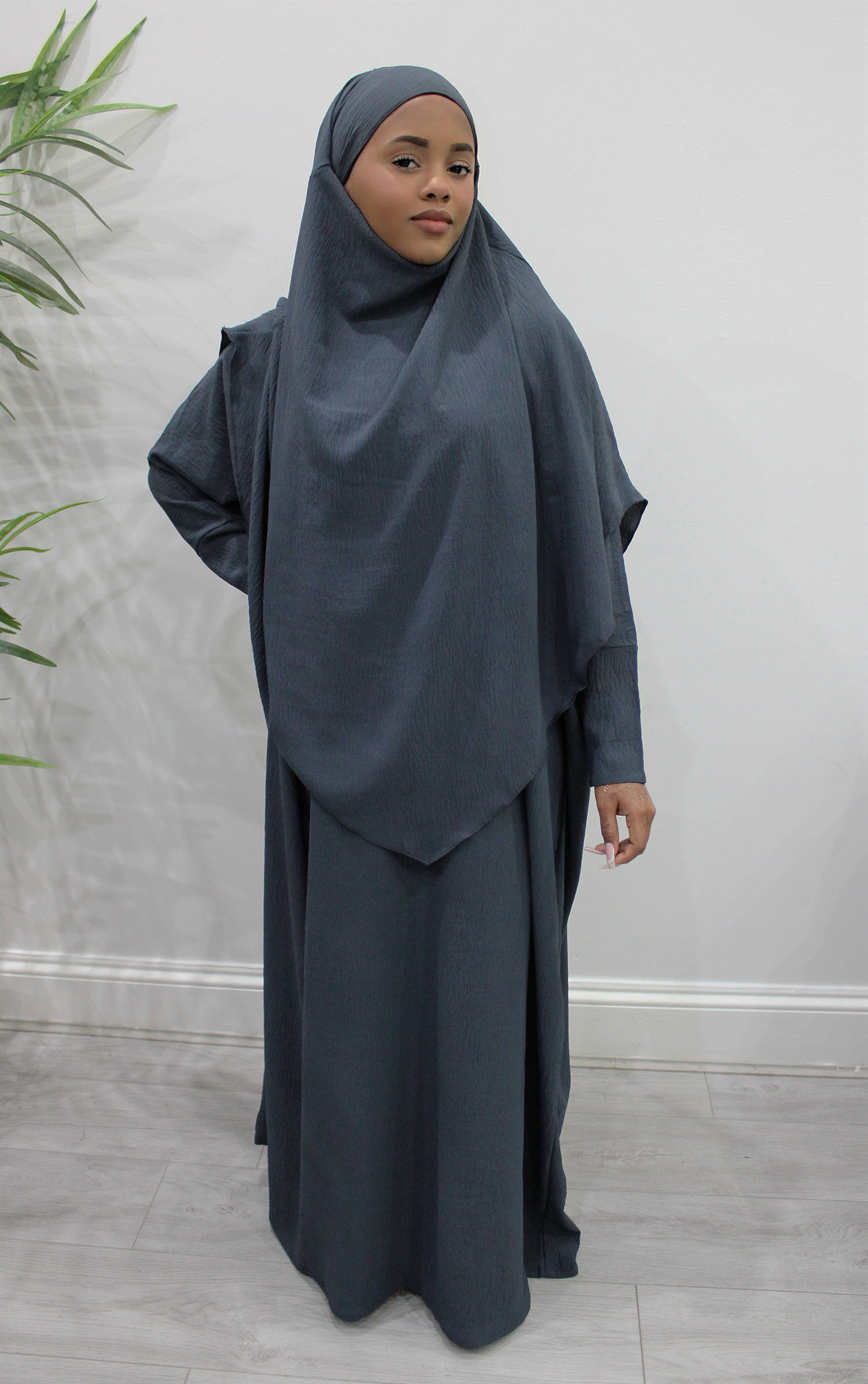
Elegant Anchor Grey Abaya and Khimar Set by Amani, crafted from premium soft crepe fabric with a loose fit and versatile long diamond-shaped khimar with tie straps.
Why styling your abaya matters beyond appearance
Styling isn’t just about looks—it’s how I communicate who I am while staying true to my values. When I dress modestly but fashionably, I feel more confident walking into any room. It’s a quiet form of empowerment, blending faith, culture, and personal expression. And honestly, it makes the day-to-day act of dressing something joyful, not a chore.
So, whether you’re dressing for a formal event or just running errands, remember: your abaya is a canvas. The cuts, fabrics, colors, and accessories you choose create a story about you. What story will you tell today?
What are the essential pieces every Muslim woman should own?
If you asked me a few years ago what the essential pieces in my modest wardrobe were, I might have struggled to name them all. But with time, experience, and countless conversations with sisters who share this journey, I’ve come to appreciate a curated set of garments that truly form the backbone of a modest, elegant, and versatile wardrobe. These aren’t just clothes — they’re companions through everyday moments, celebrations, and everything in between.
Why having essential pieces matters
There’s something so freeing about knowing you have a reliable wardrobe foundation. It’s not about owning a million outfits or following fleeting trends. It’s about having a thoughtful, modest, and functional collection that respects your faith, flatters your body, and lets your personality shine. I’ve found that these essentials save me from decision fatigue, help me dress quickly without compromise, and always keep me feeling confident and comfortable.
The modest wardrobe essentials checklist
| Essential Piece | Why It’s Essential | Styling Tips & Stories |
|---|---|---|
| Classic Black Abaya | Timeless, versatile, and appropriate for almost every occasion | I remember owning my first black abaya—it was simple yet elegant, and I wore it to family gatherings, Eid prayers, and even casual outings. A plain black abaya paired with a colorful hijab instantly feels fresh and put-together. |
| Neutral-toned Long Cardigans or Dusters | Great for layering, adding dimension without compromising modesty | On casual days, I love throwing on a beige or soft gray duster over my jeans and tunic. It’s perfect for modest layering and makes even a simple outfit look thoughtfully styled. |
| Wide-leg Trousers or Palazzo Pants | Comfortable, flowy, and modest alternative to skinny pants | Once, for a casual brunch, I paired my navy palazzo pants with a soft chiffon blouse and a neutral hijab. The outfit felt light and modest, but also sophisticated enough to feel special. |
| Basic Tunics in Solid Colors | Flexible layering pieces that pair well with pants or skirts | I rely on solid-color tunics for everyday wear—especially when paired with printed scarves or statement accessories. They’re like a blank canvas that adapts to your mood. |
| Elegant Maxi Dresses | Ideal for formal occasions, combining modesty with feminine grace | For Eid celebrations or weddings, my go-to is a maxi dress with subtle embroidery or lace detailing. It’s modest yet celebratory, and I often get asked where I found it! |
| Hijabs in Various Fabrics and Colors | Key for completing any modest outfit and adapting to weather | I’ve learned that having hijabs in cotton for hot days, silk for formal events, and jersey for casual wear means I’m never caught off-guard. Plus, switching hijab styles can completely transform a look. |
| Comfortable Closed-toe Shoes | Practical yet stylish for daily wear and special occasions | From loafers to embellished flats, my shoe collection balances modesty and comfort. I recall a day when I had to walk miles but still felt polished thanks to my trusty flats. |
How to build your modest essentials without overwhelm
I totally get how overwhelming it can be when you want to build a modest wardrobe that feels authentic and versatile. Here’s what helped me the most:
- Start with quality basics: Invest in fabrics that breathe and hold up well — trust me, it makes a world of difference when your clothes feel good on your skin.
- Choose neutral colors: Black, beige, navy, olive, and soft pastels create a solid base that’s easy to mix and match.
- Mix textures: Pair a soft cotton tunic with a sleek satin hijab or a flowing chiffon abaya — contrast keeps things interesting.
- Allow room for personality: Incorporate patterns, prints, or a splash of color through accessories or scarves to avoid feeling “uniformed.”
- Buy pieces that can transition: Something that works both for casual outings and can be dressed up with jewelry or shoes is a win-win.
A personal story: finding confidence through wardrobe essentials
One afternoon, before an important work meeting, I felt stuck staring at a closet full of clothes but nothing “right.” Then, I remembered my trusted black abaya paired with a soft cream hijab and a delicate gold necklace. That simple outfit carried me through with confidence and ease — a reminder that sometimes, essentials do more than fill your wardrobe; they anchor your self-expression.
Your modest wardrobe doesn’t have to be complicated or expensive. With a few carefully chosen essentials, you’ll find freedom in dressing modestly with style and grace every single day. What’s on your essentials list? I’d love to hear!

How do I build a modest wardrobe on a budget?
Let me be honest — building a modest wardrobe that feels authentic and stylish can sometimes feel like an expensive, overwhelming task. But here’s the secret: it doesn’t have to be. You absolutely can cultivate a beautiful, versatile, and modest collection without breaking the bank. I’ve walked this path myself, juggling budgets and desires, and I want to share with you what truly worked for me — so you don’t have to waste time or money figuring it all out alone.
Understanding quality over quantity — a mindset shift
When I first started thinking seriously about modest fashion, I used to chase trends and buy many pieces at once, hoping one or two would “work.” Spoiler: that didn’t help. What changed everything was shifting my focus to quality essentials that last longer, feel comfortable, and can be styled in multiple ways. You don’t need a closet full of clothes — you need thoughtfully chosen staples.
And here’s the catch — “quality” doesn’t always mean expensive. It means finding fabrics and brands that respect your values and offer durability without a sky-high price tag.
Budget-friendly fabrics that balance comfort and modesty
| Fabric | Why It Works | Budget-Friendly Tips |
|---|---|---|
| Cotton | Breathable, soft, perfect for daily wear and layering | Look for blends with polyester for durability; shop off-season for discounts |
| Polyester blends | Wrinkle-resistant, affordable, available in many styles | Choose blends to avoid cheap plastic feel; wash carefully to maintain quality |
| Rayon | Lightweight, drapes beautifully, great for tunics and maxi dresses | Shop clearance racks; rayon can mimic pricier fabrics like silk |
| Jersey | Stretchy, comfortable, ideal for hijabs and casual wear | Buy in bulk or multipacks online for savings |
| Chiffon (budget-friendly blends) | Elegant, flowy, perfect for layering and formalwear | Look for synthetic chiffons rather than pure silk; hand wash gently |
Smart shopping strategies to stretch your modest wardrobe budget
- Thrift and vintage stores: Don’t underestimate secondhand gems! I once found a beautifully embroidered abaya at a thrift store for a fraction of the price.
- Seasonal sales and online deals: Keep an eye out for Ramadan, Eid, and end-of-season sales — many modest fashion brands offer significant discounts.
- Invest in mix-and-match basics: Neutral colors and classic cuts let you combine pieces in fresh ways without buying new clothes constantly.
- DIY and tailoring: Sometimes, buying a plain garment and adding a lace trim or subtle embroidery can make it feel special — plus, tailoring to fit you perfectly is a game changer.
- Join modest fashion communities: I found that online groups often share discount codes, swap clothes, and support budget-friendly style ideas.
Building a modest capsule wardrobe on a budget — example breakdown
| Item | Estimated Budget | Why It’s Essential |
|---|---|---|
| Black Abaya (simple cut) | $40–$70 | Classic, versatile, can be dressed up or down |
| Neutral Tunics (2 pieces) | $25 each | Perfect for layering, can pair with pants or skirts |
| Wide-leg pants or palazzo (1–2 pairs) | $30–$50 each | Comfortable and modest alternative to skinny pants |
| Hijabs (3-4 varied fabrics) | $10–$15 each | Different textures and colors for all seasons and occasions |
| Lightweight layering cardigan or duster | $30–$40 | Adds dimension and modest coverage |
A personal story: patience and budget-friendly style wins
I remember when I wanted a chic but modest outfit for a sister’s wedding. My budget was tight, and I worried I’d have to compromise on modesty or style. Instead of rushing, I browsed online sales, thrift shops, and local markets for weeks. Eventually, I found a gorgeous chiffon dress with subtle beadwork — slightly altered by a local tailor — and paired it with a silk-look hijab I bought on clearance. The compliments poured in, and I felt radiant without overspending.
This taught me that patience and smart shopping are your best friends when building a modest wardrobe on a budget. It’s not about rushing to buy everything but about making intentional, loving choices that honor your style, values, and wallet.
So, whether you’re a student, a working mom, or someone simply starting modest fashion, know that your modest wardrobe can be beautiful, practical, and affordable. You just need a little strategy, some patience, and a heart open to creativity.
Can I wear Muslim garments if I’m not Muslim? (And how to do it respectfully)
This question comes up often, and honestly, it’s one I’ve thought about myself when friends from different backgrounds ask about modest fashion. The answer isn’t a simple yes or no — it’s layered, much like the garments themselves. Wearing Muslim garments as a non-Muslim can be a beautiful way to appreciate culture and modesty, but it calls for awareness, respect, and sensitivity to the meaning behind the clothing.
Understanding the cultural and religious significance
Muslim garments like the abaya, hijab, jilbab, and thobe aren’t just pieces of fabric. They carry deep spiritual, cultural, and historical meaning. For many Muslim women, wearing these garments is a personal act of faith, identity, and modesty. When someone outside of the faith chooses to wear these clothes, it’s important to recognize that significance rather than reducing them to mere fashion statements.
Think of it this way: if you wear a traditional garment from any culture, understanding its roots, symbolism, and the feelings it evokes in the people who cherish it helps you honor that culture instead of unintentionally offending it.
How to wear Muslim garments respectfully as a non-Muslim
- Do your research: Learn about the garment’s meaning, variations, and the values it represents. I always recommend reading personal stories and listening to voices from the community rather than just looking at photos.
- Avoid cultural appropriation: This happens when a garment is worn out of context, often as a costume or without regard for its importance. Approach Muslim garments with genuine respect, not as exotic or trendy props.
- Seek permission or guidance: If you’re attending cultural or religious events where such attire is common, it’s okay to ask respectfully if it’s appropriate to wear certain items. Many Muslim friends appreciate the openness and sincerity.
- Wear it modestly: Modesty isn’t just about coverage — it’s about attitude and intention. Wearing these clothes thoughtfully, in a way that aligns with modesty principles, is key.
- Support Muslim-owned businesses: If you decide to purchase Muslim garments, consider buying from Muslim designers or local artisans. This helps sustain the community and ensures you get authentic pieces made with care.
Common Muslim garments and their respectful use
| Garment | Meaning & Use | Respectful Wearing Tips |
|---|---|---|
| Hijab | Headscarf symbolizing modesty and faith for Muslim women | Wear it modestly and not as a costume. Understand it’s a personal act of faith. |
| Abaya | Loose, flowing robe for modest coverage, often worn in Gulf countries | Choose simple, respectful styles. Avoid pairing with flashy or revealing items. |
| Jilbab | Outer garment that covers the body, often with a hood or full-length design | Use it in modest contexts, avoid wearing for fashion only or to imitate. |
| Thobe / Dishdasha | Long robe traditionally worn by Muslim men in many countries | Wear it in appropriate settings and with awareness of its cultural significance. |
Personal story: When cultural appreciation turns into connection
I remember a dear non-Muslim friend who wanted to wear a hijab for a cultural event we were attending together. She was nervous but asked me many questions beforehand — not just about how to wear it, but about what it meant to me personally. She wasn’t trying to “dress up,” but to share in a moment of respect and learning. That moment became a genuine bridge between us — not just about clothes, but about understanding and friendship.
This kind of respect and openness is what makes wearing Muslim garments outside the community beautiful, rather than problematic. It’s about building empathy and honoring the story behind the fabric.
Final thoughts: Style with respect and heart
If you’re not Muslim but drawn to the elegance and meaning of Muslim garments, that’s wonderful — just wear them with humility and awareness. Ask yourself: Am I honoring this tradition, or am I using it superficially? Modest fashion is ultimately about dignity, respect, and faith, no matter who wears it.
So yes, you can wear Muslim garments if you’re not Muslim — but do it thoughtfully. Let your choice be a celebration of culture, not a moment of misunderstanding. When worn with respect, these garments can become a beautiful symbol of unity and shared values across faiths and cultures.

What Are the Most Common Modestwear Mistakes — And How to Avoid Them?
If you’re like me, the journey into modestwear isn’t always smooth sailing. I’ve stumbled, learned, and grown through some classic missteps — and honestly, that’s part of what makes this style so personal and evolving. But what if I told you that many modestwear mistakes are totally avoidable? Let’s dive into the most common pitfalls I’ve seen (and experienced) and how to dodge them with grace and style.
1. Choosing the Wrong Fabric: When Breathability Meets Beauty
Here’s a little confession: I once bought a stunning polyester abaya because it looked flawless online. But the moment I wore it in the summer, I felt like I was wrapped in a plastic bag. Not fun. Fabric matters, especially in modestwear where layering and coverage are key.
The wrong fabric can lead to discomfort, sweating, and a lack of confidence. Natural fibers like cotton, linen, and lightweight jersey breathe better, while blends with a bit of stretch offer comfort without sacrificing modesty.
| Fabric | Pros | Cons | Best Use |
|---|---|---|---|
| Cotton | Breathable, soft, natural | Can wrinkle easily | Everyday casual wear |
| Polyester | Durable, wrinkle-resistant | Less breathable, can trap heat | Winter or formalwear |
| Linen | Lightweight, breathable | Wrinkles easily, less stretch | Summer casual/modest layering |
| Jersey | Stretchy, comfortable | Can cling if too thin | Modest everyday basics |
2. Over-accessorizing: When Less Is More
I get it, accessories are fun! But when modestwear is your canvas, too many bold pieces can overpower the outfit’s elegance. Once, I layered chunky jewelry and a heavy handbag with a delicate abaya — the look felt unbalanced, and honestly, a bit forced.
The trick? Choose one or two statement pieces. A simple ring or a subtle hijab pin can elevate your look without screaming for attention.
3. Wearing Clothes That Don’t Fit Right
Modestwear isn’t just about loose or baggy clothes. Ill-fitting garments — whether too tight or too oversized — can miss the mark on modesty and comfort. I’ve seen too many women wear shapeless, oversized tunics that swallow their figure or tight tops that reveal more than intended.
Aim for well-tailored pieces that skim your body gently. If needed, get things tailored! A little nip and tuck can make a world of difference in feeling polished and modest.
4. Neglecting Color Coordination
Ever thrown on an outfit and thought, “Why does this feel off?” Color plays a huge role in modestwear harmony. Bright clashing colors or all-over prints can overwhelm modest styles that rely on calm, understated elegance.
My advice? Stick to a cohesive palette — neutrals with one or two soft accent colors. Earth tones, pastel hues, and classic black and white combos work wonders.
5. Ignoring Seasonal Needs
Modestwear often involves layers, which can be tricky when the seasons change. Wearing thick layers in summer or too-light fabrics in winter is a rookie mistake I’ve made. Beyond comfort, it’s about respecting your body’s needs.
Invest in versatile pieces that transition well — a lightweight cardigan for summer evenings, and heavier coats with loose cuts for winter. Layer smartly without sacrificing modesty or comfort.
My Personal Story: When a Mistake Turned Into a Lesson
Once, I wore a beautiful abaya to an Eid gathering that looked amazing in the store’s air-conditioned environment. But the fabric was synthetic, and the event was outdoors. By the time I got home, I was drenched in sweat and felt totally uncomfortable. I learned the hard way that modestwear isn’t just about style but also about practicality.
Since then, I always check fabric tags and think about where and when I’ll wear something before buying it. Trust me — that saves so much stress and lets you enjoy your special moments fully.
Quick Guide: Common Modestwear Mistakes and How to Fix Them
| Mistake | Why It Happens | How to Avoid |
|---|---|---|
| Wrong Fabric Choice | Attracted by looks over comfort | Choose breathable, season-appropriate fabrics |
| Over-accessorizing | Trying to add flair, lack of balance | Limit to one or two simple accessories |
| Poor Fit | Misunderstanding modesty as only loose clothing | Opt for tailored, flattering modest pieces |
| Clashing Colors | Not planning outfit palettes | Stick to harmonious, neutral-based colors |
| Ignoring Seasons | Lack of planning for weather conditions | Invest in versatile layers suitable for all seasons |
Final thoughts: Embrace modesty with confidence and care
Modestwear is a beautiful expression of faith, culture, and personal style — but like anything meaningful, it takes attention and heart to get it right. I want you to feel radiant, comfortable, and true to yourself every time you step out.
So the next time you’re shopping or styling your modest wardrobe, pause and ask: Does this choice honor my comfort, my values, and my style? When you do, mistakes become fewer, and your modest fashion journey becomes all the more joyful.

What Should I Look For in a Quality Hijab or Abaya?
If you’ve ever found yourself overwhelmed standing in front of a rack full of hijabs or abayas, wondering what really sets a high-quality piece apart — you’re not alone. I’ve been there, trust me. Over time, I’ve learned that quality isn’t just about price or brand; it’s about thoughtful details that blend comfort, modesty, and style. Let me share with you what I look for when choosing my favorite hijabs and abayas — because investing in pieces that truly work for you is worth every penny.
1. Fabric Matters: Softness, Breathability & Durability
First and foremost, the fabric of your hijab or abaya can make or break your entire experience. I remember buying a gorgeous silk hijab once — it looked luxurious, but it kept slipping off my shoulders all day. So frustrating! What I’ve come to value most is fabric that feels soft against my skin, breathes well in hot weather, and stands up to regular wear and washing.
| Fabric | Pros | Cons | Best For |
|---|---|---|---|
| Chiffon | Lightweight, breathable, elegant drape | Can be delicate, slightly transparent | Formal events, warm climates |
| Jersey | Stretchy, comfortable, stays put | Can cling if too thin | Everyday wear, casual outings |
| Cotton Voile | Soft, breathable, natural feel | May wrinkle, less flowy | Summer, daily wear |
| Silk | Luxurious, smooth, shiny | Slippery, needs delicate care | Special occasions |
For abayas, I lean towards fabrics like crepe, lightweight polyester blends, or soft cotton blends that provide a nice flow but also hold their shape. Breathability is key — especially for day-long wear.
2. Stitching & Craftsmanship: The Invisible Details That Speak Volumes
You know those little things you don’t notice until they’re missing? That’s how I feel about solid stitching and fine craftsmanship. A quality hijab or abaya should have clean, even seams without loose threads. I once bought an abaya with pretty embroidery, but after a few wears, the stitching around the cuffs started unraveling — a painful lesson in looking beyond the surface.
When I shop, I run my fingers along the seams and hems. They should feel sturdy but not bulky. Also, details like reinforced edges on hijabs help prevent fraying, and discreet stitching around buttons or zippers on abayas adds to longevity.
3. Fit & Cut: Flattering Modesty Without Compromise
Modesty doesn’t mean sacrificing shape or feeling frumpy. For me, a quality abaya fits comfortably without clinging — draping elegantly and allowing freedom of movement. Whether it’s a classic A-line cut, kimono sleeves, or a straight silhouette, the key is that it respects your body’s modest boundaries while enhancing your confidence.
Hijabs should also have a shape and size that works for you — enough fabric to style comfortably but not so much that it feels heavy or overwhelming.
4. Color & Versatility: A Wardrobe Ally, Not a One-Time Wonder
A hijab or abaya should be a staple you turn to again and again. I always consider the color carefully — neutral tones like black, beige, navy, or soft pastels that easily mix and match with my other garments.
For abayas, versatility means choosing styles that can be dressed up or down. For hijabs, it means selecting fabrics and colors that complement various outfits and occasions.
5. Practicality: Easy Care and Comfortable Wear
Here’s something I learned the hard way: If a hijab or abaya is a nightmare to care for, it’s going to spend more time in the closet than on you. I love pieces that are machine washable, wrinkle-resistant, and dry quickly.
Also, consider how the garment feels after hours of wear — does it itch, slip, or weigh you down? The best quality pieces feel like a second skin — comfortable and reliable.
Quick Checklist: How to Spot a Quality Hijab or Abaya
| Feature | What to Look For | Why It Matters |
|---|---|---|
| Fabric | Soft, breathable, appropriate weight | Comfort and longevity |
| Stitching | Even seams, no loose threads | Durability and neat appearance |
| Fit & Cut | Comfortable, modest, flattering | Confidence and modest expression |
| Color | Versatile, suits your wardrobe | Wearability across occasions |
| Care | Easy to clean, wrinkle-resistant | Convenience and upkeep |
A Personal Tale: When Quality Made All the Difference
Once, I invested in a high-quality abaya made from soft crepe fabric with flawless stitching. I wore it on a long day filled with errands and family visits. The comfort, breathability, and perfect cut meant I never had to fidget or adjust my outfit. I felt elegant, modest, and free.
That experience cemented for me that quality isn’t a luxury — it’s a foundation for modest fashion that supports your daily life and spiritual confidence.
Wrapping It Up
When you pick your next hijab or abaya, look beyond trends or flashy details. Seek comfort, craftsmanship, and thoughtful design that honors your modesty and lifestyle. When you find those pieces, they become more than clothing — they become companions on your modest fashion journey, helping you shine with quiet confidence every single day.
Where Can I Shop for Modestwear That’s Stylish and Ethical?
I’ve often found myself scrolling endlessly, searching for modestwear that doesn’t just look good but feels right — ethically made, thoughtfully designed, and respectful to our values. It’s a tough balance, isn’t it? Style and conscience don’t always come hand-in-hand in mainstream fashion, but thankfully, the modest fashion world is evolving. Today, I want to share where I shop (and how I choose) so you can feel beautiful *and* aligned with your principles every time you dress.
Why Ethical Modestwear Matters More Than Ever
Let me start with something close to my heart. Modestwear is more than just fabric and cut — it’s an expression of faith, identity, and integrity. Supporting ethical brands means honoring those values beyond the surface. It means workers who sew your clothes earn fair wages, the materials come from sustainable sources, and the brand respects cultural modesty without exploiting it for quick profit.
When I shop ethically, I’m investing in a story — not just a garment. And honestly? That feels so much better than fast fashion’s empty promises.
Top Ethical Modestwear Brands I Trust and Love
| Brand | What Makes Them Ethical | Style Highlights | Price Range |
|---|---|---|---|
| Aab Collection | Fair labor, sustainable fabrics | Chic abayas, elegant layering pieces | $$$ (mid to high) |
| Verve Culture | Eco-friendly materials, inclusive sizing | Modest casualwear, trendy hijabs | $$ (affordable) |
| Haute Elham | Ethical production, hand-embroidered details | Elegant eveningwear, statement pieces | $$$ (premium) |
| Unspun | Zero-waste manufacturing, fair trade | Timeless basics, minimalistic cuts | $$ (mid-range) |
How to Spot Ethical Modestwear Brands — My Tried-and-True Tips
Shopping ethical modestwear isn’t always as obvious as it should be. Here’s what I look for before clicking “buy” — a checklist built from experience and intuition:
- Transparency: Do they clearly state their production process, labor practices, and sourcing?
- Sustainability: Are natural or recycled fabrics prioritized over synthetic, wasteful ones?
- Community Respect: Does the brand honor modesty authentically without exoticizing or exploiting Muslim culture?
- Reviews and Stories: What do real customers say about fit, quality, and ethics?
- Pricing Consistency: Is the price reasonable for the quality and ethical claims, or does it feel “too cheap to be true”?
Shopping Local and Supporting Small Businesses
Nothing beats the joy of supporting local modestwear designers and boutiques. In my city, I’ve found hidden gems offering handcrafted abayas, tailored jilbabs, and hijabs made with love and care. Besides ensuring a personal touch, shopping local cuts down environmental impact and nurtures our community.
If you’re wondering how to find local modestwear stores, try community Facebook groups, Instagram hashtags specific to your region, or modest fashion pop-up events. Often, these small businesses are the heartbeats of ethical, stylish modestwear.
A Personal Shopping Story: The Dress That Changed Everything
One day, I stumbled upon a small brand run by a sister in my community. Their abayas were simple yet stunning, made with organic cotton and delicate embroidery. The price was fair, the story genuine, and when I wore one to Eid, the compliments flooded in — not just on the dress but the meaning behind it.
That moment taught me how much richer modestwear feels when it’s made and worn with care — it’s not just about the outfit but about who made it and why.
Quick Comparison: Ethical vs Fast Fashion Modestwear
| Criteria | Ethical Modestwear | Fast Fashion Modestwear |
|---|---|---|
| Fabric Quality | Natural, durable, skin-friendly | Often synthetic, cheap materials |
| Production | Fair wages, safe conditions | Mass production, questionable labor |
| Design | Timeless, culturally respectful | Trend-driven, sometimes culturally insensitive |
| Environmental Impact | Low, sustainable sourcing | High, wasteful manufacturing |
| Price | Moderate to premium | Cheap, disposable |
Final Thoughts: Fashion With Heart
Choosing where to shop for modestwear is as much a spiritual decision as a style one. When we support ethical brands, we uplift communities, protect the planet, and express our faith with pride. It’s not always the easiest path — sometimes it takes a bit more research and a bigger budget — but the rewards? They go far beyond the mirror.
So next time you’re ready to add to your wardrobe, pause and ask yourself: Does this piece honor who I am and what I believe? When the answer is yes, you’ll walk out not just looking beautiful but feeling whole.
How Do Influencers and Fashion Icons Wear Muslim Garments Today?
If you’ve ever scrolled through Instagram or TikTok wondering how Muslim women — especially influencers and fashion icons — make modestwear feel fresh, modern, and absolutely chic, you’re in the right place. Watching these women blend tradition with contemporary trends is inspiring. They show us that modest fashion isn’t just about covering up; it’s a vibrant expression of identity, creativity, and confidence.
Let me walk you through how today’s trendsetters are styling Muslim garments — the stories behind their choices, and what we can learn from them to elevate our own wardrobes.
1. Mixing Tradition with Modern Trends: The Art of Balance
One thing I notice immediately is how influencers master the balance between respecting Islamic guidelines and embracing current fashion movements. Take someone like Habiba Da Silva, for example — she pairs classic abayas with trendy sneakers or statement bags, showing us that modestwear can be sporty, edgy, or elegant all at once.
It’s about layering thoughtfully: a flowy jilbab over tailored trousers, or a sleek hijab in vibrant prints paired with neutral basics. This mix-and-match mentality keeps the look fresh without compromising modesty.
| Style Element | How Influencers Use It | Why It Works |
|---|---|---|
| Layering | Combining long coats, abayas, and cardigans with fitted basics | Adds dimension & keeps modesty without bulk |
| Bold Accessories | Statement bags, chunky sneakers, layered jewelry | Injects personality and modern flair |
| Color Blocking | Pairing neutral hijabs with bright or pastel outerwear | Creates a balanced yet eye-catching look |
2. Hijab Styling: From Classic Drapes to Trendy Twists
Hijab styling today has evolved far beyond the traditional wrap. Influencers like Dina Tokio and Leena Asad experiment with textures, layering multiple scarves, and even introducing unique knots or turban styles. It’s playful yet respectful — a perfect example of how modest fashion can embrace individuality.
And the choice of fabric plays a huge role here — chiffon for elegant drapes, jersey for casual all-day wear, and silk for a luxurious touch.
I remember trying to mimic one of these trendy hijab styles for an Eid celebration. It was tricky at first — but it felt so empowering to reinvent my look while staying true to my values. This shows us that modest fashion doesn’t have to be static or boring. It can be a creative playground!
3. Statement Abayas and Kaftans: Modest, Yet Memorable
Gone are the days when abayas were all the same. Now, fashion icons like Hana Tajima are designing and wearing abayas that tell a story — whether it’s through embroidery, unusual cuts, or unexpected fabrics.
These garments act like canvases, blending modesty with art. You might see an abaya with subtle beadwork or a kaftan featuring modern geometric prints. It’s modestwear that commands attention without shouting.
4. Sustainability & Ethics: A Growing Influence
One of the most heartening trends I see among modest fashion influencers is their growing commitment to sustainability. Many openly share their favorite slow-fashion brands or even show how they style vintage or upcycled pieces.
This movement aligns perfectly with Islamic values of responsibility and gratitude, reminding us all to cherish what we wear and buy thoughtfully.
5. How You Can Bring Influencer Style Into Your Wardrobe
Here’s a little guide I’ve picked up from watching and learning from these icons — it’s not about copying, but about adapting to your own life and taste:
- Invest in versatile basics: A good quality black abaya or solid hijabs are the foundation for experimenting with accessories and layers.
- Play with textures and colors: Try mixing a soft cotton hijab with a satin blouse or a wool coat over a silk dress.
- Use accessories thoughtfully: A well-chosen bag, shoes, or even subtle jewelry can transform your outfit.
- Prioritize comfort: The best style is one you feel good in — so choose fabrics and fits that move with you.
- Support ethical brands: Emulate the influencers who champion sustainability and mindful shopping.
My Personal Reflection: Style as Self-Expression and Faith
Watching these influencers has reminded me that modest fashion is deeply personal. It’s a way to express not just faith, but also joy, creativity, and confidence. There’s something magical about putting on a garment that makes you feel proud of your values and beautiful in your skin.
So, whether you’re layering a cozy cardigan over your abaya or trying a bold hijab style for the first time, remember: modestwear is your canvas — and you’re the artist.
What Role Does Intention Play in Dressing Modestly?
Have you ever paused in front of your closet and wondered, “Why exactly am I choosing this today?” For those of us who embrace modest fashion, intention isn’t just a nice-to-have — it’s the very heartbeat behind every layer, every fabric, every fold. Dressing modestly isn’t only about rules or appearances; it’s about purpose, reflection, and a deeply personal connection between faith, self-respect, and how we present ourselves to the world.
The Power of Intention: More Than Just Clothes
I’ll be honest — when I first started dressing modestly, I focused mostly on what to wear, how to cover, and what looked “right.” But over time, I realized it’s the intention behind those choices that truly transforms modestwear from a dress code into a way of life.
Intention shapes our mindset and influences how we carry ourselves. Are we dressing modestly to please others, to avoid judgment, or because we genuinely want to honor our values and nurture our self-worth? The answer makes all the difference.
Intentions That Shape Modest Dressing
| Common Intentions | What It Means | How It Influences Your Style |
|---|---|---|
| Faith Expression | Showing devotion and submission through attire | Choosing clothes that reflect humility, often simple and dignified |
| Self-Respect & Empowerment | Protecting your dignity and feeling confident in your identity | Selecting outfits that make you feel beautiful yet comfortable and true to yourself |
| Privacy & Boundaries | Setting limits on what you reveal, creating a personal space | Preferring looser, less revealing garments and thoughtful layering |
| Cultural Connection | Honoring heritage, community, and tradition | Incorporating traditional fabrics, cuts, or styles with pride |
| Practicality & Comfort | Balancing modesty with everyday life demands | Choosing breathable, versatile fabrics and adaptable pieces |
Stories From My Journey: When Intention Changed Everything
I remember a day when I was rushing out wearing a hijab just because “it was expected.” I felt cramped, uncomfortable, and honestly, disconnected from why I was wearing it. That day stuck with me — it wasn’t about covering up but about honoring my values and feeling grounded.
So I began asking myself before every outfit: “What am I really trying to say with this?” That simple question helped me shift from dressing out of habit or obligation to dressing with love and purpose. Suddenly, modest fashion wasn’t a limitation — it was a form of self-care.
How to Cultivate Intention in Your Modestwear Choices
It’s easy to fall into autopilot, especially when mornings are hectic or trends change fast. But cultivating intention is possible with gentle daily reminders:
- Pause and Reflect: Before choosing your outfit, take a moment to consider how it aligns with your values and mood.
- Journal Your Thoughts: Write down what modesty means to you personally — this helps clarify your unique intention.
- Mindful Shopping: Choose pieces that resonate with your purpose, not just impulse buys.
- Wear It Proudly: Carry your modestwear with confidence, knowing it’s an expression of your inner truth.
- Connect With Community: Share your intention stories with friends or online groups to inspire and deepen your understanding.
The Emotional and Spiritual Impact of Intentional Dressing
When intention leads our wardrobe, dressing modestly becomes an act of love — for ourselves, our faith, and the world around us. It transforms how we experience each day. Instead of feeling constrained, we feel empowered. Instead of blending in, we glow with authenticity.
I’ve noticed that when my intention is clear, people respond differently — not just to my clothes but to the energy I carry. It invites respect, warmth, and meaningful connection.
Quick Comparison: Intentional vs. Unconscious Dressing
| Aspect | Intentional Dressing | Unconscious Dressing |
|---|---|---|
| Mindset | Purposeful, reflective, values-driven | Habitual, reactive, influenced by external pressures |
| Confidence | Authentic and grounded | Often uncertain or insecure |
| Style | Consistent and meaningful | Inconsistent or trend-chasing |
| Spiritual Connection | Deepened and strengthened | Minimal or absent |
| Overall Experience | Empowering and joyful | Confusing or burdensome |
Final Thoughts: Wearing Intention, Wearing Yourself
Intention isn’t just a buzzword. It’s the quiet but powerful force that turns modestwear from fabric into a statement of self-love, faith, and resilience.
Next time you pick out your clothes, I invite you to pause, breathe, and ask yourself: What am I really putting on today — just a garment, or a declaration of who I am? When we answer honestly, modest fashion becomes a beautiful journey — one where every outfit is a step closer to ourselves.
How Do I Find the Right Hijab Style for My Face Shape?
Honestly, choosing a hijab style can sometimes feel like trying to solve a beautiful puzzle. You want to express your personality, stay modest, and feel comfortable, but also highlight your best features. One thing I’ve learned over the years is that your face shape plays a huge role in which hijab styles will flatter you most — and it’s not just about fashion, it’s about feeling confident every time you step out.
So let’s explore how to find the perfect hijab style tailored for your unique face shape. Trust me, once you figure this out, the daily hijab struggle becomes way easier — and way more fun.
Why Does Face Shape Matter When Styling Hijab?
When you wrap your hijab, it’s framing your face like a delicate piece of art. Certain folds and drapes can soften features, elongate the face, or balance proportions. Wearing the “wrong” style can sometimes make your face look heavier or disproportionate, and who wants that? Knowing your face shape helps you work with your natural beauty — not against it.
Identify Your Face Shape First
Before anything, stand in front of a mirror and take a good look (or snap a selfie). These are the most common face shapes and their main traits:
| Face Shape | Key Characteristics |
|---|---|
| Oval | Balanced proportions, slightly narrower chin than forehead |
| Round | Full cheeks, rounded jawline, similar width and height |
| Square | Strong jawline, broad forehead, face width and length similar |
| Heart | Wide forehead, narrow pointed chin |
| Long/Rectangular | Face longer than it is wide, strong jawline |
Hijab Styles That Flatter Each Face Shape
Here’s a friendly guide I always share with my sisters who ask for hijab advice. These tips helped me discover styles that feel like they were tailor-made for my face.
| Face Shape | Hijab Style Tips | Why It Works |
|---|---|---|
| Oval | Almost any style works. Try loose drapes or tight wraps. | Balanced proportions allow versatility |
| Round | Choose hijabs that create length—wrap higher on the forehead, avoid bulk on cheeks. | Elongates face, softens roundness |
| Square | Soft, rounded hijab folds and layers that soften the jawline | Balances strong jaw and broad forehead |
| Heart | Volume around the chin area with loose ends draped on shoulders | Balances wider forehead and narrow chin |
| Long/Rectangular | Hijabs that add width on the sides, avoid overly tight wrapping | Balances face length, adds softness |
Personal Anecdote: Finding My Own Hijab Style
I’ll admit, when I first started wearing hijab, I didn’t give much thought to my face shape. I just wrapped it the way my mother taught me. But I noticed sometimes my face looked a bit “flat” or too round in pictures, and I felt less confident.
One day, after a casual chat with a fashion-forward friend, I tried wrapping my hijab a little higher on my forehead, letting the fabric drape loosely on the sides. The difference? Instantly noticeable! My face looked more balanced, and I felt like I was wearing the hijab *on my terms*, not just as an obligation.
That moment taught me to embrace my natural shape instead of fighting it — and it made all the difference in my hijab journey.
Quick Tips to Experiment With Your Hijab Style
- Use accessories: Pins, brooches, and under-scarves can help adjust volume and shape.
- Try different fabrics: Lightweight chiffons for flow, cotton for structure, and jerseys for comfort.
- Play with layering: Add a second scarf for volume or color contrast around your face.
- Mirror test: Take selfies in different light and angles to see what feels best.
Final Thoughts: Your Hijab Style Is Yours Alone
The beautiful thing about modest fashion is that it’s personal. No one else’s style has to fit you perfectly — only you. Once you understand your face shape and how to highlight your best features, hijab styling becomes a creative expression of who you are.
Remember, it’s okay to try, fail, and try again. Your confidence will shine through every wrap, every fold, every moment you wear it intentionally. So go ahead, experiment, and find that hijab style that feels just right for your face — and your soul.
How Can Modest Clothing Boost Your Confidence and Presence?
Have you ever noticed how the right outfit can totally change the way you carry yourself? For me, modest clothing has been more than just a fashion choice — it’s a source of strength, dignity, and deep confidence. It’s funny how covering up can sometimes make you feel more visible, more heard, and more *you* than ever before.
Let’s talk about how modest clothing doesn’t just transform your look but uplifts your entire presence — the way you walk into a room, the way you hold your head high, and the energy you radiate.
The Emotional Power Behind Modest Dressing
At first glance, modest clothing might seem like just fabric choices or a style preference, but for so many of us, it’s intertwined with identity and values. Wearing modest clothes is a personal declaration — a statement of self-respect and self-love. It tells the world, “I define my worth beyond the surface.”
I remember the first time I consciously chose a modest outfit that felt authentic to me — it was a moment of quiet empowerment. No longer trying to blend in or follow fleeting trends, I was embracing who I was, flaws and all. And honestly, that feeling of being aligned inside and out gave me a confidence that nothing else matched.
How Modest Clothing Shapes Your Presence
There’s a subtle shift in the way people respond to you when you dress modestly with intention. It’s not about hiding, but about presenting yourself with grace and purpose. Modest fashion invites curiosity, respect, and admiration — because you’re standing firm in your values.
Here’s a simple table that breaks down how modest clothing impacts presence, compared to more revealing styles:
| Aspect | Modest Clothing Impact | Less Modest Styles |
|---|---|---|
| Perceived Confidence | Exudes quiet strength, self-respect | Often judged by appearance, sometimes misconstrued |
| First Impressions | Elegant, intentional, grounded | Bold, trendy, but can feel fleeting |
| Interactions | Encourages meaningful connection beyond looks | May attract superficial attention |
| Long-term Presence | Leaves a lasting impression of dignity | Sometimes quickly forgotten or stereotyped |
A Story From My Modest Fashion Journey
Once, I attended a community event feeling a little unsure about myself. I chose a simple, flowing abaya paired with a neat hijab style — nothing flashy, but perfectly ‘me.’ To my surprise, throughout the evening, I noticed how people gravitated toward me, not because of how much skin I showed, but because of the calm, assured energy I carried.
A dear friend later told me, “You have this glow that’s different now. It’s like you’re comfortable in your skin.” And that stuck with me. That evening was proof: modest clothing helped me reconnect with my inner confidence, and that radiated outward in a way I never expected.
Practical Ways to Use Modest Clothing to Boost Your Confidence
- Choose fabrics that feel good on your skin: Comfort equals confidence. When you feel physically good, your mood shifts.
- Opt for colors that energize or calm you: A bold color can boost your mood, while neutrals invite calm and poise.
- Wear pieces that honor your personal style: Authenticity shines through every outfit you love.
- Invest in versatile staples: Clothes you can mix and match reduce stress and build outfit confidence.
- Experiment with accessories: A thoughtful scarf pin or a statement bag can elevate your whole presence.
Why Confidence in Modesty Is More Than Skin Deep
Modesty is often misunderstood as limitation, but for me, it’s liberation. It’s freedom from the constant pressure to conform, to please, or to be seen a certain way. When I dress modestly, I reclaim my narrative — one that’s rooted in dignity, faith, and self-awareness.
And here’s the secret: confidence born from modesty lasts. It’s steady, authentic, and invites others to see the real you — not just the surface. That’s a kind of presence no trend can replicate.
So, if you’ve ever wondered if modest clothing can actually make you feel more powerful, I’m here to say it absolutely can. It did for me, and it can for you too — once you let your clothes reflect your values, your soul, and your strength.
How Do I Transition My Wardrobe for Different Seasons Modestly?
I still remember that first crisp autumn morning when I realized my summer wardrobe just wouldn’t cut it anymore. The soft, airy fabrics I loved wearing in June suddenly felt too thin, too exposed for the cooler breeze. But here’s the thing — as someone who’s passionate about modest fashion, transitioning my wardrobe from season to season isn’t just about swapping clothes. It’s a mindful process of balancing comfort, style, and modesty, no matter the weather.
Why Seasonal Wardrobe Transitions Matter in Modest Fashion
Modest clothing isn’t about sacrificing style for coverage, and seasonal changes can actually become opportunities to experiment and refine your look. I’ve learned that each season brings its own palette, textures, and layering possibilities that can deepen your personal style without ever compromising on modesty.
But if you’re like me, you’ve probably faced moments where your layering looked bulky or where you felt stuck between “too warm” and “not covered enough.” I want to share the practical tips that helped me glide through seasons gracefully, with confidence and ease.
Key Principles for Modest Seasonal Transitions
| Principle | What It Means | How I Apply It |
|---|---|---|
| Layer Smartly | Use breathable layers to stay warm without bulk | I choose thin cotton long-sleeves under a stylish cardigan or kimono |
| Mix Textures | Combine fabrics like wool, silk, and cotton for warmth and style | Pair silk scarves with cozy wool coats for contrast |
| Embrace Versatile Pieces | Invest in items that work across seasons | My go-to maxi skirts are lightweight enough for summer, layered with tights in winter |
| Play with Colors | Shift your palette to match the season’s mood | Light pastels in spring, rich earth tones in fall |
| Balance Coverage and Breathability | Keep modesty without overheating | Choose breathable fabrics like linen for hot days, switch to thicker layers when cold |
My Step-by-Step Seasonal Wardrobe Transition Routine
Here’s what I do when the seasons start to shift:
- Assess and Sort: I pull out my summer pieces and assess which ones can be layered or styled differently. Some cotton tunics become perfect under cozy vests.
- Introduce Layering Basics: Thin turtlenecks, long-sleeve tees, or thermal leggings become my layering friends. They’re modest yet lightweight, perfect for bridging the temperature gap.
- Swap Fabrics Gradually: I replace chiffon or voile scarves with silk or wool blends that still feel soft but keep me warm.
- Update Outerwear: A lightweight trench coat or a tailored wool jacket becomes my new staple, blending modesty and seasonal practicality.
- Play with Accessories: Hats, gloves, and boots aren’t just functional; they’re modest fashion statements that elevate the whole look.
Seasonal Modest Wardrobe Essentials I Can’t Live Without
| Season | Essential Piece | Why It Works |
|---|---|---|
| Spring | Lightweight long cardigans | Perfect for layering on cool mornings and evenings |
| Summer | Breathable maxi dresses and cotton hijabs | Maintain coverage without overheating |
| Fall | Wool coats and silk scarves | Add warmth and texture, with elegant style |
| Winter | Thermal layers and insulated boots | Keep modesty intact while protecting against cold |
A Personal Story: When Layering Saved Me
I once traveled during the unpredictable early spring — you know how mornings can be freezing but afternoons pleasantly warm? On my first day, I layered a thin thermal top under a cotton tunic, topped with a flowing duster jacket. At first, I worried it’d look bulky or awkward, but instead, I got compliments on how elegant yet comfortable I looked.
That day taught me the power of thoughtful layering — not only did I stay warm and modest, but I felt confident knowing my outfit adapted to the changing weather without compromising style.
Final Tips: Making Seasonal Modesty Your Own
- Experiment with layering at home to find combinations that feel right.
- Don’t be afraid to mix patterns and textures — it adds personality.
- Invest in quality basics that last through multiple seasons.
- Listen to your body; modesty is as much about comfort as it is about coverage.
- Use scarves creatively — they’re one of the most versatile modest wardrobe pieces.
Transitioning your modest wardrobe through seasons isn’t a chore — it’s a chance to celebrate your values and your style, whatever the weather. Trust me, once you get the hang of layering and fabric choices, you’ll find this process fun, freeing, and uniquely you.
The Rich History Behind Muslim Women’s Garments
There’s something profoundly beautiful about clothing that carries stories—stories of culture, faith, resilience, and identity. When I think about Muslim women’s garments, I’m not just picturing fabric and stitches; I’m envisioning centuries of tradition woven into every thread, every fold. The history behind modest fashion runs deep, shaped by faith, regional influences, and evolving social contexts. It’s a journey that connects us with countless women before us, each wearing their garment with purpose and pride.
Modesty Rooted in Faith: The Quran and the Sunnah
At the heart of Muslim women’s attire is the principle of modesty — an essential part of Islamic teachings. The Quran provides guidance on covering oneself, emphasizing dignity and humility rather than mere fabric coverage. I recall first reading the verses that inspired my own journey with the hijab, such as Surah An-Nur 24:31, which beautifully instructs women to draw their coverings over their chests and not display their adornment except what is apparent. This spiritual foundation laid the groundwork for diverse expressions of modest dress around the world.
The Evolution of Traditional Garments: Regional Styles and Influences
Muslim women’s clothing isn’t monolithic; it’s a rich tapestry colored by geography, climate, and local customs. I love how each region adds its own unique flair while honoring modesty.
For example, the abaya in the Arabian Peninsula is a flowing black cloak that provides an elegant silhouette, while the chador in Iran drapes gracefully around the body, often in rich fabrics and colors. In South Asia, the shalwar kameez combines modest cuts with intricate embroidery, reflecting centuries of cultural artistry.
This diversity shows how Muslim women creatively interpreted modesty, adapting garments to their surroundings yet preserving core values.
A Timeline Snapshot: Key Milestones in Muslim Women’s Modest Fashion
| Period | Garment or Trend | Significance |
|---|---|---|
| 7th Century | Early Hijab Guidance | Quranic verses set foundations for modesty in dress |
| 8th–14th Century | Islamic Golden Age | Introduction of diverse regional clothing styles influenced by trade and culture |
| 19th Century | Colonial Era & Cultural Shifts | Some regions saw adaptations; women blended tradition with new fabrics and cuts |
| 20th Century | Rise of Modern Modest Fashion | Emergence of designers creating contemporary modestwear balancing faith and fashion |
| 21st Century | Global Modest Fashion Movement | Modest fashion gains international recognition; brands cater to diverse Muslim consumers |
Personal Reflection: How History Inspires My Modest Style
I often find myself thinking about the women from centuries ago who wore similar modest garments in their own worlds — facing their own challenges, joys, and aspirations. Their quiet strength resonates with me deeply. It reminds me that modesty isn’t just fabric but an act of faith, a way of honoring ourselves and our values.
One evening, as I wrapped my favorite silk scarf around my head, I felt connected to countless women before me — each folding modesty into her identity in her own way. This connection makes my style choices feel meaningful, not just fashionable.
How History Shapes Today’s Modest Fashion Landscape
Today, Muslim women around the world navigate a fascinating intersection of tradition and modernity. Many designers draw from historical garments while incorporating contemporary cuts, colors, and fabrics. We see the rise of modest fashion influencers who celebrate heritage but also push boundaries.
The history of Muslim women’s garments is alive and evolving, reminding us that modest fashion is as dynamic as it is timeless. It’s an ongoing story where every woman adds her own chapter — with grace, confidence, and style.
Closing Thoughts: Embracing History to Empower Our Wardrobe Choices
- Understanding the spiritual roots deepens appreciation for modest fashion.
- Recognizing regional variations enriches our wardrobe with cultural pride.
- Knowing the history empowers us to make intentional style choices that honor tradition and individuality.
Next time you slip on your abaya, hijab, or modest dress, remember — you’re part of a legacy. It’s a beautiful, living history wrapped around you, encouraging you to express your faith, identity, and confidence every single day.
What Does Modesty Mean to Different Muslim Women Around the World?
I’ve often found myself reflecting on how beautifully diverse the concept of modesty is among Muslim women across the globe. When we talk about modesty, it’s not a one-size-fits-all definition. It’s a deeply personal, cultural, and spiritual experience that varies as much as the landscapes we live in. For me, modesty has been a journey — one that’s shaped by faith but also by the vibrant tapestry of cultures, traditions, and personal choices that Muslim women embrace every day.
Modesty as a Spiritual Anchor
First and foremost, modesty is about faith. For many Muslim women, including myself, modesty is an outward expression of an inward commitment to God. It’s a way to protect not just the body but the soul, fostering humility, respect, and dignity. I remember the moment I decided to wear the hijab — it wasn’t about fashion trends or social pressure, but about feeling aligned with my beliefs.
This spiritual anchor gives modesty a profound meaning, making it more than just clothing — it’s a form of worship and self-respect.
Cultural Interpretations: A Beautiful Mosaic
But modesty doesn’t look the same everywhere. Take a look around the world, and you’ll see a stunning mosaic of styles and meanings:
- In the Middle East, modesty often manifests through the abaya and niqab, garments that provide full coverage and reflect centuries of tradition.
- In South Asia, modesty shines through colorful shalwar kameez and dupattas, blending cultural vibrancy with faith.
- In Southeast Asia, modest fashion incorporates lightweight fabrics and elegant scarves suited to tropical climates, showing that modesty adapts gracefully to the environment.
- Muslim women in Western countries often balance modesty with modern fashion trends, wearing layered outfits, stylish tunics, and chic hijabs that reflect their dual identities.
This cultural richness highlights how modesty is a living, breathing concept — always evolving yet deeply rooted.
Table: Modesty Across Regions — Styles and Meanings
| Region | Common Garments | Modesty Expression | Cultural Notes |
|---|---|---|---|
| Middle East | Abaya, Niqab, Shayla | Full coverage, emphasis on modesty and privacy | Often traditional and conservative; influenced by religious and social norms |
| South Asia | Shalwar Kameez, Dupatta, Burqa | Modesty blended with vibrant colors and patterns | Rich embroidery and textiles showcase heritage |
| Southeast Asia | Tudung, Long Dresses, Kebaya | Lightweight, modest layering suited to tropical climate | Mixes Islamic and local traditions harmoniously |
| Western Countries | Layered Clothing, Maxi Dresses, Modern Hijab Styles | Balancing modesty with contemporary fashion | Often reflects multicultural identity and individuality |
Stories That Reveal the Heart of Modesty
I want to share a story from a dear friend, Amina, who grew up in Egypt but now lives in London. She told me how her understanding of modesty transformed after moving abroad. At first, she worried about standing out, but over time, she embraced mixing her traditional hijab with modern jackets and boots. “It became my way of showing who I am — both connected to my roots and the world I live in,” she said.
These personal stories remind me that modesty is never about restriction — it’s about freedom. Freedom to express faith, culture, and personality all at once.
Modesty: A Spectrum, Not a Box
If I’ve learned anything, it’s that modesty isn’t a rigid box. It’s a spectrum that allows for choice and evolution. Some days, modesty means wearing loose, flowing garments that shield me from the world’s gaze. Other days, it’s about confidently pairing a bold hijab with a tailored blazer, showing strength and style.
It’s okay — and beautiful — that modesty means different things to different women. What unites us is the intention behind it: respect for ourselves, our faith, and our communities.
Final Thoughts: Embracing Diversity in Modesty
- Modesty is deeply personal and spiritual, a form of worship for many.
- Culture and environment shape how modesty is expressed worldwide.
- Real stories highlight the vibrant, evolving nature of modest fashion.
- Modesty is a spectrum, inviting freedom and individual expression.
So next time you look in the mirror or see a sister wearing her modest attire differently than you do, remember — modesty is a shared journey. And in that diversity lies the true beauty of our faith and fashion.
How Do I Handle Criticism or Questions About How I Dress?
You know, wearing modest fashion—or specifically hijab and traditional Islamic garments—often invites more attention than just compliments. Sometimes, that attention comes wrapped in well-meaning curiosity, but other times, it can sting as criticism or even judgment. I’ve been there—feeling the weight of eyes, whispers, or blunt questions that shake my confidence. But over time, I’ve learned that handling criticism isn’t about shutting down or shrinking; it’s about owning my story with grace and strength.
Understanding Where Criticism Comes From
Before reacting, I always remind myself that criticism or questions often come from a place of unfamiliarity or misunderstanding. People tend to fear what they don’t know, and modest fashion—especially hijab—can seem “different” or “foreign” to some.
It’s not always about attacking me personally, but about grappling with cultural differences, misinformation, or societal biases. Recognizing this helped me soften my initial defensiveness and replaced it with empathy.
Here’s a little story: Once, at a family gathering, a cousin asked me outright, “Why do you cover yourself like that? Doesn’t it feel limiting?” My first reaction was to get defensive, but instead, I took a breath and replied, “It’s actually a way I feel free—free to be myself without the pressure of how others see me.” That shifted the conversation. It wasn’t just about defending my clothes—it was about sharing my truth.
Strategies to Handle Criticism and Questions
Let me share some practical ways I’ve found helpful when facing criticism or tricky questions about my modest attire:
- Stay Calm and Grounded: Taking a moment to breathe before responding prevents emotional reactions that might escalate tension.
- Answer With Kindness: Responding politely invites respectful dialogue rather than confrontation.
- Use Simple Explanations: Sometimes, a brief but honest answer like, “It’s part of my faith and how I feel comfortable,” can satisfy curiosity without opening a debate.
- Set Boundaries: It’s okay to say, “I’d rather not discuss my clothing choices,” if questions feel intrusive or disrespectful.
- Find Your Support Circle: Surround yourself with friends or family who respect your choices and can remind you why you wear modestly.
- Turn Criticism Into Opportunity: Sometimes, sharing your story can break stereotypes and build understanding.
Table: Responses to Common Criticisms & Questions
| Common Question/Criticism | Helpful Response | Tone/Approach |
|---|---|---|
| “Don’t you feel hot/uncomfortable in that?” | “I choose fabrics and styles that keep me comfortable, and modesty is more about how I feel inside.” | Informative and personal |
| “Why cover your hair? It’s just hair.” | “For me, it’s a personal choice tied to my faith and identity.” | Calm and honest |
| “Isn’t it oppressive?” | “Actually, it’s empowering. It allows me to express myself on my own terms.” | Assertive but gentle |
| “You look different from other women.” | “We’re all unique, and I love how modest fashion helps me show my individuality.” | Positive and inclusive |
| “Why don’t you just dress like everyone else?” | “Because this way feels right to me—it’s about respect and self-love.” | Firm but respectful |
The Emotional Side of Facing Criticism
I won’t pretend it’s always easy. There are days when the questions feel like needles, when you wonder if modesty makes you invisible or “other.” I remember once walking down a busy street, feeling eyes burning into me, and suddenly questioning my choice. But then I caught a glimpse of a younger girl staring with admiration, her hijab just neatly tied. That little moment reminded me — modest fashion can inspire, heal, and build community.
It’s okay to feel vulnerable. It’s okay to seek reassurance. But remember, your modesty is your strength wrapped in layers of intention and love.
Final Thoughts: Owning Your Modest Style with Confidence
- Criticism often stems from misunderstanding—meet it with empathy.
- Prepare responses that feel true to you, blending kindness with clarity.
- Remember your support network; lean on them when needed.
- Your modest style is your story—own it boldly, and it will shine.
So the next time someone questions your dress, pause. Breathe. Respond—not just to defend—but to connect, educate, and affirm your beautiful, modest journey.
What’s It Like Shopping for Modestwear Online vs. In-Store?
Shopping for modestwear feels like an adventure wrapped in anticipation and, honestly, sometimes a sprinkle of frustration. Whether online or in-store, each method carries its own unique vibe, its own rhythm, and its own set of joys and challenges. I’ve experienced both firsthand—the quiet, digital scroll through pages filled with flowing abayas and intricate hijabs, and the sensory immersion of touching fabric, trying on layers, and catching that perfect fit in a cozy boutique. Let me take you on a little journey through both worlds, so you can figure out what fits your style and soul best.
Online Shopping: Convenience Meets Caution
Online shopping is my go-to when life gets hectic, or when I’m hunting for that unique piece that local stores just don’t carry. There’s something magical about having an entire modestwear marketplace at your fingertips. From minimalist jilbabs to colorful maxi dresses, the options feel endless—and the ability to filter by fabric, price, and style saves hours of browsing.
But, let’s be honest—online shopping demands a certain leap of faith. You’re buying without touching the fabric or trying the garment on first. There’s always that nagging question: Will the material be breathable enough? Will the cut really flatter my shape? And then there’s sizing—a notorious minefield, especially since modestwear sizing isn’t standardized globally.
A quick story: I once ordered a stunning embroidered abaya from a popular online store, only to receive a piece that was a little shorter and thinner than I expected. I felt disappointed at first, but it taught me the importance of reading customer reviews, checking return policies, and looking out for detailed size charts and model info before clicking “buy.” Now, I also look for videos or photos of real customers wearing the item—because nothing beats seeing the garment in real life, even if it’s through someone else’s lens.
In-Store Shopping: The Tangible Touch of Tradition
On the flip side, shopping in-store offers an irreplaceable sensory experience. I love walking into a boutique filled with racks of flowing fabrics, the subtle scent of new textiles, and the soft rustle as I run my fingers across the cloth. Trying on different styles in real-time, adjusting my hijab, checking the silhouette in the mirror—it all builds a connection to the clothes that online images just can’t replicate.
Plus, there’s the human element: chatting with knowledgeable store owners or staff who understand modest fashion and can guide you towards cuts and fabrics that suit your body and climate. Once, I spent an afternoon in a local boutique where the owner shared stories behind traditional embroidery techniques from different Muslim regions. That experience added layers of meaning to the pieces I bought and made shopping feel like a cultural celebration.
But let’s not sugarcoat it—in-store shopping can sometimes feel limiting, especially if your city doesn’t have many modestwear boutiques. The selection may be smaller, and prices can be higher. Also, it takes time, effort, and sometimes transportation to find stores that truly cater to modest fashion, which isn’t always feasible in our busy lives.
Comparing the Pros and Cons: Online vs. In-Store
| Aspect | Online Shopping | In-Store Shopping |
|---|---|---|
| Convenience | Shop anytime, anywhere—perfect for busy schedules | Requires travel and dedicated time, but more immersive |
| Selection | Wide variety from global brands and designers | Limited to local stock and brands available |
| Fit & Feel | Depends on photos and reviews; no tactile experience | Can try on clothes and feel fabric before buying |
| Price | Often better deals and discounts; watch for shipping fees | Possibly higher prices but no shipping or returns hassle |
| Return & Exchange | Can be complicated and time-consuming depending on policies | Immediate exchange possible, easier to resolve issues |
| Emotional Experience | Exciting anticipation; sometimes uncertain or disappointing | Joy of discovery and connection to fabric and culture |
Tips for Making the Most of Both Worlds
After years of navigating both, I’ve gathered some tips that make the process smoother and more enjoyable:
- For Online: Always check detailed size charts and measure yourself carefully. Read through customer photos and reviews to get a real sense of fit and fabric quality.
- For In-Store: Go with a clear idea of what you need but stay open to surprises—sometimes the best pieces are the ones you didn’t plan to buy!
- Mix and Match: Use in-store visits to test brands and styles, then order online once you know your ideal fit and fabric preferences.
- Know Your Return Policies: Whether online or offline, understanding return and exchange rules can save you headaches.
Final Thoughts: Embracing the Journey of Modestwear Shopping
Shopping for modestwear is more than just acquiring clothes—it’s a dance between culture, faith, self-expression, and practicality. Whether I’m curled up on my couch scrolling through online shops or standing in a sunlit boutique, I’m reminded that modest fashion is deeply personal. It reflects who I am, my values, and my creativity.
So, whatever your preference—online or in-store—embrace the process with patience and curiosity. Let each piece you choose tell a story, and remember that the perfect modest outfit is one that makes you feel confident, comfortable, and beautifully yourself.
What Should You Know Before Gifting Muslim Garments to Someone Else?
Gifting Muslim garments feels like giving more than just fabric—it’s offering a piece of culture, faith, and personal expression wrapped in thoughtful intention. But here’s the truth: it’s not always as straightforward as picking a beautiful abaya or a delicate hijab and wrapping it up with a bow. If you want your gift to truly resonate and be cherished, there are some heartfelt nuances and cultural considerations to keep in mind. Trust me, I’ve learned these lessons the hard way, and I’m here to share them with you.
Understand Their Personal Style and Comfort
First off, modest fashion isn’t one-size-fits-all. The diversity among Muslim women’s styles is vast—some prefer classic, loose-cut abayas with muted colors, while others love vibrant prints, layering, or modern cuts that blend modesty with trends. When gifting, you want to honor that personal taste rather than impose your own preferences. I once gifted a friend a beautifully embroidered jilbab, but she preferred simpler styles. The gift was lovely but not quite “her.”
Before buying, ask yourself: What does she wear daily? How does she express modesty? What fabrics and colors does she gravitate toward? If you’re unsure, subtle questions or even scrolling through her social media (if you’re close enough) can give you clues without spoiling the surprise.
Know the Religious and Cultural Context
Not all Muslim garments hold the same meaning across cultures. For example, the black abaya common in the Gulf can differ significantly from the colorful jilbabs seen in Southeast Asia. Some cultures use specific embroidery or motifs with deep symbolic meanings, and gifting something inappropriate—even if beautiful—can unintentionally confuse or offend.
I remember once gifting a scarf with intricate floral designs to a friend from a conservative community where simpler scarves were the norm. She appreciated the thought, but it wasn’t quite right for her daily wear.
If possible, learn about her cultural background and preferences. Even a quick chat about her favorite traditional clothing or brands can guide you toward a respectful and meaningful gift.
Consider Size and Practicality
Sizes in Muslim garments can be tricky because modestwear tends to be loose-fitting, but length, sleeve width, and cut still matter a lot. Giving a gift that’s too tight or too short—even if it’s meant to be modest—can cause awkwardness or discomfort. When in doubt, choose pieces that offer adjustable features or come in more universal sizing.
Also, think about the climate and lifestyle of the recipient. A thick velvet abaya might be gorgeous but impractical for someone living in a hot climate. Lightweight, breathable fabrics are usually safer bets.
Here’s a quick guide I made that I wish I’d had before gifting:
| Factor | What to Consider | Gift Tip |
|---|---|---|
| Size | Length of garment, sleeve width, and overall fit preferences | Opt for loose or adjustable garments; avoid tight fits |
| Fabric | Climate suitability, comfort, and texture preferences | Choose breathable fabrics for warm climates; cozy materials for cold |
| Style | Traditional vs. modern; colors and patterns favored by recipient | Lean toward neutral colors or her preferred style cues |
| Religious/Cultural Sensitivity | Symbolic motifs, cultural dress codes, appropriateness | Research or gently inquire before selecting bold cultural pieces |
Personal Stories: The Power of Thoughtful Gifting
I’ll never forget the joy on my mother’s face when I gifted her a soft, pastel-colored hijab from her favorite local brand, wrapped in delicate tissue paper with a handwritten note. It wasn’t extravagant or flashy, but it reflected her subtle elegance and faith. That gift became her go-to hijab for important family gatherings.
On the flip side, I once received a beautiful abaya from a well-meaning friend who didn’t know my size or style. It hung in my closet for months—lovely, yes, but not really “me.” It taught me that the thought behind the gift is just as important as the garment itself.
Tips for Gifting Muslim Garments with Heart
- Listen More, Guess Less: Pay attention to what the person talks about liking or needing in their wardrobe.
- Include a Personal Note: Share why you chose the garment and what you hope it brings to them — confidence, comfort, beauty.
- Respect Privacy: If unsure about sizes or style, gift something versatile like a scarf or an accessory instead of a full outfit.
- Support Small or Muslim-Owned Brands: It adds a layer of meaning and supports the community.
Final Reflection: Gifting as a Gesture of Respect and Love
Gifting Muslim garments is an act of deep respect, cultural appreciation, and love. When done thoughtfully, it builds bridges and celebrates identity. Next time you pick out that abaya, jilbab, or hijab, pause for a moment and think about the person receiving it—their story, their values, their style. Because modest fashion is never just about covering up; it’s about unveiling the unique beauty within each of us.
Embrace Your Modest Style with Confidence — Explore Beautiful Collections Today
After diving deep into the rich history, heartfelt meanings, and personal journeys behind Muslim garments, I hope you feel inspired to celebrate modest fashion in your own unique way. Whether you’re shopping for yourself or thoughtfully choosing a gift for someone dear, remember that modestwear is more than clothing—it’s a powerful expression of faith, identity, and beauty.
If you’re ready to find stunning, authentic pieces that blend tradition with modern elegance, I warmly invite you to explore the exquisite collections at Amanis. Their carefully curated selection of abayas, jilbabs, prayer dresses, and more offer something special for every modest wardrobe.
Here are some links to guide you directly to the most beloved styles:
- Amanis Women’s Collection — From everyday elegance to special occasion modestwear.
- Beautiful Abayas — Classic cuts and modern designs that feel like they were made just for you.
- Jilbabs & Prayer Abayas — For those moments of deep spirituality and comfort.
- Modest Prayer Dresses — Graceful, modest, and perfect for your spiritual gatherings.
- Mukhawar & Jalabiya Dresses — Celebrate culture and fashion in every thread.
- Children’s Abayas — Start young with modest style that’s both adorable and respectful.
- Girls’ Burkas & Jilbabs — Perfect gifts to nurture identity and tradition from childhood.
Take a moment for yourself today — browse, discover, and fall in love with modest fashion all over again. Because every woman deserves to feel confident, comfortable, and beautifully herself.
Visit Amanis now and start your journey toward timeless, elegant modestwear that speaks to your soul.
What are the essential types of Muslim garments for women and how do they differ?
When exploring Muslim garments for women, it’s important to understand the range of traditional and modern options that cater to both religious modesty and contemporary fashion sensibilities. The core types include abayas, jilbabs, hijabs, niqabs, and kaftans, each serving distinct purposes and styles.
Abaya: The abaya is perhaps the most widely recognized Muslim garment. It’s a loose-fitting, floor-length cloak typically worn over regular clothes. Originating mainly from the Arabian Peninsula, the abaya is celebrated for its elegant simplicity and ability to provide modest coverage without compromising style. Many modern abayas incorporate embroidery, lace, or subtle patterns, blending tradition with trendiness. When I found my perfect abaya from Amani’s, it really changed how I feel about online shopping — it’s modest yet chic.
Jilbab: Similar to the abaya but often cut slightly differently, the jilbab is a loose outer garment designed for modesty. It can be worn over regular clothes but may have more structured tailoring, making it suitable for different climates or cultural preferences. Jilbabs tend to cover the arms and body more comprehensively.
Hijab: While technically a headscarf rather than a garment, the hijab is essential to Muslim women’s attire. It covers the hair, neck, and sometimes shoulders, symbolizing modesty and identity. The hijab’s style varies widely, from simple wraps to elaborate drapes, and brands like Amani’s offer a variety of fabrics and designs that make it easy to blend comfort with personal style.
Niqab: The niqab covers the face, leaving only the eyes visible. It is worn for more conservative or specific religious reasons and is less common globally but deeply significant in certain communities.
Kaftan: A flowing, robe-like garment, kaftans are often worn during special occasions. They allow freedom of movement while adhering to modesty principles. They are often beautifully embellished and come in luxurious fabrics.
Understanding these garments helps women navigate their wardrobe choices to suit their faith, climate, and style preferences. What happens if you skip this foundational understanding? You risk compromising either comfort or modesty — and that’s never the goal.
How can Muslim women balance modesty and style in their daily wardrobe choices?
Balancing modesty and style can feel challenging, but it’s absolutely achievable with the right mindset and wardrobe strategy. The key lies in embracing versatility and finding garments that offer comfort without sacrificing fashion. Brands like Amani’s excel at this balance, offering pieces that feel just right for everyday style and special occasions.
Start with basics: Invest in quality staple pieces like plain abayas, jilbabs, and hijabs in neutral colors. These form the backbone of a modest wardrobe and can be styled in many ways.
Layer smartly: Layering helps maintain modesty while adding style. For example, wear a fitted long-sleeve top under a sleeveless kaftan or pair wide-leg trousers with a tunic top.
Use accessories wisely: Belts, statement scarves, and jewelry can elevate simple outfits. Amani’s accessories complement modest wear perfectly, allowing you to express your personality.
Play with textures and fabrics: Mixing silk, cotton, or chiffon creates visual interest. For instance, a satin abaya with embroidered details adds sophistication.
Experiment with colors: Modest doesn’t mean boring. Soft pastels, jewel tones, and classic blacks all work beautifully. Try mixing and matching to discover your personal palette.
These tactics don’t just enhance style; they create confidence. The moment you realize modest fashion can be effortlessly chic, you unlock a new sense of empowerment.
What fabrics are best for Muslim garments in different climates?
Choosing the right fabric is crucial for comfort, especially when adhering to modest dressing. Muslim garments need to accommodate climate variations, from hot deserts to chilly winters.
Hot climates: Lightweight, breathable fabrics like cotton, linen, and chiffon are ideal. They allow air circulation, preventing overheating while maintaining modest coverage. Amani’s lightweight cotton abayas are a favorite for summer — they’re airy yet provide full coverage.
Moderate climates: Fabrics such as silk blends and crepe strike a balance between comfort and elegance. They drape well and adapt to fluctuating temperatures.
Cold climates: Wool, polyester blends, and heavier cottons provide warmth without bulk. Layering is key here; a warm jilbab over thermal layers can keep you cozy while respecting modesty.
Tips for fabric care:
- Always check washing instructions to preserve fabric quality.
- Invest in wrinkle-resistant fabrics for ease.
- Consider fabric opacity—choose thicker materials or lined garments if transparency is a concern.
Fabric choice directly impacts how often you’ll want to wear a garment, so investing in season-appropriate materials increases both comfort and wardrobe longevity.
How do cultural differences influence Muslim women’s clothing choices worldwide?
Muslim garments for women are deeply shaped by cultural context, religious interpretation, and local customs. From the Middle East to Southeast Asia, each region puts its unique stamp on modest fashion.
Middle East: The abaya dominates as a symbol of modesty, often in black with subtle embellishments. In Saudi Arabia, the abaya is almost mandatory in public, while in the UAE, there’s growing acceptance of colorful and embroidered versions.
South Asia: Shalwar kameez and dupattas are prevalent, with modesty reflected in longer tunics and loose pants. Hijabs are common, but styles and coverage vary widely.
Southeast Asia: In countries like Indonesia and Malaysia, modest fashion incorporates bright colors and batik prints. Loose dresses paired with stylish hijabs show the region’s rich textile heritage.
Western countries: Muslim women often blend traditional modesty with modern fashion, creating hybrid styles. Brands like Amani’s have tapped into this trend, offering pieces that feel contemporary yet respectful of faith.
Understanding these nuances helps foster cultural sensitivity and appreciation. It also broadens your wardrobe inspiration by introducing styles you might not have considered otherwise.
What are the key considerations when shopping for modest Muslim garments online?
Online shopping for modest wear has exploded, but it comes with unique challenges. To avoid disappointment, consider these essential factors:
Size and fit: Modesty relies on loose, comfortable garments, but “loose” can mean different things. Look for detailed size charts and customer reviews. Amani’s includes comprehensive guides that make size selection simple and stress-free.
Fabric description: Ensure the product listing specifies fabric type, thickness, and care instructions. Avoid surprises like transparency or scratchy textures.
Return policies: Given the challenges of sizing and feel, always check if returns or exchanges are possible. Amani’s customer-friendly policies add confidence to every purchase.
Style and versatility: Review photos closely and see if the garment suits multiple occasions—daily wear, work, or special events.
Authenticity and trust: Buy from reputable sellers with positive reviews. Authentic modest wear brands like Amani’s ensure quality, ethical production, and cultural respect.
Shopping with these considerations in mind makes your experience enjoyable and successful, reducing guesswork and enhancing satisfaction.
How do Muslim women incorporate modest garments into professional and social settings?
One of the most empowering aspects of modern modest fashion is its adaptability to professional and social environments. Muslim women no longer have to choose between modesty and fitting in—they can excel at both.
Professional wear: Opt for structured jilbabs or tailored abayas in neutral shades. Pair them with simple hijabs and minimal accessories for a polished look. Amani’s range includes sleek pieces perfect for office wear that respect modesty while boosting confidence.
Social occasions: Embellished abayas, kaftans, and maxi dresses come alive with vibrant colors and textures for weddings, parties, or religious gatherings.
Layering for versatility: Wearing a classy blazer over a modest dress or jilbab can make the outfit more formal. Scarves in silk or chiffon add an elegant touch without sacrificing coverage.
Footwear and accessories: Comfort and style go hand in hand—closed-toe flats, elegant heels, or sandals complement modest outfits beautifully.
By mixing and matching, Muslim women can project professionalism and personal style, proving that modesty and success are a powerful combination.
What role does modest fashion play in empowering Muslim women today?
Modest fashion is not just about clothing — it’s a statement of identity, confidence, and autonomy. For many Muslim women, wearing modest garments is an empowering choice rather than a restriction.
Personal expression: Modest fashion offers a creative outlet, letting women express their personality while adhering to their beliefs. Amani’s designs show how style and modesty can coexist beautifully.
Community connection: Dressing modestly fosters a sense of belonging and cultural pride. It creates bonds in social and religious circles.
Breaking stereotypes: Modest fashion challenges misconceptions that modesty limits freedom. Instead, it celebrates diversity and individuality.
Self-confidence: Wearing clothes that align with personal values boosts self-esteem and promotes inner peace.
Modest fashion today is a movement — one that champions choice, respect, and beauty from within. This makes every garment more than just fabric; it’s a symbol of empowerment.
How do you care for and maintain Muslim garments to preserve modesty and longevity?
Proper care of modest garments extends their lifespan and maintains their modesty standards. Here’s a practical guide:
Washing: Use gentle detergents and wash on delicate cycles. For delicate fabrics like silk or chiffon, hand washing is ideal. Amani’s care guides emphasize fabric-specific instructions to keep garments looking fresh.
Drying: Avoid direct sunlight which can fade colors. Air dry on a flat surface or hang inside out to prevent stretching or discoloration.
Ironing: Use low heat settings suitable for the fabric. Iron garments inside out to protect embellishments and prints.
Storage: Store in breathable garment bags. Avoid plastic covers that trap moisture and cause mildew.
Handling stains: Treat stains promptly with gentle stain removers. Avoid harsh chemicals that may damage delicate fibers.
Consistent care protects your investment, ensuring your modest wardrobe remains elegant, comfortable, and respectful for years to come.
What are the latest trends in Muslim garments for women in 2025?
Modest fashion in 2025 is blending tradition with innovation. Key trends include:
- Sustainable fabrics: Eco-conscious consumers are driving demand for organic cotton, bamboo, and recycled materials.
- Bold colors and prints: Vibrant palettes and floral patterns are making a comeback.
- Statement sleeves: Puff sleeves, bell sleeves, and embroidered cuffs add drama.
- Mix of casual and formal: Abayas and jilbabs designed to transition from day to night effortlessly.
- Inclusive sizing: More brands like Amani’s are embracing diverse body types with custom fits.
These trends reflect a vibrant future where modest fashion is exciting and dynamic, not static or limited.
How does Amani’s differentiate itself in the modest fashion market?
Amani’s stands out because it blends quality, style, and cultural respect seamlessly. Unlike many brands, Amani’s prioritizes:
- Authenticity: Designs rooted in genuine modesty principles without sacrificing fashion-forwardness.
- Quality materials: Premium fabrics chosen for comfort and durability.
- Customer-centric approach: Detailed size guides, easy returns, and attentive support.
- Versatility: Pieces suitable for daily wear, special occasions, and professional environments.
- Community engagement: Amani’s actively supports modest fashion influencers and events.
When you shop at Amani’s, you’re not just buying clothes — you’re joining a movement of confident, stylish, and empowered women.
What should new Muslim women know when building their modest wardrobe?
Starting a modest wardrobe can feel overwhelming, but focusing on essentials and personal comfort makes the journey rewarding.
Prioritize comfort: Modesty should never come at the cost of ease. Choose breathable, well-fitting pieces.
Invest in staples: Neutral-toned abayas, jilbabs, and hijabs form the base. Build around these with colorful or embellished pieces.
Experiment gradually: Try different styles and fabrics to discover what feels right.
Learn from trusted brands: Amani’s offers beginner-friendly options with expert advice.
Adapt to your lifestyle: Select garments that fit your daily routine and religious requirements.
With patience and openness, building a modest wardrobe becomes an expression of identity and faith.
How do modest fashion influencers impact Muslim garment trends?
Influencers shape trends by showcasing how to wear modest garments creatively, making modest fashion accessible and aspirational.
Style inspiration: They mix and match pieces from brands like Amani’s to create looks for all occasions.
Breaking stereotypes: Influencers challenge misconceptions, showing modesty can be stylish and fun.
Community building: They foster inclusive spaces where followers share tips and stories.
Brand collaboration: Partnering with modest fashion brands to launch exclusive collections.
Influencers play a pivotal role in evolving modest fashion beyond traditional boundaries.
What role does modesty play in Muslim women’s self-identity and spirituality?
Modesty in dress is deeply connected to self-identity and spiritual values. It reflects a commitment to inner faith expressed outwardly.
Respect for self: Wearing modest garments signifies honoring one’s body and values.
Spiritual mindfulness: Modest dress fosters awareness of one’s actions and intentions.
Community alignment: It connects women to a shared religious and cultural heritage.
Empowerment: Choosing modesty freely cultivates confidence and authenticity.
Modest fashion is thus more than apparel — it is a lived expression of belief and identity.
How can Muslim women transition modest garments from casual to formal occasions?
Versatility is key to maximizing wardrobe value. Transform casual modest garments into formal wear with simple styling tricks:
- Accessorize: Add statement jewelry, belts, or embellished hijabs.
- Layer: Pair abayas with tailored jackets or shawls.
- Footwear: Swap flats for heels or elegant sandals.
- Fabric choice: Choose pieces with subtle shine or embroidery.
Amani’s pieces often feature designs that easily adapt to multiple settings, making your wardrobe investment smart and flexible.
How does modest fashion intersect with sustainability?
More Muslim women are prioritizing sustainability, demanding modest garments made responsibly. This includes:
Eco-friendly fabrics: Organic cotton, bamboo, and recycled materials reduce environmental impact.
Ethical production: Fair wages and safe working conditions align with Islamic principles of justice.
Longevity: Investing in durable, timeless pieces over fast fashion.
Minimalism: Building a curated wardrobe focused on quality, not quantity.
Brands like Amani’s are increasingly embracing these values, providing stylish options that respect both faith and planet.
What are the common misconceptions about Muslim garments for women?
Several myths persist, but understanding the truth promotes respect and inclusivity:
- Modest clothing is boring: Modern designs show modesty can be vibrant and stylish.
- It’s restrictive: Many women choose modesty freely as a form of empowerment.
- Only black is allowed: While black abayas are common, colors and prints are widely embraced globally.
- It’s the same everywhere: Cultural diversity means Muslim garments vary widely.
Dispelling these misconceptions opens dialogue and appreciation.
What are the practical tips for styling hijabs with Muslim garments?
Hijabs are versatile and integral to modest wear. Tips for styling include:
- Fabric choice: Lightweight fabrics like chiffon or cotton blends are breathable.
- Color coordination: Match hijab colors with garments or accessories for cohesion.
- Layering: Use underscarves for volume or to keep hijabs in place.
- Accessorizing: Pins, brooches, and headbands add flair.
- Occasion: Choose simpler styles for work and elaborate ones for special events.
Amani’s hijab collections provide both everyday essentials and statement pieces to complete your look with ease.
How do Muslim garments support women’s comfort during prayer and religious observances?
Comfort and modesty are essential during prayers, where focus and ease of movement matter most.
Loose fit: Garments like abayas and jilbabs allow comfortable bending and kneeling.
Breathable fabrics: Natural materials reduce heat and discomfort.
Minimal embellishments: Avoiding heavy decorations ensures no distractions during worship.
Secure hijabs: Styles that stay in place during movements help maintain focus.
Amani’s modest wear is thoughtfully designed to honor these needs, supporting both spirituality and comfort.
What styling advice helps Muslim women stay trendy while respecting cultural modesty?
Staying trendy within modesty guidelines is achievable by:
- Following fashion cycles: Incorporate current colors and patterns seasonally.
- Mixing old and new: Pair classic staples with statement pieces.
- Layering creatively: Combine textures and lengths for depth.
- Personalizing: Use accessories to express individuality.
- Choosing versatile brands: Shops like Amani’s offer trend-savvy, modest options.
This approach allows modest fashion to evolve naturally with personal and cultural tastes.
What are the challenges and solutions in sourcing modest garments for diverse body types?
Finding modest clothing that fits well across diverse body shapes is a key concern. Challenges include:
- Limited size ranges in some brands.
- Standardized cuts that may not flatter all figures.
- Difficulty balancing modesty with comfort for plus sizes.
Solutions:
- Brands expanding inclusive sizing, like Amani’s, offering custom fit options.
- Choosing garments with adjustable features such as drawstrings or belts.
- Layering to enhance silhouette without compromising modesty.
- Encouraging brands to showcase diverse models to reflect real customers.
Embracing these solutions makes modest fashion truly accessible and empowering.
How do Muslim women navigate modest fashion in Western countries?
In Western contexts, Muslim women often face unique cultural dynamics influencing their clothing choices.
Balancing identity: Many blend traditional modesty with Western fashion to fit in socially and professionally.
Availability: Access to modest wear varies; online shopping with trusted brands like Amani’s fills gaps.
Weather adaptation: Layering and fabric choice are critical due to varying climates.
Social perception: Women often face stereotypes but use fashion to educate and express confidence.
These factors shape a dynamic and evolving modest fashion landscape abroad.
How important is customization in Muslim garments for women?
Customization adds value by:
- Allowing personal style expression within modesty.
- Ensuring better fit for comfort and confidence.
- Incorporating cultural or religious preferences like specific cuts or embellishments.
- Supporting inclusivity in sizes and shapes.
Brands like Amani’s are increasingly offering customization to meet diverse customer needs, enriching the modest fashion experience.
What styling tips help accessorize modest outfits without overwhelming the look?
Accessorizing modest wear enhances style while maintaining balance:
- Opt for one statement piece at a time (e.g., bold necklace or earrings).
- Use scarves with subtle patterns or textures to complement garments.
- Choose minimalist jewelry for daily wear and more elaborate pieces for events.
- Coordinate colors to create harmony rather than contrast.
- Belts can define the waist without breaking modesty.
Amani’s accessory line offers thoughtful options that seamlessly blend with modest wardrobes.
How can Muslim women stay comfortable and modest during physical activities?
Finding the right balance between comfort, modesty, and functionality during physical activities is essential for many Muslim women who want to maintain their values without compromising on movement or style. It’s not just about wearing loose clothing but choosing the right fabrics, fits, and designs that support active lifestyles while respecting modesty guidelines.
Key considerations for modest activewear include:
- Breathable fabrics: Opt for lightweight, moisture-wicking materials such as cotton blends, bamboo, or technical fabrics designed for sports. These help regulate body temperature and keep you dry during exercise.
- Loose but secure fit: Clothing should provide coverage without restricting movement. Garments with adjustable waistbands, elastic cuffs, or drawstrings offer flexibility and comfort.
- Layering smartly: Wearing long-sleeved tops under sleeveless pieces or pairing tunics with leggings creates modest, breathable layers that adapt to different workout intensities and weather.
- Hijab-friendly designs: Sports hijabs made of stretchy, quick-drying fabrics ensure your headscarf stays in place without overheating or slipping.
- Non-transparent fabrics: Ensuring opacity during stretching or bending is critical. Double-layered fabrics or thicker materials prevent accidental transparency.
Brands like Amani’s are innovating in this space by offering modest sportswear lines that combine fashion with function. For instance, their active abayas use soft, breathable fabrics and design features like side vents and elasticized cuffs to allow freedom of movement while maintaining modest coverage.
Real stories show the impact of such designs: “When I discovered Amani’s modest activewear, it changed my workout routine. I felt confident and comfortable, no longer worrying about my outfit shifting during yoga or jogging,” shared Layla, a longtime modest fashion enthusiast.
Practical tips to stay comfortable include:
- Choosing clothes in light colors during hot weather to reflect heat
- Carrying an extra hijab or scarf for layering when needed
- Testing outfits for opacity and movement before workout sessions
- Investing in good-quality, durable pieces that hold their shape and coverage over time
Ultimately, modest activewear is about empowering Muslim women to pursue healthy lifestyles without sacrificing their beliefs. With thoughtful choices and brands like Amani’s supporting this niche, staying active and modest is easier than ever.
What role do colors play in Muslim garments for women and how can they choose the right palette?
Color in Muslim garments is far more than just a fashion preference—it conveys cultural identity, mood, and personal expression while respecting modesty principles. Understanding the significance and practicalities of color can help Muslim women select garments that resonate emotionally and fit their lifestyle.
Colors and cultural context:
- Traditional hues: Black remains a staple in many Muslim communities, symbolizing modesty and simplicity. However, other cultures embrace whites, blues, earth tones, and jewel colors, each with unique meanings.
- Seasonal influences: Lighter shades like pastels and creams are favored in warmer months to keep cool, while deeper shades like maroon, emerald, and navy are popular for winter and formal events.
- Symbolism and occasion: Whites and light colors often appear at religious events or celebrations, symbolizing purity and peace, while brighter colors may celebrate joy and festivity.
Practical tips for choosing colors:
- Match your skin tone: Warm skin tones often look great in earthy, warm colors like mustard or olive, while cooler skin tones shine in blues and purples.
- Consider versatility: Neutral colors such as beige, navy, and gray mix well with vibrant accessories for multiple looks.
- Balance with modesty: Some prefer muted colors for everyday wear to maintain a low profile, while others enjoy bold colors for self-expression.
- Experiment thoughtfully: Mixing textures and patterns within a coherent color palette can elevate modest outfits without overwhelming them.
When I first explored color beyond black, Amani’s collection helped me realize how a simple change can brighten my mood and reflect my personality while staying modest. Their range offers both timeless classics and seasonal trend colors, making it easy to refresh your wardrobe every year.
Remember, the right color choice doesn’t just make you look good—it enhances confidence and allows your authentic self to shine through while honoring your faith. Whether you prefer the elegance of monochrome or the joy of a pop of color, the key is to feel comfortable and true to yourself.


