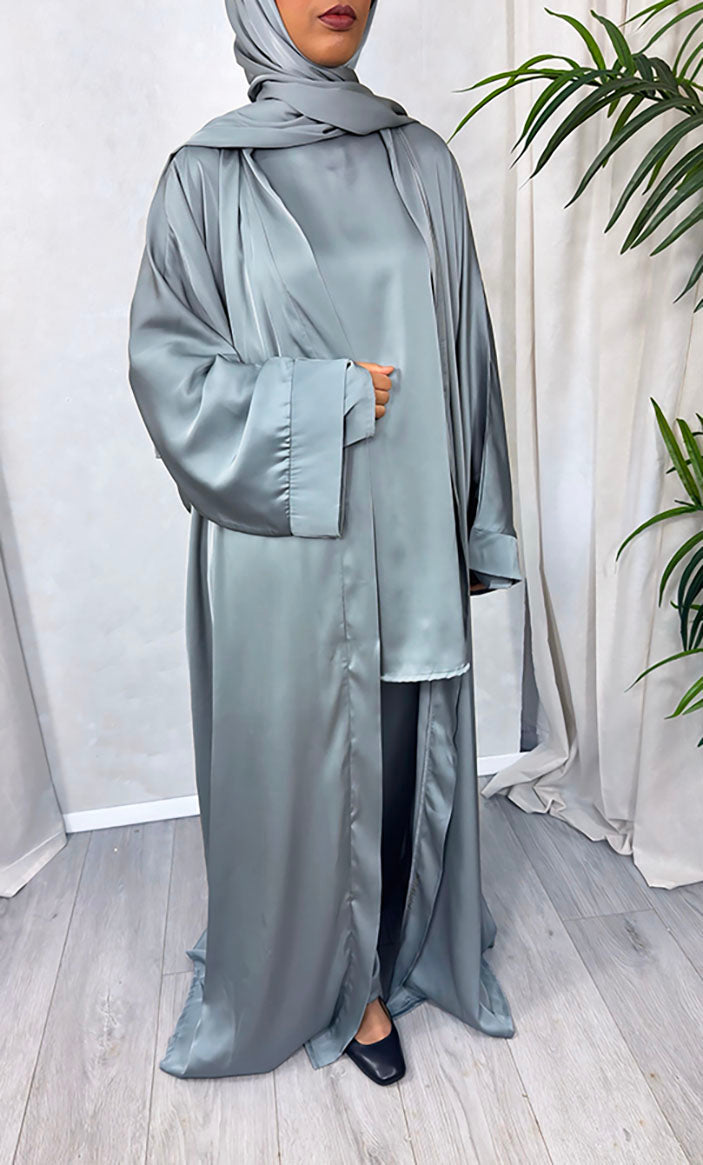
Before you buy an open abaya set
A coordinated open abaya set can take some of the work out of getting dressed. The colours have already been brought together, and the inner and outer garments may have been designed as partners. That is useful—but it does not mean every piece will fit you equally well or suit the way you prefer to wear hijab.
Before ordering, treat the set as several garments that need to work together. Check what is included, how each item is measured and whether the full outfit provides the coverage and comfort you want. A convincing photograph is the beginning of the assessment, not the end.
Some coordinated sets use trousers and a top rather than an inner dress. In that case, apply the same piece-by-piece checks to the waistband, trouser length, top hem and the overlap between them. The number of pieces is less informative than knowing exactly what those pieces are.
Confirm exactly what the set contains
The word set can mean different things between listings. It may include an outer abaya and inner dress, or it may also include a scarf, belt or another component. Read the itemised description rather than counting everything visible in a styled photograph.
Look for anything described as an accessory or sold separately. Shoes, jewellery and bags are often part of styling rather than the purchase, but you should not have to guess. Ask a direct question where the contents are unclear.
Check whether the inner garment has sleeves, whether the scarf is included and whether a fastening or tie shown in the images is supplied. These details affect the usable outfit far more than a general promise of coordinated elegance.
Compare measurements for each garment
An outer abaya is often intended to fit more loosely than an inner dress. One size label does not establish how both pieces will sit on your body. Look for the relevant measurements for each item and compare them with garments that fit you well.
Check shoulders, sleeves, body width and length as appropriate to the design. A comfortable outer layer does not compensate for a restrictive inner dress, and a well-fitting inner dress cannot correct an outer sleeve that pulls.
For Amani’s numbered abaya lengths, use shoulder-to-feet length in inches rather than total standing height. Confirm the measuring method for each component; do not assume that the inner and outer garments have identical lengths simply because they are sold together.
Assess coverage with the fronts open
Put on the inner outfit without the abaya first. Check neckline, sleeves, waist and hem against your own coverage preferences. Then add the outer layer and move normally. The fronts may separate when you walk, sit or reach.
A sleeveless inner dress can be part of a suitable layered outfit, depending on the outer garment and your intended use. It is not automatically a complete outfit for a situation where you plan to remove the abaya. Think through those changes before deciding the set meets your needs.
Check whether the outer sleeves are sheer and whether the inner layer covers the relevant area. An attractive colour match does not resolve a coverage gap. Read construction details as carefully as the product title.
Check how the fabrics behave together
Two garments can match visually yet shift or catch against each other. During a try-on, notice whether the inner dress twists, the outer layer clings or the fronts repeatedly slide into an awkward position.
Read the fibre and lining information for both pieces. A similar appearance does not guarantee the same fabric or care method. A satin-looking outer layer, for example, should not be assumed to have the same composition as the inner dress.
Look at the outfit from the side and back as well as the front. Check opacity where fabric stretches, particularly across the shoulders and seat. The full construction matters more than a label such as flowing or lightweight.
Give the supplied scarf its own assessment
A matching scarf may be convenient, but it still needs to suit your preferred coverage and arrangement. Check its dimensions, opacity, grip and feel at the neck. A scarf that matches perfectly but needs constant adjustment may not be your best option.
Try it with the actual neckline. The amount of fabric gathered around the collar can change how the whole set feels. If a different scarf works better, the set has not failed; you have found a more useful combination.
The hijab fabric guide can help you compare alternatives. Keep the matching scarf as one option rather than treating it as an obligation every time you wear the abaya.
Understand the fastenings and ties
Look for buttons, hooks, zips or ties that affect how the outer layer closes. Check whether the closure is decorative or functional and whether it stays comfortable during movement.
A belt may change the outline and hold the fronts closer together, but it should not be the only thing preventing an unsuitable inner outfit from showing. Assess the layers without relying on a tightly cinched fastening.
If the set includes several ties or decorative components, practise the intended arrangement without forcing them. Make sure nothing drags, catches or puts unnecessary strain on the fabric. Simpler is often more useful than adding another fastening to correct a fit problem.
Look at colour matching realistically
Coordinated does not always mean identical. The designer may use related shades, different textures or a deliberate contrast between the inner and outer garments. Read the description and inspect several images before expecting an exact match.
Once the set arrives, look at it in daylight. A difference that seems subtle indoors may become clearer outside. Decide whether the relationship looks intentional and whether you enjoy it, rather than assuming every variation is automatically a defect.
Where an exact shade match was explicitly promised but the received pieces appear inconsistent, contact the seller with clear information. Keep the garment unaltered while resolving the issue, following the applicable return or exchange process.
Plan a whole-set outfit you can repeat
Begin with the supplied garments, a scarf that works and comfortable shoes. Add a bag that holds what you need without rubbing delicate fabric or pulling the outer layer out of shape.
Try the arrangement seated and walking. Check both hems with the intended footwear. A shorter inner dress and longer outer abaya may be deliberate, but the outer hem still needs to remain manageable.
Once the combination works, keep a note or photograph of it for future use. A coordinated set earns some of its value by reducing decisions on an ordinary morning, not by requiring a new accessory plan every time.
Separate the pieces thoughtfully
The outer abaya may work over another appropriate dress or separates. Start with a plain inner outfit that relates to one of the set’s colours. Check coverage and fabric interaction again, because a combination that works with the supplied inner dress may behave differently with another.
The inner garment may also be useful elsewhere, but assess it on its own rather than assuming it is designed as a standalone dress. Sleeve coverage, neckline and opacity may have been planned with the outer layer in mind.
A supplied scarf can join other outfits if its size and fabric suit you. These possibilities are useful when they arise naturally; there is no need to claim that every component must work in dozens of combinations for the purchase to be worthwhile.
Adapt the set to the occasion
For relaxed use, keep accessories practical and let the coordinated garments provide the main visual arrangement. Comfortable flats or trainers may work where they suit the hem and setting.
For a dinner or celebration, one change in texture or finish can alter the emphasis. A smaller bag, a different scarf or visible jewellery may be enough. Follow the event’s dress guidance and avoid assuming that any set becomes formal simply by adding heels.
For work or study, consider the actual requirements of the setting, including sleeves, footwear and movement. The complete abaya guide helps connect styling decisions with the practical fit of the garments.
Include care in the purchase decision
Read the care labels for all components. Matching colours do not mean the pieces can be cleaned together using one method. Different fibres, linings or decoration may require different treatment.
Consider whether you can maintain the set conveniently enough for its intended frequency of wear. An occasion set with a more involved care routine may be perfectly suitable for occasional use but less useful as a daily purchase.
Keep supplied care information and spare fastenings together. Store the pieces clean and fully dry, with support appropriate to their construction. Do not assume that the outer abaya and inner dress should both be hung or folded in exactly the same way.
Read the online purchase details before ordering
Confirm the price for the complete set, the stated contents, size information and delivery details relevant to your order. Read the seller’s current return conditions, particularly where an item is customised or where you might need to return only part of a set.
Do not infer that individual components can be exchanged separately unless the seller says so. Ask before purchase when your measurements suggest different sizes for the inner and outer pieces.
Reviews can provide useful questions to investigate, but they do not replace your own measurements. Someone with different proportions or coverage preferences may find the same set works very differently.
Consider the value of the pieces you will actually use, not simply the number included. A set with an unsuitable inner dress or scarf may offer less practical value than fewer well-chosen pieces, even when the advertised bundle looks attractive.
Make a component checklist before the first try-on
When an open abaya set arrives, lay out the pieces against the order description before styling them. Identify the outer garment, inner dress, scarf, belt or any other stated component. Keep this factual: a photograph of a model wearing an accessory does not necessarily mean that accessory was included in the purchase.
Check each piece separately for the details you needed. Does the inner dress have the sleeve construction you expected? Is the scarf the stated shape and size? Are the belt and fastening arrangements clear? A set can look convincing when assembled while one component remains unsuitable for its intended job.
Then try the pieces together in the order you will normally wear them. Record any issue precisely. “The outer abaya is the right length, but the inner dress is shorter than the confirmed measurement” is more useful than “the set does not fit.” Clear descriptions make a question to the seller easier to answer without assuming what remedy will be available.
Keep labels, packaging and the purchase record as required by the applicable return instructions while you assess the set. Do not begin alterations or wear it out before settling an important uncertainty about its contents or suitability.
If every component works, make a note of any successful alternatives from your wardrobe. Another scarf may suit one occasion, while the supplied scarf completes the original combination for another. Buying a set should provide a convenient starting point, not an obligation to use every piece together on every outing. The convenience is most valuable when the individual pieces are useful as well.
Keep the convenience without accepting compromises
A good open abaya set should simplify an outfit while leaving room for your own choices. Keep the supplied scarf when it works, change it when another is better, and use the pieces separately only where their construction supports that use.
The strongest purchase is not the one with the most components or the most elaborate styling photograph. It is the set whose pieces fit, cooperate and give you a complete outfit you can comfortably wear again.