Dressing up a two-piece jilbab without losing its ease
A two-piece jilbab can already feel complete before any accessories are added. The upper garment and lower piece share a colour, a fabric or a deliberate contrast, and much of the outfit’s character comes from that relationship. Dressing it for an occasion does not have to mean putting a belt, another scarf and several decorative pieces on top.
Start by deciding what you would like to change from your everyday version. Perhaps you want a richer colour, a finer finish or one small detail that feels appropriate for a family gathering. That is a clearer brief than asking the outfit to look more elaborate everywhere.
The word “fancy” is useful only when it leads to something you genuinely enjoy wearing. An occasion set should still be comfortable through its opening, sleeves and waistband. It should also let you sit, walk and take part in the event without making its layers a constant task.
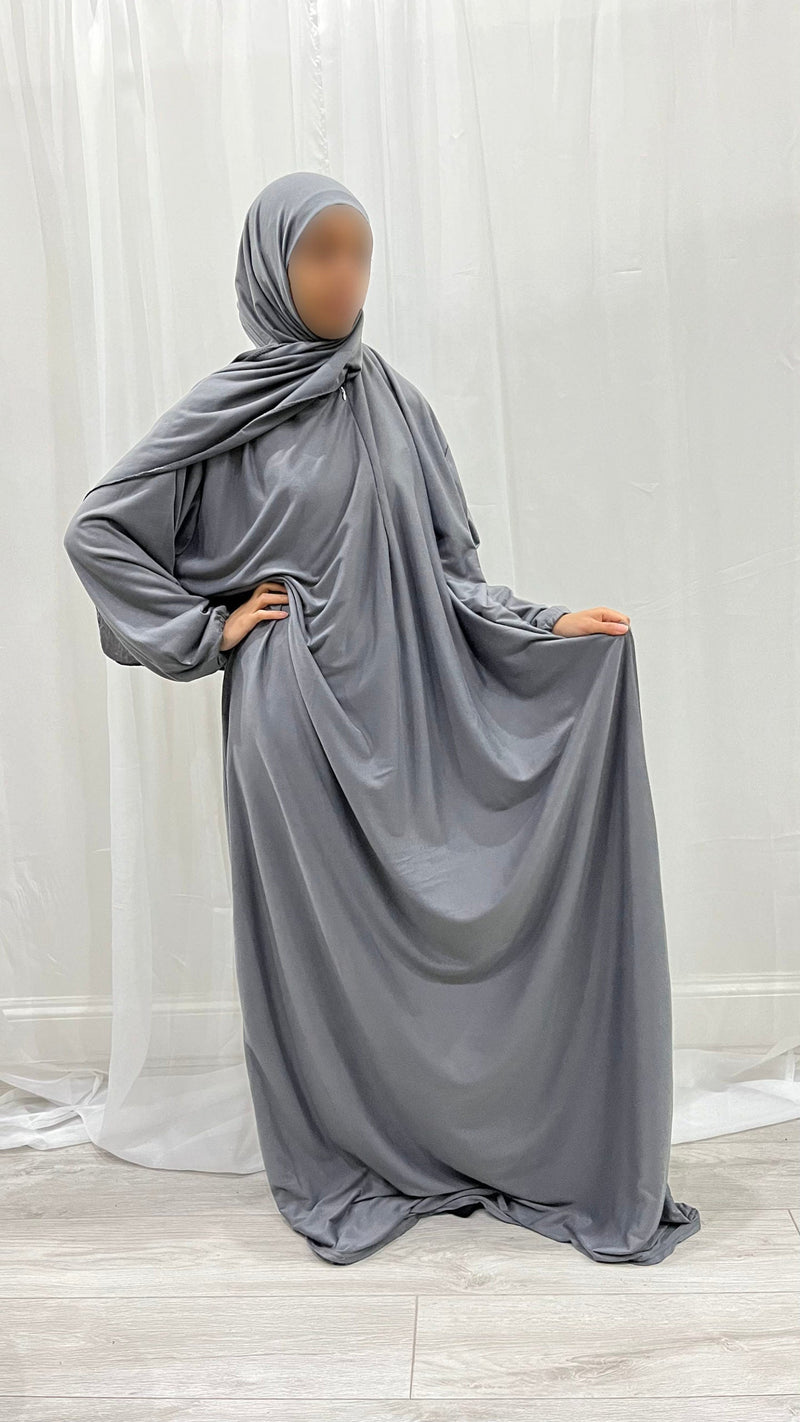
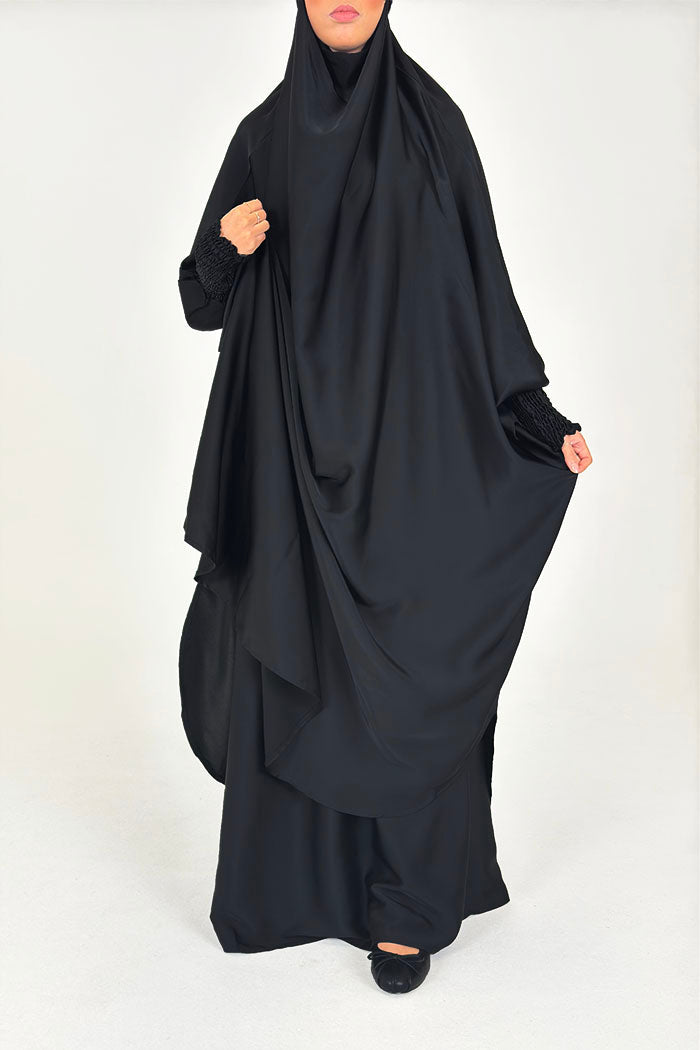
Pictured: a plain two-piece jilbab. The occasion examples below describe ways to change colour, finish and accessories rather than an embellished product shown here.
Establish what the two pieces actually are
Read the contents of the particular listing. Is the upper piece an overhead garment with an integrated head covering? Does it come with a skirt, trousers or another lower garment? A photograph may show additional clothing, and the description should make clear which parts belong to the purchase.
That answer changes the rest of the styling. An upper piece that already covers the head is not automatically improved by wrapping another scarf over it. A separate top that does not provide that coverage needs a different plan. Look at the actual shape rather than adding accessories because they appear in an unrelated photograph.
Inspect the lower piece independently. A skirt and a pair of wide trousers move differently, and their waistbands may sit at different points. A generous upper drape cannot tell you how comfortable the hidden lower garment will be during a long meal.
Ask whether any belt, removable cape, decorative fastening or separate head covering is supplied. Do not count components by what is visible on the model. Keep the reply with the order details so you have a clear basis for checking the set on arrival.
For a construction-focused comparison, our guide to finding a two-piece jilbab that fits examines how the upper and lower sections cooperate. Once those basics work, occasion styling becomes a smaller and more enjoyable decision.
Choose one feature that makes this set different
You might be drawn to a deeper shade, an embroidered cuff, a shaped lower hem or a contrasting border. Name that feature before shopping for accessories. It gives you a reason to choose this set rather than a general feeling that a celebration requires a new outfit.
Then see how the feature appears when worn. Cuff embroidery may be largely covered by the upper drape. A border may become more visible while walking. A different-coloured lower piece may show only as a small band while standing but occupy a much larger area when seated.
None of those effects is automatically a problem. They help you decide whether the design provides the change you wanted. A detail hidden throughout the event may still matter to you, but it does not need another accessory added to make up for its lack of visibility.
Look at how decoration is attached. A stitched motif, an applied panel and a loose embellishment need different attention. Check the reverse where possible, especially around the wrists, forehead and neck, where the inside may be more noticeable than the decorative surface.
For a plain set, let the colour or cut be the special feature. There is no obligation to add sparkle. A useful occasion outfit can be quiet, particularly when you prefer clothing that remains familiar enough to wear again.
Keep the fitting separate from the styling
Try the lower piece first, with the clothing you expect beneath it. Walk and sit without the upper garment concealing the result. Notice the waistband, room at the hips or seat, and where the hem meets the shoes you intend to wear.
Add the top and let it rest naturally. Check where the two pieces overlap without pulling the upper one down for the mirror. Reach forward and sit again. A lower garment that is comfortable alone should not need to be raised into an uncomfortable position merely to complete the overlap.
For an integrated head covering, inspect the face opening and the movement from the shoulders. Turning your head should not require you to rearrange the whole outfit. Ties or fastenings should be used as designed, rather than tightened excessively to compensate for an unsuitable shape.
Check sleeves with your hands relaxed and while reaching. A decorative cuff can be appealing, but its opening and inner finish must still work. If the upper garment has a broad joined sleeve shape, see whether arm movement lifts the rest of the top.
Keep measurements specific. An upper garment measured from the top of its head section is not being measured along the same route as a separate skirt. Ask for the start and end points before comparing figures. Do not turn your total height into a finished garment measurement by applying an assumed subtraction.
A shared size label is not a promise that both pieces will suit your proportions. Where the top works but the lower garment does not, ask about the options offered by the seller. Buying a larger complete set may alter the face opening or sleeves as well as the waistband.
Three occasion outfits, without a shopping list for every one
A family gathering with a softly coloured set
Imagine a plain two-piece jilbab in a shade you already enjoy wearing. Keep the upper covering in its intended arrangement and choose familiar shoes that clear the lower hem. Add a bag that carries your essentials comfortably, rather than one selected only because its colour is a near match.
Try a related neutral first. A warm grey or beige bag beside a soft green set, for example, gives a different effect from a darker bag. Compare pieces you own before buying another. The set already connects the main parts of the outfit, so the bag does not have to repeat the same shade.
For jewellery, notice what will actually be visible. A necklace beneath an integrated covering may contribute nothing while adding an uncomfortable object at the neckline. A simple ring may be enough, or you may prefer no jewellery.
Spend part of the fitting at a table. See where the upper drape and sleeves fall when you reach forward. If you expect to help with food or carry things, make that part of the outfit choice rather than relying on being unusually careful throughout the visit.
The result should feel like your own familiar clothing with a considered colour relationship. You do not have to explain why it is special enough for the occasion by adding several unrelated details.
An embroidered set for a celebration
Choose the embroidered area you want to enjoy and leave space around it. If the cuff has the main detail, begin without a bracelet. If the upper garment has a decorated border, compare it with a plain bag before reaching for another patterned or embellished accessory.
Look at the embroidery in daylight and under ordinary indoor lighting. A quiet thread can become more noticeable when it catches the light, while a contrast colour may appear deeper beside the base cloth. Match the actual finish rather than assuming a named metal colour requires identical accessories.
Inspect the inner surface behind the decoration. A fine-looking design can still have a backing or attachment that you notice at the wrist. Bend the elbow and rest the hand as you would during a meal. Decide whether the garment feels comfortable, not merely whether it can be worn for a photograph.
Try the journey’s coat too. A narrow sleeve can compress a decorated cuff or create friction at a raised detail. The coat needs to accommodate the complete garment. Its colour relationship matters only after the sleeves and neckline work together.
Keep the event’s actual guidance in view. An embellished set may suit a celebration without being the appropriate choice for every invitation. Ask about unclear expectations rather than treating a fabric or decorative label as a universal dress code.
A deeper-coloured set for dinner
A navy, plum, brown or green set can give you a richer-looking palette without requiring heavy decoration. Compare the upper and lower pieces in the light in which you are getting dressed. Coordinated colours may be deliberately different, and the amount of each shade visible changes with movement.
Choose one accessory to give a clearer outline. A structured bag can sit beside the fluid upper drape, while a simpler shoe keeps the lower half straightforward. You do not need a high heel; choose footwear you can wear comfortably through the route and the meal.
Check the bag’s position while seated. A long chain may lie against a delicate section or become awkward when placed beside you. A shoulder strap can also gather the upper garment differently from a hand-held arrangement. Use the carrying method that suits the actual set.
If the upper piece already provides head coverage, assess whether any additional scarf has a genuine purpose. Adding one purely to increase the sense of occasion can create bulk around the neck. A change of colour or accessory may give you the variation you wanted without another layer.
Try the outfit without the coat before making the final decision. The indoor version should feel complete in its own right, rather than depending on outerwear to conceal a fit or coverage issue.
Small details that are easier to appreciate than to manage
A brooch can change a plain surface, but it needs a suitable place to sit. Consider the weight, the fastening and the strength of the fabric at the proposed attachment point. Do not put a heavy piece into a fine drape and assume the covering will support it comfortably.
A decorative pin should not be the only thing keeping an essential overlap closed. The garment’s own shape and fastenings need to work first. A brooch placed to hide a difficult opening may distort the fabric rather than resolve the fit.
Long chains, rough rings and elaborate bracelets can meet the same section of cloth repeatedly. Try ordinary movements with the jewellery on, then decide which pieces are worth retaining. An accessory that requires continuous guarding is not a useful addition to an outfit chosen for ease.
A belt deserves particular care. It can lift an upper hem, gather cloth near the sleeves or change the outline you wanted from a loose two-piece design. Use it only where the garment and your preferences support that arrangement, and reassess the overlap and seated comfort afterwards.
Details can be meaningful without all being worn at once. A favourite family piece may belong better with another garment, or at another part of the occasion. Leaving it out of this combination does not reduce its value.
What happens when the two pieces move in different directions?
A coordinated photograph can make the outfit appear to move as one garment. In practice, the waistband supports the lower piece while the upper one hangs from its own construction. Watch their relationship when you stand after sitting, put on a bag or raise an arm.
If the top catches at the waist, inspect the surface beneath it. A knot, a bulky fastening or a rough waistband seam may be creating an obstacle. Compare a more compatible arrangement before deciding the whole set is the wrong size.
If the lower piece twists, check its fit by itself. Do not rely on the upper drape to hide or stabilise it. A comfortable waistband and a garment that settles naturally are useful foundations even when nobody else can see them.
If there is a gap during movement, identify where it appears and whether another construction is needed. Pulling the top lower while standing may not change what happens when reaching. The answer might be a different upper length or lower rise, not tighter fastening.
For prayer, conduct a separate check through the positions you perform and the coverage guidance you follow. The outfit’s suitability for dinner or a family gathering does not automatically settle that question. A clothing description is not a religious ruling.
Give yourself permission to choose a different set if several problems remain. Convenience should be demonstrated by the way the clothes work, not inferred from the fact that they were sold together.
Try mixing pieces only when the new outfit works independently
A separate upper piece and skirt may offer other combinations, but do not count them as extra outfits before trying them. A top that overlaps its supplied skirt well may sit differently over another waistband or trouser rise.
Begin with a lower garment you already know is suitable. Put it on alone, then add the jilbab top. Inspect the overlap, sides and back. Make sure the cloth does not catch or gather in a way that changes the coverage you intended.
Check colour as a deliberate choice. A clearly different shade can look more settled than two nearly matching colours from unrelated sets. A plain dark lower piece might work with a patterned upper garment, but compare the full arrangement rather than relying on a small fabric corner.
For a skirt used separately, choose a top that provides the coverage and ease you want when reaching and sitting. The original upper piece may have covered areas that another top leaves more visible. Do not assume the skirt’s role remains unchanged simply because the waistband fits.
Write down a successful alternative so it is easy to repeat. One genuinely useful second combination is more valuable than a theoretical claim that every piece works with everything else in the wardrobe.
Ask about the finish before accepting an occasion price
Find out what the description means by premium, luxury or fancy. It might refer to a fabric, a decorative technique or a particular finish, but the word alone does not identify what you are paying for.
Look for clear composition information, interior photographs and measurements for both parts. Ask how any decoration is attached and whether spare components are supplied where relevant. A close-up can be useful, but inspect it alongside the whole garment’s shape.
Check any specific craft or sourcing claim on its own terms. An embroidered appearance does not prove handwork, and a natural-looking shade does not establish an environmental benefit. Choose the visible details you can assess while asking for evidence about claims that depend on the production process.
Compare the total usable outfit cost. A set that needs an additional essential layer or significant alteration is a different purchase from one that works with what you own. Optional accessories should remain optional in that comparison.
Keep current order, delivery and return information with the product details you relied on. For an event, allow room for a fitting and any suitable adjustment. An occasion date should not pressure you into ignoring an unresolved size or construction question.
Two sets can look similar and ask different things of you
Consider a hypothetical pair of occasion sets in the same deep green. The first has embroidery around the upper garment’s lower edge, a plain cuff and a matching skirt. The second keeps the upper drape plain but places raised decoration around the cuffs and near the lower garment’s hem. These are examples for comparison, not descriptions of current stock.
Look first at the part of the outfit most likely to meet the table and your bag. In the first set, the cuff may be straightforward, but the embroidered upper edge could lie across your lap or near a cross-body strap. In the second, the cuff decoration may be more visible as you move your hands, while its reverse could affect how the wrist feels. Neither arrangement wins merely by having more or less decoration.
Next consider an adjustment to length. A plain skirt hem and a decorated lower border may offer different alteration options. Ask a suitable professional what would happen to the finish before choosing the longer set on the assumption that both can be shortened in the same way. The aim is to keep the detail you liked, not lose it as soon as the garment fits.
Compare care with the same seriousness. The labels may specify different handling despite the matching colour and similar photographs. Decide whether the maintenance fits the frequency of wear you expect. A set chosen for occasional celebrations can have a different place in your routine from one you hope to use for frequent family visits.
Finally, try your intended coat and carrying arrangement with each option. One may leave you more comfortable through the shoulders, or allow easier access to the bag, even where both look equally attractive while standing. That practical difference can be the reason to choose it. You are evaluating a complete garment, not awarding points for the amount of embroidery.
Keep the later part of the day in the fitting
An outfit that works on arrival should remain manageable after the formal photographs. Think about sitting for a meal, moving between rooms and putting the coat back on. Check that you can reach the coat fastening without trapping the jilbab’s drape, and that the skirt or trousers still sit comfortably after being seated.
Make any planned change modest in scale. Changing a bag or removing an optional decorative accessory is simpler than replacing an upper garment whose overlap you have not tried with the lower piece. A spare component is useful only when it forms a tested outfit, not merely because its colour looks suitable in the bag.
Keep the successful version recorded as a whole, including the shoes and any essential inner clothing. That turns the next invitation into an opportunity to enjoy a familiar outfit rather than repeat an uncertain fitting from the beginning.
A fitting note that is useful beyond this purchase
Record the upper garment and lower garment separately. Note the dimensions that worked, how they were measured and the clothing used underneath. Add the shoes that gave a manageable hem. That is more informative than remembering that a particular lettered size was comfortable.
Include the awkward details too. “Upper sleeve is comfortable alone, but tight beneath this coat” tells you something specific. “Skirt waist fits, but the top catches on the tie” identifies an interaction to compare. Neither observation requires you to decide the whole set is good or bad.
For a hypothetical example, imagine that the upper piece feels right but the skirt is too long in your usual flats. Before changing the entire size, ask whether the skirt can be adjusted appropriately or whether another available length would solve the problem. Recheck any alteration against the intended overlap and footwear.
Now imagine the opposite: the lower piece works well, but the face opening feels uncomfortable. Shortening the skirt will not help, and adding another cap may make the opening more crowded. You need information about the upper construction, not a general recommendation to size differently.
These small notes improve the next purchase because they describe the clothes and your experience accurately. They also make communication with a seller or alterations professional more useful than asking for a universally flattering fit.
Care for the outfit without losing track of its parts
Read both care labels even where the pieces look identical in colour and finish. Decoration or construction can introduce different requirements. Do not assume that a shared product name means the items should always be cleaned together.
Follow the instructions for washing, drying and any permitted pressing. The GINETEX care-symbol guide explains how those limits are communicated. A general suggestion to handwash or use a low iron is not a substitute for the actual label.
Keep detachable accessories identified. A labelled packet or a private photograph of the complete set can help you reunite the pieces without storing them all in the same way. A delicate top and a substantial skirt may need different support.
Inspect the areas you handle most: ties, cuff openings, the waistband and decorative attachments. Set aside anything needing repair rather than returning it to the ready-to-wear space and rediscovering the issue before an event.
Make sure every section is dry before storage. Give decorated areas enough space that they are not compressed beneath other garments. For wider organisation, the wardrobe care routine explains a simple way to separate ready outfits from items awaiting attention.
Let it remain useful after the celebration
Try the set again with the accessories removed. A lightly detailed outfit may work for another gathering with only a different bag or shoes. A more elaborate piece may remain an occasion garment, which is a perfectly reasonable role.
There is no need to describe every new purchase as suitable for every day and every event. Decide where you genuinely enjoy wearing it. Repeating a successful outfit is part of getting value from the clothes you chose.
Before buying another set, look at the gap it would fill. A different weight, a more manageable sleeve or an upper opening that suits another routine may be useful. Another nearly identical colour with the same unresolved fitting issue is less likely to make dressing easier.
A dressed-up two-piece jilbab does not need to lose the straightforwardness that attracted you to it. Choose one feature you enjoy, let the pieces fit properly and keep additions purposeful. The occasion can be special without every part of the outfit having to announce it.