Abaya Pattern Ideas: Motifs, Placement and Embroidery
A patterned abaya can be as restrained as a line of tonal embroidery at the cuff, or as expressive as a large floral design running across the whole garment. The difference is not simply how much decoration it has. Motif size, spacing, colour, placement and the way the cloth falls all contribute to the result.
Choosing a design becomes easier when you separate those decisions. You might love a particular flower but prefer it as a border rather than an all-over print. You might enjoy a geometric pattern in two close shades but find the same arrangement too busy in black and white. Neither choice is more correct; they serve different wardrobes.
This guide explores pattern ideas for ready-made abayas, a design you discuss with a dressmaker, or a small decorative project at home. Start with a garment that gives you the fit and coverage you need, then decide what you would like its surface to do.
First, decide which kind of abaya pattern you mean
The word “pattern” can describe the decoration on the cloth or the template used to cut and sew the garment. These are related, but they are not interchangeable. A floral print tells you nothing by itself about sleeve width, the shape of the armhole or the finished length.
For a sewing project, you need a cutting pattern with appropriate measurements and construction instructions. For a decorative project, you need a motif and a plan for where it belongs. A drawing of an embroidered abaya is design inspiration, not a complete sewing pattern.
It also helps to distinguish the ways decoration is made. A printed design sits on the fabric surface; embroidery uses stitches; appliqué adds separate pieces of material. A woven pattern is formed as the cloth is made. When comparing garments, ask which method you are looking at rather than judging only the photograph.
These distinctions give you better questions to ask. Is the cuff decoration stitched through the lining? Does the printed design continue around the back? Is a contrasting panel part of the garment or a layer attached on top? The answers matter more than a flattering name.
Build your idea around motif, scale and spacing
Choose the motif before choosing every accessory
A motif is the individual element within a design: a leaf, flower, star, line or abstract shape. Begin with one family of shapes that genuinely appeals to you. A preference for fine branching stems suggests a different direction from a preference for strong squares and straight borders.
Look at the motif on its own before deciding whether you like the whole arrangement. Sometimes the element is beautiful but repeated too closely for your taste. Keeping the same motif and allowing more plain fabric around it may produce the quieter result you had in mind.
Judge scale on the garment, not only in a close-up
A close photograph is useful for seeing a thread or printed edge, but it cannot show how a pattern feels across a full-length abaya. Ask for both a detail image and a view of the complete garment. Include the back and sleeves in that assessment.
There is no need to assign certain motif sizes to certain bodies. Instead, consider the impression you want. For a subtle everyday design, try small motifs with generous gaps or a larger motif confined to one area. For a more expressive design, try larger shapes across broader panels and keep the other elements simple.
Use plain space deliberately
Plain space is part of the design, not an area that needs filling. It can separate an embroidered cuff from a decorated sleeve, give a floral border room to stand out, or make a single asymmetric panel feel intentional.
When sketching, draw a version with all your proposed details, then a second version with one removed. Compare them from a distance. This is a useful way to decide whether the design needs more decoration or simply a clearer arrangement.
Understand the inspiration behind the motif
Geometric repetition, plant-inspired ornament and calligraphy offer distinct sources of design inspiration. The Metropolitan Museum of Art describes geometry, vegetal patterns and calligraphy as important non-figural forms of decoration in Islamic art, including combinations of repeated and interlaced shapes. Its discussion provides a useful starting point for understanding geometric ornament and its construction.
That artistic context does not establish the origin of a particular modern abaya. A flower, star or scrolling line is not enough to assign a garment to a country, period or craft tradition. Where a maker names a specific tradition, ask about the design and its provenance rather than supplying a story yourself.
With lettering, find out what the words say before choosing them as decoration. Do not assume unfamiliar script is a blessing, or that a calligraphic-looking shape is meaningful writing. For a personal project, an abstract motif may be a better choice when you cannot verify the text and its context.
You can appreciate heritage without making a universal claim about it. Describe the details you can actually see: repeated stars, fine scrolling stems, a stitched floral border or contrasting panels. Clear descriptions make it easier to choose what you like and to discuss it with a dressmaker.
Six pattern directions to consider
Tonal floral embroidery
For a gentle introduction to pattern, consider an abaya with embroidery close to the colour of the base fabric. A charcoal floral motif on black, for example, is a design idea that places more emphasis on texture than on a sharp colour contrast.
Try locating the decoration at the cuffs or along one front edge rather than adding it everywhere. Before deciding, inspect the reverse of the stitching and try the sleeve with your arms bent. A beautiful surface is not enough when the inside catches or feels uncomfortable.
Spaced botanical prints
A scattered leaf or flower arrangement can leave plenty of the base colour visible. This gives you an obvious starting point for choosing a plain hijab. You could repeat the background shade for a coordinated outfit or pick one quieter colour from the motif.
Check the arrangement on the actual garment where possible. On ready-made clothing, do not assume every item will place a large flower in precisely the same position as the photographed sample. Ask about variation when the location of a particular motif matters to you.
Geometric borders
A narrow geometric border offers a contained way to use an intricate design. Try it along an opening, around a cuff, or above the hem. Keeping the rest of the abaya plain allows the repeated shapes to remain distinct.
Look closely at corners and joins. Where the border changes direction or meets a seam, ask whether the interruption feels intentional. Perfect matching is not essential to every design, but a close-up helps you decide whether you are happy with the finish.
Asymmetric placement
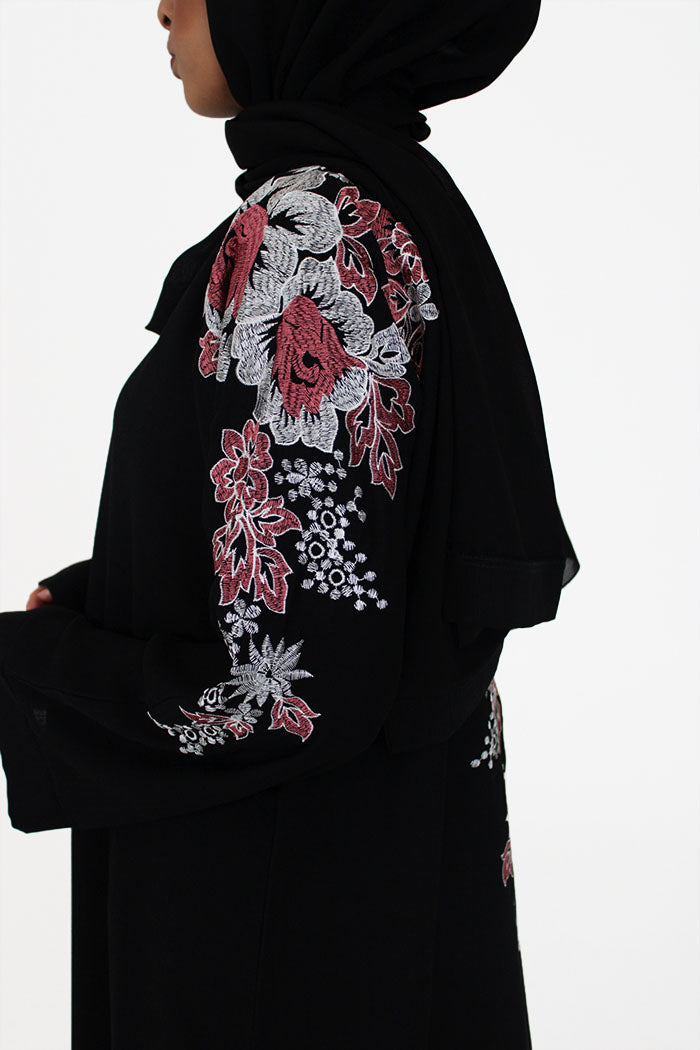
An embroidered branch on one shoulder or a patterned panel on one side can create an interesting design without a full repeat. Sketch the front and back together so the idea does not end abruptly in a place you had not considered.
Think about what your usual hijab will cover. A shoulder motif may be largely hidden under a long drape, while a decoration lower on the front may remain visible. Choose the placement around the coverage you prefer, rather than changing your coverage just to reveal the design.
Colour-blocked panels
Pattern does not have to involve flowers or ornament. Contrasting panels can create a graphic arrangement using the garment's own lines. For a first experiment, try two colours rather than combining several blocks, a busy print and decorative trim at once.
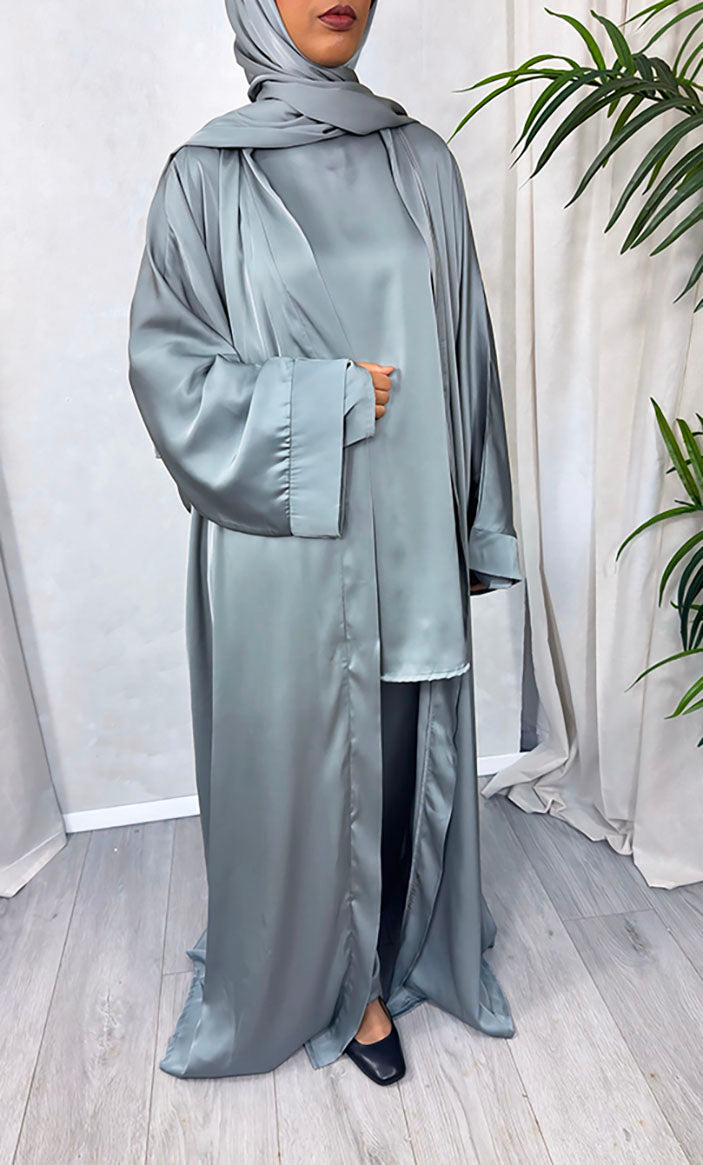
Consider how the panels look with the front open and closed. An open abaya introduces the colour of the outfit beneath it, so include that layer in your sketch. The result may already have all the contrast you need.
A small metallic or textured accent
For an occasion design, you might prefer a restrained metallic stitch, a velvet panel or a little raised appliqué to a fully embellished garment. Choose the detail because you enjoy it, not because a celebration requires heavy decoration.
Test the parts that will touch a chair, bag strap or another layer. Ask to see how a raised detail is attached, and check that any loose ends or edges are properly finished. A close look at these areas is more useful than judging the garment only while standing still.
Plan the placement around how you will wear the abaya
Before settling on a design, mark the areas you want to decorate on a simple front-and-back outline. Add the sleeve shape, front opening and approximate hijab drape. This gives you a practical map rather than a collection of unrelated attractive details.
For a cuff design, decide whether it should be visible with the arm relaxed, bent or lifted. For a hem border, consider the shoes you normally wear and any length alteration the garment may need. Ask a dressmaker how shortening would affect the border before having it cut.
For an open abaya, check the design with the front edges separated. A motif arranged across both sides may look very different when the garment is moving. A border placed independently on each side is another option to compare, not a rule you must follow.
For an all-over design, examine the shoulder, side seams and sleeve joins as well as the centre front. Ask to see the garment hanging naturally, without a belt, clip or pose holding the fabric in a particular position.
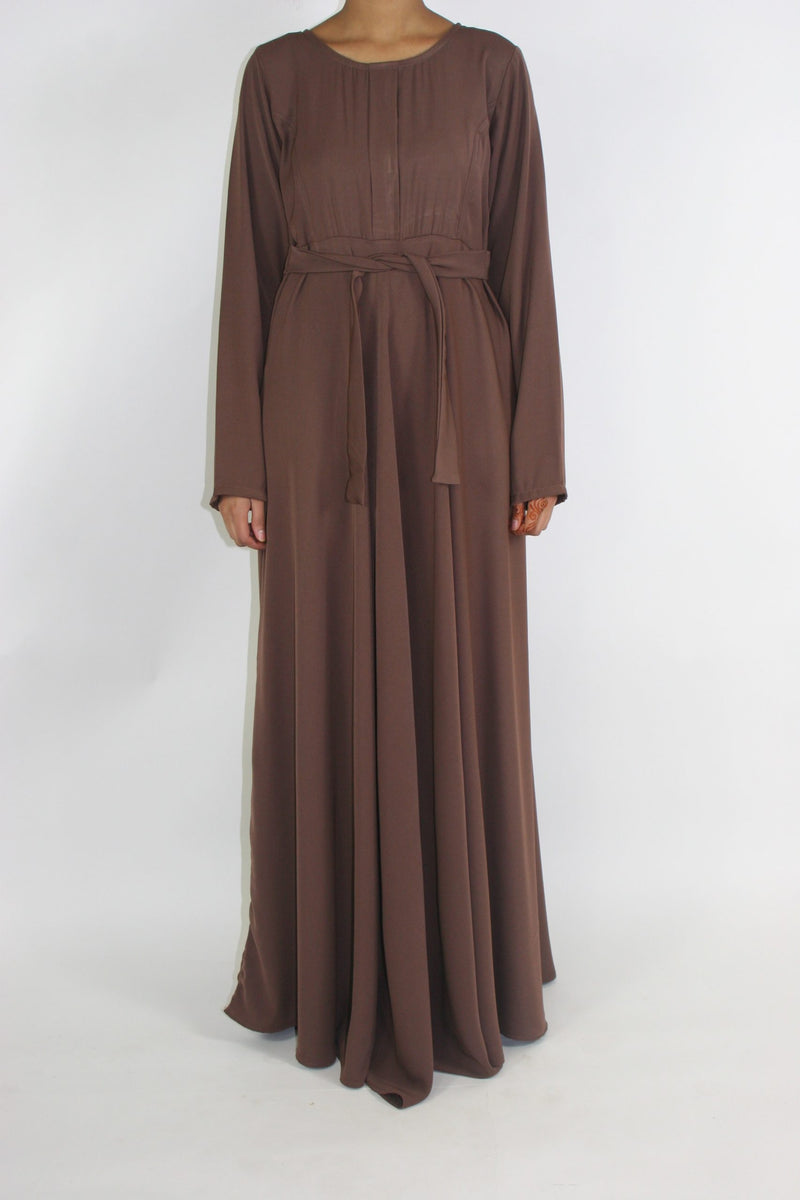
Pattern and cut should be considered together. A broad sleeve provides a different space for decoration from a narrower sleeve, and a full skirt presents a different arrangement from a straight silhouette. Our guide to abaya cuts, fabrics and finishing details can help you compare the underlying shapes before choosing their decoration.
Choose a direction for everyday wear or a special occasion
Think about an ordinary day first. Will you sit at a desk, carry a shoulder bag, use public transport or put a coat over the abaya? Try the design with those movements and layers rather than assuming it is practical because the colour is understated.
For everyday wear, a useful design brief might be a plain base, a small amount of decoration and a care routine you are willing to follow. This is a personal starting point, not a requirement. A bold print can be an everyday favourite when the garment itself works well for you.
For Eid, a wedding or an evening gathering, begin with the event and your preferences. Decide whether you want the garment to feel softly detailed or more expressive. Then choose one main feature: the motif, the fabric surface, the colour contrast or the embellishment.
For example, an occasion idea could combine a deep-coloured abaya with a narrow embroidered front edge and a plain hijab. Another could use a floral abaya with quiet accessories. A third could keep the whole surface tonal and place the interest in a textured cuff.
Decoration must not replace a coverage check. Inspect lace, openwork and cut-out sections against the layers you intend to wear beneath them. Check the front opening, neckline and sleeves while sitting and reaching. A pattern can be attractive while the garment still needs a different lining or an additional layer to meet your preferences.
Coordinate the hijab without redesigning the whole outfit
Once you have chosen the abaya design, put it beside the scarves you already wear. Start with the background colour, a minor colour within the motif, or a plain neutral that you like with the whole palette. Try these options before buying a new set of accessories.
For a highly detailed abaya, a plain scarf is an easy starting point. For a very subtle design, you might enjoy a little contrast in the scarf's surface. Neither approach requires an exact colour match; compare the pieces together in ordinary light and decide whether the difference looks deliberate to you.
Notice the finished drape as well as the colour. A scarf that looks right when laid flat may cover the detail you wanted to show or form folds you do not enjoy around the neckline. Our guide to choosing and styling hijab fabrics explores those scarf decisions in more depth.
Keep the shoes and bag simple while testing the combination. You can add more interest afterwards, but it is harder to judge a new pattern when everything changes at once. For detailed outfit examples, see our advice on styling a printed abaya without overwhelming the look.
Turn inspiration into a small, manageable DIY project
A modest first project is easier to assess than decorating a whole garment in one sitting. Choose an abaya you own, identify what you would like to change, and inspect its condition. Do not begin on a valuable, fragile or irreplaceable piece while learning a new technique.
Make a sample using compatible spare material where available. Try the complete combination: base cloth, paint or stitching, added trim and any finishing treatment. Follow the instructions supplied for each material. A successful sample helps you decide whether the effect is worth taking further; it is not a guarantee for a different fabric.
Project idea: a small stitched motif
Draw a simple leaf or line design on paper and try several positions beside the garment. Settle on one location before transferring anything to the fabric. Practise the stitches on your sample, checking both the face and the reverse.
Keep checking the fabric while you work rather than pulling every stitch as tightly as possible. Stop when the surrounding cloth gathers or the motif sits unevenly. For a lined sleeve or a difficult fabric, discuss the construction with someone experienced before stitching through layers you may need to keep separate.
Project idea: an appliqué detail
Try a small piece of lace or a fabric motif on top of the abaya before committing to a long border. Lay the proposed arrangement out, then assess it with the garment hanging naturally. Check whether its edges, shape and thickness suit the original fabric.
Do not assume an adhesive or iron-on backing is suitable because it is sold for textiles. Check the product instructions and the garment's care restrictions together. When they conflict, choose a different method or leave the garment unchanged.
Project idea: a painted motif
Choose a textile-paint system specifically suitable for the material you intend to decorate. Work through its application, drying and setting instructions on the sample first. Some projects will not suit an existing garment's permitted care or heat treatment.
Use a modest design area for a first attempt. An outline, a small group of dots or a single abstract shape can be easier to evaluate than a large filled panel. Decide whether you like the sample's feel and appearance after the prescribed treatment before painting the abaya itself.
Record what you used and how the finished decoration should be cared for. The original label describes the garment as supplied; an added trim, coating or embellishment can introduce new restrictions. When there is no clearly compatible care method, reconsider the project before making permanent changes.
Write a clear brief for a dressmaker
A useful brief describes the garment, not just the mood. Include the silhouette, where you want the decoration, its approximate size, the colours, your coverage preferences and the occasions you have in mind. Add photographs of your own garments or references you are authorised to use.
Ask for a sample of the proposed decorative technique where that is feasible. Specify whether the design should continue around the back and sleeves, and whether matching across joins is important to you. Discuss the care requirements before finalising the material choices.
Keep the fitting questions separate from the decoration questions. Confirm how length will be measured, what movement the sleeve should allow and how the front will close. Then agree where the motif belongs on that fitted shape. This is clearer than expecting the dressmaker to infer all those details from one inspiration photograph.
Care for the actual garment, not for a pattern category
There is no single washing or pressing instruction for all patterned abayas. The finished garment may combine several materials and finishes. Begin with its own label rather than assuming hand washing, dry cleaning or low-temperature ironing is always appropriate.
GINETEX's textile-care guidance explains the permitted treatments indicated by care symbols. It also advises selecting the maximum ironing temperature from the care label, rather than from the fibre name alone. Check any restriction on steam as well; do not substitute steaming for ironing without establishing that it is suitable.
For storage, the Canadian Conservation Institute highlights the risks of prolonged light exposure and inadequate support for decorated textiles. Keep special pieces clean and dry, away from bright sunlight, and consider how their weight is supported. Its basic textile-care advice is particularly useful background for delicate or treasured items, rather than a substitute for a modern garment's label.
Before cleaning a decorated abaya, inspect it for loose stitches, lifting edges or damaged embellishments. Ask the maker or a suitable professional when the label is missing, the decoration has been altered, or the permitted method is unclear. A guessed treatment is not worth risking a garment you value.
Frequently asked questions about abaya pattern designs
Which design is easiest to try first?
Start with a contained area and one technique. A tonal cuff motif, a small appliqué or a narrow border lets you explore decoration without committing to an all-over arrangement. For home projects, test on compatible spare fabric before touching the garment.
Can a large pattern still feel understated?
Try a larger motif with generous plain space or colours close to the base shade. Alternatively, keep the large motif within one panel. Compare complete garment views, because a close-up does not show the overall arrangement.
Should the pattern match across every seam?
Not necessarily. Some designs use deliberate interruption or contrasting panels. Decide what finish you expect, inspect the actual joins, and make matching part of the brief when commissioning a garment. Do not assume it is included without discussing it.
Is a printed abaya the same as an embroidered abaya?
No. The descriptions refer to different decorative methods. Look for a close-up and a clear account of the construction, particularly when a photograph makes a flat print resemble raised stitching. A garment can also combine more than one method.
What should I do when the design includes words?
Find out exactly what they say and whether their placement suits your own practice and preferences. Ask for reliable information rather than guessing from the appearance of the script. Choose a non-text motif when you cannot establish the meaning.
Do I need a separate patterned abaya for every occasion?
Start by trying different scarves and accessories with a garment you already like. One design may work for several settings when its fit, coverage and care requirements suit you. Buy or commission another only when it serves a different need.
Choose the detail you will enjoy wearing
The strongest starting point is not the most elaborate design. It is a clear idea of the garment you want: a comfortable cut, the coverage you prefer and a motif placed where it makes sense for you.
Choose the decorative method, test the scale, plan the placement and check the finish. Then try the complete outfit in movement. Those practical decisions turn an appealing pattern into an abaya you can enjoy beyond the first photograph.