Choosing an abaya for a special evening
The invitation may say dinner, reception or celebration, but the evening usually involves more than the event itself. There is the journey, the entrance, time spent standing, a meal and the trip home. An evening abaya has to work through those changes, not simply look suitable beside a chandelier.
Start by picturing that whole sequence. It makes the important decisions clearer: how formal the outfit needs to feel, how much movement the cut should allow and which details are worth carrying for several hours. An impressive sleeve or embellished hem is more enjoyable when it does not become a practical obstacle.
Use the invitation as information, not guesswork
Look for a stated dress code, venue and any useful guidance from the host. An intimate meal at someone’s home and a large formal reception can call for different choices, even when both take place in the evening. Where the expectations are unclear, asking a simple question is better than assuming that more decoration is always safer.
Consider the activities. Will there be a long walk from parking, outdoor photographs, several flights of stairs or seating that requires a generous amount of movement? These details do not make the occasion less special. They help you choose an outfit that lets you participate in it.
Timing also matters. A garment bought for one important date needs to arrive early enough for a proper try-on and any agreed alterations. Do not base the plan on discovering a fit problem just before leaving.
Decide what should make the abaya feel like evening wear
There are several ways to create an occasion effect: a distinctive fabric surface, a more considered cut, a rich colour, embroidery or a carefully placed reflective detail. You do not need all of them together. Choose the feature you most enjoy and allow it to lead.
A plain abaya with a particularly beautiful fall can be an evening option. A decorated one may still feel relatively relaxed if the motif is small and the fabric is casual. “Evening” is not a separate body shape or a requirement to wear a closer fit.
Likewise, a daytime abaya does not become unsuitable simply because it is comfortable. It may be possible to wear it differently for dinner, provided its condition, construction and appearance suit the occasion. The distinction is about the whole outfit and setting, not a rigid division between cotton for day and silk for night.
Assess fabric by touch, movement and information
Read the composition and lining details, then examine how the particular garment behaves. A smooth, lustrous surface may show folds and seams more clearly. A sheer outer fabric requires a deliberate inner arrangement. A heavier textile can create a defined line but may feel different after several hours of wear.
Do not treat silk, satin, lace and chiffon as equivalent fibre choices. Some names describe fibres; others describe fabric structures or types. The actual label is needed to understand the material and care, while a try-on tells you how the finished garment feels.
For online shopping, look for images that show the abaya moving or hanging naturally. Check whether the model is holding the skirt or arranging the sleeve in every photograph. The pose may reveal the design, but you also need to understand how it rests without being supported.
Choose colour in the light you will wear it
Black is one option, not the definition of an evening abaya. Deep green, blue, burgundy, warm neutrals and pale shades can all be considered according to the garment and event. Choose a colour you like beside the hijab and accessories you intend to use.
Compare the fabrics under ordinary indoor light as well as daylight. A shade that appears distinct in a studio photograph may read differently in a dim room. Reflective thread or a glossy surface can also become more prominent once the lighting changes.
Keep any event-specific colour expectations in mind, particularly for weddings. Follow the host’s guidance rather than assuming that a colour is universally appropriate or universally forbidden. The useful question is what works for this invitation.
Check the fit where movement begins
Start at the shoulders, upper arms and across the back. A loose body does not guarantee comfortable reach if the armhole or sleeve is restrictive. Move your hands forward, raise your arms and sit down. The garment should not require a different posture to keep its appearance intact.
Then check the neckline and front. A closure should sit without obvious pulling, and an open design should work with the inner outfit when the edges move apart. Do not use a pin to force an unsuitable cut into a position it was not designed to hold.
Length should be assessed with the shoes you will actually wear. A hem that looks attractive with one heel height may drag with the flats you change into later. Plan that change in advance rather than treating spare shoes as an afterthought.
Our complete abaya guide offers a wider explanation of cut and sizing. For evening wear, the important point is that formality does not remove the need for usable ease.
Place decoration where it will remain enjoyable
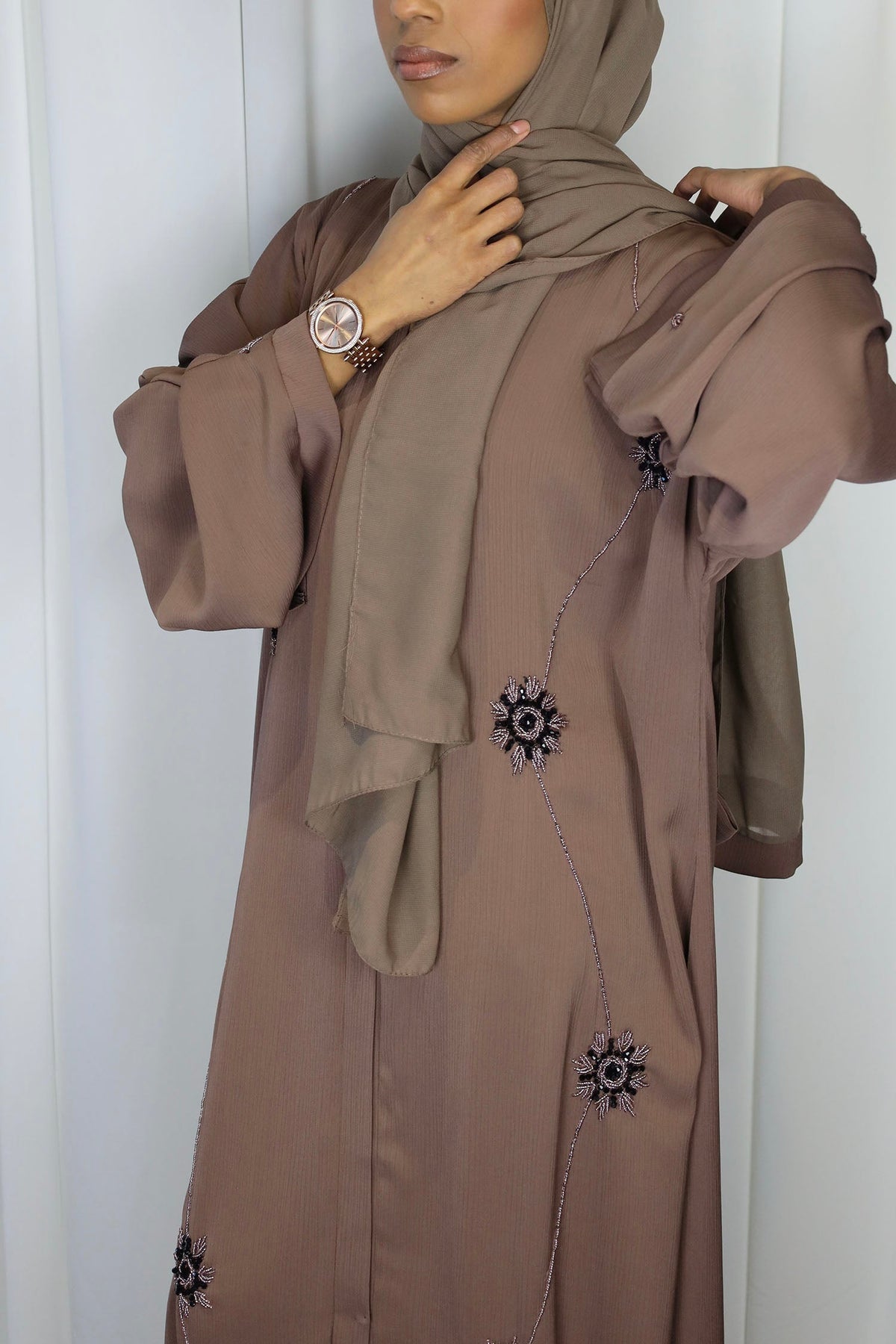
Neckline detail can frame the face, but it may catch a delicate scarf or be hidden by your usual drape. Cuff embellishment is visible in conversation but sits near tables, bags and food. A decorated hem may complicate alterations and needs enough clearance from the ground.
Inspect the reverse of raised details where possible. A rough backing or stiff seam can affect comfort even when the outside looks carefully finished. Check how the abaya folds at decorated areas when you sit, especially around the elbows and waist.
More decoration is not automatically better quality. A small, well-integrated detail may be easier to wear and more coherent with the cut than a collection of unrelated trims. Choose the amount that suits your taste and the practical demands of the evening.
Build the hijab arrangement with the dress on
Put the scarf on after fastening the abaya and any inner layer. The neckline, collar and shoulder shape can change how the fabric sits. A wrap that works with a plain top may become bulky or awkward beside an embellished collar.
For a detailed abaya, try a quieter scarf first. For a plain garment, the scarf can introduce texture or a related shade. Neither approach requires an exact match. Compare the complete arrangement around the face and shoulders, where the relationship is most visible.
Keep coverage and comfort central. Turn your head, lean forward and check the back. A beautiful arrangement that shifts whenever you speak or greet someone is not finished simply because it photographed well once.
Select shoes for the route as well as the room
Think about the surfaces you will cross and the time you will spend standing. Shoes should be secure enough to walk in at your normal pace. A formal appearance does not depend on a high heel, and a low shoe still needs to work with the hem and the occasion.
Try the full outfit while walking and using a step. If you need to shorten your stride because of the dress or shoes, identify the cause before the event. Do not assume that you will simply move more carefully for several hours.
Where you plan to change footwear, compare both pairs with the abaya. A small difference may be manageable; a large change can alter the length relationship completely. It may be better to choose one reliable pair than to plan an outfit around shoes you already expect to remove.
Give the bag a practical job
Choose a bag that holds the items you genuinely need without becoming awkward to carry. A tiny clutch may look elegant but be inconvenient if you also need medication, glasses, keys or a phone charger. A slightly larger plain bag can be the more considered choice.
Check its fittings against the garment. Rough edges, chains and decorative clasps can catch delicate fabric or thread. A shoulder strap may compress a draped sleeve or change the line of an embellished front. Test the bag in the position you will use, not only held for a photograph.
Jewellery and other accessories should earn their place in the same way. A bracelet that repeatedly snags a cuff is not helping the outfit. Keep the details that add something you enjoy and remove those that create unnecessary maintenance.
Do not forget the journey layer
A shawl, coat or jacket should be chosen for the weather and tried over the completed outfit. Check that it has room for the abaya’s sleeves and does not catch the scarf or decoration. A light wrap may be enough for one journey and inadequate for another.
If the outer layer will be removed at the venue, plan where it can be kept. Make sure the outfit beneath looks complete without relying on the coat to cover a neckline or an opening you have not otherwise addressed.
The guide to assessing an abaya coat’s sleeves, fit and closures is useful when the weather layer is part of the decision. A coordinated colour is helpful, but enough physical room matters more.
Rehearse an ordinary ten minutes
Before the occasion, spend a short period in the complete outfit doing ordinary movements. Sit at a table, pick up your bag, reach for something and walk between rooms. This is where a dragging hem, slipping scarf or awkward cuff usually becomes clearer.
Make small, deliberate adjustments and test again. Do not solve every issue by tightening a fastening or adding another pin. Sometimes the better choice is a different underlayer, a simpler scarf arrangement or an accessory that does not compete with the garment.
Check the care instructions before wearing the abaya so you know how it should be handled afterwards. Give it appropriate attention when you return rather than leaving a mark or damaged detail undiscovered until the next event.
Two outfit plans for different evenings
For a dinner in a restaurant, you might begin with a plain deep-blue closed abaya, a softly textured grey hijab and low shoes that work with the hem. The outfit's interest comes from the colour and fabric rather than a large decorative feature. Choose a bag that can be placed beside you without a chain lying across the sleeve, and check the scarf while seated at a table rather than only while standing.
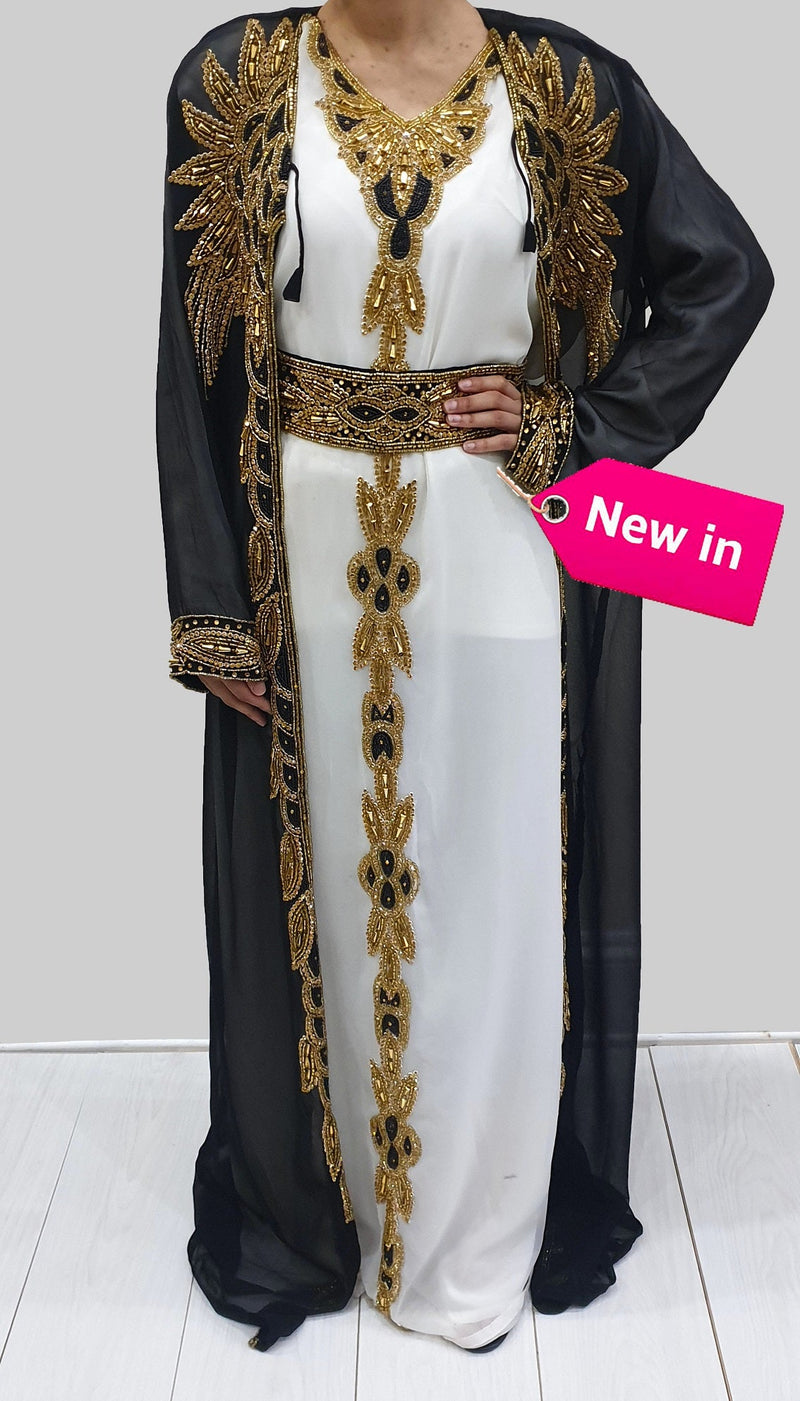
For a larger reception, a black open abaya with a narrow embroidered border could sit over an opaque inner dress in a related dark shade. A quiet hijab keeps the border visible without competing with it. The inner garment needs to look complete when the fronts separate, so check its neckline and sleeves independently. This combination does not require a heavily embellished bag simply because the occasion is formal.
These are examples, not a shopping list or a rule about what evening guests should wear. You might prefer warm neutrals, brighter colour or a different silhouette. Keep the method: identify the setting, choose one feature you enjoy, and build a complete outfit around it using pieces that work together physically.
Compare either plan with what you already own before buying anything. Perhaps the abaya is suitable but the scarf creates too much bulk at the neck, or the outfit works perfectly until a narrow coat sleeve is added. Solving that particular problem is more useful than replacing the whole look. An existing outfit can feel newly considered when the pieces cooperate and the detail you love is allowed to stand out.
Take a photograph of the final arrangement with the outer layer removed and another with it on. This records the actual combination, including the shoes, and helps you notice anything you missed from the front mirror. Keep the plan simple enough to recreate without needing a second person to rearrange it throughout the evening.
A useful definition of the right evening abaya
The right piece suits the occasion, gives the coverage you intend and lets you move without repeatedly managing it. Its fabric and details feel special to you, and its care is something you can realistically provide.
That may be a quietly finished plain abaya or a more elaborate design. Either can be a considered choice. The aim is an outfit that belongs at the celebration and allows you to be present in it, rather than one whose demands become the main event.