How to wear a white maxi hijab
A white maxi hijab can change the feel of an outfit without adding another strong colour. Over a dark abaya it creates a clear contrast; beside a pale dress it can form a quieter, almost tonal combination. The generous fabric also gives you room to arrange a longer front, a shoulder drape or a broader frame around the upper body.
That extra fabric is useful only when the scarf itself works for you. White makes opacity and undertones particularly worth checking, while a maxi size can bring more material around the neck than you expected. A beautiful folded scarf is not yet a comfortable finished outfit.
Rather than treating white as suitable for every person, event and season, start with three questions: is this the white you like beside your clothes, does the worn scarf provide your preferred coverage, and can you manage its length through the day? The styling choices become much easier once those points are settled.
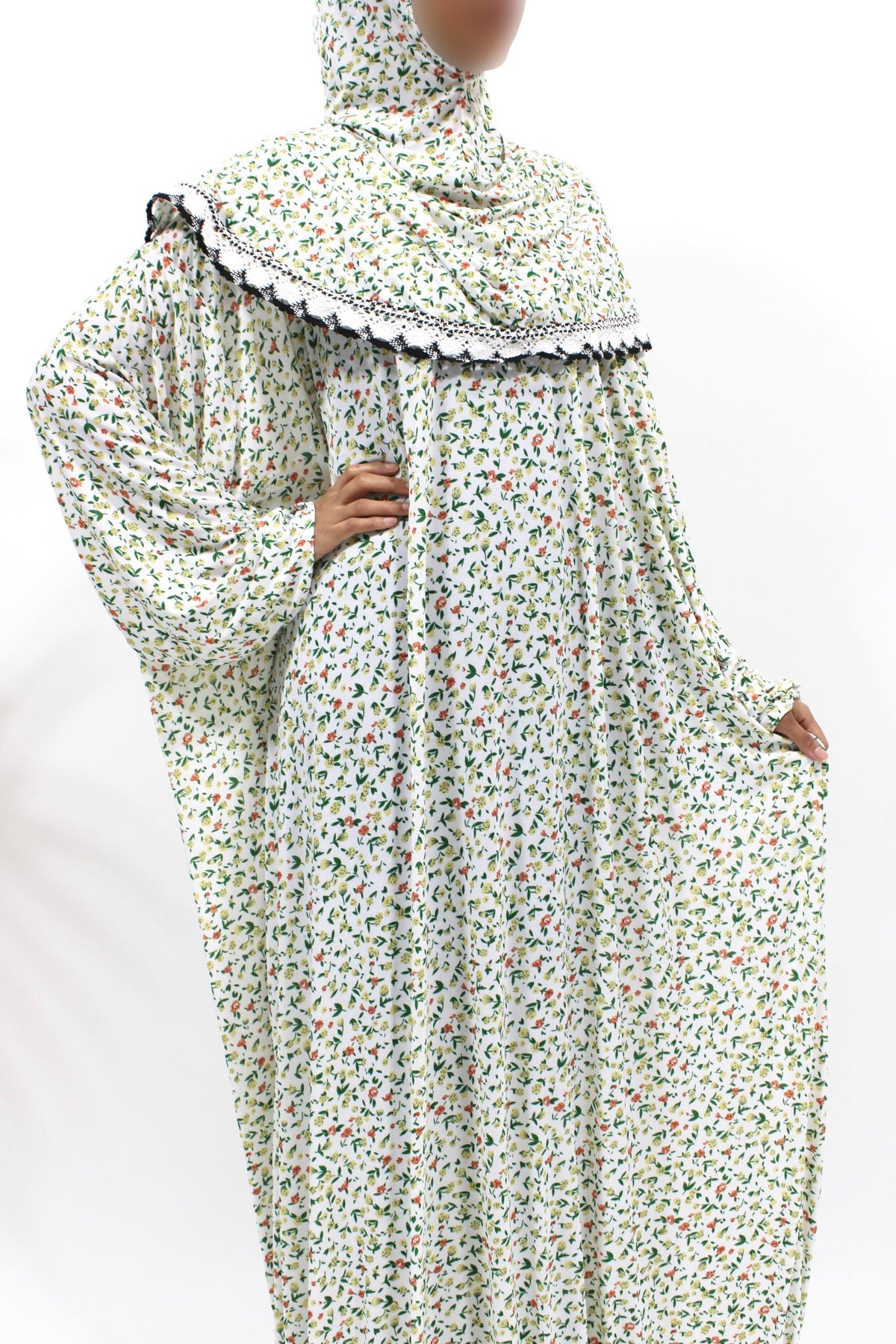
The photograph shows a white floral prayer dress with an attached hijab. The maxi-scarf wraps below apply to separate flat scarves.
Find out what “maxi” means in the particular listing
Do not buy by the size label alone. Ask for the scarf’s actual length and width, then compare them with a scarf you already find useful. A long, narrow rectangle gives different options from a shorter, wider one, even when both are described as maxi.
Measure a familiar scarf flat without stretching it. Note which dimension you tend to fold and where the ends finish once it is worn. You might discover that you want extra width for a fuller front rather than extra length trailing behind the shoulder.
A large square and a large rectangle also behave differently. A square folded into a triangle creates a particular distribution of fabric at the back and front. A rectangle offers longer free ends but may need a different fold to provide the same depth of coverage. Choose the shape according to the arrangement you enjoy wearing.
Check whether the product is a flat scarf, a pre-sewn hijab or a shaped covering. A photograph with a broad drape does not establish the construction. A flat maxi scarf gives you adjustable folds; a sewn garment may fix part of the opening and the way the fabric falls.
For a useful comparison of shapes and materials, see our guide to hijab fabrics and styling choices. The aim is to understand what the scarf allows you to do, not to collect the largest dimensions available.
Turn a familiar scarf into a useful size reference
Put on a scarf you already own and arrange it in the way you would like to wear the white one. Leave a little time to settle the folds, then look at the part you would change. Perhaps the front finishes where you want it, but the shoulder end is longer than you find convenient. Perhaps the length is right, but you have to narrow the front to leave enough fabric at the back.
Take the scarf off carefully and measure it flat. Record the full dimensions and, separately, the depth of the fold you used along the face edge. That fold reduces the usable width, which explains why two equally wide scarves can appear different once arranged. A thicker edge may also need a different fold from a fine one.
For example, imagine comparing a long, narrow rectangle with a slightly shorter but wider rectangle. The first may give you more material to carry across a shoulder, while the second may offer more depth for a broad front. These are possibilities to test, not guaranteed results: the cloth’s weight and drape will still affect the outcome. Do not choose between them using length alone.
Photograph the arrangement for your own reference, showing the front and back without pulling the scarf into an unusually neat position. Add a short note such as “front length works; too much fabric beneath coat collar”. When looking at a new product, you now have a specific question to ask about its dimensions or construction.
This approach also helps prevent an unnecessary purchase. If the scarf you own becomes comfortable after changing the fold or moving an end, you may not need a larger size at all. If you do need more fabric, the comparison tells you where that extra material should be useful rather than leaving you to buy a maxi label and hope for the best.
Compare white, ivory and cream beside the outfit
White is not a single visual result. Two scarves sold under the same colour name can look noticeably different beside each other. One may appear crisp and cool, another softer or warmer. The difference often becomes clearer next to a white blouse or pale dress than it does in an isolated product photograph.
Put the scarf beside the largest area of the outfit, then try it near the face. Use ordinary daylight where practical, and look again under the lighting in which you expect to wear it. This is a personal comparison, not a test that assigns certain whites to certain skin tones.
With a cream dress, a bright white scarf can create a deliberate contrast. It can also look like an accidental near-match if you expected the pieces to be identical. Neither result is inherently wrong. Decide whether you want a contrast, a close tonal relationship or a clear colour separation before buying.
For an online purchase, ask for the seller’s description of the shade and compare available photographs. Screen images are helpful references, but they cannot guarantee an exact match to a garment in your wardrobe. Where matching is important for an event, a physical comparison or sample is more informative.
Do not overlook the foundation beneath the scarf. Its colour may affect the appearance of a sheer or lightly layered white fabric. Test the complete arrangement rather than choosing the outer white and assuming the underlayer will be invisible.
Check opacity in the arrangement you will actually wear
A white scarf can look opaque when folded several times and more transparent once spread into a broad drape. Inspect the worn garment from the front, sides and back. Pay particular attention to the areas where only one layer remains.
Use the foundation you intend to wear, then turn your head and look down. Check whether the outer fabric moves away from the covered area or exposes a gap near the neckline. Extra width can help you arrange coverage, but the size itself does not establish opacity.
Look at the scarf against both lighter and darker clothing. Contrast can make the behaviour of the fabric easier to see. A patterned top beneath the front drape may be visible in a way that a plain top is not. This can influence the outfit even when your foundation provides the head coverage you want.
If the scarf needs repeated folds to become suitable, assess the result around the neck and shoulders. Several layers may create a shape you like, or they may feel too crowded. A different scarf construction can be a simpler solution than adding more and more material.
A white cap is not automatically the best foundation for every white scarf. Compare the actual items and choose according to comfort, visibility and coverage. The guide to what to wear under a hijab can help you consider fit without treating one cap colour or style as a universal answer.
Choose the material for its behaviour, not its reputation
Start with the fibre composition, but also inspect the weight, surface, drape and edge finish. A smooth scarf may fall into soft folds, while a more structured one may hold a broader outline. Try to see the actual fabric moving rather than relying on words such as luxurious or premium.
For a wide front drape, check whether the material falls comfortably over the chest or forms stiff folds that project away from the body. For a neater shoulder arrangement, check whether the free end stays where you place it without pulling at the face frame.
Think about the clothing it will touch. A delicate scarf can catch on textured decoration, rough fastenings or jewellery. A heavily embellished outfit may therefore call for a simpler scarf surface and an arrangement that keeps it away from those details.
White lace, embroidery or a decorative border changes the decision further. Inspect where the decoration sits when the scarf is folded. A substantial border may add weight to one edge or make a fold bulky. Check whether the design remains visible in the arrangement you prefer.
Do not assume that white, cotton, chiffon or another fabric description guarantees coolness, weather protection or suitability for every season. Consider the full number of layers and the conditions of your day. A maxi scarf can be a styling choice without being a substitute for appropriate protection from the weather.
Four draping ideas to try with a large flat scarf
These approaches assume a flat scarf with enough usable fabric for the arrangement. Adjust them to the garment’s actual dimensions and your preferred coverage. Keep any fastenings suitable for the fabric, close sharp points securely and avoid pulling the wrap tight to compensate for an unstable fold.
A broad, uncomplicated front
Place the scarf so that you have enough fabric on each side to frame the face and create the front you want. Settle the opening first. Then bring one end across gently, allowing the front to remain broad rather than gathering everything into a narrow band beneath the chin.
Check the lower edge while seated. A generous front can look graceful over a plain abaya, but it should not become something you need to hold away from a desk or plate throughout the day. Reposition the length within your available fabric rather than assuming that a longer drape is always better.
This arrangement can be useful when you want the scarf to soften a plain outfit without adding much decoration. Let the fabric itself provide the interest. A large brooch or several extra folds are not necessary unless you genuinely enjoy them.
A shoulder drape with a quieter front
Keep the face frame comfortable and place one end over the shoulder. Watch the opposite side of the neck as you do this. The movement should not pull the front away from an area you intended to cover.
Try the bag before deciding where the end belongs. A shoulder strap can compress or displace the drape, especially when the scarf is wide. You might prefer the fabric on the opposite shoulder or a bag position that does not sit directly over it.
For an occasion outfit, this can leave more of a dress front visible while still giving the scarf a generous outline. Check it from behind as well as in the mirror, because a long end may fall differently at the back than you expect.
A lightly folded, contained arrangement
Use a shallow fold to control excess width, then arrange the ends so they remain manageable around the upper body. Avoid folding so much fabric around the neck that the advantage of the larger size disappears into bulk.
This can be useful with a blazer or coat, but try the outer layer both open and fastened. Make sure the lapels or collar do not push the scarf upwards. Keep the ends clear of zips, buttons and bag hardware.
Remove the outer layer during the trial. A contained arrangement should still look intentional once the coat comes off. If it relies on the coat to hold every fold in place, it may need a different fastening or a different drape for indoor wear.
A square scarf with a longer triangular drape
If your maxi scarf is square, fold it according to the depth you need rather than automatically matching the corners exactly. Check how the resulting triangle sits at the back and how much fabric remains at the front.
Arrange the face frame, then settle the front ends without dragging the back section forwards. Turn your head and check the sides. A square scarf can give a distinctive shape, but the amount of coverage depends on its dimensions and the fold you choose.
Keep the first attempt simple. Once you know where the material naturally falls, you can decide whether to retain the broad back, bring more fabric forwards or choose another scarf shape for a different result.
White maxi hijab outfits for ordinary days
For a casual outfit, try the scarf with a long shirt or tunic and comfortable trousers. A denim jacket can be an option where its length and sleeves work with the base outfit. Check the collar against the scarf rather than assuming that a familiar jacket will fit around every maxi drape.
A white scarf can also sit neatly with a plain everyday abaya. The contrast may make the face frame and front folds more noticeable, so start with an arrangement you can repeat easily. If the abaya has embroidery near the neckline, decide whether you want that detail visible or mostly covered.
With knitwear, look at the amount of fabric gathered around the shoulders. A chunky jumper, a high collar and a wide scarf can become crowded together. A simpler neckline or a more contained drape may be enough to make the outfit comfortable.
Do not reserve the scarf for a completely pristine, carefully staged day. Instead, think about how you will use it. If a long loose end is likely to trail across surfaces during your routine, choose an arrangement that keeps it contained. Practical positioning is more useful than spending the whole day worrying about the colour.
Keep a spare scarf where that would genuinely help your routine, particularly for a long day or an event. It need not be identical. The point is to have a workable alternative, not to treat a small mark as a disaster that ruins the outfit.
Make a work outfit look intentional
A tailored blazer and trousers can work with a white maxi hijab, provided the scarf has space around the lapels. Put the blazer on before deciding how much fabric should sit at the front. A broad drape may cover the lapels entirely; a narrower arrangement may show more of the tailoring.
Check the outfit while seated at a desk. The scarf should not require constant lifting away from a keyboard or adjustment around a headset. If you use a lanyard, place it in a way that does not pull the scarf or catch in a fastening.
For a softer work outfit, try a plain long dress or tunic with a suitable outer layer. The white scarf can provide contrast without additional jewellery. Choose accessories according to the tasks and dress expectations of your own workplace rather than treating one combination as universally professional.
A simple practical test is to wear the full arrangement for part of your normal preparation routine. Put on the coat, pick up the bag and sit down. Notice what shifts. A work outfit earns its place through those repeated actions, not through a colour that supposedly creates authority or confidence on its own.
Style it for an event without assuming white is always the right choice
Consider the invitation, setting and host’s preferences. White clothing and head coverings can have different meanings in different events and communities. Where you are uncertain about the dress expectations, ask rather than relying on a universal rule about what a white scarf signifies.
Try the scarf with the event outfit well before the day. A pale gown, a white scarf and a light outer layer can form a beautiful tonal arrangement, but small differences in shade will be visible. Decide whether those differences are intentional and pleasing to you.
With a heavily decorated dress, a plain white scarf may be the simpler choice. With an unadorned dress, a border or modest embellishment can provide the detail. Check that any decoration does not land beneath a fastening or rub against the dress trim.
Our guide to choosing a formal dress with comfortable coverage can help you assess the whole outfit. The scarf should work with the neckline, sleeves and outer layer, rather than being selected separately and forced into place at the end.
For a customised scarf, agree on the placement, scale and method of decoration. Ask how it affects care and how the finished item will be checked. A small embroidered area may be enough; adding decoration across every edge can make the scarf heavier or harder to fold in the way you intended.
Pair white with prints and stronger colours
A plain white scarf can give a patterned outfit a quieter area near the face, but it does not automatically match every print. Look at the white or pale tones already present in the pattern. A bright white scarf beside a warm cream motif will create a different effect from a close tonal match.
For a floral dress, try the scarf with the full garment rather than a small swatch. The scale and distribution of the print matter. A dense pattern near the neckline may feel different from a dress that keeps the upper body mostly plain.
With a strong solid colour, decide how much contrast you want. A deep green, navy or burgundy garment can look very clear beside white. A pale blue or soft pink outfit may create a gentler relationship. These are options to compare, not promises that a particular pairing suits everyone.
Accessories can connect the pieces without matching every colour exactly. You might repeat a shade from the dress in the bag, or keep the shoes and bag neutral. Avoid adding an accessory solely because the white scarf makes you feel that the outfit needs more decoration.
For more ideas about controlling competing details, see our guide to styling prints without overcrowding the outfit. A useful decision is often to leave one area uncomplicated rather than searching for another statement piece.
Care for white fabric without improvised whitening treatments
Read the care label and any instructions for embroidery, lace or embellishment. White is a colour, not a washing method. Do not assume that every white scarf can be washed at the same temperature, treated with the same stain remover or exposed to bleach.
Before cleaning, identify the material and the nature of the mark as far as you can. Avoid vigorous rubbing or experimenting with several household treatments in succession. Use a method suitable for the finished item, and seek professional advice where the fabric or decoration is unfamiliar.
Separate items according to their care needs and the instructions provided, rather than treating all pale scarves as one wash load. Check fastenings and trims before washing. Remove detachable accessories where the instructions allow, so they do not catch on the cloth or leave pressure marks in storage.
Dry and press only as directed. A scarf that looks plain may still contain a blend or finish that needs particular handling. Test the finished appearance in the same arrangement you wear, because a creased edge can affect the face frame even when the rest of the scarf is smooth.
Store the clean scarf away from objects likely to snag or transfer marks onto it. Give embellished edges enough space not to be crushed. Keeping the scarf ready to use is more practical than saving it indefinitely for an occasion that feels worthy of white.
Questions that come up after the first try-on
Why does the scarf look different over a dark outfit?
Check whether the fabric is allowing the underlying colour or pattern to show through. Also compare the lighting and the number of layers in the drape. A darker outfit can make differences in opacity easier to notice. Adjust the arrangement or choose another scarf if the result is not what you want.
Do I need to match a white scarf exactly to a white dress?
No, but it helps to know whether you are creating a tonal combination or a close match. Put the actual items together and decide deliberately. A contrast between ivory and bright white can be attractive; it is less satisfying when it is an unexpected result you were trying to avoid.
Is a maxi scarf better for coverage than a smaller one?
It gives you more fabric to arrange, but coverage still depends on dimensions, opacity, construction and the worn position. A large scarf that slips away from the neckline may be less useful to you than a smaller one that sits reliably in the arrangement you prefer.
Can I use the same scarf for work and a formal event?
Often the question is whether the shape and material suit both outfits. Try each complete combination. You may keep the same simple drape and change the clothing or accessories, rather than attempting a complicated transformation of the scarf itself.
Will white keep me comfortable in warm weather?
Do not judge comfort or protection by colour alone. Consider the actual fabric, the foundation, the number of layers and the conditions. A generous scarf should not be wrapped into unnecessary bulk simply because it appears light in a photograph.
What does wearing a white hijab say about me?
It does not allow other people to determine your personality, level of faith or reasons for dressing. You may choose it for a personal meaning, a particular occasion or simply because you like the outfit. There is no need to carry a universal story about purity, empowerment or cultural identity every time you wear a colour.
A white maxi hijab is most useful when you understand its particular shade, dimensions and behaviour. Give those details the same attention you would give the fit of a dress or coat. Then choose a drape that remains comfortable as you move, and let the scarf support your outfit rather than turning it into another thing to manage.