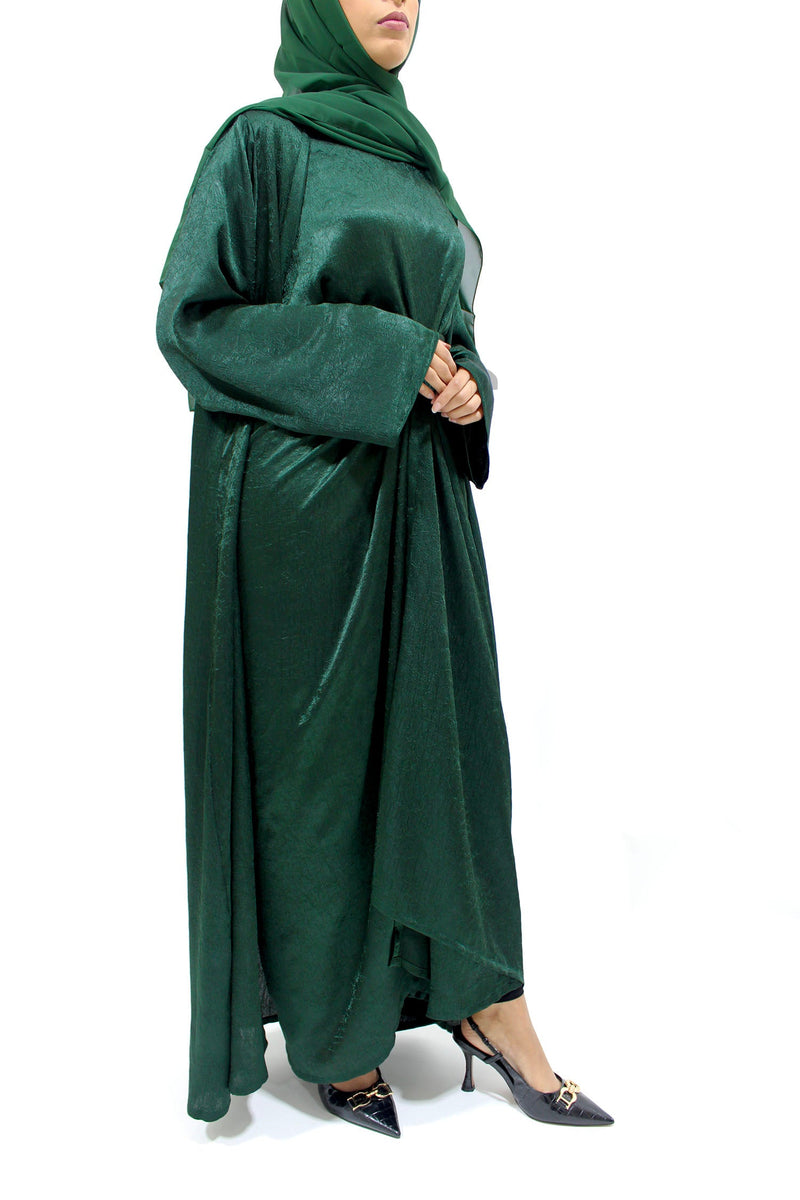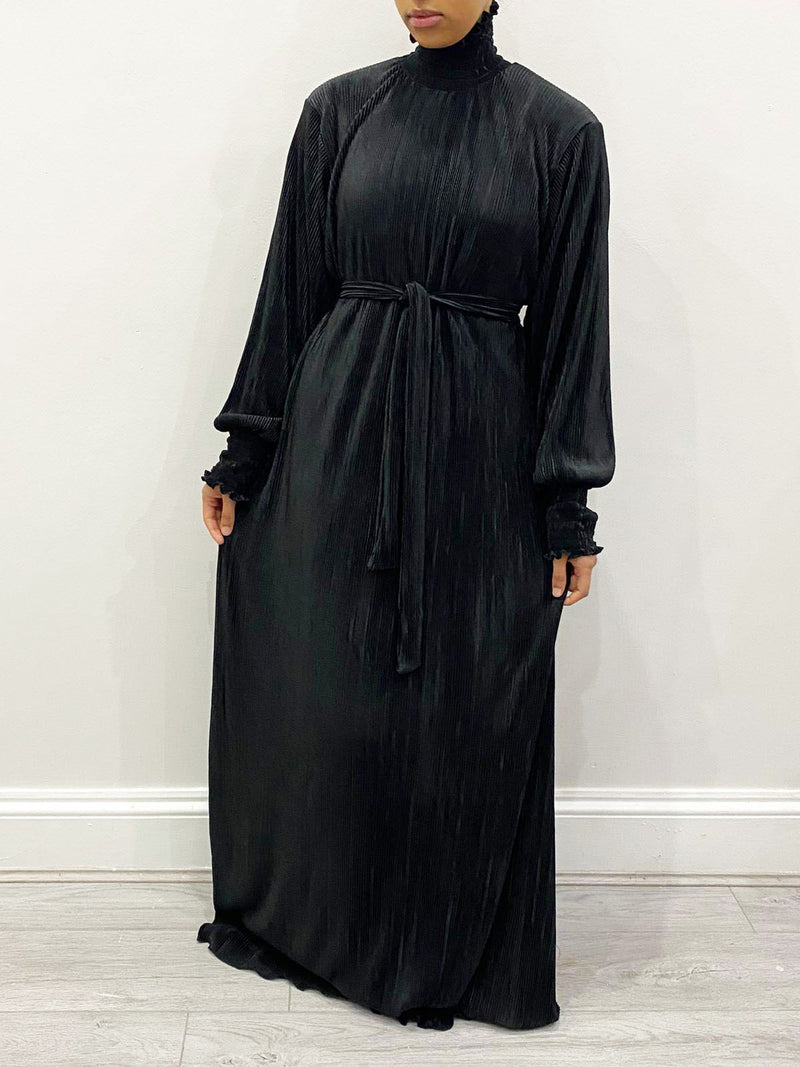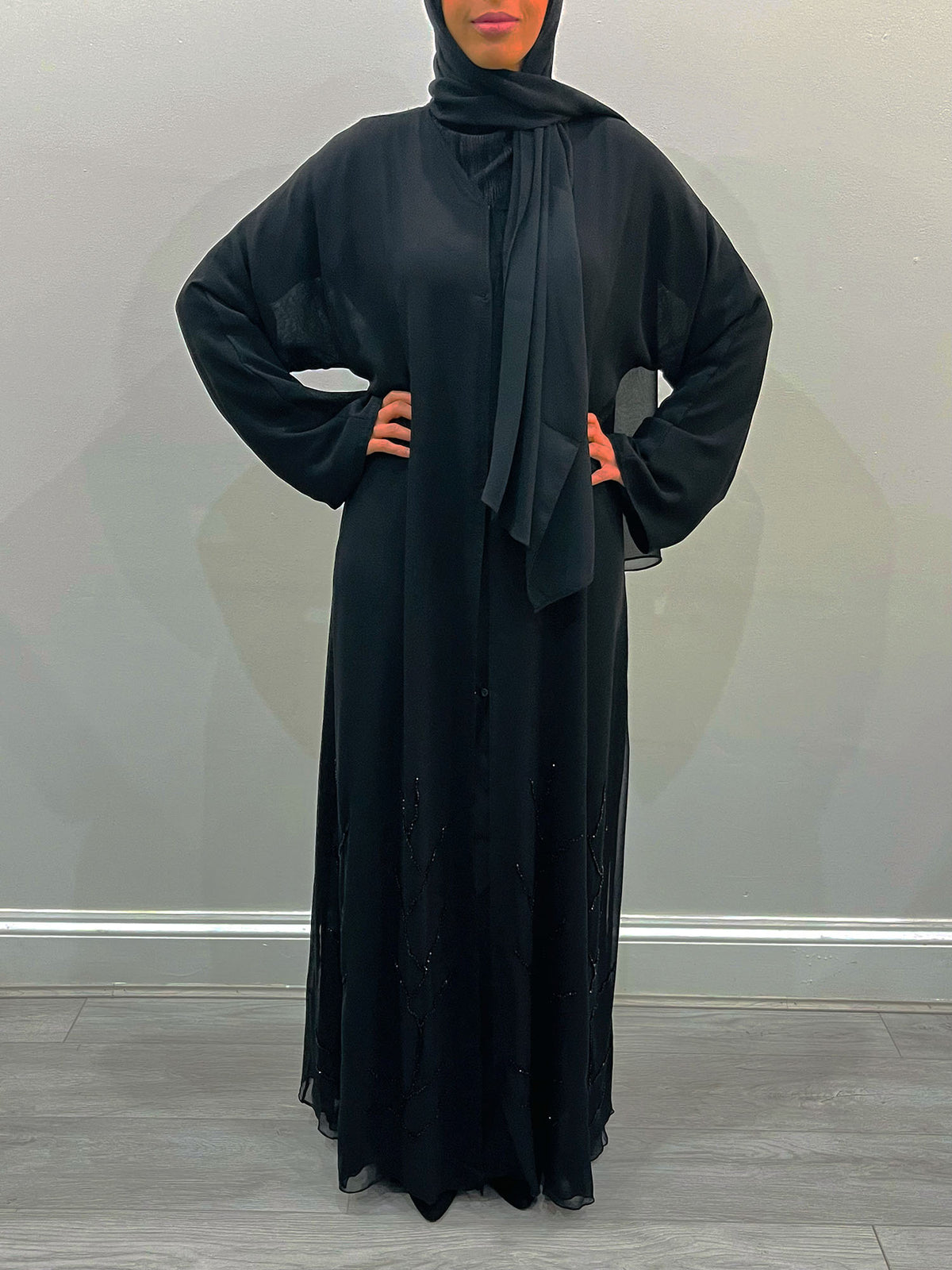
What to wear under an abaya
The clothes beneath an abaya may be barely visible, but you feel them all day. A seam that catches, a waistband that shifts or a collar that bunches can affect the outer garment as much as an obvious styling choice. Choosing the inner outfit carefully is therefore part of choosing how the abaya fits.
Begin with the construction of the outer layer. An open abaya, a sheer outer garment and an opaque closed dress ask different things of what sits beneath. There is no single under-abaya outfit that is automatically suitable for all three.
Give the inner layer a clear job
Decide whether it needs to provide visible coverage, a smoother surface, warmth or simply the clothing you are already wearing beneath an outer garment. These jobs can overlap, but identifying them helps prevent unnecessary layering.
For an open abaya, assess the inner outfit as clothing that will be seen when the front moves. For a transparent outer layer, check the areas visible through the fabric, including sleeves and neckline. For an opaque closed abaya, the main question may be comfort and how the inner pieces sit.
Do not assume that a garment sold as an underdress provides every part of the coverage you need. Some have narrow straps or a low neckline because they are designed for particular combinations. Read the actual details and test the complete outfit.
Choose between a dress and separates
An inner dress creates a continuous layer without a waistband joining two pieces. That can be convenient beneath an open front or a smooth outer fabric. Check its shoulder fit, neckline, sleeve arrangement and hem, rather than choosing it solely because it is labelled a slip or underdress.
Separates let you adjust the upper and lower layers independently. A suitable top with trousers or a skirt may work well for a day when you remove the abaya indoors. Check the overlap at the waist during sitting and reaching so that the arrangement remains as you intend.
Neither option is inherently more modest or more comfortable in every setting. The cut, fabric and way the pieces move together matter more than the category. Choose the combination that works with your outer garment and your own coverage requirements.
Check neckline and shoulder compatibility
Put the inner garment on first and make sure it sits comfortably without the abaya holding it in place. Then add the outer layer and hijab where relevant. Look for a collar or seam that creates a ridge, pushes the scarf upwards or changes the outer neckline.
A high inner neckline can be useful, but it still needs enough room to feel comfortable. A lower one may require another planned coverage arrangement. Do not rely on a loose scarf end staying in exactly the same position throughout the day.
Shoulder straps and seams can also show through a smooth or sheer outer fabric. Check in suitable light and from more than one angle. The goal is not to eliminate every sign that layers exist, but to avoid an unintended outline or gap that bothers you.
Make sleeves work as a pair
An inner sleeve needs to fit beneath the outer sleeve without twisting or bunching. A thick cuff can be awkward under a narrow wrist opening. A very loose inner sleeve may gather inside a closer outer one even when both garments feel comfortable separately.
Raise and lower your arms, reach forward and bend your elbows. Notice whether one sleeve drags the other or travels farther up the arm than expected. Adjust the combination rather than repeatedly pulling the fabric back into place.
If the outer sleeve is sheer, the inner sleeve’s length and opacity may be part of the visible coverage plan. Do not assume that the main body lining extends into the arms. Inspect the actual garment.
Compare lengths with shoes on
For an inner dress or skirt, decide how its hem should relate to the abaya’s. Similar lengths can create a continuous effect, while a deliberate difference can show the layered design. Check the side and back views as well as the front.
Walk and sit to see whether the layers catch. A longer inner hem can become awkward if the outer fabric repeatedly folds over it. A shorter one may reveal more than you expected when an open abaya moves apart.
Use the intended shoes for the comparison. A change in footwear can alter the practical clearance of both garments. Do not shorten one layer without considering what job it was doing in the complete outfit.
Assess the surface, not just the softness
A fabric can feel pleasant in the hand yet catch against another material when worn. Try the layers together and notice whether the outer garment falls freely or collects around the hips, waist or sleeves. Surface texture and seam placement can be as important as the general feel.
Rough lace, raised trim or bulky embellishment may be uncomfortable beneath a close layer. That does not make those details unsuitable everywhere; it means they need to be chosen for the particular combination. A smooth, simpler inner garment is often a useful starting point.
If static or clinging becomes an issue, first reassess the fit and the pairing of fabrics. Avoid spraying an unfamiliar product on the outfit without establishing that it is suitable. A different layer can be a more controlled solution than an improvised treatment.
Use fibre information accurately
Cotton, linen, wool and silk name fibres, while terms such as jersey and satin describe aspects of fabric construction. Viscose is a regenerated cellulosic fibre. These distinctions help you read a label, but they do not allow you to predict every property of the finished garment.
A light-looking cotton-containing layer may still be closely cut or densely woven. A jersey can vary in thickness, stretch and recovery. A smooth woven fabric may fall beautifully in one design but feel restrictive in another. Consider the specific cloth, cut and lining together.
Descriptions such as “bamboo fabric” need clearer composition information before you assume what the material actually is. Do not use a plant-related name as proof of comfort, environmental benefit or a particular care method.
Our fabric guide explains related terminology, while the product label remains the reference for the pieces in your outfit.
Plan warm-weather layers as a complete system
Start with the minimum number of layers that provides the coverage and comfort you need. Then assess the weight, fit and amount of cloth. Adding several individually light garments can still create a substantial outfit.
For an open abaya, a suitable inner dress may be simpler than several separate coverage pieces. For another design, separates may give a better fit. There is no universal answer based on the weather alone.
Test the combination in conditions reasonably close to its intended use where possible. Pay attention to the neck, underarms and waist, where fabric can collect. Do not assume that a single fibre label guarantees comfort in heat.
Add warmth without filling every sleeve
In cooler conditions, choose an inner layer that provides useful warmth while fitting beneath the abaya. A thick jumper may be comfortable by itself but crowd the outer shoulders or arms. A different weight or cut can work better than simply choosing a larger outer garment.
Check the full arrangement with the weather coat too. The coat must accommodate both the abaya and the inner clothing, plus the scarf arrangement. Try the closures and move your arms; colour coordination cannot compensate for insufficient space.
Read the care information for warmer fibres and blends. Wool-containing garments do not all require the same method, and a soft or expensive material is not automatically easy to maintain. Choose something that suits your actual routine.
Let visible colour be intentional
When the inner layer shows, decide whether you want it to blend with the abaya or create contrast. A related shade can give a quieter effect. A clearly different colour can emphasise the open front or the movement of the outer layer.
Compare the actual fabrics around the neckline and hem. A small band of an almost matching colour may look accidental to you, while a stronger difference reads as a deliberate choice. Prints beneath a plain abaya can work, but check how much appears when you walk.
There is no reason that only expensive wardrobes can use coordinated colour. Begin with the pieces you own and test them together before buying a supposedly necessary matching layer.
Make an occasion underlayer practical
For a wedding or dinner, the inner garment may be a visible part of a more formal outfit. Choose the neckline and surface with the outer detail in mind. A highly decorated inner bodice can catch or compete with an embroidered open front.
Sit for a realistic period in the complete outfit. Check waistbands, seams and any trim that rests against the body. A layer that is out of sight can still become the most uncomfortable part of the evening.
Do not assume that an inner dress needs a close fit to look refined. Appropriate ease can help it fall more cleanly beneath the abaya. The complete abaya guide offers more context for balancing fit and layering.
Trace bunching back to the layer that causes it
If an outfit keeps gathering at the waist or beneath the arms, adding another layer is unlikely to explain the problem. Start by wearing the inner clothing alone. Check whether its seams sit where intended and whether a waistband, sleeve or strap needs repeated adjustment before the abaya is added.
Next put on the abaya without a bag, belt or coat. Walk and sit, then notice where the two surfaces catch. A bulky top tucked into a skirt may create a ridge beneath a light outer garment. An inner sleeve that is much longer than the abaya sleeve may accumulate near the wrist. These are compatibility questions rather than proof that either individual garment is unsuitable.
Change one component and repeat the same movements. For example, compare the tucked-in top with an inner dress, or try a smoother sleeve beneath the same outer sleeve. Keep the comparison modest: you do not need to buy a collection of underlayers to investigate a single awkward combination.
When you find a successful pairing, store or record it as a complete outfit. An underdress that works particularly well beneath one abaya can have that specific role. It need not work equally well under a very different cut.
If discomfort persists after the layers are separated and checked, reconsider the fit of the outer garment itself. Inner clothing should not become a complicated workaround for an abaya that lacks the room or coverage you need.
Keep the care of each piece distinct
Read the instructions on every layer, even when the garments are similar colours or sold as a coordinated outfit. A cotton-containing item is not automatically suitable for tumble drying, and a silk-containing one should not be assigned a treatment from its name alone.
Plan washing and drying so a useful inner layer is available when needed. A small rotation can be more practical than relying on one piece that must be cleaned immediately before every wear. Store the layers in the way their construction requires.
After a full day, note any repeated adjustment. The underlayer should make the abaya easier to wear, not create hidden work. When neckline, sleeves, hems and surfaces cooperate, the whole outfit feels more settled—even when the inner clothing is hardly visible.