One embroidered net abaya, three occasion outfits
An embroidered net abaya can look so complete in a photograph that choosing the clothes beneath it seems like a minor decision. In practice, changing the inner dress can change almost everything you notice: the outline of a flower, the space between motifs, the colour around the neckline and the amount of contrast when the front moves.
That gives you a useful way to restyle an occasion garment without collecting another set of accessories. Instead of asking which bag goes with the abaya, begin with the relationship between the embroidered layer and its background. Then choose a scarf, shoes and bag for the particular gathering.
The three outfits below take different directions: dark embroidery over a dark base, a lighter inner dress that makes the stitching stand out, and an open embroidered layer over familiar separates. They are worked examples, not descriptions of current stock. Use the pieces you own, keep the coverage you require and leave an option aside when the construction of your garment does not support it.
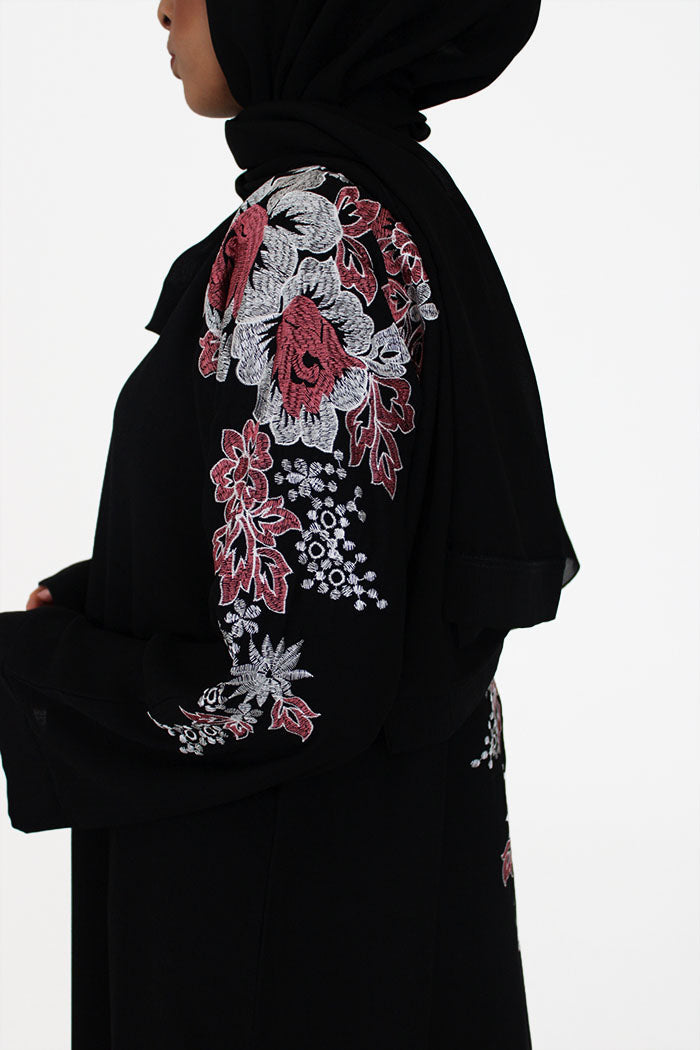
The pictured black abaya illustrates floral placement. It is not a specification of the net fabrics or hypothetical outfits discussed below.
Begin with the pieces you can actually separate
Put the abaya on a suitable hanger or lay it out carefully and identify its components. Is the embroidered layer a separate open jacket? Is it attached to an inner dress? Are there several supplied pieces, each with its own fastening? This is an inventory of the outfit you have, not a reason to start undoing its construction.
A sewn-in lining is not an interchangeable accessory. Do not detach it to create a contrasting background without an appropriate assessment of the garment. It may contribute to the way the dress is finished and supported. You can still restyle a fixed-lined design through the scarf, visible outer layers and accessories, even when its underlying colour cannot change.
With a separate inner dress, try that piece first. Check its own neckline, sleeves, opacity and walking room before putting the embroidery over it. You need a reliable base, not one that becomes acceptable only when somebody holds the outer front together. Sit down and reach forward to see whether the inner dress stays comfortable.
Keep the supplied head covering and belt in the inventory, but do not assume you must use both for every outfit. A belt may be optional or part of the intended closure; establish which before leaving it out. A matching scarf is a useful starting point when it suits you, not an obligation to reproduce the original styling photograph.
Net is an open textile structure; the Museum of Fine Arts Boston's CAMEO reference describes the mesh construction. Here, the practical consequence is that the background can remain visible through areas between the embroidery. Evaluate the complete arrangement rather than assuming that a dense flower at one point supplies coverage everywhere.
Choose what you want the embroidery to do
Step back from the garment and notice its largest visual feature. Perhaps a narrow border outlines the front, or flowers spread across the sleeves. An all-over pattern creates a different starting point from one decorated shoulder. Decide which detail you would like to remain prominent when the scarf and bag are added.
Now hold two possible inner colours behind a section of the overlay where that can be done without straining it. This small comparison is only an initial colour check. A piece of fabric held behind one motif does not establish the fit, opacity or appearance of a whole outfit. It tells you which combination deserves a proper try-on.
A close colour relationship can make the texture more noticeable than the outline of each motif. A clearer contrast can make the open spaces and thread shapes easier to distinguish. Neither approach is automatically more refined. Choose according to whether you want a quiet surface or a more clearly drawn pattern.
Keep a simple note: “show the cuff detail”, “let the front border stand out” or “keep the whole outfit dark”. That gives you a useful way to judge later additions. A scarf that completely hides your chosen feature may still be beautiful, but it is taking the outfit in another direction.
Outfit one: dark embroidery over a dark inner dress
Imagine a black embroidered open layer over a plain black inner dress with the sleeves and neckline you need. Begin without jewellery or a decorative bag. The first question is whether you enjoy the relationship between the mesh, the stitching and the base when no accessory is competing with it.
Two black fabrics need not look identical. One may be more matte, another more reflective, and the thread can introduce a third surface. Compare them in daylight and ordinary indoor light. A deliberate difference can give the outfit depth; an almost-match that bothers you is worth noticing before you build the rest around it.
Try a simple black scarf first, using a familiar wrap. Keep the face opening comfortable and put the remaining length where it supplies the coverage you want. Look at the embroidery that remains visible. A long chest drape may cover a central motif while leaving the front edges clear; a different arrangement may reveal more of the bodice.
Do not reduce coverage merely to display the stitching. You may prefer a garment whose decoration falls lower down, or accept that part of a design is visible only when you move. The outfit should work around your way of dressing, not require you to keep a scarf in an unfamiliar position all evening.
For a seated dinner, choose a bag that carries your essentials and sits comfortably beside the garment. A plain, smooth-sided bag is a sensible first comparison. It need not be tiny, and it need not have a metallic chain. Put your phone and other usual items inside before deciding how it hangs.
Wear shoes already tested with the hem. If the net extends below the inner dress, check its lowest point from the side and back as well as the front. Take an ordinary step. A graceful edge that repeatedly gets beneath your shoe is not made practical by resolving to walk carefully.
Now introduce one optional detail. You might try a favourite ring, a small brooch in a suitable supported area, or a bag with a quieter metallic clasp. Add one, step back and decide whether you prefer the change. The dark embroidery can remain the main interest without additional sparkle.
If the outfit feels too visually uniform, change the scarf before buying new accessories. A deep grey scarf or a restrained difference in texture may give you enough separation. Alternatively, keep it entirely black because that is the effect you enjoy. Contrast is an option, not a correction that every dark outfit needs.
For the final trial, sit with the bag nearby and bring your hands towards the centre of a table. Notice where the cuff embroidery travels. Stand again without immediately smoothing the skirt. The useful version is the one that settles into a wearable arrangement, not the one that needs its folds reset for every photograph.
Outfit two: a lighter base that brings the pattern forward
For a more pronounced design, compare the same suitable dark overlay with a light inner dress. A cream, ivory or pale neutral can make the embroidery appear more distinct. This is a different outfit idea, not an instruction to replace the supplied lining of a fixed construction.
Begin with the inner dress on its own. A pale colour that displays the stitching beautifully still needs the fit and opacity you want. Check the sleeves, neckline and lower edge under appropriate light. Establish which garment covers each area before adding another layer to hide a problem.
Then put on the overlay and look at a complete view. The lighter colour shows through undecorated mesh as well as behind flowers or borders. You may find that the open areas become a larger part of the appearance than expected. Judge that whole effect rather than deciding from one especially attractive close-up.
Compare a light scarf with a dark one while keeping the rest unchanged. A light scarf can relate to the inner dress and give the upper part a clear colour connection. A dark scarf can frame the face more distinctly while keeping attention on the contrasting layers below. Choose the relationship you enjoy in the actual fabrics.
Check where the scarf ends meet the front opening. An edge falling directly beside a strong embroidered border may look orderly, or it may make that area feel crowded. Redirect the drape where it remains comfortable and secure. You do not need to force the scarf into an exact parallel line with the decoration.
For a family celebration, one possible combination is black embroidery over cream, a plain cream scarf, dark shoes and a simple dark bag. Another keeps the same dresses and shoes but uses a black scarf and a light bag. Those substitutions alter the distribution of light and dark without requiring a new main garment.
At a wedding-related gathering, follow the hosts' guidance about colours and dress. An outfit with a substantial pale area may need a different decision from a dark dress with a small light accessory. Do not assume that describing the outer abaya as black answers every question about the visible finished outfit.
Take a side and back view before deciding the pairing works. A lining ending above the mesh hem may reveal a change that is more obvious over a light base. A separate inner dress can also sit at a different length from the one supplied. Inspect the arrangement in movement instead of disguising the difference by holding the fronts still.
When the contrast feels too strong, try a deeper neutral rather than immediately adding another scarf or necklace. A medium grey or another appropriate shade you already own can sit between the two extremes. The aim is not the maximum possible visibility of the embroidery; it is a pattern-and-background relationship you want to wear.
Keep the first successful combination recorded. Write down the exact inner dress and scarf, not simply “cream underneath”. A later near-match may have a different neckline, sleeve finish or opacity. The practical value lies in a known outfit, not in remembering only its palette.
Outfit three: an embroidered outer layer with familiar separates
This option belongs to an abaya intended to be worn open as an outer layer. Start with a complete top-and-skirt or top-and-trouser outfit that already meets your preferences. The embroidery adds another surface; it should not be the only thing concealing a gap in the clothing beneath.
Choose a relatively uncomplicated base for the first trial. A plain long top and a suitable skirt, for example, let you see how the embroidered fronts behave around the waist. A top and relaxed trousers provide another silhouette. Use pieces you already understand rather than introducing three new fits at once.
Put on the lower garment and top without the abaya. Sit, reach and check their overlap. Inspect side slits and any shirt opening. If something needs repeated adjustment now, resolve it before adding the overlay; a long decorative layer will not make the underlying task disappear.
Add the abaya and leave its panels in their intended position. Watch how they move when you walk. A bag strap, trouser pocket or waistband knot may catch the fabric at one point. A different top surface or carrying position can be more helpful than fastening the embroidered fronts together with an extra pin.
Imagine a coloured embroidered jacket over a quiet dark base. Choose a plain scarf that relates to either the base or one thread colour. Keep the first comparison to those two choices. Repeating every colour in the embroidery through shoes, jewellery and a bag can make an otherwise clear outfit unnecessarily busy.
A long skirt and a shorter outer hem create a visible layered edge. Decide whether you like that difference from all angles, not just at the centre front. With trousers, look at how the abaya falls alongside the legs while walking. The outer layer should not continually collect around the knees or become trapped beneath a shoe.
For an informal gathering, familiar shoes and a useful bag may be all you need. That does not turn every elaborate net garment into everyday wear. An exceptionally delicate overlay can still have a narrow occasion role, even when the trousers beneath are part of your regular wardrobe.
Try removing the abaya in a suitable private fitting. Would the base outfit be appropriate in the circumstances where you might take the outer garment off? You do not have to plan to remove it, but the answer helps clarify whether that is a real option or something you have only assumed.
If the separate pieces fail to cooperate, return to the inner dress that works. A coordinated set has not disappointed you simply because its jacket does not also suit every trouser outfit. One dependable alternative is useful; several untested combinations are only ideas.
Keep the comparison fair: change one part at a time
It is difficult to identify why an outfit feels better when the scarf, shoes, bag and inner dress all change together. Begin with the most important variable: the base beneath the embroidery. Keep the outer abaya and footwear the same while comparing two suitable inner outfits.
Next compare the scarf, leaving the successful base in place. Look at the neckline and at how much of the embroidered front remains visible. The scarf's colour and its amount of drape are separate choices. A broad pale drape can change the outfit more than a small difference between two pale shades.
Only then add the bag and jewellery you might use. This sequence is not a rule about how to dress; it is a way to answer a question without several changes obscuring the result. Keep the original version nearby so you can return to it rather than losing track of what worked.
| What you are comparing | Keep unchanged | What to notice |
|---|---|---|
| A dark and a lighter inner dress | The overlay, shoes and initial scarf arrangement | How the motifs and open areas appear, plus the fit of each base |
| A light and a dark scarf | The two garment layers and footwear | The neckline, visible embroidery and distribution of colour |
| Two bags | The complete clothing arrangement and normal contents | Where the strap or bag rests and whether it catches the fabric |
| Different footwear | The intended fastened garment and inner layer | Clearance of both hems during walking and sitting |
A private photograph taken in similar light can help you remember the alternatives. It is a record of the clothes, not a reason to criticise your body. Keep the combination you can comfortably repeat, even when another produces a more dramatic still image.
Let the scarf leave room for the part you chose
Place the scarf around the actual neckline after the garment is fastened. A high embroidered collar may leave little space for a thick stack of folds. A lower neckline may need a dependable base layer. Do not ask one loose scarf corner to remain over an opening it cannot reliably cover.
For a detailed shoulder, try moving the main scarf drape lower or to the other side where that suits your coverage. Check the back as well as the front. A design can remain interesting even when some stitching is hidden, but it helps to know which sections you will actually see.
For cuff embroidery, the neckline can stay quieter. A plain scarf allows a hand movement to reveal the detail without putting another elaborate feature beside the face. A textured scarf is also an option; compare rather than assuming that a decorated garment forbids all other texture.
Inspect the places where the scarf touches the embroidery. Raised attachments or rough edges can catch the cloth. A colour-perfect pairing is not the best option when you must repeatedly free one fabric from the other. Another scarf surface or garment arrangement may be more useful than extra careful handling.
Our hijab fabric guide explains the broader choices. For these outfits, keep the question specific: does this scarf sit comfortably beside this neckline while leaving the detail you enjoy in view?
A bag should not become part of the fastening system
Try the bag with its ordinary contents. A cross-body strap may hold one front panel against the inner dress while the other remains free. Decide whether the effect is comfortable and acceptable to you. Do not count the strap as the thing that keeps an otherwise unsuitable opening covered.
Look at the surfaces contacting the net or threadwork. An exposed clasp, chain link or decorative corner may sit exactly where the fabric moves most. A plain bag can still have rough fittings, so inspect the actual contact rather than judging only how decorative it looks.
A handheld bag avoids a shoulder strap but occupies a hand. Think about steps, greeting people and carrying a coat. Choose a carrying arrangement you can manage throughout the event, not one that works only while someone else holds the rest of your belongings.
If a piece of cloth catches, stop the movement that adds tension. Inspect the contact before pulling. Where it cannot be released gently, seek suitable help rather than cutting an uncertain thread or dragging the garment across the object. Afterwards, address the accessory that caused the problem as well as any repair.
Rehearse the evening, including the journey
Put on the finished outfit, then add the coat you will use to get there. Its sleeves need room for the abaya and any decorated cuff. Its collar should not push the scarf into the neckline. Try fastening it where you expect to wear it fastened, rather than judging only an open photograph.
Remove the coat and sit at a table. Rest your arms, reach for a glass and stand again. Watch the inner dress and overlay independently. One can twist or catch even when the other remains well positioned. Name the actual problem before deciding it needs another accessory.
Check the intended shoes once more with both hems. If you plan to change into lower shoes later, try that version separately. An outer edge that clears one pair can trail with another. The easiest solution may be one comfortable pair that works throughout, not two shoes and an improvised hem adjustment.
Think about what happens if you remove a wrap or another optional layer. The base outfit should still provide the coverage you intended for that setting. A journey layer should not be the unnoticed structure holding the whole arrangement together.
Where prayer is part of the day, assess the complete clothing arrangement separately through the movements and requirements you follow. This is practical outfit planning, not a religious ruling. An occasion label does not determine whether a garment supplies the coverage needed for another use.
Keep the successful arrangement simple enough to repeat without a long rehearsal every time. Note the inner dress, scarf and shoes. When replacing one of them later, remember that a similar colour does not necessarily provide the same neckline or length.
Buying an inner piece: specify the gap before spending
If none of your inner clothes works, identify what is missing. Is it a suitable sleeve, a higher neckline, more room through the upper back or the correct length? Those are different requirements. “Something plain for underneath” can produce another purchase that almost works without resolving the actual difficulty.
Compare any proposed garment on its own measurements, using the seller's stated route. A flat width is not a body circumference. A length from the shoulder is not a measurement from the top of a head covering. Keep the units and starting points clear rather than selecting by a familiar size label alone.
When buying a whole set, confirm the supplied components before counting its value. A photograph may show sleeves, a scarf or a belt not included in the price. Request a clear list and inspect the neckline and lower lining length. You are purchasing the delivered pieces, not everything arranged around them in the image.
For two hypothetical sets, compare the cost of the complete usable outfit. One may include a suitable long-sleeved inner dress; another may need an extra purchase to provide your preferred arm coverage. Neither is automatically better because it contains more embroidery. Establish the missing piece and its fit before comparing totals.
Do not turn a small gap into an automatic shopping list. If a familiar scarf and shoes already work, keep them. Spend on the component needed for coverage or comfort rather than matching every colour simply because the main garment is new.
Preserve the border before agreeing to an alteration
A decorated hem can be the reason you like the abaya and the reason shortening needs careful assessment. Show the actual garment to an appropriate alterations professional before assuming the edge can be moved unchanged. Ask what happens to the lining, motif spacing and shaped corners.
Take the intended inner dress and shoes to the fitting. Establish the final relationship between both hems while the clothes hang naturally. Shortening only the outside can expose an inner layer in a way you did not want; shortening the inner dress first can remove coverage you relied on.
For sleeve changes, check where the embroidery begins and how the cuff is finished. A small difference in length can require more work than expected when a motif sits across the proposed line. Explain the feature you want preserved, not just how many centimetres you want removed.
Fit problems higher up need separate attention. A tight shoulder or a lining that restricts the stride will not be solved by a new hem. Compare the likely result and cost of the assessed work with choosing another garment, especially when several parts need substantial alteration.
Look at how the embroidery meets side seams and the front opening before deciding where to alter it. A scattered motif can end naturally at a join, while a strong border may depend on a particular turn or spacing. Matching every stitch across every seam is not a universal requirement. The useful question is which visible relationship matters to you. Point it out during the fitting, inspect the sleeves with your arms relaxed and ask whether the proposed change preserves that feature. A drawn cutting line on a photograph is not enough to explain how the finished fabric will fall.
Keep purchase suitability and irreversible work separate. Resolve an issue with a new garment under the seller's applicable arrangements before changing it. A beautiful border is a reason to consider an alteration carefully, not a reason to overlook every other unresolved concern.
When you want embroidery made for a particular outfit
Where your chosen maker offers a custom service, explain the outfit rather than sending several unlabeled photographs. Identify the base colour, the areas of decoration and the way you expect to wear the scarf. A motif planned for a shoulder you always cover may not serve the purpose you intended.
Mark approximate placement on a simple front-and-back outline. Separate motif size, thread colour and garment measurements in the brief. A reference image showing an attractive flower does not establish that you want its entire dress copied. State which feature the reference is meant to explain.
Ask how the proposed decoration will be supported and finished on the reverse. A cuff or neckline needs attention where it meets the wearer, not only on the visible face. Discuss a sample where feasible and agree how the completed garment will be cared for.
The V&A's illustrated embroidery reference shows the variety of techniques. Do not infer handwork, a regional origin or symbolic meaning from appearance alone. Ask for information supporting a specific craft claim and keep it separate from your own personal association with the motif.
Record the final agreed version and any later changes. Resolve the garment length before confirming the border's final location. This advice concerns a commission with a maker you select; it is not an offer of a bespoke embroidery service from Amani's.
Get the outfit ready for its next outing, not just this one
Keep the care information for every component. A separate inner dress, embroidered outer layer and scarf may have different instructions. They do not become one washing load because their colours coordinate. GINETEX's care-symbol guidance explains the treatment information on textile labels; use the instructions for each finished item.
Inspect the garment after wear while you remember anything that happened. A spill, a caught thread and a loose fastening are different tasks. Avoid rubbing an uncertain mark or pulling at a thread to make the surface look tidy. Seek a suitable assessment where the material or construction is unfamiliar.
Give each piece appropriate support during drying and storage, and put it away only when fully dry. A substantial inner dress and a delicate decorated layer need not share one hanger. Keep them connected through a label or outfit note rather than forcing identical handling.
For travel, pack the exact components used in the fitting. Protect the outer fabric from exposed fastenings, shoes and toiletries, and avoid compressing raised decoration unnecessarily. On arrival, inspect the outfit with time to follow its permitted care; an unfamiliar iron or steamer is not automatically a safe last-minute solution.
Plan the journey home too. Do not leave an outfit needing attention in a closed travel bag until another invitation arrives. Set it apart from ready clothing, identify the next action and return it to the wardrobe once the care or repair is complete.
Our fabric-care guide provides the broader routine. For this outfit, the useful record is small: the pieces that work together, the treatment each allows and any detail that needs attention before another wear.
Keep two dependable versions rather than ten imagined ones
You may prefer the dark-on-dark outfit so much that you rarely use the lighter inner dress. Or the contrast may be precisely what makes you reach for the embroidery. Keep the version you enjoy, and let another combination remain optional rather than treating versatility as a target you must meet.
Ask what changed successfully: the visibility of the motifs, the amount of colour near the face, the ease of sitting or the usefulness of the bag. Those observations give you something to repeat. A general promise that the abaya suits every occasion does not.
The embroidery can remain the part that makes the outfit special. The work beneath it is quieter: a suitable inner layer, a comfortable scarf, workable hems and a few accessories that do not get in the way. Once those pieces cooperate, you can enjoy the gathering instead of continually reconstructing the look.