Is a silk underscarf worth it?
A silk underscarf is worth considering for what touches your hair and skin, not because an expensive-looking label promises to transform the whole hijab routine. The inside surface, the position of the seams and the way the cap stays on can matter more than a glossy photograph of the outside.
Begin by deciding what you want the underscarf to do. You may want a smoother contact layer, an easier place to arrange loose hair, a visible band beneath a sheer scarf or a cap that sits more comfortably than the one you already own. Those are different priorities, and one design will not necessarily answer all of them.
Before buying several colours, understand the material and test one complete combination. A silk-lined cap that works with your familiar scarf is more useful than a collection of attractive pieces that only stay in place when everything is pulled too tightly.
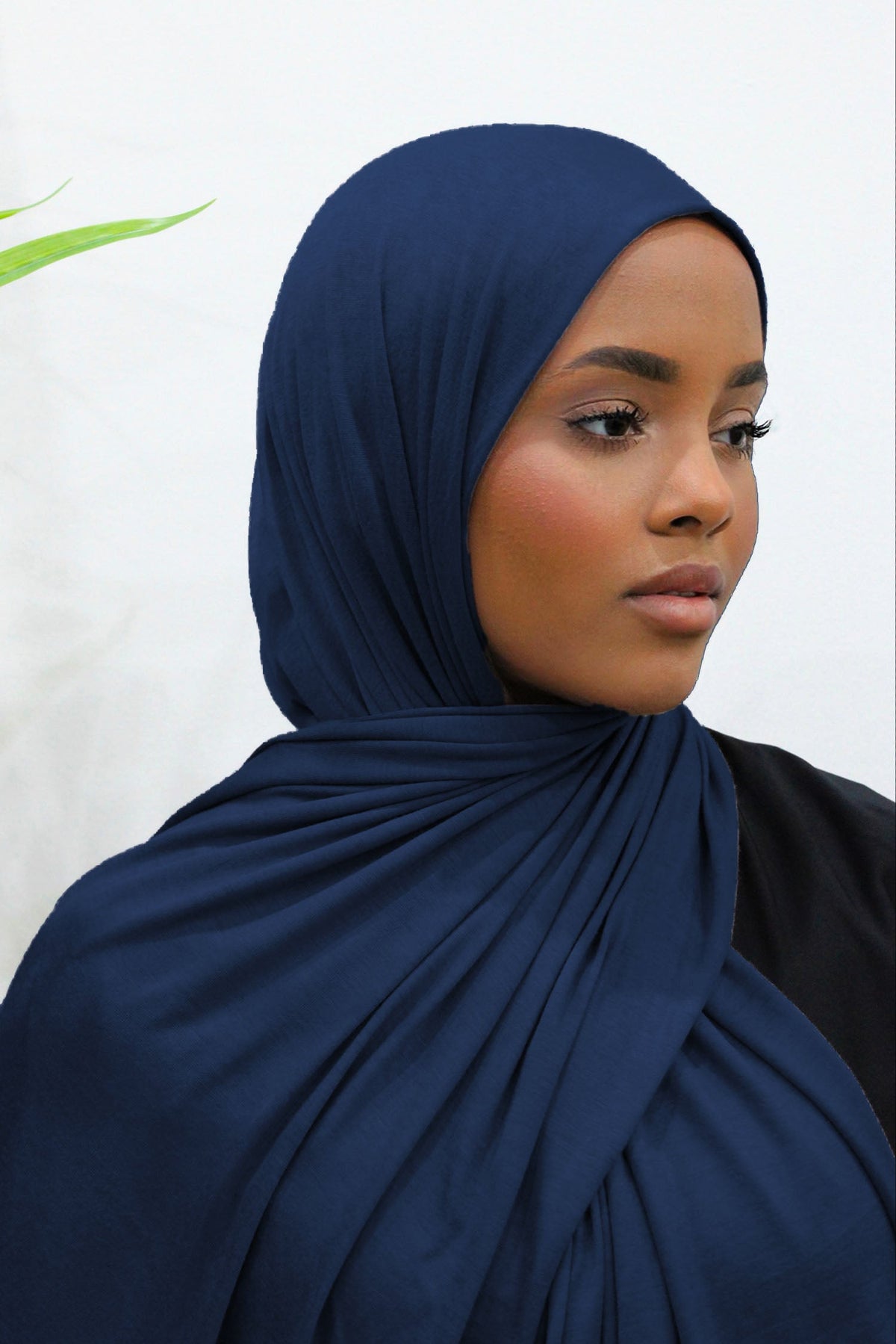
The navy jersey hijab illustrates an outer scarf, not a silk underscarf. Check the material and construction of the layer beneath it separately.
Silk and satin are not interchangeable descriptions
Silk identifies a fibre. Satin identifies a weave that can be made with different fibres. The Museum of Fine Arts, Boston’s CAMEO textile reference describes satin construction and notes that silk, polyester and nylon are among the fibres used. A shiny satin surface therefore does not, by itself, establish that an underscarf contains silk.
Read the composition for the exact item. “Silky”, “silk feel” and a photograph showing sheen are not substitutes for that information. If the listing names silk without stating which part contains it, ask before treating the whole cap as a silk garment.
Distinguish an all-silk underscarf from a silk-lined cap. A lined design may combine a different outer fabric with silk on the inside. That can be a deliberate construction choice, but you need to know where the lining extends and which surface will actually touch your hair.
A silk blend is another possibility. Check the stated proportions and the materials used for bands, ties or other components. More detail is useful because the cap is a finished item with seams and fittings, not simply a square of fabric.
There is no need to reject a non-silk satin purely because it is not silk. The point is to buy the material you intended, at a price you are comfortable with, and assess its fit honestly. A clear description is more valuable than an impressive name that conceals the construction.
Look at the inside before the colour range
Ask for an interior photograph where one is not provided. Check the front band, crown, back and seam allowances. A smooth lining over the crown may still leave a different fabric or a raised edge against the hairline.
Look at how the lining is attached. Does it lie flat, or does it form folds when the cap is worn? Can it move independently of the outer fabric? These questions help you identify the item’s construction without assuming every lining is arranged in the same way.
Inspect labels and joins in places you expect to feel them. A small label can be more noticeable in a close-fitting cap than in a loose outer garment. Before removing anything, retain the care information and check that the change will not damage a seam or affect a return.
Check any elastic, tie or adjustable section separately. The presence of silk elsewhere does not establish that the band will feel comfortable. A broad band and a narrow one can sit differently even when the overall cap size appears similar.
Choose the relevant details before deciding whether you need five matching colours. Much of an underscarf may remain hidden. The most useful colour is the one that works beneath your actual scarf without distracting you from a poor fit.
Compare the shape with the job you need it to do
A tube-style underscarf
A tube may be convenient when you like a simple opening and do not need the cap to enclose the hair fully. Check how it sits at the front and back and whether it moves when the outer scarf is added.
Make sure you understand which parts are lined in a product described as silk-lined. A lining panel may not cover the entire tube. Ask for dimensions and a clear view instead of assuming the interior matches the exterior photograph.
A closed cap
A closed design may give you a more contained foundation, but its depth matters. If it is too shallow for the arrangement beneath, it can pull back at the front. If it has excess space, the fabric may gather in a way you do not enjoy.
Assess the cap with your ordinary hair arrangement rather than changing that arrangement dramatically to make the product fit. The useful question is whether it works with your routine, not whether you can create the exact shape shown by a model.
A tie-back design
Ties can provide some adjustment, but they should not become a reason to pull the band very tight. Check where the knot rests and whether it presses when you sit against a chair or add a coat collar.
Make sure the ties are manageable beneath the outer scarf and do not need to be pinned through several layers to stay hidden. Use the fastening as intended, and choose another design if it requires a complicated workaround.
A separate lining or scarf used beneath another covering
A separate piece can give flexibility, but it also adds another edge and another step. Check that the arrangement stays comfortable without relying on excessive wrapping or a stack of fastenings.
A rectangular silk scarf is not automatically equivalent to a fitted underscarf. It may work for a particular arrangement, but its dimensions, opacity and securing method need their own assessment. Do not assume an attractive drape on the shoulders predicts an easy fit beneath hijab.
Check fit without making tightness the solution
Put the cap on by itself and allow the band to sit naturally. Look at the forehead, temples and behind the ears. It should not need to be pulled into an uncomfortable position before the outer scarf is even present.
Turn your head, look down and return to a relaxed position. Notice whether the front edge moves significantly or whether the back pulls on it. Adjust placement gently and compare the result, without repeatedly tightening the same area.
Add your usual scarf in a familiar wrap. Keep the rest of the outfit simple during this first comparison so you can identify what the cap changes. A high collar or thick jacket can be added later once the basic combination works.
Remove the outer scarf and check the cap again. If the cap stayed put but the scarf moved, those are different problems from both items sliding together. Identifying the moving layer is more useful than fastening everything more tightly.
Do not wear an arrangement through pain in the hope that it will become normal. A comfortable-looking fabric name cannot make an unsuitable band, seam or hairstyle comfortable for everyone.
Keep hair-care claims in proportion
The American Academy of Dermatology’s guidance on styles that pull advises keeping hair loosely arranged beneath a covering and notes that silk or satin coverings can be gentler on hair. It also warns about repeated pulling and recommends changing a style that causes pain or scalp symptoms. A smooth cap does not cancel out a tightly pulled hairstyle beneath it.
That guidance is not proof that a particular product prevents all breakage, treats hair loss or regrows hair. Hair loss has different causes. If you notice thinning, persistent discomfort or a scalp concern, seek medical advice rather than relying on a new underscarf as treatment.
Choose the item as clothing that may fit your preferences, not as a guaranteed health intervention. A product’s texture, band pressure, seams and how you arrange the hair all remain relevant to the experience.
Likewise, do not assume that a “hypoallergenic” description means nobody can react to the finished item. Stop using something that irritates you and obtain appropriate advice where needed. A homemade patch test is not a guarantee that prolonged wear will be suitable.
Work out why a smooth underscarf is slipping
Begin with the cap alone. Is its opening too loose, is the depth unsuitable, or is the shape being pulled backwards by what is arranged beneath it? A smoother surface may be part of the experience, but fit still needs attention.
Next add the outer scarf without a complex wrap. If the cap remains comfortable while the scarf shifts over it, compare another scarf or a different arrangement. You may prefer a lined cap with an outer surface that works better with your usual hijab.
Check whether a long heavy drape is pulling from one side. Distribute the fabric differently while retaining the coverage you want. Adding more folds around the head can increase the amount to manage rather than solve the original imbalance.
Do not insert pins into hair or use a hard clip against the scalp as an improvised grip system. Use only appropriate fastenings in a way suited to the scarf and keep them clear of pressure points. If the combination cannot stay comfortable with a sensible arrangement, choose a different one.
Our broader guide to what to wear beneath hijab compares foundation choices. Silk is one material option within that decision, not a requirement for a successful wrap.
Compare the visible band with the outer scarf
Decide whether you intend the underscarf edge to show. A deliberately visible band can introduce a small colour or texture contrast. A band you want hidden needs a shape and placement that work beneath your chosen face opening.
Try the outer scarf in the light where you normally dress and near daylight where practical. A contrasting cap may be visible through a sheer section even when its front edge is concealed. Judge the full arrangement rather than the colour of the cap alone.
There is no universal invisible shade. Compare the particular cap and scarf together. A closer colour match may suit one combination, while a deliberate contrast is preferable to an almost-match in another.
Keep coverage separate from colour. A matching undercap does not automatically make a sheer scarf opaque in every area, and a decorative band does not provide neck or chest coverage merely because it looks coordinated.
Before buying a new colour, test two outer scarves you already own with the same cap. You may find that one neutral underscarf does several jobs, or that a specific pale scarf genuinely benefits from a different foundation.
Think about glasses and the area around the ears
With glasses, check the cap edge and any seam beside the frame arms. Several thin layers can still collect in one small place. Compare the fit of the glasses alone with the fit after adding the cap and scarf.
Do not tilt or bend the frame to accommodate an awkward fold. Move the fabric where that remains compatible with your covering, and seek an optician’s help for a frame-fitting issue. The glasses should not be trapped by a tightly secured cap.
Practise taking them off and putting them on again. A cap that feels fine until you need to remove your glasses may be less convenient than another shape. This matters particularly during a day with frequent reading, appointments or changes of eyewear.
For a fuller outfit discussion, see wearing hijab comfortably with glasses. Keep the actual frame and the real scarf arrangement in the comparison rather than assuming every wearer needs the same solution.
Make an everyday trial useful
Choose an ordinary, low-pressure occasion to try a new cap with familiar clothing. Do not make a long event the first time you discover whether its tie position or lining works for you.
Note what you are comparing. Perhaps the old cap slips at the back or has a seam you dislike. Look for whether the new one improves that particular issue rather than expecting a vague feeling of luxury to answer every question.
Keep a suitable alternative available if the arrangement becomes uncomfortable. You do not need to keep wearing the new item simply because you have paid for it. Follow the seller’s conditions while deciding whether it is suitable.
Afterwards, record the cap, outer scarf and wrap used. “Comfortable with the plain navy scarf, but gathers under the high coat collar” is useful information. It separates a successful clothing combination from one that still needs adjustment.
A short trial can reveal initial suitability, not establish long-term hair or skin benefits. Keep those two kinds of conclusion separate when deciding whether to buy another.
Use the same foundation checks for an occasion outfit
A special event does not make the cap’s fit less important. Put on the dress, undercap, scarf and any veil or accessory together before the day. A comfortable cap can feel different once the outer arrangement carries more fabric or a decorative attachment.
Check where each accessory is supported. Do not expect a fine silk lining to hold the weight of a headpiece or an elaborate veil. The support needs to suit the actual construction and remain comfortable.
Practise any planned change, such as removing a veil after a ceremony. The underscarf should not be the accidental attachment point that comes away with everything else. Make sure whoever helps understands which layers are meant to remain in place.
Keep a tried alternative cap or scarf where practical, not simply another item in a similar colour. A replacement works best when you already know how it behaves. An unfamiliar fabric can create a different problem in a rushed changing space.
Do not let the material name decide the temperature
Assess how the complete head-covering arrangement feels, including the cap, outer scarf, number of folds and any high collar. A thin-looking underscarf does not tell you the weight or warmth of everything worn over it.
For warmer conditions, consider whether all the layers have a purpose. A cap that needs another cap to grip, followed by a heavily folded scarf, may not be the simple arrangement you intended. Another construction could be more useful.
For cooler conditions, check the cap with the scarf and coat you will actually use. A knot at the back or a thicker band can become noticeable against a collar even if the material feels comfortable on its own.
Do not buy on a promise that one fibre will keep every wearer cool in summer and warm in winter. Choose the actual item for your circumstances, and keep clothing comfort separate from health or weather-protection claims.
Read the care instructions before choosing it for daily wear
Check the method for the finished cap, not only the silk panel. An outer fabric, elastic section, tie and lining may all be part of the same item. You need instructions that account for their construction together.
Do not assume handwashing is automatically permitted or that a machine’s delicate setting is automatically unsuitable. Follow the supplied label. Where the instructions are missing, ask the seller before experimenting.
If pressing is allowed, use the garment’s stated limits. GINETEX’s care-symbol guidance explains that the ironing temperature should be chosen from the care label, not from the fibre name alone. Steam restrictions also matter; a low setting is not permission to ignore them.
Plan enough time for the item to dry according to its instructions. A small cap still needs every part fully dry before storage or wear. Keep an alternative available rather than forcing the process with an unapproved heat treatment.
For the wider wardrobe routine, use our fabric care guide. A daily item is useful only when its maintenance fits your routine as well as its appearance does.
Keep storage simple and separate from sharp accessories
Store the underscarf clean and dry, without pins, rough jewellery or exposed fastenings pressed into its surface. A small dedicated space can make it easier to find the right cap without pulling it from beneath several other items.
Keep any detachable components together and retain the label information. If you own similar-looking lined and unlined caps, identify them clearly enough that you do not assume they share the same care method.
Inspect the band, seams and lining periodically. A loose attachment may change how the inside sits even when the outside still looks tidy. Seek an appropriate repair where needed instead of tugging at the lining to reposition it permanently.
For travel, keep the cap away from shoes, toiletries and loose pins. Pack a complete familiar scarf arrangement rather than isolated accessories that have never been tried together. A silk label does not make the item immune to rough handling.
Three product descriptions that are not the same purchase
Imagine three hypothetical listings: “silk cap”, “cap with a silk crown lining” and “satin underscarf”. None tells you the complete story. The first needs a clear composition and construction description. The second identifies a particular lined area but leaves the band and remaining interior to check. The third describes a fabric construction without confirming its fibre.
Ask for the same interior view of each, including the front band. Then compare that information with the reason you wanted a new cap. A silk panel over the crown may not address discomfort caused by a thick seam at the forehead. An all-silk material description does not tell you whether the opening suits your usual arrangement.
Keep the price comparison tied to what is supplied. You may decide that a clearly described lined cap is worth trying, or that your existing cap already answers the need. The useful outcome is an informed clothing choice, not a conclusion that the most expensive description must be better for your hair.
Ask specific questions about price and production
Compare what the product actually includes: fibre composition, lining coverage, stitching, size options and care information. A higher price may reflect materials or construction, but it does not prove that the fit will suit you.
Claims about ethical sourcing or environmental benefits need information about the product and its production. Silk is not automatically proof of every sustainability claim attached to it. Ask which process, certification or sourcing detail the seller is referring to.
Do not assume a natural fibre description guarantees a particular lifespan. How the cap is made, used and maintained still matters. Choose an item you can care for and use regularly rather than paying for a broad promise that it will last forever.
A useful first purchase may be one cap in a colour that works with several scarves. Once you have assessed it properly, you can decide whether another would add practical value. Buying a complete colour range before testing the fit is a less informative way to spend.
A fair comparison with the cap you already own
Use the same outer scarf, a similar hair arrangement and the same wrap when comparing two underscarves. This makes it easier to notice differences in the band, seam placement and how the scarf rests above them.
Try the first cap by itself, then with the scarf. Repeat with the second without adding extra fastenings to compensate immediately. Note which part moves and which part feels comfortable.
Include the coat and glasses where those are part of your day. An improvement at the crown may be less useful if a new band creates pressure beside the frame or a knot rests against the collar.
Keep the observations modest and concrete. “The inner seam feels smoother” is a direct experience. “This will cure my hair loss” is a medical conclusion that a clothing comparison cannot establish.
You may find that the two caps suit different scarves rather than one replacing the other entirely. That can still be useful, provided the extra item has a clear role and does not turn getting dressed into a more complicated process.
A message to send when the listing is unclear
Ask about the item rather than requesting a general assurance of comfort. For example: “Could you confirm the fibre composition of the lining and outer fabric, whether the lining reaches the front band, and how the opening is measured?” Add a question about the fastening or depth if that is important to your usual arrangement.
Keep the answer with the product information. On arrival, compare the actual interior with what was described before removing labels or beginning a care routine. A difference in lining coverage is a specific question to raise, not something you need to compensate for by wearing another cap underneath.
This small clarification can be more valuable than choosing between several colour names. It establishes which part of the garment you are paying for and whether it performs the role you intended.
Common questions about silk underscarves
Is a silk-lined cap the same as an all-silk cap?
No. Read which sections contain silk and which materials form the rest. A lined design may be exactly what you want, but the extent of that lining and the fit of its outer band should be clear before you order.
Does satin mean the cap is silk?
No. Satin describes the weave rather than proving a particular fibre. Look for the composition label and ask for clarification when the listing uses terms such as silky without stating the material.
Should I make the scarf tighter to stop slipping?
Do not use uncomfortable tension as the solution. Identify whether the cap, the outer scarf or both are moving, then compare the fit and arrangement. Another cap construction or scarf may be a better match than adding pressure.
Will it suit every hair type and hairstyle?
No product description can guarantee the same fit and experience for everyone. Assess the cap’s depth, band and contact surface with your ordinary arrangement. Keep hair-care concerns separate from the purchase and obtain professional advice where needed.
Is it worth wearing for an ordinary day?
It can be, if the item feels comfortable and its care requirements suit your routine. There is no need to reserve a useful underlayer for occasions simply because it contains silk. Equally, there is no requirement to replace a cap that already works well for you.
A good underscarf should become a dependable part of getting dressed. Know what is inside it, choose a comfortable fit and test it beneath the scarf you actually wear. Silk may be a material you enjoy, but clear construction and a sensible arrangement matter more than promises of effortless luxury.