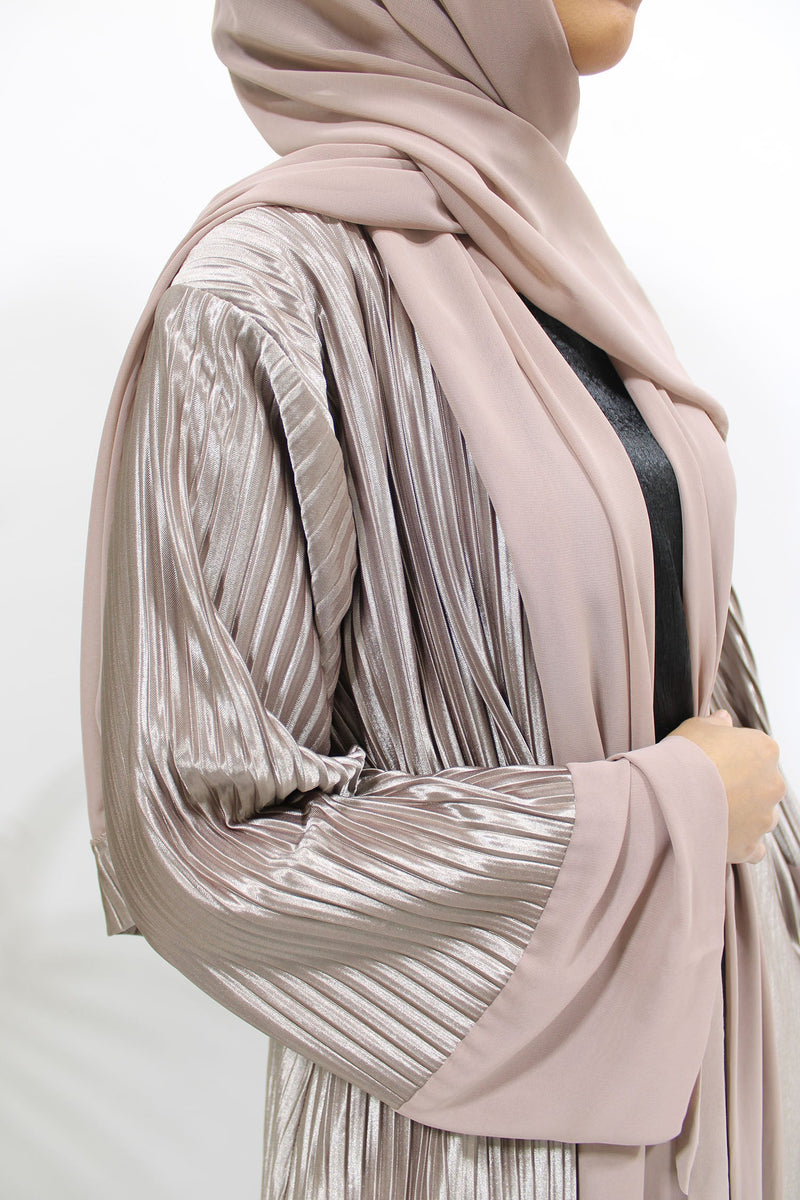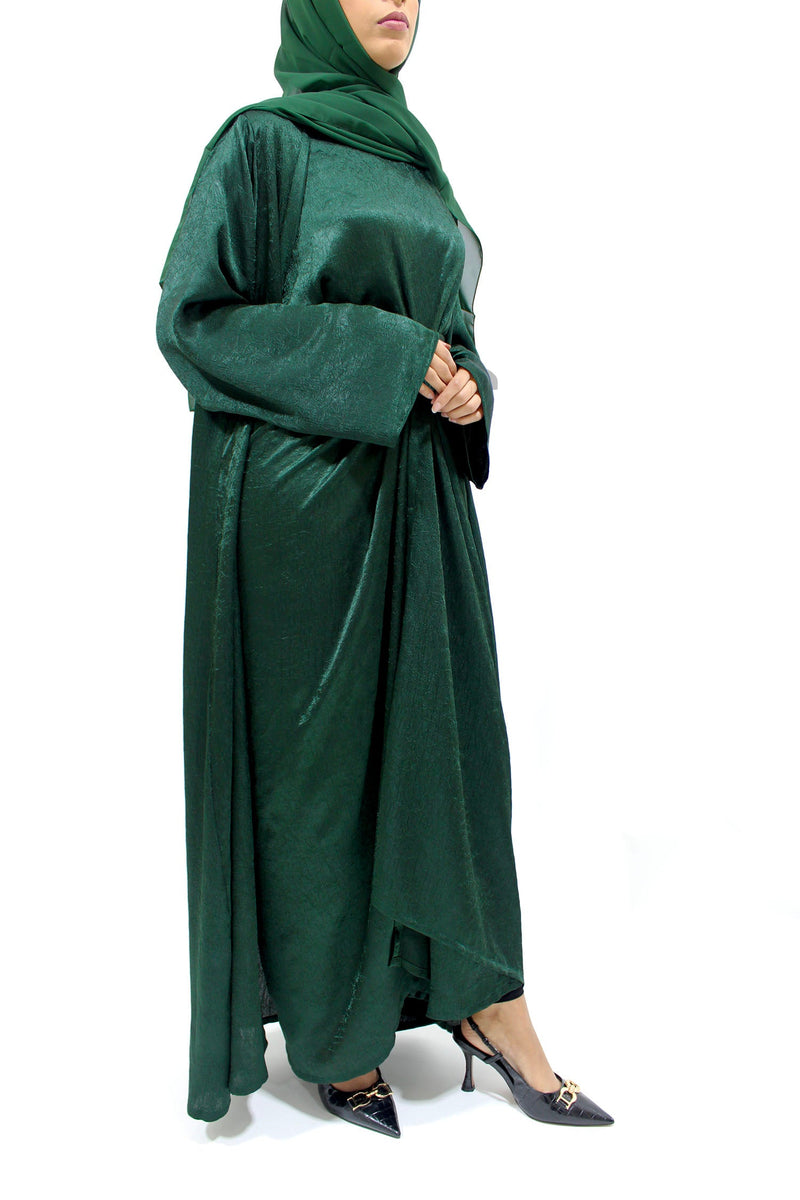
Finding an instant chiffon hijab that fits
An instant chiffon hijab is worth considering when the repeated work of folding, aligning and fastening a scarf is the part of getting dressed you would like to simplify. Its appeal is not that everyone needs a faster routine. It is that some of the arrangement may already be built into the garment, leaving you fewer decisions to make each time you wear it.
The important word is “may”. Instant hijabs do not all use the same construction. One might have a sewn face opening and a free end to drape. Another might include a separate or attached cap. A third might rely on a fastening that still needs to be positioned carefully. The useful question is not simply whether it is instant, but which part of your usual routine it removes.
Chiffon adds another consideration: the actual scarf needs to provide the drape, opacity and feel you want, with any foundation or lining included in the assessment. Here is how to choose and use an instant design without assuming that one label guarantees an effortless fit.
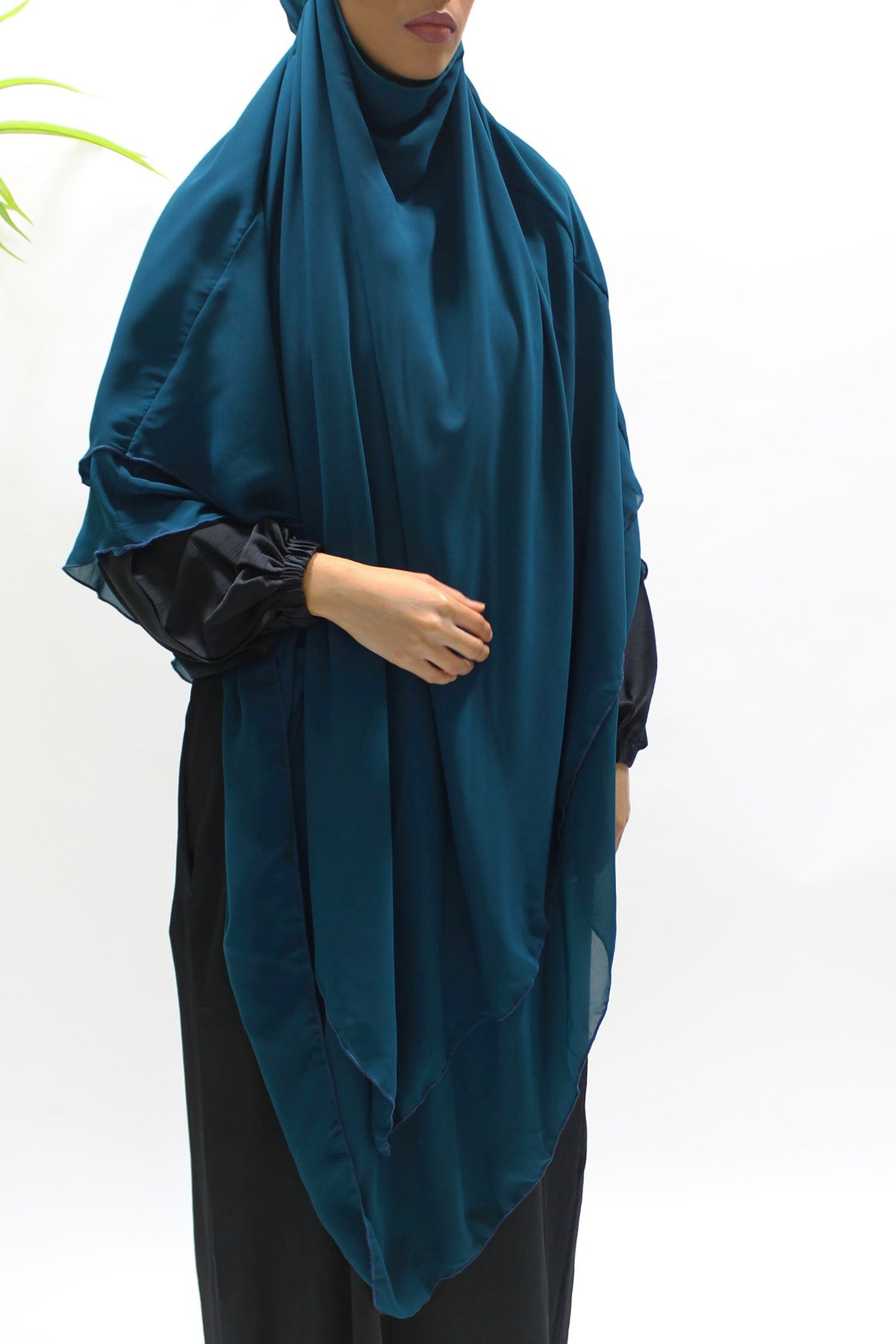
Shown above: a two-layer chiffon khimar. Instant hijabs come in different constructions; check the opening, attachments and drape of the specific design you choose.
Work out what has already been done for you
Start with clear photographs or a demonstration of the hijab being put on. Look for the opening, seams, ties, fastenings and loose ends. A finished outfit photograph may conceal all of these, making a product look simpler than it is to use.
A sewn opening usually fixes part of the face frame. That can be useful if you like returning to the same shape, but it may offer less freedom to change the position than a flat rectangular scarf. Check whether the front edge can be folded or adjusted, rather than assuming you can restyle it in every way shown in a general hijab tutorial.
If there is an attached cap, ask how it is joined to the outer fabric. Does the chiffon move independently, or does adjusting the drape pull on the cap? Does the cap have ties or a fixed opening? Those details matter more than a promise that the hijab suits everyone.
With a pre-arranged drape, identify what remains loose. You may still need to place an end over a shoulder, secure a particular fold or smooth the front. That does not make the design less useful. It simply lets you judge whether the remaining steps are manageable for your own routine.
A scarf with a convenient fastening is not necessarily fully pre-styled. Ask the seller to distinguish the fastening method from the shape of the garment. Knowing which feature you are paying for makes comparisons between products much clearer.
Choose according to the task you want to simplify
Think about your existing scarf routine and name the difficult part. Is it keeping the two sides even? Repeating a comfortable face frame? Managing loose ends? Finding the right fastening point? An instant design is most useful when its construction addresses that particular task.
For example, a fixed opening might help someone who dislikes starting the face frame again each morning. It may not solve the problem of long ends catching beneath a coat. A shorter, contained drape might help with those ends, but only if it still provides the coverage the wearer wants.
Someone who enjoys changing the face frame but wants a quicker finishing step may prefer a partly sewn design rather than a fully fixed shape. Someone who wants fewer separate items to locate may value an attached foundation, while another person may prefer a separate cap that can be chosen and washed independently.
There is no need to treat a traditional flat scarf as difficult or an instant hijab as a beginner-only option. They offer different kinds of flexibility. The right choice is the one that fits your preferences, clothing and practical needs.
When comparing options, describe the benefit in ordinary terms: “I want the opening to sit reliably without several adjustments” is a more useful brief than “I need something perfect for busy women”. It gives you a feature to inspect rather than a marketing phrase to accept.
Check the face opening without using a face-shape rule
Begin with comfort and coverage. Put the hijab on without pulling the opening into place aggressively. Observe where the edge sits around the forehead, cheeks and chin, then turn your head and look down. The shape should work with your movement, not only while you hold a particular pose.
If the opening feels tight, look for a legitimate adjustment provided by the design. Loosening a tie is different from stretching a sewn edge beyond its intended shape. Do not assume that a tight opening will become comfortable after repeated wear or washing.
If it feels loose, identify where the excess sits. A small adjustment to the foundation may help, but repeated fastening at unrelated points can create an arrangement that is no longer convenient. It may be more sensible to choose another size or construction.
A face-shape label cannot predict the result. Two people who describe their faces in the same way may prefer different forehead coverage, side folds and amounts of fabric around the jaw. Product dimensions and a careful try-on are more useful than rules about making a face appear longer or narrower.
Check the opening with any glasses you normally wear. The scarf edge, cap and spectacle arms should not have to compete for the same small space. Put the glasses on and take them off during the trial, rather than testing the hijab only without them.
Assess the foundation and chiffon as one arrangement
Look at the scarf in ordinary daylight with the foundation you intend to wear. Check the sides, back and front rather than judging opacity from a folded corner. A double layer in one area does not establish the coverage of a single layer elsewhere.
If the design includes an attached cap or lining, inspect its actual extent. Does it cover the area you expect beneath the chiffon? Does the outer fabric shift away from it when you turn? An attachment can simplify dressing, but its presence alone does not answer every coverage question.
If the foundation is separate, choose it for fit and compatibility rather than adding one automatically because it appears in a demonstration. The combined layers should sit comfortably and allow the outer scarf to fall as intended. Our guide to choosing an underscarf and arranging a comfortable foundation explores those decisions in more detail.
Check the feel of the seams against the skin. A neat outer appearance can hide a seam that lands exactly where you find pressure uncomfortable. Try the hijab long enough to notice this, especially around the forehead, ears and underside of the chin.
Do not rely on the word chiffon to guarantee comfort in every season. Consider the particular cloth, the number of layers, the foundation and the conditions in which you will wear it. A light-looking scarf can still form a crowded arrangement if its construction gathers several layers around the neck.
A first try-on that tells you something useful
Use a familiar, uncomplicated outfit for the first trial. A plain neckline makes it easier to see how the hijab sits without the distraction of a high collar, decorative buttons or a bulky outer layer. Follow the product’s instructions where they are provided.
First, find the intended front and opening. Do not assume that a longer end always belongs on a particular side. Check any labels, seams or demonstration photographs before putting it on. An asymmetrical design may behave poorly simply because it has been positioned the wrong way round.
Next, settle the foundation without tightening it unnecessarily. Smooth the outer fabric using light adjustments, then arrange any free end according to the design. Work with the sewn structure rather than repeatedly pulling against it to imitate a different scarf shape.
Look at the neckline, shoulders and back. Check the coverage you want from each direction. Turn your head, look down, reach forward and sit. Note which adjustment, if any, you need after each movement. One small settling action is different from rebuilding the whole arrangement repeatedly.
Finally, add the items that change the outfit: coat, bag, glasses or headphones. Test taking the outer layer off as well as putting it on. An instant hijab should be judged through the ordinary actions of the day, not only by how quickly it first goes over the head.
Three ways to use an adjustable drape
Only use these approaches where the construction permits them. A fixed shape should not be forced into a tutorial intended for a flat scarf. If a seam or fastening starts to pull, return to the intended arrangement and choose another design for a different look.
A simple front drape
Let the free fabric fall towards the front, checking that it covers the neckline as you prefer. Smooth the material so it rests rather than bunches beneath the chin. This can be a useful everyday arrangement with a plain dress, abaya or tunic.
Look at the lower edge when you sit. A long front may land on a desk or become caught under a bag strap. Reposition it within the design’s available range, or choose a shorter drape if that is what your daily routine requires. The longest possible front is not automatically the most practical option.
A shoulder drape
Where there is a free end, place it over the shoulder without pulling the face opening backwards. Check the opposite side of the neck after you make the adjustment. A tidy shoulder line is not useful if it exposes an area you intended to cover.
Test the arrangement with your bag on the same shoulder and then on the other side. The strap may change how the fabric falls. A fastening should suit the scarf and the product’s instructions; it should not be used to carry the weight of a drape that continually pulls against the opening.
A contained arrangement for outerwear
Some designs allow loose ends to sit neatly within a coat or beneath an outer layer. Before using this approach, make sure the scarf is not twisted and that the coat does not pull it tight when fastened. Keep fabric clear of zips and other moving fastenings.
Remove the coat during the trial and inspect the result. If the scarf emerges crushed or displaced every time, the arrangement may not be convenient for a day with repeated indoor and outdoor transitions. A different end position, coat collar or hijab shape may work better.
Build an everyday outfit around the actual shape
An instant chiffon hijab does not need an elaborate outfit to justify it. Start with the clothing you wear most often and check where the scarf lands. A long front drape may work over a plain tunic but cover the details of a buttoned shirt. A shorter shape may leave more of a dress neckline visible.
For a casual outfit, try a simple top or tunic with trousers, or a familiar everyday abaya. Keep the first colour combination straightforward so you can assess the scarf’s shape. Once you know it works, you can introduce more contrast or pattern without changing every variable at once.
For work or study, consider the equipment and surfaces around you. Does the drape sit near a keyboard? Do headphones move the opening? Can you use a lanyard without tangling it through the scarf? These small checks often matter more than whether a product is advertised as suitable for the office.
With a textured jumper, inspect the meeting point between the knit and the chiffon. A high neckline or thick collar can push a pre-sewn shape upwards. You may prefer a less bulky neckline, a lighter foundation or an instant design with more room in that area.
For broader outfit decisions, our guide to building modest outfits with practical coverage can help you consider the clothing and scarf together rather than treating the hijab as a finishing piece with no effect on fit.
Make occasion styling more deliberate, not more complicated
A formal outfit may already contain embroidery, a raised neckline, a cape or prominent sleeves. Look at those details before adding a more elaborate scarf arrangement. A simple instant drape can be a useful counterpoint to a dress that already has plenty of interest.
Choose the scarf with the dress on. Check whether it hides a feature you want visible or leaves a neckline you intended to cover. Where the dress has a collar or shoulder decoration, make sure the scarf does not catch on it as you turn your head.
Accessories are optional. A decorative pin or brooch should be compatible with the cloth and placed where it does not distort a sewn opening. Do not assume that a pre-styled hijab needs extra embellishment to look appropriate for an event. A well-chosen colour and a comfortable arrangement may be enough.
Try the whole outfit before the day, including the coat or wrap you will wear on the journey. Practise sitting for a meal, using your bag and removing the outer layer. This is more useful than discovering at the venue that the scarf and dress fastening occupy the same space.
If you will change from a daytime outfit to an evening one, plan the change realistically. You might keep the hijab and alter the outer layer or jewellery. A fixed instant design cannot necessarily be transformed into a completely different drape without taking it off, and there is no need to pretend that it can.
Choose colours and prints by comparing real combinations
Lay the scarf beside two or three outfits you already own. Look at the overall colour balance rather than asking whether one shade is universally flattering. A colour can feel lively, quiet, warm or cool in a particular combination without belonging to a strict complexion rule.
A neutral scarf is useful only if its particular shade works with your clothing. Grey, cream, beige and brown all vary. Compare the actual items in ordinary lighting rather than assuming that two products with the same colour name will match.
For a printed scarf, inspect how the pattern appears once the instant shape is worn. Seams and folds can place a prominent motif at the forehead or repeat a detail unevenly. That may be a feature you enjoy, but it is worth seeing the garment arranged rather than relying on a flat fabric photograph.
Mixing prints is a personal styling choice, not a requirement to be adventurous. You might repeat one colour from the scarf in a printed dress, or keep the clothing plain and let the scarf carry the pattern. If the result feels crowded, simplify one area before replacing the entire outfit.
Do not confuse a new colour with a new function. Buying several shades of a shape that does not fit comfortably will not solve the fit problem. Establish the construction you like first, then decide which colours would genuinely expand your outfit options.
When an instant hijab is not saving you effort
You keep adjusting the opening
Check whether the size and foundation are compatible. A fixed opening that sits in the wrong place may not become reliable through more pins or tighter ties. Compare another construction before assuming that the problem is your face shape or lack of practice.
The sewn drape pulls to one side
Confirm that the hijab is correctly orientated and that a free end has not been arranged against the intended direction. Check whether a bag strap or coat collar is carrying part of the fabric. If the pulling remains, inspect the fit and construction rather than forcing the opposite side to compensate.
The neckline feels crowded
Try the hijab with a simpler neckline to separate the scarf problem from the clothing problem. If it is comfortable there, the original collar may be the issue. If the crowding remains, consider whether the design gathers more fabric around the neck than you prefer.
You need several additional fastenings
Ask whether each fastening has a clear purpose. One may be part of the intended design, but a collection of improvised fixes can defeat the reason you chose an instant garment. A different shape may be more practical than continuing to modify this one every morning.
The look is too fixed for your preferences
That is a valid reason to choose a flat scarf or a partly sewn option. Convenience and creative flexibility do not always increase together. You can keep different types for different days rather than expecting one garment to do everything.
A useful comparison between two designs
Suppose one option has a fixed opening and a long free end, while another has a similar opening but a shorter sewn front. Try to compare them with the same top, foundation and outer layer. Otherwise, a difference caused by the coat or cap can be mistaken for a difference between the hijabs.
For the first option, record how you place the free end and whether it stays clear of your bag. For the second, check whether the fixed front reaches the area you want covered when you sit. Notice which actions require your hands and which adjustments are difficult to make away from a mirror.
You may discover that the longer version suits an occasion outfit while the contained version works better with your everyday coat. That is more useful information than choosing whichever one takes fewer seconds to put on during the first trial. It also gives you a clear reason for owning two constructions, rather than buying near-identical scarves and hoping one will behave differently.
Care for the seams and any attached components
Follow the care instructions for the finished hijab, including its cap, elastic, ties, decoration or fastening. Do not use a blanket washing rule solely because the outer fabric is called chiffon. An attached component may have different handling needs from a plain scarf.
Before cleaning, inspect the opening and seams for strain or loose stitching. Check whether any removable fastening should be detached according to the instructions. Avoid pulling the wet garment into a new shape or using heat on an unfamiliar component to try to make the opening fit differently.
Dry and store it in a way that supports the intended arrangement. Keep the opening and drape easy to identify so the next wear does not begin with untangling the garment. A separate space in a drawer or a suitable storage arrangement can help, provided it does not crush delicate details.
If the shape changes unexpectedly after care, compare it with the instructions and contact the seller where appropriate. Do not keep stretching a seam or cutting stitches as an improvised repair. Altering a pre-sewn design can change the fit, coverage and way the whole garment hangs.
What to ask before buying online
Ask for the construction details, available sizes, relevant measurements, fibre composition, lining or cap information and the care label. Request a demonstration of the hijab being put on where the listing only shows the finished look. Establish whether any separate cap or fastening shown in the photographs is included.
Check the seller’s current delivery and return information directly. Read how they describe trying on an item and reporting a fault, rather than assuming that every scarf seller uses the same process. Keep the product description and order information so you can compare what arrives with what was offered.
For a first purchase, one carefully assessed design can be more informative than several colours bought at once. Wear it with the combinations you planned, note what works and then decide whether another colour or a different construction would be useful.
Questions worth settling before it becomes your everyday scarf
Does instant mean no pins?
Not necessarily. Check the specific construction and instructions. Some designs may need no additional fastening for the arrangement shown; others may leave an end to secure. Do not remove an intended fastening or add unsuitable hardware simply to meet a general idea of what instant should mean.
Can it replace every scarf in a wardrobe?
It might cover many of your usual outfits, but that is something to establish through wear. A fixed shape may suit one neckline and feel crowded with another. Keeping a flat scarf for occasions when you want a different arrangement is a practical choice, not a failure to simplify.
Is it always quicker?
The relevant comparison is your complete routine, including the foundation, adjustments and outerwear. A design that goes over the head quickly but needs repeated correction may not save effort overall. Try it several times in ordinary conditions before deciding how it fits into your day.
Can I make major changes to the sewn shape?
Only treat this as an alteration project once you understand the construction and any consequences for returns. A seam may control more than the visible fold beside it. For substantial changes, seek someone who can assess the garment rather than experimenting by cutting stitches at random.
An instant chiffon hijab earns its place when the built-in shape suits you and the remaining steps feel straightforward. The aim is not to achieve an identical look every day unless that is what you enjoy. It is to choose a construction that gives you the right balance of reliable coverage, comfortable fit and room for your own styling choices.