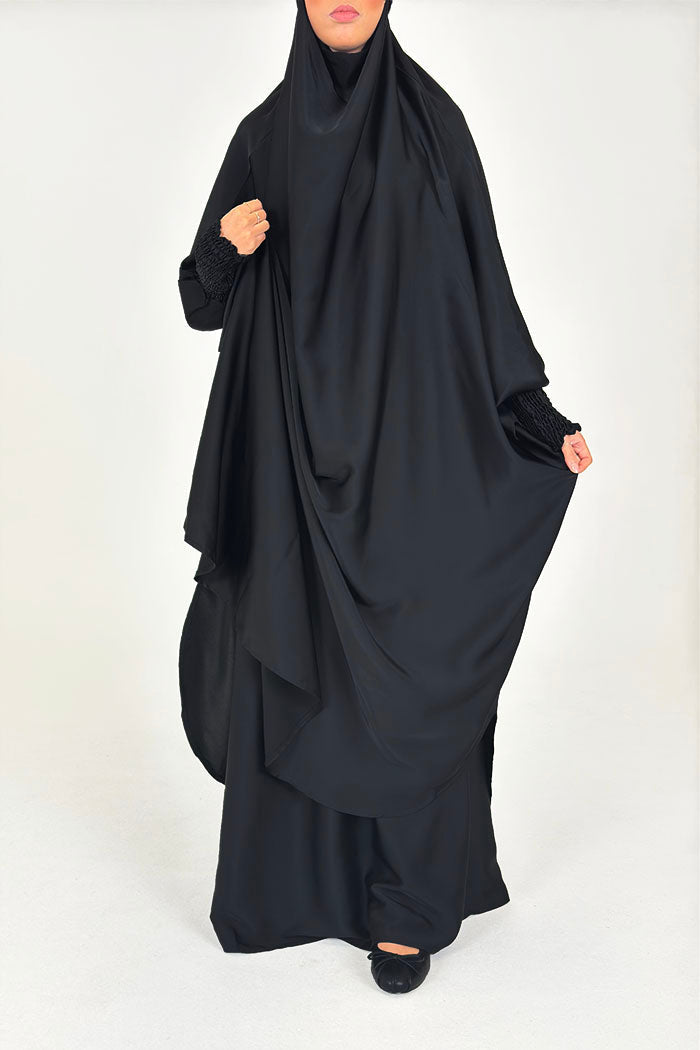
Full, Half, Layered, Cap or Instant Niqab? The Right Shape Depends on How You Move
A niqab can sit perfectly for thirty seconds in front of a mirror and become a completely different garment on the stairs. You look down, turn your head, speak to someone, pull a coat on, hurry for a train, and suddenly the face opening has shifted or a front layer is brushing somewhere you did not notice while standing still. That is why choosing between a full, half, layered, cap or instant niqab is not mainly about which shape looks neatest when nothing is moving.
The useful question is what the construction does when you move. A half niqab may feel light and uncomplicated because there is less fabric to manage. A longer full style can feel beautifully settled because the extra panel has enough weight to hang. A three-layer design may give you options, but those extra panels also have their own movement. A cap niqab can reduce tying, yet the cap shape has to suit your head comfortably. An instant niqab can be quick to put on, but speed only helps if the eye opening returns to the right place after you turn, speak and bend.
There is no universal winner. Two women can try the same construction and have completely different experiences because face shape, head shape, underlayers, glasses, fabric, fastening tension and daily routine all change the result. The aim is not to collect every type. It is to understand what each shape is trying to do, then choose the one that asks the least from your hands once you leave the mirror.
One terminology point helps from the beginning. A niqab is a face veil. Retailers do not use words such as full, half, three piece, cap and instant in exactly the same way, so the name on a listing is only a clue. If you need the wider garment distinctions around niqab, hijab and other forms of modest dress, our niqab and hijab guide explains that broader context. Here, we are staying with construction: what covers the face, where it anchors, how many panels there are and what happens when the wearer is actually in motion.
Start with the parts that move, not the name on the packet
Every niqab has a small number of practical zones, even when the design looks very different. There is the face opening, the upper edge around the bridge of the nose and cheek area, the fastening or head section, and the fabric that falls below. A layered design adds more panels. A cap design adds a shaped head section. An instant design may change the fastening completely. Those are the parts worth comparing because they are the parts that respond when you move.
The face opening is especially important. It has to stay clear enough for comfortable vision without demanding so much tension that the upper edge feels harsh. The lower panel then has to move independently enough that speaking, looking down or turning does not drag that opening out of position. If the front panel and eye opening behave as if they are one rigid unit, ordinary facial and neck movement can make the whole piece travel.
The fastening controls a different kind of movement. Ties give you adjustment, but knots and tie tension can create pressure. Elastic can be quick and consistent, but only if the elastic length suits you. A cap-like section spreads grip over a wider area, yet that wider contact can feel warmer. No mechanism is automatically better. You are looking for a balance between grip and freedom.
Finally, consider recovery. Fabric is allowed to move. A niqab does not need to stay frozen against the body. What matters is whether it settles back into a usable position by itself. If every turn of the head creates a new correction, you are not dealing with normal movement any more; you are dealing with a fit that keeps handing its work back to you.
What a “full niqab” means can change from one seller to another
The word full sounds precise, but in retail descriptions it can point to different features. One seller may use it for a longer front panel. Another may mean fuller face coverage around the sides. Another may use it for a niqab that is part of a more covering set. The label does not tell you enough on its own, so look at the actual pattern pieces and measurements when they are available.
For movement, longer is not automatically harder. A full-length front panel can sometimes hang more steadily because there is enough fabric below the face to create a clean vertical fall. That can feel calmer than a very short, feather-light panel that lifts with every gust. The opposite can also happen: a very long panel can catch under a bag strap, coat zip or outer layer and tug upwards when you turn.
Side coverage matters too. A wider piece can give a generous drape, but more width means more fabric moving around the shoulders. If the panel repeatedly folds back on itself, that extra fullness may be doing nothing useful for your day. If it falls cleanly and gives the coverage you prefer without interfering with your arms, it can feel extremely easy.
So when a product is described as a full niqab, ask three practical questions: how long is the front panel, how wide is it around the sides, and how is the face opening anchored? Those answers tell you far more than the word full. The right version is the one whose extra fabric creates steadiness or coverage you actually value, rather than simply creating more cloth to arrange.
A niqab covers the face; whole-body coverage comes from the garments around it
Some online descriptions use phrases such as “full body niqab” for an entire modest outfit. That wording can make it sound as though the niqab itself is the head-to-toe garment. It is clearer to separate the pieces. The niqab is the face veil. An abaya, jilbab, khimar or another outer garment may provide the body and head coverage around it, depending on the outfit.
This distinction matters when you are comparing shapes because the niqab can only be judged properly for the job it actually has. A long front niqab panel may extend over part of the upper chest, but that does not turn it into an abaya or jilbab. Equally, a coordinated set may be sold together while still containing separate garments with separate fit questions.
If you want a more covering overall silhouette, inspect both parts of the outfit. Check the niqab for eye-opening stability, face fit, fastening and panel movement. Check the outer garment for length, opacity, ease and coverage in its own right. A face veil should not be expected to compensate for a body garment that does not meet the coverage you intend, and a very full outer garment will not fix an uncomfortable niqab opening.
Keeping the terms separate also makes online buying less confusing. Instead of asking whether a “full body” label sounds more covering, look at exactly what is included in the set and which piece provides each area of coverage.
A half niqab can feel lighter because there is less fabric competing with your movement
A half niqab usually refers to a more compact face-covering shape, often with less fabric extending down the front than a long or fuller design. The exact cut varies, so it is still worth checking the piece itself. What many women notice immediately, though, is the reduction in moving fabric. There is simply less material to catch, lift, twist or sit underneath other layers.
That can be useful on a busy day. If you are repeatedly putting on and taking off a coat, carrying a cross-body bag, using public transport or moving between indoor and outdoor spaces, a shorter panel may stay out of the way more easily. It can also feel less warm because there is less overlapping fabric across the upper chest.
The trade-off is that a smaller panel has less weight. Very light fabric can flutter more readily, especially in wind, and a shorter cut may give you less of the front drape you personally prefer. A half style can also expose fit problems quickly because there is no long panel disguising the way the upper section is sitting. If the face opening is unstable, the compact design will still be unstable.
Think of the half niqab as an efficiency choice rather than a reduced version of something “better”. It suits women who want the face-covering function with fewer moving parts. If that description sounds like your routine, the simple shape can be a strength. If you enjoy a longer fall or want more fabric over the upper chest, a different construction may feel more complete for you.
Single-layer niqabs are simple, but simple still needs good geometry
A one-layer niqab has an obvious appeal: one main panel, fewer hems, less fabric near the head and no extra layers to arrange. On warm days or for women who dislike bulk, that simplicity can make the piece feel almost weightless. It can also be quick to wash, dry and fold because there are fewer panels to tangle.
But one layer has nowhere to hide weak construction. If the upper edge is too soft, it may fold inward. If the panel is too light, breath or wind may push it towards the face. If the opening is cut in a way that does not suit your features, there is no second layer changing the way the front hangs. Simple construction needs the proportions to be right.
Pay attention to how the panel drops from the eye area. A clean fall should allow your jaw to move without repeatedly lifting the upper edge. Speak normally for a few minutes. Look down at your hands, then back up. Turn to each side. If the single panel moves but the opening remains usable, the design is doing what it should.
One layer is also a good reference point when you are trying to work out what bothers you about a more complex niqab. If a simple piece feels comfortable but a layered one feels heavy, you have useful evidence that the extra panels, not niqab in general, are the issue. If both shift in the same way, look higher up at the opening or fastening.
Layered niqabs change the movement because every panel has its own weight
A layered niqab is not just a one-layer niqab with decoration added. Each extra panel changes the balance of the piece. A second, third or fourth layer adds weight near the fastening, changes airflow around the face and creates another piece of fabric that can separate, overlap or lift as you walk. The visual effect can be graceful, but the practical effect depends on how those layers are cut.
Three-layer and four-layer designs are sometimes spoken about as if the number itself tells you the quality. It does not. Three well-proportioned panels can feel controlled; three very light panels can feel busy. Four layers made from fine fabric may still be comfortable for one woman, while another finds the extra material too warm. Count tells you how many moving parts there are, not whether those parts will suit you.
Look at the difference in layer lengths. If every panel ends at almost the same point, they may cling together and behave like one heavier sheet. Graduated lengths can create separation, but the shortest top layer may also be the first to lift in wind. If one layer is intended to be moved or lifted, check whether doing that changes the tension around the face.
The most useful layered niqab is one where each panel has a reason to exist. Perhaps you like the extra front coverage. Perhaps the layered fall sits better over a khimar. Perhaps you want the option of an additional veil panel in circumstances where you personally choose to use it. Whatever the reason, test the design with all the panels in their normal positions. A layered piece should feel deliberate, not like several fabrics negotiating with each other all day.
Three-piece niqab labels need a closer look because “piece” can mean different things
Some products are described as three-piece niqabs, but that phrase can refer to different constructions. It may mean three veil panels attached to one head section. It may mean separate components sold together. It may be a retailer’s own naming system. Never assume that “three piece” and “three layer” are interchangeable until you have seen exactly what is included.
This matters because attached layers and separate pieces behave differently. Attached panels share one anchor point, so the total weight is carried by the same fastening. Separate pieces can sometimes be positioned independently, which gives more control but also gives you more items to align. If a component is optional, you may be able to simplify the setup for an ordinary day and add it only when you want that function.
For movement, check where the load sits. If all three pieces pull from the back of the head, a design that feels feather-light in your hands can still create concentrated tension after several hours. If the pieces spread across a cap or wider head section, the pressure may feel more distributed, but warmth can increase. Your scalp and temples will tell you more than the number in the product name.
Before buying, try to answer: are the pieces attached or separate, which one creates the face opening, and can any piece be removed without making the rest unstable? That turns a vague label into a construction you can actually assess.
A cap niqab can make dressing quicker, but the cap becomes part of the fit
A cap niqab generally uses a shaped head section rather than relying only on narrow ties. Depending on the design, the cap may sit like an undercap or form part of a pull-on structure. This can be appealing if you dislike tying knots or want a piece that goes on in a more repeatable way. It can also give the fabric a broader area to grip.
The important thing is that the cap is no longer a background detail. Its circumference, stretch, seam placement and depth all affect the face opening. If the cap rides backwards, the opening may be pulled higher. If it creeps forwards, the visible eye area can narrow. If it is too tight, the niqab may look beautifully stable while creating a headache.
Hair arrangement and any layer worn underneath also change the result. A cap that fits comfortably over a low, flat arrangement may feel completely different over more volume. If the design is intended to replace an undercap, adding another snug layer underneath can make the total fit tighter than the maker planned. Test the construction the way you actually intend to wear it.
Cap styles are particularly worth trying for at least an hour at home. Five minutes will tell you whether it looks neat. An hour will tell you whether the elastic edge, seams and overall pressure disappear from your awareness or slowly become the only thing you can think about.
An instant niqab is only truly convenient if it still fits after the first minute
“Instant” usually signals that a niqab is designed to go on quickly, with less tying or arranging. It may be pull-on, elasticated, pre-shaped or built into another head section. The exact method varies. For women moving between private and public spaces, travelling, caring for children or simply preferring fewer dressing steps, that convenience can be genuinely useful.
The risk is assuming that quick equals forgiving. A fixed or partly fixed structure gives you fewer opportunities to fine-tune the fit. If the opening sits too low, you may not have a tie to shorten. If the elastic feels firm, you may not have much room to loosen it. An instant design therefore needs to match you well from the start.
Test speed and stability separately. First, see whether you can put it on without a mirror once you know the construction. That is the convenience test. Then wear it while walking, speaking, looking down and turning. That is the fit test. A piece that goes on in ten seconds but needs adjustment every two minutes is not saving time.
Also notice what happens when you remove and replace it several times. Does the opening return to roughly the same position each time, or is every attempt a new puzzle? Repeatability is one of the best things an instant niqab can offer. If the design gives you that, it can make ordinary transitions much easier.
The nose area should stabilise the shape without becoming a pressure point
Some niqabs use a shaped or reinforced upper edge around the bridge of the nose. Retail descriptions may call this a nose piece or nosepiece. The actual construction can vary, so the useful question is what that shaping does. Ideally, it helps the face opening hold its line without needing excessive overall tension.
A firmer upper edge can be helpful if very soft fabric tends to fold inward on you. It can also help create a little space between the cloth and the lower face. But firmer is not automatically more comfortable. If the shaping presses, rubs or leaves you feeling sore, it is not solving the fit problem in a useful way.
Check the position while you speak and smile. Facial movement changes the way the upper edge meets the cheeks and nose. A piece that feels fine with a neutral expression can become irritating if the edge is pulled too tightly across an area that moves. The best shaping follows your face rather than asking your face to remain still.
If you are comparing a plain soft edge with a nose-piece design, do not decide from appearance alone. Wear each at the lightest tension that still keeps the opening stable. The one that stays clear with less pressure is usually the more promising construction for long wear.
Tight is not the same as secure
When a niqab slips, the instinctive response is often to tighten it. Sometimes a small adjustment is exactly what is needed. But if you repeatedly have to pull a design very tight to keep the eye opening in place, the cut, fastening position or friction may be wrong for you.
Over-tightening can create pressure behind the head, at the temples, around the bridge of the nose or along the upper cheeks. It can also make the fabric less forgiving when you speak. A very tight tie fixes the back of the niqab while your jaw and head continue moving, so the tension has to go somewhere.
Instead of asking, “How tight can I make this?”, ask, “What is the least tension at which this shape stays dependable?” That change in question is useful. It directs your attention to the design rather than treating discomfort as the price of stability.
If loosening the niqab by a small amount makes the whole opening collapse, try a different anchor system, a fabric with more grip, a different underlayer or another face-opening shape. Secure clothing should feel secure because the construction works with you, not because it has been pulled into submission.
The face opening should return to position after you turn your head
The face opening is where fit becomes visible, but it is also where several forces meet. The fastening pulls backwards, the panel hangs downwards, your cheeks and jaw move underneath, and your head turns independently of your shoulders. A good opening allows those movements without wandering so far that you have to stop and rebuild the shape.
Test the opening from ordinary angles rather than only straight on. Look over each shoulder as if checking behind you. Look down towards the floor. Tilt your head slightly while listening. Then return to neutral without touching the niqab. If the opening comes back to a comfortable position, that recovery is more valuable than perfect stillness.
Different contours can suit different faces. A straighter upper line may sit beautifully on one woman and feel awkward on another. A slightly shaped or peaked centre can follow the bridge area differently. Some product descriptions use distinctive names for these contours, but the naming is much less important than whether the edge remains clear of your eyes and feels even at a comfortable tension.
Do not force symmetry if your natural fit is a little different from the model image. Human faces are not perfectly symmetrical and head coverings underneath can add their own small differences. Clear, stable vision and low pressure come first. Once those are right, the opening will usually look neater because you are no longer constantly pulling it into place.
An eye veil adds another layer, so visibility has to be tested deliberately
Some layered niqabs include an additional veil that can sit over the eye area according to the wearer’s chosen use. That extra panel changes the practical demands of the design because you are no longer only assessing face coverage and drape. You are assessing what you can see through or around as you move.
Never assume that a fine-looking fabric will behave the same in every light. A mesh or sheer panel can seem easy to see through in a bright room and feel very different at dusk, in rain, under artificial lighting or when the fabric doubles over itself. If a layer reduces your vision, do not use it in a situation where clear sight is necessary.
Peripheral vision matters as much as the view straight ahead. Check stairs, kerbs, doors and people approaching from the side. Do not drive, cycle or undertake any activity that requires clear vision through a layer that makes that vision less reliable. Practical modest clothing should never turn visibility into a guessing exercise.
Also check whether the eye veil has its own tendency to fall unexpectedly. A panel that is meant to stay lifted should stay lifted securely when that is how you are wearing it. If it drops as you bend or move quickly, the problem is not merely annoying; it can interrupt your view at exactly the wrong moment. The safest shape is the one whose position you can predict.
Long layers can feel steady until a bag, coat or seat belt catches them
A long niqab panel has enough vertical fabric to create a graceful fall, and that extra weight can make light cloth feel calmer. The difficulty often appears not while walking freely, but when another object crosses the panel. Cross-body bags, backpack straps, coat fronts and car seat belts can pin one section while your head continues to move.
That creates upward tugging. You turn to the side and the lower fabric cannot travel with you, so the tension transfers towards the face opening. What looked like a face-fit problem may actually begin much lower down. If your long niqab only shifts when you carry a particular bag, the bag is part of the fit equation.
Try placing straps underneath the loose front panel where appropriate for your outfit rather than trapping the niqab itself. When fastening a coat, make sure the panel is falling where you intend before you zip or button. In a car, arrange clothing so the seat belt lies correctly against the body and is not compromised by loose fabric. Safety equipment must be able to do its job.
If your routine includes lots of carrying, commuting or outerwear, a slightly shorter front can be easier even if you love the look of a very long design. The point is not to avoid length. It is to give the fabric enough freedom that your neck can turn without the lower half of the niqab acting like an anchor.
Shorter niqabs reduce catching, but very light panels can become lively in wind
A small or compact niqab can feel wonderfully free because the lower panel stays away from bag straps, desks and coat fastenings. For errands and quick transitions, that reduced footprint may be exactly what you want. There is less fabric to gather when eating or drinking in private, less to fold into storage and less warmth across the chest.
The movement challenge is wind. A short panel has less hanging weight, so a gust can lift it more easily. If the fabric is also extremely light, the whole front may flick upwards or towards the eyes. That does not mean every short niqab is unsuitable outdoors. A slightly denser cloth or a cut that sits close enough to the body can behave very differently.
Test outdoors before relying on the style for a full windy day. Face into a breeze, then turn sideways. Notice whether only the hem moves or whether the movement travels all the way to the eye opening. Hem movement is ordinary. An opening that shifts every time the lower edge lifts suggests the design is transferring too much motion upwards.
Small can also refer to the face opening rather than the panel, depending on how a product is described. Always clarify which measurement is being discussed. A compact panel may suit you perfectly; an opening that is physically too small for comfortable vision will not become better simply because the rest of the niqab feels light.
“Big niqab” can describe fullness, width or length, and those are three different experiences
A generously cut niqab can offer a soft, enveloping drape, but the word big is too vague to tell you how it will move. Extra length pulls downwards. Extra width spreads across the shoulders. A larger face opening changes the visible eye area. Each dimension creates a different fit, so look for actual construction details rather than treating size as one number.
More width can be pleasant if you dislike a narrow panel sitting close to the sides of the face. It may also give the lower fabric more room to fall over a khimar or abaya without bunching. On the other hand, a very wide front can fold towards the arms, catch under outer layers or feel cumbersome when you sit at a desk.
More length may give stability, but only while the hem remains free. A larger opening may reduce fabric near the eyes, but if it is too generous for your face it can shift more readily. None of these outcomes can be predicted from the word big alone.
If you know you enjoy fuller silhouettes, concentrate on the distribution of that fullness. Fabric placed lower down often feels different from bulk gathered around the temples. A roomy niqab can still feel light at the head if the construction is thoughtful. That is the kind of “big” that tends to move gracefully rather than simply feeling like more material.
Speaking is one of the best tests because the jaw moves underneath the whole design
Stand in front of a mirror without speaking and almost any reasonably fitted niqab can appear settled. Conversation is more revealing. Your jaw lowers, cheeks change shape and the lower face moves forward and back. If the niqab relies on very precise contact around those areas, speech can start pulling the fabric upwards.
Read a page aloud at home. Say a few longer sentences rather than testing with one word. Notice whether the panel repeatedly touches the lips, whether the upper edge climbs and whether you compensate by tightening the fastening. A design that only remains tidy while you are silent is not truly fitted for an ordinary day.
Some women prefer a front panel with a little more body because it holds slightly away from the mouth. Others prefer softer cloth that follows movement without feeling rigid. The right answer depends on the specific weave and cut. What you are trying to avoid is fabric that collapses inward so much that every sentence becomes an adjustment.
If speaking is the main trigger for movement, do not immediately blame the fastening. Check whether there is enough ease between the eye opening and the hanging panel. A small change in cut can give the jaw room to move without lifting the upper edge. That is often more comfortable than simply adding tension at the back.
Looking down reveals whether the niqab and your neck can move independently
We look down constantly: at steps, a phone, a child, a shopping basket, a bag, a book or the pavement. That small neck movement is one of the quickest ways to expose a panel that is too tightly connected to the face area. If the lower fabric catches against the chest, the top edge may be pulled down or forwards.
Try the movement slowly first. Lower your chin, then return to neutral. Next, look down while one hand holds a bag strap where it usually sits. Finally, repeat it with your coat fastened. Each version adds a realistic point of friction.
A long layered niqab may need more room over the chest than a short single-layer one. A cap niqab may hold the upper section firmly enough that the lower panel slides more freely. A very tight tie may do the opposite, fixing the top so firmly that every tug below becomes noticeable around the nose and temples.
You are not aiming for zero fabric movement. You are checking whether the niqab lets your neck do an ordinary job. If you have to lift the whole front with your hand every time you look down, a shorter panel, freer lower cut or different way of arranging the surrounding layers may suit your routine better.
Turning quickly shows whether the fastening grips or drags
Slow mirror turns are useful, but real life contains quicker movement. Someone calls your name. You check for traffic. You turn towards a child. You hear an announcement behind you. The niqab has to follow your head without lagging so far behind that the opening shifts across your eyes.
Tie-back styles usually allow you to fine-tune this grip. Too loose and the whole piece may rotate. Too tight and the niqab follows perfectly but creates pressure. Elastic can give consistent tension, although worn or overly soft elastic may stop recovering well. Cap constructions can spread the grip over more of the head, which can reduce rotation if the cap itself fits properly.
Do five quick but comfortable left-to-right turns at home. Do not hold the niqab. After the fifth turn, see where the opening is. If it is slightly different but still clear, that may be completely workable. If it has travelled significantly to one side, look at the fastening before deciding the opening shape is wrong.
Friction underneath matters. Smooth satin-like underlayers and grippier cotton-feel surfaces can change how much the niqab rotates. There is no need to stack more and more undercaps to solve this. Sometimes simply pairing the niqab with the head layer you actually use gives you the answer: either the combination works, or it does not.
Bending and reaching show whether extra layers stay where you expect
Picking something up from the floor is a very different movement from turning your head. Gravity pulls every loose layer forwards. A long layered niqab may swing away from the chest, and shorter top panels may slide over longer ones. If you regularly care for children, work around the home, stack shelves, study, garden or simply live an active day, this test is worth doing.
Bend from the hips as you normally would, then stand up without touching the fabric. Reach up to a high shelf. Sit down and stand again. Watch what each layer does. The aim is not to prevent the niqab from swinging. The aim is to see whether the layers settle back in the right order and whether the face opening stays clear.
Layered designs differ enormously here. Panels cut from slightly different weights may separate cleanly. Very soft layers can cling together after they move. A top veil may slide forwards when you bend if there is nothing holding it in its intended position. An instant construction may recover well because the upper geometry is fixed, or poorly if that fixed geometry does not suit your head.
If a design requires you to smooth every panel after every bend, ask whether you enjoy that level of management. Some women will not mind. Others will find a single layer far more peaceful. Neither preference is a failure of style; it is simply a difference in how much moving fabric you want to supervise.
Wind is not a fabric problem alone, it is a shape problem too
Wind gets most of the blame when a niqab becomes difficult outdoors, and fabric weight certainly matters. But shape determines how much surface the wind can catch and where that force travels. A wide panel acts differently from a narrow one. A very short layer lifts differently from a long one. Several loose panels can separate and pull in different directions.
For a layered niqab, notice which layer moves first. If the lightest top panel lifts but the main face opening stays stable, the construction may still work well. If the lifting layer tugs at the same seam that forms the eye opening, the whole shape can become unsettled. Attachment points are as important as fabric weight.
A cap or broad head section can sometimes help the upper construction resist rotation in gusts, while a tie-back style may let you adjust tension for the day. Do not respond to wind by tying so tightly that you are uncomfortable. A better answer may be a less floaty design for windy weather.
It is sensible to have different niqabs for different conditions if that suits your wardrobe. The lightest piece may be lovely on a warm calm day. A steadier single layer may be easier for a blustery commute. Choosing by weather is not overcomplicating modest dress; it is the same practical judgement we use with coats, shoes and scarves.
Heat builds where layers, caps and underlayers overlap
A niqab can be made from a light fabric and still feel warm if several parts overlap at the head. A cap, undercap, tie band, hijab or khimar edge, plus three or four niqab layers can create a concentrated zone of warmth around the temples and back of the head. The lower panels may look airy while the fastening area feels completely different.
If you run warm, count layers where they actually sit, not only what you can see from the front. A four-layer niqab does not necessarily mean four layers are covering the mouth at all times, but four panels may still be attached near the same upper point. A cap style may replace another underlayer for some wearers, which can simplify things. An instant style may have built-in structure that makes extra grip layers unnecessary.
Warmth also changes fit. Perspiration can make some fabrics grip more and others feel slippery or irritating. Elastic may feel more noticeable. A seam that was invisible in a cool room can become annoying. This is why long-wear testing matters more than touching the cloth in your hand.
For summer, prioritise the simplest construction that still gives you the coverage and stability you prefer. “More” is not a virtue if the extra material has no job. A thoughtfully cut single or half style can be more practical than a dramatic layered design, while a well-balanced layered niqab can still work if the fabric and attachment points remain light.
Glasses make the face opening test more exacting
Glasses introduce fixed edges close to the niqab opening. The upper fabric can catch on the frame, push the glasses upwards or sit between the lenses and your field of view. A style that feels perfectly stable without glasses may therefore need a different position once frames are involved.
Put the glasses on before you finalise the niqab tension. Turn your head, look down and push the glasses up the way you naturally would during the day. Notice whether that ordinary movement dislodges the upper edge. If the fabric repeatedly catches the outer corners of the frames, a slightly different opening width or a less bulky side construction may help.
Cap and instant styles can be useful if they keep the side fabric predictable, but they are not automatically better for glasses. A fixed opening that happens to sit exactly against your frames may be harder to adjust than a tie-back shape. The only reliable comparison is with your own glasses on your own face.
Fogging is another clue that the setup needs attention. Warm breath moving upwards can affect lenses, especially in colder weather. The solution is not to make the niqab painfully tight. Check whether the upper edge is sitting smoothly, whether the front fabric has enough space and whether the shape channels too much warm air towards the lenses. The goal is a comfortable arrangement, not a sealed one.
Coats and hoods can turn an easy niqab into a different shape
Winter outerwear adds pressure from below and behind. A high collar can lift a long front panel. A hood can press against the back of a cap or knot. A thick scarf-like khimar edge can increase the circumference underneath the fastening. If you only test a niqab with light indoor clothing, you may miss the combination that causes trouble outside.
Try the complete cold-weather setup. Fasten the coat fully. Put the hood up and down. Turn your head as if crossing a road. Sit, because bulky collars often behave differently when your shoulders are relaxed against a seat. If the eye opening becomes narrow only when the coat is zipped, the niqab may not be the sole problem.
A shorter half niqab can be useful with structured coats because less fabric is trapped at the front. A longer style can still work if it sits freely over the outerwear. Cap styles may need enough room at the back for a hood not to push them forwards. Layered niqabs need space for the panels to fall rather than bunching into the neckline.
There is no need for one niqab to perform perfectly with every coat you own. But if a particular outer layer is part of your daily uniform, test it before deciding the niqab is your everyday shape. Everyday fit belongs to the whole outfit.
Use a movement table to compare formats instead of relying on first impressions
| Format | What can feel easy | What to watch in motion | Best test before deciding |
|---|---|---|---|
| Half niqab | Less front fabric, lighter feel, fewer catching points | Short light panels lifting in wind | Brisk walk outdoors and repeated head turns |
| Full or long niqab | Steady vertical drape and more generous front coverage | Bag straps, coats or seat belts trapping the lower panel | Wear it with your usual outerwear and bag |
| Single layer | Low bulk and simple handling | Very soft fabric folding or blowing towards the face | Speak, look down and face a light breeze |
| Three or four layers | Flexible drape and several panel options | Heat, separation, tangling and top layers lifting | Bend, reach, walk and let the layers settle without touching them |
| Cap niqab | Broad grip and no knot to tie | Cap pressure, warmth or the whole shape creeping forwards or back | Wear for at least an hour with your normal hair arrangement |
| Instant niqab | Quick, repeatable dressing | Less room to fine-tune a fixed opening or elastic tension | Put it on several times, then complete the full movement test |
| Eye-veil design | An additional veil option for the wearer’s chosen use | Reduced or interrupted vision and a panel falling unexpectedly | Check light levels, peripheral vision and secure lifted position |
The point of a table like this is not to rank the formats. It is to connect each construction to a likely movement issue. A woman who spends most of her day seated at a desk may care about heat and glasses more than wind. Someone walking several school runs may care about gusts, bags and rapid transitions. Someone travelling may value a fast instant shape that can be put on consistently without a mirror.
Once you compare shapes against your actual day, the decision becomes much less abstract. You are no longer asking which niqab sounds most complete. You are asking which set of compromises you would rather live with.
Choose for your busiest hour, not your calmest five minutes
Think about the part of your day when clothing is hardest to manage. It might be the morning commute with a coat, tote bag and phone in your hand. It might be collecting children when you are bending, turning and carrying things. It might be a long work or study day where pressure becomes more important than wind. That busiest hour is a better fitting room than the calmest moment at home.
If your day is full of quick transitions, an instant or compact half style may remove unnecessary steps. If you spend long periods outside, a steadier panel may matter more than the fastest fastening. If you are indoors for hours, a light head area and low pressure may outrank dramatic drape. If you regularly wear glasses, face-opening clearance becomes one of your first checks.
This is also why two niqabs can both be “right”. One can be the easy warm-weather option and another the windy-day option. One can work beautifully with an abaya while a shorter one cooperates better with a winter coat. A small, purposeful rotation is often more practical than forcing one shape to solve every possible situation.
When you know what your most demanding movement looks like, product names lose some of their power. You can look past “full”, “premium”, “instant” or a layer count and ask the much better question: what happens to this exact construction during the hour when I have the least time to adjust it?
If it rides up when you speak, change the relationship between the opening and the front panel
A niqab that climbs towards the eyes during conversation is often telling you that movement lower down is being transmitted upwards. The first response should not automatically be a tighter knot. Look at where the panel begins, how freely it hangs and whether the upper edge is already under tension before you speak.
Try loosening the fastening slightly and see whether the fabric can move with the jaw without dragging. If that makes the whole piece unstable, compare a different cut. A slightly longer drop between the eye opening and the main front panel, or a fabric with more body, may create enough separation for speech.
If you are wearing several layers underneath, remove any unnecessary bulk and test again. Sometimes the niqab is sitting on a rounded stack of fabric rather than a stable surface, so every facial movement encourages it to travel. A cap design may solve that for some women; for others, a simple tie-back over a flatter base is easier.
Watch the pattern rather than the symptom. If it only rides up while talking, choose a shape that gives your jaw more independence. If it rides up even when silent, the problem is more likely the general opening, fastening or friction.
If the opening drifts sideways, investigate rotation before changing the panel length
Sideways drift often begins at the back or sides of the head. One tie may be sitting higher than the other. Elastic may be pulling unevenly. A cap may be rotating over a smooth underlayer. The front panel can look guilty because that is where you see the movement, but shortening the panel will not fix a fastening that is turning.
Place the niqab carefully, then mark mentally where the centre sits. Turn left and right several times. If the whole upper section has shifted, experiment with the fastening tension or underlayer. If only the lower panel has twisted while the eye opening stays centred, the problem is different and may come from asymmetric fabric catching on a shoulder or bag.
Tie-back constructions give you the most direct chance to correct uneven tension. With elastic or cap styles, fit has to come from the construction itself. If a cap consistently rotates, it may simply be too loose or the wrong depth for you. More pins are not always the best answer, especially near a sensitive face and head area.
A stable niqab should not require a complicated engineering project. One or two sensible adjustments are normal. If keeping it centred requires constant intervention, another format may fit your movement more naturally.
If layers keep entering your vision, treat that as a design problem, not an inconvenience to tolerate
Loose top panels can look soft and elegant, but any layer that repeatedly drops into the eye area deserves immediate attention. Vision is a functional requirement. You should not have to accept a fabric edge appearing unpredictably because the design has several layers.
Work out which panel is moving and why. Is it intended to remain down, lifted or folded back? Is wind catching it? Does bending make it slide? Is the attachment point too close to the eye opening? If the panel has a secure intended position, make sure it stays there. If it does not, choose a simpler arrangement.
This is one area where a single-layer niqab can feel dramatically easier. There is no secondary veil to manage, so the face opening has fewer potential interruptions. A layered design can still be excellent, but it has to control its layers properly.
Do not use a vision-reducing layer for driving, cycling or other tasks where clear sight is required. If lighting changes and visibility is no longer reliable, prioritise seeing clearly. Practical judgement belongs inside modest dressing, not outside it.
Buying online is easier when you ask for construction details instead of style labels
Photographs can tell you the approximate silhouette, but they rarely tell you how the niqab will feel after two hours. When measurements or product details are available, use them. Look for panel length, face-opening information, fastening type, whether layers are attached, and what exactly is included in a multi-piece set.
If a listing says “full”, confirm what is full. If it says “three piece”, confirm whether there are three separate items or three attached sections. If it says “instant”, look at how the piece opens and closes. If it says “cap”, see whether the cap is integrated and whether it stretches. Those questions reduce the chance of buying based on a word that a different retailer uses differently.
Photographs of the back and side are particularly useful because they show where ties, elastic, seams and cap edges sit. A front photograph may make two niqabs look nearly identical even though one uses narrow ties and the other a wide head band. That hidden difference can completely change your experience.
Keep your own notes after trying a style. “Long front good, narrow tie caused pressure” is more useful for your next purchase than remembering only the brand or product name. Over time, you build a personal fit language. That makes buying simpler because you know which construction details deserve your attention first.
Do a seven-part movement test before calling any niqab an everyday fit
- Speak for several minutes. Use normal sentences and notice whether the upper edge climbs, the panel collapses towards the mouth or the fastening begins to feel tighter.
- Turn your head repeatedly. Look over both shoulders, then return to centre without touching the fabric. Check whether the opening recentres itself.
- Look down and back up. Repeat with your coat and usual bag, because trapped lower fabric can pull at the face area.
- Bend, reach, sit and stand. Let layered panels swing naturally, then see whether they settle back into their expected positions.
- Walk briskly outdoors. A short breeze will tell you more about light panels than a long mirror session indoors.
- Wear your real accessories and layers. Add glasses, undercap, khimar, coat or hood if they are part of your normal outfit. Test the system, not an artificial version of it.
- Leave it on long enough for pressure to appear. An hour at home can reveal cap edges, elastic tension or knots that felt harmless during the first few minutes.
After the test, count how often you touched the niqab. Not every touch is a problem, but repeated unconscious correction is useful information. The best everyday shape usually becomes less interesting after you put it on because it stops asking for attention.
Then ask one final question: when the fabric moved, did it recover? Movement itself is not failure. A niqab that shifts slightly and returns to a clear, comfortable position can be much easier than one that looks perfectly rigid but achieves that rigidity through pressure.
Questions about full, half, layered, cap and instant niqab shapes
What is the practical difference between a full niqab and a half niqab?
The labels are not completely standard, but a half niqab usually has a more compact front shape while a full style may have a longer or more generous panel. The practical difference is often how much fabric moves across the chest and shoulders. A shorter shape can reduce catching and warmth; a longer one can hang more steadily. Check the actual length, width and face-opening construction rather than relying on the label alone.
Is a three-layer niqab better than a one-layer niqab?
Not automatically. Three layers give you more panels, visual depth and sometimes additional wearing options, but they also add weight, warmth and moving fabric. A one-layer niqab can be easier in heat or wind if the cut is stable. Choose according to what the extra layers do for you. The useful test is whether the panels stay predictable while you walk, bend and turn, not whether one design has a higher layer count.
What should I check before buying a cap niqab?
Check how the cap fits around the head, whether it stretches, where its seams sit and whether you are expected to wear another underlayer beneath it. The cap should hold the face opening without creating pressure or creeping forwards and backwards. Try it with your usual hair arrangement and keep it on long enough to notice warmth or tension. A quick fit can feel very different after an hour.
What makes an instant niqab convenient?
An instant niqab is designed to reduce tying or arranging, often through a pull-on, elasticated or pre-shaped construction. Its real advantage is repeatability: you should be able to put it on quickly and have the opening return to a reliable position. If the fixed shape needs constant correction once you start moving, the fast dressing time is not much help. Test both how quickly it goes on and how steadily it wears.
Can a niqab be too tight even if it stays in place?
Yes. Stability created by excessive tension is not good fit. If you develop pressure at the temples, behind the head, across the nose or around the upper cheeks, loosen the niqab and reassess the construction. A well-suited shape should stay reasonably secure at a comfortable tension. If loosening it makes the opening collapse, a different fastening, face-opening shape or fabric may suit you better.
What is a nose-piece niqab?
Retailers may use “nose piece” or “nosepiece” for a niqab with a shaped or reinforced upper edge around the bridge of the nose. Construction varies between products. The useful purpose is to help the opening hold its shape without needing excessive tension. It should not press painfully, rub or interfere with normal facial movement. Judge the actual edge and how it feels while speaking rather than assuming the label guarantees a better fit.
How should I test a niqab with an eye veil?
Check visibility deliberately in different lighting and make sure any panel you intend to keep lifted stays securely in that position. Look straight ahead, to both sides and down at steps. If the veil reduces clear sight, do not use it for driving, cycling or any activity where reliable vision is necessary. An extra eye-area layer should never be treated as harmless if it can fall unexpectedly or make your surroundings difficult to see.
Why does my niqab move when I talk?
Speaking moves the jaw and cheeks beneath the fabric. If the hanging panel is closely connected to the upper edge, that movement can pull the opening upwards or inwards. Try the niqab at a comfortable, slightly looser tension and see whether the panel has enough freedom to move with your jaw. If the problem remains, a different cut with more separation between the opening and front panel may work better than simply tying tighter.
Does a longer niqab stay in place better in wind?
Sometimes, because extra length adds hanging weight, but length also gives the wind more surface to catch. The result depends on fabric weight, panel width and attachment points. A long panel can also be trapped by a coat or bag and tug the face opening. Test the actual niqab outdoors. You want the lower fabric to move without that movement travelling strongly into the eye area.
How do I know which niqab shape is best for everyday wear?
Choose the shape that behaves best during your real routine. Test speaking, turning, looking down, bending, brisk walking, glasses, outerwear and at least an hour of wear. Then notice how often you have to correct the fabric. The best everyday niqab is usually the one that returns to a clear, comfortable position after movement and stays secure without excessive pressure or complicated arranging.
The right niqab shape is the one that gives your hands less work
A full niqab is not automatically more complete for your day. A half niqab is not automatically easier. Three or four layers are not automatically more refined, and one layer is not automatically basic. Cap and instant designs are not shortcuts in a negative sense, nor are they guaranteed solutions. Every format simply changes where fabric sits, where tension is carried and what has to move when you do.
Once you understand that, choosing becomes calmer. You can notice that your current problem is not “niqabs slip”, but “this opening rotates over my smooth underlayer”. You can realise that you do not dislike layered niqabs; you dislike a short top panel that falls into your vision. You may find that a longer front actually moves less on you, or that the lighter half shape you dismissed is exactly what works under your winter coat.
The mirror still matters. You should like how the niqab sits and feel comfortable in the shape you choose. But the more revealing moment comes ten minutes later, when you have spoken, turned, bent down, put your coat on and forgotten to keep checking yourself. If the opening is still clear, the pressure is still comfortable and the panels have found their own place again, the construction is doing its job.
That is the standard worth keeping. The right niqab should move because you move, then settle without making you manage every centimetre of fabric. When the shape works with your day, you stop choosing by labels and start choosing by experience.