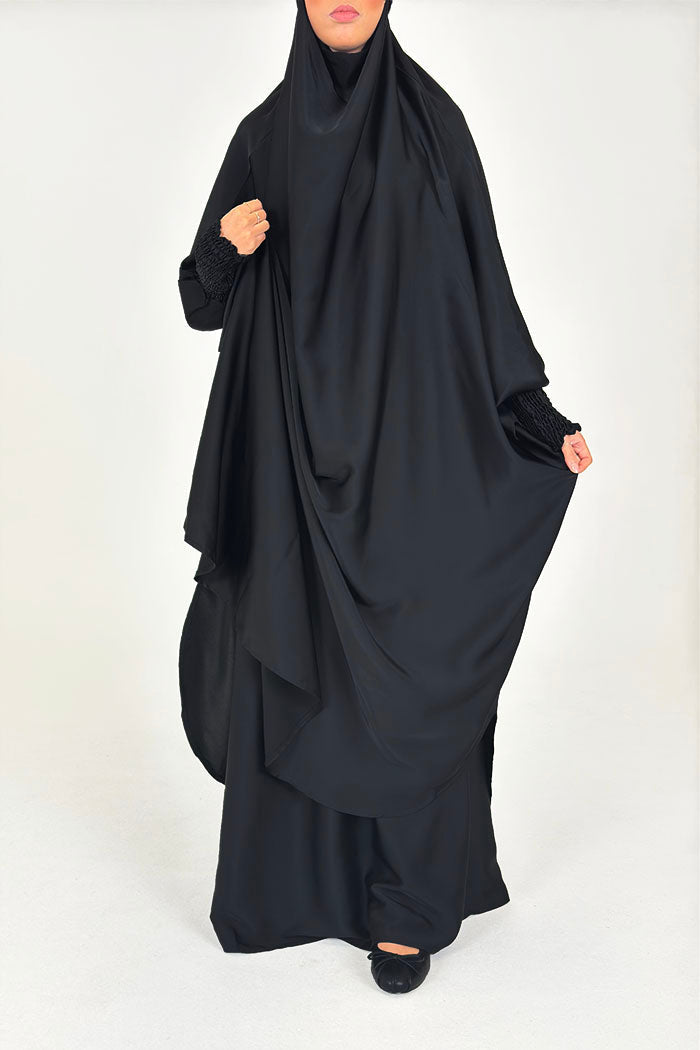
Can a Jilbab Wedding Dress Still Give You That Unmistakable ‘I’m the Bride’ Feeling? Absolutely
A bridal outfit does not become special simply because more has been added to it. In fact, a jilbab can lose some of its grace when every possible “wedding” detail is competing at once: heavy lace, dense stones, a dramatic veil, a sparkling belt, a glossy fabric and an oversized bouquet. The question is not whether a jilbab can look bridal enough. It can. The better question is which details will make it feel unmistakably like your wedding outfit without asking the jilbab to stop being what you chose it for in the first place.
For many Muslim brides, that balance matters deeply. You may want the ease, coverage and calm silhouette you already love in a jilbab, while still wanting the moment you enter the room to feel different from Eid, a family dinner or an ordinary occasion. You may be planning a nikah in a masjid, a small civil ceremony, a larger walimah, or several events with very different levels of formality. You may also be trying to avoid a conventional bridal gown that feels too fitted, too sheer, too complicated or simply unlike you.
A beautiful jilbab wedding dress works because the bridal signals are deliberate. Fabric can become richer without becoming flashy. Ivory can be warm rather than stark. Embroidery can frame a cuff or hem instead of covering every inch. A softly structured khimar, a veil-like layer or a clean headpiece can change the whole impression. Even the way the garment moves when you walk can make it feel ceremonial.
This guide stays focused on that exact problem: how to make a wedding jilbab feel bridal, elegant and occasion-worthy while preserving the coverage, movement and composure that made the silhouette appealing in the first place. If you want a broader explanation of jilbab shapes, coverage and everyday construction before thinking about bridal details, our complete jilbab guide gives that wider foundation. Here, we are concentrating on the wedding version — the choices that create beauty without turning the outfit into a costume.
A wedding jilbab should look intentional before it looks embellished
The strongest bridal jilbabs usually have one thing in common: the base garment already looks considered before decoration begins. The shoulders sit properly, the fabric hangs cleanly, the hem has enough presence, the sleeves move well and the overall length feels generous rather than accidental. If those foundations are right, a surprisingly small amount of bridal detail can have a large effect.
This matters because decoration cannot rescue a silhouette that feels wrong. If the fabric collapses awkwardly around the body, if the sleeves pull when you lift your arms, or if the front opens in a way that makes you keep checking yourself, additional embellishment will not make the outfit feel more luxurious. It may only make the problems harder to alter. Bridal dressing is full of photographs, greetings, sitting, standing, walking, eating and often several hours of being “on”. Comfort problems that seem minor during a fitting become very noticeable over a full wedding day.
Start with the outline. A jilbab that falls in a long, uninterrupted line can look beautifully ceremonial because it creates visual calm. A two-piece version can work just as well when the upper and lower pieces read as one complete composition. If there is extra volume, decide where it belongs: perhaps in a soft A-line skirt, a cape-like upper layer, a wider sleeve or a little more sweep at the back. Volume everywhere can overwhelm a smaller frame and become difficult to manage; volume in one chosen area often feels more refined.
Then look at proportion from a distance. Bridal outfits are seen close up, but they are also seen from across a hall and in full-length photographs. If the garment looks graceful before anyone notices the beadwork, you have a strong base. The embellishment can then behave like punctuation: it tells the eye where to look, but it does not have to carry the whole sentence.
What does “bridal enough” actually mean to you?
“Bridal” is not one universal look. One woman pictures pearl beading, another pictures plain ivory satin, another wants lace at the cuffs, and another feels most like a bride in a perfectly cut white jilbab with almost no decoration at all. Before choosing fabric or trim, it helps to identify which details make a wedding outfit feel special to you.
Think about the moments you are looking forward to. Is it walking into the nikah space? Sitting beside your husband for photographs? Greeting family? Having a quiet morning with your mother and sisters before everyone arrives? The answer can reveal what you actually need from the outfit. A bride who wants a serene masjid nikah may care most about beautiful drape, secure coverage and a head covering that stays composed through salah. A bride planning a formal evening reception may want more lustre, a longer hem treatment or hand-finished embellishment that catches soft light.
It is also useful to separate “special” from “expensive-looking”. A garment can feel bridal because the colour is chosen with care, the sleeves are beautifully shaped, the fabric has a refined hand and the finish is immaculate. None of those details needs to shout. Equally, a highly decorated garment can feel less bridal if the decoration looks generic or if it fights the wearer’s personality.
Make a short list of three words you want the outfit to communicate. They might be serene, luminous and traditional; soft, romantic and modest; clean, modern and regal; or warm, intimate and feminine. Three words are enough to create a filter. When you are offered another trim, another stone, another layer or another accessory, ask whether it strengthens those words. If not, leaving it out can make the final outfit feel more confident.
White is not the only route to a bridal jilbab
White remains powerful because it is immediately associated with weddings in many places, but it is not the only colour that can make a jilbab feel bridal. Ivory, soft cream, oyster, champagne, pale beige, muted blush and very light taupe can all create a wedding mood, especially when the undertone suits the wearer and the fabric has enough depth to keep the colour from looking flat.
Undertone matters more in pale colours than many brides expect. A blue-white can look crisp and modern but may feel harsh beside warm skin or warm indoor lighting. A yellow cream can look rich in person but photograph differently under cool LEDs. Ivory often sits between the two and can feel softer, though even “ivory” varies considerably between fabrics. If your head covering and main garment are separate pieces, compare them in daylight as well as indoor light. Two whites that seemed identical online can reveal very different undertones when placed together.
There is also no rule that the bride must wear a pale shade. Deep emerald, burgundy, midnight blue, chocolate, muted gold and other rich colours can look unmistakably ceremonial when the styling is cohesive. In some families, these colours may feel more connected to cultural wedding traditions than white does. The key is to avoid treating colour as a consolation prize. If you choose a coloured jilbab, commit to it. Coordinate the head covering, embroidery, bouquet and jewellery so the palette feels designed rather than like a regular occasion outfit that happens to be worn at a wedding.
For photographs, test the complete palette beside the groom’s outfit and any close family colours that matter to you. You do not need everyone to match. You simply want to avoid combinations that clash unexpectedly in the images you care about most. A small fabric swatch photographed on a phone in several lighting conditions can prevent a surprisingly large amount of last-minute uncertainty.
Fabric creates more bridal atmosphere than people give it credit for
A plain garment in the right fabric can feel more bridal than a heavily embellished garment in the wrong one. Fabric affects how light travels across the body, how the hem moves, how the sleeves fall and whether the garment feels substantial enough for an important occasion. It also determines how comfortable you will feel after several hours.
Matte crepe gives a calm, elegant finish and tends to let the shape of the jilbab lead. It can be especially beautiful for a bride who wants clean lines or plans to place detail in the head covering, cuffs or accessories. Satin brings more obvious occasion energy because it reflects light, but the amount of shine varies enormously. A softly lustrous satin can look luxurious; a very bright surface can dominate photographs and may show creasing, pulls or underlayers more readily. Chiffon offers softness and movement, although it usually needs careful lining because bridal paleness can make transparency more obvious.
Jacquard can create richness without added stones because the pattern is woven into the fabric. Organza can add a light, sculptural layer, but it can also be crisp or noisy depending on quality and construction. Lace is often most effective as a secondary fabric rather than the entire garment: a cuff, an overlay panel, an edge or a detachable layer can give romance while allowing the main jilbab to retain a clean fall.
Before choosing on appearance alone, handle the fabric. Crush a small section in your fist and release it. Hold it to strong light. Move it over another layer. Listen to it. See whether it snags easily. A bridal fabric has to survive more than the entrance. You will sit in it, hug people in it, perhaps kneel in it, eat in it and be photographed from every angle. Luxury that cannot cope with the actual day quickly stops feeling luxurious.
Opacity deserves a bridal fitting of its own
Pale wedding fabrics can be deceptive. A garment that looks perfectly opaque on a hanger may become translucent against daylight, flash photography or a bright stage light. Layers can also change visibility: a seam, pocket, underdress or waistband may suddenly show through a cream outer fabric even when the skin itself is covered.
Do an opacity test with the exact layers you intend to wear. Stand in front of a bright window. Ask someone you trust to look from behind as well as the front. Take photographs with and without flash. Then sit, bend and lift your arms because fabric stretches and shifts. If the jilbab includes a skirt or flowing lower panel, check whether the fabric becomes more revealing when it is pulled across the knees while sitting.
Lining is not automatically the answer if it makes the outfit heavy, hot or clingy. The better solution may be a denser base fabric, a partial lining in the areas that need it, or a breathable slip layer that moves independently. The objective is reliable coverage without creating a bulky costume underneath. A bridal outfit often already includes more fabric than everyday clothing, so each added layer should have a clear job.
Colour matters here too. A bright white underlayer beneath warm ivory may make the outer layer look patchy. A skin-toned or closely matched layer can disappear more effectively, depending on the fabric. Test rather than assume. The wedding day is not the moment to discover that the modest silhouette you carefully chose looks transparent under the photographer’s lighting.
A little embroidery can do more than a whole garment of sparkle
Embroidery is one of the easiest ways to make a jilbab feel ceremonial without changing its essential character. The placement matters as much as the design. Detail around the cuffs draws attention to the hands, which can be lovely for ring photographs and henna. A narrow border around a khimar or veil frames the face. Embroidery placed low on the skirt or around the hem can create richness while leaving the upper body calm.
Think in zones rather than coverage. If the sleeves carry intricate work, the front panel may need very little. If the head covering has a beaded edge, the neckline area can stay plain. When every zone has its own motif, the eye does not know where to rest. Restraint is especially useful in photographs, where small details become more visible than they seemed in the mirror.
Choose motifs that feel connected to the overall mood. Fine botanical embroidery gives a softer, romantic effect. Geometric borders can feel cleaner and more architectural. Tone-on-tone threadwork is subtle up close but adds depth as you move. Metallic thread can be beautiful in small quantities, particularly on warm ivory or champagne, but it should be tested under light because the contrast can become stronger in photographs.
Also think about the physical side of embellishment. Dense beadwork adds weight. Sequins can catch on delicate fabric, bouquets or another layer. Raised stones on cuffs can scratch the face when adjusting a head covering or hugging relatives. The prettiest option on a sample board is not always the easiest to live in for a full day. Bridal detail earns its place when it looks beautiful and behaves well.
Beading should catch the light, not carry the whole outfit
Beading works beautifully on a wedding jilbab when it is used to create points of light rather than a continuous glittering surface. Pearls, tiny crystals, seed beads and subtle stones can make plain fabric look special, especially under soft evening lighting. The effect is often most sophisticated when you notice it as the bride moves rather than from every angle at once.
Consider concentration. A graduated pattern that becomes denser at the cuff or hem can feel deliberate. A small beaded motif repeated with generous space around it allows the fabric to remain visible. A narrow line of pearls along an edge can create a bridal finish without turning the jilbab into an embellished gown. If you love sparkle, choose one place where it can be generous and let the rest of the outfit support it.
Weight is the practical limit. Beads alter drape. A heavily decorated sleeve may pull from the shoulder; a beaded front panel may stop a lightweight fabric from moving naturally. If the embellishment is being added by hand, pin or tack a sample to the actual fabric and wear it for a while before committing to the whole design. The difference between a small sample and several thousand beads is considerable.
Durability matters as well. Ask how the beads are attached and what happens if a thread breaks. A wedding garment will be handled during dressing, steaming, transport and photographs. A secure, repairable finish is worth more than a delicate technique that sheds stones as soon as the fabric brushes a chair. The goal is not to avoid embellishment; it is to make sure the detail behaves like part of the garment rather than something temporarily resting on top of it.
Lace feels most modern when it has a clear purpose
Lace is strongly associated with bridalwear, which means even a small amount can shift the mood of a jilbab immediately. It is also easy to overuse. Full lace from head to toe can look beautiful in the right design, but it can become visually busy, heavy or unexpectedly transparent. Using lace as an architectural detail often gives a more contemporary result.
One option is a lace cuff over an opaque sleeve. Another is a narrow appliqué running from shoulder to wrist, or a detachable lace cape that sits over a plain base for the ceremony and can be removed later. A scalloped edge on a khimar or veil can create a bridal frame without adding decoration to the body of the jilbab. Lace panels near the hem can be striking if they are fully backed and do not compromise opacity.
Scale should suit the garment. Large floral motifs can overwhelm fine, narrow sleeves; very tiny lace can disappear on a voluminous silhouette. Place the sample on the actual fabric, step several metres away and photograph it. What feels intricate at arm’s length may read as a solid patch from a distance. The reverse also happens: a motif that seems bold in your hand can look balanced once the whole garment is visible.
Pay attention to texture around the face. Stiff lace edging can rub the jaw or catch on pins. Glittered lace may shed. Beaded lace can become surprisingly heavy when used around a large head covering. If lace is the detail that makes the outfit feel bridal to you, let it be beautiful — but give it a defined role instead of asking it to cover every available surface.
The sleeve can be the most memorable part of the outfit
Wedding photographs often focus on hands: rings, bouquets, henna, holding a parent’s hand, signing documents. That makes the sleeve one of the most useful places to add bridal character. It is close enough to be seen in detail but does not need to change the modest overall silhouette.
A simple sleeve can become special through a deep cuff, covered buttons, pearl edging, tone-on-tone embroidery or a layered finish. A slightly fuller sleeve can give graceful movement as long as the wrist remains practical and the volume does not drag through food or catch on furniture. If you prefer a clean look, a beautifully cut plain cuff in a richer fabric may be enough.
Test the sleeve with the actions you will actually make. Reach forward as if receiving a gift. Lift a glass. Hug someone. Hold a bouquet. Make wudu if that is likely during the event. Raise your hands for takbir and move into sujood if you expect to pray in the outfit. A sleeve that looks perfect with your arms resting at your sides may pull, expose, bunch or become cumbersome as soon as you move.
If there is hand embellishment, check the inside as carefully as the outside. Rough knots, exposed wire or scratchy backing can become irritating after several hours. Bridal clothing is often judged by what everyone else sees; comfort depends on the surfaces touching your skin. A polished design considers both.
A longer hem can feel ceremonial without becoming a dangerous train
A little extra sweep at the back can make a jilbab feel more formal, but a wedding train is not automatically necessary. Traditional bridal trains are designed for drama in a setting where someone may help arrange the dress. A jilbab is often chosen for ease and independent movement, so the length needs to match the reality of the day.
If you love the idea of a train, consider a modest extension rather than metres of fabric. A slightly longer back hem can create a graceful line in photographs while remaining manageable. A detachable overskirt or cape-like panel can provide ceremony drama and then be removed for the meal. This gives you two moods without forcing you to carry the most elaborate version all evening.
Think about the venue floor. Masjid carpets, outdoor paths, wet pavements, hotel stairs and crowded reception spaces all behave differently. A hem that glides beautifully across a clean studio floor may collect debris outdoors or catch under shoes on carpet. Practise turning, sitting and walking backwards a step, because photographers may ask for small movements that reveal whether the length is truly manageable.
Also check what happens when someone stands close behind you. Family members, children and guests do not always notice a pale train underfoot. If the extra length makes you anxious about being stepped on, it is not contributing to a graceful wedding experience. Bridal presence comes from the way you carry yourself; a hem should support that, not make you spend the day looking over your shoulder.
Your head covering can provide the bridal signal the jilbab does not need
One of the most useful ways to keep the main jilbab simple is to let the head covering do more of the bridal work. A softly draped khimar, a longer veil-like layer, delicate edging or a subtle headpiece can transform a plain outfit while keeping the body of the garment quiet.
The most important question is how the layers work together. If the jilbab already has a cape or very wide upper section, adding a huge veil may create too much fabric around the shoulders. If the main garment is sleek and simple, a longer head covering can bring the softness and ceremony you want. Balance is more important than size.
Secure the head covering for the full day, not just the mirror. Bridal dressing often involves more movement and more people touching or adjusting you than usual. A photographer may ask you to turn repeatedly; relatives may hug you; a veil may be lifted for a detail shot. Choose an arrangement that does not need constant rebuilding. If you use pins, magnets or an undercap, test them for several hours beforehand.
Consider how much of the embellishment sits near your face. Pearls or fine embroidery can frame beautifully; heavy crystals may compete with makeup, jewellery and the bouquet. If you plan to wear a tiara, comb or other headpiece, decide whether it is the focal point and simplify the edge around it. Bridal styling is often strongest when one element gets to be the star.
A veil with a jilbab works best when it behaves like a layer, not a disguise
A bride can absolutely wear a veil with a jilbab, but the veil should make sense with the garment underneath. The most successful combinations look as though the pieces were planned together, even if they were bought separately.
Length is the first decision. A short veil can add softness around the shoulders without changing movement. A fingertip or longer veil feels more traditional and may show beautifully in photographs. Very long veils create drama but require management, especially if the jilbab itself is long or voluminous. There is no prize for wearing the most fabric. Choose the length that gives you the feeling you want and still allows you to walk, sit and greet people comfortably.
Next look at edge treatment. If the jilbab has detailed cuffs and hem embroidery, a plain veil can give those details room. If the jilbab is completely plain, a lace or pearl edge can introduce the wedding reference. Matching every motif exactly is not necessary, but the elements should share something — a similar thread colour, bead tone, level of shine or visual weight.
Opacity and coverage need their own check. A traditional sheer veil is decorative rather than a substitute for a secure head covering. If you rely on a khimar or hijab for coverage, style the veil over that base rather than assuming the veil will behave like it. This also makes removal easier later: you can take off the ceremonial layer and remain comfortably covered without rebuilding your entire head covering.
The waist does not need to be defined for a bride to look dressed up
Conventional bridal styling often depends on a fitted waist, which can make a bride wonder whether a loose jilbab will look “enough”. That assumption is worth challenging. Formality can come from proportion, fabric, length, finish and movement just as powerfully as it comes from body definition.
A long vertical line is inherently elegant when it is cut well. A softly flared lower section can create shape through movement rather than cling. Pleats, panels and controlled gathers can add structure while preserving ease. A cape or layered upper section can make the silhouette feel architectural. None of these techniques requires a belt.
If you are considering a belt because you feel the outfit looks too plain, ask whether the real issue is elsewhere. Perhaps the fabric needs more body. Perhaps the sleeve is too basic. Perhaps the head covering and dress are identical in texture and need a little contrast. A belt can be beautiful when it genuinely suits your modesty preferences, but it should not be used automatically as a shortcut for “bridal”.
Photographs also reward clean silhouettes. A beautifully pressed, flowing jilbab with a deliberate shoulder line and a controlled hem can look striking precisely because the eye is not being pulled towards the waist. The bride becomes the focus rather than the outline of her body. For women who chose a jilbab because they value that sense of ease and coverage, maintaining it can be part of what makes the wedding outfit feel true.
Wedding-day movement is the fitting test that matters most
A bridal fitting should involve much more than standing still in front of a mirror. Jilbab dressing is about coverage in movement, and a wedding contains constant movement. Sit on a low chair and a high chair. Walk quickly. Turn. Climb a few stairs. Reach above shoulder height. Bend to pick something up. Hug someone. Hold a bouquet. If the event includes salah, practise the full sequence in the exact layers you expect to wear.
Watch what the fabric does rather than only how it feels. Does the front rise when you lift your arms? Do sleeves slide back? Does a cape separate from the base in a way you dislike? Does the skirt pull across the knees while sitting? Does a veil tug the head covering when you turn? These are design questions, not personal failures. The garment should be adjusted around the body’s normal movement.
Photograph the test from the side and back. Mirrors encourage us to assess the front; wedding photographs do not. A seam that twists, a lining that is too short or a head covering that separates at the shoulder may be much clearer on camera.
Finally, wear the outfit for at least an hour before the wedding if possible. Heat and weight reveal themselves slowly. A headpiece that seems secure for ten minutes may create pressure after forty. Beaded sleeves may start to feel heavy. A waistband on an underlayer may roll. These are fixable when discovered early. The goal is to reach the wedding day with fewer surprises and more freedom to be present.
If you may pray in the outfit, plan for salah before the wedding day
A wedding can easily span prayer times, so it is sensible to think about salah while the outfit is still being designed. This does not turn a wedding jilbab into dedicated prayer wear; it simply means the clothes you are already wearing should not become an obstacle when it is time to pray.
Start with movement. You need to be able to raise your hands, bow, kneel and make sujood without the garment pulling tightly, uncovering unexpectedly or trapping your feet. Very long trains, rigid underskirts and heavily beaded hems can make this harder. If a dramatic detachable layer is part of the look, decide whether it can be removed easily before prayer while the base jilbab remains complete.
Think about the head covering too. A complicated veil arrangement may not be the layer you want to manage during salah. A secure khimar or hijab underneath can make the transition simple: remove the decorative layer if necessary, pray, then replace it without rebuilding everything. If your sleeves have fitted cuffs or many buttons, test how practical they are for wudu. You may decide to make them easier to open or to plan your timing accordingly.
Do not leave the first full test until the wedding. Pray in the complete outfit once during a fitting if you can, or at least rehearse the movements. You will learn more in five minutes of real movement than in half an hour of staring at the garment on a hanger. A wedding day contains enough emotion already; clothing that cooperates with worship is one less thing to think about.
A two-piece jilbab can look every bit as formal as one continuous gown
Some brides worry that a two-piece jilbab will read as less formal because the outfit is visibly constructed from separate garments. It does not have to. The eye reads continuity through colour, texture, proportion and finish. If the pieces share the same fabric family and the transition between them is calm, the result can feel extremely polished.
Two pieces also allow useful control. The upper layer can be softer or more decorative while the lower layer provides weight and opacity. A cape-style top can carry embroidery around the edge while the skirt remains plain. A slightly different texture — matte crepe below, fine chiffon above, for example — can add depth without introducing another colour.
Pay attention to what happens when you sit or lift your arms. The upper piece should remain long enough and secure enough for the coverage you want. The skirt waistband should not create a visible ridge under a lightweight top, and the skirt should not rotate independently until seams move out of place. These practical details are what make two garments behave like one outfit.
If the pieces are intended to match, compare them in natural light before alterations. Dye lots and fabric types can shift colour. If they are intentionally different, make the contrast obvious enough that it looks designed. A near-match that is slightly off can look accidental; a deliberate tonal pairing can look sophisticated.
A one-piece wedding jilbab wins on calm simplicity
A one-piece jilbab has a particular advantage for a wedding: visual continuity. There is less to interrupt the line from shoulder to hem, which can make the outfit feel serene and expensive even when it is minimally decorated. It is also easier to manage because there are fewer separate components to shift.
The challenge is giving that simplicity enough occasion character. Fabric becomes especially important. A richer crepe, satin-backed fabric, jacquard or fully lined chiffon can create presence. Sleeve design, covered buttons, a beautifully finished hem or a detachable veil can carry the bridal references without breaking the long line.
Fit still matters. One-piece does not mean shapeless in the careless sense. The shoulder width, armhole, sleeve length and distribution of fullness determine whether the garment hangs elegantly. Too much fabric gathered in one place can add bulk; too little can make the garment pull during movement. A skilled alteration can be more valuable than another row of embellishment.
If you are drawn to minimal bridal style, resist the pressure to keep adding simply because the garment looks “plain” on a hanger. Put on the full head covering, shoes and bouquet before judging. The complete composition often supplies the ceremony that the isolated dress seems to lack.
Modest does not have to mean visually heavy
Coverage can be generous without the outfit looking heavy. Visual weight comes from a combination of colour, fabric density, layer count, embellishment and silhouette. A bride in a fully covering jilbab can still look light and graceful when those elements are controlled.
For a softer effect, keep some surfaces plain. If the outer fabric has movement, let it move rather than covering it with dense decoration. Choose one transparent-looking decorative layer only when the base underneath is reliably opaque. Use tonal embroidery rather than high-contrast motifs. Keep the bouquet airy. Small choices accumulate.
Temperature matters as well. Wedding venues become warm, especially once guests arrive. Multiple synthetic layers, heavy beadwork and tightly wrapped head coverings can make a bride uncomfortable even in winter. Breathability is not visible in photographs, but discomfort eventually is. If you need opacity, look for the least bulky way to achieve it.
There is also emotional lightness in an outfit that does not require constant checking. Secure coverage allows you to sit, stand and greet people without repeatedly adjusting the front or pulling at the sleeves. That ease is part of the beauty. A jilbab wedding dress should support the calm you want to bring into the day, not make you monitor your clothes every few minutes.
Alterations are where a beautiful idea becomes your wedding outfit
Bridal outfits often need adjustment even when the original size is technically correct. For a jilbab, alterations are less about sculpting the body and more about making the garment move cleanly around your height, shoulder width, sleeve length and chosen shoes.
Hem length is the obvious one, but check sleeve balance, the position of embroidery, the fall of any cape layer and the relationship between the head covering and shoulders. If a border is being shortened, decide whether the embellishment needs to be lifted and reapplied rather than simply cut away. If the garment has a longer back, preserve the intended proportion when altering the front.
Bring the exact wedding shoes and underlayers to fittings. A thicker slip or different petticoat can change hem height. A structured undercap can alter how a khimar sits. The fitter needs to see the real combination, not an approximation.
Leave enough time for a second fitting. The first alteration can create a new issue, particularly with layered garments. A shortened hem may change the visual balance of embroidery. Taking in a sleeve can affect how the cuff closes. A bridal jilbab should look effortless on the day, and that effortlessness is often the result of careful, unglamorous fitting work beforehand.
How to shop for a wedding jilbab without being seduced by the product photo
Wedding shopping makes it easy to fall in love with a photograph before you know whether the garment will work for your body, venue and day. Product images are useful for seeing the intended silhouette, but they rarely answer every practical question. Read the fabric description, check the length measurements, understand what is included, and look closely at how the garment is layered.
If you are comparing jilbabs online, use the image as the beginning of the evaluation rather than the end. Ask whether the fabric is likely to be opaque in your chosen colour. Check how the sleeve closes. Look for front and back views. Consider whether the head covering shown is part of the set or simply styling. If the garment has embellishment, find out whether it is stitched, glued or attached in another way where that information is available.
It can help to browse a wider range before deciding what “bridal” means for you. A plain jilbab may become the perfect wedding base with the right veil and tailoring, while an already embellished style may need almost nothing else. You can browse jilbab styles to compare silhouettes and then return to the wedding question with a clearer eye: which base gives you the coverage, movement and mood you actually want?
Do not assume you need a product explicitly named “wedding jilbab”. Bridal styling is often created through composition. The right colour, fabric, alteration, head covering and one carefully chosen detail can turn a simple garment into something deeply personal. Naming on a product page matters less than whether the garment gives you a strong, reliable foundation.
A small nikah and a large walimah may call for different levels of detail
The scale and setting of the event can help you decide how much visual drama feels right. A quiet nikah in a masjid often suits a softer, calmer look: beautiful fabric, immaculate drape, subtle embroidery and a secure head covering. A large evening walimah can carry more sheen, a longer veil, stronger embroidery or a richer colour because the room and lighting can absorb more visual detail.
If you have more than one event, you do not necessarily need completely separate bridal outfits. A simple jilbab can change dramatically through removable layers. Add a veil and beaded cape for the formal entrance, then remove them for a smaller family gathering. Change the bouquet, headpiece or outer layer rather than rebuilding the entire wardrobe.
This approach can also make the wedding day easier. The bride gets the special visual moment she wants without spending every hour inside the most elaborate version of the outfit. It creates flexibility for prayer, eating and moving between venues.
Most importantly, match the outfit to your own comfort with attention. A large wedding does not require a loud dress, and a small wedding does not require a plain one. The point is coherence. When the setting, the garment and the bride’s personality all pull in the same direction, the outfit reads as intentional.
The final bridal check is not “does this look expensive?”
Before you decide the outfit is finished, put everything on together and ask a different set of questions. Do I feel covered in the way I intended? Can I move without thinking about the clothes? Does one detail clearly lead, or are five things competing? Does the colour flatter me in the light where the wedding will happen? Can I recognise myself in this?
That last question is especially important. Weddings can encourage women to wear a version of “bride” that has little connection to how they normally feel beautiful. If you love jilbab because it gives you ease, dignity and a clear modest silhouette, your wedding outfit does not need to abandon those qualities to prove that the day is special.
Bridal enough is not a measurement of stones, metres of fabric or price. It is the point where the garment feels intentionally different from your everyday wardrobe and still feels like yours. Maybe that comes from luminous ivory and pearl cuffs. Maybe it is a deep green jilbab with gold threadwork. Maybe it is plain white crepe, an impeccable hem and a veil that moves softly behind you.
When the details are chosen well, the jilbab does not need to compete with a conventional wedding gown. It is answering a different brief. It can be modest, calm, practical and unmistakably bridal at the same time.
Questions brides often ask about jilbab wedding dresses
Can a jilbab really be worn as a wedding dress?
Yes. A jilbab can work beautifully as a bridal outfit when the base garment has the coverage and silhouette you want and the occasion details are chosen deliberately. Fabric, colour, tailoring, sleeve finish, embroidery, a veil-like layer or a bridal head covering can make it feel ceremonial without turning it into a fitted conventional gown.
What colour jilbab looks most bridal?
White and ivory are the most immediately recognisable bridal shades, but cream, oyster, champagne, blush and other soft neutrals can work just as well. Rich colours such as emerald, burgundy or navy can also feel strongly bridal when they suit your cultural setting and the rest of the styling is cohesive.
How can I make a plain jilbab look bridal without adding too much sparkle?
Use finish and texture first. A beautiful fabric, precise tailoring, an elegant sleeve, a soft veil, tone-on-tone embroidery, pearls at the cuff or a refined bouquet can create a bridal impression without covering the garment in stones. Often one or two deliberate details look more sophisticated than several competing forms of embellishment.
Can I wear a veil over a jilbab?
Yes. Treat the veil as a decorative bridal layer over a secure hijab or khimar rather than relying on a sheer veil for coverage. Match the veil’s length, weight and edge detail to the jilbab so the two layers move together. A detachable veil also gives you the option to simplify the outfit later in the day.
Is a two-piece jilbab formal enough for a wedding?
It can be. A two-piece jilbab feels formal when the pieces look intentionally connected through colour, texture and proportion. A coordinated skirt and cape-style top can be especially elegant, and it may give you more control over opacity, movement and where to place embroidery or other bridal detail.
What fabric is best for a jilbab wedding dress?
There is no single best fabric. Matte crepe gives clean, calm drape; softer satin gives lustre; chiffon adds movement when properly lined; jacquard creates richness through woven texture; and lace works well as a secondary detail. Choose by opacity, comfort, movement, venue temperature and the kind of bridal finish you want.
Should a wedding jilbab have a train?
Only if you genuinely want one and can manage it comfortably. A slightly extended back hem or detachable overskirt can create ceremony without the practical difficulties of a very long train. Test the length on the venue surface and with your wedding shoes before deciding.
How do I make sure a pale bridal jilbab is not see-through?
Test the exact garment and underlayers in bright daylight, strong indoor light and flash photography. Check it while standing, sitting and moving. If coverage is not reliable, consider a denser fabric, carefully placed lining or a suitable slip rather than simply piling on heavy layers.
Can I pray in my wedding jilbab?
If the jilbab gives you the coverage you require and allows the movements of salah, you may be able to pray in the outfit, but test it in advance. Long trains, rigid layers and complicated decorative veils can get in the way. A removable ceremonial layer over a secure base often makes the transition much easier.
How do I stop a modest wedding outfit from looking too plain?
Look at the complete composition before adding more. Head covering, fabric, sleeve finish, bouquet, shoes, jewellery and tailoring all contribute to the bridal impression. If the base jilbab is elegant, one strong detail — such as pearl cuffs, a lace-edged veil or beautiful embroidery — may be enough to make the outfit feel special.
A bridal jilbab should let you remember the wedding, not the outfit management
The nicest sign that a wedding outfit has been designed well is that, once the day begins, you can largely stop thinking about it. The hem stays where it should. The head covering remains secure. The sleeves do not need pulling. The embellishment does not catch. You can sit beside the people you love, pray when you need to, smile for photographs and move through the day without your clothes demanding constant attention.
That is why “bridal enough” is not solved by adding more. It is solved by choosing the right few things. Start with a jilbab whose silhouette and coverage already feel right. Give the fabric enough quality and presence. Choose a colour that comes alive on you. Decide where the bridal detail belongs, then let the rest of the garment stay calm. Test every layer in real movement and real light.
Your wedding jilbab does not need to imitate another kind of bridal dress to be legitimate. It can have its own language: softness instead of tight structure, sweep instead of body definition, pearls instead of a crystal-covered bodice, a graceful khimar instead of an elaborate exposed hairstyle. What makes it bridal is not how closely it copies a conventional gown. It is the care with which it has been set apart for the day.
If you step into it and feel both special and settled, the outfit has done its job.