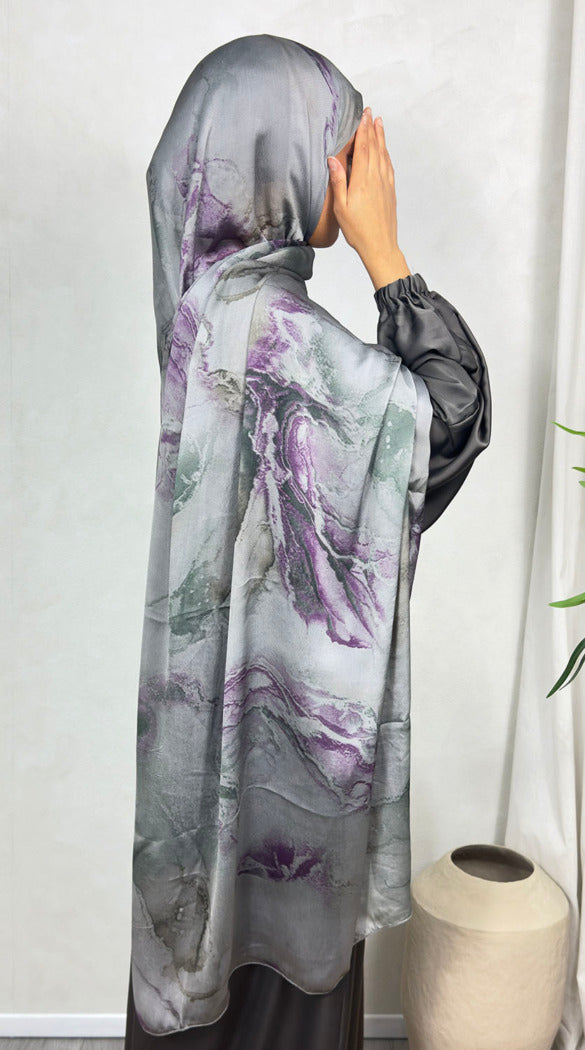
Black Khimar Styling Changes Completely Once You Play With Length, Shape and the Way the Fabric Falls
Black looks simple until you put two black khimars beside each other and realise they can create completely different outfits. One falls in a soft point below the hips, another makes a broad rounded cape, a third is light enough to move with every step, and a fourth has enough structure to sit away from the shoulders. The colour is doing very little of the work. Shape, length and fabric are deciding almost everything you notice.
That is why a black khimar can be one of the easiest pieces in a modest wardrobe and still be surprisingly easy to choose badly. The colour works with almost anything, but that convenience can tempt you to ignore the questions that matter more: where the front finishes, how much fabric gathers at the sides, whether the face opening stays comfortable, whether the material grips or slips, and whether the khimar still feels manageable under a coat or over an abaya.
I would not begin with a rule about what you should wear with black. I would begin with the garment itself. If you understand how your khimar is built, the styling becomes calmer. If you are still comparing the basic forms, cuts and practical differences, the complete khimar guide gives the wider foundation. Here, the focus stays on black: how to keep such a familiar colour from becoming flat, bulky or more complicated than it needs to be.
Black does not make every khimar look the same
Colour can hide differences at first glance. On a product grid, several black khimars may look almost interchangeable because the eye sees one dark block. On the body, the distinctions become obvious. A deep triangular point creates a vertical line. A rounded hem spreads the visual weight across the shoulders and sides. A two-layer cape adds movement and depth. A shorter front leaves more of the abaya visible, while a longer front makes the khimar the dominant upper layer.
This is useful because it means you do not need embellishment to make a black outfit feel intentional. Proportion can do that job. If the khimar is long and dramatic, the rest of the outfit can be very quiet. If the khimar is compact and practical, a textured abaya or softly contrasting dress can bring enough interest. The garment does not need decorative detail simply because the colour is dark.
Black also changes how edges read. A soft chiffon-like layer against a black abaya can almost disappear from a distance, especially when both surfaces are matte. A crisper khimar over a fluid abaya creates a clearer outline even though the colour matches. A slightly textured crepe beside smooth nida-like fabric gives the eye something to separate. These are small differences, but they stop an all-black outfit from becoming one undifferentiated shape.
Before styling anything else, stand in the khimar and look at its outline from the front, side and back. Ask where the volume sits. Does it widen the shoulders? Does it fall close to the body? Is the longest point at the centre? Do the sides finish high enough to show much of the sleeve? That outline tells you far more about what to pair with it than the word black ever could.
The front length decides how much of the outfit still has a voice
A long front can give generous chest coverage and make the khimar feel like the main visual layer of the outfit. That can be beautiful, particularly with a simple abaya underneath, because the eye sees one calm sweep of cloth rather than several competing lines. But a long front also covers much of whatever is beneath it, so details on the upper part of an abaya may disappear completely.
If you have an abaya with embroidery across the chest, decorative buttons or an open-front construction, decide whether you actually want those details visible. Sometimes the answer is no. The black khimar can quieten a busier garment and make the overall outfit feel more restrained. Other times you bought the abaya because you love its upper detail, and a shorter khimar will let that detail remain part of the look.
Front length also changes how practical the garment feels. A very long front can sit near your hands when you work at a desk, prepare food or carry a child. That does not make it unsuitable, but it means you should test the real movement. Raise your arms. Sit down. Reach forward. If the fabric repeatedly falls into the task, the length may be better for a different part of your wardrobe.
A shorter front is not automatically less elegant. It can create a lighter line and work beautifully with a fuller abaya, especially if the back still gives the length you prefer. The important question is whether the actual coverage meets your needs. Length should be judged in relation to the body and the garments underneath, not as a competition for the largest number.
When buying online, compare the front measurement with a khimar you already own. If the seller measures from the crown, chin or shoulder, make sure you are using the same point. A few centimetres can look more significant on a straight front edge than they do on a long pointed back.
The back can be long without making the whole khimar bulky
Many black khimars use a pointed back because the shape creates length without distributing the same amount of fabric evenly around the sides. That is one reason a long khimar can still feel surprisingly manageable. The centre point may reach low while the outer edges rise gradually toward the arms.
A rounded long back behaves differently. The length is spread across a wider area, which can give fuller coverage around the sides and a more enveloping cape. It can also mean more cloth under a coat, around a chair or beside a shoulder bag. Again, neither shape is better in the abstract. They solve different problems.
If you like the visual drama of a very long back, check what happens when you sit. A centre point can fold beneath you or fall over the edge of a chair. On stairs, it may brush the step behind. Outdoors, wet pavement matters. You do not need to avoid long khimars; you simply need a length that you can manage without spending the day rescuing fabric.
Black can make very long shapes appear visually lighter than bright colours because the outline feels continuous and quiet. That can be helpful if you enjoy generous coverage but do not want the garment to look ornate. The risk is that you may underestimate how much fabric is actually present. Look beyond the elegant silhouette and check the measurements, width and number of layers.
If the khimar is being worn over a black abaya, a long back can create an almost uninterrupted line from head to hem. To stop that from feeling heavy, you can let texture or movement do the separating. A matte cape over a lightly lustrous abaya, or a fluid khimar over a more structured outer garment, can be enough.
Side length is where beauty and daily movement negotiate
The sides of a khimar rarely get the attention the front and back receive, but they are where you feel the garment during ordinary tasks. Deep sides can give generous coverage around the arms and upper body. They can also fall near your hands, catch on bag straps or bunch beneath outerwear.
Try putting your coat on while wearing the khimar. If you always need to fold large sections of fabric into the sleeves or neckline, the combination may become annoying in winter. Some women prefer to wear the khimar over the coat, which changes the calculation completely. In that case, enough width to sit comfortably over the extra shoulder bulk matters more than compactness beneath the coat.
Side length also affects how much sleeve you see. With a shorter side, the sleeve of the abaya becomes part of the styling. That can be useful if the abaya has a contrasting cuff, gathered sleeve or subtle texture. With deeper sides, those details disappear and the khimar creates a more complete cape effect.
Black makes this easy to control because it does not demand attention. You can decide whether the sleeve should show and then choose the proportion that supports the decision. A black khimar over a cream abaya, for example, looks very different when the cream sleeves are visible than when the cape covers most of the upper arm. The first feels more graphic; the second feels calmer and more enveloping.
Do not judge side length only while standing still. Lift a shopping bag, reach for a shelf, hold a phone and sit at a table. The best proportion is the one that keeps the coverage you want while letting your hands remain useful.
A pointed black khimar creates a different mood from a rounded one
A pointed khimar naturally draws the eye downward. The centre line lengthens the body and gives the garment a more directional shape. In black, that can look especially clean because there is no colour break interrupting the point. It often suits women who like a defined silhouette without decorative detail.
A rounded khimar has a softer visual rhythm. Instead of one long centre point, the hem moves in a curve around the body. That can make the cape feel fuller and gentler, particularly in a fabric with soft drape. It can also work well over a straight abaya because the curved upper layer gives contrast to the vertical garment beneath.
Diamond, butterfly and layered shapes sit somewhere between these ideas depending on their construction. Retail names are not standardised, so do not rely on the label alone. Look at the actual edge line in photographs and, where possible, at a flat-lay image. The same word can describe quite different cuts between shops.
For styling, think in shapes rather than rules. A sharply pointed khimar over a sharply flared abaya may create several strong lines at once. That can be beautiful if the fabrics are quiet, but if the outfit already has pleats, panels or a very dramatic hem, a rounded cape can soften the whole composition. Conversely, a simple straight abaya can carry a more sculptural khimar without becoming busy.
Black gives you permission to focus on those proportions. You are not trying to coordinate a difficult colour. You can spend your attention on the outline that actually changes how the outfit feels.
One layer, two layers and three layers do not behave like the same garment
Layered khimars are often photographed in motion because the overlapping edges look beautiful as they separate. In black, the effect is subtle rather than colourful, which can make the layers feel elegant without obvious decoration. But every extra layer changes weight, warmth, opacity and wind behaviour.
A single-layer khimar can feel light and direct. If the fabric is opaque enough for your needs, there is less cloth around the head and shoulders and fewer edges to manage. The trade-off is that a very light single layer may move more in wind or show the shape of whatever lies beneath it more clearly.
Two layers add depth. The shorter upper layer can soften the shoulder line while the lower layer provides the main length. They may also give more coverage where the fabrics overlap. The question is total weight. Two light layers can still feel airy; two substantial layers can become warm and heavy over a long day.
Three layers create the most visible movement, but they can also produce more bulk around the back of the head and more fabric under coats. If each layer has a pointed edge, the stacked points can look graceful when aligned and untidy when they twist in wind. That does not make the design impractical; it simply asks for a little more tolerance for adjustment.
With black, layered edges need enough texture or light difference to be visible. A slightly matte surface can help. In very low light, the layers may read as one dark mass, which is not a problem if you like that simplicity. If you bought the garment specifically for the layered effect, check product videos in ordinary light rather than expecting the studio image to reproduce everywhere.
The fabric decides whether black looks soft, crisp, polished or flat
Black is unusually sensitive to surface. A matte crepe-like fabric absorbs light and can look calm and understated. A smoother weave may catch a soft sheen that makes the folds more visible. Jersey-like fabric can look very soft and relaxed, while a structured woven material can hold a clear cape away from the body.
This is why two black garments can fail to match even when the colour is technically black. One may have a warm undertone, another a cool blue cast, and the difference can become obvious in daylight. More often, the mismatch comes from sheen. A very matte khimar beside a glossy abaya can make one piece look darker than the other because light is reflecting differently.
You do not need exact matching for a successful outfit. In fact, slight surface contrast can make all-black dressing feel richer. The goal is intentional difference rather than accidental near-match. If the khimar is softly textured and the abaya is smooth, let that be the point. If both are matte, introduce a different texture through the bag, shoe or underlayer rather than trying to force colour variation.
For comfort, evaluate fabric through behaviour: opacity, drape, grip, weight, breathability description and care. A black fabric can look opaque in photographs and still become more transparent in strong backlight. A smooth cloth can look luxurious and slide constantly against a smooth undercap. A substantial fabric can hang beautifully and create too much pressure if the khimar is very long and layered.
Do not let the colour reassure you into ignoring the textile. Black solves coordination; it does not solve fabric behaviour.
Matte black is easy to wear, but it still needs dimension
There is a reason matte black is loved in modest clothing. It is quiet, forgiving and less reflective than satin-like surfaces. On a khimar, a matte finish can keep a large amount of fabric from feeling theatrical. It works especially well when the shape itself is already dramatic.
The risk is visual flatness. If the khimar, abaya, bag and shoes are all the same matte black with similar texture, the outfit can lose every line except the outer silhouette. Sometimes that is exactly the calm effect you want. Other times you may feel that the clothing looks heavier than it is.
Dimension does not require colour. A ribbed undercap visible only at the forehead, a softly textured abaya, a leather-grain bag or a brushed winter coat can create enough separation. Even the difference between a flowing khimar and a structured abaya can do it. Light will catch the folds differently and show where one garment ends and the other begins.
If you prefer colour, keep it controlled. Taupe, stone, olive, burgundy, navy and muted rose can all sit comfortably beside black depending on your wardrobe and undertone. The important thing is not to add a colour simply because someone says black needs brightening. If you feel most like yourself in black and charcoal, texture may be the better answer.
Jewellery is not necessary to finish a black khimar outfit, and depending on how the khimar covers the neck and chest it may not be visible anyway. Let the clothing structure do the finishing. A neat face frame, balanced length and fabric that falls cleanly can look more considered than adding accessories for their own sake.
A slightly lustrous black khimar needs restraint around it
Some black fabrics catch more light. They are not necessarily shiny in the dramatic sense; they may simply have a smoother finish that makes folds glow softly. This can be beautiful for occasions because the movement becomes visible without beads, crystals or embroidery.
If the khimar already has that light-catching quality, pairing it with a very glossy abaya can push the whole outfit toward more shine than you intended. A matte or softly textured base usually gives the khimar room to be the luminous element. The contrast also stops two similar-but-not-identical sheens from looking like an unsuccessful match.
For daytime, the same fabric may look more reflective in direct sun than it did indoors. If you are choosing a khimar online for everyday wear, look for outdoor photographs or movement video. Studio lighting can make a smooth textile appear richer or flatter depending on the setup.
Sheen can also make wrinkles and seam lines more visible. If the fabric creases during storage, you may find yourself steaming it more often than a textured matte material. Check care instructions before assuming a polished surface will remain effortless.
None of this means a lustrous black khimar is only for formal wear. It means the surface has a stronger visual voice. Style the rest of the outfit accordingly. A plain closed abaya, simple bag and calm footwear are often enough.
Black khimar with black abaya works when the two pieces are allowed to be different
All-black pairing is the obvious starting point, but the best version rarely depends on perfect colour matching. If the khimar and abaya come from different fabric batches, they may never be identical in daylight. Trying to make them look like one piece can make a small mismatch more noticeable.
Instead, let them have different jobs. The khimar can be soft and fluid while the abaya is more structured. The khimar can be matte while the abaya has a gentle sheen. The upper layer can be long and pointed while the lower garment falls straight. When the textures and shapes are clearly different, a slight shade difference stops looking like an error.
Proportion is especially important. A very wide khimar over a very wide butterfly abaya creates a lot of volume. That can be wonderfully modest and graceful, but if you feel swallowed by the fabric, simplify one layer. A straighter abaya beneath a generous cape can keep the outfit easier to move in. Conversely, a shorter khimar can sit beautifully over a full abaya because each piece gets room.
Look at the sleeves. If the khimar sides are shorter, sleeve shape becomes visible. Balloon cuffs, narrow wrists or gathered sleeves can add detail to an otherwise quiet outfit. If the khimar covers most of the arm, the sleeve becomes less relevant and you can prioritise comfort instead.
All black is not a fallback. When the textures and proportions are considered, it can be one of the most deliberate combinations in the wardrobe.
Black khimar with cream or beige needs the contrast to stay balanced
A black khimar over cream, oatmeal, stone or beige creates immediate contrast around the upper body. Because black is visually strong, the khimar becomes the frame and the lighter abaya becomes the field beneath it. The longer the khimar, the more dominant that frame becomes.
If the contrast feels too sharp, soften the transition elsewhere. A taupe bag, dark brown shoe or patterned texture with both dark and light notes can bridge the two. You can also choose a softer off-black khimar rather than the deepest jet black, though you do not need to buy a new shade merely to make the outfit work.
Undertone matters more with beige than with black. A warm camel abaya can look rich beside black; a cool grey-beige can look cleaner and more minimal. Neither is more correct. Look at your skin, the lighting and the other pieces you own. If the beige makes you feel washed out near the face, remember that the black khimar is already sitting closest to your complexion and may provide enough definition.
Fabric contrast is useful again. A soft matte black cape over a textured linen-look beige abaya has depth even though the palette is simple. In winter, black wool outerwear can add another dark layer, so check whether the outfit still feels balanced once the coat is on.
The easiest mistake is adding too many additional colours because the black-and-beige base feels simple. Let simple remain simple. One warm neutral bag or muted shoe is usually enough.
Black khimar with colour works best when you decide who is leading
Black will sit beside almost any colour, but that does not mean every colourful outfit becomes easier. The useful question is whether the colour or the khimar should lead.
With a deep emerald, burgundy, navy or plum abaya, black can act as a quiet frame. The colours are already rich, so the khimar does not need extra texture or decoration. A clean matte fabric often works well. With a pale blue, sage, dusty rose or lilac abaya, the contrast is softer but still clear. The black may make the pastel feel more grounded and less sweet.
Bright colours deserve more thought. A saturated cobalt or red abaya under a very long black khimar creates a bold graphic block. That can look striking, but if you wanted a quiet outfit it may feel stronger than expected. A shorter khimar that reveals more of the coloured sleeve and lower garment can look more intentionally colour-blocked; a very long cape can make the colour appear only in narrow areas, which creates a different effect.
Prints are possible too. If the abaya has a subtle print, a plain black khimar can calm it. If the print is large and high-contrast, consider whether enough of it is visible beneath the khimar to make sense. Sometimes a busy chest print half-covered by a cape looks more awkward than either garment alone.
You do not need a black handbag and black shoes simply because the khimar is black. Let the accessories relate to the abaya or to one another. The khimar already provides the dark anchor.
A black khimar with denim needs one polished decision
For women who wear modest denim pieces, black can make the outfit feel immediately more grounded. A dark denim maxi skirt with a black khimar can look clean and grown-up, especially when the top or outer layer is simple. A long black cape can also reduce the casual feeling of denim because it brings a strong, flowing modest layer to the upper body.
The balance usually benefits from one polished element. That might be a structured tote, neat loafer, simple ankle boot or a tailored long coat. Without that point of finish, denim plus trainers plus a soft khimar can become very relaxed. There is nothing wrong with relaxed clothing; the question is whether it matches the setting you are dressing for.
Watch fabric weight. Heavy denim underneath a heavy khimar and winter coat can make the outfit physically bulky. A lighter khimar can keep the upper body more comfortable. In summer, breathable layers and movement matter more than the visual idea of denim.
If the denim is faded or washed, the contrast with deep black will be stronger. That can look intentional when the rest of the palette is quiet. Very distressed denim may not suit the modest look you are trying to build, depending on the garment and coverage, so judge the actual piece rather than the category name.
The black khimar should not be asked to “fix” clothing that does not meet your own coverage standards. Use it as part of the outfit, not as camouflage for a garment you are uncomfortable wearing.
Coats change the shape of a black khimar more than the colour
Winter is where khimar styling becomes engineering. The coat adds shoulder bulk, a collar, perhaps a hood, and sometimes a belt. A khimar that falls perfectly over a summer abaya can sit very differently once all of that is underneath or over it.
If you wear the khimar under the coat, a broad cape may bunch around the neckline or upper back. The sides may fold into the coat opening. A more compact shape can feel easier, but check that the coat itself still provides the coverage you want over the rest of the body.
If you wear the khimar over the coat, you need enough width to accommodate the shoulders without pulling the face opening backwards. Try it with the actual coat, not an imagined one. Hoods can push fabric upward, and high collars can change how the khimar settles beneath the chin.
Black-on-black winter layering can become visually heavy because wool coats, boots and bags all absorb light. Texture helps. A brushed coat beside a smooth khimar, or a crepe-like khimar over a structured twill coat, creates separation. A charcoal or dark brown coat can also soften the all-black effect without introducing a bright colour.
Practical length matters in rain. A long back that feels elegant indoors may brush wet steps or pick up spray. If your winter commute involves public transport, sit down in the complete outfit before deciding the shape works. Comfort on a hanger means very little compared with comfort on a crowded bus.
Wind reveals whether your black khimar is genuinely easy to wear
A black khimar can look exceptionally calm in a photograph and become lively the moment you walk into a crosswind. Lightweight fabrics lift, long points blow sideways, and layered edges can separate. None of this is unique to black; the dark colour simply makes the moving silhouette more visible against a pale sky or coat.
Fabric weight helps, but more is not always better. A heavier material may hang steadily and also create more pressure around the head. A very light khimar may feel comfortable but require more thoughtful pinning or undercap grip depending on its construction. The right balance depends on how exposed your daily environment is.
Shape matters too. A wide round cape presents more surface area to wind than a narrower pointed cut. Multiple layers can catch air between them. If you live near the coast, walk across open bridges or spend time at school gates, wind behaviour is not a minor detail.
Test movement safely at home or outside in ordinary conditions before relying on a new khimar for a long day. See what happens when you turn quickly or walk with a bag. If the front repeatedly blows back, consider whether the garment's own fastening system is sufficient. Avoid unsafe improvised fastening that could catch or cause injury.
A successful everyday khimar is not one that never moves. Fabric is supposed to move. It is one whose movement does not make you feel as though you are constantly rebuilding the outfit.
The face area should feel soft even when the overall shape is dramatic
A khimar can have a long sweeping back and still succeed or fail because of the few centimetres around the face. That is where you feel pressure, slipping, heat and interaction with glasses or an undercap.
Black frames the face strongly, so the exact line matters visually as well. A smooth curve can feel softer; a tight opening pulled high on the cheeks can look and feel more severe. But comfort comes first. If you keep tugging the opening down or away from the chin, the styling is not working no matter how neat it appears.
Check whether the khimar ties behind the head, stretches into place or uses another construction. Ties give adjustability but can press beneath a bun or under a hood. Stretch can be comfortable but should recover properly rather than becoming loose after a few wears. Elastic can hold firmly but may create pressure for some women.
If you wear glasses, put them on after the khimar and notice whether the fabric presses the arms into your temples. If you regularly wear headphones, hearing devices or a particular undercap, test those too. A garment should work with the way you live rather than asking you to change every small habit around it.
For an all-black look, a black undercap is the easiest visual choice, but it is not mandatory. A taupe, brown or charcoal undercap can soften the face line if a small edge is visible. Choose based on comfort and the amount that actually shows rather than creating extra layers purely for colour.
A black khimar should not need constant accessories to stay interesting
When an outfit feels plain, the instinct is often to add. A brooch, decorative pin, belt, jewellery, patterned bag, contrasting undercap and elaborate shoes can all arrive in the same outfit before you realise the original simplicity has disappeared.
With a khimar, I would be cautious about attaching decorative objects to the fabric unless the garment is designed for it and you are confident the method is safe and will not damage the textile. Heavy brooches can pull fine material. Sharp pins can snag. Decorations around the head can create pressure or catch on other layers.
You rarely need them. A black khimar already creates a strong frame. If the shape is beautiful and the fabric falls well, that is enough visual information. Let the bag or shoe provide the small point of personality if you want one.
For occasions, texture can replace ornament. A subtle jacquard abaya, softly pleated skirt beneath a long tunic, or slightly lustrous fabric can make the outfit feel special without placing decoration on the khimar itself. For everyday wear, the lack of decoration is often the advantage: fewer things to catch, match or worry about.
Simplicity is not the absence of styling. It is the result of deciding which element is doing the work and allowing the rest to support it.
Black can be the easiest travel khimar if the fabric cooperates
Travel makes you notice every demanding garment. You are carrying bags, moving through security, sitting for long periods, using small washrooms and sometimes changing climate in a few hours. Black is forgiving with colour coordination, so one khimar can work with several outfits, but fabric and shape determine whether you are glad you packed it.
A very wide layered khimar can occupy surprising space in hand luggage. A compact single-layer design may pack smaller and be easier to manage on a plane or train. Creasing matters if you will not have easy access to an iron or steamer. Some fabrics release folds quickly when hung; others keep every suitcase line.
Black can show lint, dust and pale makeup transfer more than mid-tone colours. Pack a small clothes brush or lint roller if that bothers you. Keep the face edge protected from makeup when changing, and store the khimar where rough zips or jewellery will not snag it.
If you are travelling somewhere hot, do not assume black alone makes the khimar unsuitable. Heat comfort depends on fabric, airflow, coverage, sun exposure and your individual tolerance. A light breathable-feeling black layer may be easier than a heavy pale one. At the same time, dark colours can absorb more solar radiation, so consider the complete conditions rather than a slogan about colour.
The best travel piece is the one that asks little of you. If you can put it on, move comfortably and pair it with most of what you packed, black is doing exactly what people love it for.
For work, the khimar should disappear from your attention once you arrive
Professional dressing is less about making a black khimar look formal and more about making the whole outfit dependable. If you are adjusting the face opening during meetings, moving fabric away from a keyboard or rebuilding the layers after every coat change, the garment is taking attention away from work.
A medium or long khimar can look polished with a simple straight abaya, modest maxi dress or coordinated skirt-and-tunic outfit, provided the workplace setting and your own standards are served. Black naturally creates a sober frame, so you do not need to force a business-like effect with rigid fabrics or elaborate accessories.
Think about chairs. Very long back points can become trapped when you sit. Think about lanyards, which can interfere with layered fabric. Think about desk height, commuting bags and coat storage. These are mundane details, but they decide whether the outfit works for eight hours.
If your workplace is warm, a heavy layered khimar may become uncomfortable indoors even when it is perfect for the commute. Separating warmth into a coat rather than the khimar itself can give you more control. A lighter black khimar can then stay consistent throughout the day.
Professional polish usually comes from neatness, condition and proportion. A clean hem, well-cared-for fabric and comfortable face line matter more than whether the khimar is labelled “office” or “formal”.
For Eid or occasions, let one quality make the black khimar special
Black can feel celebratory without becoming heavily decorated. Choose one quality: exceptional drape, a layered hem, a soft sheen, a beautifully cut point or a fabric with subtle texture. When one feature is strong, you can keep the rest restrained.
This is particularly useful if your occasion abaya already has embroidery, beading or a statement sleeve. A plain black khimar can calm the upper body and keep the decorative focus lower down. If the abaya is completely simple, a layered khimar can become the main occasion detail.
Photos matter at events, and black can lose detail in low light. Texture and movement help the camera see the garment's shape. You do not need to choose something shiny purely for photographs, but be aware that a matte black cape over a matte black abaya may read as one block under dim lighting. A slight surface difference can preserve the outline.
Comfort still matters after the first photograph. If the face opening is tight, the layers are heavy or the side points keep catching on chairs, the outfit will feel less special as the hours pass. Try the complete look at home long enough to discover those problems before the event.
A black khimar is at its most elegant when it still lets you forget about it and enjoy the day.
Care is part of black khimar styling because fading changes the whole outfit
Black textiles show care differences quickly. Repeated washing, high heat, harsh detergent or prolonged sun can alter depth of colour depending on the fabric and dye. One piece may remain deep black while another softens toward charcoal, making an all-black pairing look different over time.
Always follow the garment's own care label rather than a generic black-clothing rule. Some khimars tolerate machine washing; others need gentler handling. If the product says to wash cool, avoid deciding that hotter must be cleaner. If it says not to tumble dry, take that seriously. Care instructions are part of the textile design.
Turn garments inside out when appropriate, separate items that shed lint, and avoid rough closures catching fine fabric. Black khimars often collect pale fibres from towels, wool knits and fleece coats. A lint roller can restore the surface quickly without adding unnecessary washing.
Store the khimar in a way that suits its fabric. A crease-prone woven material may benefit from hanging, provided the hanger does not stretch the face area or ties. A soft knit can sometimes be better folded so its own weight does not distort it. Keep sharp jewellery, rough Velcro and exposed zips away from delicate edges.
If two black pieces no longer match because one has faded, you do not have to stop wearing them together. Treat the difference as tonal variation and introduce another texture so the contrast looks deliberate. Clothing changes with wear; good styling adapts rather than expecting permanent showroom condition.
When black feels too heavy, change proportion before changing colour
Sometimes you put on a black khimar and feel that the outfit has become too dark or too large. The first thought may be that black does not suit you. Often the real issue is proportion.
If the khimar is very long at the front and broad at the sides, it covers most of the upper outfit. Switching to a shorter or more pointed shape can reveal more of the abaya and make the same black colour feel lighter. A single layer can reduce visual and physical volume compared with multiple layers. A fabric with more movement can soften a structured outline.
Near the face, a softer undercap tone or a slightly looser drape may change the feeling without altering the khimar. A cream or taupe abaya can provide contrast below. In winter, a camel, grey or olive coat can break the dark column while the khimar remains black.
Texture is another lever. Flat matte surfaces across the entire outfit can feel dense. Introduce a subtle weave, smooth leather-grain bag or soft ribbed knit to create light variation. You are not trying to decorate the outfit; you are helping the eye read separate layers.
Only after those adjustments would I conclude that the colour itself is the problem. Black is strong, but it is also flexible. Shape usually has more influence than we give it credit for.
If black looks too severe near your face, soften the frame
Deep black creates high contrast, especially on lighter complexions or against very soft colouring. Some women love that definition; others feel it makes the face look tired or overly sharp. You do not need to abandon black if you like its practicality.
Start with the face line. A khimar that pulls tight around the cheeks creates a stronger frame than one that sits softly. If the construction allows adjustment, a comfortable looser line may feel gentler. Do not compromise security or coverage simply for appearance, but notice how tension changes the visual effect.
The undercap can also help if a narrow edge is visible. Charcoal, cocoa, taupe or another muted tone may soften the immediate contrast while the khimar remains black. This works best when the undercap is there for practical reasons anyway; there is no need to create complicated layers solely for colour theory.
Choose what sits below the khimar carefully. Warm cream, dusty rose, olive or soft blue can reflect different tones upward and change how the whole outfit feels. Makeup is personal and optional, so I would not make it part of the solution. Clothing should work whether or not you wear any.
Most importantly, trust your own response in natural light. A mirror beside a window is more useful than a rule about who can wear black. If you feel calm and comfortable in the colour, that matters more than somebody else's palette system.
The black khimar borka search usually needs a garment question answered first
Search language is not always the same as precise garment language. Someone may type a phrase that combines black khimar with “borka” or “burqa” because those are the words available to her, because a local shop uses them broadly, or because she is trying to describe a complete modest covering rather than one exact construction.
The practical response is not to police the vocabulary. It is to clarify the garment. Are you looking for a khimar that covers the head and extends over the upper body? A face-covering piece as well? A full outer garment? A coordinated set? The answer changes what you should buy.
If a product is labelled “black khimar borka”, inspect the included pieces. Does it contain only the khimar? Is a niqab panel attached? Is there an abaya, skirt or jilbab included? How is the face area constructed? What are the front, back and side lengths? Retail names can vary; physical construction is harder to misunderstand.
This approach also protects you from ordering a garment that solves the wrong problem. A beautifully long khimar does not replace an abaya if what you need is a full body outer layer. A face veil does not tell you how the rest of the outfit is constructed. A coordinated photograph does not prove every piece is sold together.
Use the search term to find options, then let measurements and product details make the decision.
A black khimar hijab is still about the khimar’s construction, not a special colour category
People often use “hijab” as a broad word for head covering, so “black khimar hijab” can simply mean a black khimar worn as the person's hijab. There is no need to invent a separate garment category where the product construction does not support one.
What matters is how the khimar covers and fastens. Does it slip over the head? Tie behind? Stretch around the face? How far does it extend over the chest and back? Is it one layer or several? Those features will determine comfort and styling.
If you are moving from rectangular scarves to khimars, expect the experience to be different. A khimar usually gives a pre-shaped upper-body silhouette, so you spend less time arranging long scarf tails. In return, you have more fabric distributed around the shoulders and may have fewer ways to alter the shape once it is on.
Black can make that transition easy because it works with much of an existing modest wardrobe. You can learn the shape without also learning a difficult colour. Start with the length and fabric you are most likely to wear, not the most dramatic style on the product page.
If you already wear black rectangular hijabs comfortably, do not assume the same fabric preference transfers automatically. A small scarf in heavy jersey can feel fine while a very long khimar in the same weight feels much heavier simply because there is far more material.
Choose the black khimar for the day you actually live
There is a version of modest dressing that exists only in saved photographs: no wind, no bags, no coats, no children tugging your sleeve, no hot office, no wet pavement and no need to reach for anything. Real clothing has to work outside that frame.
If most of your days are active, choose the khimar that lets you move. If you commute, test it with the coat and bag. If you are at a desk, sit in it. If you care for children, bend, lift and reach. If you attend long classes or work shifts, wear the face opening at home long enough to know whether it creates pressure.
A black khimar can be wonderfully versatile because colour coordination becomes almost effortless. That versatility is wasted if the shape only suits one idealised pose. The best everyday piece is usually the one you stop noticing after you leave the house.
Occasion khimars can be different. You may willingly manage extra layers or a longer back for a few hours because the movement feels special. The point is to know which job you are buying for. One garment does not need to excel at every possible setting.
Build your decision around frequency. If you need a khimar three times a week for ordinary errands and work, prioritise ordinary ease. The dramatic version can wait until there is a genuine place for it.
A simple checklist is more useful than another styling rule
- Check front, back and side length separately. One maximum measurement does not describe the whole cape.
- Identify the outline. Pointed, rounded, layered and broad shapes distribute fabric differently.
- Assess the face opening. Ties, stretch or elastic should feel secure without creating pressure.
- Judge fabric behaviour. Look at opacity, drape, grip, weight, stretch and care rather than relying on the colour.
- Test your coat. Decide whether the khimar sits under or over it and whether the shoulder volume still works.
- Test your bag. Cross-body straps and backpacks change the way cape fabric falls.
- Use texture deliberately. Especially in all-black outfits, surface differences can create enough dimension without extra colour.
- Keep occasion detail restrained. Let either the khimar or the abaya provide the stronger visual feature.
- Follow the care label. Fading, lint and snagging affect how black reads over time.
- Choose for your real routine. The most beautiful khimar is not the most useful if you keep adjusting it all day.
Browse black and neutral khimar options with proportion in mind
Current colours, lengths and fabrics can change, so this article should not pretend a specific product will always be available. When you are ready to compare live options, browse the current khimar collection and use each product page for its present measurements, fabric details and included pieces.
Keep your own reference numbers beside you. If you already own a khimar that works, note its front, back and side measurements and the construction around the face. That small habit makes product comparison much more accurate than judging every image from zero.
Black gives you a forgiving colour. Use that freedom to be demanding about the things that actually affect wear: shape, length, fabric and comfort.
Frequently asked questions about black khimar styling
What colours look best with a black khimar?
Black can sit comfortably with most colours, so the better question is what mood and contrast you want. Cream, beige and stone create a clear light-dark contrast; burgundy, emerald and navy feel rich and quiet; sage, dusty rose and soft blue feel gentler. You do not need a contrasting colour at all. An all-black outfit can look intentional when the khimar and abaya have different textures or silhouettes. Choose from colours you already wear well rather than adding a shade simply because a styling rule says black needs brightening.
Can I wear a black khimar with a black abaya?
Yes. The combination often works best when the two pieces are allowed to differ in texture, drape or shape rather than being forced into a perfect match. A matte khimar over a gently lustrous abaya, a fluid cape over a structured garment, or a pointed back over a straight silhouette creates separation. If the blacks are slightly different in daylight, a clear fabric contrast can make that look intentional. Pay attention to total volume as well: a very wide khimar over a very wide abaya can feel physically bulky.
Is a pointed or rounded black khimar easier to style?
Neither shape is universally easier. A pointed khimar creates a strong vertical line and can give long back coverage without the same depth at every side. A rounded khimar spreads fabric more evenly and often creates a softer cape effect. Your abaya shape, coat, bag and movement matter more than the colour. If your base garment is already very full, a narrower point may feel calmer; if the abaya is straight and simple, a rounded cape can add softness without making the outfit busy.
How long should a black khimar be?
Choose length according to the coverage and movement you need rather than chasing the longest available option. Check front, back and side measurements separately. A long front may give generous chest coverage but fall near your hands during work; a very long back may brush chairs, stairs or wet ground; deep sides may create more arm coverage and more fabric under coats. Compare the measurements with a khimar you already understand and test the garment through sitting, reaching and walking.
What fabric is best for an everyday black khimar?
For everyday wear, prioritise behaviour rather than a fabric name. You may want enough opacity, manageable weight, comfortable grip, easy care and a drape that does not need constant adjustment. A textured crepe-like fabric can provide grip and a matte finish, a light woven fabric can feel fluid, and a jersey-like knit can be soft and stretchy. The same fabric name can vary between sellers, so check actual composition, thickness, stretch and care information where available.
How do I stop an all-black khimar outfit looking flat?
Use texture and shape before adding extra colour. A matte khimar over a smoother abaya, a flowing cape over a structured coat, a textured bag or a softly ribbed undercap can create enough dimension. You can also vary the silhouette by pairing a broad khimar with a straighter abaya or a shorter khimar with a fuller garment. If you enjoy colour, one muted neutral or deep tone is plenty. The goal is readable layers, not decoration for its own sake.
Can a black khimar work for Eid or weddings?
Yes, if black suits the event and your own preferences. Let one quality make the khimar feel special: layered movement, a beautifully cut hem, subtle texture or a gentle sheen. If the abaya is already embroidered or embellished, keep the khimar simple so the two pieces do not compete. Test the complete outfit for several hours at home before the occasion. A comfortable face opening and manageable side length matter more after the first photograph than any decorative feature.
What should I wear over a black khimar in winter?
The practical answer depends on whether you wear the khimar under or over your coat. Under a coat, very broad or layered khimars can bunch around the neckline; over a coat, the khimar needs enough width for the extra shoulder bulk without pulling backwards. Black works with camel, grey, olive, brown, navy and black outerwear, but shape is the bigger issue. Try your actual coat, hood, scarf and bag together before relying on the combination for a long commute.
What does “black khimar borka” usually mean in a product search?
It can be mixed retail language rather than one standard garment. The shopper may be looking for a black khimar, a khimar with face covering, a full modest outfit or a coordinated set. Instead of relying on the label, check the physical contents: whether there is a khimar only, a niqab panel, an abaya or another lower garment, and how each piece is measured. Search wording can vary by region and shop; construction tells you what you are actually buying.
Is a black khimar hijab different from a normal khimar?
Usually the phrase simply describes a black khimar being worn as the person's hijab or head covering. The useful differences are in construction, not the label: face opening, ties or stretch, front and back length, number of layers, fabric and whether any face-covering piece is included. If you are moving from rectangular scarves to a khimar, remember that the khimar is pre-shaped and uses much more fabric, so your preferred scarf weight may not automatically be your preferred khimar weight.
Black is the easy part; the right khimar is the real styling decision
A black khimar does not need a complicated formula. It needs a shape that makes sense with your body and your abayas, a length that gives the coverage you want without creating avoidable difficulty, and a fabric you can live with for the hours you expect to wear it.
Once those things are right, styling becomes almost quiet. You can wear black with black and let texture separate the layers. You can use cream or beige for contrast. You can put it over rich colour and let the khimar frame the outfit. You can keep it everyday-matte or choose a softer sheen for an occasion. None of those choices requires turning the garment into something elaborate.
The most useful black khimar is rarely the one with the most dramatic product photograph. It is the one that still feels right after the coat goes on, after you sit down, after the wind changes direction, after the first hour at work and after the excitement of a new parcel has worn off.
Black gives you simplicity. Shape, length and fabric decide whether you actually get to keep it.