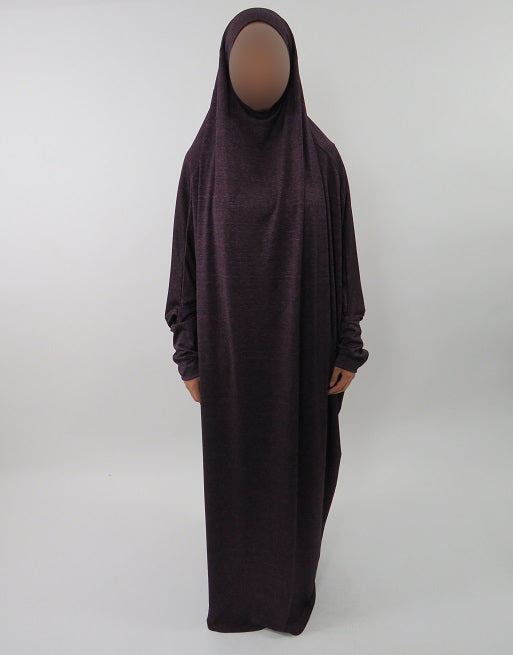
Ribbed abayas: look past the texture
The attraction of a ribbed abaya is often quite subtle. A plain colour gains texture, light catches the raised lines, and a simple shape looks less flat without needing a print or a decorated sleeve. The question to ask before buying is what those lines do when the garment is worn, not only how they look in a close-up.
Do the ribs sit together when the abaya is relaxed, or spread widely across the upper arms? Does the skirt settle after sitting? Can the fabric move over your usual inner layer without collecting around the waist? Those observations help distinguish a garment you will enjoy wearing from one whose texture looked lovely on a hanger.
This guide takes the ribbed surface as a starting point, then works through construction, measurement, dressing and care. There is no single correct body shape or occasion for it. There is, however, a particular fit and routine that will work for you.
Marled jersey is shown for comparison, not as an example of rib knitting. The ribbed structure discussed below needs its own close-up and material information.
Find out what the seller means by ribbed
Ribbed describes a visible texture, not a fibre. Before comparing two abayas, check whether the description refers to a rib knit, another fabric with a raised-line effect, or ribbed trim on an otherwise plain garment. Their appearance can be similar in a small photograph while their construction differs.
In a basic rib knit, alternating columns of face and reverse stitches create the familiar ridged surface. CottonWorks’ explanation of knit structures describes how those columns open as the fabric stretches across its width, and how ribs can be fine or chunky. This explains why a relaxed fabric sample does not tell you everything about the appearance on a fitted garment.
Read the composition separately. You may see a named fibre or a blend, but “ribbed” alone establishes neither. Ask for the percentage composition where it is missing and check whether the information covers the lining as well as the outer fabric.
You do not need technical expertise to shop more clearly. Three useful questions are enough to begin: what is it made from, what parts are lined, and are the listed measurements taken with the garment relaxed? Answers to those questions are more helpful than a description that repeats “premium” without explaining the item.
Decide whether you want a loose dress or a closer inner layer
A ribbed garment may be designed to fit relatively close, to fall loosely, or to act as an open outer layer. The name abaya does not remove the need to establish that intention. Look at side and back photographs and read the cut information.
If you prefer a loose shape, start with sufficient room in the pattern rather than hoping the ribs will create it. The fact that fabric can expand does not mean you will enjoy wearing it expanded across your body. Ease is a choice about the finished fit, not simply the maximum stretch available.
If the ribbed dress will sit beneath an open abaya, assess its coverage independently. The outer panels will move, and the inner garment may become the main visible area. Choose that combination deliberately rather than assuming a close-fitting piece disappears once another layer is added.
An open ribbed abaya needs a different check: how its fronts hang over the outfit beneath. See whether the panels sit evenly and whether the neckline or shoulders shift after walking. A belt might alter that arrangement, but it should not be the only thing holding an unsuitable cut in place.
Use relaxed garment measurements as a clear reference
Ask how the seller measures the chest, hips, upper sleeve and length. If a chart supplies a stretch range, clarify the unstretched dimensions too. A very broad “fits” range does not tell you how much ease each wearer will experience.
Compare a garment you already like, measured using the same route. Lay it on a flat surface without pulling the fabric outward. Record which measurements are flat widths and which are circumferences so the figures are not confused later.
Keep the desired fit beside the numbers. You might write, “This chest width is comfortable, but I would prefer more room in the upper sleeve.” That is more useful than asking for a larger size without identifying the point that needs changing.
For Amani’s numbered abaya lengths, the number describes shoulder-to-feet inches rather than total standing height. Check the individual design for its width and sleeve information as well. A longer length option should not be treated as proof of a wider body fit.
Do not stretch a new garment firmly to measure its limit. The aim is to compare the dimensions supplied and assess ordinary wear, not to conduct a destructive fabric test. Ask the seller where a measurement remains unclear.
Watch the ribs at the shoulders and upper arms
Put the abaya on over the layers you intend to use and let it settle. Look at the surface while your arms are relaxed. Notice whether the ribs have a broadly consistent appearance or open noticeably across one area.
Now reach forward as though holding a bag in front of you. Some movement in the cloth is expected; the useful question is whether you remain comfortable and still like the coverage and outline. A neckline that is pulled towards the arm or a sleeve that remains strained deserves another look.
Do not solve an upper-arm restriction only by choosing wider cuffs. The part around the wrist and the part above the elbow are different measurements. Likewise, extra volume at the lower hem cannot provide room across the back.
With a dropped or integrated sleeve, compare the measuring method carefully. The apparent shoulder seam may not sit at your own shoulder. Ask where the sleeve measurement starts instead of comparing it directly with a conventional set-in sleeve.
If the garment feels close in several areas, try another size or a different cut. You do not need to make your body conform to the texture’s resting shape. The clothing should provide the room you want from it.
Take time over the seated fit
Sit in an ordinary chair with your feet resting naturally. Check the waist, hips and thighs before smoothing the skirt. Does the fabric remain comfortable, or do you immediately want to pull it away from the body?
Look at the neckline and sleeves again. Sitting can reveal a connection between parts of the garment: fabric caught beneath you may pull the upper body backwards, or a belt may gather material into a thick section at the waist.
Stand up and allow the abaya to settle on its own. A small adjustment is normal dressing; repeatedly reconstructing the whole skirt after every movement may be more work than you want. Compare another inner layer if the two surfaces appear to be catching.
A short home try-on cannot prove long-term recovery or durability. It can tell you whether the initial fit is comfortable and whether obvious interactions need resolving. Keep those conclusions separate from promises about how the fabric will behave after months of wear.
Check opacity where the surface opens
Inspect the completed outfit in suitable daylight and ordinary indoor light. Pay attention to the elbows, shoulders, seat and any other area under tension. The loose folds at the hem are not the only parts that matter.
Use the underwear and layers intended for the outfit. A very different fitting-room base may conceal or exaggerate an issue that changes once you dress normally. Check from the side and back, using a mirror or a suitable private photograph where helpful.
If a lining is included, find out how far it extends and whether it allows the movement of the outer garment. A lining that is tighter than the abaya can become the limiting layer. Its presence is not an automatic answer to every fit or coverage question.
A separate slip may be useful, but it should earn its place. Check the added neckline, sleeves and hem, as well as whether the surfaces move together. An additional garment can solve one problem while creating another if it is chosen only for colour.
Notice the direction and scale of the texture
Look at the ribs across the entire design. They may run in one direction through the body and another through a cuff or panel. Decide whether you like the arrangement as a design detail rather than expecting all lines to remain vertical from every angle.
Seams interrupt texture. Inspect prominent joins and see whether the transition looks intentional and well finished. You do not need perfect matching at every point, but a clear photograph should let you understand what you are choosing.
A fine rib may give a relatively quiet surface; a broader one can be a more visible feature. Neither belongs to a particular body type. Try the scale beside your scarf and outerwear and decide how much texture you want in the complete outfit.
Do not buy the garment because a description promises vertical lines will make everyone look taller or slimmer. You can simply enjoy the surface. Fit, coverage and personal taste are enough reasons to choose it.
Check the neckline and front opening while dressing
For a pullover design, use the opening as intended rather than pulling hard at the fabric. It needs to work with your usual dressing routine. A comfortable body width does not guarantee an easy head opening.
Inspect any buttons or zip with the abaya on. Fasten the garment without pulling the sides together under tension, then move your arms. Look for gaps, a distorted edge or a neckline that changes position after fastening.
For an open design, decide whether you want the fronts to meet or remain apart. Ask about that fit before ordering. A garment intended to hang open may not provide the overlap you expect even when the body measurement seems generous.
Check decorative ties separately from functional closures. A supplied belt can shape the outline, but it may not close the whole front. Keep an appropriate inner outfit in place wherever the design remains open.
Three everyday ways to wear the texture
A plain scarf and a useful bag
Start with a ribbed abaya in a colour you already wear. Add a plain scarf with a surface different enough to make the two pieces distinct. A smooth-looking scarf beside a more pronounced rib can be an easy combination to assess.
Put the usual contents in your bag before testing its position. A strap can gather or pull the garment at the shoulder or side. Adjust the carrying method rather than assuming you need to tolerate an uneven neckline all day.
Finish with footwear that clears the hem. The texture already supplies interest, so there is no need to add a brooch, belt and statement necklace to prove the outfit is complete.
A short jacket over a longer line
A jacket can make a clear break above the length of the abaya. Try it with the actual sleeves beneath and fasten it if that is how you plan to wear it. Check that the inner fabric does not become tightly packed in the arms.
Look at the back after sitting. The jacket may catch the abaya and lift it slightly, or it may move freely. This is a reason to compare the combination rather than deciding from two garments laid side by side.
Keep the scarf comfortable at the collar. A substantial jacket collar may call for a simpler drape, but you should not need to compromise your chosen coverage to make the outerwear fit.
A tonal outfit with contrasting surfaces
Try neighbouring shades rather than an exact matching set. A dark brown ribbed abaya, a softer brown scarf and a plain bag can look connected while retaining a difference between the pieces.
Compare the actual fabrics in the same light. Similar colour names do not guarantee a match, and surface shine changes what you notice. A visibly different shade is sometimes more satisfying than a close match that never quite feels right.
Keep the shoes familiar while testing the colours. Changing every component at once makes it harder to identify which relationship you enjoy.
Make an occasion version without treating shine as compulsory
A ribbed abaya may suit an occasion through its cut, colour or detail, not merely because you add heels. Begin with the invitation and the setting. A plain relaxed garment can be ideal for a family visit yet not answer every formal dress code.
Try a scarf with a restrained sheen or a more structured bag as the first change. Choose one and assess it before adding another decorative element. The texture of the abaya may already give the outfit enough depth.
Inspect jewellery where it touches the fabric. Rough fittings and projecting edges deserve attention near a textured knit. A bracelet hidden beneath a substantial cuff might be unnecessary, while a smooth ring may give you the detail you wanted.
Spend part of the fitting seated, with the bag and shoes in place. An occasion outfit should remain comfortable during the meal or ceremony rather than only at the moment you stand for a photograph.
Use a belt only if you like what it changes
A belt gathers the ribbed fabric and changes the outline at the waist. Try the garment without it first, then compare the supplied belt or another suitable option. You may prefer either result; neither is a requirement.
Check the folds beneath the belt when seated. A broad band can compress more fabric than you expect, while a narrow one may shift into the same point repeatedly. Choose a comfortable placement rather than tightening it simply to hold a preferred photograph pose.
Make sure the belt hardware does not catch the surface. A very heavy buckle may not be a useful partner for a soft dress. If the garment has belt loops, use them as intended and check their condition.
When an open abaya is belted, assess the inner clothing again. The belt may bring the upper fronts together while leaving the lower part free to move. It should not be counted as a complete coverage solution without checking the whole outfit.
Read a size chart without borrowing room from the stretch
Imagine comparing a ribbed abaya with a garment that already fits you comfortably. Your reference measures 64 cm flat across the chest when relaxed. One listing gives a relaxed flat chest width of 60 cm; another gives 66 cm. These are fictional figures to illustrate a comparison, not Amani’s product measurements or recommended sizes.
The first listing also says the fabric stretches. That is additional information, not a replacement for the missing relaxed width. You would be relying on some extension to reach the width of your reference garment. Decide whether that is compatible with the loose fall you want before considering the maximum stretched measurement.
The second option gives more relaxed width at that particular point, but it has not yet won the comparison. Ask about the upper sleeve, hip area and lining. Check the shoulder-to-hem length separately. More space across the chest cannot answer whether a cuff will be comfortable or whether the neckline will sit where you want it.
Confirm that both sellers are measuring the same way. A circumference is not a flat width, and a stretched measurement is not a relaxed one. Keep the unit and measuring method next to the number in your notes. Where the listing gives only a broad size range, ask for the actual garment measurement instead of trying to calculate it from a photograph.
Finally, try the selected garment with your intended layers. Measurements narrow the choice; they do not reproduce the interaction between two fabrics. This distinction is especially useful with a ribbed design, where an attractive close-up of the texture can distract from the space you need inside it.
Questions that make an online listing easier to judge
Ask for a full-length front and back view, a close view of the texture and a clear account of any lining. A detail photograph alone cannot show the cut, while a distant model image may hide how the ribs open.
Request the relevant measurements and their method. “Is it stretchy?” is less useful than knowing the relaxed garment width and whether the chart describes the garment or the intended body size. Explain any recurring sleeve or neckline difficulty.
Confirm which pieces are included. An inner dress, scarf or belt visible in the styling may be separate. Include any essential extra layer in your plan before comparing the price with another garment.
Read current delivery and return information for the actual order. Keep the listing and any measurement reply with the purchase record. Do not assume a material description or a review from someone with different preferences guarantees your own fit.
If a listing promises wrinkle resistance, exceptional durability or guaranteed shape retention, look for specific information about that product rather than accepting the ribbed texture as evidence. There is no need for the garment to promise everything to be worth wearing.
Care for this garment rather than every ribbed fabric alike
Read the care label before selecting a wash, drying or pressing method. Composition, lining and trim can introduce different requirements. The raised lines themselves are not a universal instruction to handwash, soak or iron at a particular setting.
Empty pockets and check fastenings before cleaning. Where a removable belt has its own construction or decoration, follow the supplied guidance for that piece as well. Keep components identified so the outfit can be put together again.
Use the specified drying arrangement and provide suitable support. Do not suspend a heavy wet garment from a small point or pull it firmly back into shape as an improvised correction. If the care method is unclear, ask before treating a valued piece.
Do not press the ribs flat just because the surface looks uneven to you. Establish whether pressing or steaming is permitted and what the maker recommends for the finish. A protective cloth does not make an otherwise unsuitable treatment safe.
Our fabric care guide provides a broader routine, but the instructions for your garment guide the actual method. Keep a photograph of the label if it might become difficult to read later.
Look at snagging and surface changes without guessing
If a loop catches, avoid tugging at it or cutting it simply to make the surface look tidy. Inspect the area and seek appropriate repair advice when the structure is unfamiliar. A quick cosmetic action can change more than the one visible strand.
Notice where friction occurs in your outfit. A rough bag strap, a sleeve repeatedly rubbing a desk edge or an unsuitable accessory may be contributing to local wear. Adjusting that contact can be more useful than repeating a repair without addressing the cause.
If the shape changes after cleaning, compare the result with the care method used and the seller’s information. Do not jump straight to applying more heat or stretching the garment. Describe the change clearly when asking for help.
Record the garment’s useful measurements before the first wash when practical. A simple reference can help you distinguish a real change from a different way of measuring or wearing it. It is not a substitute for following the care label.
A fitting comparison you can make at home
Choose one suitable inner outfit and wear the ribbed abaya over it. Do not add a belt, coat or bag yet. Look at the surface relaxed, then sit, stand and reach forward. Note any area where you want more room or where the layers catch.
Change only the inner garment and repeat those movements. If the abaya falls more comfortably, you have learned something about the pairing. If the same upper-arm restriction remains, the issue may be the outer garment’s fit rather than its companion.
Next add the bag, then the coat, one at a time. This sequence lets you identify which component changes the drape. It avoids dismissing the abaya because of a problem created by one particular strap or sleeve combination.
Keep the result specific. “Comfortable over this smooth inner dress, but the coat sleeve is too narrow” gives you a useful outfit note. “Ribbed fabric never works for me” turns one combination into a rule that may not help with the next garment.
Compare two sizes with one purpose in mind
Suppose one size feels comfortable through the chest but close at the upper arm, while the next size gives more sleeve room and a looser neckline. Neither is automatically the right answer. Try the two with the same inner layer and describe each difference separately. You may prefer the larger neckline, or you may find that another sleeve construction is the better solution.
Compare the length again after changing size. The garment may sit differently at the shoulder, so the hem can move even when both options carry the same stated length. Put on the intended shoes rather than deciding from a barefoot mirror check.
Keep any return decision separate from alterations. Assess whether the basic garment suits you before asking a professional about a change. A small hem adjustment and reconstructing a neckline are not equivalent jobs. The purpose of the comparison is to find a workable garment, not to convince yourself that the more expensive or larger option must be better.
Common questions about ribbed abayas
Does a ribbed abaya have to fit closely?
No. Look at the garment’s cut and relaxed measurements. Texture and stretch do not dictate how much ease you should prefer. Choose the shape that provides your intended coverage and movement without relying on the fabric’s maximum extension.
Can I wear one in warmer weather?
Judge the finished outfit, including fabric weight, lining and inner layers. A fine rib may look lighter than another, but the appearance alone does not establish how comfortable the whole combination will feel. Choose for the conditions and the amount of time you expect to wear it.
Should I size up automatically?
Not without checking the measurements. A different size may add useful room, but it can also alter the shoulders, neckline and length. Identify the specific area that needs more ease and compare that measurement before deciding.
Will the ribs keep their shape forever?
No garment should be chosen on an unqualified promise of permanent shape or appearance. Ask about the actual product, follow its care instructions and inspect how it behaves in use. A short try-on can reveal initial fit, not guarantee years of performance.
Which scarf works best beside the texture?
Try a plain scarf with a different surface first, then compare a print if you enjoy one. Choose the fabric for its own fit, coverage and drape as well as the colour. There is no need to repeat the ribs in the hijab to make the outfit feel connected.
A ribbed abaya can bring interest to an otherwise simple outfit, provided its construction and fit support the way you want to wear it. Give the texture room to sit naturally, test it with real layers and keep the care instructions close. The best result is not a garment you keep stretching into place, but one you enjoy putting on.