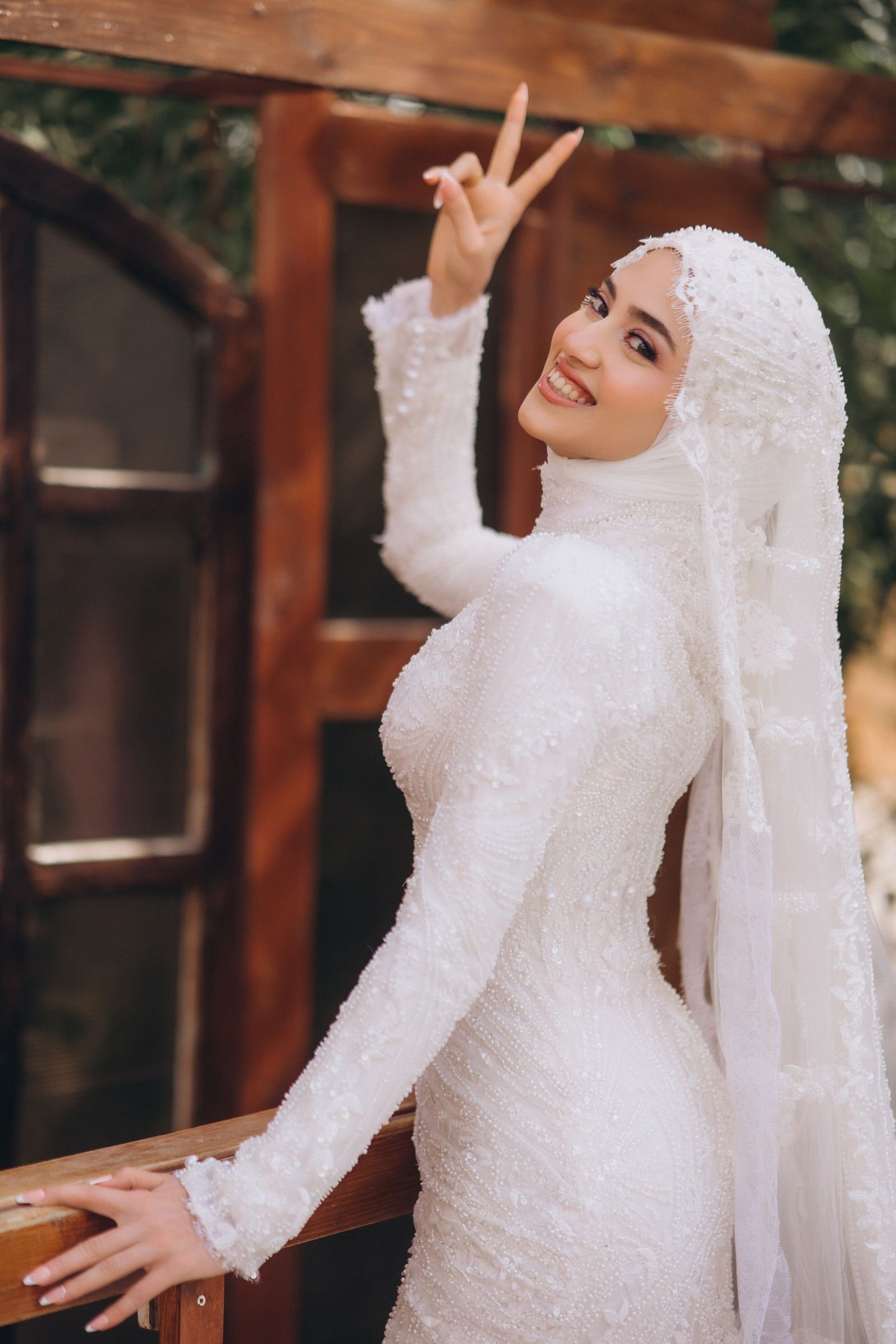
What Should a Wedding Dress With Sleeves Still Let You Do Comfortably Once the Ceremony, Photos and Sitting All Begin?
A wedding dress can have sleeves and still ask too much from the bride who chose it for coverage. The sleeve may be lace with open spaces. The neckline may only look high because a sheer panel is holding the shape. The back may be lower than the first photograph suggested. The skirt may look full while the lining underneath is narrow. Sleeves matter deeply, but they are not the whole modesty decision.
That is why a bride needs more than a list of pretty gowns. She needs a way to read the dress. She needs to know what is opaque and what is only illusion, what can be altered and what would require rebuilding the gown, what will move calmly through a long day and what may feel secure only while standing still in a boutique mirror.
This guide is for the bride who wants a wedding dress with sleeves that still feels unmistakably bridal. She may wear hijab, she may want a veil, she may want both, or she may have another coverage preference altogether. The point is not to make the gown plain. The point is to choose a dress whose beauty is supported by construction, movement and honesty. For wider modest dressing principles beyond bridalwear, the complete modest fashion guide gives the broader foundation. Here, the focus stays on the bride, the sleeves, the gown and the wedding day itself.
Sleeves solve one bridal problem, not the whole dress
Long sleeves can feel like relief after a bride has seen rows of sleeveless, strapless or deeply open gowns. That relief is real, but it should not end the inspection. A sleeve covers the arm only if the fabric is genuinely doing that job. It also has to work with the shoulder, armhole, bodice, neckline and back. These pieces move together. When one part pulls, another part may shift.
A sleeve that looks secure while the bride stands still may lift the bodice when she raises her arms. A lace sleeve may appear dense in warm shop lighting and become visibly open near a window. A fitted sleeve may make the gown look polished but restrict the elbow when she hugs family or carries flowers. A bride should never feel that she must accept these issues because the dress technically has sleeves.
The better question is not simply, does this gown have sleeves? The better question is, do the sleeves give the coverage, comfort and movement I need for the way I will actually wear this dress?
Write the non-negotiables before the appointment
A bride often becomes more flexible once she is standing inside a beautiful gown. That can be lovely when it opens her to a style she did not expect. It can also be risky when it slowly moves her away from the coverage she came for. Before appointments, it helps to write the standards in plain language: opaque sleeves, a neckline that remains secure, a back that feels comfortable, lining in the right places, enough room to sit, and a hem that works with the shoes she intends to wear.
This written standard protects the bride from vague advice. Instead of saying she wants something modest, she can say exactly what must be checked. Maybe the sleeves must be opaque, but the skirt shape is flexible. Maybe the back must be high, but the fabric can be simple or decorated. Maybe hijab integration matters more than a veil. Clarity does not remove beauty from the process. It gives beauty a safe place to land.
No bride should have to defend her standard as though it is an inconvenience. The dress is supposed to serve the woman wearing it.
Opaque sleeves and lace sleeves are different promises
Lace sleeves can be beautiful, but lace is often patterned with open space. The sleeve may reach the wrist and still reveal the arm beneath it. Tulle, mesh, chiffon and embroidered net can create a similar effect. From a distance, the sleeve may read as complete. Up close, or under stronger light, it may behave differently.
A bride should check the sleeve in more than one condition. Stand near natural light. Bend the elbow. Raise the arm. Look at the upper arm, the shoulder and the underarm, not only the wrist. Fabric stretches and opens in places where the sleeve works hardest. If the bride wants opacity, she needs to know whether the sleeve is actually opaque, lined, partly lined or intentionally sheer.
Adding lining can help, but lining is not invisible. It can change the colour of the lace, the contrast of embroidery, the weight of the sleeve and the way the wrist falls. That does not make lining wrong. It simply means the bride should decide with evidence.
A high neckline may still be an illusion neckline
Many bridal gowns create the appearance of a high neckline with sheer mesh. Lace motifs may sit over that mesh, giving the eye a covered shape while the actual fabric remains transparent. Some brides are happy with this. Others are not. The important point is that a high-looking neckline is not automatically the same as opaque coverage.
The bride should ask how the neckline is constructed. Is it solid fabric? Is it lace over mesh? Is it lined behind the lace? Does the lining stop at a certain point? Does the neckline remain stable when she sits, turns her head or wears a scarf with it? These are practical questions, not criticisms of the design.
A scarf should complete the gown, not rescue it. If hijab has to be pinned under tension to hide a gap, the gap is still part of the dress. On a long wedding day, the bride deserves a neckline that does not depend on constant adjustment. It should hold its place while she moves, greets people and lives inside the gown.
The back view can change everything
A wedding dress can look covered from the front and be open at the back. Low backs, keyholes, sheer lace panels, corset lacing and cut-out details are common in bridal design. None of these features are automatically wrong, but they must be known. The bride should never decide from the front mirror alone.
Ask for back photographs, side photographs and a short movement view if possible. If the gown has buttons, a zip or lacing, check whether the closure is supported by opaque fabric or sheer construction. If a veil will sit over the back, remember that a veil is not a fixed back panel. It moves, lifts, shifts for photographs and may be removed later. It should not be the only reason the bride feels covered.
Closing an open back can be complicated. The zip, boning, lace pattern and bodice shape may depend on the original design. Sometimes the best answer is not a difficult alteration. Sometimes it is a different gown whose back already respects the bride's standard.
Corset construction needs comfort as well as shape
Structured bridal gowns can use boning, internal cups, lace-up backs and firm bodice seams. These details can support a heavy skirt and keep the gown sitting properly. The issue is not whether structure is good or bad. The issue is whether the structure works for the bride's coverage preference, comfort and movement.
A gown may have sleeves and a high front but still fit very closely through the chest, waist or hips. Skin coverage is not the only question. The silhouette also matters. The bride should sit fully, breathe normally, turn, bend slightly and raise her arms. If the bodice presses painfully, shifts the neckline or creates tension across areas where she wants ease, that is garment information. It is not a judgment on her body.
Sizing up is not always the answer. A larger bridal size may loosen the waist but disturb the shoulder, bust support or neckline. The better solution may be another size, a careful alteration, a softer silhouette or a different gown.
A full skirt does not guarantee a modest gown
A full skirt can create distance from the body, but it does not prove the whole dress meets the bride's standard. A ball gown can still have a sheer bodice, low back, transparent sleeves or narrow inner lining. An A-line gown can still pull through the waist or reveal more at the neckline than expected. Silhouette labels describe shape. They do not prove coverage.
The bride should look at the skirt layers separately. The outer layer may be tulle, lace or another light fabric, while the opaque lining may stop higher or sit much closer to the legs. If the lining is narrow, walking can become difficult even when the outer skirt looks generous. If the lining is pale, strong light can reveal more than the boutique mirror suggests.
Take real steps. Sit. Climb stairs if the setting allows. A wedding gown has to move through entrances, photographs, transport, meals and greetings. A skirt that only works from the front pose can become exhausting.
Simple gowns can still feel bridal
Some brides worry that choosing more coverage means losing the bridal feeling. That fear often comes from seeing bridalwear divided into two rooms: the dramatic gowns with the details she loves, and the covered gowns that feel like an afterthought. A well-chosen sleeved dress does not have to accept that split.
Bridal feeling can come from proportion, fabric, movement, covered buttons, a thoughtful veil, a soft train, a beautiful sleeve line, a precise collar, quiet embroidery or the calm of a gown that finally feels like it belongs to her. Heavy beadwork is not the only route. A simple dress with excellent fit can feel more bridal than an overloaded gown that makes the bride keep fixing herself.
The question is not whether the gown is plain or ornate. The question is whether the design choices speak the same language. Sleeves, neckline, back, skirt and head covering should feel connected. When they do, modesty and bridal beauty stop competing.
Alterations should be assessed before the deposit
Bridal alterations can be powerful, but they have limits. Raising a neckline, lining sleeves, closing a back, changing a hem or adjusting a bodice may all be possible in some gowns. In others, lace placement, beadwork, boning, seams, zips or fabric availability may make the alteration difficult or visibly different from the original design.
A bride should not buy a gown assuming someone can fix everything later. If the dress requires several major changes before it meets her standard, that is a warning sign. The seamstress may be excellent, but the gown still has its own construction. Some designs welcome modification. Others resist it.
Ask early. Show the coverage standard. Ask what can be altered, what might change visually and what cannot be promised. Do not ask for invented costs or universal timelines; those depend on the actual gown and professional working on it. The key is feasibility before commitment, not panic after purchase.
Adding sleeves is not always the simple answer
Many brides fall in love with a sleeveless gown and imagine adding sleeves later. Sometimes that can work. Sometimes it changes the dress more than expected. Sleeves need the right armhole, fabric, structure and balance. A strapless bodice may not have the support points needed for a sleeve that looks original. Matching lace or fabric may be difficult. The added sleeve can change the whole upper body of the gown.
If sleeves are central to the bride's standard, a dress designed with sleeves from the beginning is often calmer. The shoulder, bodice and sleeve can work together rather than being forced into a design that did not plan for them. This does not mean every sleeveless gown must be rejected, but it does mean the bride should be honest about how much rebuilding is required.
A sleeve should not look like an apology attached after the dress was already finished. It should feel like part of the gown's language.
Lining sheer sleeves can change the romance of the sleeve
When a bride sees delicate lace sleeves, she may imagine simply placing lining underneath for coverage. That may solve opacity, but it can also change the character of the sleeve. The lace may stand out more strongly. The colour may look warmer or cooler. The sleeve may become stiffer. The wrist may no longer fall in the same soft way.
This trade-off is not failure. It is information. A bride may prefer the lined version because it gives her ease. Another bride may decide that the alteration changes the gown too much and continue looking for a dress with opaque fabric from the beginning. Both decisions can be thoughtful.
The important thing is to view the lined sleeve as a new design choice, not an invisible repair. Ask to see fabric samples where possible. Hold potential lining behind the lace. Look in daylight. The bride deserves to know what she is choosing, not only what she is hoping for.
Raising a neckline can affect the whole bodice
Filling a low neckline is not always as simple as adding a small panel. The neckline may be tied to the bodice shape, lace direction, straps, seams, internal structure and proportions of the gown. A panel that gives coverage may also change how the dress frames the face, how it sits under hijab and how the upper body balances with the skirt.
A good alteration should look intentional. If the added fabric seems like a patch rather than part of the gown, the bride may not feel the peace she wanted. This is especially true when the dress has heavy lace, embroidery or beading. Matching texture and placement can be difficult.
If a neckline must be raised for the bride to feel comfortable, that conversation should happen before purchase. The answer may be yes, no or yes with visible design changes. All three answers are useful. What is unsafe is buying first and discovering later that the dream neckline cannot become the gown she needs.
Slits need to be checked in movement
A gown can be floor length and still have a slit. The slit may be subtle while standing and open more when the bride walks, sits, steps into transport or climbs stairs. Sleeves do not cancel this issue. A bride who wants a covered lower body needs to inspect the skirt construction, not only the hem length.
Ask whether there is a slit. If there is, check how high it opens during normal movement. Look at the lining, not only the outer layer. Some slits can be reduced or closed, but fabric, seams and skirt shape affect the result. Do not assume the change will be invisible.
If a bride loves the rest of the gown, a slit may become an alteration conversation. If the slit is central to the skirt design, closing it may change how the dress moves. Again, the goal is not fear. The goal is evidence before commitment.
The train is beautiful, but it is also a practical feature
A train can make a gown feel ceremonial. It can add presence, movement and softness behind the bride. It can also affect walking, stairs, transport, outdoor ground, crowded rooms and photographs. The longer or heavier the train, the more the bride needs a plan for what happens after the entrance.
Do not judge a train only by how it looks spread across the floor. Ask how it will be managed later. Can it be lifted? Can it be held? Can it be secured depending on the gown and alteration plan? Do not assume every dress has a bustle or that every train can be managed in the same way. The construction matters.
A bride wearing hijab or a veil should also consider layers at the back. A veil, scarf fabric, train and possible cape can all meet behind her. That can look beautiful, but it needs testing so the back view feels graceful rather than tangled.
Sitting is one of the most revealing bridal tests
A wedding dress may look perfect while standing and feel completely different when the bride sits. Structured bodices can press. Necklines can lift. Sleeves can pull at the shoulder. Skirts can tighten across the lap. Trains can gather awkwardly. If the bride will sit for a meal, nikah, photographs, speeches or travel, sitting is not optional information.
Sit fully, not halfway. Let the dress settle. Notice whether breathing feels normal, whether the neckline moves and whether the bodice digs. If the dress requires the bride to stay rigid, it may not serve the day. Comfort is not vanity. It is part of being present.
This test is especially important with fitted gowns, firm corsetry and narrow linings. A gown can pass the standing mirror and fail the chair. That does not mean the bride's body is wrong. It means the garment needs adjustment, a different size, another silhouette or another choice.
The reach and embrace tests matter on a wedding day
Wedding days involve arms. A bride reaches for her bouquet, adjusts fabric, greets relatives, embraces family, holds hands, lifts a skirt edge, steps into a car and moves through many small moments. Sleeves should be tested for those movements. If they restrict the arms severely, pull the bodice or shift the neckline, the problem will not disappear because the day is important.
Raise both arms gently. Reach forward. Bend the elbow. Move as though greeting someone. The sleeve should not feel like a locked tube. It should support the shape of the gown while still allowing ordinary movement. Lace and mesh sleeves can be delicate, so the bride should also notice whether jewellery, bouquet stems or beading might catch.
These tests do not need to become a rigid ritual. They are simply reminders that the dress will be worn by a living woman, not displayed on a mannequin.
Footwear changes the hem and the whole posture
Heels are not required to look bridal. A bride may choose flats, low heels, block heels, platforms or another shoe that works with her comfort and venue. The gown should be fitted with the footwear she actually intends to use. A hem measured for high heels can become too long with flats. A hem measured for flats can lift too much with heels.
Footwear also changes posture and movement. A bride who feels unsteady may hold her body differently, lift the skirt more often or become tired earlier. Bridal beauty should not depend on pain. The shoe and gown need to cooperate.
Venue matters as well. Carpet, grass, stairs, polished floors and outdoor paths all affect walking. If the bride has a train, a full skirt or a narrow lining, footwear becomes part of the modesty and movement decision. The question is not which shoe looks most dramatic in a photograph. It is which shoe lets her move calmly in the dress she chose.
Hijab should be planned with the dress, not added at the end
For a hijabi bride, the scarf is part of the bridal design. It affects neckline, shoulder line, veil placement, jewellery, headpiece, sleeve detail and the way the face is framed. Leaving hijab until the final fitting can create avoidable problems. The dress may have neckline details that disappear under the scarf, shoulder beading that catches fabric or a back veil arrangement that conflicts with scarf layers.
Bring the hijab fabric, or a close substitute, to fittings. Check how it sits with the neckline. Check whether it needs pins near lace or beading. Check whether the scarf fabric changes the balance of a veil. A matte scarf may calm a highly decorated gown. A softer fabric may suit a simple gown. These are design decisions, not afterthoughts.
The hijab should complete the look. It should not be forced to hide a neckline or back that the bride already knows does not meet her standard.
A veil is optional, and it is not the same as hijab
A bride may wear hijab only, hijab with a veil, a veil arranged over hijab, or another culturally meaningful head covering. None of these choices should be treated as the only bridal answer. A veil can add ceremony and softness, but it is not required for every bride to feel complete.
If she does choose a veil, she should test weight and attachment. A heavy veil can pull on pins, disturb the scarf or create discomfort after several hours. A long veil can interact with the train and back of the gown. Embellishment can catch on lace sleeves or shoulder details. These issues do not mean the veil is wrong; they mean it should be tried properly.
The veil should support the bride's ease. It should not become another layer she has to manage nervously while also managing sleeves, skirt, train and family attention.
Jewellery and headpieces should not compete with the sleeves
Long sleeves often carry detail: lace, buttons, embroidery, cuff shapes or beading. Jewellery should be chosen around what the dress already does. A heavily decorated sleeve may not need a bracelet. A high neckline under hijab may not need a necklace. Earrings may not be visible depending on the scarf style. A headpiece may be lovely, but it is optional.
Accessories should not become a second gown fighting the first one. If the dress has ornate sleeves and a veil, quieter jewellery can let those details breathe. If the gown is simple, a careful brooch, ring or head detail may add a bridal finish without overwhelming the bride.
Practicality matters too. Anything near lace or tulle can catch. Rings may snag delicate sleeve fabric when adjusting the train or bouquet. The most refined choice is often the one that lets the bride move without worrying about damage.
Do not let decoration become a substitute for fit
Beading, pearls, embroidery and lace can make a gown feel special, but they do not fix poor construction. A sleeve that is too tight remains too tight even if it is embroidered. A bodice that presses painfully remains uncomfortable even if it sparkles. A sheer neckline remains sheer even if lace sits beautifully over it.
It helps to separate admiration from evidence. The bride can love the decoration and still ask whether the dress works. Does the sleeve move? Is the neckline dependable? Is the back acceptable? Does the lining provide the coverage she expects? Can the dress be altered without damaging the details? These questions protect the beauty of the gown by making sure it can actually be worn.
More detail is not automatically more bridal. Sometimes a cleaner dress with stronger fit gives the bride more peace than a dramatic gown that keeps creating practical problems.
Fitted silhouettes need nuance, not body shame
Some bridal silhouettes follow the body more closely through the bodice, hip or thigh before opening lower down. A bride may love that shape, dislike it, or feel unsure. The article should not tell her that certain bodies are allowed to wear it and others are not. The question is not whether her body deserves the style. The question is whether the dress shape suits her own modesty standard and movement needs.
If a fitted gown is being considered, check how it behaves while walking and sitting. Look for pulling, cling, lining tension and comfort. If the bride wants more ease, the answer might be another cut, a different fabric, a size adjustment or a different gown. It should never be weight-loss advice.
The bride is not a project for the dress. The dress is the object being evaluated. Keeping that order clear protects the fitting from becoming cruel.
Petite, tall and plus-size fit should be judged by measurements
Bridal sizing does not always feel like everyday clothing. A bride should rely on the specific gown's measurements, size chart and fitting process rather than assuming her usual size will translate exactly. Bust, waist, hip, shoulder, sleeve length, height and proportion all matter. Weight alone cannot decide any of them.
A petite bride may need more than a hem change. Sleeve length, shoulder width, waist placement and bodice depth can all affect the way the gown sits. A tall bride may need full length checks, sleeve checks and train awareness. A plus-size bride should not be told to hide herself or choose only certain shapes. She needs the same thing every bride needs: a gown with enough ease, stable construction and respectful fit.
Measurements are technical. They are not moral. The aim is not to make the bride smaller. The aim is to choose a dress that can move with her body through the day.
Modesty panels should look intentional
Some gowns can be adapted with panels at the neckline, back or sleeves. A good panel should feel like part of the dress, not a rushed cover-up. Matching fabric, lace direction, colour, edge finish and placement all matter. A panel can give peace when it is well planned. It can also make a gown feel less bridal if it looks disconnected.
The bride should ask whether the panel will be visible, whether that visibility is acceptable and how it changes the design. A sheer panel is not the same as an opaque panel. A skin-toned insert is not the same as matching bridal fabric. A lace insert may need support underneath. Details matter because they decide whether the alteration will honour the gown or fight it.
If every major area needs a panel, the dress may not be the right foundation. There is no shame in continuing the search for a gown that begins closer to the bride's standard.
Online bridal buying needs full-garment evidence
Buying a wedding dress online requires more evidence than buying a simple everyday garment. The bride needs front, side and back views. She needs close-ups of sleeves, neckline, back, lining and closure. She needs information on fabric, measurements, return terms, custom terms and alteration expectations. If a detail is missing, it should be treated as unknown, not assumed to be fine.
Video can help because it shows how the dress moves, but even video is not a substitute for measurements and construction details. Screens can change colour. Lighting can hide transparency. A model photograph may not show the back clearly. If the dress is important and the wedding date matters, uncertainty becomes expensive emotionally as well as financially.
The bride should ask questions before ordering. Are the sleeves lined? Where does the lining end? Is the neckline mesh? Is the back open? Is there a slit? What are the exact measurements? Clear answers help her decide whether the gown deserves a place in the final shortlist.
When style names appear, return to the garment
A bride may arrive with names, saved screenshots, boutique references or style notes. Those can help her remember what she liked, but they should not become the article's voice or the basis of the decision. The actual gown in front of her must still be checked for sleeves, neckline, back, lining, opacity, fit and movement.
Two dresses can share similar wording and behave completely differently. One long-sleeved gown may have opaque crepe sleeves. Another may have open lace sleeves. One high neckline may be solid fabric. Another may be sheer mesh. One full skirt may have a wide lining. Another may be narrow inside. The wording around the dress does not replace construction evidence.
This is also how the bride avoids being pushed into a product-catalogue mentality. She is not collecting names. She is choosing the gown she will live in on one of the most significant days of her life.
Guest and attendant ideas must stay outside the bridal decision
A bride choosing her own wedding dress is not solving the same problem as a guest choosing an outfit. Guest colour etiquette, reception dresses, attendant gowns and occasionwear all have their own questions. They should not take over the bridal article. The bride's dress carries different emotional, practical and construction demands.
This distinction matters because wedding language can become crowded. A modest dress for a guest may only need to work for a few hours of attendance. A bride's gown has to carry ceremony, movement, photographs, family contact, possibly prayer, travel and a much stronger sense of identity. It also often involves more complex structure and alterations.
When the bride is the reader, the advice should stay with her. Does this gown meet her standard? Does it feel bridal to her? Can she move in it? Can it be altered responsibly? Does it work with hijab or veil where relevant? That is enough.
Faith language should be careful and never cruel
Many brides connect modest dressing with faith, intention and personal boundaries. That deserves respect. It does not give an article permission to make religious rulings, label a specific gown lawful or unlawful, rank brides spiritually or shame women with different standards. Bridal fashion guidance should remain guidance.
A bride may need to discuss details with someone she trusts religiously or personally. She may have family expectations, community norms or private convictions. The article can help her ask construction questions, but it should not pretend to replace scholarship, family context or her own conscience.
Respectful language matters. Avoid phrases that suggest a proper bride must choose one exact look. Avoid implying that white is spiritually superior or that sparkle is wrong. Avoid turning modesty into fear. The aim is to help the bride choose thoughtfully without making her feel watched, judged or diminished.
Do not make weight loss part of the gown plan
A bride should not be told to buy a smaller dress as motivation, diet into the gown, hide problem areas or change her body to deserve bridal beauty. That kind of advice is harmful and unnecessary. A wedding dress should be chosen for the body that exists now, using current measurements and realistic alteration options.
If the bride expects natural body changes before the wedding, that can be discussed with a fitter in a practical way. But the core decision should not rely on shrinking, punishing or pressuring herself. A gown with structure needs accuracy. Ordering too small can create stress, expensive alterations and emotional harm.
The dress is the adjustable object. The bride is not defective. Fit conversations should stay with shoulders, bust, waist, hips, length, sleeve movement and construction. Technical language can be kind. It can help without wounding.
Family opinions can help, but they should not drown the bride
Wedding dress appointments can become loud. One person may want more sparkle. Another may want a larger skirt. Someone may prefer a different colour. Someone else may think a modest gown should look a certain way. Family love can be real and still become overwhelming.
The bride needs one or two trusted people who understand her standard, not a crowd of competing preferences. A good supporter can notice whether the back is open, whether the sleeve pulls, whether the bride looks comfortable and whether the gown still feels like her. That is more useful than simply reacting to drama in the mirror.
After the appointment, the bride should return to her written standard. Did the dress meet the non-negotiables? Did it feel bridal without asking her to ignore discomfort? Did it need one reasonable alteration or several major rebuilds? Family joy is precious, but the bride is the one who must wear the gown.
A bride should know when a gown is asking for too many fixes
Some dresses are close to right. A sleeve lining, a hem adjustment or a small bodice tweak may bring the gown into harmony. Other dresses ask for too much: add sleeves, raise neckline, close back, line bodice, reduce slit, manage train, change fit and rebuild the upper body. At that point, the bride may be trying to create a new dress from an old one.
Knowing when to walk away is not defeat. It is protection. A gown that needs too many structural changes may lose the detail the bride loved in the first place. It may also cost more time, energy and uncertainty than a better foundation would require.
A peaceful gown does not have to be perfect from the first moment, but it should not need the bride to negotiate with every major part of it. When the essential areas already work, alterations can polish. When the essentials fail, alterations become rescue work.
Use a final fitting checklist that respects the whole day
Before saying yes, the bride should check the dress as a complete garment. The list should serve her decision, not make her anxious. It should include sleeve opacity, neckline construction, back coverage, bodice comfort, lining length, skirt movement, slit behaviour, train management, hem with shoes, hijab or veil placement, sitting, reaching and walking.
It can help to photograph the front, side and back. Look again after the appointment when the first emotion has settled. A dress can feel magical and still reveal practical problems. Another dress can feel quieter at first and become the clear choice because it honours every important need.
The final question is simple but serious: can I wear this dress for the actual day, with the people, movement, worship, photographs, weather and emotions that belong to my wedding? If the answer is yes, the bride can move forward with more trust.
| Part of the gown | What the bride should verify | Why it matters |
|---|---|---|
| Sleeves | Opacity, lining, movement and wrist comfort | Length alone does not prove coverage |
| Neckline | Opaque fabric or illusion mesh, stability and scarf compatibility | A high shape may still be sheer |
| Back | Height, closure, mesh, lacing and alteration feasibility | The front view can hide the main exposure |
| Bodice | Comfort while sitting, breathing and turning | Structure should support the bride, not punish her |
| Skirt | Lining width, lining length, slit and stride | A full outer layer can hide a narrow foundation |
| Train | Weight, handling and later movement | Drama still needs a practical plan |
Supporting pieces should help, not sell a fantasy
Once the gown passes the construction checks, supporting pieces become easier. Shoes, scarf, veil, underlayers, pins and outer layers should serve the dress and the bride's movement. They should not be used to hide major design conflicts. If a scarf, cape or outer layer is necessary for coverage, it should be planned intentionally rather than added in panic.
A bride may also want modest outfit inspiration for other parts of her wedding season, family events or later wardrobe building, and she can browse related modest styles separately. That should not be confused with a claim that ordinary collection pieces are bridal gowns. The wedding dress decision remains its own careful choice.
Commercial trust matters. A bride deserves guidance that helps before it sells. If no exact bridal product evidence is available, the article should not invent bridal stock, fabric claims, delivery promises or alteration guarantees. Honesty is part of the service.
The gown should let the bride be present
The right sleeved wedding dress is not the gown that impresses everyone for ten seconds and then makes the bride manage discomfort for ten hours. It is the gown that lets her enter the day with steadiness. It allows her to move. It lets her sit without fear. It works with hijab or veil if she chooses them. It gives beauty without asking her to abandon her standard.
Presence matters because a wedding is not only a photograph. It is voices, family, food, greetings, prayer for some brides, weather, stairs, nerves, joy and small private moments. The dress will be part of all of that. If it constantly needs rescue, the bride may become more aware of the garment than the day.
When the sleeves, neckline, back, lining and movement all work together, modesty feels less like a problem to solve and more like a design language. That is the aim.
Frequently asked questions about modest wedding dresses with sleeves
These answers stay with the bride choosing her own wedding dress. They do not turn the topic into guest outfits, attendant dresses or general occasionwear.
Are long sleeves enough to make a wedding dress modest?
No. Long sleeves help with arm coverage, but the bride still needs to check sleeve opacity, neckline, back, bodice fit, lining, slit, skirt movement and how the gown behaves when she sits, reaches and walks.
How can I tell if bridal sleeves are sheer?
Look at the sleeves in daylight and with flash, then bend and raise the arms. Lace, mesh, tulle and chiffon can look denser on a hanger than they do over the arm, especially around the upper arm and elbow.
Can lace sleeves be lined for more coverage?
Often they can, but the result depends on the gown. Lining can change colour, contrast, stiffness, sleeve shape and movement, so the bride should see the likely effect before relying on it as the solution.
What should I check with an illusion neckline?
Check whether the neckline is opaque fabric or sheer mesh with lace over it. A high-looking shape is not the same as full coverage. Test it with sitting, turning and hijab placement where relevant.
Can an open-back wedding dress be altered for more coverage?
Sometimes, but not always easily. Zip placement, corsetry, lace motifs, buttons, seams and available fabric all matter. A bride should confirm alteration feasibility before buying, not after the deposit is paid.
Is a ball gown automatically modest?
No. A full skirt may provide volume, but the bodice can still be low, sheer, fitted or open at the back. The entire gown needs inspection. Shape names do not prove coverage.
Should I size up for a more modest bridal fit?
Not automatically. Bridal gowns often rely on precise shoulder, bust, waist and bodice placement. Sizing up may solve one area and create instability elsewhere. Measurements and targeted alterations are safer than a universal rule.
How should hijab be planned with the wedding dress?
Bring the hijab fabric, or a close substitute, to fittings. Test it with the neckline, sleeves, veil, headpiece and shoulder details. Hijab should complete the design, not hide construction problems.
Can I wear a veil over hijab?
Yes, many brides do, but it is optional. The veil's weight, attachment and length should be tested with the scarf so it does not pull, disturb pins or make movement uncomfortable.
What movement tests matter most?
Sit fully, raise both arms, reach forward, greet someone, walk full steps and try stairs if possible. These movements reveal sleeve restriction, neckline shifting, bodice pressure, lining tension and train management issues.
What should I check before buying a bridal gown online?
Ask for front, side and back views, sleeve and neckline close-ups, lining details, measurements, back construction, slit information, custom terms and alteration expectations. Treat missing details as unknown.
Can a simple sleeved dress still feel bridal?
Yes. Bridal feeling can come from fit, proportion, fabric, movement, covered buttons, train, veil, hijab integration, texture and personal meaning. Heavy decoration is not required for a gown to feel complete.
A final word for the bride choosing sleeves
May the gown you choose hold both beauty and ease. May it let you enter the day without feeling that bridal joy and modesty live in separate rooms. You are allowed to want sleeves, coverage, softness, structure, movement and a dress that still feels like your wedding dress.
Choose with evidence, not pressure. Let the sleeves prove themselves in light and movement. Let the neckline, back and lining be checked honestly. Let alterations support the garment without asking your body or your values to become smaller. The dress should serve the woman wearing it.
When the gown lets you breathe, walk, embrace your family, pray if that is part of your day and look in the mirror without negotiating with discomfort, it has done more than look bridal. It has honoured the bride.