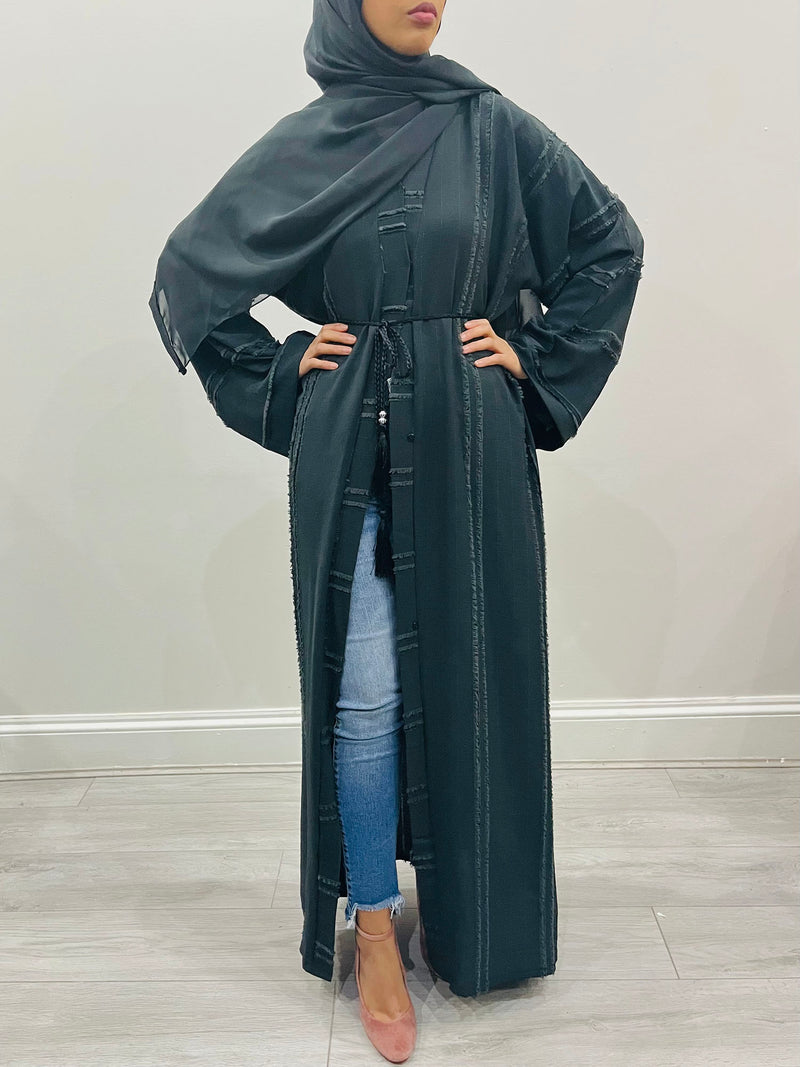
Grey Muslimah Dress Styling Doesn’t Need a Splash of Bright Colour — Sometimes Texture Is Enough
Grey is one of those colours that tells you very quickly whether an outfit has enough going on. In black, a simple dress can look deliberately severe. In navy, the depth of the colour does some of the work for you. Grey is quieter. Put a smooth grey dress beside a near-matching scarf, add shoes in the same middle tone, and the whole outfit can merge into one long, polite column before you quite understand why the mirror feels unfinished.
That does not mean grey needs bright accessories or heavy embellishment. Most of the time it needs only one clear difference: matte beside sheen, soft beside structured, charcoal beside dove, a textured hijab beside a smooth dress, or a darker coat cutting through a pale base. Once one surface or one tone has a distinct job, grey starts to look intentional rather than absent.
A grey Muslimah dress can be especially beautiful because modest silhouettes give colour a large uninterrupted area in which to work. Long sleeves, a full skirt, a loose body and generous length create calm coverage, but they also mean there is a lot of one colour in view. The answer is not to break that coverage for the sake of shape. It is to use fabric, proportion, layers and tone more intelligently.
This is the kind of outfit where small choices are visible. The weave of the dress, the depth of the hijab, the finish of a bag, the line of a coat and the way the skirt moves can matter more than adding another colour. If you want the broader principles of building modest outfits around fabric, coverage and proportion, the complete modest fashion guide gives that wider context. Here, we can stay with grey and solve the particular problem it creates so well.
Grey only feels flat when every surface speaks at the same volume
Flatness is not the same as simplicity. A simple outfit can be beautiful because the eye understands where to rest. A flat outfit has no clear hierarchy: the dress, scarf, shoes and outer layer are all similar in depth, similar in texture and similar in visual weight. Nothing is wrong with any individual piece, yet together they blur.
Imagine a mid-grey crepe dress with a mid-grey chiffon hijab, pewter flats and a grey cardigan. If the dress is smooth, the scarf is smooth, the cardigan is fine-knit and every shade sits within a narrow middle range, the outfit may look washed into one surface. Change only the scarf to a deeper charcoal with a visible georgette texture and the whole arrangement can suddenly make sense.
You can create that difference in several ways. Tonal contrast uses lighter and darker greys. Textural contrast places a grainy, pleated, ribbed or softly crinkled surface beside a smoother one. Finish contrast uses matte against subtle sheen. Structural contrast pairs a fluid dress with a cleaner coat, tailored bag or defined shoe. You rarely need all four at once.
This is useful if you prefer a restrained wardrobe. You do not have to introduce burgundy, green, rose and gold simply because grey seems quiet. One controlled contrast can be enough. The more modest and expansive the silhouette, the more effective a single deliberate difference often becomes because it can be read from across the whole outfit.
Before buying anything new, stand back from the mirror and ask what is actually missing. If the colour depths are already different, perhaps the problem is texture. If the surfaces already vary, perhaps the outfit only needs one darker line at the face or outerwear. Diagnosis is cheaper and usually better than adding another accessory.
Begin with undertone before you decide what should contrast
Grey is not one temperature. Some greys lean blue, violet or steel. Others carry brown, taupe, green or mushroom warmth. Charcoal can look almost blue-black in daylight, while a pale warm grey may sit surprisingly close to stone or greige. If you ignore undertone, an outfit can feel disjointed even when every piece is technically “grey”.
Daylight is the easiest place to see this. Hold the dress beside something you know is a neutral black, cream and navy. A cool grey often looks cleaner beside navy and may make cream appear yellow. A warm grey usually feels more at home beside taupe, camel or chocolate. You are not trying to perform a colour-analysis test; you are simply looking for the family the dress already belongs to.
This matters most near the face. A cool silver-grey dress with a warm beige hijab can be beautiful if the contrast is deliberate, but a nearly matching warm-grey scarf may look accidental if its undertone disagrees. Likewise, a mushroom-grey dress paired with icy silver accessories can create a sharpness you may not have intended.
When you do want contrast, decide whether you want temperature contrast or depth contrast. A charcoal hijab on a pale cool-grey dress keeps the temperature related while changing depth. A cocoa or taupe scarf on the same dress introduces warmth. Both can work, but they create different moods.
Grey becomes much easier once you stop asking, “What matches grey?” Almost everything can. The more useful question is, “What kind of grey am I looking at, and do I want to echo it or interrupt it?” That small shift gives the rest of the outfit direction.
Texture can do the work that another colour would normally do
If you want to stay within one grey family, texture is the strongest tool you have. A smooth dress beside a softly pleated hijab creates visible separation even when the colours are close. A matte crepe dress under a fine knit cardigan gains depth through surface alone. A satin panel, embroidered cuff or chiffon overlay can catch light differently without making the outfit colourful.
The reason is simple to see: texture breaks light into smaller changes. A perfectly smooth surface reflects or absorbs light evenly. A woven, crinkled or pleated surface creates tiny shadows and highlights. In grey, those shifts are especially noticeable because the colour itself is restrained.
You do not need texture everywhere. In fact, too many competing surfaces can make a modest outfit look busy. If the dress already has pintucks, pleats, embroidery or a textured weave, choose a calmer hijab. If the dress is plain and fluid, the scarf or outer layer can carry more surface interest.
Texture also gives plain grey more presence at occasions. A dress does not have to be densely embellished to look dressed. A slightly lustrous fabric against a matte hijab, a softly gathered sleeve, or a fine jacquard-like surface can produce enough richness for an evening without turning the garment into a statement piece you wear once.
Think about touch as well as appearance. Some highly textured fabrics are rougher against sensitive skin or catch on jewellery and bags. Texture is useful when it improves the outfit without becoming a maintenance problem. The best choice is one you are willing to live with for the whole day.
If the dress is smooth, give one other element a different surface
A very smooth modest grey dress can look elegant, but it often needs a companion with more character. The easiest place to add that character is usually the hijab because it sits against the face and occupies a smaller area. Crinkle, georgette, fine pleating, soft modal texture or a lightly woven scarf can separate the upper half of the outfit without changing its overall calmness.
Outerwear is another option. A smooth grey dress under a boucle-style coat, brushed wool layer, textured knit or structured matte trench creates a clear surface change. You can keep the entire palette neutral and still avoid that one-note effect. In British weather, this is practical because the coat is part of the outfit for much of the journey anyway.
Footwear can contribute too, but it should not have to rescue the whole look. Suede, grain leather, a soft metallic finish or a defined loafer shape can add a small visual break. If the dress and scarf already have enough difference, the shoes can remain quiet.
Bags work in the same way. A smooth, slouchy bag beside a smooth, fluid dress may continue the blur. A firmer bag with a clear edge gives the eye somewhere to stop. That does not mean every modest outfit needs a structured handbag; it simply shows how shape can act like texture.
Choose one place for the contrast to be strongest. If the hijab is highly textured, keep the bag and shoes simpler. If the coat is the main structural element, let the scarf sit softly. Grey looks expensive and considered when the differences seem intentional rather than accumulated.
Monochrome grey works best when at least two depths are visible
A head-to-toe grey outfit can be one of the easiest ways to make modest dressing look polished, but identical mid-grey from head to toe is rarely the most interesting version. Use a small depth range. A dove dress with charcoal hijab, a slate dress with pale grey scarf, or a medium-grey dress under a darker coat gives the monochrome idea enough definition.
The tones do not have to be dramatically different. Even a two-step shift can work when the fabrics also differ. A light matte scarf over a slightly darker satin-sheen dress may create enough separation. Likewise, charcoal suede shoes under a medium crepe dress give the hem a clear ending without introducing another colour.
Keep an eye on undertone. Three different greys can look sophisticated when they share a cool or warm family. Three near-identical greys with conflicting undertones can look as though you tried and failed to match them. If the tones are clearly different, undertone mismatch is more forgiving because the contrast reads as intentional.
Monochrome also benefits from negative space. Do not wrap every layer tightly around the body. A long open coat, broad scarf drape or fluid skirt creates areas where light and shadow move as you walk. That movement makes tonal dressing look alive.
If you enjoy very minimal dressing, this is where grey can become a signature rather than a compromise. You can wear little or no decorative detail and still have depth because the outfit is built from value, surface and movement rather than ornament.
Black gives grey a clean edge, but pure black is not the only anchor
Black is the obvious companion for grey because it creates instant definition. A black hijab sharpens a pale grey dress. A black coat gives a medium-grey outfit a stronger outline. Black shoes can ground a long skirt so the hem does not visually disappear into a similar-toned floor or pavement.
It can also be too hard for some greys. Very pale warm grey beside pure black may produce a stark contrast that feels more graphic than you wanted. Deep charcoal, espresso, navy or dark taupe can provide almost the same anchoring effect with a softer transition.
If the dress has black buttons, piping, embroidery or a belt detail already built into it, repeating black once elsewhere can make those details look intentional. You do not need to match every accessory. A black hijab and grey dress may be enough, with the bag or shoes in another quiet neutral.
For formal outfits, black can reduce the risk of too much shine. A silver-grey satin or embellished dress paired with a matte black hijab lets the dress remain special without making every surface reflective. The black becomes a visual pause.
For daytime, charcoal often feels gentler. It keeps the outfit tonal and can be more forgiving if the dress is a softer dove or mushroom grey. Try both beside your face in daylight; the difference between “defined” and “severe” is personal and often smaller than a colour chart can tell you.
Cream, taupe and brown can warm grey without turning it beige
Grey does not have to live only with black and white. Warm neutrals can make it feel softer and more human, especially if the dress itself has a taupe or mushroom undertone. Cream beside grey reduces the sharpness of white, while chocolate or mocha gives depth without the formality of black.
A warm stone hijab with a medium-grey dress can be particularly useful if you want the face area to feel gentle. The warmth is close enough to remain neutral but different enough that the scarf does not disappear into the dress. Brown shoes or a bag can then echo that warmth in a smaller way.
With cool steel grey, warm neutrals create more obvious temperature contrast. That can look sophisticated if you repeat the warm note once, perhaps in the hijab and footwear. If only one small beige item appears against an otherwise icy outfit, it may look accidental.
Cream works well when you want a lighter, cleaner result. It is especially useful with charcoal because the contrast is strong without being as stark as pure white. In winter, a cream knit, scarf or coat lining can lift dark grey without making the whole outfit pale.
You do not need to convert grey into a brown outfit. Keep the dress visually dominant and use warm neutrals as framing colours. The grey remains clearly grey; it simply gains warmth around it.
The hijab decides whether grey looks soft, sharp or washed out near the face
Because the hijab sits closest to your complexion, it often matters more than the shoes or bag. A grey dress can be perfectly suited to you while a near-matching grey scarf makes the whole outfit look tired. The solution may be as simple as changing the scarf depth or temperature.
If pale grey washes you out, try a deeper charcoal, plum, navy, chocolate or muted berry near the face. If dark grey feels heavy, try cream, stone, dusty rose, soft blue or a lighter grey with more visible texture. These are starting points, not rules. The useful test is your actual face in daylight.
Texture helps here too. A flat, smooth grey scarf may create a broad block of one tone around the face. Georgette, crinkle or a fine woven surface breaks the colour slightly, making the same shade feel more dimensional. A subtle border can do similar work if it does not make the scarf unnecessarily busy.
If the dress has detail at the neckline or bodice, keep the scarf simpler so those elements do not compete. If the dress is very plain, let the scarf provide the surface change. One of the easiest mistakes with grey is adding detail to both pieces because each one seemed quiet on its own.
Also test the scarf with the coat you will actually wear. A beautiful grey-and-mauve combination can change once a black winter coat frames the entire upper body. The final outfit is the set of layers you leave the house in, not the dress and hijab in isolation.
Fabric weight changes whether grey looks fluid, crisp or heavy
Colour cannot be separated from cloth. A grey jersey dress can look soft and casual because the fabric follows movement closely. Medium crepe can create a cleaner fall. A crisp woven fabric may hold a more architectural line. Satin catches light and can make the same grey look brighter or more silver.
For modest dressing, weight matters because it affects both drape and coverage. A fabric that is too light may cling, show the outline of underlayers or become transparent in strong light. A fabric that is too heavy may look beautiful on a hanger but feel tiring across a long day or restrict the natural movement of a full skirt.
Grey makes these differences visible. A heavy dark grey dress can become visually dense if paired with equally heavy scarf and outerwear. A light grey dress in a thin fabric can look insubstantial if every layer is equally airy. Use contrast in weight as well as colour: a fluid dress with a firmer coat, or a substantial dress with a lighter scarf.
Movement is part of the visual texture. A gathered skirt that opens as you walk creates shadow and depth. A rigid tube of fabric in one mid-grey tone gives the eye much less variation. That is why cut matters even when you want a very simple dress.
When shopping, do not rely on the word “crepe”, “jersey” or “satin” alone. Fabric names cover many qualities and blends. Look for composition, lining, close-up images, garment measurements and movement in video where available. The name tells you a family; the garment tells you how that family was used.
Pale grey deserves a proper opacity check before you build the outfit around it
Light grey can appear more opaque than white in a product photograph and still become revealing in strong daylight. Studio lighting, a matching lining and the colour of the model’s underlayers can all affect what you see. Treat opacity as a construction question, not a colour assumption.
Check the dress at the sleeves, back, lower skirt and any area where fabric stretches during sitting or reaching. Hold a contrasting layer behind the cloth if you can. If the dress is lined, check where the lining begins and ends. A lining that stops abruptly above the knee can create a visible horizontal change in a pale skirt.
Fit and opacity are connected. Fabric that looks dense while hanging loose can become more translucent when pulled across the hips, shoulders or elbows. Enough ease helps both modesty and drape. You should be able to sit, take a long step and lift your arms without turning a calm grey into a tension map.
Underdresses and slips can solve some transparency issues, but they add warmth and may alter the way the skirt moves. Decide on that extra layer before judging the size or occasion suitability of the dress. A garment is not truly effortless if it only works after you discover a complicated hidden system.
Darker grey can disguise transparency from the eye, but it does not guarantee opacity either. Backlighting is honest. Test the actual garment rather than trusting depth of colour.
Shape should come from cut and movement, not from making the dress cling
A long modest dress does not need a tight waist to avoid looking shapeless. Shape can come from shoulder seams, sleeve construction, a yoke, controlled gathers, a tier, an A-line skirt, a panel seam or simply the way the fabric falls away from the body. Those elements give the garment architecture while preserving ease.
Grey benefits from that architecture because a very plain straight column can appear visually flat. A skirt with enough sweep creates changing shadows. A softly gathered sleeve adds texture at the arm. A seam or panel can break one large surface into quieter sections without adding decoration.
If the dress includes a belt, decide how you want to use it according to your own modesty preferences and the garment design. You do not have to cinch a waist simply because a belt arrived with the dress. It can sometimes be tied loosely, used at the back, removed, or replaced by shape from the outer layer.
Check the side and back view as carefully as the front. A dress may appear loose from the front but pull across the seat when walking or sitting. A fuller skirt is useful only if the upper body also gives comfortable movement.
The aim is not to make grey more “flattering” by forcing the body into a particular outline. It is to give the fabric enough structure and motion that the outfit looks designed rather than unfinished. Good cut can do that quietly.
Long layers can create contrast without adding another busy element
An open coat, abaya-style outer layer, cardigan or long jacket can give a grey dress a vertical frame. This is especially effective when the dress is pale and the outer layer is darker. The open centre keeps the grey visible while the sides provide definition.
The reverse can work too. A charcoal dress under a cream, taupe or soft-grey coat creates a lighter frame. In spring and autumn, a long trench with a firmer surface can add structural contrast to a fluid dress without needing jewellery or print.
Pay attention to length. If the outer layer ends at an awkward point across the fullest part of the skirt, it can interrupt the silhouette. A longer layer often looks more coherent with a maxi dress, though practical length depends on your height, footwear and daily movement.
Bulk is another consideration. A voluminous dress under a very oversized coat can become physically and visually heavy. If the dress has a full skirt or large sleeves, choose outerwear with enough room but a cleaner line. If the dress is simple, the coat can afford more texture.
Grey is particularly good for layered dressing because the colour tolerates repetition. A charcoal coat over slate dress with dove hijab can look rich without using multiple colour families. The layers create the contrast.
A modest grey cocktail dress should look special through fabric and finish, not reduced coverage
The phrase modest grey cocktail dress can sound contradictory if “cocktail” is associated only with short hemlines or fitted silhouettes. In practice, the useful part of the idea is the level of occasion: a dress polished enough for an evening reception, dinner, engagement gathering or formal celebration while keeping the coverage and ease you personally require.
Grey works beautifully here because it can move towards silver, charcoal or smoky taupe depending on fabric and light. Instead of relying on exposed skin for evening impact, use a richer surface: satin-backed crepe, a chiffon overlay, fine pleating, velvet detail, beaded cuffs, embroidery or a subtle metallic thread.
Keep one area quieter. If the dress has visible embellishment, choose a matte hijab and simple bag. If the dress is plain satin, a textured scarf can prevent the upper half from looking like one reflective surface. If the scarf has sparkle or a decorative edge, let the dress remain cleaner.
Check venue lighting before committing to a very pale silver-grey. Flash can make a reflective fabric much brighter than it looked at home, while warm restaurant lighting can turn cool grey slightly beige or green. A photograph in daylight and a warm indoor room can reveal more than a product label.
Comfort still decides whether the outfit works. Sit for a meal, move your arms, walk upstairs and test the dress with the actual coat. An occasion look that demands constant protection from movement is not more elegant because it photographs well for five minutes.
Weddings and family occasions reward one deliberate point of richness
Grey can be an excellent guest colour because it is formal without automatically competing with stronger event colours. The challenge is making it look celebratory enough for the setting. One rich element is usually more effective than trying to decorate every part of the outfit.
A dove dress with embroidered sleeves may need only a deeper scarf and metallic bag. A charcoal dress with a fluid skirt can take a pearl-grey or muted mauve hijab. A smooth medium-grey gown might benefit from a brocade-style coat or textured shawl if that layer suits the event and your coverage preferences.
Jewellery is optional, not the default answer. If you wear it, keep the finish connected to the undertone of the grey. Cooler silver-toned pieces can sharpen blue-grey; warmer gold-toned details can soften mushroom or taupe-grey. Mixed metals can work too when the dress itself already bridges warm and cool.
Family events often involve more movement than formal photographs suggest. You may be greeting relatives, helping children, carrying plates, praying or moving between rooms. Keep long scarf ends, delicate beadwork and floor-skimming hems realistic for the role you will actually have.
A grey Muslimah dress at a wedding does not need to announce itself. It needs enough depth that the outfit reads as complete. Texture, a well-chosen hijab and one controlled finish can achieve that without turning quiet elegance into over-decoration.
For work, let contrast make the outfit clear rather than dramatic
Grey belongs naturally in workwear because it sits comfortably beside black, navy, cream and muted colours. A modest grey dress can simplify mornings, but the same neutrality can become dull under fluorescent light if every layer is a similar mid-tone.
Use one clear anchor. A charcoal hijab with a light-grey dress, a navy blazer over medium grey, or a cream scarf with charcoal can give the upper half definition. If your workplace is more formal, a structured bag or clean shoe shape adds another quiet line without making the outfit decorative.
Fabric behaviour matters over a long day. Check whether the dress creases badly at the lap, pills where a lanyard or bag rubs, or becomes clingy in dry indoor heating. A fabric can look immaculate at 8 a.m. and tired by lunch. Repeat-wear clothing earns its place through endurance.
Think about practical objects. ID cards, headsets, backpack straps and office chairs all interact with clothing. A highly textured scarf may catch on a rough lanyard; a long loose sleeve may drag across a desk. Make the outfit work with the tools of your day.
Grey can be extremely useful when you create two or three reliable combinations. Once you know which scarf, coat and shoes work, you can repeat the dress without it looking identical every time. Change texture or depth, not the whole wardrobe.
Everyday grey becomes easier when the fabric can handle ordinary life
An everyday dress should survive sitting in the car, carrying shopping, school runs, a quick meal and the occasional rain shower without making you protective of it. Grey is practical in some ways because it is less stark than white and softer than black, but different shades show different kinds of wear.
Very pale grey can show makeup, food marks and damp spots. Dark charcoal can show lint, deodorant traces and light dust. Mid-greys often hide small marks well, but textured surfaces may hold lint more visibly. None of this makes a shade bad; it simply tells you what care the dress will ask from you.
For regular wear, look at how the skirt moves around steps and seating. A very full hem is beautiful but may be inconvenient on public transport. A narrow skirt may restrict stride. Grey will not compensate for a cut that is wrong for your routine.
Casual styling can use softer contrast. A grey dress with a stone jersey hijab, trainers and a darker long cardigan can feel relaxed without becoming shapeless. If the dress is already jersey, use a scarf with a slightly different surface so the entire upper half does not become one soft knit texture.
The best everyday version is the one you stop worrying about after you leave the house. Grey should make dressing easier, not become a neutral canvas that requires ten additions every morning.
British winter gives grey plenty of depth if you use the coat properly
Grey suits British winter almost too well: cloud, pavement, wool and wet light all sit in the same family. That can look beautiful, but it also means an all-grey outfit may disappear into the season unless the layers have clear contrast.
Use outerwear deliberately. A black, navy, deep olive, chocolate or cream coat can frame a grey dress. If you prefer a grey coat too, choose a noticeably different depth or texture. Charcoal brushed wool over a smooth dove dress works because the surfaces and values separate.
Scarves and hijabs become important when coats are closed. Once the dress is mostly hidden, the face area carries the outfit. A warmer taupe, muted rose, deep berry or clear charcoal scarf can keep the look from becoming one grey block between collar and hood.
Wet weather changes fabric. Some greys show rain spots temporarily, especially on smooth pale materials. Long hems also collect water and road dirt. Check whether the dress length is realistic with winter shoes and whether a coat protects enough of the fabric for your commute.
Indoor heating then creates the opposite problem. Heavy dress, thick underlayer, knit hijab and wool coat can become too warm quickly. Build warmth from removable layers rather than assuming every visible piece needs to be heavy.
Summer grey needs lightness without becoming transparent or washed out
Pale grey can be lovely in summer because it feels visually lighter than charcoal and works with cream, soft blue, rose, sage and natural neutrals. The risk is that a very thin fabric looks washed out or requires so many underlayers that the supposed summer dress becomes hotter than expected.
Look for a fabric with enough body to release from the figure and enough opacity for the intended coverage. A breathable-feeling garment is about the whole construction, not just one fibre name. Lining, sleeve layers and how closely the fabric sits around the neck all affect comfort.
Use texture rather than dark contrast if you want a softer summer palette. A pale grey crepe dress with a crinkled stone hijab can have enough depth without introducing black. A woven bag or suede-effect flat can add another surface difference.
If the dress is nearly silver, bright sun may make it appear much lighter outdoors. Check it beside the hijab in direct but safe daylight before deciding the scarf is too pale or too dark. Summer light is less forgiving than a bedroom mirror.
For very hot conditions, choose health and comfort over styling persistence. If you are overheating or unwell, respond appropriately. A beautiful modest outfit should support the day, not become something you have to endure.
Shoes and bags should finish the contrast, not create a matching puzzle
Grey encourages over-matching because so many accessories are available in black, silver and grey. You can end up with a dress, scarf, bag and shoes all chosen individually because they “go with grey”, yet together they feel oddly uniform.
Let footwear ground the hem. Black, charcoal, chocolate, taupe, navy or cream can all work depending on the grey and the season. Metallic shoes can suit formal wear, but a reflective silver shoe beside a shiny silver-grey dress may be more shimmer than the outfit needs.
The bag can introduce structure. A soft flowing dress often benefits from a firmer bag shape. A structured dress can take a softer pouch or slouchier bag if that suits the occasion. This is another form of contrast that has nothing to do with colour.
You do not need a bag and shoes to match exactly. Repeating the same temperature or depth is often enough. Dark brown shoes and a taupe bag can belong together. Black shoes and a charcoal bag can create a tonal base. Cream shoes with a stone bag can lighten a pale outfit.
If the hijab already provides the main contrast, let the accessories support rather than compete. The eye should not have to solve four separate styling ideas.
Photographs and indoor lighting can change grey more than you expect
Grey is unusually responsive to light because it sits between black and white. Cool office lighting can pull blue out of a neutral grey. Warm restaurant light can make the same dress look taupe. Camera flash can turn satin grey into bright silver while making matte charcoal appear almost black.
If the dress is for a wedding, graduation, dinner or another photographed event, test it in more than one light. Stand near a window, then under warm indoor lighting. Take one phone photograph with and without flash. You are not chasing a perfect camera colour; you are checking that the hijab and dress still look related.
Texture also changes on camera. Fine pleats and embroidery may look stronger in directional light. Very subtle texture can disappear in a flat front-facing photograph. That does not mean the outfit lacks depth in real life, but it helps to know what the camera will emphasise.
Makeup and undercap colour can affect pale grey around the face. A warm foundation transfer on a cool light-grey scarf is more visible than on taupe. A black undercap can show through a sheer silver scarf. Test the complete face area, not just the dress.
Do not let photography become the main measure of the outfit. The dress still has to work while you walk, sit, eat, greet people and pray. A camera is one environment, not the whole day.
Buying a grey dress online means looking past the colour name
Online listings often give you “grey”, “charcoal”, “silver” or “stone” as though that settles the question. It does not. Screen settings, studio lights and editing can shift grey noticeably, so look for several images and, where available, photographs in natural light.
Read the fabric composition and construction details. Is the dress lined? Are the sleeves lined too? Does it have stretch? Is the skirt gathered, panelled or straight? Are the cuffs elasticated, buttoned or wide? Those details affect how the garment feels far more than a poetic colour name.
Measurements are essential. Compare garment length, chest width, sleeve length and any waist or hip measurement to a dress you already own. Do not assume a loose product photograph means the cut will give the same ease on every body.
Look closely at texture. A small product image can make crepe, jersey and satin look equally smooth. Zoom into cuffs, seams and skirt folds. If the entire purpose of the dress for you is texture, you need evidence of that surface before buying.
Check the return terms before removing tags or relying on the dress for an event. Grey is a colour where undertone and face effect can surprise you in person. A sensible return option gives you room to assess it honestly.
Once you know the type of dress, fabric and depth you actually need, you can shop related styles without treating every grey-looking item as interchangeable. Current availability changes, so use the live collection as a place to compare what is present rather than assuming a particular dress, shade or size will always be there.
A home try-on should test the whole outfit, not just the front mirror view
Keep the tags on and build the outfit you would genuinely wear: dress, underlayers, hijab, shoes, bag and coat. A grey dress can look finished by itself and become flat once a near-matching outer layer is added, or it can look plain alone and become excellent once the full contrast is present.
Stand in daylight first. Check undertone, opacity and whether the scarf and dress merge. Then move away from the mirror. Sit, take a long step, raise your arms, bend to pick something up and turn to the side. Modest coverage has to survive movement, not only a still front pose.
Put on the coat and carry the bag. Does the bag strap pull the scarf? Does the coat crush a textured sleeve? Does the hem catch under the shoe? These practical interactions determine whether the outfit will feel calm outside.
Take one photograph from the back. It can reveal pulling across the shoulders or hips that the front mirror misses. Check the lining line and whether the fabric becomes more transparent where it stretches.
Finally, ask whether you kept touching the outfit during the test. If you continually adjusted the scarf, pulled the dress away from the body or repositioned a belt, identify the exact cause. A colour problem cannot be fixed by tugging, and a fit problem cannot be fixed by adding another accessory.
One diagnostic table can tell you why the grey outfit feels unfinished
| What you notice | Likely reason | First change to try |
|---|---|---|
| The dress and hijab merge into one block | They are too similar in both depth and surface | Change either the scarf depth or its texture, not necessarily both |
| The outfit looks severe | The contrast is too hard for the grey | Swap pure black for charcoal, navy, chocolate or a warmer neutral |
| Pale grey looks washed out | There is not enough depth near the face | Try a deeper or more textured hijab and test it in daylight |
| Monochrome looks accidental | The greys are nearly matching but their undertones disagree | Use clearly different depths or bring the undertones closer together |
| The dress looks shapeless | The cut gives no seam, movement or structural break | Look at skirt sweep, panels, gathers or a clean long outer layer rather than tightening the fit |
| The formal outfit looks too shiny | Dress, scarf and accessories all reflect light | Introduce one matte surface, usually the hijab or outer layer |
| The outfit feels too busy | Several textures are competing | Choose one main textured element and quieten the others |
| The winter outfit feels heavy | Every layer is dark, thick and low-contrast | Lighten the face area or use a smoother/lighter layer in one part of the outfit |
Change one variable at a time. If you replace the hijab, coat, shoes and bag together, you will not know which decision actually solved the problem. Grey rewards small experiments because the colour is quiet enough for subtle differences to show.
This is also a useful way to avoid unnecessary shopping. Sometimes the dress is perfectly good and the existing scarf is the issue. Sometimes the scarf is lovely and the dress needs a stronger outer layer. Sometimes the outfit is fine, but the shoes keep the whole lower half in the same flat mid-tone.
Care matters because grey shows wear in its own particular ways
Grey is forgiving of some marks and surprisingly unforgiving of others. Charcoal can display lint and pale fibres. Light grey can show foundation, food marks or dirty rainwater. Smooth mid-grey may reveal pilling because the raised fibres catch light differently from the base cloth.
Follow the garment’s care label rather than treating all grey fabrics alike. Washing temperature, drying method and ironing depend on fibre and construction. A dress with pleats, embellishment or a delicate overlay may need much gentler handling than a plain jersey piece.
Wash dark greys with appropriate colours to reduce visible lint transfer and colour dulling. For pale grey, be careful with products that could alter the shade or leave residues. If a stain needs special treatment, test it on an inconspicuous area first when the care instructions allow.
Store embellished or textured dresses so rough hardware does not catch them. Avoid forcing a full skirt into an overcrowded wardrobe if the fabric creases deeply. A padded or suitable hanger can help some dresses, while knits may be better stored differently to prevent stretching.
Wear is not always a reason to discard a dress. Pilling, loose hems, missing buttons and small seam issues may be repairable. A well-cut grey dress can remain useful for years if the fabric is cared for and small problems are dealt with early.
Alterations can improve proportion without changing the modest character of the dress
A dress that is almost right can sometimes be made far more useful through a thoughtful alteration. Hem length is the obvious example. A dress that drags can become safer and cleaner when shortened to work with your usual shoes, while still keeping the length you prefer.
Sleeves can sometimes be adjusted too, depending on construction. If they cover the hands too much or catch during work, a skilled alteration may improve them. If they are too short for your needs, adding length is more complicated and may require matching fabric or a deliberate cuff.
Lining deserves specialist attention. A narrow lining under a full outer skirt can restrict stride or cling even when the dress itself looks loose. Replacing or widening a lining may transform movement, but it is work for someone who understands garment construction.
A belt loop, tie or decorative tab can sometimes be removed if it makes you feel the garment is asking for a waist definition you do not want. Likewise, shoulder pads or stiff details may be alterable depending on how they are built. Do not cut first and hope later; inspect the construction or ask a professional.
Grey is worth altering when the colour, fabric and overall cut already serve you. A small proportion correction can make the same dress work with several hijabs and coats, which is often more useful than replacing it with another almost-right neutral.
A grey Muslimah dress is a wardrobe category, not one fixed garment design
The words “Muslimah dress” are used broadly in modest-fashion shopping. They may describe a maxi dress with long sleeves and generous ease, an abaya-like closed dress, a tiered everyday style, a formal gown or another garment chosen because its coverage works for a Muslim woman. There is no single universal pattern hidden behind the label.
That is why construction matters more than the category name. Check neckline, sleeve width, length, opacity, ease through the body and how the skirt behaves in movement. A dress can be marketed towards modest wearers and still not meet every woman’s preferences or needs.
Religious practice and standards of dress are personal and can involve scholarly guidance. A clothing article can help you inspect coverage, movement and layering, but it should not pretend to issue a universal ruling about one garment. If you have a religious question, ask a qualified scholar you trust.
For styling, this broader category is actually helpful. It means grey can appear in everyday cotton-rich dresses, formal crepe gowns, layered chiffon pieces, jersey maxis and many other constructions. The right texture or contrast depends on what the dress already is.
So do not buy the word “Muslimah” and stop inspecting the garment. Buy the cut, cloth and coverage that work for your life. The label can help you find the section; the dress still has to earn its place in your wardrobe.
Frequently asked questions about grey Muslimah dresses
How do I stop a grey Muslimah dress from looking flat?
Change one visual property rather than adding lots of accessories. If the dress and hijab are similar in depth and both smooth, use a more textured scarf or choose a lighter or darker tone. If the dress is already pleated or embroidered, keep the hijab calmer and create contrast through a coat, bag or shoe. Grey usually needs one clear difference in depth, texture, finish or structure, not several competing styling ideas.
What hijab colours work well with a grey dress?
It depends on the undertone and how much contrast you want. Charcoal, black, navy and deep plum can define pale grey; cream, stone, taupe and dusty rose can soften darker grey. Warm mushroom-grey often works beautifully with mocha or beige, while cool steel grey sits naturally with blue, charcoal and cooler neutrals. Test the scarf beside your face in daylight because the best combination is not only the one that matches the dress.
Can I wear grey from head to toe without looking dull?
Yes. Use at least two visible depths or two different surfaces. A dove dress with a charcoal hijab, a slate dress with a pale-grey scarf, or a smooth dress with a textured outer layer can keep the outfit dimensional while staying monochrome. Keep undertones reasonably related when the shades are close. If all the greys are almost identical in colour, fabric and finish, the outfit is more likely to merge into one flat block.
Is a modest grey dress suitable for a wedding or evening event?
Yes, provided the garment suits the formality and the coverage you want. Grey can become very elegant through satin sheen, chiffon layers, fine pleating, embroidery, velvet detail or a well-cut fluid skirt. You do not need to make the silhouette tighter to make it formal. Keep one part of the outfit restrained: if the dress is embellished, use a matte hijab; if the dress is simple, let texture or one refined accessory provide the richness.
How can I style a modest grey cocktail dress?
Think of “cocktail” as the level of occasion rather than a requirement for a short or fitted cut. A long, loose grey dress can still feel evening-ready through fabric, finish and controlled contrast. Try a deeper matte hijab with a softly luminous dress, or a textured scarf with smooth crepe. Add a small structured bag or one metallic detail if you like. Test the complete outfit while sitting, walking and wearing the intended coat so elegance remains practical.
Does pale grey need a lining?
Not every pale-grey dress needs one, but colour alone cannot guarantee opacity. Check the actual fabric in strong daylight, especially at sleeves, back, skirt and areas that stretch during movement. If the dress is lined, inspect the lining length and width as well as the outer layer. If you need a slip or underdress, include that layer when assessing fit and comfort because it can change warmth, drape and how freely the skirt moves.
What shoes look good with a grey Muslimah dress?
Black, charcoal, chocolate, taupe, navy, cream and some metallic finishes can all work. Choose by the grey’s undertone, the occasion and the amount of contrast already present. Shoes should ground the hem rather than become a separate styling project. If the dress and hijab already have strong textural contrast, simple footwear is often enough. For an evening outfit, avoid automatically adding shiny silver shoes if the dress itself is already highly reflective.
How do I make a grey dress look warmer?
Introduce a warm neutral near the face or through outerwear. Taupe, mocha, chocolate, cream, camel-like neutrals and muted rose can soften coolness, especially with mushroom or warm mid-grey. With a very cool steel grey, repeat the warm note at least once so it looks deliberate, such as a taupe hijab with brown-toned shoes. You do not need to change the dress colour; the surrounding tones can alter the overall temperature of the outfit.
Is grey practical for everyday modest wear?
It can be very practical because it coordinates easily and is less stark than black or white. Choose the fabric and shade for your routine. Pale grey can show makeup and rain marks; charcoal may show lint; textured greys may collect fibres. Check movement, wash care, pilling risk, hem length and how the dress works with your usual coat and bag. A dependable everyday grey dress should become easier to wear through repetition, not require a new styling plan each time.
What should I check before buying a grey dress online?
Look beyond the colour name. Check fabric composition, lining, exact measurements, sleeve and neckline construction, skirt width, close-up texture, care instructions and return terms. Compare several photographs because screens and studio lighting can shift grey noticeably. If possible, look for natural-light images and movement. When the dress arrives, keep tags attached while you test opacity, undertone, fit, sitting, walking and the complete outfit with hijab and outerwear.
Grey looks finished when one difference is clear enough to be intentional
You do not need to rescue grey from being boring. Grey is already useful because it can be calm, elegant, serious, soft or formal without shouting. The part that needs attention is the relationship between its surfaces. If every piece sits at the same depth, finish and weight, the colour has nowhere to breathe.
Give it one clear contrast. Let charcoal frame dove. Let a crinkled hijab sit against smooth crepe. Let a structured coat cut through a fluid dress. Let cream warm a cool outfit, or let matte black calm a reflective evening fabric. Then stop. The outfit does not become better simply because you can add another idea.
A good grey Muslimah dress should still behave like clothing after the styling is finished. It should let you move, sit, layer, work, attend an occasion and carry on with the day without continually rearranging it. Coverage, opacity and fit remain more important than creating a perfect photograph.
Once the dress has the right cut and fabric, texture or contrast is often the small final decision that makes the whole thing make sense. Grey does not need to be louder. It only needs enough difference for you to see the thought that is already there.