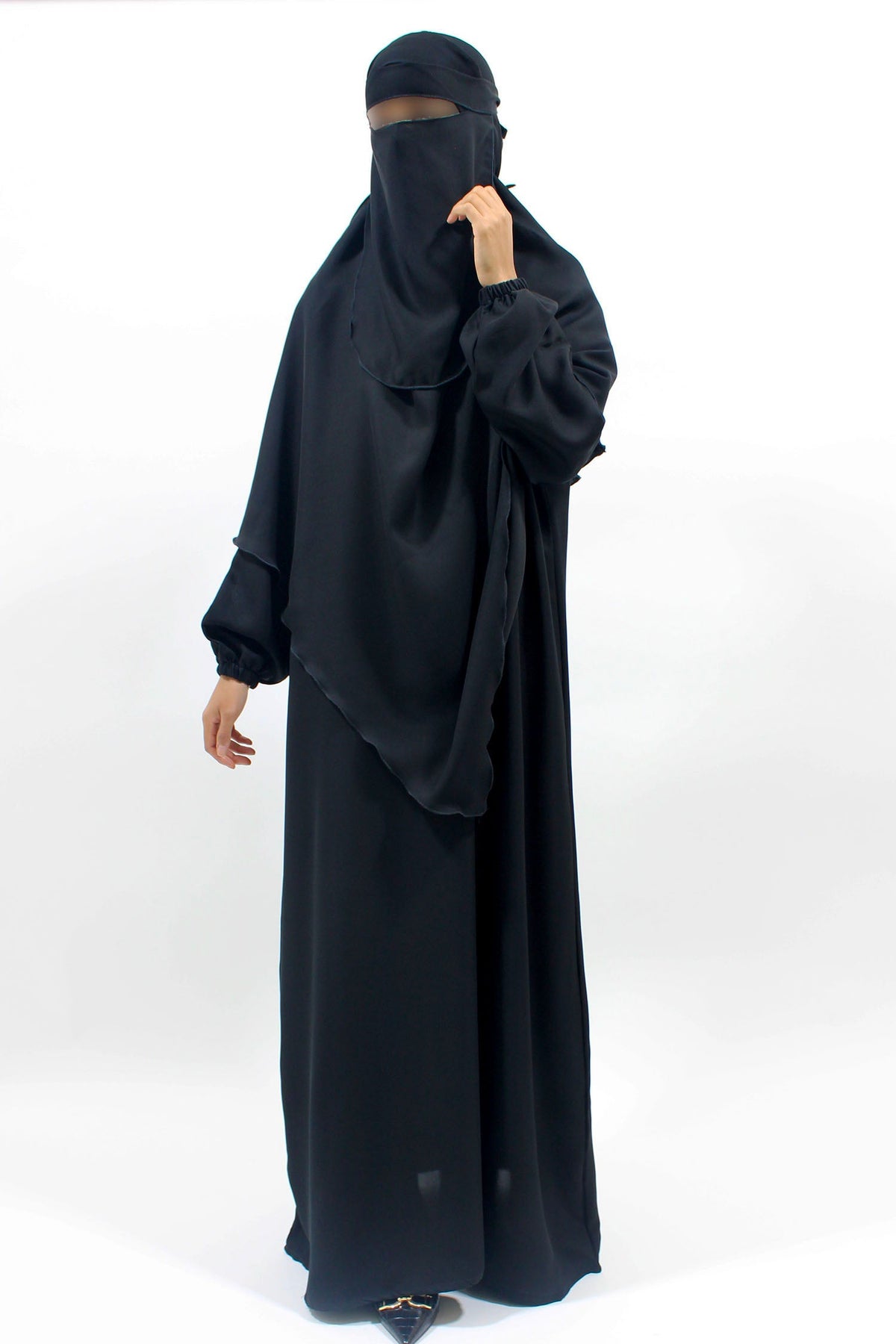
How Can You Wear Amani's Khimar Abaya and Niqab Set in Black?
Amani's Khimar Abaya and Niqab Set in Black gives you three coordinated pieces: an overhead abaya, a long diamond-shaped khimar and a matching niqab. The easiest way to wear them is to establish the abaya's fit first, arrange the khimar over it, and then add the separate niqab when it is part of your chosen outfit. That sequence lets each piece sit comfortably without relying on another layer to hold it in place.
The black colour keeps the main outfit visually continuous. You can enjoy that simplicity with black shoes and a familiar bag, soften it with warm neutral accessories, or add a restrained colour through your coat or bag. The character of the outfit comes from the long khimar, the loose abaya and the way you arrange the pieces together.
This guide follows Amani's Khimar Abaya and Niqab Set in Black through a first fitting, several complete outfit ideas and the practical choices involved in wearing the pieces separately. Choose the combination that fits your own preferences and the day ahead.
Understand the role of each of the three pieces
The abaya is an overhead body garment with a loose cut and elasticated cuffs. The khimar is a separate, long diamond-shaped head covering with two adjustable straps. The matching niqab completes the three-piece set and can be worn separately from the khimar. The material is described as Neda fabric; check the garment labels for the full fibre composition and care instructions.
Think of the abaya as the base of this particular outfit. Its shoulders, sleeves and hem need to work with the clothes you wear underneath. The khimar then adds the head, shoulder and chest arrangement you want, with its pointed shape creating the main draped line. The niqab has its own fit around the face.
The useful feature of separate pieces is that you can adjust them individually. You can settle the abaya before arranging the khimar, and you can wear the abaya and khimar without the niqab when that is your preference. A coordinated set gives you those choices while keeping the colour relationship straightforward.
Before ordering, read the details for the particular option you select. Confirm the measurements that matter to you, especially the abaya length and the khimar's dimensions. Keep any question specific: a missing front-length measurement is easier to resolve than asking whether the set will fit everybody.
Fit the overhead abaya before adding the khimar
Begin with the underclothes you expect to wear most often. A thin top and trousers may give a different result from a thicker dress or winter layers. Choose a realistic base, put on the abaya and let it settle from the shoulders before looking at the full-length outline.
Check that you can put it on and take it off comfortably over that base. Smooth any inner sleeve caught near the armhole, then let your arms rest. Look at where the cuffs and lower edge fall. A familiar size label can help you choose an option, but this actual fit is what makes the garment useful.
Bring your hands forward, sit down and stand again. Notice the upper back, the room around the hips and the way the body returns to its resting position. If the abaya pulls, identify the area before changing the size: a bunched inner layer and insufficient room in the outer garment need different responses.
Try the cuffs over your usual sleeves. They should sit comfortably in the position you want. If an inner cuff gathers beneath the elastic, smooth it or compare another base top. When you move the outer sleeves for washing before prayer, return them to their ordinary position afterwards and check that neither side has remained caught higher.
Finally, assess the length with your intended footwear and in the indoor setting where you will use it. Check the garment through your normal movements, using any support you ordinarily need. Keep the lower edge manageable so the fitting does not depend on repeatedly lifting the hem.
Arrange the diamond-shaped khimar over a settled base
Once the abaya feels comfortable, put on the khimar and identify its front and back. Let the long panels fall before securing the two adjustable straps in their intended arrangement. Begin with comfortable tension and check the position around the face before making smaller adjustments.
The diamond shape gives the khimar a pointed line. Look at the centre length and the side coverage separately. A centre point tells you where that part finishes, while the sides determine how the fabric sits around your arms. Notice how the shape works on your own body rather than trying to reproduce the exact proportions of a photograph.
Turn your head gently, look down and bring your hands forward. See whether the khimar remains comfortably arranged over the abaya or catches beneath an arm. If it pulls, free the fabric and reassess the fastening. A loose panel trapped under another layer can make the head area feel tighter than it did a moment earlier.
Choose the front drape you find comfortable. Allow enough space for your hands and the tasks you expect to do, while keeping the coverage you want. A long point can be an attractive part of the outfit without needing to hang in precisely the same place throughout every movement.
If you wear an undercap, include it from the start of this fitting. Its thickness and seams affect the space beneath the khimar. Use the arrangement you prefer and judge the combination as a whole; there is no need to add an extra cap simply because another outfit happens to use one.
Add the niqab independently
With the abaya and khimar comfortable, add the matching niqab using its own fastening. Arrange the eye area so your view remains clear, then turn your head and look down in a safe, familiar space. Keep the fabric comfortably positioned around your face and reset it if it shifts into your view.
Pay attention to where the niqab's fastening meets the khimar straps. Settle one piece at a time so you can tell which adjustment affects which garment. If the two fastenings create a bulky point, review their intended placement and the arrangement beneath them. Tightening everything together makes it harder to identify a simple fit problem.
If you wear glasses, include them during this stage. Check the position of the frames beside the fabric and look in the directions you normally need to see. Choose an arrangement that lets you use your glasses comfortably. If something feels restrictive or uncomfortable, stop and adjust it before wearing the outfit out.
The separate niqab can be removed without taking off the entire set. Practise your preferred sequence in a private setting so you can do it calmly when needed. Keep a suitable clean place for it, especially if the day includes a meal or another period when you choose not to wear it.
The broader guide to khimar and niqab set contents explains how separate and attached designs differ. Here, the helpful starting point is that the black Amani's set supplies the abaya, khimar and niqab as coordinated individual pieces.
Make the first outfit deliberately simple
For the first complete version, keep all three black pieces together and use familiar shoes and a familiar bag. This lets you understand the set before adding another colour, a new coat or an unfamiliar accessory. The long khimar already gives the outfit a distinct outline.
Try the bag with the contents you usually carry. A shoulder strap may sit above or below the khimar depending on your chosen arrangement, and each position can affect how the fabric falls. Compare practical options without trapping the head covering or repeatedly dragging it forward.
Use the shoes you genuinely expect to wear for the outing. A black flat, loafer or another comfortable style can keep the palette continuous. If the outfit is for an occasion and you prefer a different shoe, assess the hem with that pair too. The right choice is the one that works for the complete day.
Once the basic version feels settled, you can make changes with a clear reference. A new bag colour becomes one visible difference; a different coat becomes one practical difference. You will know which part altered the result.
Outfit one: an understated black combination for everyday wear
Wear the abaya and khimar with black shoes and a simple black bag, adding the niqab according to your own preference. Keep the accessories relatively plain so the pointed khimar and the loose body remain the main details. This is a straightforward version for an ordinary visit or a day when you want a consistent palette.
Black accessories do not need to have identical surfaces. A smooth bag, a matte shoe and a softer fabric can sit together without looking mismatched. Compare them beside the actual set and decide whether the small differences add interest or create more contrast than you enjoy.
Give the bag a clear job. If you carry a phone, keys and other essentials, choose a size that accommodates them comfortably. A very small bag may look neat but make the day less convenient if the remaining belongings have no suitable place.
For a visit involving a seated meal, check the front point of the khimar with the chair and table. Arrange it comfortably before settling, keeping your hands and the table edge clear. Choose a clean, convenient place for the niqab when you remove it, if that is part of your routine.
This outfit can remain simple without feeling unfinished. The coordinated three-piece design already provides a clear relationship between the garments; the accessories only need to help you wear it comfortably.
Outfit two: warm neutrals with the black set
A camel, taupe or warm beige bag can soften the contrast around a black outfit. Start with one accessory you already own and keep the shoes black. That gives you a small, deliberate change without needing to find matching neutral shades across every item.
If you want to repeat the warm tone, try it through a suitable coat. Put the coat on over the assembled outfit and check the shoulder and sleeve room. Decide how you want the khimar arranged in relation to the coat, then move your arms and turn your head to assess that particular combination.
The coat's collar deserves attention. A substantial collar may gather the khimar around the neck; a simpler neckline may leave more room for the fabric. Use the actual fitting to choose, especially if you expect to fasten the coat fully during the journey.
When you remove the coat, let the khimar settle again before judging the outfit. Check whether its side panels have caught under the sleeves or bag strap. A small, familiar reset can be part of the routine; repeated pulling may suggest that another coat or carrying arrangement would be easier.
This palette is useful when you enjoy black clothing but want a little warmth around it. Keep the colour choice flexible: the best taupe is the one that looks right beside your own garments and that you enjoy wearing again.
Outfit three: a burgundy accent for a gathering
For a more defined accent, try a burgundy bag with the black set and black shoes. The coloured accessory gives the outfit a focal point while leaving the abaya, khimar and niqab coordinated. A smooth, uncomplicated bag shape is a helpful first option beside the long drape.
Compare the actual burgundy with the set in daylight and indoor light. A redder shade will feel different from a darker plum. Choose the depth you prefer rather than searching for one colour that is supposed to suit every person or event.
If you enjoy jewellery, add it where it is comfortable and visible in your chosen arrangement. A ring or small detail at the wrist may be all you want. Check any raised edge or clasp near the cuffs and khimar, particularly when bringing your hands together or carrying the bag.
For a dressier shoe, prioritise the pair you can wear through the occasion. Recheck the length if you change to flats indoors. The outfit should remain manageable when you are greeting people, sitting down or walking between rooms, rather than only while standing for a photograph.
You can make this version more restrained by keeping the burgundy bag as the only accent. The black background gives it a clear place, so there is no obligation to repeat the colour in another garment.
Outfit four: the abaya and khimar without the niqab
When you choose to wear the abaya and khimar on their own, begin with the same comfortable base fitting. Arrange the khimar straps independently and check the face opening in this configuration. The removal of one piece can change how the remaining fabric sits, so give it a moment to settle.
Keep the black palette with familiar accessories, or use one of the neutral and burgundy combinations above. The long khimar remains the main upper layer. You can enjoy the set's coordinated appearance while using the combination that suits your preferences that day.
If you move between configurations during an outing, keep the niqab in a suitable clean pouch or compartment when it is not being worn. Place it where you can retrieve it without emptying the rest of the bag. Avoid packing it with rough keys, uncovered cosmetics or anything that could catch or mark the fabric.
Practise putting it back on without disturbing the khimar straps unnecessarily. A mirror can help you identify the sequence while learning it. Once you know how the pieces sit together, the adjustment can become more familiar without requiring the same arrangement for every situation.
Can you use the pieces with other clothes?
The black abaya can be worn with another suitable head covering from your wardrobe. Choose a scarf or khimar that gives the neckline and chest coverage you want, then check the sleeves and overall outline as a complete outfit. A different head covering changes more than the colour: its length and volume affect the shoulders too.
For example, a plain grey khimar you already own may create a softer contrast over the black abaya. Try it with the same base clothes and shoes first. Notice whether its sides meet the sleeves comfortably and whether its length works with your bag. The fact that one khimar works well does not mean every shape will behave identically.
The supplied black khimar can also be tried over another appropriate body garment. Start with one whose neckline, sleeves and opacity already suit you. A charcoal dress may create a close colour relationship; a deeper coloured abaya can give more contrast beneath the pointed edge.
Use the niqab separately only in combinations that fit comfortably and meet your preferences. Check its fastening with the new head covering rather than copying the tension used with the supplied khimar. A different headband, scarf thickness or undercap can change the space around the face and head.
You do not need to build a separate outfit for every component. One complete set and one comfortable alternative can be a useful wardrobe result. Choose the combinations you will actually wear instead of treating the number of theoretical possibilities as a measure of value.
Keep the pointed khimar manageable through the day
The diamond-shaped drape is part of the appeal of this set. Give it room to fall, then notice where its longest points meet your ordinary surroundings. A chair back, bag strap or coat opening can catch a section that felt completely free while standing.
Before sitting, arrange the fabric so you can settle comfortably without pulling on the head area. When you stand, allow the panel to fall again rather than drawing the whole khimar forward from the face. A small adjustment lower down may release the part that was caught.
When carrying a bag, check whether the strap crosses a section you often need to move. You may prefer the strap beneath or above a particular panel, depending on the bag and your outfit. Choose an arrangement that remains accessible and comfortable while keeping the fabric clear of closures and rough hardware.
For hands-on tasks, consider whether this long drape is the garment you want to wear for that activity. The set can be useful for a visit without needing to serve every household task. Keep loose fabric clear of moving equipment and choose appropriate clothing for the work you are doing.
If the shape repeatedly feels cumbersome in a setting where you want to use it, compare the dimensions with a khimar you already find manageable. That gives you a practical reference for a future choice, rather than a reason to keep tightening the straps of a garment whose length is the real issue.
Choose sizes by the parts that need to fit
Start with the abaya measurements, particularly the stated length and the room you need over your usual base clothes. Compare garments using the same measuring route and units. A shoulder-to-hem dimension and a measurement from the top of the head describe different starting points.
Then consider the khimar's front, back and side lengths where provided. Its pointed design makes the relationship between those lengths useful. If a missing dimension would decide your choice, ask for it before assuming the overall longest measurement explains the whole shape.
Check the adjustment available around the face separately from the body size. Two straps offer a way to arrange the khimar, but the rest of the construction still needs to suit you. The niqab has its own fit too, so judge all three pieces rather than assuming a comfortable abaya establishes the complete set.
For a gift, ask the recipient which size and arrangement she prefers. Confirm that she wants this particular three-piece combination, including the separate niqab. A useful clothing gift reflects the wearer's choices as well as a pleasing colour or an occasion.
If an alteration is needed, show the relevant pieces together to a suitable professional. Explain the problem precisely and include the shoes and underlayers involved. A change to the abaya's length should be considered alongside the long khimar so the finished proportions remain what you want.
Check the black layers in ordinary light
Look at the assembled outfit in daylight as well as the room where you first tried it on. Check the abaya over your intended base, particularly where the cloth sits closer during sitting or reaching. Assess the khimar and niqab in their intended arrangements too. The useful result is coverage you are comfortable with throughout the outfit.
Compare the three pieces in the same light. Different folds and positions can make parts of a black outfit appear lighter or darker. Let the garments settle and look at them together before deciding whether a contrast is an actual difference between pieces or simply the way a surface is facing the light.
If you change the underclothes later, repeat the relevant check. A pale inner top, a raised seam or a thicker sleeve can create a different appearance beneath the same outer garment. Keep the successful base combination in your outfit notes so a later wear begins with the layers you already know work together.
Care for each piece and keep the set easy to find
Read the care information for the individual garments. Coordinating pieces may have different construction details, and the black colour does not establish a shared washing or pressing method. The fabric name Neda also leaves the full composition and permitted treatment to the actual labels.
GINETEX's care-symbol guide can help you interpret those instructions. Choose washing, drying and ironing methods from the relevant label. If essential information is missing, obtain guidance for the particular garment before applying heat or moisture.
After wearing, inspect the abaya cuffs and hem, the khimar straps and the niqab's fastening area. Each piece meets the body and surrounding objects differently. Set aside anything needing cleaning or repair while the issue is easy to identify.
Store the pieces fully dry and with support suitable for their shape and weight. Keep the set identifiable without twisting the straps around the garments. A separate, clearly associated place for the niqab can make it easier to find while keeping its fabric protected.
A private photograph or short note of a comfortable arrangement can be helpful, especially when first learning the straps and the relationship between the layers. Record the successful outfit, then allow yourself to adjust it when your base clothes or outerwear change.
Choose the version that feels natural to wear again
The black set is most useful when you understand how its three pieces relate to your own routine. A comfortable overhead abaya provides the base, the diamond-shaped khimar creates the drape, and the separate niqab gives you the configuration you choose around the face.
Begin with one complete outfit and a familiar set of accessories. Once the fitting feels settled, try a warm neutral bag, a burgundy accent or one alternative use for a component. Keep the combinations that work comfortably through the day.
That gives you a practical way to enjoy the simplicity of a matching black set while retaining personal choice. The finished outfit can be understated or more dressed, with each piece arranged for the way you want to wear it.