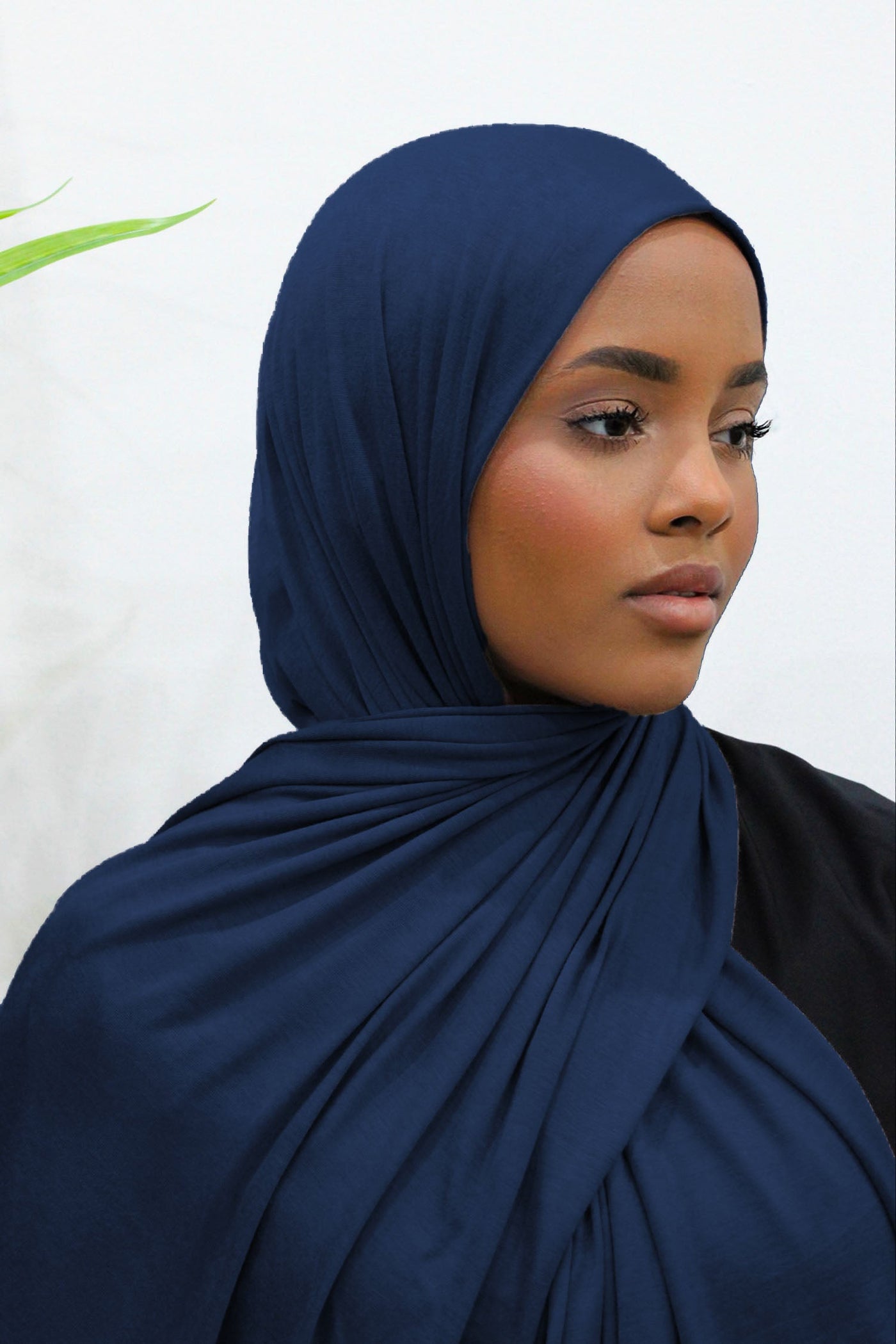
Your Hajj Hijab Needs to Stay Comfortable Long After You’ve Stopped Thinking About How It Looks
A scarf can stay perfectly still for half an hour at home and still be the wrong scarf for Hajj. The real test begins when the day is hot, your shoulders are carrying a bag, you have been walking for hours, the fabric at your hairline is damp, and you are too tired to care whether the front fold still looks neat. At that point, a hijab either behaves quietly or becomes one more thing asking for your attention.
That difference matters. Hajj is not a setting where you want to spend the day checking a mirror, tightening an undercap or searching through a bag for a missing magnet. You may move through crowded spaces, long waits, prayer, transport, rest and repeated changes of pace. A scarf that works beautifully for an ordinary afternoon can become irritating when every small weakness is repeated for many hours.
So the useful question is not, “Which Hajj hijab looks most appropriate?” It is, “Which scarf system stays secure when my day stops being tidy?” The answer is usually less glamorous than a packing video suggests. It is a fabric you already understand, a wrap you can reproduce without fuss, enough coverage without unnecessary layers, and a fastening method that holds because the scarf is well balanced rather than because everything has been pulled tight.
If you are still deciding between scarf fabrics, undercaps and everyday shapes more generally, the complete hijab guide gives you that wider foundation. Here, the focus is much narrower: how to make a hijab for Hajj stay comfortable, covered and dependable when heat, movement and long wear all arrive at once.
The best Hajj hijab is the one you can stop thinking about
There is a strange kind of success in clothing becoming forgettable. You put it on, make sure the coverage is where you want it, and then the garment leaves your mind. That is especially valuable during Hajj. Your scarf does not need to make the journey feel special. It needs to stop competing with the journey.
A dependable hijab should survive ordinary movements without a running conversation in your head. You should be able to turn to speak to someone, look down into a bag, raise your head, sit, stand and walk at a purposeful pace without wondering whether the crown has crept backwards. The front does not need to remain photograph-perfect. It does need to remain secure enough that you are not repeatedly fixing it.
This is why I would choose familiarity over novelty almost every time. If you have one scarf that has already survived a long workday, a busy family gathering, a warm commute or hours at the masjid without irritating you, that experience is useful evidence. You know how tightly it needs to be fastened. You know whether it stretches during wear. You know if the edge curls after washing. You know whether it stays put when your glasses go on and off.
A brand-new scarf has none of that history yet. It may still be an excellent choice, but let it earn your trust before it reaches the suitcase. Wash it according to its care instructions. Wear it for several hours. Take a brisk walk in it. Use the bag you expect to carry. Pray in it. Sit somewhere warm. Notice what happens after the first hour, because the first ten minutes tell you very little.
Security is not the same as stiffness. A scarf can soften through the day and still be doing its job. A front fold can relax. A shoulder drape can shift by a few centimetres. These are not failures if the coverage remains sound and the scarf still feels comfortable. The goal is not to freeze fabric around your head. It is to build an arrangement that tolerates movement without falling apart.
That distinction can save you from over-fastening. If you expect the scarf to look untouched after ten hours, you may add extra pins, tighter layers and more undercap tension than you need. If you expect it to live with you, you can secure the points that genuinely matter and let the rest of the fabric move naturally.
Heat turns unnecessary layers into a problem very quickly
When a hijab feels too warm, the fabric often gets blamed first. Sometimes the fabric is part of the problem. Just as often, the real issue is accumulation: a full undercap, a doubled front edge, two complete wraps around the crown, another loop around the neck, a high collar underneath, and then a long tail tucked back into the same area.
Each layer may feel light in your hand. Together, they create a dense pocket of material around the scalp, ears and neck. Hajj can involve demanding heat and long periods of movement, so there is little value in wearing fabric that is not doing a useful job.
Start by asking what each layer is for. Is the undercap holding your hair and adding grip, or is it there simply because you always put one on? Is the second wrap needed for opacity, or only for shape? Is the scarf wound around the neck because the style requires it, or because the fabric is longer than you need? Removing one unnecessary layer can do more for comfort than buying an entirely different scarf.
Opacity has to be considered at the same time. The coolest-feeling scarf on a hanger is not automatically the coolest finished arrangement. A very fine pale chiffon may need an opaque cap and several overlapping layers to give you the coverage you want. A slightly more substantial scarf may be comfortable in one broad layer. Judge the complete setup, not the textile label.
Loose drape can also matter. Fabric pulled taut against the head and neck often feels more noticeable than fabric allowed to lie lightly. You still need a secure face opening, but security does not require wrapping every centimetre tightly. A broad shoulder panel can cover more with less bulk than a narrow tail wound around several times.
Clothing is only one part of coping with hot conditions. A scarf choice cannot replace rest, shade, hydration or current official Hajj health guidance, and feeling seriously unwell is not something to solve by adjusting a hijab. The clothing goal is simpler: do not add avoidable heat or pressure when your body already has plenty to manage.
Fabric labels help, but the surface of your actual scarf tells you more
People often ask for the single best fabric for a Hajj hijab. I understand why. A one-word answer would make packing easy. Unfortunately, “jersey”, “modal”, “chiffon”, “viscose” and “cotton” describe broad families, not identical pieces of cloth. Two scarves sold under the same name can differ in thickness, weave, stretch, finish and grip.
Instead of ranking fabric names, test the scarf in your hands. Rub one layer gently against another. Does it slide immediately, or is there a little resistance? Hold it towards daylight. Can you see clearly through one layer? Stretch the edge. Does it snap back, stay distorted or barely stretch at all? Drape it over your shoulder. Does its own weight pull it down, or does it stay where you placed it?
Jersey can be reassuring because stretch and surface grip often help it stay in place with few fastenings. A light jersey may be wonderfully uncomplicated. A dense jersey wrapped repeatedly can feel warm and heavy, so thickness matters. Chiffon and georgette-type scarves can feel light and polished, but smoother finishes may need a stable base or carefully placed fastening. Modal and viscose-type rectangles can spread beautifully over the chest, though some very fluid versions travel backwards unless they are anchored well. Cotton-rich scarves may grip comfortably, but a tight or heavy weave can hold warmth and take longer to dry.
None of these behaviours is automatically good or bad. They are trade-offs. The sister who hates an undercap may prefer a scarf with more natural grip. The sister who has worn chiffon every day for years may find it easier than a fabric everyone else calls “practical”. Skill and familiarity change the answer.
Do not assume that a scarf marketed for summer, travel or pilgrimage has passed your personal test. Product language can describe intention; it cannot predict your head shape, hair, preferred coverage or tolerance for pressure. Your own rehearsal remains the most reliable evidence.
One small test I find useful is to wear the scarf for an hour without touching it. No smoothing the crown when you pass a mirror. No tightening under the chin. No pulling the shoulder back into place. At the end, look at what actually moved. A scarf that softened but stayed covered may be perfectly serviceable. A scarf that migrated several centimetres backwards has given you a real problem to solve.
Security comes from friction, weight and anchor points, not from pulling harder
When a scarf slips, tightening is the most instinctive response. Pull the ends more firmly, tighten the undercap, place another pin, tuck the tail more aggressively. The scarf may stop moving for a while, but now the tension is being carried by your temples, jaw or ears. Several hours later, the “secure” style can become the thing you most want to remove.
A better approach is mechanical. Ask what is moving and why.
If the whole scarf is sliding backwards from the crown, the surface beneath it may be too smooth, the scarf may be weighted too heavily at the back, or the face opening may have been set too loosely for that fabric. If one side keeps dropping, the ends may be badly balanced. If the front opening stretches wider through the day, the fabric may be elastic and under tension. If the scarf rotates around the head, one fastening point may be taking too much of the load.
Friction is the quiet helper. Hair, undercaps and scarf fabrics all have different surfaces. A grippy scarf over a compatible base may need very little fastening. A silky scarf on a silky cap can move even when both pieces are individually good quality. Sometimes changing the undercap fabric fixes more than adding another magnet ever could.
Weight matters too. A long tail hanging from one side behaves like a small constant pull. It may not feel heavy in your hand, but gravity works on it for hours. Spread a long panel across the chest or shoulder rather than letting all its weight hang from a narrow point. If the scarf is much longer than your style requires, consider whether a shorter dimension would be easier.
Then choose anchor points. One under-chin fastening, one discreet shoulder point, or a well-fitted undercap may be enough. The exact system depends on the scarf, but each fastening should solve an observed movement problem. If you cannot explain what a pin is preventing, you may not need it.
This is especially useful for Hajj because a simple system is easier to reset. A scarf held by two purposeful points is much easier to rebuild than one held by six hidden fasteners whose positions you can only reproduce with a mirror.
An undercap should earn the space and heat it adds
Undercaps can make a Hajj scarf far easier. They can contain hair, add friction and stop a smooth scarf from walking backwards. They can also create the headache, heat and pressure that make you blame the scarf. The only sensible rule is to use one when it improves the complete arrangement.
Pressure can be deceptive because it builds slowly. A tube cap that feels snug and secure at breakfast may be pressing painfully at the temples by midday. A tie-back cap may seem adjustable, but a bulky knot can become uncomfortable when you lean your head against a coach seat. A full underscarf can give wonderful hair control while also adding a complete extra layer over the scalp.
Test the cap separately before blaming or praising it. Wear it at home for two or three hours without the scarf. If it creeps backwards, rolls at the hairline or leaves deep pressure marks, it is unlikely to become friendlier under another layer. Then test the scarf and cap together, because friction between the two matters as much as the cap fit alone.
Hair arrangement changes the result. If your bun is high and firm, it may push the cap backwards. If the hair is tied very tightly, soreness may start before the cap goes on. Long, thick hair packed into one concentrated point can also create leverage against the scarf. A lower, stable arrangement often spreads bulk more comfortably, but the method you already know is usually better than a new hairstyle learned for the trip.
Some sisters are happiest with no undercap at all. If your scarf has enough grip, your hair stays contained and the wrap does not shift, there is no prize for adding an extra layer. Others genuinely need the cap to keep the system stable. Both can be sensible.
The important thing is to stop treating the undercap as invisible. It is part of the heat, part of the pressure, part of the friction and part of the washing routine. Judge it with the same seriousness as the scarf.
Your face opening has to survive talking, drinking and turning your head
A front view can hide most problems with a hijab. Face forward, chin still, shoulders square, and almost any wrap can look secure for a photograph. Real life begins when your jaw moves and your head turns.
Set your scarf the way you expect to wear it, then speak for several minutes. Drink from a bottle. Look over each shoulder. Tilt your head slightly upwards and downwards. If you wear glasses, take them off and put them on again. Watch what happens around the jaw and ears.
An under-chin fastening placed too high can tug whenever you speak. A tight front edge can push the arms of glasses into the head. A loose opening may spread at the side of the neck when you turn. A stretchy scarf can gradually enlarge the face opening as the day goes on if it is being pulled from a heavy tail.
Fix the particular problem rather than shrinking the whole opening. Sometimes moving a magnet or pin a centimetre lower is enough. Sometimes the scarf needs to be rebalanced so less weight hangs behind the shoulder. A higher neckline underneath may reduce how much work the scarf has to do. A slightly grippier fabric may allow the front to sit gently without tension.
Your jaw should not feel trapped. You will be talking, drinking and moving through an exhausting day. A scarf that is only secure while your face is still is not genuinely secure.
Neck coverage deserves a side check as well. Turn fully left and right in front of a mirror, or ask someone you trust to look at the back. You may discover that the scarf and clothing work perfectly together even though the scarf alone would move. That is useful. Modest clothing is a system; the scarf does not have to perform every job by itself.
Chest coverage is easier when you stop spending all the fabric around your head
If you prefer generous chest coverage, a long scarf can give it beautifully, but only if enough fabric remains after you have secured the head. A scarf wrapped twice around the crown and once around the neck may have very little useful width left for the shoulders and chest.
Scarf dimensions change the answer here. A wider rectangle can often spread over the upper body with fewer turns. A very narrow scarf may be long but still create two thin tails rather than a broad drape. Measure a scarf you already like and use those dimensions as your reference. That is more useful than relying on a generic “maxi” label.
After setting the face opening, open the remaining fabric rather than twisting it. A broad panel distributes weight and tends to move less dramatically than a narrow rope of cloth. If one end is much longer, place the long end where it gives useful coverage rather than allowing it to hang as unused weight behind you.
Now add your day bag. A cross-body strap can cut through a chest drape and pull it towards the centre. A shoulder strap can drag one side backwards. A lanyard or document pouch can sit beneath the scarf and create bumps that encourage fabric to shift. These are Hajj realities that a scarf-only mirror test will miss.
Try the whole arrangement before travel. Put the bag on with a realistic load. Walk. Reach into the bag. Take the strap off and put it back on. If the scarf stays secure, excellent. If the strap repeatedly catches one panel, change where the fabric sits rather than planning to fix it all day.
Coverage that survives the accessories you actually carry is far more useful than coverage created for a still outfit.
Crowded movement makes loose ends more troublesome than soft drape
There is nothing wrong with a flowing scarf. Soft drape can be comfortable and modest. The trouble begins when pieces of fabric are not really part of the silhouette at all: an extra-long tail hanging behind the back, a decorative loop that swings away from the shoulder, or a loosely pinned panel that catches every time a bag moves.
In crowded movement, contained fabric is easier to live with. That does not mean wrapping tightly or making the scarf small. It means giving each section somewhere to rest. A long end might spread across the chest, sit beneath an outer layer, or be secured at one shoulder if that is how you normally dress. The aim is to avoid having fabric trailing where you cannot see or control it.
Do a crowd-style test at home by moving through a narrow space while wearing your loaded bag. Turn sideways through a doorway. Sit beside someone. Stand up without first arranging the scarf. Reach forward. If loose fabric repeatedly catches beneath the strap or swings into your hands, you have found a practical nuisance.
Do not solve it by covering the scarf with fastenings. Often the better answer is proportion. A shorter scarf, a wider but less excessively long scarf, or a simpler wrap may give the same coverage with less surplus.
Hajj can involve times when you are moving slowly in dense surroundings and times when you are walking more freely. Your scarf has to cope with both without changing personalities. Stable drape gives you that middle ground: soft enough to move with you, contained enough that you are not protecting it from everything around you.
When fabric gets damp, yesterday’s perfect wrap can behave differently
Heat, perspiration and washing change fabric. That is one reason a Hajj hijab needs to be judged as working clothing rather than an occasion accessory.
Some scarves become slightly grippier when there is moisture at the hairline. Others cling in a way that makes the front feel tighter. Undercaps can absorb perspiration and stay damp longer than the outer scarf. Pale edges can show marks from skincare or sweat. Jersey can feel heavier when damp; very fine fabrics may dry quickly but reveal water marks until they do.
You do not need to be embarrassed by any of this. A long, hot day has ordinary physical realities. Preparation is simply acknowledging them before they become inconvenient.
Choose scarves and undercaps you are willing to wash. If a scarf requires delicate handling, elaborate ironing or a very long drying time, decide whether you have enough rotation to let it recover properly. Saving your most difficult fabric for Hajj because it looks beautiful can turn laundry into work you did not need.
At home, wash every scarf you plan to take at least once according to its label. Then wear it again. Some scarves lose factory stiffness and become easier; others become more slippery, curl at the edges or change dimensions slightly. The post-wash scarf is the one you will actually live with.
Pack a small clean cloth or handkerchief if you find it useful for blotting moisture at the hairline. Avoid rubbing vigorously at the scarf while it is on, because that can disturb the wrap. If the scarf becomes genuinely wet or uncomfortable, changing into a dry backup when practical is often easier than spending hours trying to make a damp arrangement feel fresh.
A good rotation gives you that option without turning your suitcase into a scarf shop.
A long day exposes pressure points that a quick fitting cannot
Pressure is one of the easiest problems to miss because the first hour may feel fine. Then a tight hair tie, undercap edge, magnet, glasses arm and scarf fold all happen to sit within the same two centimetres above your ear. Nothing is dramatic. Together, they become exhausting.
Map pressure rather than accepting it. If your temples ache, loosen or change the undercap before altering the scarf. If soreness sits behind the ears, test the glasses with and without the cap. If the nape feels strained, look at the hair arrangement and the weight hanging from the back of the scarf. If your jaw feels restricted, move the fastening or reduce tension at the face opening.
Change one variable at a time. If you change the scarf, cap, hair tie and pin position together, you will not know what fixed the problem. Wear the revised setup long enough for the pressure to have appeared before. That is how you learn whether the change genuinely worked.
Be especially suspicious of any system you describe as “fine once I get used to it”. Mild unfamiliarity is one thing. A setup that becomes painful after several hours has given you useful information. Hajj is not the ideal place to test your ability to endure preventable clothing discomfort.
If you experience significant or persistent headaches or pain, that moves beyond ordinary styling and deserves appropriate professional attention. Clothing advice should not pretend otherwise. For normal pressure caused by fit, however, the solution is often wonderfully mundane: less tension, fewer stacked layers, a lower hair arrangement or a fastening point moved away from a sensitive area.
Prayer movement should not require a full scarf rebuild afterwards
A scarf that stays put while walking can still reveal a weakness when you bow or go into sujood. The direction of gravity changes. A shoulder panel falls forwards. A heavy end slides towards the floor. The front edge may lift slightly at the chin or move away from the neck.
Before Hajj, pray in the complete scarf and clothing arrangement you intend to use. Do not make the test ceremonial. Use the bag before and after. Sit for a while first. Let the scarf become as settled as it would after normal wear. Then notice what happens through movement.
If one panel falls forwards every time, it may need a quieter resting place on the shoulder rather than another tight wrap around the head. If the chin opening changes, look at the fastening position. If the undercap creeps backwards, the prayer movement may only be exposing a problem that started earlier.
The useful standard is recovery. When you stand again, does the scarf return to a sensible position by itself, or do you immediately reach for it? A tiny cosmetic change does not matter. A scarf that repeatedly leaves the neck or chest coverage where you do not want it is asking for a better arrangement.
You may also have religious questions about prayer clothing, wudu, ihram or covering in particular situations. Those deserve qualified religious guidance rather than an online styling article pretending to settle them. The clothing question here is more modest: can you manage the scarf calmly while following the practice you have learned?
A dependable system respects that boundary. It gives you predictable fabric behaviour without making claims about matters that belong with scholars.
Wudu is easier when your fastening method has a memory
Hajj days can include repeated moments when you need to manage clothing around washing and prayer. From the scarf side, the worst system is one you can only reconstruct after studying yourself in a mirror. If every reset requires finding six invisible pins and rebuilding three exact folds, tiredness will make it feel harder than it did at home.
Practise your normal wudu routine with the scarf before travel, according to the religious guidance you follow and with appropriate privacy. Pay attention to the clothing mechanics rather than inventing a new fiqh answer. Where do your fasteners go if the scarf comes off? Can you loosen or remove the arrangement without dropping magnets near water? Can you put it back on without starting an entirely different style?
A small zipped pouch is one of the least glamorous useful objects you can pack. Give pins, magnets and spare hair ties one home. Do not let them roam loose through a tote bag. When you are tired, knowing exactly where the spare fastening lives is more helpful than owning ten different fastening options.
Try resetting the scarf without making the front perfect. Secure the face opening, restore the coverage you need, arrange the shoulder drape and leave. A scarf does not need its morning crease to be valid for the rest of the day. The more comfortable you become with a functional reset, the less pressure you place on yourself to preserve the original styling.
If your usual scarf is difficult to remove and rebuild, a simple pull-on backup can be useful in situations where you have privacy and want a quick change. It does not have to replace your main style. It is simply another tested tool.
Rest changes the way a scarf presses against your head
Walking tests matter, but Hajj also includes periods of waiting and rest. A scarf may feel fine while you are upright, then become uncomfortable as soon as you lean your head against a seat, wall or cushion.
Look at the back of the arrangement. A high bun, thick undercap knot, large magnet or folded stack of fabric can create a hard pressure point when your head rests against something. On a coach or in a waiting area, that can turn an otherwise comfortable scarf into a nuisance.
Test it deliberately. Sit against a firm chair for half an hour. Lean back. Turn your head. If you instantly need to move your hair arrangement, change it before the trip. A lower, flatter arrangement may be more comfortable for long seated periods, especially when combined with a less bulky cap.
Also consider what happens when you become drowsy. A scarf that is only secure when you sit perfectly upright may move as your head tips to one side. You do not need to engineer it like protective equipment, but a stable crown and balanced tails help the scarf tolerate ordinary resting movement.
In women-only private spaces you may choose to remove or loosen your hijab as appropriate to your circumstances and the guidance you follow. The practical point is to know where your scarf, cap and fasteners go when they are off. A small packing cube or pouch can keep a clean scarf separate from used clothing and stop tiny accessories disappearing into bedding or luggage.
Rest is not a failure to prepare for. It is part of a demanding journey. Your clothing should make it easier, not make you feel you must remain perfectly arranged every minute.
Glasses, sunglasses and lanyards can quietly undo a good wrap
The scarf may be perfectly designed until another object is introduced. Glasses arms press beneath the fabric. Sunglasses are pushed on and off. A lanyard catches the chest drape. A document pouch pulls one shoulder lower. These small interactions are worth rehearsing because they happen repeatedly.
If you wear prescription glasses, test whether the arms sit more comfortably beneath the scarf, over the undercap but beneath the outer layer, or over the full wrap. There is no universal answer. You are looking for a position that does not create a sore point above the ear and does not lift the scarf every time the glasses move.
Sunglasses deserve the same test. Repeatedly placing them on top of the head can disturb the crown, so a case may be more practical when you take them off. If you keep them on a neck cord, check that the cord does not tangle with scarf ends or lanyards.
Then add whatever identification or travel pouch you expect to carry. Does the strap sit under the scarf, over it, or cut through the chest drape? Whichever position you choose, practise removing the pouch without pulling the scarf. A setup that works only while everything remains untouched will be frustrating during real movement.
I would rather change one accessory position than redesign the whole hijab around it. The scarf should remain the stable part of the system while bags, glasses and lanyards come and go.
Colour is secondary to fabric behaviour, but it can make care easier or harder
There is no need to invent a special Hajj colour palette for your hijab. A scarf does not become more useful because it matches someone else’s picture of pilgrimage. Choose colours you already wear comfortably and that work across several garments.
Practical differences still exist. Very pale scarves can show skincare, dust or moisture more quickly at the edges. Very dark scarves may make certain marks less obvious, though fabric weight, weave and the number of layers matter far more to how warm the finished wrap feels than colour alone. Mid-tones can be forgiving in a travel wardrobe because they coordinate easily and do not demand much care.
Try to make each scarf work with more than one outfit. If three scarves combine with nearly everything you have packed, you reduce decisions and make laundry delays less annoying. There is no reason to take twelve scarves just because the trip lasts many days if you would rather rotate a smaller set you genuinely trust.
Colour can also affect opacity. A fabric that is comfortably opaque in navy may be noticeably sheer in cream, even when the weave is nominally the same. Check every actual scarf against light rather than assuming one colour tells you how another behaves.
If you love white or cream for Hajj, wear it because you like it and it works. Test the front edge for makeup or skincare transfer and make sure one layer gives the coverage you want. If black is your everyday certainty, you do not need to abandon it for an invented rule of style. Familiarity is useful preparation.
A packing rotation should assume that at least one scarf will be unavailable
Instead of asking for a magic number of hijabs, build a small rotation with redundancy. Imagine that your favourite scarf is damp, marked or still drying. Can the remaining scarves carry you through the day without forcing you into an unfamiliar style?
A practical rotation might include a main everyday scarf, a second option with similar dimensions and a slightly different weight, and one dependable backup. Your exact number will depend on the length of your trip, laundry access, how quickly fabrics dry and how often you prefer to change. The principle is more important than the count: do not make the entire system depend on one irreplaceable piece.
Keep dimensions reasonably consistent if you want low mental effort. If every scarf is a different width and length, the same wrap will land differently each morning. You may enjoy that variety at home; during Hajj, consistency can be a gift. Two or three scarves that behave similarly allow your hands to remember the method.
Undercaps need rotation too if you use them. They sit directly against the hair and skin and may need washing more often than the outer scarf. A clean dry cap can make a familiar scarf feel much fresher. Pack enough that one can dry properly rather than being put back on damp.
Store a spare scarf where you can actually reach it. If every backup is buried at the bottom of large luggage, it is not much help during a long day. A compact spare in your day bag may be worthwhile when practical, particularly if you know you are uncomfortable continuing in a wet scarf.
The point is not to prepare for every possible disaster. It is to make ordinary disruption boring.
Your emergency kit should be tiny enough that you actually carry it
A scarf emergency kit can easily become another pouch of clutter. Keep it narrow. Take only what can solve a problem you have genuinely encountered.
- One or two spare fasteners. Carry the same pin or magnet type you already use rather than an unfamiliar gadget.
- A spare hair tie. A broken elastic can undermine the whole base of the scarf.
- A small zipped pouch. This gives sharp or magnetic pieces a safe, predictable place.
- A clean cloth or handkerchief. Useful when the hairline or face needs drying without rubbing the scarf around.
- A compact spare scarf when practical. Choose a dependable one you can put on quickly, not a delicate “just in case” piece.
If you require a mirror to use your emergency kit, keep it small. Better still, practise your rescue method until you can do most of it by touch. The aim is not to recreate a styled photo in the middle of a long day. It is to restore secure coverage and comfort.
Anything else has to justify its weight. Ten pins, several brooches, a second style of undercap and multiple decorative magnets may make you feel prepared while packing, but they also create choices when you are tired. A kit is successful when it is boring enough to forget until you need it.
Have a five-minute reset for the moment the scarf genuinely fails
Even a well-tested scarf can go wrong. A magnet can be lost. A cap can shift. A drink can spill. A scarf can become too damp to tolerate. Planning for a reset is more realistic than demanding perfection from the garment.
Decide in advance what “reset” means. For some women, it is finding appropriate privacy, removing one fastening, centring the scarf and rebuilding the usual wrap. For others, it is changing into a pull-on hijab kept in the bag. The best method is the one you can complete calmly and consistently.
Practise it with a timer once or twice, not because Hajj should be rushed, but because complexity becomes visible under a simple time limit. If your reset takes fifteen minutes and requires laying several pins on a counter, the everyday wrap may be too elaborate for the role you are asking it to play.
Also decide which changes do not require a reset. A softened fold is cosmetic. A tail sitting three centimetres lower may be irrelevant. A secure scarf that no longer looks freshly ironed is still secure. Save your energy for shifts that affect comfort or the coverage you intend.
This is one place where emotional preparation matters. Clothing can become a source of perfectionism, especially on a journey that feels spiritually important. You do not have to keep your scarf pristine to prove that you prepared properly. A practical reset is not a failure. It is the system working as designed.
Shopping for a Hajj hijab should begin with your existing best scarf
If you need to buy scarves for Hajj, do not start with a search for whatever is labelled “pilgrimage”. Start by examining the scarf you already reach for on hard days.
Measure it. Notice the fabric weight. Check whether it stretches. Look at the front edge after washing. Count how many fastenings you normally use. Think about whether you need an undercap. That scarf is your personal specification.
Then compare new options against it. A beautiful scarf that is thirty centimetres narrower may not give the chest coverage you expect. A very long scarf may create more tail than you know what to do with. A highly polished fabric may require a cap even if your usual textured scarf does not. These differences are easier to judge when you have a known reference.
Read the live product page rather than assuming colour, fabric, size or availability from an old article. Amani’s assortment can change, and the current product listing is the right place to confirm what is actually for sale. Once you know the dimensions and behaviour you want, you can shop related styles and compare them against your own wear test rather than buying from the photograph alone.
Order early enough to return a scarf that does not work. A Hajj purchase is not automatically a successful Hajj item. It becomes one after you have washed it, worn it, moved in it and decided that the scarf asks very little from you.
Give the whole system a Hajj-style rehearsal before it reaches the suitcase
You cannot recreate Hajj at home, and you should not try. You can still create a useful clothing rehearsal that combines duration, warmth, movement and accessories. The purpose is to reveal friction points while you have time to change them.
Choose a day when you can wear the setup for several hours. Use the hairstyle, undercap, scarf, glasses, outer garment and bag you actually expect to use. Do ordinary things. Walk briskly. Climb stairs. Sit in a warm room. Drink water. Pray. Rest against a chair. Take the bag on and off. Leave the scarf alone as much as possible so you are testing it rather than constantly rescuing it.
| Rehearsal moment | What to watch | What the problem may be telling you |
|---|---|---|
| Forty-five minutes of walking and errands | Crown movement, loose tails, heat around the neck | The scarf may need better weight distribution or fewer layers |
| Repeated head turns | Jaw tension and side-neck gaps | The face opening or fastening point may need adjustment |
| Prayer movement | Front drape falling, crown slipping, chin opening changing | The scarf needs a more stable anchor or broader shoulder placement |
| Resting against a seat | Pressure at bun, cap knot, magnets or glasses | Back-of-head bulk may need reducing |
| Warm period without adjustments | Undercap dampness, neck bulk, fabric cling | Remove unnecessary layers or change the base fabric |
| Bag on and off several times | Chest drape dragged backwards or strap catching an end | Change the scarf placement or bag route |
| Quick private reset | Number of steps and accessories needed | The style may be too complicated for tired hands |
| Post-wash wear | Grip, dimensions, edge curl and opacity | The scarf’s real behaviour may differ from its new condition |
Afterwards, write down the one or two things that annoyed you most. Fix those first. Do not redesign the entire system because the fold softened or the shoulder drape moved slightly. You are looking for recurring work: the adjustment you made six times, the pressure point that grew steadily, the tail you kept rescuing from the bag strap.
Repeat the test after changing one variable. If the second run is quieter, you have improved the system. That practical silence is the goal.
Keep Hajj-specific religious questions with qualified sources
A clothing article can tell you that a loose tail catches on a bag, that a tight undercap creates pressure or that chiffon may need more grip. It should not pretend that those observations answer questions of fiqh.
Women may have questions about ihram, face covering, gloves, wudu, prayer clothing or what is required in particular stages of Hajj. Those questions deserve a qualified scholar or trusted Hajj teacher whose guidance you follow. Travel procedures and official regulations can also change, so current official Saudi Hajj information should be checked close to the journey rather than relying on an old packing post.
This separation is not a weakness. It keeps each kind of advice honest. Practical scarf preparation can help you build a secure arrangement. Religious teaching tells you what you need to observe. Official travel guidance tells you what procedures apply now. One source should not impersonate all three.
If a religious instruction changes what you need from the scarf, bring that requirement back into the wear test. For example, if your trusted guidance means you need to manage the scarf in a particular way at a particular time, practise the clothing mechanics before travel. You can prepare without turning a style article into a ruling.
Frequently asked questions about choosing a hijab for Hajj
What is the best hijab for Hajj?
The best hijab for Hajj is a scarf system you have already tested for long wear, movement and warmth. Look for enough opacity, manageable weight, a face opening that stays secure without tightness, and a fabric you can reset easily. The specific fabric name matters less than how your actual scarf behaves with your hair, undercap, outer clothing, glasses and bag.
How can I stop my Hajj hijab slipping backwards?
Work out where the movement begins before tightening the scarf. A smooth undercap, slippery fabric, high hair arrangement or heavy tail can all pull the crown backwards. Try improving friction, lowering the hair bulk or redistributing the scarf’s weight. Secure only the point that actually moves. A scarf held by good balance and grip is usually more comfortable than one kept in place by strong tension.
Do I need an undercap for Hajj?
Only if it helps. An undercap can contain hair and add grip, especially with smooth scarves, but it also adds heat and may create pressure at the temples or nape. Test your cap for several hours before travelling. If the scarf stays secure without it and your hair is comfortably contained, an extra layer may not be useful.
Is jersey or chiffon better for a Hajj hijab?
Neither fabric is universally better. Jersey often gives stretch and grip, but thicker versions can feel warm when heavily layered. Chiffon can be light and polished, but smoother versions may need an undercap or fastening. Judge the exact scarf for opacity, grip, thickness, drying behaviour and how confidently you already know how to wear it.
How many hijabs should I pack for Hajj?
There is no fixed number that suits every trip. Build a small rotation around your trip length, laundry access and drying time. Make sure you still have a dependable option if one scarf is damp or being washed. A few versatile scarves with similar dimensions can be easier than many different styles because you can use the same familiar wrap each day.
Should I choose a black or white hijab for Hajj?
Choose the colour that works with your wardrobe, fabric and comfort rather than treating black or white as a styling requirement. Pale scarves may show skincare or moisture more easily and can be more transparent in fine fabrics. Dark scarves can be familiar and practical, while warmth depends heavily on fabric weight, weave and layering. Test the actual scarf.
How do I keep my hijab secure in crowded movement?
Contain loose ends and make sure your day bag does not drag the shoulder drape backwards. Broad fabric placed across the chest or shoulder is often easier to control than a long narrow tail left hanging. Test the scarf with your loaded bag, lanyard and glasses, then walk, turn and sit without touching it. Solve the movement you observe rather than adding fasteners everywhere.
What should I do if my hijab gets damp from heat or washing?
If the scarf becomes uncomfortable, a dry backup can be easier than repeatedly adjusting damp fabric. Pack scarves and undercaps you can wash and allow to dry properly, and learn how each fabric behaves after laundering. A small clean cloth can help with moisture at the hairline. Significant heat-related illness needs proper health support, not a clothing fix.
Can I wear a pull-on hijab for Hajj?
A pull-on hijab can be very practical if the face opening, length and fabric suit you. Its advantage is repeatability: fewer fasteners and less rebuilding when you are tired. Test it through head movement, prayer, glasses, heat and long wear just as you would a rectangular scarf. “Instant” does not automatically mean comfortable if the opening is tight or the built-in layers are heavy.
How should I test a hijab before taking it to Hajj?
Wear the full setup for several hours with the same hair arrangement, undercap, glasses, outer garment and bag you expect to use. Include brisk walking, sitting, prayer movement, head turns and a period in warmth. Try not to adjust the scarf during the test. Afterwards, note slipping, pressure, neck or chest gaps, dampness and any accessory that repeatedly caught the fabric.
Your scarf does not need to survive Hajj looking untouched
There is freedom in lowering the right expectation. Your Hajj hijab does not need to look exactly as it did at sunrise. It does not need a crisp front fold after a long day. It does not need to appear in every photograph as though you have just stepped away from a mirror.
It needs to give you the coverage you intend, stay comfortable enough that you are not fighting it, and have a simple repair method when real life changes it. That is a much more generous standard.
Choose the scarf you already understand or give a new one enough ordinary wear to become familiar. Let friction do more work than tightness. Remove layers that have no purpose. Test your undercap separately. Put on the bag, glasses and lanyard before deciding the wrap is secure. Wash the scarf before you trust its behaviour. Carry a tiny repair kit and know your five-minute reset.
Then stop asking the fabric to carry the meaning of the journey. A scarf cannot make Hajj more sincere, and a softened fold cannot diminish it. The best clothing prepares carefully and then becomes quiet.
That is what you are looking for: not a perfect Hajj look, but a hijab that stays with you through heat, movement and long hours while leaving your attention free for something far more important.