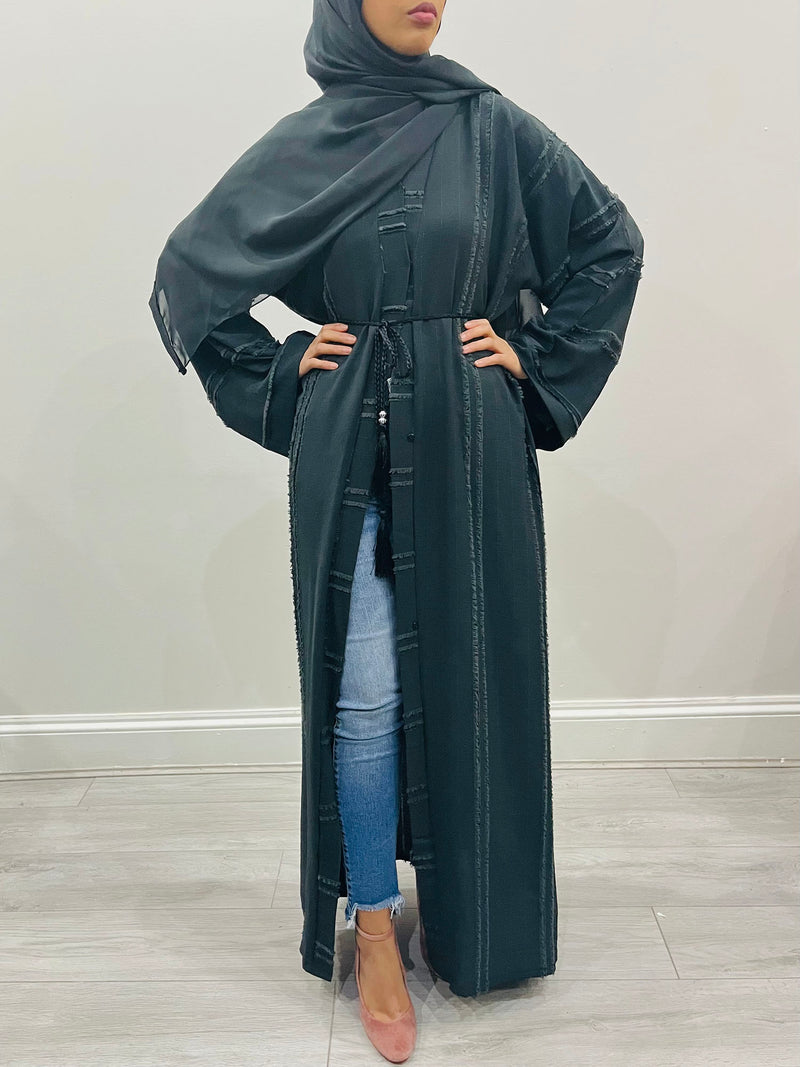
When Does Stone Work on an Abaya Look Thoughtfully Finished Rather Than Heavy Once the Embellishment Starts Catching the Light?
Bismillah. Abaya designs stone work can look special in a photograph, but a sister still has to live inside the garment. She has to walk, sit, greet family, carry a bag, make wudu if prayer time enters, and move through the day without feeling that every raised detail is waiting to catch, pull or expose more attention than she wanted. That is why I judge stone work by more than shine. I look at placement, weight, modest coverage, fabric strength, care and whether the whole abaya still feels calm on the body.
A beautiful embellished abaya should not make modesty feel difficult. The detail should serve the garment, not take it over. A quiet cuff, a controlled neckline, a soft front border or a carefully balanced hem can add grace without turning the outfit into a burden. Heavy shine in the wrong place can make even a modest cut feel hard to wear, while small detail in the right place can make a plain abaya feel considered, joyful and complete.
I also avoid making promises that the garment itself has not proved. Unless the product details clearly confirm the material, I do not assume decorative stones are crystal, glass, pearl, bead or any other specific finish. Unless the construction is shown clearly, I do not assume how the detail has been attached. Good buying advice should help a woman ask better questions, not push her into trusting a beautiful image too quickly.
This guide is written for the sister who wants beauty with ease. Maybe she is dressing for Eid, a family dinner, a nikah, a wedding invitation, a graduation, an evening gathering or a polished work setting. Maybe she loves stone work abaya designs but worries they will feel too delicate, too shiny or too hard to style. The answer is not to reject detail. The answer is to choose detail with clear eyes and a softer kind of confidence.
I also want the article to protect the reader from feeling rushed. Embellished clothing can create urgency because it feels special, and special pieces often seem as though they might disappear if we wait. But haste is where mistakes happen. A sister may overlook sleeve width, lining, opacity or care because the stones looked perfect in one image. Slow checking is not hesitation. It is respect for her money, her modesty and the peace she wants to feel when she wears the abaya.
My rule is simple: the abaya should pass real movement before it earns trust. If the stones look beautiful but the sleeves catch, the neckline fights the hijab, the hem drags or the fabric pulls, the garment has not finished proving itself. If the detail sits well, the fabric supports it and the styling stays restrained, stone work can become a quiet form of occasion beauty that still honours modesty.
Start with placement, because placement decides everything
The first question is not how bright the stones are. The first question is where they sit. Detail at the neckline changes the face frame. Detail at the cuff changes hand movement. Detail down the front changes the line of the abaya. Detail at the hem changes walking, stairs and alterations. Detail at the shoulder changes how a coat or bag will sit. Each placement has a different practical life, so each one deserves its own judgement.
I like to imagine the abaya being worn for several hours, not only held up in front of a mirror. Will the wearer reach for food, hold a child, sit in a car, lift her hands in greeting, climb stairs or carry a handbag? Stones placed where the body moves most need more caution than stones placed where the garment falls calmly. The best design is not the busiest one. It is the one where every decorated area has a reason.
I also compare placement with the sister's personality. Some women feel peaceful when detail is close to the face because it makes the outfit feel complete without extra accessories. Others prefer detail lower on the garment because they do not want attention near the neckline. Neither choice is automatically better. A good abaya should match the woman's comfort as well as the event. The design should not ask her to perform a confidence she does not feel.
Neckline stone work has to respect the hijab
Stone work near the neckline can frame the face beautifully. It can make a black, cream, mocha, navy or muted abaya feel finished without adding heavy jewellery. But neckline detail is also the easiest place for a hijab to catch. A raised edge, sharp setting or rough surface can snag chiffon, georgette, lace or loose weave scarves. Even if the abaya itself fits well, the outfit can become annoying if the scarf keeps rubbing against the stones.
I choose the scarf after checking the neckline, not before. A smooth jersey, soft modal or matte scarf may sit more easily than a fragile sheer one, depending on the design. If the neckline is already decorated, I keep pins, brooches and necklace styling minimal. The hijab should calm the detail and protect the fabric around it. A modest outfit feels more peaceful when the face frame is beautiful but not busy.
Neckline detail also changes how the scarf is wrapped. A higher wrapped hijab may hide part of the stones, while a loose drape may reveal them more clearly. If the scarf needs many pins to stay away from the detail, the outfit may become fussy. I prefer a wrap that feels secure with minimal adjustment. When the hijab and neckline agree, the whole outfit feels calmer and more expensive, even when the design is simple.
Cuff detail needs a hand movement test
Cuffs are one of the most graceful places for stone work because they move with the hands. A neat cuff border can look elegant when greeting guests, pouring tea or adjusting a scarf. But cuffs also meet tables, keyboards, car doors, wudu sleeves, pram handles, shopping bags and coat linings. If the detail is too raised or too wide, a beautiful cuff can become the part of the abaya that constantly asks for attention.
Before trusting cuff detail, I think through ordinary hand movements. Can the sleeve move back enough for washing? Does the cuff knock against a table? Will bracelets catch on it? Does the sleeve feel heavy at the wrist? If a sister works with her hands, teaches, cooks, travels or cares for children, cuff practicality matters even more. A pretty sleeve is only successful if it lets her keep being herself.
I also check whether the cuff detail sits on the outside, around the whole wrist or close to the palm side. Detail on the palm side may touch more surfaces and feel less practical. Detail only on the outer sleeve can be easier to wear because it shows when the hand moves but does not constantly scrape against tables or objects. Small construction choices like this can decide whether an abaya becomes a favourite or stays unworn.
Front panels can look elegant, but they must not pull the abaya forward
Stone work down the front can create a long, formal line. It can make the abaya feel taller, more structured and more occasion ready. But front-panel detail also changes how the fabric hangs. If the stones are heavy, the front can pull forward. If the abaya is open, the panels may swing, separate or rub against the inner layer. If a bag strap crosses the body, the detail can be pressed repeatedly in one place.
For an open embellished abaya, I never rely on the outer layer alone. The inner dress, slip, skirt or co-ord should be modest enough even if the front shifts. For a closed abaya, I check whether the decorated front sits flat without pulling across the bust or stomach. Front detail is beautiful when it lengthens the garment. It becomes a problem when it starts controlling how the garment moves.
If the front is decorated, I also think about how the abaya looks from the side. Sometimes the front looks perfect in a straight photograph, but side movement shows that the panel pulls away or hangs lower than the rest of the garment. That can make the abaya feel uneven. A strong front line should still sit naturally with the side seam, sleeve and lower hem. Elegance should continue around the body, not stop at the first photograph.
Hem stone work needs length discipline
A decorated hem can look lovely in movement. It catches light near the floor and gives the abaya a dressier finish without placing shine near the face. But the hem lives in the hardest part of the day. It meets pavement, stairs, wet floors, car doors, shoes, hems of coats and the edge of chairs. If the abaya is too long, stone work near the floor becomes a care problem almost immediately.
I check length before admiring the border. Can the wearer walk without holding the abaya up all day? Will the stones scrape when she climbs stairs? Can the hem be shortened without damaging the design? A low decorative border may be perfect for a short indoor event, but less suitable for a rainy outdoor journey. Hem beauty needs practical boundaries, especially in British weather.
Alterations matter here too. A plain hem can often be shortened more easily than a decorated one. Once stones, borders or shaped panels sit close to the floor, shortening may disturb the design or become expensive. For a sister between lengths, this matters before purchase. It may be wiser to choose a cleaner hem and add elegance elsewhere than to buy a decorated length that cannot be adjusted without losing the very feature she loved.
Shoulder embellishment must work with coats and bags
Shoulder detail can give an abaya a formal shape, especially when the rest of the garment is plain. It can draw the eye upward and make the outfit feel polished. But shoulders carry more pressure than people realise. Coats sit there. Bags sit there. Seatbelts cross near there. If the stones are raised or stiff, they can press into the body or rub against outerwear during travel.
I ask whether the sister will wear this abaya indoors only, or whether it has to survive the whole journey. A shoulder feature for a hall, hotel or home gathering may work beautifully. The same detail under a heavy winter coat may feel uncomfortable. Stone work should match the route as well as the room. That is the kind of judgement that keeps beauty from becoming frustration.
Shoulder work also changes posture in a quiet way. If the detail feels bulky, a sister may start holding herself stiffly so the stones do not rub. That stiffness can make an outfit feel less natural. A good shoulder feature should let her relax her arms and walk normally. It should add presence without making her feel as though she has to protect the garment every second.
Scattered stone work should still feel intentional
Scattered stones can soften a plain abaya and make the design feel lighter than a dense border. They can look delicate across sleeves, lower panels or the front of the garment. But scattered detail only works when it has rhythm. If the stones appear randomly placed without balance, the abaya can look less refined than a simpler design would have looked.
I look at whether the pattern has a beginning, a middle and a natural fade. Does it balance both sides of the body? Does it follow the abaya's movement? Does it leave enough quiet space for the eye to rest? A few stones placed with care can look expensive and graceful. Too many scattered pieces without structure can make the garment feel unfinished.
The spacing of scattered stones should also respect modesty. If the detail is concentrated only around the bust, waist or hip, the eye may stop there in a way the wearer does not want. A softer spread across sleeves, lower panels or borders can feel more balanced. I am not looking for decoration to erase the body. I am looking for decoration that does not make one area feel unnecessarily highlighted.
Tone on tone stone work gives the quietest elegance
Tone on tone detail is often the easiest way to wear embellishment with modest calm. Black stones on black fabric, soft stones on taupe, grey detail on grey or muted decoration on a deep shade can create texture without making the abaya loud. It is the kind of beauty that appears as the garment moves, then softens again when the wearer is still.
The only caution is visibility. Under low indoor light, tone on tone work may look plainer than expected. That may be perfect for a sister who wants subtlety, but disappointing for one who wanted a stronger occasion look. I would check the abaya in the light where it will actually be worn. Quiet detail should still feel deliberate, not invisible.
Tone on tone work is especially helpful for sisters who love texture but dislike feeling too dressed up. It gives the abaya a private kind of beauty. Up close, the detail is clear. From a distance, the garment remains composed. That can be ideal for family gatherings, work dinners or occasions where the sister wants to show care without feeling as though every eye has been invited toward her outfit.
Contrast stones need the rest of the outfit to calm down
Contrast stones make a clearer statement. Pale detail on a black abaya, dark detail on a cream abaya or metallic looking detail on a deep colour can feel formal very quickly. That does not make the design wrong. It simply means the rest of the outfit has to behave with restraint. The scarf, bag, shoes and jewellery should not all compete for the same attention.
When the abaya already has contrast, I choose one calm direction. A matte scarf, plain bag and simple shoe often do more for the outfit than extra sparkle would do. If the cuff is detailed, jewellery can be minimal. If the neckline is detailed, the scarf can be smooth. An embellished abaya looks more elegant when the surrounding pieces give it space.
Contrast also affects photographs. A strong pale detail on a dark abaya may appear brighter in flash than it feels in person. A metallic looking border can become the brightest part of the whole image. Before a major event, I would check the outfit with a phone camera in similar lighting. This is not vanity. It is practical, because many occasion garments are remembered through photos as well as through wear.
Hand work abaya designs need close evidence
Hand work abaya designs can sound special, but the words need evidence. Hand work may refer to decorative stitching, attached detail, bead style embellishment, stone work, thread work or other labour intensive finishing. The phrase alone does not prove quality, comfort or durability. I look for close photographs, even spacing, clean backing, secure edges and a design that follows the garment's cut instead of fighting it.
I also care about how the reverse side feels. Raised work can look beautiful from the outside but feel rough inside the sleeve, neckline or shoulder. If the product images do not show construction, I remain careful. Craftsmanship should bring dignity to the garment. It should not simply be a label that makes the buyer stop asking practical questions.
Even beautiful hand work should not make the buyer ignore fit. A sister may feel tempted to accept tight arms, a short lining or a difficult hem because the detail looks special. I would not do that. Craft is only part of the garment. The abaya still has to cover her kindly and move with her body. A design can be beautifully worked and still be the wrong abaya for her day.
Beads, pearl style detail and sequins are separate decisions
Beads, pearl style detail and sequins can appear beside stone work, but they should not be treated as identical. Beads create texture and can add weight. Pearl style detail looks softer but may still be raised. Sequins bring flat shine and can reflect strongly under light. Each finish has its own snagging, care and styling concerns.
A good embellished abaya description should make the difference clear where possible. If a garment uses stones, I judge the stones. If it uses beads, I think about bead weight and spacing. If it uses pearl style detail, I check whether the surface will rub or catch. If it uses sequins, I think about shine and care. Lumping every finish together can hide the practical truth.
The sound and feel of embellishment can matter too. Some bead or sequin detail may make a small noise as the wearer walks, especially in quiet settings. Some sisters do not mind that, and some find it distracting. Pearl style pieces can feel smooth but still add weight. Sequins can feel light but catch more than expected. These details are not small when the garment is worn for hours.
Thread work and cut work should not be confused with stones
Thread work sits differently from stone work. It can be raised, dense, soft, delicate or textured depending on the stitch and fabric. Cut work creates openings or shaped negative space, often needing lining or careful layering. Neither one proves the same things that decorative stones prove. The garment may have several techniques, but each technique changes modesty, comfort and care in its own way.
This matters because a sister may be choosing between stone work abaya designs and a softer embroidered option. If she wants less catching around her scarf, thread detail may suit her better. If she wants a stronger evening look, stone placement may feel more dressed. If she wants airflow or shaped detail, cut work needs lining and opacity checks. The right choice depends on use, not on one decorative word.
Cut work needs particular modesty care because shaped openings can change opacity even when the main fabric is dense. If the design exposes lining, contrast fabric or skin through gaps, the wearer needs to understand that before styling. It may still be beautiful and modest with the right underlayer, but it should never be judged only from the front image. The practical question is always what happens when light passes through and the body moves.
Fabric strength comes before embellishment
Stone work sits on fabric, so fabric strength matters before decoration. A fine chiffon outer may need support from lining or an inner dress. A crepe fabric may carry modest structure more easily. A satin finish may reflect light and show pulls. A soft flowing fabric may move beautifully but struggle with heavy decoration. The same stone pattern can behave differently on different cloth.
I do not assume fibre from appearance. Satin does not automatically mean silk. Smooth fabric does not automatically mean opaque. Heavy fabric does not automatically mean high quality. I look for composition, lining, opacity, care instructions and how the garment falls. If the fabric cannot support the work, the stones cannot rescue it. The foundation has to be trustworthy first.
Fabric also decides whether the abaya feels graceful or stiff. Some heavily decorated pieces become board like because the cloth cannot move naturally under the embellishment. Others keep a soft fall because the work is lighter and better placed. I prefer a fabric that can carry detail without losing its modest flow. The abaya should still feel like clothing, not like a decorated panel being held around the body.
Lining can help coverage, but it can also restrict movement
Lining can make an embellished abaya feel safer because it improves coverage and helps the outer fabric sit more smoothly. But lining has to be checked separately. If the lining is narrower than the outer abaya, the garment may pull when walking or sitting. If the lining fabric clings, it can show shape even when the outer layer looks loose. If the sleeves are unlined, the arm may still need an inner layer.
I check lining in the bodice, sleeves, skirt, side openings and front panel. I also think about static between layers. Stone weight can pull the outer fabric while the lining moves differently underneath. A lined abaya can still need careful testing, and an unlined abaya can still work if the fabric is dense and the styling is thoughtful. Construction decides the result.
The colour of the lining matters as well. A lining too light or too shiny can change the outer shade, especially under pale abayas. A lining too dark can show through in unexpected places. If the abaya has stone work, the buyer may focus on the detail and forget the underlayer that gives the garment its true coverage. A good lining should support modesty quietly, without becoming another styling problem.
Opacity is never proven by sparkle
Decoration can make a garment look complete, but it does not prove opacity. A pale abaya with stone work may still need an underdress. A dark abaya may look modest while standing and then reveal more shape when sitting. Flash photography, sunlight, venue lighting and backlighting can all change what the fabric shows. Stones may distract the eye, but they do not become coverage.
I test opacity in realistic conditions. I think about windows, car lights, wedding photography, phone flash, prayer movement and sitting down. If the abaya is open, the inner layer carries part of the coverage decision. If the fabric is light, the underlayer should be chosen before the event, not discovered at the door. Modesty is built from fabric, fit and movement first.
I also pay attention to cling. A fabric can be opaque and still cling in a way that makes the wearer uncomfortable. Static, stretch, humidity and layered fabrics can all affect how an abaya sits. Stone work may add formality, but it cannot correct cling. If the garment needs an anti static slip, wider sizing or a different inner layer, that should be solved before the abaya is trusted for a public event.
Weight should feel supportive, not tiring
A little extra weight can help a sleeve or hem fall beautifully. Too much weight can pull the garment down, tire the shoulders or make the front feel heavy. Weight is not automatically a sign of quality. It has to be distributed kindly across the abaya. Dense decoration at one point can distort the drape, while lighter detail spread with care can feel easier.
I think about time. A garment can feel fine for ten minutes and uncomfortable after three hours. A sister may be standing, greeting, travelling, sitting and praying during the same day. If the abaya starts to feel heavy before the event has properly begun, the design has not been kind enough. Occasion beauty should still let the body breathe.
Weight is especially important for petite sisters, tall sisters who need longer lengths and anyone who already finds heavy garments tiring. A long abaya with decorated cuffs and a decorated hem can feel very different from a shorter or simpler one. I would rather choose one strong embellished area than accept weight everywhere. Selective detail often looks more refined and feels more merciful on the body.
Snagging should be planned around, not ignored
Raised detail can catch on chiffon hijabs, lace, knitwear, rough bags, crossbody straps, seatbelts, coats, jewellery, table edges and chair arms. This is not a reason to fear every embellished abaya. It is a reason to style it honestly. A delicate scarf may not be the best choice beside a raised neckline. A sharp bag edge may not belong against a decorated front panel.
I plan the surfaces that will touch the abaya. A smooth scarf, a hand held bag, simple jewellery and careful outerwear can reduce risk. I also avoid forcing several textured pieces into the same outfit. Stone work looks better when it is allowed to be the main texture. Planning does not remove every risk, but it makes the garment easier to enjoy.
Snagging also affects how the garment ages. The first wear may look perfect, but repeated rubbing can loosen threads, lift settings or create small pulls around the detail. That is why I think beyond the event. If the abaya is meant to be worn many times, the styling should protect it each time. A special garment does not need to be fragile, but it does need respectful handling.
Workwear abayas need quiet detail and practical sleeves
A work abaya has a different job from an occasion abaya. It may need to handle commuting, desks, meetings, typing, teaching, retail tasks, care work or long hours away from home. In that setting, detail should be controlled. A small cuff feature, subtle front line or tone on tone placement can look polished without becoming distracting.
If a sister wants a work wear abaya with embellishment, I would check sleeves first. Can she type without the cuff knocking? Can she wear a coat? Can she carry a bag without rubbing the stones? Does the shine feel calm under office lighting? Professional modest dressing does not need to be plain, but it should not make the sister feel watched for the wrong reason.
For work settings, I also think about authority and ease. Some sisters want to look polished without inviting comments about being overdressed. A controlled embellishment can help. It adds care, but not noise. Darker bases, tone on tone stones, clean sleeve shapes and minimal accessories often feel more confident than a glittering statement. A work outfit should help the sister focus on her responsibilities, not make her feel self conscious.
Occasion abayas should pass a long day, not just a photograph
Occasion dressing can make the heart lift. A little beauty before Eid, a wedding, a nikah or a family gathering can feel like care, joy and gratitude. But an occasion abaya still has to move through the whole day. There may be travel, greetings, food, prayer, children, stairs, photographs and long sitting. A garment that only works while standing still is not ready for real life.
I ask whether the abaya can stay comfortable after hours of wear. Does the neckline remain secure? Do the sleeves behave? Does the hem stay safe? Does the inner layer remain modest? Can the wearer sit without stones pressing into her lap or waist? A special abaya should let her be present with people, not trapped in constant adjustment.
I also think about the emotional side of occasion dressing. A sister may already feel pressure at family events: to look right, to be modest enough, to be dressed enough, to avoid criticism. The abaya should reduce that pressure, not add to it. When fit, coverage and movement are solved, she can enjoy the gathering with a lighter heart. That is a kind of beauty too.
Wedding styling needs beauty with humility
A stone-work abaya can suit a wedding or nikah setting when the colour, cut and detail match the role of the wearer. A bride, sister, mother, guest or bridesmaid may need different levels of formality. Stone work can make an abaya feel joyful, but it should still sit inside the boundaries of modesty, comfort and sincere intention.
I do not believe every wedding abaya needs heavy shine. Sometimes a soft cuff, a modest neckline border or gentle front detail feels more elegant than a fully decorated garment. The outfit should honour the occasion without making the sister feel as though modesty has become a performance. Beauty is safer when it remembers why it is being worn.
Colour matters in wedding settings as well. Black, ivory, champagne, taupe, blush, navy and emerald can all feel different depending on culture, venue and role. Stone work can make a shade feel more formal, so the wearer should consider whether she wants to blend, honour the dress code or stand out gently. The goal is not to disappear. It is to choose a level of presence that feels respectful.
Eid detail should still allow worship and family life
Eid dressing can carry happiness, memory and love. Many sisters want something a little more special than an everyday abaya. Stone work can offer that special feeling, especially when the detail is placed with care. But Eid also includes prayer, visiting, food, children, travel and long family conversations. The abaya needs to support all of that.
I check sleeves for wudu, front coverage for sujood, hem length for walking and fabric comfort for several hours. If the abaya is too delicate for the day, the wearer may spend Eid protecting the garment instead of enjoying the people. A better choice is an abaya that feels joyful but still lets her move with ease and gratitude.
With Eid, I also think about warmth and weather. A heavily lined or decorated abaya may feel lovely in the morning and tiring by afternoon, especially when houses are busy or the day includes travel. A lighter embellished area can bring the same joy with less strain. Eid clothing should feel like gratitude, not like a garment that has to be managed all day.
Accessories should not compete with the abaya
When the abaya already has stone work, accessories need discipline. A plain bag can look more elegant than a decorated one. Simple shoes can protect the hem better than fussy straps. Minimal jewellery can prevent catching around cuffs and neckline detail. The aim is not to remove personality. The aim is to let the abaya's chosen detail breathe.
I usually choose one feature to lead. If the neckline is decorated, the hijab stays calm. If the cuff is decorated, bracelets become optional. If the front panel is decorated, the bag should not scrape across it. If the hem is decorated, shoes should support safe movement. Too many features can make the outfit restless. One clear feature can make it feel complete.
The bag is often the most overlooked accessory. A rough chain strap, zip edge or beaded clutch can damage stone work quickly. If the abaya is decorated at the front or shoulder, I prefer a smoother bag shape that can be carried without rubbing. This does not mean the bag must be boring. It simply means it should respect the garment. Beautiful pieces can harm each other when their surfaces clash.
Care begins before the first wear
Care does not begin after the event. It begins when the garment arrives. I check the care label, inspect the stones, look for loose edges, test how the fabric responds to light handling and decide how the abaya will be stored. If the label limits washing, heat, steaming or pressing, I respect that instruction. General habits should never overrule the garment's own care guidance.
I would be careful with perfume oil, makeup, deodorant, food marks and strong rubbing near embellishment. Direct heat over raised detail can damage finish or attachment, so pressing should be cautious and label led. Storage also matters. An embellished abaya needs space, dryness and protection from rough neighbouring fabrics. Good care is part of the cost of choosing a special piece.
I would also photograph the detail when the abaya is new, especially if it is for an important event. That gives a simple reference point if a loose stone, pull or defect appears during first inspection. It also helps the wearer notice whether the garment arrived as expected. Care is not suspicion. It is stewardship. When a sister spends money on a special abaya, she has the right to protect that choice.
Buying online requires evidence beyond the best photo
A beautiful product photograph can inspire interest, but it should not carry the whole decision. I want to see full length images, close ups, sleeve views, hem views, back views, lining information, included pieces, garment measurements and care guidance. The more detailed the abaya, the more evidence the buyer deserves.
I also check whether the listing makes clear if the abaya is open or closed, whether an inner dress is included and where the stones sit. If the page does not prove a claim, I keep that claim uncertain. A careful buyer can still fall in love with a garment, but she should not have to fill missing evidence with hope. Evidence turns attraction into trust.
Reviews can help, but I treat them carefully. A five star review may praise beauty without mentioning fit, lining, opacity or care. A complaint may come from wrong sizing rather than poor construction. The useful reviews are the ones that describe height, size, fabric feel, heaviness, sleeve length and how the garment behaved during wear. Specific evidence is more helpful than excitement alone.
Try the abaya at home before trusting it outside
The home try on is where many truths appear. I would try the abaya with the actual hijab, inner layer, shoes and bag. I would sit down, walk, raise the arms, turn sideways, check light near a window and see whether anything catches. I would avoid perfume and makeup until I knew the garment was staying, because returns should remain clean and fair.
This is not being fussy. It is being responsible. A sister deserves to know whether the abaya works before the event begins. If it fails the home test, she can exchange, alter or choose another outfit without panic. If it passes, she can wear it with more peace. Confidence often comes from checking the ordinary things early.
The home test should also include stillness. Stand in front of a mirror without posing, then sit normally, then walk naturally. Sometimes an outfit looks beautiful only when the body is arranged carefully. Real confidence comes when the abaya still feels modest and graceful in ordinary posture. A sister should not have to hold herself like a mannequin for the garment to work.
A stone-work abaya checklist I would use before buying
- Check where the stones sit: neckline, cuffs, shoulders, front panels, sleeves, hem or scattered areas.
- Confirm whether the abaya is open, closed, lined, layered or sold with an inner piece.
- Compare garment measurements with an abaya that already fits well.
- Test opacity in daylight, indoor light, flash and sitting movement.
- Choose hijab fabric based on snagging risk around the neckline and shoulders.
- Think about bags, coats, jewellery, seatbelts, chairs and table edges.
- Check whether the sleeves allow wudu and comfortable hand movement.
- Judge whether the hem length is safe for shoes, stairs and outdoor walking.
- Read the care label before assuming it can be washed, steamed or pressed normally.
- Try the complete outfit at home before removing tags or relying on it for an event.
The checklist is not meant to make buying joyless. It is meant to protect the joy. When the practical matters are answered, the sister can stop worrying and actually enjoy the garment. She can step into the room knowing the sleeve is manageable, the hijab is safe, the hem is the right length and the inner layer is doing its job. That kind of quiet certainty changes how an outfit feels.
For wider help with silhouette, fabric, length and modest fit, I would compare this decision with the complete abaya guide. Stone work adds decoration, but the foundation remains the same. The abaya must cover well, fit kindly and move with the sister's real life.
My decision table for stone-work details
| Detail area | What it can add | What I check before trusting it |
|---|---|---|
| Neckline | Frames the face and makes a plain abaya feel dressed | Hijab snagging, chest placement, scarf coverage and shine near the face |
| Cuffs | Adds graceful movement around the hands | Wudu, typing, table friction, jewellery and sleeve weight |
| Front panels | Creates a long formal line | Panel pull, bag straps, inner-layer coverage and opening security |
| Shoulders | Gives structure and presence | Coat comfort, bag pressure, seatbelt rubbing and long wear |
| Hem | Makes walking and photographs feel special | Length, stairs, shoes, outdoor floors, cleaning and alteration limits |
| Scattered detail | Softens a plain garment without one heavy focal point | Pattern rhythm, balance, snagging points and whether it looks intentional |
I use a table like this because embellished abayas can become overwhelming when every detail is judged at once. Separating neckline, cuffs, front panels, shoulders, hem and scattered detail helps the buyer slow down. It also prevents one beautiful feature from hiding another practical problem. A clear decision is usually a kinder decision.
When I check current Amani's abayas
After the practical checks are clear, I look at the current abaya collection for live styles, colours, sizes, prices, included pieces and availability. I do not treat an old example as proof of what is available today. Current product pages matter because stock, colours, measurements and details can change.
When comparing Amani's abayas, I keep the same questions with me. Where is the detail placed? What fabric carries it? Is the design open or closed? Does it need an inner layer? Is the length practical? Will the hijab catch? Can the garment be cared for honestly? These questions turn browsing into a calmer decision, especially when the abaya looks beautiful at first glance.
I also remember that a collection page is only the starting point. The individual product page should still be read carefully because two abayas in the same collection can behave very differently. One may be open, one closed, one lined, one unlined, one lightly decorated and one more formal. The final choice should come from the specific garment, not from the general category.
A final reflection on beauty that still feels peaceful
I understand why stone work pulls the eye. Sometimes a sister wants her abaya to feel a little more special because the day itself feels special. Sometimes she wants quiet detail after months of plain everyday dressing. Sometimes she wants to look cared for without feeling uncovered, loud or unlike herself. Those feelings are real, and they deserve guidance that is practical without being cold.
The best stone-work abaya gives beauty without taking ease away. It lets the wearer feel dressed without making her guarded. It brings light without demanding attention from every direction. It supports movement, coverage, prayer needs, travel, family life and the small private comfort of feeling put together. That is the balance I want for a sister: not sparkle for its own sake, but detail that serves dignity.
I want the reader to feel permitted to love detail, but not pressured by it. Modesty does not require every abaya to be plain, and beauty does not require every abaya to be loud. There is a middle place where a garment can feel feminine, covered, thoughtful and easy. That is the place I keep looking for when I judge stone work: the point where the decoration supports the sister instead of asking her to serve the decoration.
May Allah place barakah in what we choose, protect us from waste, and make our clothing a means of modesty, gratitude and calm confidence. A stone-work abaya can be beautiful. It can also be thoughtful, practical and gentle on the woman wearing it. That is when the design feels complete.
Frequently asked questions about abayas with stone work
I have kept the answers focused on the decisions that matter most: what the detail means, whether it can still be modest, how to style it, how to care for it and where it belongs in real life. These are the questions that help a woman move from admiration to a confident, evidence based choice.
What does stone work mean on an abaya?
Stone work usually means decorative stone style detail placed on an abaya, often around the neckline, cuffs, sleeves, front panels or hem. Unless the product details confirm the exact material and construction, I keep the wording general and judge the garment by placement, comfort, care and coverage evidence.
Are abayas with stone work still modest?
Yes, they can be modest when the cut, opacity, fit, movement and styling remain covered and comfortable. Stone work itself is not the only issue. Placement matters. Detail across the chest or neckline needs more care than quiet cuff, sleeve or border detail, especially when worn with a hijab.
How do I choose between subtle and bold stone work?
Choose subtle stone work if you want repeat wear, calmer styling and easier hijab pairing. Choose bolder contrast detail only when the event, lighting and accessories support it. A bold abaya usually needs simpler scarves, bags and jewellery so the outfit does not become visually crowded.
What hijab fabric works best with stone work?
Smoother hijabs often work better near raised detail because they reduce catching. Jersey, modal or smoother woven scarves may be easier than very delicate chiffon or lace around a decorated neckline. The best fabric depends on the stone placement, scarf texture, pin method and how much movement the day requires.
Can I wear a stone-work abaya for work?
Yes, but I would keep the detail controlled. A work abaya needs practical sleeves, calm shine, comfortable shoulders and easy movement. Subtle cuff detail or tone on tone decoration can look polished, while heavy cuffs, sharp raised stones or strong front shine may feel distracting during long office or practical days.
Is a stone-work abaya suitable for Eid or weddings?
Stone work can be suitable for Eid, nikah events, weddings and family gatherings when the design fits the setting. I still check prayer movement, sleeve behaviour, hem length, comfort after several hours, hijab snagging and care requirements. Occasion beauty should not make the wearer feel trapped.
Does stone work make an abaya harder to wash?
It can. Care depends on the fabric, lining, dye, decorative finish and attachment method. The garment's own care label should always come first. I avoid rough rubbing, careless heat and harsh handling around raised detail unless the label clearly allows a method and the garment has been checked carefully.
What should I check on an open stone-work abaya?
Check the inner layer first. The dress, slip or outfit underneath should remain modest if the front panels move. Then check front-panel weight, closure security, side openings, wind movement, hijab catching and whether the stones rub against the inner fabric when walking or sitting.
How can I tell if stone placement is practical?
Imagine the full day. If stones sit where bags rub, cuffs move, hems drag, shoulders carry coats or hijabs touch the neckline, test more carefully. Practical placement looks good while standing but also survives sitting, walking, wudu, stairs, travel and greeting people without constant adjustment.
Where should I check current Amani's abayas with detail?
Check the live Amani's abaya collection and the individual product pages for current colours, sizes, measurements, prices, included pieces and availability. Then compare each option by placement, fabric, lining, fit, care and styling needs so the final choice is based on evidence rather than the best photograph.