Everyday Abaya: Why It Matters More When You Are Dressing for Real Life
Bismillah. Let us talk about the abaya a sister actually wears.
Not the abaya saved for the perfect occasion. Not the one hanging beautifully in the wardrobe waiting for Eid, a wedding, a dinner or a photo. Not the one that looks stunning for five minutes but feels too delicate, too long, too warm, too slippery or too difficult for an ordinary day. This conversation is about the everyday abaya. The one you reach for when life is moving quickly. The one you wear for errands, school runs, work, university, masjid visits, appointments, shopping, prayer and those tired mornings when you still want to leave the house feeling covered and dignified.
An everyday abaya matters because most of our lives are not special events. Most of our lives are made of normal days. We wake up, pray, answer messages, get ready, look after families, work, study, cook, travel, clean, shop, support others and try to keep our hearts steady. If modest clothing only works on beautiful days, it does not truly serve us. A good everyday abaya should help a sister dress with less stress on the days that are not polished.
That is why this guide is written with real life in mind. We are not going to pretend that every sister has endless time, endless budget, endless confidence or a wardrobe full of matching pieces. We are not going to speak as if every woman is the same height, shape, age or routine. We are going to talk about what makes an everyday abaya genuinely useful: coverage, comfort, fabric, movement, prayer ease, colour, layering, care, emotional confidence and whether it helps you feel like yourself without requiring too much effort.
If you are a revert sister building your first modest wardrobe, this is for you. If you have worn abayas for years but still struggle to find one that works for ordinary days, this is for you too. If you keep buying occasion pieces but never know what to wear on a normal Tuesday, you are welcome here. If you want modesty to feel less like pressure and more like peace, take a breath. We will go through it gently.
Why an everyday abaya matters more than we admit
It is easy to give attention to occasion abayas because they photograph beautifully. Embroidery, satin, cape layers, beadwork, soft shine and statement sleeves all catch the eye. There is nothing wrong with loving a special piece. A sister is allowed to enjoy beauty, dress neatly and feel feminine in a modest way. But if the everyday part of your wardrobe is weak, getting dressed becomes stressful even when you own beautiful clothing.
The everyday abaya is the foundation. It is the piece that carries you when you do not have time to plan. It helps you answer the door. It helps you step out quickly. It helps you pray at work or at a friend’s house. It helps you go to the masjid without feeling like you need a whole outfit change. It helps you feel covered when you are tired, hormonal, busy, overwhelmed or simply not in the mood to think about clothes.
Many sisters discover this after spending money on pieces they rarely wear. They buy something stunning, then realise it is too dressy for errands. They buy a trendy colour, then realise it matches nothing. They buy a delicate fabric, then avoid washing it. They buy a dramatic cut, then feel awkward wearing it on the bus or to the supermarket. The wardrobe looks full, but the daily decision still feels hard.
An everyday abaya solves a different problem. It is not asking, “Will people notice this?” It is asking, “Will this support me again and again?” That is a quieter kind of beauty, but often a more valuable one. A piece that helps you leave the house with dignity thirty times is more useful than a piece that impresses once and then stays unworn.
This is especially important for sisters who are growing into modest dressing. A reliable everyday abaya can make the journey feel possible. It removes some of the anxiety because you know you have something ready. You do not need to build a whole look from scratch each day. You have a foundation that says, “I can get dressed, I can feel covered, and I can move through my day.”
Choose for real life, not perfect life
A common shopping mistake is choosing for the life we imagine rather than the life we actually live. We imagine calm mornings, matching scarves, clean weather, enough time to steam every crease and a day where nothing unexpected happens. But real life often looks different. The child cannot find one shoe. The bus is late. The rain starts. Someone needs help. The doorbell rings. You spill tea. You remember an appointment. You need to pray outside. On those days, your abaya needs to work with you, not against you.
Before buying an everyday abaya, think about your actual week. Where do you go most often? How much walking do you do? Do you drive? Do you carry children, bags, books or shopping? Do you need to sit for long periods? Do you work in an office, a shop, a school, a clinic, a home setting or from your own business? Do you pray outside the home? Do you get warm quickly? Do you prefer loose sleeves or cuffed sleeves? Your answers should shape the abaya you choose.
If your days are active, fabric weight matters. If you walk a lot, length matters. If you work with your hands, sleeves matter. If you need easy prayer coverage, neckline and drape matter. If you are a new Muslim sister and still building confidence, colour and simplicity matter. None of these details are small. They decide whether the abaya becomes your favourite or another item you avoid.

A coordinated abaya set can sometimes work well for real life because it reduces decision making. When the pieces already belong together, you do not need to search for matching layers. But even then, ask whether you will wear the set often. Can you sit comfortably? Can you walk easily? Can the pieces be worn separately? Does the colour fit your wardrobe? A set is only useful when it serves your routine, not only when it looks complete in a photo.
The more honest you are about your life, the better your wardrobe becomes. You stop buying for fantasy and start buying for support. That does not make your style less beautiful. It makes it more sincere.
Coverage should not require constant adjusting
One of the biggest signs of a good everyday abaya is that it lets you stop thinking about your clothes every few seconds. If you are constantly pulling the sleeves, checking the chest, fixing the scarf, lifting the hem, closing the front or worrying about fabric clinging, the abaya may technically be modest but emotionally tiring. Everyday modest clothing should give peace, not constant work.
Start with chest coverage. If the abaya has buttons, an open front or a wrap style, check whether it stays secure when you walk and sit. If it has a lower neckline, think about whether your hijab or khimar gives enough coverage. If you often feel exposed around the upper body, choose cuts that provide more structure or layer with a longer scarf. Do not wait until you are outside to discover that the front opens more than you expected.
Then check sleeves. Wide sleeves can look graceful, but if they fall back every time you reach for something, you may need an inner sleeve or cuffed design. Tight sleeves may feel neat, but they should not restrict movement. If you cook, clean, carry bags, type, write, push a pram or work with your hands, sleeve practicality matters all day.
Check the lower half too. Does the abaya cling around the hips or legs? Does it ride up when walking? Is the slit too high for your comfort? Is the fabric too light in wind? Does the hem drag? A modest outfit must be tested in movement. Standing still in front of a mirror is only the beginning.
For many sisters, a khimar or longer hijab can make an everyday abaya feel more secure. For others, a simple hijab and a well cut closed abaya is enough. There is no one answer. The right answer is the one that lets you move through the day without anxiety.
If you are always adjusting a piece, ask whether it truly belongs in your everyday wardrobe. Sometimes the issue can be fixed with a better underlayer, pin or scarf. Sometimes the cut itself is not right for your routine. Be honest. You deserve clothing that helps you feel covered without making you fight for that coverage all day.
Choose fabric that can survive normal days
Fabric is where many everyday abayas succeed or fail. A fabric can look beautiful online but behave differently in real life. It may crease quickly, cling in wind, feel too warm, show marks easily, require delicate washing or become uncomfortable after a few hours. For occasion wear, you may accept more effort. For everyday wear, the fabric has to be kinder.
Think about opacity first. A daily abaya should not make you worry every time you step into daylight. If the fabric is light, sheer or pale, you may need an underdress. That can be fine, but only if you are willing to layer regularly. If you dislike layering, choose something more opaque from the start.
Think about breathability. If you get warm quickly or wear your abaya for long hours, heavy fabric may feel tiring. If you live in a cooler climate or need winter coverage, slightly heavier fabric may feel comforting. The right fabric depends on your body and weather, not only the season shown in the product photo.
Think about creasing. Some sisters do not mind a few natural creases because real life is real life. Others feel uncomfortable if fabric wrinkles quickly. If you need a low maintenance daily piece, choose fabric that can handle sitting, travelling and repeated wear. An everyday abaya should not require a full ironing session every morning unless you genuinely have time for that.
Think about care. Can it be washed gently at home? Does it need special treatment? Will the colour fade easily? Does it attract lint? Does it hold smells? Does it dry quickly? These questions may not feel glamorous, but they decide whether you actually wear the abaya weekly.

A soft neutral or earthy colour in a coordinated set can feel practical when the fabric moves well and the layers do not feel heavy. But again, the key is not the photo. The key is whether the fabric supports your day. If it can move, cover, wash and repeat, it becomes valuable.
Length and movement matter more than trend
Length is one of the most practical parts of an everyday abaya. Too long, and you may trip, drag the hem or feel unsafe on stairs. Too short, and you may feel exposed or uncomfortable. The ideal length depends on your height, footwear, routine and personal preference. There is no shame in needing a different length from the model.
If you are petite, look carefully at product measurements and model height. An abaya that looks elegant on a tall model may drag on you. Dragging fabric can collect dirt, tear at the hem and make movement stressful. You may need a petite-friendly length, a style that can be tailored, or shoes that lift the hem safely.
If you are tall, do not assume one size will cover enough. Check sleeve length and overall length. A piece that appears full length online may sit above your ankles. That may or may not be acceptable depending on your comfort and how you style it. Taller sisters deserve clear length information, not guessing.
Movement matters as much as length. Can you take a natural step? Can you climb stairs? Can you sit on public transport? Can you get in and out of a car? Can you walk in wind? Can you pray in it? A narrow abaya may look neat but feel restrictive. A very wide abaya may feel graceful but become difficult if the fabric is heavy. Balance is everything.
One useful test is to imagine your busiest day. Not your prettiest day. Your busiest day. Would this abaya survive it? Would you still feel comfortable by the afternoon? Would the sleeves annoy you? Would the hem get in the way? Would the fabric feel too warm? Would you still be able to pray? If the answer is yes, that is a strong sign.
Trends come and go. A practical length stays useful. The everyday abaya is not supposed to make your life harder just to look fashionable. It should let you move with dignity and ease.
Choose colours you can repeat without stress
Colour decides how often you wear an everyday abaya. A colour may be beautiful, but if it matches nothing in your wardrobe, it becomes difficult. A daily piece should connect with your hijabs, khimars, shoes, coats and bags. It should not require a new shopping list every time you want to wear it.
Black is popular for a reason. It is easy to repeat, easy to style, grounding and familiar. For many sisters, a black everyday abaya is the safest first step. But black is not the only practical colour. Navy, charcoal, slate grey, chocolate, dark green, taupe and deep brown can also work beautifully. The right colour is the one that suits your wardrobe and helps you feel calm outside.
If you prefer softer colours, choose them with care. Beige, nude, rose, mauve and cream can feel gentle and feminine, but they may need more careful layering and washing. They may also feel more noticeable if you are still building confidence. That does not mean you should avoid them. It simply means you should ask whether the colour suits your daily life.

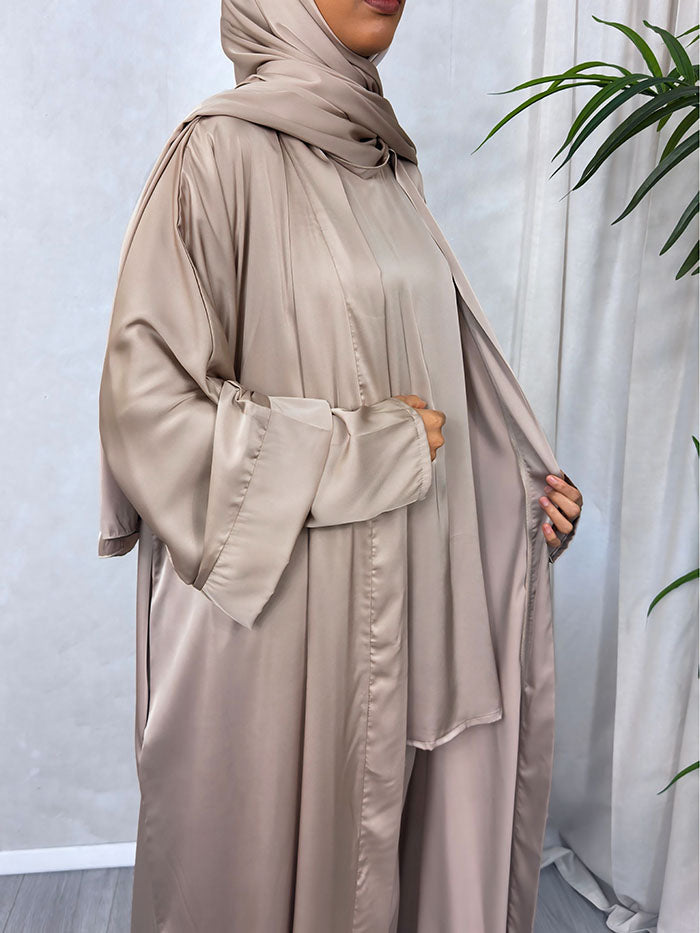
A warm beige abaya can feel peaceful and elegant. It can work with cream, taupe, chocolate, nude and soft brown layers. But if you choose a light neutral for everyday wear, think about marks, weather and underlayers. A colour can be both beautiful and practical if you know how it fits into your wardrobe.
A good rule is the three match test. Before buying an everyday abaya, ask whether you already own three things that match it. This could be a hijab, a khimar, a coat, shoes, a bag or an underdress. If the abaya works with what you own, it is more likely to be worn often. If it needs several new purchases, it may not be the right everyday choice yet.
Do not let social media make you feel that repeating colours is boring. Repetition creates ease. A sister who knows her colours can get dressed faster, buy less and still look put together. That is not boring. That is wisdom.
Why a prayer-ready abaya can change your day
An everyday abaya becomes even more valuable when it helps you pray with ease. Many sisters know the feeling of being outside and realising they need to pray, then worrying about sleeves, chest coverage, scarf security, skirt width or whether the outfit will shift in sujood. A prayer-ready abaya removes some of that stress.
This does not mean every everyday abaya must be a full prayer dress. But it should support modest movement. You should be able to raise your hands, bow, prostrate and sit without feeling exposed or restricted. If the neckline is open, your hijab or khimar should cover properly. If the sleeves are wide, you may need inner sleeves. If the fabric is light, you may need an underlayer. The aim is to focus on salah, not fabric.
For work, university or travel, this matters even more. You may not always have a perfect prayer space. You may pray in a quiet room, at someone’s house, in a fitting room, at a service station or in a small masjid corner. When your outfit is already prayer friendly, you feel less panic. You can answer the call to prayer with more calm.
New Muslim sisters often find this especially helpful. When everything is still new, from prayer times to wudu to finding the qiblah, clothing should not add more fear. A reliable everyday abaya can become a form of support. It says, “I am ready enough. I can pray.” That is a beautiful thing.
If you are building a modest wardrobe slowly, prioritise at least one outfit that makes salah easier. It may be an abaya, a jilbab, a khimar set or a prayer dress. You do not need many pieces at first. You need one that helps you worship without feeling exposed or overwhelmed.
The everyday abaya looks different for different sisters
There is no single everyday abaya that works for every woman. A mother may need something washable, easy to move in and safe around children. A student may need something practical with trainers and a backpack. A working sister may need something neat enough for professional settings. A revert sister may need something simple and emotionally comfortable. An older sister may need soft fabric, easy fastenings and modest coverage without heavy layers.
This is why copying another sister’s exact outfit can be disappointing. Her life may be different. Her height may be different. Her climate may be different. Her confidence may be different. Inspiration is helpful, but it should not replace self-knowledge. The everyday abaya has to belong to your life.
For busy mothers, pockets can be useful, but only if they do not distort the drape. Cuffed sleeves can help when handling children. Darker colours may be easier. Washable fabric matters. A piece that survives spills, school runs and quick errands is more valuable than something delicate that causes worry.
For students, comfort and movement matter. You may be carrying books, walking between buildings, sitting in lectures and using public transport. A simple neutral abaya with practical shoes and a secure hijab may serve you better than a dramatic piece. You need a style that lets you focus on learning.
For work, think about polish and practicality. A clean cut, calm colour and neat fabric can look professional without losing modesty. Avoid styles that require constant adjusting or make tasks difficult. If you wear a uniform or badge, test how it sits over the abaya.
For revert sisters, the best everyday abaya may be the one that feels least frightening. A simple black, navy or grey abaya can provide coverage without demanding too much attention. Over time, you may explore more colours and cuts. There is no need to rush into everything at once.
How to style an everyday abaya without overbuying
The secret to styling an everyday abaya is not buying more. It is building small combinations that you can repeat. One abaya can create several looks if you use hijabs, khimars, shoes and bags wisely. You do not need a new outfit every time you leave the house. You need reliable formulas.
Start with three hijab anchors: one dark, one neutral and one soft colour. For example, black, cream and taupe. Or navy, grey and white. Or brown, beige and rose. These anchors can change the feeling of the same abaya without requiring a new main piece. If you prefer khimars, choose the same kind of anchors in longer coverage styles.
Then choose shoes based on your routine. Trainers can make an everyday abaya practical for errands. Flats can make it softer. Boots can work in colder months. The shoes should suit the length. If the abaya drags with flats but works with a slight platform, remember that. Styling should include safety and comfort, not only appearance.
Bags should support the drape. Crossbody bags can pull fabric across the chest, which some sisters dislike. Shoulder bags, totes or handheld bags may work better depending on the abaya. Test at home. If a bag ruins the modest shape, choose another.

A softer or more detailed abaya can still be worn without overbuying if you keep the styling simple. A plain scarf, simple underdress and calm shoes may be enough. Let the main piece speak. You do not need to add more just because the abaya feels special.
| Everyday formula | How it feels | Why it works |
|---|---|---|
| Black abaya, cream hijab, trainers | Simple and practical | Easy for errands and busy days |
| Neutral abaya, taupe khimar, flats | Soft and covered | Good for masjid or visits |
| Dark abaya, matching hijab, boots | Grounded and neat | Useful in colder weather |
| Open abaya, plain underdress, long scarf | Layered and modest | Works when coverage is planned |
| Softer colour abaya, nude scarf, simple bag | Gentle and feminine | Nice for family gatherings |
Care, repeat wear and making one abaya work harder
An everyday abaya earns its place through repetition. That means care matters. If you look after it properly, one reliable abaya can serve you for a long time. If you treat it harshly, even a good piece can lose shape, colour or softness quickly.
Always check care guidance first. Gentle washing, cool temperatures and air drying are often safer for modest garments. Avoid strong heat unless the fabric allows it. Turn darker garments inside out where suitable. Keep lint heavy items away from black or dark abayas. Use a steamer or gentle iron if the fabric needs it, but do not damage delicate finishes.
Repeating an abaya is not something to hide. It is sensible. A repeated outfit that is clean, cared for and worn with confidence can look more elegant than a brand new outfit worn awkwardly. Many sisters feel pressured to constantly show something different, but real modest dressing is allowed to be steady. You can wear what works.
If you want one abaya to feel fresh, rotate hijabs. Change shoes. Add a different coat. Wear a khimar instead of a scarf. Use a simple belt only if it preserves modesty and suits the cut. Small changes can give the same abaya new life without buying another main garment.
Keep a small outfit note on your phone. Take photos of combinations that work. On busy mornings, you can choose from your own saved outfits instead of standing in front of the wardrobe feeling lost. This helps prevent panic buying because you remember what you already own.
There is dignity in maintaining your clothing. It teaches gratitude. It reduces waste. It helps your budget. It also makes modest fashion feel less like chasing and more like caring for what Allah has provided.
When it is actually time to buy a new everyday abaya
Buying less does not mean never buying. Sometimes a new everyday abaya is genuinely needed. The key is knowing the difference between a real wardrobe gap and a moment of pressure. A real gap shows up again and again. Pressure appears suddenly after scrolling, seeing a sale or comparing yourself to someone else.
It may be time to buy a new everyday abaya if your current one no longer fits, feels uncomfortable, is worn out, has become too short or tight, or no longer supports your modesty needs. It may also be time if your routine has changed. Starting work, university, motherhood, pregnancy, postpartum life, regular masjid attendance or travelling more often can all create new clothing needs.
A new everyday abaya may also be wise if it unlocks consistency. For example, if you avoid leaving the house because you do not have anything modest and comfortable enough, one reliable piece can make a big difference. If you are a revert sister trying to build your first wardrobe, an everyday abaya is not a luxury. It can be a foundation.
But pause if the reason is only comparison. Pause if you already own something similar. Pause if the colour needs five new pieces to match. Pause if you only want it because it is trending. Pause if the fabric does not suit your daily life. A pause protects you from regret.
Before buying, ask five questions. Will I wear this at least twice a month? Does it match pieces I already own? Does it solve a real problem? Can I care for the fabric? Does it help me feel covered and comfortable? If the answer is mostly yes, the purchase may be worth it. If the answer is unclear, wait.
The emotional comfort of having something ready
There is something deeply calming about knowing you have an outfit ready. For some sisters, this sounds small. For others, it changes the whole day. When you are trying to dress modestly, especially if you are new to it, the wardrobe can become emotional. You may feel exposed, confused, judged, behind or unsure. A good everyday abaya gives you one less thing to fight.
On hard mornings, it says, “You can still get dressed.” On nervous masjid days, it says, “You have something respectful and comfortable.” On busy family days, it says, “You can move.” On prayer days outside the home, it says, “You are covered enough to focus.” That emotional reliability matters.
Many women underestimate how much clothing affects their confidence. If an outfit feels wrong, the whole day can feel harder. If an outfit feels secure, you stand differently. You walk differently. You speak with less self-consciousness. This is not about vanity. It is about feeling at peace in public while trying to honour your values.
For sisters who have experienced body changes, the everyday abaya can also feel merciful. It does not demand that your body be a certain shape. It can give room. It can offer coverage without punishment. It can help you show up without explaining yourself.
For revert sisters, it can become part of identity building. The first everyday abaya may be the piece you wear to the masjid, to your first Islamic class or to pray at work. It may carry memories. Choose it with tenderness. It does not have to be perfect. It should simply help you take the next step.
Frequently asked questions about everyday abayas
What makes an abaya good for everyday wear?
A good everyday abaya is comfortable, opaque, easy to move in, practical to care for and simple to style with pieces you already own. It should support prayer, errands, work, study or family life without needing constant adjusting. The best daily abaya is one you can repeat with confidence.
Which colour is best for an everyday abaya?
Black is a popular first choice because it is easy to repeat and style. Navy, charcoal, grey, brown, taupe and dark green can also work well. The best colour is one that matches your existing hijabs, shoes and outerwear, and one you feel comfortable wearing outside often.
Should an everyday abaya be plain or detailed?
Plain abayas are often easier for daily wear because they can be styled many ways. A little detail can still work if it does not make the piece too delicate or too dressy. For everyday use, comfort, coverage and repeat wear matter more than heavy decoration.
Can I wear an everyday abaya for prayer?
Yes, if it gives enough coverage and movement for salah. Check the sleeves, neckline, fabric opacity and lower half before relying on it outside. A prayer friendly abaya should allow ruku and sujood without making you worry about exposure or constant adjustment.
How many everyday abayas do I need?
You can begin with one reliable everyday abaya. Over time, two or three may make rotation easier, especially if you wear abayas daily. It is better to own fewer pieces that work well than many abayas that do not suit your routine.
What fabric is best for an everyday abaya?
The best fabric depends on your climate and routine. Look for fabric that is opaque, comfortable, breathable enough for your day and easy to care for. Avoid fabrics that cling, crease too quickly or require care you cannot realistically maintain.
How do I stop my everyday abaya from feeling boring?
Change small styling elements before buying another abaya. Try a different hijab, khimar, shoe, bag or coat. Keep outfit photos on your phone so you can remember combinations that work. Repeating a good abaya is not boring when it supports your life.
Can a new Muslim sister start with an abaya?
Yes. An abaya can be a gentle and practical starting point for modest dressing. A new Muslim sister may begin with one simple abaya that helps her pray, attend the masjid and feel covered. There is no need to buy everything at once.
How do I know if an abaya suits my daily routine?
Try it with your real shoes, hijab and underlayers. Walk, sit, raise your arms and test prayer movement at home. If it feels secure and comfortable through normal movement, it is more likely to work for everyday life.
People also ask
What is the difference between an everyday abaya and an occasion abaya?
An everyday abaya is designed or chosen for regular wear, comfort, movement and easy styling. An occasion abaya may include more delicate fabric, shine, embroidery or statement details. Some abayas can do both, but daily wear usually needs more practicality.
Can an everyday abaya still look elegant?
Yes. Elegance often comes from clean drape, calm colours, neat styling and good care. An abaya does not need heavy detail to look beautiful. A simple piece can feel very graceful when it fits well and is worn with confidence.
Should I choose an open or closed everyday abaya?
A closed abaya is often easier because it needs fewer layers and feels secure. An open abaya can be versatile, but it usually needs an underdress or careful layering. Choose based on your comfort, coverage needs and how much styling you want to do.
How can I make an abaya more modest?
You can add a longer hijab, khimar, underdress, inner sleeves or opaque base layer. Also check whether the abaya opens, clings or shifts when moving. Modesty is not only about standing still. It should work while walking, sitting and praying.
Is it okay to repeat the same abaya often?
Yes. Repeating clothing is practical, modest and wise. If the abaya is clean, cared for and comfortable, wearing it often is not a problem. A reliable repeated outfit can be more valuable than many unused pieces.
What should I wear under an everyday abaya?
This depends on the design and fabric. You may wear a slip dress, long sleeve base, leggings, trousers, inner sleeves or comfortable home clothing underneath. If the abaya is light, open or pale, choose an opaque underlayer for confidence.
Sisterhood reflections for real life modest dressing
Sometimes the most helpful thing a sister can hear is that modest fashion does not have to be perfect to be meaningful. You do not need an impressive outfit every day. You need something that helps you show up with dignity.
“I stopped saving all my best abayas for special days and finally bought one that worked for normal life. It made getting dressed so much easier.”
“As a revert, one simple everyday abaya helped me feel ready for the masjid without overthinking every detail.”
“I realised the abaya I wore the most was not the fanciest one. It was the one I could pray in, walk in and wash without stress.”
These reflections are not here to pressure you. They are here to remind you that many sisters are trying to dress modestly in ordinary life, not only in perfect moments. You are allowed to choose ease. You are allowed to repeat what works. You are allowed to build slowly.
About Amani's
At Amani's, modest fashion is not treated as just clothing. It is part of a sister's journey, her worship, her confidence and her everyday dignity. We create and curate abayas, hijabs, jilbabs, khimars, prayer wear and modest pieces for women who want coverage without losing softness, beauty or ease.
Our experience in modest fashion comes from listening to real sisters. We think about how clothing moves, how it feels during salah, how it supports reverts, how it works for busy routines and how it can help a woman feel gently put together without pressure.
If you are choosing your first everyday abaya, replacing a worn favourite, or trying to build a wardrobe that feels calmer, you are welcome here.
With love and du'a,
Amani's
More than clothing, a community intention
Amani's was built with a purpose beyond fashion. Modest clothing can help a sister feel covered and confident, but the work is also connected to sisterhood, sadaqah jariyah and caring for women who may be at the beginning of their modest dressing journey.
In Ramadan, Amani's donates abayas to reverts as part of our wider intention to support sisters who are beginning or strengthening their journey with modest dress. For us, this is not only about giving fabric. It is about dignity, welcome and reminding a sister that she is not alone.
When you choose Amani's, we want you to feel part of something gentle, sincere and rooted in care. Modest fashion should not make a sister feel pressured. It should help her feel supported.
Where to begin with your everyday abaya
Begin with the day you actually live. Think about where you go, how much you move, how often you pray outside, what colours you already wear and what kind of fabric you can realistically care for. Then choose an abaya that supports that life with mercy.
If you need a practical foundation, explore the Amani's abaya collection. If you want fuller coverage for busy or prayer focused days, browse jilbabs and khimars. If salah ease is your main priority, begin with prayer dresses. If you already have an abaya but need better styling anchors, choose hijabs that match your real wardrobe.
You do not need to buy everything today. You do not need to dress like someone else. You do not need a perfect wardrobe before you start. Choose one everyday abaya that helps you feel covered, comfortable and quietly ready for real life. That kind of piece may not shout the loudest online, but it can carry a sister through the days that matter most.