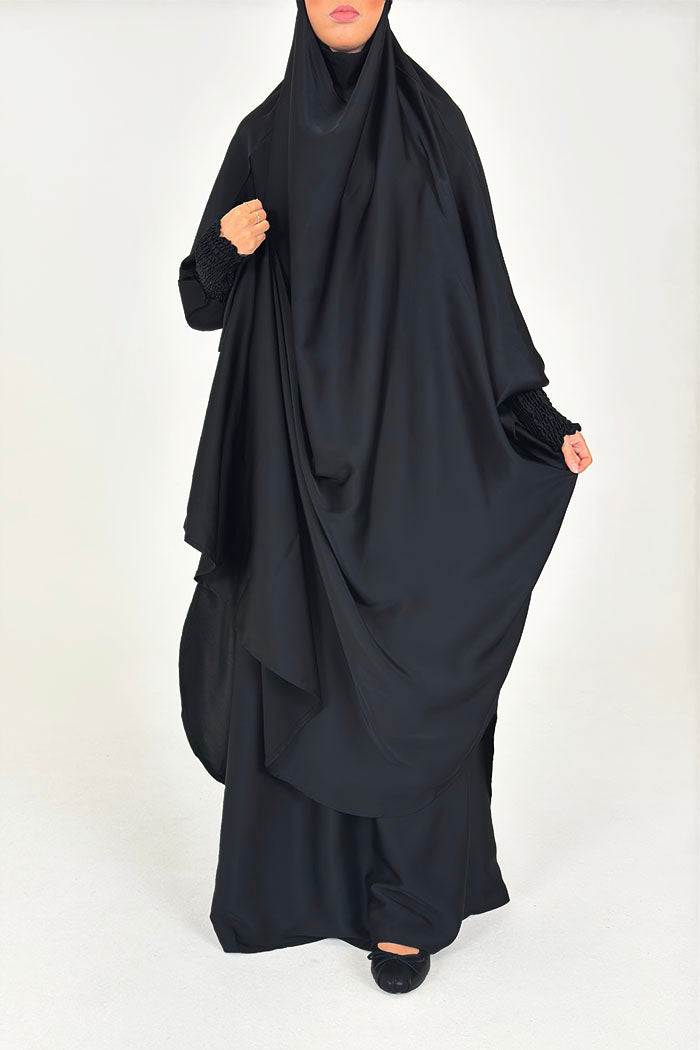
A lighter prayer outfit for warmer days
A prayer outfit can look light on its own and feel much heavier once it is worn over the clothes already on your body. Add a long scarf, an undercap, an inner sleeve and a lining, and the purchase described as a summer garment may have become several garments. Before looking for another fabric, look at what each layer is doing.
The useful aim is to retain the coverage you need without adding cloth that has no clear purpose. That might mean a separate prayer dress, a longer head covering over suitable existing clothes, or a two-piece outfit that works without another full dress beneath it. There is no single arrangement that will suit every home, working day or journey.
Most of the examples below concern women’s prayer clothing, with a separate section on assessing men’s garments. This is practical guidance about clothing construction and use, not a ruling on prayer requirements. Follow the religious guidance relevant to your practice, and assess the actual outfit rather than assuming a product name settles its suitability.
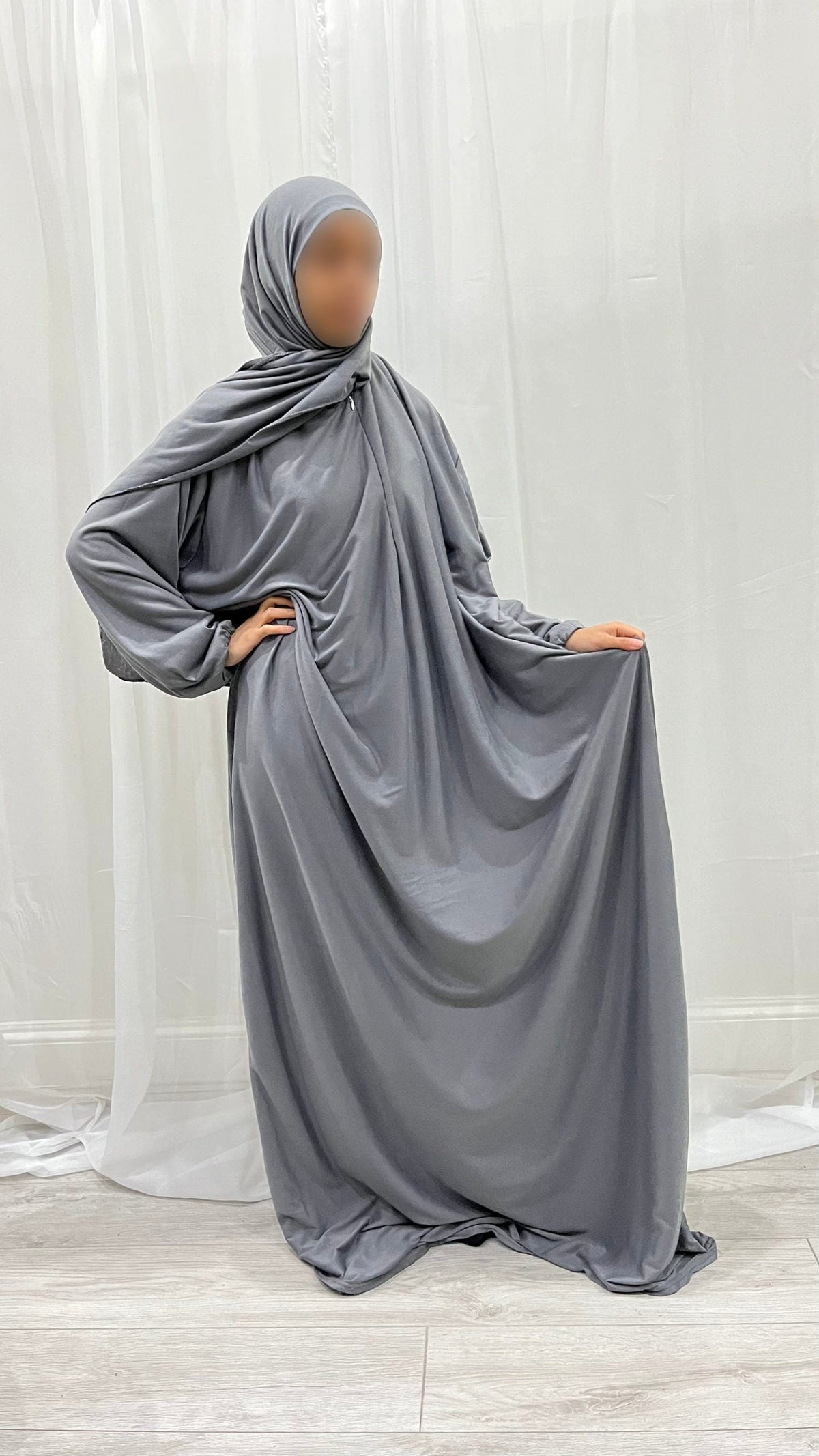
Pictured: a one-piece prayer dress with an attached covering, one of the constructions discussed below. Its photograph is not evidence of cooling performance.
Count the layers you wear, not the pieces you buy
Put out the complete arrangement you normally use. Include the clothes beneath the prayer garment, any separate sleeves, head covering and undercap. Inspect lining as another part of the construction even though it is not a separate item you put on.
Now give each layer a job. One may provide opacity, another sleeve coverage, another the length you need. A head covering may also cover the neckline and chest. Keep those jobs distinct from details you simply enjoy, such as an extra decorative scarf. Both can be legitimate choices, but they are not equally necessary to the coverage plan.
If two layers seem to do the same job, test the arrangement with one omitted where that remains appropriate. Check it fully before making the change permanent. Removing a lining or cutting a sleeve is not part of this exercise; you are comparing wearable combinations, not altering a garment whose construction you have not assessed.
For example, a sheer sleeve can make a long-sleeved inner top necessary, even where the outer body is lined. A garment with suitably opaque sleeves might let you use a simpler base. Conversely, a dress that appears more substantial on a hanger could produce a less complicated complete outfit than a very thin outer layer.
Write down the unresolved issue specifically. “I need arm coverage without another full top” leads to a different search from “the face opening pulls when I bow”. Treating both as a need for a more breathable fabric can leave the original difficulty untouched.
Three ways to simplify, with different trade-offs
A dedicated dress with an attached head covering
This can reduce the number of separate pieces to arrange. Check how the head section joins the body, how the sleeves are formed and where the garment is measured from. The convenience depends on those details, not simply on the phrase one piece.
Try putting it on over the clothes you will actually be wearing. If you need to change most of the base outfit first, it may still be a good choice, but it is not the quick additional layer you had imagined. Assess the whole routine before deciding.
An attached head section also moves with the garment. Bring your arms forward and lower your head, noticing whether movement elsewhere pulls at the face opening. More length at the hem will not necessarily solve an uncomfortable connection at the shoulders or neck.
Look at the care of the complete piece. A small mark on one area can involve handling the whole garment according to its instructions. A separate covering has a different maintenance arrangement. Neither is automatically simpler for every household.
A long prayer covering over clothes that already work
If your existing clothes provide the required lower-body and arm coverage, a suitable long head covering may answer a more limited need. Check what remains visible at the sides and back. Its length should be assessed while worn rather than inferred from the amount of fabric laid flat.
This option can be convenient when you do not want another full-length layer. It does depend on the clothing beneath it. A short sleeve, an open neckline or a lower garment that shifts needs its own answer; the head covering should not be expected to remain stretched over every area at once.
Try the arrangement with your usual glasses or undercap where relevant. The cap should have a clear role, not be added automatically because it appears in a styling photograph. Several small layers around the head can still create a substantial arrangement.
Keep the prayer covering and its suitable base identified as a combination. A scarf that works over one neckline may not work the same way over another. Knowing the reliable pairing is more useful than having several coverings whose fit remains uncertain.
A two-piece top with a skirt or trousers
A two-piece construction lets you assess the upper and lower garments separately. Confirm what the listing actually includes: a skirt and an overhead top are not the same outfit as trousers and another type of upper garment. Read the product details rather than treating the name as universal.
Check the overlap while sitting, reaching and moving through the positions you use in prayer. The upper piece should not depend on being held down, and the lower garment should not need an uncomfortable waistband setting merely to stay in place.
You may find that different proportions are needed in the two pieces. Ask whether separate sizing is available rather than assuming one shared label resolves both. The two-piece jilbab fitting guide explains that relationship in more detail.
This arrangement can also change how clothing is washed and kept ready. Read both labels and keep the components together in your records, even when their appropriate storage or care differs. Two pieces are useful only if the whole outfit is available when you need it.
Read fabric information without asking one fibre to do everything
A fibre description is useful, but it does not reveal the thickness, lining, openness or cut of the whole garment. Compare those details alongside the composition. A cotton-containing garment can be knitted or woven, fitted or roomy, lined or unlined; those are not interchangeable experiences.
When considering cotton or linen, ask about the particular cloth and its care, not just a general promise of summer comfort. Check whether the garment provides the coverage you need without extra layers. A light-looking cloth may be attractive but less simple to wear than expected.
For jersey or other stretch fabrics, inspect the fit at rest. The garment should have appropriate room before the material stretches to accommodate ordinary movement. Stretch alone is not a substitute for ease, and a close fit can change the appearance of the cloth under tension.
For a fluid woven material, try it against the inner clothes you expect to wear. Notice whether it settles or catches. A smooth surface may be pleasant in your hand while behaving differently beside a textured top or an elasticated waistband.
A fabric described as synthetic or as a blend should not be treated as one uniform category either. Read its actual composition and construction. The most useful question is whether this finished garment, in this complete outfit, suits your circumstances.
Where the listing gives only words such as airy or cooling, ask for more concrete information. Photographs of the inside, lining details, measurements and a clear care label can help you make a clothing decision without relying on a broad performance promise.
Check opacity before assuming a layer is optional
Try the garment with the intended clothing beneath it in ordinary indoor light and near daylight where practical. Look at the sleeves, upper back and areas where the fabric becomes more taut as you sit or reach. Inspect the side view rather than checking only the front.
A dark colour can still require this assessment. A pattern may make a surface look busy without establishing the coverage of the underlying cloth. Similarly, a pale garment should be assessed on its actual construction rather than rejected or accepted from colour alone.
Find out where lining begins and ends. An outer skirt may be full length while its lining is shorter. An upper body may be lined while the sleeves are not. Those differences matter when choosing which layers remain necessary.
Choose any inner layer for the particular gap it needs to address. Avoid adding another complete dress before establishing whether it actually solves the issue. The better answer may be a different outer garment whose construction is closer to what you need.
Do not force a choice between coverage and comfort when the garment itself is the mismatch. Changing the cut, fabric weight or outfit arrangement may be more useful than repeatedly making an unsuitable piece work through extra clothing.
Start the fitting at the face opening and wrists
Put on a pull-on covering without stretching it forcefully. Let the opening sit naturally, then turn your head and look down. Check for pulling at the jaw, ears or forehead. An opening that feels uncomfortable before you add any other piece needs attention on its own.
If the design has ties, use them as intended and assess the knot position. Tightening should not become the automatic response to slipping. The shape, weight distribution or placement of the covering may be the issue rather than a lack of tension.
For sleeves, check the upper arm and the cuff separately. A large body does not guarantee room where the arm bends. An elasticated cuff may be convenient, but it still needs to feel comfortable on your wrist and work over any inner sleeve.
Practise putting the garment on and taking it off with the help you normally have available. A close opening or hard-to-reach fastening can be inconvenient even when the outfit feels comfortable once arranged. Choose a design that fits your routine, not just its finished photograph.
Where limited dexterity or another personal requirement affects dressing, describe the particular task when asking a seller about the design. A photograph of a fastening or a clear account of the opening can be more useful than an assurance that the garment is easy for everyone.
Length needs a measuring route, not a guess from height
Confirm where the seller starts the measurement. Shoulder-to-hem, the top of an attached covering and the waistband of a separate skirt are different routes. Keep those figures separate when comparing products.
For Amani’s numbered abaya lengths, use shoulder-to-feet inches rather than full standing height. Check the information for the individual item, including the other dimensions. Do not assume a longer option automatically gives more width or a different face opening.
During a home fitting, assess the footwear situation in which you will use the clothing. A long garment chosen for outdoor shoes may behave differently during prayer. Check the lower edge through the movements you perform and against the coverage guidance you follow.
For shaped hems or a longer back panel, inspect the longest point as well as the front centre. The useful length is one you understand in use, not the highest number available in a size list.
Discuss alterations before cutting anything. A hem adjustment can affect a lining or border, and it will not move pockets or change the upper-body proportions. Resolve any return question before making an irreversible alteration.
A movement check that tells you what to change
Use a private, suitable space and put on the complete arrangement. Begin standing naturally. Check the head covering, neckline and sleeves before adjusting anything, then move through the positions relevant to your prayer.
Notice what moves first. Does raising the arms pull the head section backwards? Does the upper garment lift away from the lower piece? Does excess cloth gather beneath you? Specific observations make the next adjustment clearer than a general feeling that the outfit is too big or too small.
Change one factor at a time. Try another appropriate underlayer if the surfaces catch, or compare the covering’s position if its weight pulls from the back. Do not add several fastenings at once and assume the first problem is solved.
Repeat the sequence without using a hand to hold the garment where you wish it would stay. A little natural movement is different from a gap or restriction you need to manage continually. Decide which kind of movement you are seeing.
If the result remains unsuitable, another construction may be the better choice. You are not obliged to keep an awkward garment because its label says prayer wear. Our prayer-wear guide gives a broader comparison of clothing arrangements and the practical questions to bring to a fitting.
At home: make the useful outfit easy to reach
A garment kept ready at home can have a different role from one carried through the day. You may not need it to fold into a tiny space or look like an ordinary outdoor outfit. You may care more about being able to put it on comfortably over the clothes you are wearing.
Try it over two realistic bases. One could be your usual lighter home outfit; another could have a different neckline or sleeve. Do not assume the covering resolves the same gaps in both. Keep a note of the combinations that genuinely work.
Choose a storage position suited to the construction and available space. The garment should be fully dry before it is put away. Avoid leaving it in a small closed pouch after wear simply because that pouch arrived with it.
Keep essential components nearby without collecting unnecessary accessories. If the covering works with a particular cap, identify it. If no extra cap is needed in your chosen arrangement, there is no reason to add one as a visual finishing step.
A simple ready-to-use system can be more helpful than owning several elaborate options. The convenience comes from knowing the garment fits your routine, not from a promise that a particular fibre makes dressing effortless.
At work or study: think about the change as well as the clothes
Begin with the facilities and privacy actually available to you. Establish whether you plan to put on an additional garment or change part of the outfit. A dedicated prayer piece can be convenient, but not if you discover that its opening will not comfortably pass over the clothes or headwear you are already wearing.
Practise the sequence at home. Put the garment on, arrange it, remove it and return it to its storage place. Notice which steps require a mirror, a spare fastening or more space. This is a test of the routine, not a competition to dress as quickly as possible.
Choose a bag arrangement that protects the clothing from toiletries, shoes and exposed hardware. A separate clean compartment or suitable bag can help keep the pieces identifiable. Do not assume a pouch protects against every spill or provides suitable long-term storage.
After use, follow the garment’s care needs before packing it tightly. If it is damp, do not treat that as ready for indefinite closed storage. Plan a practical way to bring it home for appropriate drying or cleaning rather than expecting the bag to solve the problem.
Keep any alternative simple and tried. An unfamiliar spare scarf is less dependable than a combination you have already worn. The useful workday arrangement should ask for fewer last-minute clothing decisions, not add a separate collection of accessories to your bag.
A family visit or journey: pack one known combination
For a day away, decide whether your main outfit will also be used for prayer or whether you will carry a separate piece. Assess either plan before leaving. A garment’s suitability for visiting or travelling does not automatically answer its coverage during prayer.
Pack the exact components you used during the fitting. Similar colours do not establish the same dimensions or behaviour. A replacement head covering may be shorter at the sides, or an alternative inner sleeve may move differently beneath the top.
Consider the space in which you may change and where the clothing can be placed afterwards. You do not need to predict every circumstance, but knowing the normal arrangement can prevent carrying pieces that are difficult to use without a large private changing area.
For a longer trip, read the care instructions before deciding what to take. Do not assume that a light item dries immediately or that an unfamiliar iron will be suitable. Choose clothing you can reasonably maintain with the facilities available.
Keep a familiar alternative where practical. Its job is to offer another usable arrangement if a piece needs care, not to double the luggage with speculative outfits. A smaller set of tested combinations is often easier to manage than many individually attractive garments.
Comparing two possible purchases
Consider two invented options. The first is a very fine outer dress with an attached covering, unlined sleeves and a body lining. The second is a somewhat more substantial, unlined two-piece set. These are examples of constructions to assess, not descriptions of specific Amani’s stock.
The fine dress may seem like the obvious summer choice. But your preferred coverage might require another long-sleeved top beneath it. You also need to check how the lining fits and whether movement at the shoulder affects the attached covering.
The two-piece set may look less airy in a photograph yet work over a simpler base. Its waistband and overlap still need a careful fitting. The absence of lining is not automatically an advantage, and it does not establish opacity.
| Question | What to compare |
|---|---|
| What must go underneath? | List the actual extra layers needed by each option, not the ones shown in the styling photograph. |
| Where does movement cause a problem? | Check the face opening, shoulders, wrists, overlap and lower edge separately. |
| Can you put it on in your usual setting? | Try the real changing sequence with familiar base clothing. |
| Can you maintain it? | Read each label and consider drying space, time and suitable alternatives. |
| Which gap in your wardrobe does it fill? | Give the purchase a clear role rather than assuming another summer label adds useful variety. |
The result may be that one suits home use and the other suits your bag, or that neither fits well enough. You do not need to select a winner based only on fabric weight. A useful comparison keeps the complete outfit and the practical routine together.
Colour and decoration can stay personal
You may prefer a plain garment, a floral print or a soft colour that makes the outfit pleasant to use. None needs an invented promise about improving concentration or expressing a particular level of faith. Choose the appearance you like while retaining the coverage and comfort you need.
Inspect decoration where it contacts the face, wrists or floor. An attractive edge should not be scratchy, heavy or difficult to manage in the positions you use. Keep removable jewellery separate from the essential clothing arrangement.
A matching set can make selection straightforward, but you do not need every component to be the same shade. If a separate covering works better with the outfit, assess it on its own merits. Colour coordination should not override a more comfortable opening or a useful length.
For care and everyday wearability, pay attention to the specific trim rather than treating plain and embellished garments as two fixed quality categories. A small, well-finished detail can be easy to live with; a larger one may suit a different role.
For men, assess the whole outfit in the same practical way
Check any thobe, shirt or lower garment through the movements in which it will be worn. A long garment can still be restrictive across the back or at the lower opening. Look at the actual dimensions and the clothes beneath it rather than assuming its name settles the fit.
For a buttoned neckline, use the opening as intended when dressing. Check the collar while looking down and the sleeves while reaching forward. A close collar and an additional top can create a different feel from the same garment worn over another base.
Inspect light-coloured fabric in realistic lighting, including where it becomes taut while seated. Confirm lining where relevant. Do not assume white, cotton or a traditional silhouette guarantees a particular degree of coverage.
Any headwear you choose also needs a comfortable fit and appropriate care. This guide does not make a particular cap or garment a religious requirement. Direct questions about required dress to qualified guidance rather than treating an online clothing description as an answer.
For shared household care, keep each item’s instructions identified. Two pale garments may have different fabrics, trims and permitted treatments. A household’s summer clothing is not one identical load simply because the colours look compatible.
A warm room needs more than a different garment
Clothing is only one part of managing hot conditions. The UK Health Security Agency’s heat guidance recommends appropriate lightweight, loose clothing alongside measures such as keeping cool, seeking shade outdoors and drinking fluids. A garment described as breathable should not be treated as protection against overheating.
Choose a comfortable setting where you can, and do not use a clothing trial to test how much discomfort you can tolerate. If you feel unwell, stop the trial and address the symptoms rather than assuming a different scarf fold is the answer.
The NHS guidance on heat exhaustion and heatstroke explains the warning signs and when urgent help is needed. Confusion, a seizure, loss of consciousness or other signs of heatstroke require emergency help. In the UK, call 999 for suspected heatstroke. Clothing advice is not a substitute for medical guidance.
Keep that boundary clear when reading a product description. No prayer outfit should be bought on a promise that it prevents heat illness, and no personal discomfort needs to be dismissed because a fabric has a reassuring name.
Plan washing and drying before buying several sets
Read the instructions for each complete garment. Do not infer a permitted hot wash, soak or drying method from a familiar fibre. An attached covering, cuff, lining or trim may be part of the finished item’s care requirements.
Allow enough space for the stated drying method. Check thicker joins, pockets and lined sections before putting the garment away. A dry-looking outer surface is not a reason to ignore a damp section underneath.
Keep a usable alternative while an item is being cleaned or dried. That may be another prayer garment or a suitable outfit you already own. There is no universal number of sets everyone needs; the useful number depends on your routine and the care each item requires.
Inspect frequently handled areas such as ties, neck openings and cuffs. Identify a loose fastening or damaged seam before the next wear. Keep a garment needing attention separate from the ready clothing so the same issue does not surprise you again.
For permitted pressing, follow the label’s limits. GINETEX’s care-symbol reference explains that ironing temperature and steam restrictions belong to that care information, not to a general assumption about the fibre. Our modest-wear care guide can help you organise the wider routine.
Questions to settle before ordering online
Ask for the composition of the outer fabric and lining, the included pieces and the relevant garment measurements. Request the measuring route where it is not clear. A number without a starting point is difficult to compare with clothing you already own.
Look for front, side and back views, including the sleeves and openings. A close-up of the face opening or cuff can answer a question that a distant full-length photograph cannot. Ask for that detail rather than accepting a vague promise that the fit suits everyone.
Read current purchase and return information before removing labels or beginning a care routine. Try the garment according to the seller’s conditions while deciding whether it works. Do not alter an unresolved neckline or length problem before settling that decision.
If a listing promises environmental benefits or improved health, look for specific supporting information. A natural-looking colour or a familiar material name does not establish every claim made about the finished product. You can choose a garment for its practical fit without adopting an unsupported explanation for why it is superior.
Keep a note of the combination that actually works
Record the item, base clothing and any cap or scarf used. Add useful limits: perhaps it works over a thin sleeve but not a bulky jumper, or the head opening is comfortable with glasses only in a particular arrangement. Specific observations are more valuable than a broad label such as perfect summer outfit.
Keep measurements from the route used by the maker, and record any later alteration separately. That gives you something reliable to compare when replacing a well-used piece. It also helps prevent buying another garment with the same unresolved sleeve or length problem.
Reassess when your routine changes. A garment kept at home may not be the right one for a work bag. A familiar outfit may need a different arrangement with new glasses or another base layer. You do not have to replace everything, but it is worth checking rather than assuming the previous result transfers unchanged.
A lighter prayer outfit is not necessarily the one with the thinnest fabric. It is the combination that gives you the required coverage, fits comfortably and avoids unnecessary layers. Once those practical questions are settled, the clothing can take less of your attention.