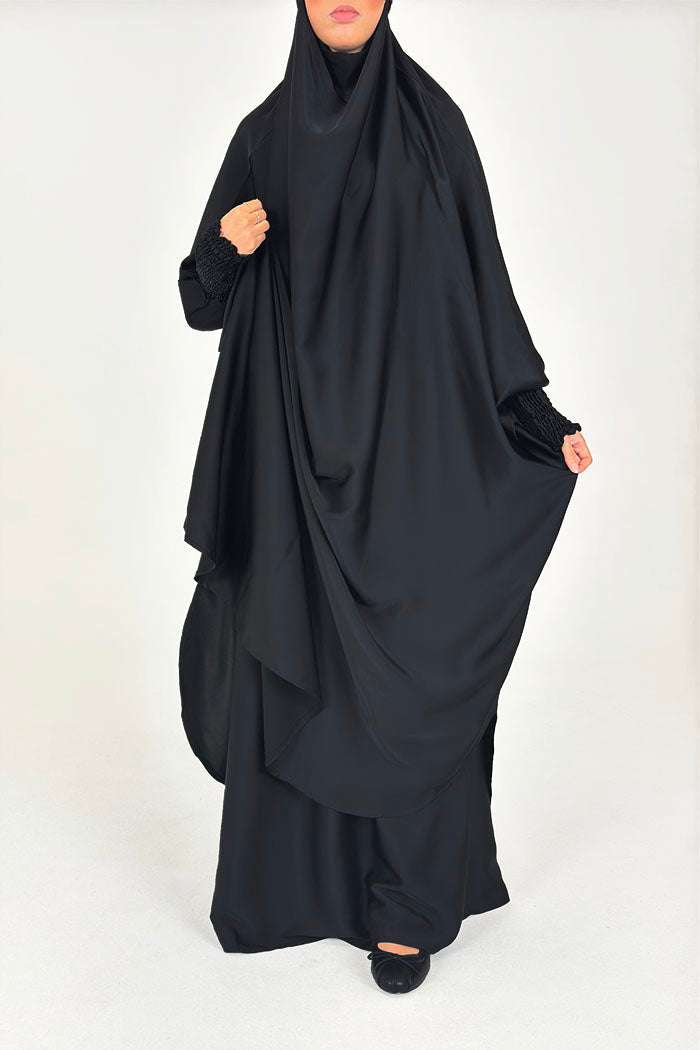
Jilbab With Niqab Sounds Like Simple Layering — Until Both Pieces Start Competing Around the Face
Some outfits look completely settled on a hanger and become argumentative the moment you put them on. Wearing a jilbab with niqab can be exactly like that. Both pieces may be beautiful. Both may give the coverage you wanted. Yet when they meet around the forehead, temples, cheeks and shoulders, one layer can tug against the other until you spend half the day adjusting what looked effortless in the mirror.
I think this is one of the most useful things to admit about modest clothing: good coverage is not only about how much fabric is present. It is also about whether that fabric behaves properly while you live in it. A niqab that keeps sliding because the jilbab head section is pulling backwards is distracting. A forehead opening that feels fine for five minutes but starts pressing after an hour is not a small detail. Neither is a knot that sits exactly where a hood, khimar-style panel or gathered seam wants to rest.
The answer is rarely to keep adding more pins, tighter knots and extra underlayers. Usually, the better approach is to understand which piece should carry which job. The jilbab needs to sit securely without depending on the niqab to hold it in place. The niqab needs enough stability of its own that it is not being dragged by the jilbab. Once those two foundations work, the rest becomes much calmer.
This guide is about that practical relationship: face-opening fit, tie placement, fabric friction, glasses, breathing space, movement, weather, prayer, work, travel and the ordinary moments when layers reveal whether they genuinely cooperate. I am not trying to turn personal styling choices into religious rulings. Muslim women follow different scholarly guidance and different forms of covering. Where you need a religious ruling, ask a qualified scholar you trust. Here, the goal is narrower and very practical: helping the garments you have chosen stop fighting each other.
If you are still deciding between one-piece, two-piece, overhead and other jilbab constructions, the complete jilbab guide is the better place to compare those broader shapes first. Once the jilbab itself is right, this page will help you work out how a separate niqab can sit with it comfortably and consistently.
Start by making the jilbab work on its own
Before you add the niqab, put the jilbab on by itself and give it a proper movement test. This sounds almost too simple, but it is the fastest way to find out which garment is creating the problem. If the head section creeps backwards, the forehead opening twists, the shoulders pull or the fabric drifts into your eyes before the niqab is even present, the niqab is not the cause. Adding another layer will only hide the original issue for a few minutes.
Stand naturally rather than holding your head in the position that makes the garment behave. Turn left and right. Look down as if you were checking your phone or reading. Raise your arms. Walk through a doorway. Sit down and stand back up. If your jilbab has an integrated head section, notice whether it remains in the same place or whether movement elsewhere in the garment pulls it around your face.
This matters because a jilbab is a large garment. The skirt, sleeves and upper section are connected through fabric tension. A heavy bag on one shoulder, a coat over wide sleeves or a long stride can create small pulls that travel upwards. If the face opening is already marginally tight, those pulls can become pressure at the temples. If it is too loose, the same movement can make the opening drift.
Make any basic adjustment now. That might mean choosing the correct size, changing how the head section is positioned, loosening an over-tight fastening or accepting that a particular cut simply does not suit the way you move. The useful rule is that the jilbab should not require the niqab to rescue its fit. When the first garment is stable on its own, the second layer has a fair chance of working.
There is another reason to isolate the jilbab first: it tells you whether you are unconsciously using the niqab as a measuring tool. Sometimes we position the jilbab by judging how much niqab fabric is visible rather than by checking whether the jilbab itself is centred and comfortable. That can make the two pieces look symmetrical while the underlying head section is actually twisted. Use your ears, temples and shoulder seams as reference points. If the garment has a central seam or shaped opening, check that it is sitting where the maker intended. Once that base is centred, adding the niqab becomes a second step rather than a correction.
The face opening is where two good garments can start competing
The face opening is the meeting point, so a few millimetres can make a surprising difference. One jilbab may frame the forehead high and wide. Another may sit lower at the brow or closer to the temples. A niqab may have a narrow eye opening, a broader opening, a nose string, elastic, ties or a layered flap. None of these features is automatically a problem. The difficulty begins when their pressure points occupy the same space.
If the jilbab opening sits close to the temples and the niqab ties also pull from that level, you can get a concentrated band of pressure. If the jilbab sits low on the forehead and the niqab top edge also needs that position, the layers may creep over one another. You then compensate without noticing: push the jilbab back, pull the niqab down, tighten the tie, lift the fabric again. By lunchtime the whole arrangement feels less secure even though every adjustment was meant to make it more secure.
Try putting the two pieces on slowly and watching where they actually touch. You are looking for three things: overlap, pressure and movement. Some overlap is normal. Pressure should feel even rather than sharp. Movement should not cause one garment to drag the other out of place. If you feel a particular seam, knot or elastic point pressing, do not dismiss it because the outfit looks correct. Comfort that disappears after twenty minutes was never really comfort.
A mirror helps, but your fingertips can tell you more. Trace the line around the temples and back of the head. If two bulky joins are sitting directly on top of each other, shifting one slightly may solve more than tightening everything. The best arrangement often feels less engineered, not more.
Face shape matters here in a completely practical sense. Forehead height, cheek shape and the distance between the temples affect where soft fabric naturally wants to sit. That is why a friend's method may not translate exactly to you even when you own the same design. You do not need to judge your face against the garment; judge the garment against your comfort. If an opening repeatedly folds inward near the eyes or leaves one side tighter, reset it from the top rather than pulling the lower fabric sideways. Small asymmetries often begin higher up than the place where you first notice them.
Tie tension should create stability, not a headache
A niqab tie is easy to over-tighten because tightness gives an immediate feeling of security. The problem is that security and pressure are not the same thing. A tie that is pulled hard enough to resist every movement may create a headache, leave tender areas behind the ears or make the face opening feel progressively smaller through the day.
Start with the least tension that keeps the niqab where you want it during ordinary movement. Then test it. Look down, turn your head, speak, walk briskly and bend slightly. If it stays stable, extra tightness is not giving you anything useful. If it moves, first check the direction of movement. A niqab that slides down may need a different tie angle or better fabric friction, not simply more force.
Where you place the knot matters as well. A large knot at the back of the head can become uncomfortable under another layer, especially if the jilbab has a seam, hood or gathered section in the same position. A flatter knot or slightly different height may remove that clash. If your design uses elastic, check that it has not stretched unevenly or become twisted.
Pay attention to delayed discomfort. Pressure can feel completely acceptable when you first get dressed because you are focused on appearance and security. An hour later, the same pressure may feel exhausting. When testing a new combination at home, wear it long enough to learn what happens after the first few minutes. That small trial is far more useful than finding out halfway through a long day.
If you change tie tension, make the adjustment while your jaw and neck are relaxed. It is easy to tighten while lifting the chin or holding the head unusually still, then discover that the fit changes once you speak, swallow or look down. I also prefer to retest after adding any outer layer because a hood or collar can alter the position at the back of the head. The goal is not a tie that never moves by a millimetre; it is one that returns to a comfortable position and does not transfer strain into the jilbab.
Fabric friction can either hold the layers together or make them slide
Two fabrics touching each other create their own behaviour. A matte, lightly textured niqab against a matte head section may grip gently and stay stable with very little effort. Put a smooth, slippery fabric against another smooth surface and the same tie tension may suddenly feel inadequate. Add an undercap or another scarf layer and you have changed the system again.
This is why copying someone else's exact tying method can fail even when your garments look similar. The fibres, finish and weight may be different. A soft crepe-like surface has different friction from a satin-like one. A lightweight fabric may move with every turn of the head, while a heavier one may stay put but create more downward pull. Neither is automatically better; you just need to understand what your combination is doing.
If the layers slip, change one variable at a time. First try the niqab at a slightly different tie angle. Then test whether the jilbab head section is sitting too far back. If you use an underlayer, check whether that underlayer is helping or making everything smoother. Avoid adding a handful of pins before you know which surface is actually moving.
Friction also changes through the day. Heat, humidity and movement can make a fabric sit differently. A smooth scarf that felt secure in a cool room may shift after a crowded train journey. A damp edge after rain can cling in a different way. It is worth testing the combination in the conditions you genuinely live in rather than judging it only in a quiet bedroom.
Static electricity can complicate the picture in dry indoor conditions. Two synthetic-feeling surfaces may cling unexpectedly, while another combination slips. If you notice fabric sticking to the face or to the jilbab in a way it normally does not, consider the environment before changing your whole tying method. Gentle garment care according to the label can also preserve the intended surface; harsh heat or unsuitable products may change how a fabric feels. The more you treat the material as part of the fit system, the less mysterious these day-to-day differences become.
Separate the job of coverage from the job of keeping things still
When layers feel unstable, it is tempting to make every layer responsible for everything. The niqab gets tightened to hold the jilbab. An undercap gets added to hold the niqab. Pins get added to hold the undercap. Before long the head feels wrapped in solutions to problems created by other solutions.
A calmer approach is to give each piece a clear role. The jilbab should provide the coverage and silhouette it was designed to provide. If it has a head section, that section should sit correctly by its own construction. The niqab should provide the facial coverage you have chosen and remain stable through its own ties, elastic or fastening method. An underlayer, if you use one, should solve a specific problem such as hair containment or added friction rather than existing because every other layer is unstable.
This separation makes troubleshooting easier. If the niqab shifts but the jilbab stays still, adjust the niqab system. If both move together, inspect where they are catching. If the jilbab moves first and drags the niqab, return to the jilbab fit. You are no longer randomly tightening the whole arrangement; you are identifying the part that failed.
It also makes getting dressed quicker. Once you know that each garment can do its own job, you do not have to recreate a delicate balance every morning. You can put on the jilbab, settle it, add the niqab, check the meeting point and go.
This principle is especially useful when you are tired or in a hurry. A complicated setup can tempt you to skip the diagnostic step and simply tighten everything because it worked once before. A role-based setup is easier to reproduce: centre the jilbab, secure the niqab, confirm the overlap, then leave it alone. If something feels wrong, you know which layer to inspect first. That predictability is valuable for early mornings, school runs, travel days and any moment when you want your clothing to support the day rather than become the day's first problem.
Glasses change the geometry around your eyes
Glasses add a rigid object to an area that is otherwise made of soft fabric, so even a combination that works perfectly without them may need a different setup. Frames create pressure at the bridge and temples. The arms need space to travel back towards the ears. If the niqab edge or jilbab opening presses those points, the frames can lift, tilt or dig into the skin.
Put your glasses on before making the final niqab adjustment. Check whether the frames sit naturally or whether fabric is forcing them closer to your eyes. Then look down and back up. If the glasses rise with the fabric or the niqab catches underneath the nose pads, loosen and reposition rather than pushing everything tighter.
Fogging is another practical issue, especially in cold weather. Warm breath can move upwards behind the niqab and condense on cool lenses. The exact solution depends on the niqab design and your frames, but the principle is to avoid creating an unnecessary channel that directs breath straight at the lenses. A top edge that sits smoothly and a nose area that is not excessively loose may help. Anti-fog products designed for your lens coating can also be useful if the manufacturer allows them.
Do not accept painful pressure as the price of wearing glasses with your chosen covering. A few millimetres of tie height, a flatter frame arm or a different fabric arrangement can transform the experience. Test for a full hour at home if you rely on glasses all day.
Frame size can change the experience too. Deep lenses, thick arms and prominent nose pads occupy more space than very slim frames. That does not mean you need different glasses purely for clothing, but it does mean your normal pair belongs in the fit test. Sunglasses should be tested separately if you use them outdoors because they may be larger. If you switch between glasses and no glasses during the day, make sure removing the frames does not leave the niqab suddenly too loose or allow the jilbab edge to drop into the eye line.
Speaking, eating and drinking reveal whether the lower layer has enough freedom
An outfit can feel secure while you are silent and standing still, then become awkward the moment you start speaking for any length of time. Jaw movement changes the tension across the lower face. If the niqab is pulled too tightly or is caught under another layer, repeated speaking can drag the fabric down or create pressure around the nose and cheeks.
Have a normal conversation while testing a new setup. Read a page aloud if you are alone. Notice whether you keep wanting to pull the fabric away from your mouth, whether the top edge shifts, or whether the tie starts to feel tighter as your jaw moves. These are signs that the niqab needs more independent movement.
Eating and drinking require privacy and practical judgement according to your own circumstances, but the garment still needs to be manageable. If lifting or moving the niqab causes the jilbab head section to shift every time, the two layers are too dependent on each other. Practice the movement at home so you know which part to hold and which part should remain untouched.
The same applies to coughing, sneezing and taking a drink of water. Real clothing has to survive ordinary human actions. A beautiful arrangement that only works while you pose in front of a mirror is not yet an everyday system.
Walking quickly exposes drag that standing still hides
Long garments create movement from the ground upwards. When you walk quickly, the skirt swings, the shoulders respond and the head section may experience small repeated pulls. Add a niqab and those movements become easier to notice because the face covering gives you another fixed reference point.
Take a brisk walk around your home or another private, safe space. Turn corners. Carry a bag. If you normally push a pram, hold a tote or wear a backpack, imitate that load. You may find that the jilbab shifts only when one shoulder is weighted. That is useful information because the solution might be changing how you carry the bag rather than changing anything around your face.
Stairs are particularly revealing. Longer strides and the need to manage the hem can alter your upper-body posture. If you instinctively pull the garment forward with one hand, that may change the tension around the head. Learn a hem-management method that does not disturb the head section more than necessary.
Wind adds another force entirely. A loose outer layer can billow and tug while the niqab catches moving air around the face. You want enough security to remain covered without making the whole setup painfully tight. Calm weather testing is useful; windy-day testing tells you whether the system is genuinely robust.
Try the same test with your hands occupied. Carrying shopping, holding a child's hand or managing an umbrella removes the option of constantly reaching up to adjust the face area. That is a good thing during testing because it reveals whether the arrangement can genuinely look after itself. If you can walk, turn and manage the hem without touching the niqab or head section, you have a much stronger everyday setup. If not, fix the source of the drift while you still have privacy and time rather than relying on repeated public adjustments later.
A coat can create problems even when the jilbab and niqab work perfectly indoors
In Britain, the outfit you perfect indoors often has to disappear under a coat ten minutes later. That coat can change everything. Narrow shoulders can compress the jilbab. A high collar can push fabric upwards. A hood can sit directly over a niqab knot. Fastening the coat can pull the jilbab backwards across the chest and shoulders.
Put the coat on after the jilbab and niqab are settled and then repeat your movement test. Do not assume that because the coat is your normal size it has enough room for the garment underneath. Wide jilbab sleeves need sleeve space. A generous upper body needs ease across the back. If the coat changes the face opening when you raise your arms, it is too restrictive for that layering combination.
Hoods deserve their own check. A hood worn down can bunch at the back of the neck and sit over ties. A hood worn up changes airflow and may push the niqab sides towards the face. You might find that a flatter knot or a coat without a bulky hood works much better on days when you plan to wear both garments for hours.
Outerwear should support the outfit rather than turn it into a tension system. If one coat constantly causes problems, that does not mean the jilbab and niqab combination is wrong. It may simply mean the coat was designed for a much less voluminous layer underneath.
Scarves worn for warmth can create the same hidden pressure as a coat. If you wrap something around the neck or shoulders, check whether it traps the jilbab fabric and stops it moving naturally. A layer that is snug at the neck may pull downward when you turn your head. The effect can travel upwards and make the face opening feel tighter on one side. Try moving the warming layer outside rather than between structural parts where appropriate, or choose a shape that gives the jilbab room. Again, the point is not a universal styling rule but a way to diagnose tension.
Rain and wind make practical fabric choices more important than perfect matching
Rain does not care whether your fabrics look beautifully coordinated. It changes weight, cling and friction. A damp jilbab can become heavier at the hem. A wet outer surface may pull differently at the shoulders. A niqab exposed to fine rain can feel cooler and may sit closer to the face until it dries.
If you live somewhere with frequent wet weather, prioritise fabrics that you can care for easily and a length you can manage without dragging through puddles. The exact material choice depends on the garment and care label, but the principle is simple: an everyday combination should not become unusable every time the forecast turns grey.
Wind needs a little more thought around loose layers. A lightweight niqab may move more than expected. A very loose jilbab may catch gusts and pull across the upper body. Rather than over-tightening the face covering, test whether the outer garment can be stabilised through its intended construction and whether your chosen niqab fabric has enough weight for the day.
When you come indoors, check that wet fabric has not shifted and that any damp layers can dry properly. Small habits like this protect comfort and help the garments keep their shape over time.
Prayer is a useful movement test even when the outfit is not your dedicated prayer wear
Whether or not you use the same garments specifically for salah, prayer movements illustrate something important about fit: clothing has to cope with repeated changes in posture. Bowing, lowering the head and moving between positions can reveal tension around the face, shoulders and back that ordinary standing does not show.
If you know you may pray while out, test the combination privately beforehand according to your own clothing practice. The aim here is not to give a fiqh ruling about what must be worn. It is to notice whether the niqab tie becomes uncomfortable when your head angle changes, whether the jilbab pulls backwards, or whether fabric needs constant rearrangement afterwards.
A secure setup should recover naturally when you stand again. If every movement leaves the face opening twisted, investigate the garment fit rather than training yourself to accept repeated adjustment. Modest clothing should help you get on with what matters, not demand attention at every transition.
Work and study need a setup you can forget about for several hours
At work or in class, the best clothing system is often the one that becomes boring in the nicest possible way. You put it on, check it once and stop thinking about it. If you are touching the face opening every ten minutes, you are spending concentration on clothing that should be serving you.
Think about the movements your day actually contains. Do you look down at a laptop for long periods? Turn repeatedly to speak to people? Wear a headset? Carry an ID lanyard? Put on protective equipment? Travel between warm rooms and cold platforms? Each of these can interact with layers differently.
For long desk work, pressure at the back of the head becomes more noticeable if you rest against a chair. A bulky knot that felt fine while standing may press directly into the headrest. If you wear headphones or a headset, test how the band or ear pieces sit with the niqab ties and jilbab construction. Do not wait until your first full shift to discover the clash.
Keep an emergency fix simple. A spare pin, tie or small mirror can be sensible if those are things you normally use, but the everyday setup should not require a repair kit. If it does, change the foundation rather than carrying more tools.
Speaking for long periods is another workplace test that is easy to overlook. Teaching, customer service, meetings or studying aloud can create far more jaw movement than a quick conversation at home. If your work involves this, spend ten minutes talking continuously during the home test. Notice heat, moisture, pressure and whether the lower fabric keeps returning to the same place. Comfort under realistic use is a better standard than comfort while silent. If a minor change makes speaking noticeably easier without compromising your chosen coverage, that is a meaningful improvement.
Travel magnifies every small discomfort
A fifteen-minute outfit can hide flaws that a four-hour journey exposes. Travel adds sitting, carrying bags, temperature changes, rushing, leaning against seats and sometimes sleeping. A tight tie becomes tighter. A bulky knot becomes harder. A sliding layer becomes something you adjust hundreds of times.
Before travelling, choose the version of your jilbab-and-niqab setup that has already proved itself, not the most elaborate one. Familiar fabric and familiar tie placement are valuable. If you are flying or taking a long train journey, think about security procedures, eating, hydration and how easily you can adjust in an appropriate private space if needed.
Backpacks are worth testing because two shoulder straps distribute pressure differently from a handbag. They can pull the jilbab backwards evenly, which may sound better but can still change the face opening. Put the loaded bag on at home and walk around. If the head section moves, loosen the backpack straps or reconsider the layer before the journey.
Travel is also when simplicity pays off. The fewer dependent layers you have, the easier it is to recover after a nap, a rushed connection or a coat coming on and off several times. Stability should come from good fit, not from a fragile sequence you are afraid to disturb.
Pack one simple backup rather than several experimental alternatives. If a tie breaks, a pin is lost or a fabric becomes wet, knowing exactly what your fallback is reduces stress. The backup should be something you already know how to use, not a new style you hope to figure out in an airport washroom. Also think about where you can make adjustments privately and respectfully if needed. Planning those small practicalities in advance makes the clothing feel less fragile and lets you focus on the journey itself.
Heat changes what feels comfortable around the face
Warm weather can make a perfectly acceptable winter setup feel too heavy. Multiple layers around the forehead and lower face retain warmth, and any excessive tie pressure becomes more noticeable when you are hot. Breathability, fabric weight and the amount of overlapping material all matter.
Choose lighter fabrics only when they still give the coverage and opacity you need. Lightweight should not mean unstable. Some very light fabrics cling or blow easily, so test them in movement. A fabric that sits slightly away from the face can feel different from one that collapses inward with every breath.
Hydration and breaks matter more than styling perfection. If you are spending a long day outdoors in heat, plan how you will drink and cool down appropriately. Clothing should not become a reason to ignore physical signs that you need rest or water.
At the same time, avoid assuming that tighter is cooler because it creates a smaller-looking arrangement. Compression can increase discomfort. Give each layer enough room to do its job without unnecessary bulk.
Cold weather creates the opposite temptation: adding too many head layers
In winter it is easy to solve every problem with another layer. A warm undercap, thick scarf, hood, coat collar and niqab may all be individually sensible, but together they can create a crowded area around the head and neck. The result can be pressure, reduced movement and constant fabric migration.
Decide where the warmth really needs to come from. A warm coat and suitable base layers may do more for comfort than adding thickness directly around the face. If you do add an underlayer, make sure it does not push the jilbab opening forward or change the angle of the niqab ties.
Cold weather also brings condensation, especially with glasses. Step from a cold street into a warm shop and the lenses may fog immediately. Give yourself a moment rather than tugging at the niqab in frustration. If fogging is frequent, test different positioning at home and follow safe cleaning guidance for your lenses.
Winter comfort is a system. Warmth, visibility, secure footing and freedom of movement matter more than making every layer visually seamless.
Do not mistake a sizing problem for a styling problem
Some layer battles cannot be fixed with technique because the underlying garment does not fit. If the jilbab opening is genuinely too tight, pulling it backwards may expose or distort areas you intended it to cover. If it is too loose, tying the niqab tighter will not make the jilbab smaller. If the shoulders are restrictive, no scarf arrangement will give the upper body more ease.
Look for consistent signs: pressure at the same point every wear, seams that pull when you move, a face opening that will not stay centred, sleeves that shorten when you reach, or a hem length that forces you to alter your posture. These are fit clues.
Measurements help when shopping, but garment construction matters too. Two jilbabs with similar width can behave very differently if one has a gathered head section and the other falls from the shoulders. When measurements are missing, ask the retailer if you can. When returns are allowed, keep tags and packaging intact until you have performed a private movement test.
It is kinder to yourself to say “this cut does not work for me” than to spend months trying to train your body around a garment. Clothing is supposed to fit the wearer, not the other way around.
A niqab that works with one jilbab may not work with another
Once you find a comfortable niqab, it is natural to expect it to work with everything. Often it will, but not always. A different jilbab can change the height of the forehead opening, the volume behind the head or the amount of fabric at the temples. Those small differences can make the same niqab feel completely different.
Think in combinations rather than assuming one universal setup. You may find that a flatter, lighter niqab works best with a jilbab that has more fabric around the head, while a slightly more structured niqab works beautifully with a simpler overhead cut. That is not a failure. It is the same reason one coat works better over one dress than another.
Keep a mental note of the pairings that work without effort. The goal is not to own many versions; it is to know which pieces cooperate. If you have two reliable niqabs that cover most of your jilbab wardrobe, that can be more useful than a drawer full of options that each need special handling.
When shopping for a new jilbab, you can use your most reliable niqab as part of the fit test at home. That immediately tells you whether the new face opening and your normal tie placement are compatible.
Pins and magnets should solve specific problems, not hide bad fit
Fasteners can be helpful, but they are easy to overuse. A pin can stop a small area drifting. A magnet can hold two appropriate layers together. What they cannot do is turn a fundamentally incompatible fit into a comfortable one.
If you use pins, think about fabric safety and placement. Fine fabrics can snag or develop permanent holes. A pin placed where there is tension can pull harder as you move. Keep sharp points secure and away from areas where they could press into the skin. If you use magnets, follow the product's safety guidance and keep them away from anyone or anything for whom strong magnets may be unsafe.
Most importantly, remove the fastener during troubleshooting and see what the garments naturally want to do. If the jilbab immediately pulls one way and the niqab another, the fastener has been acting like a bridge between two opposing forces. That may hold for a photograph, but it can create strain over a long day.
A good fastener supports an already sound arrangement. It should not be the only thing preventing collapse.
Buying online is safer when you look for construction evidence, not just a styled photograph
A product photograph can show you colour and general silhouette, but it may not tell you enough about the face opening, tie system or how the garment behaves in motion. For a jilbab you plan to wear with niqab, those details matter.
Look for close photographs of the head section, side views and any description of fastening. Check whether the product is one-piece or multi-piece, whether a head covering is integrated, and whether the stated size information includes useful length or width measurements. If a model is shown, remember that height and proportions affect where the garment falls.
Read fabric and care information. A smooth fabric may behave differently from the matte one you already own. A very heavy fabric can change how the head section pulls. If the retailer offers a returns policy, read it before ordering so you know whether you can perform a proper home fit test without losing the option to return.
Do not assume that an image showing a niqab means the niqab is included unless the product description says so. Likewise, do not assume a jilbab has an attached face veil because a styled image makes the layers look integrated. Product contents should be confirmed from the listing itself.
Reviews can be useful when they describe measurable or observable details such as length, weight, opacity, slipping or whether the head section runs small. Treat purely aesthetic comments more cautiously because another person's idea of “perfect fit” may not match yours. If reviewers mention height or garment size, use that only as context rather than a guarantee. The best evidence combines measurements, clear photographs, construction details and a returns route. That gives you several independent ways to judge the purchase instead of relying on the colour name or one flattering image.
When you are ready to compare live sizes, colours and constructions, you can shop related styles in the current jilbab collection. Availability changes, so use the product page for current commercial details and use this guide for the fit questions that remain useful beyond one season.
A five-minute dressing routine is a better goal than a perfect mirror moment
There is a point where styling advice can accidentally make ordinary dressing feel like a technical project. I do not think that is the goal. The useful outcome is the opposite: you understand the mechanics well enough that getting dressed becomes simpler.
A practical routine might be: put the jilbab on and centre the face opening; move your head once to confirm it is stable; add the niqab with familiar tension; check the temples and nose; put on glasses if you wear them; add the coat or bag; then do one final movement check. Once it passes, stop adjusting.
That last part matters. Constant checking can create problems of its own because every touch changes the position slightly. If the setup is secure and comfortable, give it the chance to stay that way.
Over time, your hands learn the correct tension and placement. You stop measuring with your eyes and start recognising the feel of a good fit. That familiarity is what turns two separate pieces into a dependable everyday combination.
When something goes wrong, change one variable at a time
If your layers are fighting, resist the urge to rebuild the entire outfit. One-variable troubleshooting is faster and tells you what actually worked.
| What you notice | First thing to check | What not to do immediately |
|---|---|---|
| Niqab keeps sliding down | Tie angle, fabric friction and whether the jilbab is dragging it | Do not automatically pull the tie much tighter |
| Pressure at the temples | Whether the jilbab edge and niqab ties overlap at the same point | Do not add another tight underlayer |
| Jilbab opening moves when walking | Jilbab fit, shoulder tension, bag straps and outerwear | Do not make the niqab responsible for holding the jilbab |
| Glasses lift or fog | Frame position, nose area and airflow | Do not force the frames under a tight fabric edge |
| Everything shifts under a coat | Coat room at shoulders, sleeves, collar and hood | Do not assume the head layers are the original problem |
| Jaw movement pulls the niqab | Lower-face freedom and tie tension | Do not keep shortening the face opening |
After each change, repeat the movement that caused the problem. If it improves, you have learned something. If it does not, return to the previous position and test the next variable. This prevents the common situation where you make five changes at once, the outfit suddenly works, and you have no idea which change mattered.
Keep the process practical rather than perfectionistic. The aim is not a mathematically motionless arrangement. Fabric moves because people move. You are looking for reasonable stability, comfortable pressure and coverage that remains where you intend without constant intervention.
It helps to make a tiny mental note of the successful change. You do not need a spreadsheet for getting dressed; simply remember something concrete such as “knot slightly higher with this jilbab” or “coat first felt fine, hood caused the pull.” Those observations stop you repeating the same frustrating experiment. After a few wears, patterns emerge. You may discover that the problem belongs to one coat, one fabric or one particular face opening rather than to wearing a jilbab and niqab together generally. That distinction protects both your confidence and your wardrobe.
Modesty should not require you to spend the whole day thinking about your clothes
There is a quiet irony in choosing clothing because you want calm, coverage and focus, then ending up more preoccupied with fabric than ever. If a setup keeps pulling your attention back to your face, neck, shoulders or hem, it deserves practical adjustment.
That does not mean every tiny sensation is a failure. New garments can take a little familiarity. But repeated pain, slipping or exposure risk should not be romanticised as something you simply have to endure. Comfort and function are legitimate parts of choosing clothes you can live in.
It is also worth resisting comparison. A sister online may wear a particular combination beautifully, but you cannot see the pin placement, fabric weight, head shape, climate or five minutes of adjustment that happened before the photograph. Your successful setup may look simpler. That can be a strength.
There is dignity in clothes that quietly let you get on with worship, family, work, study, errands and rest. When the layers cooperate, you stop noticing the engineering. You simply wear them.
Frequently asked questions about wearing a jilbab with niqab
How do I stop my niqab sliding when I wear it with a jilbab?
First check whether the jilbab is moving and dragging the niqab with it. If the jilbab stays stable, adjust the niqab tie angle and fabric friction before making the tie much tighter. Test the result by turning your head, looking down and walking.
Why does my jilbab feel tight around the temples with a niqab?
The jilbab face opening and niqab ties may be pressing at the same level. Feel where the seams, edges and knot sit, then move one pressure point slightly rather than tightening both garments. Persistent pressure can also indicate that the jilbab opening is too small for you.
Can I wear glasses with a jilbab and niqab?
Yes, many women do. Put the glasses on before the final niqab adjustment and check that the frame arms are not trapped by tight fabric at the temples. If lenses fog, review the nose-area fit and use only lens-safe anti-fog care approved for your glasses.
Should the niqab hold my jilbab head section in place?
Ideally, no. The jilbab should be secure according to its own construction, and the niqab should be stable through its own fastening. When one garment is being used to hold the other, movement can create pulling, pressure and repeated adjustment.
What fabric works best when layering a niqab with a jilbab?
There is no single best fabric. Matte surfaces often create more friction, while very smooth fabrics may slide more easily. Weight, breathability and finish also matter. Test the actual combination you own because two fabrics with similar names can behave differently.
How tight should a niqab tie be?
Use the least tension that keeps the niqab secure through normal movement. A tie does not need to be painfully tight to be stable. If it slides, check tie angle, fabric friction and interference from the jilbab before increasing tension.
How do I test a new jilbab and niqab combination at home?
Wear the jilbab alone first, then add the niqab. Turn your head, look down, speak, walk briskly, sit, stand, use stairs and put on your normal coat and bag. Wear the setup for long enough to notice delayed pressure, not just the first five minutes.
What should I check before buying a jilbab online to wear with niqab?
Look for clear information about the head section, face opening, fastening, measurements, fabric, care and returns. Use multiple product images rather than one styled photograph, and do not assume a niqab is included unless the listing explicitly says so.
Why does my outfit shift only after I put my coat on?
The coat may be compressing the jilbab at the shoulders, sleeves, collar or back of the head. Test the full outfit with the coat fastened. If the face opening changes when you move your arms, the outerwear may need more room.
Is an attached niqab the same as wearing a separate niqab with a jilbab?
Not necessarily. An attached face covering is designed as part of a particular garment, while a separate niqab has its own fastening and interacts with the jilbab as another layer. Construction varies, so always follow the details of the specific garment you own or are considering.
When the layers stop fighting, the whole outfit becomes quieter
A jilbab with niqab does not have to feel like two garments negotiating with each other all day. Start with the jilbab on its own. Give the niqab enough independence to sit securely without becoming a support strap for the garment beneath it. Watch the meeting points at the forehead, temples, nose and back of the head. Then test the combination in movement, with the coat, bag, glasses and weather that belong to your real life.
The most useful changes are often small: a slightly different tie angle, a flatter knot, a less slippery fabric pairing, more room in the coat, or simply accepting that one jilbab cut works better with your usual niqab than another. Those changes matter because they reduce distraction.
Beautiful modest clothing does not need to be visually complicated or physically demanding. When the fit is right, the layers can share the work. You can stop managing them and carry on with your day.