New Muslim Modest Dressing Guide: Hijab, Prayer Wear and Confidence
Bismillah. If you have found this guide because becoming Muslim feels close to your heart but the clothing questions feel enormous, I want to begin somewhere gentler than a shopping list. You do not need to arrive with a perfect wardrobe, a perfect hijab style or a perfect answer for every relative. You need truthful guidance, room to learn and practical clothes that help rather than frighten you. That is the spirit in which I have written this.
When I help a sister think through modest dressing, I rarely begin by telling her what to buy. I begin with what her real day looks like. Does she commute in the rain? Does she work in a uniform? Is she learning to pray at home? Does she have sensory sensitivities, limited money, young children or a family who does not yet understand her choice? Those details are not distractions from modesty. They are the details that make a modest wardrobe liveable.
This is a clothing and confidence guide, not a personal religious ruling. I can explain garments, coverage, fabric, fit, prayer movement, washing, layering and the questions worth asking. For the religious obligations that apply to your circumstances, learn from a qualified scholar or trusted teacher who can hear the full situation. I will not use a product page to pressure you, and I will not pretend that a scarf can measure the sincerity in your heart.
You may read this from beginning to end, or move directly to the part you need today. Some sisters need the first prayer outfit. Some need a quiet plan for work. Some need to know that Islam is not a cultural costume. Some are already wearing hijab and need reassurance that confidence can grow slowly. Wherever you are, I am speaking to you as a whole person, not as a before-and-after photograph.
What people may mean when they search for hijab before Islam
That phrase can carry two very different questions. One person may be asking a historical question about veiling before the revelation of Islam. Another may mean something much more personal: do I need to understand or wear hijab before I can become Muslim? Search engines place those intentions beside each other, but a woman standing near shahada needs a different kind of answer from someone writing a history paper.
Modest covering existed in different societies and religious communities before Islam, but this guide is not trying to flatten that history into one sentence. My focus is the woman who is worried that an unfinished wardrobe disqualifies her from beginning her faith. Clothing questions matter, but they should be placed in the right order. Belief, worship, learning and dress are connected parts of life. They are not a costume test at the door.
If the clothing question is delaying a decision about Islam, speak to a knowledgeable, compassionate teacher. Explain exactly what is worrying you. A reliable teacher can separate what is essential from what is cultural, what is immediate from what needs learning, and what can be planned with care. I can then help you turn that guidance into clothing that works on an ordinary Tuesday.
You are not required to become a different personality
One of the quiet fears I hear behind modest-fashion questions is the fear of disappearing. A woman may love colour, tailoring, trainers, books, gardening or a very British cup of tea and wonder whether Islam expects her to become a visual copy of somebody else. It does not help when online images present only one face, one colour palette and one cultural style.
Modesty changes how clothing covers and communicates, but it does not erase temperament. You can remain thoughtful, funny, creative, practical, reserved or expressive. You may prefer black and clean lines, or soft browns, navy, green and muted print. The goal is not to produce a uniform personality. The goal is to build choices that support the guidance you follow without asking you to perform another woman’s identity.
I write from a modest-fashion perspective, so I pay attention to silhouette, opacity, movement and function. I also pay attention to whether a garment feels like something the wearer can honestly live in. A wardrobe that looks correct in a photograph but makes you dread every morning is not yet a successful wardrobe.
What this guide can decide and what it cannot
I can help you tell a khimar from a hijab, an abaya from a prayer dress and a one-piece jilbab from a two-piece set. I can show you how to test opacity, how to stop an undercap from causing pressure and how to check whether sleeves stay practical for wudu. I can help you spend less by buying in the right order.
I cannot decide your personal religious responsibility, diagnose anxiety or skin conditions, interpret employment law, or tell you that every family situation should be handled in the same way. Those questions need the right person: a scholar, clinician, counsellor, legal adviser, employer or safeguarding professional. Good guidance includes knowing when a clothing editor should stop speaking.
I will also avoid telling you that buying a particular garment proves stronger faith. A prayer dress can make salah easier to prepare for. A jersey hijab can make a first public day less fiddly. An abaya can simplify layering. These are useful functions. The worship, intention and courage belong to the woman, not to the product.
Start with the life you already have
Before you order anything, write down five ordinary settings from your week. Home, work, college, school run, mosque, medical appointments, public transport and family visits are common examples. Beside each one, note what you already wear, what feels exposed or impractical, and what change would make the setting easier.
This exercise prevents a common mistake: buying an occasion abaya when the actual need is a washable outfit for commuting. It also exposes hidden requirements. A laboratory may require fitted protective equipment. A nursery shift may involve kneeling and lifting. A wheelchair user may need shorter hems. A woman who gets migraines may need to avoid tight undercaps.
I have learned to trust the ordinary-day test. If a garment can survive your real morning, allow safe movement, wash without drama and still feel calm by late afternoon, it earns its place. Modest dressing becomes steadier when it is designed for life rather than an imagined version of life.
A first twenty-four-hour clothing plan
If you have just become Muslim, the first day does not need a complete wardrobe transformation. Begin by identifying what you can already use. A loose long-sleeved dress, maxi skirt, wide trousers with a longer top, cardigan, shawl and opaque scarf may create workable combinations while you learn.
For prayer, prepare one clean outfit or dedicated prayer garment in an accessible place. The exact coverage requirements should be learned from a qualified teacher, but the practical principle is simple: do not make prayer preparation harder than it needs to be. Keep the pieces together, remove pins that slow you down and test the outfit through bowing, prostration and sitting.
Write down only the first genuine gaps. It might be one opaque scarf, one undercap and one prayer dress. It is rarely fifteen new outfits. Your first twenty-four hours are for grounding, prayer, support and learning, not for proving yourself through a large delivery.
A first-week wardrobe plan
During the first week, wear your existing clothes in new combinations and notice what repeatedly fails. Perhaps a blouse rides up, a maxi dress is sheer in daylight, a cardigan opens when you move or a scarf slides every ten minutes. Specific problems are easier to solve than the feeling that everything is wrong.
Choose one reliable public outfit and one reliable prayer setup. Repeat them. Repetition is not a lack of style; it is how you learn what your body and routine need. Keep a note on your phone with the fabric, length and fastening details that worked.
At the end of the week, review without judgement. Which garments made you forget about your clothes and get on with the day? Which demanded constant adjustment? Which felt physically uncomfortable? Keep the first group, troubleshoot the second and stop forcing the third.
A first-month wardrobe plan
By the first month, patterns become clearer. You may know that jersey hijabs stay put but feel warm, that chiffon feels elegant but needs magnets, or that a one-piece prayer dress is faster than separate pieces. This is the right time to add a small rotation rather than buying at random.
A practical first-month aim could be three everyday outfits, two hijabs you can tie confidently, one prayer outfit, one weather layer and one smarter option. The numbers are not religious rules. They are a way to create breathing room between washing days without turning the wardrobe into a project.
Review your budget before adding occasion clothing. Everyday needs usually deserve priority. Eid, weddings and special events can be planned when they become real, not purchased in anticipation of every possible invitation.
Islam is not a cultural costume
A new Muslim can feel caught between communities. Her family may think every loose dress looks foreign, while some Muslims may imply that only one regional style looks properly modest. Clothing words also change between cultures. The same garment may be called an abaya, jilbab, burqa or prayer dress in different shops.
Learn through coverage and function as well as names. Ask what covers the hair, neck, chest, arms and body. Ask whether the fabric is opaque, whether the cut is loose and whether it works for the setting. A British maxi dress can sometimes be layered modestly. An abaya can be beautifully modest or poorly fitted. A cultural label is not a substitute for looking at the actual garment.
I value traditional garments because they can solve coverage elegantly. I also value honesty. A woman should know why a piece works, not feel that she must wear it because it looks more visibly Muslim.
What to wear when taking shahada
There is no need to purchase a ceremonial outfit simply to say the shahada. Wear clean, respectful clothing in which you feel able to focus. If the shahada will take place at a mosque, ask whether there is a women’s space and whether a scarf is expected in that setting. A simple long-sleeved outfit and borrowed or owned scarf may be enough for the practical occasion.
Do not allow clothing anxiety to turn a sincere spiritual moment into a styling performance. Photographs are optional. Public announcements are optional. Some women want loved ones present; others need privacy. Ask the mosque or teacher what will happen so the practical unknowns do not become larger than the moment.
If someone offers clothing, you may accept with gratitude without feeling obliged to keep every piece forever. A gift can support the beginning, but your wardrobe will develop as you learn your own fit and needs.
What to wear on a first mosque visit
For a first mosque visit, I would choose clean, loose, comfortable clothing and a head covering that stays secure. You do not need expensive or culturally specific clothing. Ask in advance about entrance, prayer times, women’s facilities and whether there are spare garments available.
Choose shoes that are easy to remove and socks you are comfortable wearing. Keep belongings simple. If you are nervous about tying a scarf, practise once at home and use a style with fewer pins. A jersey scarf or pull-on hijab can reduce adjustment.
Arrive with enough time to find the right door without rushing. Mosque layouts are not always obvious. A trusted sister can meet you if available. The first visit should help you learn and worship, not test whether you already know every unspoken custom.
Your first prayer outfit at home
A home prayer outfit should be clean, opaque, easy to reach and comfortable through every movement. Many women keep a one-piece prayer dress or a long skirt and khimar together. The best choice is the one you can put on correctly without searching through drawers while the prayer time passes.
Test the outfit before relying on it. Raise your arms, bow, prostrate and sit. Check whether the skirt moves under your feet, whether the face opening slips and whether sleeves expose more than expected. Use a mirror once, then make the setup repeatable.
Prayer wear is for prayer at home or another suitable prayer setting. It is not automatically an outdoor outfit, and a prayer dress does not need belts, jewellery or complicated accessories. Its beauty is often in how quietly it removes a barrier between hearing the time and standing to pray.
One-piece prayer dresses
A one-piece prayer dress combines body and head coverage in one garment. For a new Muslim, that simplicity can be deeply useful. There are fewer decisions and fewer pieces to misplace. Look for an attached head section that fits without choking, sleeves that remain practical for wudu and enough width for prostration.
Length must suit the wearer. Too short can affect coverage, while excessive length creates a trip risk. Test on carpet and hard flooring. If the garment has a face opening, check that it stays in place when the head lowers.
The complete prayer wear guide goes further into one-piece and two-piece designs. I would use that deeper guide when you are ready to compare construction rather than simply choose a first workable option.
Two-piece prayer sets
A two-piece prayer set usually combines a long skirt with a khimar or overhead top. It gives more flexibility in length and can be easier to size when the upper and lower body need different proportions. It also creates two pieces to store and wash.
Check the waistband. It should stay secure without painful pressure. The khimar should overlap the skirt during bowing and prostration. A very short upper piece may create a gap when the body moves, while an extremely long one can become trapped beneath the knees.
For travel, a two-piece set can be divided between bags as a backup, but keeping the pieces together at home prevents last-minute searching. Fold or hang them as one set.
Choosing your first hijab
For a first hijab, I prefer predictability over drama. Choose a fabric you can control, a size that gives enough coverage and a colour that works with several outfits. Jersey is often forgiving because it grips and stretches. Chiffon can look light and elegant but usually needs more technique. Modal feels soft and drapes well, though thin versions require an opacity check.
A standard rectangular scarf gives flexibility, while a pull-on hijab removes most styling decisions. Neither is more sincere. The right first scarf is the one you can put on, leave alone and wear without pain.
The complete hijab guide contains a full fabric and style comparison. Here, I want you to remember one thing: one dependable scarf is more valuable than ten scarves you are frightened to wear.
Why jersey hijab is often a calm beginning
Jersey has stretch and grip, so it can stay in place with minimal pinning. That makes it useful for commuting, long days and women who are still learning hand placement. A medium-weight jersey usually offers better opacity than very thin stretch fabric.
The trade-off is warmth and potential bulk. A tight wrap, thick undercap and heavy jersey can create pressure. Use fewer layers and let the scarf drape rather than pulling every edge firmly. If the face opening changes shape during the day, the scarf may be stretched too tightly.
One of the verified Amani’s options is the navy premium jersey hijab shown below. I use the image here to demonstrate a simple, repeatable fabric choice, not to imply that a new Muslim needs a particular colour.

Chiffon, modal and cotton scarves
Chiffon is light and polished, but it can slide. Use magnets or a small number of pins placed safely away from the face, and check that the fabric is opaque when layered. A slightly textured chiffon is often easier than a very smooth satin finish.
Modal and viscose blends can feel soft and generous. They suit relaxed draping, but the edges may move in wind and lighter colours can be semi-sheer. Cotton is breathable and familiar, although some cotton scarves crease or grip hair strongly without an undercap.
Fabric names are starting points, not guarantees. Weight, weave and finish matter. Touch the scarf if you can, or read measurements and close photographs online. I would rather see an honest description of texture and opacity than the word luxury without explanation.
Undercaps without headaches
An undercap can hold hair, improve grip and protect a scarf from oils. It can also cause headaches if too tight. Tube caps are simple but may slide backward. Tie-back caps allow adjustment. Full-coverage caps can help with smoothness but add heat.
Test the cap alone for an hour before layering. If pressure appears around the temples or behind the ears, change the size or design. Do not accept pain as part of hijab. Hair should not be pulled into a heavy, high knot that strains the scalp.
Silicone bands and strong grip fabrics can work for some women and irritate others. Sensory needs differ. The most secure setup is not the one with the greatest pressure; it is the one whose materials and shape suit your head.
Pins, magnets and safe fastening
Pins are inexpensive and precise, but they need careful placement. Keep sharp points away from the eyes and mouth, close them fully and do not leave loose pins where children can reach them. Magnets reduce holes and are quick, but they are small objects and may not be suitable near some medical devices.
A no-pin style is entirely possible with jersey, pull-on hijabs, khimars or a well-fitted scarf. Do not add tools simply because a tutorial uses them. Each extra fastening is another thing to manage.
Create one reliable method and practise it. A calm routine is more useful than learning a different social-media style every morning.
Hair care beneath hijab
Hair and scalp care remain ordinary health and grooming needs. Avoid covering wet hair for long periods. Rotate the position of buns, use ties that do not pull and wash undercaps regularly. A scarf that stays clean longer because of an undercap is still not a reason to neglect the undercap itself.
Some women experience dryness, breakage or scalp irritation. Fabric, tension, products, washing frequency and health can all contribute. Loosen the setup and seek appropriate clinical advice for persistent symptoms rather than treating every problem as inevitable.
At home and in private settings, give the hair time without pressure. Hijab is not meant to turn discomfort into a secret.
A closet audit before shopping
Take every potentially useful garment from your wardrobe and place it into four groups: ready now, workable with layering, needs alteration and not suitable for the intended setting. Try pieces on rather than judging them on hangers. Sit, bend, raise the arms and walk.
Ready-now pieces might include maxi dresses, long cardigans, opaque skirts, wide trousers and high-neck tops. Layering pieces may need a longer shirt, slip dress or cardigan. Alteration may solve a short lining, open neckline or loose sleeve.
This audit often saves more money than a sale. It also protects continuity. Keeping familiar fabrics and colours can make modest dressing feel like a development of your life rather than the destruction of everything before it.
Building a small capsule wardrobe
A starter capsule does not need to be monochrome. It needs to coordinate. Choose two base colours and one or two softer accents. Build three everyday outfits, one prayer setup and one smarter combination. Every new item should work with at least two pieces already owned.
A simple capsule might contain two loose dresses or abayas, one maxi skirt, two long tops, one cardigan, two hijabs, one undercap, one prayer dress and weather-appropriate outerwear. Adjust for your work and body. The list is a planning tool, not a religious formula.
Photograph the combinations privately. On a rushed morning, the photograph removes decision fatigue. You can see whether the neckline, sleeve and length work together before leaving.
Abaya, jilbab and khimar in plain language
An abaya is a long outer garment. It may be open or closed, straight or wide. A jilbab is also an outer covering, and modern products include one-piece overhead garments and two-piece sets. A khimar covers the head and extends over the shoulders, chest and back.
These garments can simplify modest dressing because they create coverage with fewer separate decisions. They can also feel unfamiliar at first. Try one in a safe environment, learn how it moves and compare the shape with your daily needs.
For deeper choices, use the complete abaya guide, complete jilbab guide and complete khimar guide. This pillar remains your route map, while those guides handle the garment details.
Trying an abaya and khimar set
A coordinated set removes colour matching and can provide a clear, complete silhouette. It is useful when a sister wants fewer styling decisions. Check whether the abaya goes overhead or opens, how the khimar ties, whether separate underclothes are needed and what sizes are available.
Do not confuse visual completeness with universal suitability. Several layers of the same fabric can become warm. A tie-back khimar may conflict with glasses or a sensitive scalp. An overhead abaya may be wonderfully simple for one woman and difficult for another with limited shoulder movement.
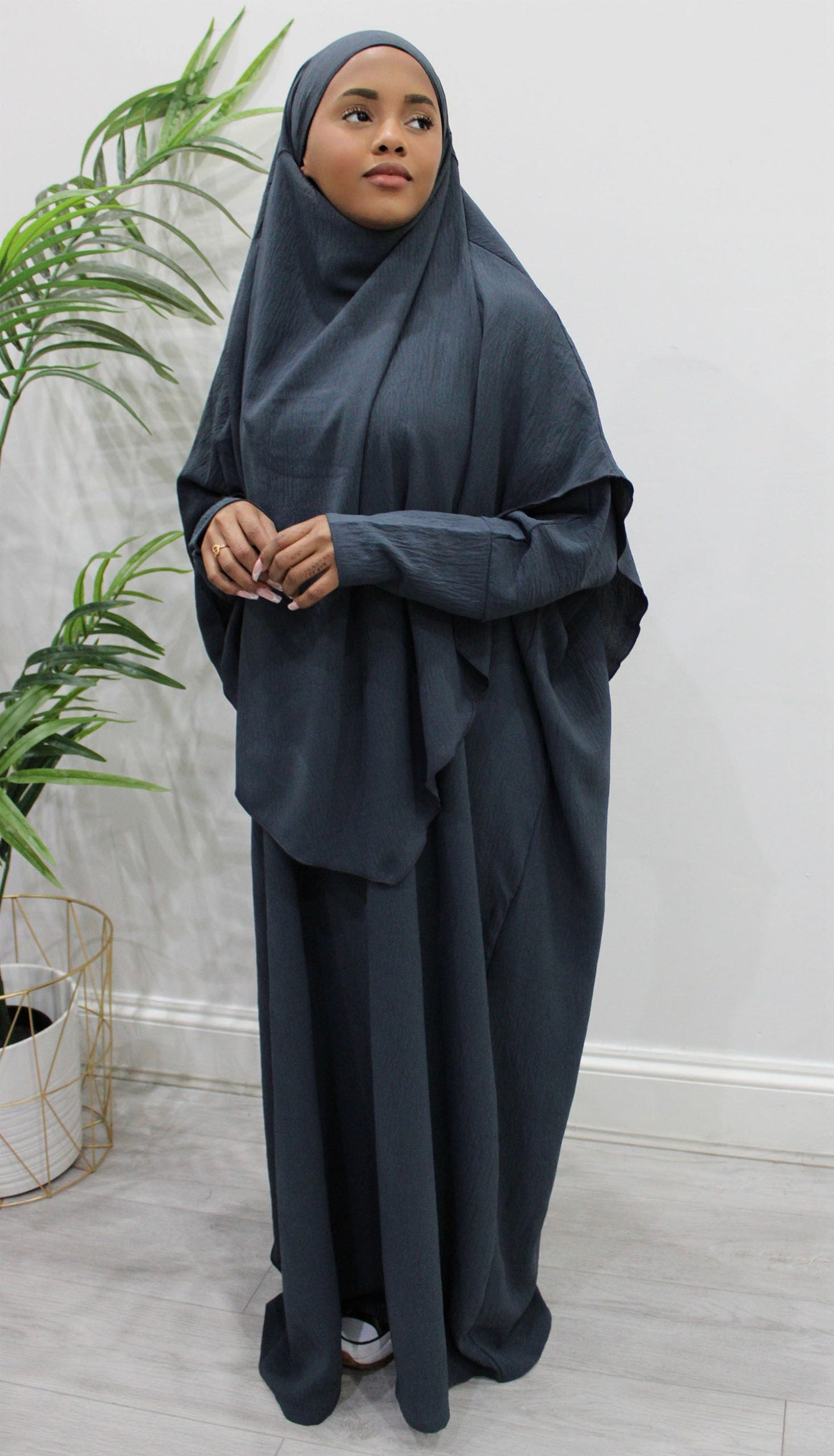
The anchor-grey set below shows how an abaya and khimar can work as one system. I would still test movement, length and head pressure before calling it an everyday solution.

Modest dressing for work
Start with the actual role. Office work, healthcare, catering, teaching, warehouses and laboratories have different safety and uniform needs. Read the written policy. Identify where loose fabric, sleeves, identification or protective equipment require discussion.
A professional modest wardrobe can be simple: loose tailored trousers, longer shirts, opaque maxi skirts, structured abayas where suitable, cardigans and secure hijabs. Neatness comes from fit, fabric condition and coordination, not from making every outfit tight or decorative.
If a conversation is needed, explain the practical request clearly. Ask how identity checks can be handled, whether a uniform can be adapted and which safety standards apply. Employment rights and legal procedures are current, location-specific matters, so seek qualified advice when the stakes are significant.
Modest dressing for college and university
Students move between lecture rooms, laboratories, placements, libraries and social spaces. Build an outfit system that survives that movement. A backpack can pull a scarf backward, a laboratory coat can catch wide sleeves and a long skirt can behave differently on stairs.
Keep one compact scarf and undercap in your bag if changing is part of the day. Speak to tutors early about practical requirements rather than waiting for an assessment or placement. Ask for policies in writing.
Your first year as a Muslim does not require you to answer every question from classmates. Prepare one short explanation and one boundary. You can be open without turning every break into a debate.
Modest dressing for school runs and parenting
Parenting clothes need to bend, lift, carry bags and survive spills. Choose secure necklines, washable fabrics and sleeves that do not fall into food or nappies. A pull-on khimar, jersey hijab or simple abaya can reduce dressing time.
Keep visibility and footwear practical when pushing a pram or crossing roads. Long hems should not catch under wheels. Bags should not pull the scarf loose. These are small design checks with real consequences.
Children may ask why your clothing changes. Answer in calm, age-appropriate language. You are learning to dress in a way connected to your faith. They do not need to be recruited into adult conflict.
Modest dressing with limited mobility or disability
Garments must serve the body that wears them. A wheelchair user may need shorter front length, smoother back fabric and fewer bulky layers. Limited shoulder movement may make overhead garments difficult. Hand weakness can make tiny pins impractical.
Look for side openings, easy fastenings, stretch, two-way zips or adapted lengths. A tailor can sometimes convert a beautiful but inaccessible garment into a useful one. Test how fabric interacts with wheels, crutches and medical devices.
Religious guidance for disability and hardship belongs with a qualified scholar. Practical adaptation is not a failure of modesty. It is part of making clothing honest to the wearer.
Sensory needs and neurodivergence
Texture, heat, sound and pressure can become overwhelming. A seam near the neck, a pin click, fabric touching the lips or layers around the ears may make concentration impossible. Do not dismiss these sensations as fussiness.
Test fabrics against the skin, remove tags carefully and build tolerance only when that is genuinely helpful. A soft pull-on hijab may work better than an undercap and scarf. Another woman may prefer firm structure because loose fabric feels unpredictable.
Keep one sensory-safe outfit for demanding days. Modesty should not require you to abandon the knowledge you have about your nervous system.
Body shape, size and proportion
Modest does not mean drowning every body in the same rectangle. The garment needs enough ease without creating unsafe excess. Shoulder width, bust, hip, height and arm length affect how fabric falls. Size charts should be read with garment measurements, not only body labels.
A petite woman may need hemming. A tall woman needs verified length. A fuller bust may require more front width so the garment does not pull. Pregnancy and postpartum bodies need room that changes over time.
Fit checks are neutral information. They are not a judgement of the body. When I assess a garment, I ask whether the fabric can fall freely and whether the wearer can move. I do not ask her to apologise for her measurements.
Pregnancy, postpartum and breastfeeding
Pregnancy can change length, balance and heat tolerance. Choose generous cuts, adjustable layers and footwear that supports stability. Do not rely on a pre-pregnancy hem length once the garment lifts over the bump.
For breastfeeding, discreet openings and easy outer layers can help. Test zips and panels with one hand. A khimar or large scarf may provide privacy, but feeding and infant safety come first. Keep fabric away from the baby’s face.
Postpartum recovery is not the time for harsh wardrobe expectations. Bodies, routines and sensory tolerance change. Adapt with mercy and seek medical guidance when needed.
Wudu-friendly sleeves and practical cuffs
Sleeves that can be raised securely make wudu easier. Elasticated or ruched cuffs are useful when they are not too tight. Wide open sleeves may need a hidden inner cuff or a method for holding them above the forearm.
Test the sleeve when wet. Some fabrics become heavy and slide down. A beautiful cuff that cannot move above the required area may not suit daily prayer routines.
Keep a small sleeve band only if it is safe, washable and does not create circulation pressure. Good prayer-oriented design should reduce fuss rather than add equipment.
A prayer dress as a confidence tool
A prayer dress cannot create faith, but it can remove the moment of panic when you realise your everyday outfit is not ready for prayer. That matters. Habits become easier when the environment supports them.
Choose a piece you can wash often and put on quickly. Keep it where prayer normally happens. The teal one-piece dress below shows an attached head covering and full-length body piece, which can simplify preparation at home.
Read the live product description for measurements and current availability. The image is an example of construction, not a promise that one style fits every woman.

British spring clothing
Spring is a season of false confidence. A bright morning can become cold rain by the afternoon. Use adjustable layers: a breathable base, loose outer piece and water-resistant coat that does not crush the scarf around the neck.
Pollen can irritate eyes and skin, so wash scarves and undercaps regularly. Keep tissues easy to reach. Pale colours feel seasonal, but check opacity in daylight.
Wind is the practical test. Secure the scarf before leaving and make sure a hood does not block side vision. A pin-free style that works indoors may need one discreet fastening outside.
British summer clothing
Summer modest dressing depends on total layers, not one fabric label. A light abaya over heavy polyester clothes can still feel hot. Use breathable underlayers, looser cuts and as few unnecessary layers as possible.
Plan hydration and private breaks. Heat on buses and trains can be stronger than the forecast suggests. Carry a dry undercap or scarf for a long day. If you feel faint, confused or unwell, seek help and prioritise health.
Light colours can reduce heat absorption but may show through. Test every pale garment against daylight and movement. A dense light weave can be more useful than a thin dark fabric.
British autumn clothing
Autumn rewards repeatable layering. Jersey scarves, medium-weight abayas, long cardigans and practical shoes handle changing temperatures. Keep a small umbrella and a breathable pouch for damp fabric.
Darker evenings make visibility important. Modesty does not require becoming invisible to drivers. Reflective details on a coat or bag can support safety without changing the garment beneath.
Leaves and rain make pavements slippery. Check hem length with the footwear you actually wear. A skirt that clears the ground in trainers may drag in flat shoes.
British winter clothing
Winter adds hats, hoods, scarves, glasses and thick coats around the head. Too many layers can create pressure. Build from the inside out and check that you can turn your head and hear traffic.
Warm the body with base layers and outerwear rather than choosing the thickest possible hijab. Breath meeting cold lenses causes fogging, so carry a clean cloth and test how the scarf sits around glasses.
Long coats can support coverage, but open fronts, side splits and wind still need attention. A modest winter outfit is a system, not a single dramatic coat.
Rain, wind and emergency spares
Keep one folded scarf, undercap and simple fastening in a clean pouch. This is useful after sudden rain, a broken magnet or a spilled drink. The spare should be a fabric you already know how to wear.
Do not store damp fabric in a sealed bag. Change when possible, then wash or air the wet piece. Rain can make pale or loosely woven fabrics transparent, so test wet behaviour before trusting them.
An emergency spare reduces anxiety because the solution is already in the bag. It should not become another reason to carry half the wardrobe.
Family conversations before changing your dress
Choose a calm time, not the doorway before a family event. Explain what you are learning and what the clothing change means to you. Name practical facts: you are still going to work, you are not rejecting your family and you are taking time to understand your faith.
Relatives may react to fear rather than fabric. They may worry about prejudice, marriage, control or losing the person they know. Listening does not require accepting insults. You can acknowledge fear and set a boundary around disrespect.
Do not promise that nothing will change. Faith can change priorities. Promise honesty, continued love where safe, and a willingness to discuss practical concerns. If there is coercion or danger, seek confidential support.
When family buys or rejects your clothing
A relative may buy a scarf as an attempt to support you, even if the colour or fabric is wrong. Receive the care if you can, then make your own practical decisions. Gratitude does not require wearing an uncomfortable item every day.
Another relative may refuse to be seen with you. That rejection hurts. Do not spend beyond your means or abandon safe boundaries to win instant approval. Find supportive community without turning every family disagreement into public content.
Clothing can become the visible focus of a much deeper adjustment. Give relationships time where time is safe, and seek wise mediation when conversations repeat without progress.
Workplace conversations about hijab
Prepare a short, professional explanation. You are changing your dress for religious reasons and want to understand any uniform, identification or safety requirements. Ask for the written policy and propose solutions rather than apologising for existing.
For uniforms, ask whether a longer top, matching headscarf, looser trouser or skirt option is available. For identity, ask about a private check. For equipment, follow actual safety standards. A hijab should not be tucked into machinery or compromise protective fit.
Document agreements. Legal rights can change and vary, so obtain qualified advice if an employer refuses or the situation affects your livelihood.
Handling questions from colleagues and friends
Decide what you are willing to explain. A simple answer may be enough: I am Muslim and I am choosing to dress more modestly. You do not owe a theology lesson during lunch.
Warm curiosity can become a genuine conversation. Intrusive questions can receive a boundary: I prefer not to discuss that at work. Rehearsing both answers helps when attention feels sudden.
Friends may need reassurance that you can still share food, humour, work and ordinary life. You are allowed to change and remain recognisable.
Harassment and personal safety
If a stranger is hostile, your first task is safety, not winning the argument. Move toward staff, other people or a secure place. Call for help when needed. Record details only when it is safe.
Plan routes, keep a charged phone and tell a trusted person about concerning patterns. These are ordinary precautions. They do not mean you have failed to trust Allah or that modest clothing should be abandoned without thought.
After an incident, seek emotional and practical support. Harassment is the responsibility of the person who chose it. Do not turn their behaviour into evidence against your worth.
Confidence when everyone seems to be looking
A visible change can make ordinary streets feel like a stage. The body becomes alert to every glance. Some people are curious, some are indifferent and some may be unkind, but anxiety can make every face feel like a verdict.
Begin with familiar routes and manageable durations. Walk with someone you trust if that helps. Wear an outfit you have already tested. Confidence often grows after several uneventful journeys, not after one dramatic act of bravery.
I do not define confidence as never feeling nervous. I define it as knowing what you are wearing, why you chose it and what you will do if a practical problem appears.
When you miss your old style
Missing old clothes does not mean you regret Islam. Clothing carries memory, identity and social ease. You may miss a silhouette, a hairstyle or the freedom of dressing without explanation. Acknowledge the feeling instead of treating it as betrayal.
Look for what can be translated. A love of tailoring can become structured modest layers. A favourite colour can move into scarves and abayas. Jewellery may remain part of private or appropriate settings. The wardrobe changes, but taste can continue.
Some pieces can be adapted, stored or passed on. Make those decisions slowly. A rushed purge can create unnecessary grief and expense.
Colour, beauty and avoiding a new uniform
Black is practical and beautiful, but it is not the only route to a coherent modest wardrobe. Navy, chocolate, olive, grey, burgundy, taupe and muted colours can feel calm and easy to repeat.
Use colour deliberately. One base colour across shoes, coat and scarf can make a loose outfit feel polished. Tonal dressing removes the pressure of exact matching. Pattern can work when the fabric, cut and setting remain appropriate.
Religious questions about adornment deserve qualified guidance. From a clothing perspective, beauty and coverage are not enemies. The challenge is balance, context and intention.
A one-piece jilbab as a low-decision outfit
A one-piece jilbab combines head and body coverage in one garment. For some new Muslims, it creates relief because there is no scarf styling and fewer pieces. For others, the overhead structure feels unfamiliar or restrictive.
Test the head ties, sleeve shape, length and field of vision. Walk on stairs and sit. Jersey versions can feel soft and flexible, while woven fabrics may hold shape. A style used for prayer or mosque visits may not need to become the only everyday outfit.
The purple jersey jilbab below shows the simplicity of a one-piece structure. Use it as a construction example and compare the live measurements before buying.

Shopping online without panic
Start with a written need. I need an opaque navy jersey hijab for commuting is a better brief than I need Muslim clothes. Search becomes calmer when the garment has a job.
Read measurements, fabric, care, fastening, included pieces and return terms. Look at front, side and back photographs. A styled image can hide whether an abaya is open, whether a khimar ties or whether the inner dress is included.
Do not let countdowns or social pressure decide. A product that is right for you will still need the correct size and function. Pause when information is missing.
How to read a size chart
Compare garment measurements with a comfortable item you own. Body measurements and garment measurements are not interchangeable. Ease is the difference that allows fabric to fall and the body to move.
Check length from the stated point. Shoulder-to-hem, head-to-hem and waist-to-floor produce different numbers. Sleeve length can be measured from shoulder or centre back. Ask when the diagram is unclear.
Do not choose a much larger size only to create modesty. Excessive length and dropped shoulders can become unsafe or distort the intended coverage. Choose the cut and ease designed for the purpose.
Opacity testing
Hold fabric against a window with a contrasting layer behind it. Then wear it and move. Stretching across shoulders, bust or hips can change opacity. Camera exposure and studio lighting are not reliable tests.
White, beige and pastel garments may need lining. Dark fabric can also be sheer if the weave is open. Check sleeves and lower panels as well as the body.
If an outer layer is intentionally sheer, the inner outfit must provide the real coverage. Product descriptions should say this clearly.
Movement testing before removing tags
Try the garment with the underlayers and shoes you intend to wear. Raise arms, reach forward, bend, sit, climb stairs and take a long step. Check necklines, side splits and sleeves.
Use a mirror from the side and back. A garment may look loose from the front and pull elsewhere. Ask whether the hem remains safe and whether pockets drag the fabric when filled.
Keep tags attached and follow the return policy during the test. Do not wear an item outside and return it as new.
A realistic starter budget
Spend first on the pieces used most often: reliable scarf, prayer setup, everyday outer layer and weather needs. Delay special-event clothing until there is a real event.
Set a total budget including delivery, returns and alterations. One well-fitting item may cost more than a sale purchase, but unused bargains are the most expensive clothes in the wardrobe.
Track cost per wear only after the garment proves useful. Do not use the calculation to justify endless buying. The aim is enough, not accumulation.
Avoiding overconsumption in the name of modesty
Modest fashion still uses urgency, trends and newness. A woman can replace one pressure with another, moving from fear of not looking fashionable to fear of not looking Muslim enough.
Create a waiting list. Write the item, purpose and three outfits it will join. Revisit after seven days. Many impulses disappear when the emotional moment passes.
Repair, alter and rotate. Contentment is not visually dramatic, but it is powerful. Your wardrobe can support faith without becoming the centre of it.
Washing hijabs and prayer wear
Follow care labels. Use mild detergent, rinse thoroughly and avoid heavy fragrance near the face. Mesh bags protect delicate scarves and small fastenings. Separate colours during early washes.
Prayer garments need regular cleaning according to wear, environment and fabric. A garment that looks clean can hold deodorant, skincare and dust. Dry fully before storage.
Keep one clean backup while another dries. This small rotation prevents damp garments and last-minute stress.
Drying, ironing and storage
Air drying is gentle for many scarves and prayer fabrics. Reshape face openings, cuffs and ties while damp. Do not hang heavy wet garments from one narrow point if the fabric can stretch.
Use low heat on synthetics and keep irons away from elastic, magnets and plastic supports. A steamer can help, but hot steam must be handled safely.
Store daily pieces where they are easy to reach. A beautiful prayer dress hidden behind occasion clothes does not support the routine as well as one placed beside the prayer space.
Stains, makeup and skincare transfer
Allow skincare to settle before wrapping a scarf. Wash undercaps and the scarf edge regularly. Makeup and sunscreen transfer are ordinary fabric-care issues, not a reason for shame.
Blot stains rather than rubbing delicate chiffon. Test cleaning products on a hidden area. Do not mix chemicals. Persistent dye transfer or strong odour should be raised with the retailer.
Dark colours hide some marks but still need washing. Fragrance cannot replace cleanliness.
What to wear for Eid as a new Muslim
Eid can be joyful and socially intense. Choose an outfit that lets you pray, travel, eat and meet people without constant adjustment. A familiar hijab style is wiser than a complicated experiment on the morning.
You do not need the most expensive abaya to belong. Clean, beautiful clothing within your means is enough. Ask about prayer arrangements, photographs and whether the event is mixed or separated.
If Eid brings loneliness, clothing cannot solve it. Reach out to a trusted mosque or sister in advance. Plan the human support as carefully as the outfit.
Weddings and family occasions
Understand the setting before choosing the outfit. Who will be present? Will photographs be shared? Is there a private women’s space? Can the outfit move between ceremony, meal and prayer?
An open abaya over a suitable inner dress can create occasion styling, while a closed embellished abaya reduces coordination. Keep the hijab secure and avoid embellishment that scratches or catches.
Family weddings may be emotionally difficult after conversion. Decide boundaries early. A calm outfit plan cannot remove conflict, but it can stop clothing details from adding to it.
Travelling as a new Muslim woman
Pack outfits, not isolated pieces. Each scarf should match more than one garment. Keep one prayer setup and one hijab in hand luggage. Carry a breathable pouch for used items.
Check identity procedures and local conditions. A scarf may need brief adjustment for official identification. Ask for privacy where available and cooperate with legitimate requirements.
Travel days are long. Use familiar fabric, comfortable shoes and easy layers. The airport is not the place to discover that a new undercap causes pain.
Building community without losing boundaries
A supportive community can teach practical skills that no article can show, from finding the women’s entrance to arranging a scarf. Choose people who explain without humiliating and who respect your pace.
You are allowed to say no to photographs, public conversion stories, clothing gifts or advice from strangers. Gratitude and boundaries can coexist.
Community should widen your support, not make you dependent on approval. Learn, ask, then make informed decisions with the qualified guidance you trust.
How established Muslims can support a new sister
Begin by asking what she needs. It may be a lift, a prayer dress, a quiet explanation or simply company. Do not arrive with bags of unsuitable clothing and expect gratitude to solve fit.
Explain cultural differences. Tell her which practices are mosque customs, which are clothing preferences and which religious questions need a teacher. Avoid speaking with certainty outside your knowledge.
Do not turn her into inspirational content. Protect her privacy. New Muslims deserve ordinary friendship as much as educational support.
The difference between encouragement and pressure
Encouragement offers information, practical help and patience. Pressure uses fear, comparison, shame or withdrawal of belonging. The visible result may look similar for a day, but the inner experience is different.
A woman can be invited to learn without being publicly inspected. She can receive a scarf without being asked when she will wear it. She can ask hard questions without being accused of rejecting faith.
I want Amani’s content to support choice informed by knowledge, not to manufacture urgency. That is why this guide keeps directing religious questions to qualified people and clothing questions to practical tests.
When progress does not look linear
You may wear hijab confidently for a week and struggle the next. Weather, family, work, health and emotion change. A difficult day does not erase every sincere step.
Return to the smallest reliable routine. One secure outfit. One prayer setup. One trusted person. Solve the actual problem rather than condemning the whole journey.
Consistency grows through repair. It is not always a straight line drawn in public.
Your private reasons do not belong to strangers
A colleague may ask why. A relative may demand proof. Another Muslim may ask which opinion you follow. You decide how much personal reasoning to share.
A short answer protects energy: I am learning and making a considered choice. A boundary can be equally polite: I prefer to keep that private.
Privacy is not dishonesty. The heart does not become public property because clothing becomes visible.
A practical decision tree
If the immediate need is prayer at home, begin with prayer wear. If it is public hijab, begin with one stable scarf and an outfit from clothes you own. If it is full outer coverage, compare abaya, jilbab and khimar. If it is workplace adaptation, read policy before buying.
If discomfort is the problem, identify whether it comes from heat, pressure, texture, visibility or social anxiety. Each has a different solution. Do not buy another colour when the real problem is a tight undercap.
If the question is religious, pause the shopping and seek qualified guidance. Buying should follow understanding.
Where to shop next
For everyday headscarves, browse the Hijabs collection. For home salah and practical preparation, use the Prayer Wear collection. For loose outer garments, compare the Abayas collection.
If you want extended head and chest coverage, explore Khimars. For integrated one-piece and two-piece outfits, visit Jilbabs. Read measurements and current product details rather than assuming the collection name answers every question.
For a softer first step before this full pillar, read For the Woman Trying Modest Fashion for the First Time. For the emotional meaning of beginning again through clothing, read Why a Muslim Modest Dress Can Be the Piece That Helps You Start Again.
A final thirty-day review
After thirty days, ask what has become easier. Which scarf do you reach for? Which prayer garment stays ready? Which outfit works for rain, work and family? Keep evidence of ease.
Ask what remains difficult without using vague blame. Is the problem money, fit, heat, policy, family hostility or uncertainty about guidance? Name it and take it to the right person.
Then decide the next single step. Alter one dress. Buy one spare hijab. Speak to a teacher. Arrange a workplace meeting. A steady wardrobe grows through clear next steps, not through panic.
My closing advice to the sister reading
I would rather you own five useful pieces and understand them than own fifty pieces bought through fear. I would rather you ask a scholar an honest question than repeat a confident answer from a product caption. I would rather your first hijab be simple and wearable than impressive and painful.
Let clothing support the life of faith you are building. Keep prayer easy to prepare for. Keep work and travel safe. Keep room for your body, your culture and your real responsibilities. Learn the principles, then practise them with patience.
You are not a mannequin for anyone’s idea of the perfect revert. You are a Muslim woman learning, worshipping, adjusting and growing. May your wardrobe become one quiet form of support, never the measure of your worth.
The new Muslim modest wardrobe checklist
- Faith guidance: one trusted teacher or scholar for personal religious questions
- Prayer: one clean, opaque, movement-tested prayer setup
- Hijab: one or two fabrics you can secure without pain
- Everyday clothing: three repeatable outfits suited to your real week
- Weather: coat, footwear and layers suitable for the UK season
- Work or study: written policies and practical adaptations understood
- Care: washing, drying and storage that fit your home
- Safety: clear vision, safe hems, secure fabric and an emergency spare
- Budget: a written limit and a needs-first purchase order
- Support: at least one person who helps without shaming
Use this list as a review, not a test. A blank item shows the next practical question. It does not show that you are failing.
When clothing is the last fear before shahada
I have seen how one practical fear can grow until it begins to stand in front of the whole faith. A woman believes, but she imagines work on Monday, her mother’s face, summer heat, old photographs and the unfamiliar feeling of fabric around her head. None of those concerns is silly. They are simply too many to solve in one frightened moment.
Separate the decision to learn about Islam from the fantasy that you must already look like an experienced Muslim woman. Speak to a qualified teacher about what belongs to belief, what belongs to religious practice and how to approach change responsibly. Then bring the clothing questions back into their proper size. A scarf can be learned. A hem can be altered. A workplace conversation can be prepared.
I would never want a sister to confuse a retailer’s enthusiasm with a religious deadline. My role is to make the practical path clearer after you have received sound guidance, not to place a basket between you and Allah.
The first time you see yourself in hijab
The mirror can produce several feelings at once. You may feel peaceful, unfamiliar, beautiful, exposed, relieved or suddenly serious. Do not demand one approved emotion. A visible change takes time for the mind to recognise as your own.
Look at function before judgement. Is the hair secure? Is the neck covered according to the style you are learning? Can you turn your head? Does the fabric hurt? Once the practical issues are settled, step away from the mirror. Wear the scarf while making tea, reading or doing something ordinary. Familiarity grows through living, not through staring.
Photographs can help you remember a style, but they can also turn the first day into a performance. Keep the moment private if privacy feels kinder.
Learning one hijab style properly
I recommend choosing one style and repeating it until your hands know the sequence. Place the undercap, centre the scarf, create the face opening, secure it and arrange the chest coverage. Use the same mirror and the same fabric during practice.
Time yourself only after the style feels comfortable. Speed is not the first goal. A rushed technique often hides painful tension or uneven coverage. Once the method is reliable, practise without a large mirror so you can manage at work, while travelling or in a small washroom.
Tutorials are useful, but stop collecting them when they make you feel behind. One lived skill is better than thirty saved videos.
A new Muslim mosque bag
A small mosque bag can remove several quiet worries. I would include a clean scarf or pull-on hijab, socks if you use them, a prayer garment where needed, a small reusable bag for shoes, tissues and a bottle of water. Keep it light enough that you actually take it.
Add a card with emergency contact details if that suits your circumstances. Avoid loose pins in the bottom of the bag. Store any sharp fastenings in a closed container and keep magnets away from children.
After each visit, empty the bag. Wash used fabric, remove rubbish and replace what is missing. A permanently packed bag only works when it remains clean.
Prayer away from home
Prayer at work, college or while travelling becomes easier when you identify the space before the time arrives. Ask about a prayer room, quiet room or suitable private area. Learn the location for wudu and whether you need to bring a prayer mat.
Clothing should be quick to manage in a limited space. A compact pull-on khimar and long skirt, a one-piece prayer dress or an everyday outfit already suitable for prayer can reduce stress. Keep the garment in a breathable pouch, not loose beside shoes or food.
Religious questions about combining prayers, travel or exceptional circumstances need qualified guidance. The practical preparation is still worth doing because it prevents avoidable panic.
Wudu in public and shared facilities
Public wudu can feel awkward when you are new. Choose sleeves that lift and remain up. Carry a small towel and footwear that is safe on wet floors. Keep scarves and long hems away from sinks.
Some facilities have dedicated washing areas, while others do not. Ask a trusted sister to show you the first time if possible. Clean water spills and leave the space considerate for the next person.
If a health condition, bandage, makeup product or workplace environment creates a religious question, ask a qualified teacher rather than improvising from a clothing article.
Menstruation, worship routines and clothing
Menstruation changes certain worship routines, and the details should be learned from a qualified teacher. From a wardrobe perspective, it can also change comfort, temperature, bloating and tolerance for pressure. A softer waistband, looser abaya or gentler undercap may feel better.
Keep prayer garments clean and stored even during times when they are not being used for salah. The routine will be easier to resume when the clothing remains ready. Do not let a pause in one act of worship become a reason to abandon every supportive habit.
Questions about purity, prayer and specific rulings are not for a fashion guide to settle. Good modest-fashion advice knows that limit.
Ramadan as a new Muslim woman
Ramadan can make clothing feel more physical. Sleep changes, commutes feel longer, evening prayers are crowded and hydration is limited during fasting hours. Choose breathable, familiar outfits and avoid testing a difficult new hijab on the first long day.
Prepare mosque clothing before sunset. Keep a clean prayer garment, easy shoes and a secure scarf ready. For iftar gatherings, choose an outfit that allows eating, prayer and travel without constant adjustment.
Health and fasting questions need qualified religious and medical guidance. Do not use clothing to hide signs that you are unwell. Modesty and self-neglect are not the same.
Your first Jummah or busy congregational prayer
A busy prayer can feel socially intense. Arrive early enough to find the women’s entrance, make wudu and settle. Wear a scarf that stays in place during prostration and an outfit that does not spread into another person’s space more than necessary.
Keep perfume, noisy jewellery and large bags considerate of the setting. Turn your phone off. If you do not know the sequence or local arrangement, sit near a trustworthy woman and follow calmly.
Leaving without speaking to many people is not a failure. The first purpose is worship. Friendship can grow over repeated visits.
Eating with hijab at family gatherings
A headscarf does not usually make eating difficult, but long ends, loose sleeves and open outer layers can meet plates and drinks. Arrange the scarf away from the table and use sleeves that can be controlled without exposing the arm unexpectedly.
Family may watch more closely because the change is new. Do not let that pressure turn a meal into a demonstration. Eat normally, answer what you choose and change the subject when the conversation becomes invasive.
If photographs are common, state your boundaries before the table fills. It is easier to prevent an image than to chase it after sharing.
Photography and your old image online
Conversion and hijab can make old photographs feel newly complicated. You may want some removed, made private or left alone. Do not make every decision in one emotional evening. List the accounts and people involved, then act in order of importance.
Ask friends not to repost uncovered images if that reflects the guidance you follow. Some will cooperate quickly; others may need a clear explanation. Platform tools can help with tags and privacy, but they cannot guarantee that every copy disappears.
New photographs also need consent. A women-only gathering is not truly private when phones are recording. Ask before uncovering and before allowing others to take pictures.
Social media modesty pressure
Online modest fashion can educate and inspire, but it can also create a second surveillance system. Every scarf angle becomes a debate, every outfit a verdict and every woman a public example. That atmosphere is not a healthy teacher.
Curate your feed. Keep educators who explain with evidence and kindness. Remove accounts that make you shop compulsively or feel spiritually ranked by appearance. Private learning may be more nourishing than public comparison.
I want this guide to return you to your actual life. The right outfit is the one that supports prayer, work, weather and wellbeing, not the one most likely to receive approval from strangers.
Body image after changing silhouette
Loose clothing can change how you recognise your body. Some women feel relief from scrutiny. Others feel larger, shapeless or disconnected because they were taught that a flattering outfit must reveal shape. These reactions are learned and can be unlearned with patience.
Proportion still matters. Shoulder seams, garment length, sleeve scale and fabric drape can create a balanced look without close fitting. Tailoring for length and structure is not the same as tailoring to display the body.
Speak kindly when trying clothes. The body is not wrong because a pattern is wrong. Change the garment, not your worth.
Weight change and wardrobe flexibility
Weight can change through health, medication, pregnancy, stress and ordinary life. Build some flexibility with open abayas, adjustable inner layers, elastic that does not pinch and cuts that remain loose across a range.
Do not buy an entire wardrobe for a hoped-for future size. Dress the body you have today with dignity. Alter when practical and keep a small number of pieces through transitions.
Sudden or concerning weight change belongs with a clinician. Clothing can adapt, but it should not hide a health issue from you.
Skin, acne and fabric around the face
Fabric, heat, detergent, makeup and friction may affect skin. Begin with clean scarves and undercaps, rinse detergent fully and avoid wrapping tightly against irritated areas. Rotate contact points where the style permits.
Choose fragrance-free products if scent causes sensitivity. Wash new scarves before extended wear when care instructions allow, especially if they carry strong finishing odour.
Persistent acne, rash or pain needs clinical advice. Do not buy endless fabrics in place of treating a medical problem.
Glasses, sunglasses and hijab
Place glasses before final scarf adjustment so the arms sit naturally. A tight undercap can press frames into the temples, while a very loose scarf may catch them. Test looking down and removing the glasses with one hand.
Sunglasses are often wider than prescription frames, so the same style may behave differently. In winter, warm breath and cold air can fog lenses. Carry a proper cloth and avoid wiping coatings with rough fabric.
Clear vision comes before a perfectly fixed fold. Adjust the style if the frames tilt or the scarf narrows awareness.
Sports, walking and active days
Active modest clothing needs secure fabric, ventilation and freedom of movement. Long loose pieces should not approach wheels, gym equipment or moving machinery. Choose sportswear designed for the activity rather than using an ordinary abaya for everything.
A sports hijab or close, breathable head covering can reduce pins and loose ends. Test hearing and side vision. For outdoor walking, use safe footwear and visible outerwear in low light.
Exercise and health needs vary. Seek medical advice where a condition affects heat, breathing or balance.
Sleepovers, hospital stays and overnight travel
Overnight settings raise questions about who may enter and what clothing needs to be within reach. Pack a simple outer garment and pull-on head covering that can be worn quickly without panic. Clarify room arrangements in advance where possible.
In hospital, health and access take priority. Ask for privacy and female staff where available, but do not delay urgent examination or treatment. A front-opening garment may be more practical than an overhead style.
Keep clean and worn clothing separate. Include one spare outfit in hand luggage or a reachable bag, not at the bottom of a car or checked suitcase.
Medical appointments and modest clothing
Choose clothing that allows the relevant area to be examined without removing more than necessary. A two-piece outfit, loose sleeves or an open abaya can be easier than one uninterrupted garment. Tell the provider what privacy would help.
Bring a clean pouch for a scarf or outer layer if it must be removed. Avoid complicated pins near the area being examined. Medication, tests and emergency care come before keeping the outfit visually perfect.
Religious questions about examination and necessity should be taken to a qualified scholar. Medical questions belong with the clinician.
Marriage conversations after conversion
A change in faith and clothing can affect dating history, an existing marriage, future marriage hopes and family expectations. Do not let strangers use modest dress to rush you into personal decisions. Clothing is not proof that you are ready for marriage.
If you are married, discuss practical routines and religious learning honestly. Coercion should not be disguised as leadership or concern. Seek knowledgeable, trustworthy support for serious conflict.
If you are single, build community and understanding before allowing clothing compliments to become emotional pressure. Your new identity deserves time to settle.
Shopping with a Muslim friend
A helpful friend asks your budget, measurements and daily needs before choosing. She explains fabric and shop terminology without making you feel ignorant. She does not fill the basket to perform generosity.
Try to keep final decisions in your hands. A friend may love black chiffon while you need navy jersey. Her experience is valuable evidence, not a universal rule.
After shopping, review each purchase at home. Friendship should make you more confident in your judgement, not dependent on hers.
Receiving donated modest clothing
Donations can be a blessing, especially at the beginning. Sort garments for size, condition, opacity and actual use. Wash them before wearing where appropriate. You do not need to keep damaged, unsuitable or uncomfortable pieces out of guilt.
Ask what each garment is called and how it is worn, but verify religious questions with a teacher. A donated jilbab may be excellent for prayer and impractical for your workplace. Reassign it honestly.
Pass on clean useful pieces you cannot use. Generosity continues when it respects the next woman’s dignity.
Modest clothing and British cultural events
Work parties, school events, funerals, graduations and community celebrations each have their own dress expectations. You can meet the formality of the event while maintaining modest coverage. Begin with colour, fabric finish and structure rather than reducing modest dressing to casual black.
A tailored long coat, closed abaya, maxi dress with suitable layering or coordinated trouser outfit can feel appropriate. Check whether the event includes prayer, outdoor standing, alcohol-focused spaces or photography, and make personal decisions with guidance and boundaries.
Belonging does not require copying every custom. Respect can be shown through punctuality, clean clothing, kind speech and thoughtful participation.
When modest clothes feel expensive
Specialist garments can be expensive, especially when you are replacing several functions at once. Slow the process. Use existing clothes, second-hand outerwear, simple scarves and alterations. Save for the item that solves the greatest repeated problem.
Compare price with construction, not only branding. Look at seams, opacity, care and whether the garment needs extra pieces. A low-priced sheer abaya that requires a new inner dress may cost more in reality.
Speak openly about budget with anyone helping you. Financial strain is not a sign of weak commitment.
Sustainability and a wardrobe that lasts
Choose washable fabrics for daily use, repair loose hems and store pieces correctly. Rotate scarves so elastic and fibres recover. Avoid buying several versions before the first has survived washing.
Natural, regenerated and synthetic fibres each have environmental and practical trade-offs. There is no perfect wardrobe material. Buy fewer pieces that serve real needs and care for them.
Modesty can include restraint. A wardrobe does not become more meaningful because it becomes larger.
What I look for in beginner-friendly clothing
I look for an honest size chart, opaque fabric, comfortable movement and a design that can be repeated without special skill. I look for sleeves that work with daily life, necklines that stay secure and care instructions a real household can follow.
I also look for what is missing from the description. Is an inner dress included? Does the khimar tie? Is the scarf shown but sold separately? Clear information is part of respectful retail.
Finally, I ask whether the garment solves the problem named by the sister. A beautiful answer to the wrong question is still the wrong purchase.
What experience has taught me about first wardrobes
Experience has taught me that women remember comfort. They remember the scarf that stopped slipping, the prayer dress that was ready, the coat that made the first winter commute manageable. Those quiet successes build more confidence than a dramatic outfit worn once.
It has also taught me that shame creates poor decisions. A shamed woman buys too much, hides questions and endures pain because she thinks discomfort proves seriousness. A supported woman can assess, learn and adjust.
That is the first-person truth I bring to this guide: practical mercy makes modest dressing more sustainable. Clear information serves faith better than pressure.
Frequently asked questions for new Muslim women
Do I need to wear hijab before I become Muslim?
Do not let an unresolved clothing question prevent you from seeking Islam. The precise religious guidance and timing that apply to you should be discussed with a qualified, compassionate teacher. You can begin learning about hijab and preparing practical clothes without pretending you already know everything.
What does hijab before Islam mean?
It may mean historical veiling before Islam, or it may be a personal search about wearing hijab before becoming Muslim. This guide addresses the second intention while acknowledging that modest covering existed in multiple earlier societies and faith communities.
Do I need an abaya to be a Muslim woman?
An abaya is a useful loose outer garment, not the only possible garment. Coverage depends on the whole outfit, including looseness, opacity, length and the guidance you follow. A qualified teacher can explain the religious principles; a clothing guide can help you apply them.
What should I wear when saying shahada?
Wear clean, respectful clothing in which you can focus. If the shahada is at a mosque, ask about the women’s space and head-covering expectations. You do not need an expensive ceremonial outfit.
What should I wear for my first prayer?
Prepare clothing that provides the coverage required by the guidance you have learned and remains secure through standing, bowing, prostration and sitting. A one-piece prayer dress or coordinated skirt and khimar can simplify preparation.
Can I pray in my normal clothes?
Normal clothes may work when they meet the relevant prayer coverage and cleanliness requirements. Because personal religious questions require proper context, confirm the details with a qualified teacher. Practically, test the outfit through every movement.
Is a prayer dress only for home?
Prayer dresses are commonly kept for home prayer or suitable prayer spaces. They are designed to make preparation easy and are not automatically outdoor garments. Check the fabric, length and construction before using one outside.
What is the easiest hijab fabric for a beginner?
Many beginners find jersey manageable because it grips and stretches with little pinning. Pull-on hijabs are also simple. Chiffon and modal can work well when their movement and opacity suit you. There is no single best fabric for every head, climate or sensory need.
Do I need an undercap?
Not always. An undercap can hold hair and improve grip, but some scarves and pull-on styles work without one. If an undercap causes headache, slipping or heat, change the fit or design rather than accepting pain.
Are magnets better than pins?
Magnets avoid holes and are quick, while pins offer precise placement. Both need safe handling. Magnets are small objects and may be unsuitable around certain medical devices. Pins must be closed and kept away from the face and children.
How many hijabs should I buy first?
One or two dependable hijabs are enough to begin learning. Add a small rotation after you know which fabric, size and colour you actually wear. Buying many unfamiliar scarves at once often creates waste.
Which hijab colour should I buy first?
Choose a neutral or favourite colour that works with several outfits. Navy, black, brown, grey, taupe and olive are versatile. The best first colour is the one you will wear, not the one that appears most expected online.
Can I still wear colour as a Muslim?
Muslim women wear a wide range of colours. Questions about adornment and context should be learned from qualified guidance. From a wardrobe perspective, colour can be coordinated modestly through opaque fabric, appropriate cut and thoughtful styling.
Can I keep my old clothes?
Yes, and many pieces may be useful with layering or alteration. Audit each item for coverage, opacity and movement. Keep familiar clothes that work, adapt those with potential and release only what is genuinely unsuitable.
How do I build a modest wardrobe cheaply?
Begin with what you own, prioritise prayer and everyday needs, buy one solution at a time and use alterations. Choose coordinating colours and repeat outfits. Avoid spending first on occasion clothing or large trend-led orders.
What is the difference between an abaya and a prayer dress?
An abaya is generally a long outer garment for modest dressing. A prayer dress is designed to provide quick coverage for salah, often with an attached or coordinated head covering. Some products overlap in appearance, so read the construction and intended use.
What is a khimar?
A khimar is a head covering that extends over the shoulders, chest and back. Lengths vary. It can be worn with a dress, abaya, skirt or other suitable body covering.
What is a jilbab?
A jilbab is a loose outer covering. Modern retail use includes one-piece overhead garments and two-piece sets. Check photographs and component lists because the word does not describe one standard pattern everywhere.
Do I have to wear black?
A clothing guide should not make a universal religious ruling about colour. Black is practical and widely worn, but modest wardrobes also use navy, brown, grey, green, burgundy, beige and other colours. Seek qualified guidance for questions about adornment.
How can I dress modestly for work?
Start with the role, written uniform policy and safety requirements. Build loose, opaque professional outfits and a secure head covering where used. Discuss identity, equipment and uniform adaptations clearly, and obtain qualified employment advice when needed.
Can an employer ask me to remove hijab?
Employment rules and rights are specific to the country, role and circumstances. Ask for the written policy and the exact reason, especially where safety or identification is cited. Seek qualified legal or employment advice rather than relying on a general fashion article.
How do I tell my family I want to wear hijab?
Choose a calm time, explain what you are learning and name the practical changes honestly. Listen to specific fears while setting boundaries against insults or coercion. Seek confidential support if the conversation creates danger.
What if my family refuses to accept my clothing?
Protect safety and seek trusted support. You may need time, mediation or a practical plan for housing, work and relationships. A clothing purchase cannot solve coercion or abuse. Use qualified safeguarding and community support where necessary.
How do I handle staring in public?
Begin with familiar routes, tested clothing and supportive company if helpful. Prepare a short response for questions and a safety plan for hostility. Confidence often grows through repeated ordinary experiences rather than forcing yourself into the hardest setting first.
Can I wear hijab with glasses?
Yes. Place glasses securely and avoid scarf pressure that lifts the frames. Test undercaps and pins around the arms of the glasses. In cold weather, keep a lens cloth and adjust layers to reduce fogging.
What if hijab gives me headaches?
Remove the setup and identify pressure from the undercap, bun, pins or tight wrapping. Use looser ties, a lower hairstyle or different fabric. Persistent or severe headaches need medical advice.
What if I have sensory issues?
Choose soft seams, fewer layers and predictable fastenings. Test fabric privately and keep a sensory-safe outfit for demanding days. Disability and sensory needs deserve practical adaptation, not shame.
Can I wear hijab with hearing aids?
Often yes, but ties and undercaps must not press or dislodge the devices. Test removal and replacement carefully and ask the relevant clinician for device-specific guidance.
What should I wear in hot weather?
Use lightweight opaque fabrics, loose cuts and fewer unnecessary layers. Plan hydration and breaks. Dark colour is not the only factor; weave, total layers and airflow matter. Seek help if you develop signs of heat illness.
What should I wear in rain and wind?
Use a secure scarf, weatherproof outer layer and safe hem length. Carry a dry spare in a breathable pouch. Check that hoods do not block side vision and that wet fabric does not become transparent.
How do I wash hijabs?
Follow the care label. Use mild detergent, protect delicate pieces in a mesh bag and air dry where suitable. Wash undercaps regularly and avoid relying on fragrance instead of cleaning.
How do I store prayer wear?
Keep it clean, dry and easy to reach near the usual prayer area. Store coordinated pieces together. Do not seal damp fabric in plastic or hide the garment where preparation becomes difficult.
Can I buy a complete modest outfit set?
Yes. A coordinated abaya and khimar or jilbab set can reduce styling decisions. Check every included piece, measurements, fabric weight, head fastening and care. A visual set is not automatically suitable for every body or climate.
How do I know whether an online garment is opaque?
Read fabric and lining details, inspect close photographs and ask the retailer. Test the garment in daylight after delivery while keeping tags attached. Colour alone does not guarantee opacity.
Should I size up for modesty?
Choose a cut designed with adequate ease rather than automatically buying several sizes larger. Excessive length and dropped shoulders can become unsafe. Compare garment measurements with a loose item you already wear.
Can I alter clothes I already own?
Often. A tailor may add lining, lengthen a hem, close a neckline, adjust sleeves or add panels. Alteration can preserve familiar style and reduce waste. Test the finished garment through movement.
What should I wear to Eid as a new Muslim?
Choose clean, beautiful clothing within your means that supports prayer, travel and the event setting. Use a hijab style you already know. Ask about photographs, privacy and who will attend.
What should I wear to a Muslim wedding?
Confirm whether the event is mixed or women-only and how photographs are handled. Choose an outfit that remains manageable for prayer, meals and travel. An embellished abaya or layered modest dress can work when the construction suits the setting.
Can I exercise in modest clothing?
Yes, with clothing designed for the activity and environment. Avoid loose fabric near equipment, protect vision and manage heat. Use appropriate modest sportswear and seek medical guidance where health conditions affect exercise.
Can I swim in ordinary abaya or prayer clothes?
Ordinary garments are not designed for swimming and can become heavy, cling or create danger. Use purpose-designed modest swimwear in a safe setting and follow the facility’s rules.
How can a friend support a new Muslim woman?
Ask what she needs, offer practical help without inspecting her progress and respect privacy. Explain cultural differences honestly and direct religious questions to qualified teachers. Ordinary friendship matters.
What if I buy something and never wear it?
Identify why. The fit, fabric, colour, social anxiety or actual need may be wrong. Alter, reassign, sell or donate a clean suitable garment where possible. Use the lesson to improve the next purchase rather than buying another version immediately.
How do I avoid looking like I am wearing a costume?
Keep familiar colours, fabrics and silhouettes where they support modesty. Add new garments gradually and coordinate them with your existing wardrobe. Understanding coverage lets you make choices that feel integrated rather than copied.
Is it wrong to care about looking beautiful?
Beauty and personal care are not automatically opposed to modesty. The appropriate balance, intention and context are religious questions for qualified guidance. Clothing can be well-made, clean and aesthetically thoughtful without becoming the measure of faith.
What if I am not ready for every clothing change?
Be honest about where you are, continue learning and seek qualified guidance rather than creating your own ruling from fear. Build practical steps and support. Difficulty should lead to knowledge and planning, not public shame.
Where should I begin today?
Choose one action: prepare a prayer outfit, audit your wardrobe, practise one hijab, contact a trusted teacher or write your first shopping brief. One clear step is more useful than a large, anxious list.
More focused guides when one question needs its own space
A first modest wardrobe is easier to build when you can separate a broad principle from the exact garment or occasion in front of you. The guides below take three common situations further without asking you to change everything at once.
If a convertible occasion dress is what you are trying to make work, our birdy grey convertible dress guide looks closely at wrap positions, neckline security, sleeve and chest coverage, and what changes once you sit and move rather than only pose for a photograph.
If the bigger question is how to dress after becoming Muslim while still feeling recognisably like yourself, the new muslim dress style guide focuses on gradual wardrobe changes, familiar colours and shapes, practical coverage and the difference between learning modesty and copying somebody else’s identity.
For a bridal decision, the new muslim wedding dress guide covers coverage, movement, family expectations and the emotional side of choosing something that feels bridal without making a new Muslim woman feel as though she has to become a different bride.