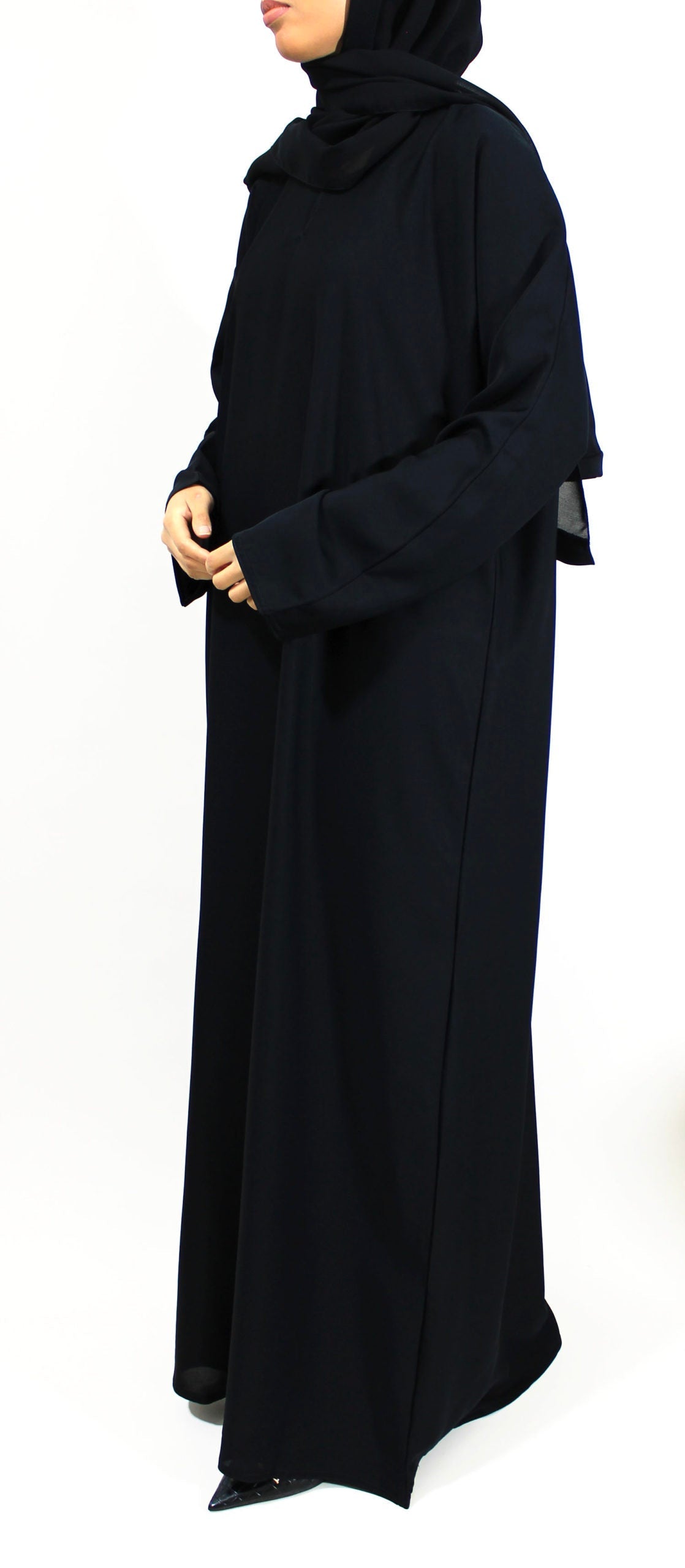
Muslimah Work Attire Should Let You Walk Into the Room Feeling Professional and Fully Yourself
There is a particular kind of workday frustration that begins before you have even opened your laptop. The blouse is technically long enough until you sit down. The trousers are loose until the fabric catches across the thigh when you climb the station stairs. The cardigan gives the extra coverage you wanted, but by lunchtime you are too warm to keep it on. Then somebody tells you that looking “professional” means a sharper waist, a shorter jacket or a tucked shirt, and you are back to translating somebody else’s office wardrobe into something you can actually wear.
Muslimah work attire should not require that translation every morning. Professionalism and modesty are not opposite ends of a scale. A woman can look prepared for her workplace while choosing longer lines, looser cuts, opaque fabric and coverage that remains dependable when she sits, reaches, commutes, prays or spends ten hours away from home.
The difficult part is that workwear has several jobs at once. It needs to meet the culture and practical requirements of your actual workplace. It needs to survive movement rather than only look polished in a mirror. It has to work with British weather, indoor heating, bags, ID cards, chairs and whatever your job asks your body to do. And ideally, it should be repeatable enough that Wednesday morning does not feel like another styling project.
This article is about the whole wardrobe rather than the hijab alone. We will look at modest work dresses, blouses, longline layers, skirts, trousers, abayas, summer work clothes, colour, fit, fabric behaviour, prayer practicality and the small details that decide whether an outfit remains useful after several hours. If you want the broader foundations of modest dressing across many settings, the complete modest fashion guide goes further into garment types, coverage, fabric, sizing and layering.
Here, the standard is simpler: can you do your job in the clothes without modesty becoming another problem to solve?
Professional does not mean fitted, short or colourless
A lot of mainstream workwear advice begins with a visual shorthand: tailored trousers, a tucked blouse, a fitted blazer, a knee-length dress, a pencil skirt. Those pieces can look professional, but the silhouette is not the definition of professionalism. A workplace usually cares about whether you are appropriately dressed for the setting, clean, presentable, safe and able to perform the role. How that is achieved can look very different from woman to woman.
For a Muslimah who wants more coverage, the same visual clarity can come from line, fabric and proportion rather than body emphasis. A long blazer can look deliberate because the shoulder sits cleanly and the lapel lies flat. A loose maxi dress can look polished because the fabric has enough body to fall smoothly rather than collapse around the figure. Wide-leg trousers can work because the hem is controlled and the top has a clear relationship with them.
There is no need to make every garment oversized. In fact, buying everything several sizes too large can create dropped shoulders, sleeves over the hands and excess fabric that looks accidental rather than modest. The aim is enough ease where you need it, with construction that still knows where your shoulders, wrists and hem are meant to be.
Colour does not have to disappear either. Black, navy, charcoal and taupe are useful because they combine easily, not because they possess a special professional status. Deep green, burgundy, muted blue, chocolate, plum and many softer shades can belong at work when they sit comfortably within the dress culture of the workplace.
Professionalism becomes easier once you stop trying to imitate one narrow uniform and start asking what communicates care, competence and appropriateness in the room you actually enter.
Read the workplace before you build the wardrobe
A solicitor meeting clients in a traditional firm, a teacher, a university administrator, a pharmacist, a designer, a shop manager and somebody working three days from home do not have the same clothing problem. Even two offices in the same industry can have completely different expectations.
Start with the actual environment. Is there a written dress code? Are jackets expected for client meetings? Are clean trainers ordinary, or would they look out of place? Do you spend most of the day at a desk, or are you on your feet? Are there uniform, hygiene or safety requirements that affect sleeves, loose fabric, footwear or head coverings? Where such requirements apply, the safest clothing decision is to work within them rather than treating appearance as the only priority.
Look at the most polished women in your own workplace and notice the level of formality rather than copying their exact garments. One office might interpret “smart” as a knit, tailored trouser and loafers. Another expects jackets and formal shoes. A creative workplace may welcome print and colour that would feel unusually expressive in a conservative corporate setting.
Your week can contain more than one level. Monday may be quiet administration. Tuesday may involve an external meeting. Friday may be hybrid and relaxed. A good wardrobe does not force every day into the formality of the most serious meeting. It gives you a dependable base and a few ways to raise or soften the finish.
Most Muslim women are not dressing for a boardroom every day. A useful work wardrobe has to handle ordinary professional life as well as the occasional sharper moment, without forcing Tuesday's desk day to dress like the most formal meeting of the year.
Build your modesty baseline before choosing “work” pieces
Work clothes become stressful when you decide what feels modest only after the garment is already in your wardrobe. Before shopping, establish your own practical baseline: the neckline you are comfortable with, the sleeve coverage you want, how loose you prefer clothing through the bust and hips, the length you like over trousers, and what you expect from a skirt or dress when seated.
This is not a religious ruling or an attempt to define one standard for every Muslim woman. Personal religious questions deserve qualified guidance. From a clothing perspective, the value of a baseline is consistency. You stop buying a blouse that only works if the scarf stays perfectly spread across the chest, or trousers that require a particular coat to remain on indoors because the top is shorter than you wanted.
Test your baseline in movement. A blouse may cover the hips while standing and rise above them when you reach for a shelf. A dress may look loose at the waist and pull across the thighs in a chair. A side slit may appear modest until you take a long step. A wide cuff may expose more of the arm when your hand is raised.
If you know which of those things matter to you, shopping becomes less emotional. You can say, “The dress is beautiful, but the slit starts too high for the way I want to wear it,” rather than trying to persuade yourself that a cardigan, slip and scarf will somehow repair every problem.
A reliable work wardrobe is not built from garments you can just about make acceptable. It is built from pieces that already agree with the way you want to dress.
A work dress should pass the chair test before the mirror test
Modest work dresses can be wonderfully easy because the outfit is largely decided in one piece. But sitting exposes weaknesses that standing photographs hide. The fabric stretches across different areas, waist seams move, button plackets can gape and hems rise.
Put the dress on and sit in the kind of chair you use at work. Lean forward as though typing. Cross or reposition your ankles. Stand and sit again. Look from the side. You are not inspecting your body; you are inspecting the garment. Does the bodice remain loose enough? Does a wrap front stay closed? Does the waist become restrictive after several minutes? Does the skirt give enough room to stand without pulling?
Length deserves practical judgement. A very long dress can provide the line you like and still be unsafe if it catches beneath shoes or chair wheels. A slightly shorter maxi that clears the floor may be more useful for a commute. If you regularly wear boots in winter and flats in summer, test both heights.
Sleeves should survive ordinary tasks. Bell sleeves can be elegant but sweep over keyboards and sinks. Very tight cuffs can become annoying for wudu. Bracelet-length sleeves may expose more of the wrist when reaching than you expected. None of these styles is automatically wrong; they simply need to fit the way you work.
The best work dress tends to become quiet once it is on. It does not require a belt to stay in position, a scarf to cover a moving neckline or a second skirt because the first layer becomes transparent near a window.
Blouses earn their place through length, opacity and movement
A modest blouse for work is rarely difficult because of the front view. The trouble appears at the sides, back and sleeves. A shirt can look generous while standing and pull tightly across the back when you reach forwards. A longline blouse can finish perfectly at the front while curving much higher over the hips at the side. Pale fabric can look opaque at home and show the outline of a vest beneath bright office lighting.
Check the shoulder first. If the seam is meant to sit at the shoulder and is several centimetres beyond it, the sleeve may become too long and the whole upper body may look heavier than intended. If the blouse is deliberately dropped-shoulder or oversized, make sure that volume is part of the design rather than a sizing accident.
Buttons need a seated test. Pulling between buttons is not solved by wearing a scarf over the area. A larger size, different cut or concealed placket can be more dependable. If the blouse is long enough to give the coverage you want, see whether it remains long enough when you raise your arms.
Fabric determines how formal the blouse reads. Crisp poplin creates a cleaner line but creases. Fluid crepe can soften tailoring but may cling if it is too light. Satin looks polished yet can show marks and highlight the shape of layers underneath. A matte woven fabric often sits comfortably between structured and relaxed.
You do not need ten “office blouses”. Two or three that genuinely work with your trousers, skirts and outer layers can carry far more of the week than a wardrobe full of almost-right shirts.
Tucking is optional, and there are better ways to create a finished waistline
So much professional styling advice assumes that a blouse will be tucked into trousers or a skirt. If that is not how you want to dress, you are not left with only shapeless alternatives.
A blouse can be designed to be worn out. Look for a deliberate hem, enough length through the back and side, and fabric with enough structure to hang cleanly. A tunic can have a straight line without looking casual. A longline shirt under a shorter blazer can create a layered proportion that still reads as intentional.
You can also create structure higher in the outfit. A clean shoulder, firm collar, lapel, cuff or vertical front seam gives the eye somewhere to settle without cinching the waist. Tonal dressing can make a loose silhouette look coherent because the pieces connect through colour rather than through tightness.
Belts are another option only when you actually want them. A belt can change the shape of an open abaya, dress or cardigan, but it can also make a garment cling or shift when seated. It should not be treated as the price of looking “put together”.
When clothes are loose, the difference between deliberate and accidental often comes from proportion and finish: sleeves that end properly, hems that relate to one another, fabric that is not crushed and shoes that suit the level of formality. You can create a professional line without borrowing the silhouette of a tucked shirt and fitted trouser.
Wide-leg trousers need enough room before they become wide
Wide-leg trousers are useful in modest workwear because they can move easily, work with long tops and sit beneath blazers or coats. The label “wide leg”, however, tells you very little about the upper half of the trouser.
Some styles are wide from the knee but fitted through the hip and thigh. Others fall broadly from the waist. If your intention is a looser silhouette, check the actual hip and thigh measurements and look at the side view. Sit down. Fabric that hangs away from the leg when standing can pull closer once the hip is flexed.
Rise matters through a long day. A very high, firm waistband may look smooth and become uncomfortable after several hours seated. A soft elastic waist can be comfortable but may look too relaxed for some offices unless the top and outer layer provide structure. Tailored waistbands with partial elastic can offer a useful middle ground.
Length is part of modesty because it affects how normally you can move. Trousers that pool under the foot make you shorten your stride or gather fabric. A hem that just clears your work shoes usually looks neater and behaves better in rain.
If you wear a longline top or blazer for additional coverage, test the combination seated. A jacket can rise substantially behind you. The trousers and top should work together rather than depending on one exact standing position.
A long skirt can be polished without becoming restrictive
Long skirts belong naturally in a professional wardrobe, but the cut determines whether you can walk through a station, climb stairs and sit for hours without thinking about them.
A-line skirts usually offer movement without too much fabric. Pleated skirts can feel elegant and easy, though static may make them wrap around the legs. Straight maxi skirts create a clean line but need enough width or a sensibly placed vent. Deep back or side splits should be checked in a full stride rather than judged only from a product photograph.
Waistbands deserve more respect than they receive in styling advice. A thick elastic band may be comfortable for an hour and unpleasant by late afternoon. A hard zip or button can press when seated. If the skirt rotates around the body as you walk, the fit or fabric may not be as stable as it looked.
Pairing also changes proportion. A very full skirt with an extremely oversized shirt and long open layer can put volume everywhere. That may be a look you enjoy, but if it feels physically cumbersome, let one piece carry the fullness and keep another more controlled.
For a work skirt, I would value predictability over drama. It should allow a normal stride, stay opaque, return to its shape after sitting and coordinate with at least a few tops you can wear untucked or beneath a useful outer layer.
The third layer can create polish without becoming permanent armour
Blazers, long cardigans, coatigans, waistcoats and open abayas can all act as a third layer. They add visual structure and often extend coverage over trousers or a skirt. The danger is buying an outfit that only works while that layer stays on.
If the office becomes warm, can you remove it and still feel comfortable in the base outfit? If not, the layer is not simply styling; it is carrying a coverage job that may be difficult to maintain all day. Sometimes that is fine, especially with an open abaya system. But it should be deliberate.
A blazer needs shoulder room over the blouse beneath it. Button it. Reach forwards. If the back pulls or the lapels strain, the jacket will become more irritating every time you move. A long cardigan should have enough weight not to twist around the body or cling through static. A waistcoat needs armholes large enough to sit over sleeves without cutting into them.
Open abayas can work as elegant work layers when the individual style suits the setting. A plain, controlled fabric often reads more naturally in daytime professional environments than heavy embellishment. But an abaya should not be declared “workwear” merely because it is long. The hem, sleeve, opacity, fabric and movement still need the same test as anything else.
The best third layer raises or completes the outfit, then gives you the option to forget about it.
Your hijab should cooperate with the outfit, not carry the whole outfit
Hijab matters in Muslimah workwear, but this is deliberately not another office-hijab article. The broader question is whether the head covering works with the neckline, shoulder layers and tasks already built into the clothes.
A high blouse collar plus an undercap, thick jersey scarf and high blazer lapel can create a surprising amount of fabric around the neck. A long scarf tail can be caught beneath a lanyard or bag. A delicate drape can be pushed out of place by a coat collar. These are relationship problems between pieces, not proof that one scarf style is wrong.
Keep enough room around the neckline that the scarf can sit without being crushed by everything underneath it. If your blouse already has a strong bow, ruffle or high collar, a simpler hijab arrangement may let both pieces breathe. If the outfit is very plain, colour or texture in the scarf can provide personality without changing the clothing silhouette.
Headsets, glasses and ID lanyards deserve a home test. If a fastener sits exactly beneath an earphone pad or spectacle arm, move it. If the scarf catches every time you pull the lanyard forward, change the layer order.
The work wardrobe is strongest when the hijab gives the coverage you intend and then becomes one settled component of the outfit rather than the garment responsible for rescuing every neckline, layer and proportion beneath it.
Fabric behaviour matters more at 4pm than it does at 8am
Workwear is repetitive. You sit in it, lean on it, carry a bag over it, warm it under a coat and wear it long enough for creases, static and cling to appear. That is why fabric performance matters more than a luxury description.
A crisp cotton blouse can look excellent in the morning and develop strong elbow and lap creases. That may be completely acceptable if you like cotton and the office is relaxed. Linen can feel beautifully breathable while showing every movement crease. Crepe often resists creasing better and can drape cleanly, though different weights vary in warmth and opacity.
Jersey gives movement and comfort, but thin jersey can cling and dense jersey can become warm. Satin catches light and can look formal, yet marks and underlayers may show more clearly. Fine knitwear can be a useful professional base, but check pilling where a bag or desk rubs against it.
Static can turn a generous skirt into something that wraps around the legs. A slip, different tights or another fabric combination may help. Opacity can change under bright daylight even when the fabric seemed substantial indoors.
Imagine the garment after six hours. Is it still comfortable when the office heating comes on? Can it survive sitting without needing constant smoothing? Will you realistically wash or steam it as often as work rotation requires? Those questions have more value than whether the fabric looked expensive for the first five minutes.
Summer workwear is an exercise in removing unnecessary layers
Modest summer work clothes can become unnecessarily hot when the solution to every coverage issue is another layer. A sleeveless dress plus long-sleeve top plus cardigan plus scarf may be technically workable, but one opaque long-sleeve dress could be much easier.
Start by reducing repairs. Choose necklines that are already secure. Look for sleeves that give the coverage you want without an extra base. Prefer opaque fabric where possible so you do not need a full slip solely to stop transparency. A looser cut allows more air around the body than a garment relying on stretch.
Natural fibres can be comfortable, but fibre name alone is not enough. A dense cotton can feel warmer than a light woven blend. Linen can be airy and may require an underlayer if the weave is very open. Crepe comes in many weights. Judge the complete garment rather than assuming “cotton” automatically means cool.
The commute and the office may have opposite temperatures. You can leave home in heat and spend the day under strong air-conditioning. Carry or keep a light structured layer that can be added without changing the whole outfit. A blazer, cardigan or longline overshirt can solve indoor cold more efficiently than building warmth into the base.
On very warm days, comfort is not a styling contest. Choose the safest, least complicated version of your modesty baseline and respond sensibly to heat. Clothing should support the workday, not become a test of endurance.
Winter is easier when warmth sits underneath the professional line
Cold-weather work outfits can become bulky very quickly. A thick jumper, oversized blazer, huge scarf and narrow coat may each be comfortable alone and impossible together.
Use warmth strategically. A thin thermal or fitted base can add more useful insulation beneath a loose blouse or dress than several bulky top layers. A fine knit can sit beneath tailoring without changing the shoulder line. Tights or soft leggings beneath long skirts and dresses can add warmth without affecting the visible outfit.
Your coat needs enough ease over the finished clothes. If it pulls an abaya or long dress tightly against the body, the outerwear has changed the silhouette you planned. Button or zip it during the fitting test. Move your arms. Sit if your commute involves long periods on a train or bus.
Hem control matters in rain. A floor-skimming dress that is beautiful indoors can collect water before you reach the office. Shoes with enough grip and a hem that clears the pavement are part of practical modest dressing.
Once indoors, you should be able to remove the coat and perhaps one warm layer without revealing an unfinished outfit. That flexibility is what keeps winter workwear from feeling like a stack of garments you spend all day managing.
Colour can make a repeat wardrobe look intentional rather than repetitive
Repeating clothes is normal. A work wardrobe should repeat. The easier question is how to make those repetitions feel connected rather than accidental.
Choose a small group of base colours already present in the pieces you wear most. Perhaps yours is navy, charcoal, cream and chocolate. Another woman may rely on black, olive, stone and burgundy. There is no correct professional palette.
Then use scarves, blouses or a single outer layer to vary the emphasis. The same charcoal trouser can work with cream one day, muted blue another, deep green later in the week. A navy dress can look different with taupe, burgundy or soft grey near the face.
Tonal outfits are especially useful in modest silhouettes because they keep the long line calm even when several layers are involved. Chocolate with camel and cream, navy with blue-grey, or black with charcoal can create depth without demanding exact matches.
Print belongs at work when it suits the workplace. A restrained stripe, small geometric, subtle floral or checked layer can make a simple wardrobe more personal. If one piece is patterned, give the other layers enough quiet space around it.
A connected palette saves time as well as creating polish. When five tops work with three bottoms and several scarves, you stop needing a new “look” every day.
Workwear gets easier when you design around movement
Many clothing problems are really movement problems. A garment does not need to be tight while standing to become restrictive when you reach, bend, lift or walk quickly.
Try what I call the workday movement test. Sit at a table and lean forwards. Reach to a high shelf. Pick something up from the floor. Walk upstairs. Put on your bag. Turn as though somebody has spoken behind you. If you regularly carry boxes, teach children, move stock or work between rooms, include those motions too.
Watch where fabric travels. Does the tunic rise sharply when your arms lift? Do wide sleeves slide far back? Does the skirt twist around your legs? Does the long blazer pull across the shoulder blades? Does the dress neckline change when you bend?
The purpose of the test is not to find a garment that remains visually frozen. Real clothing moves. You are looking for changes that create repeated adjustment or undermine the coverage you intended.
Some work settings have safety or equipment requirements that place limits on loose sleeves, long trailing fabric or accessories. Follow the rules relevant to your role and seek workplace guidance where needed. Modesty works best when it is built alongside real function, not when a beautiful silhouette puts you in conflict with tools or safety equipment.
Desk work has its own modesty problems
A desk may sound like the easiest environment for clothing, yet sitting changes almost every line. Tops rise, blazers open, skirts spread, waistbands press and long sleeves brush keyboards and drinks.
Do the desk test with a side view. Check where the back of the top finishes when you lean towards the screen. If you wear trousers and rely on a long blazer for extra coverage, see how much the jacket rises once seated. If a dress has a waist seam, notice whether it remains comfortable after thirty minutes rather than thirty seconds.
Chair arms and wheels also interact with long garments. Extremely wide sleeves can catch beneath forearms. Floor-length hems can end up beneath wheels. A very long open cardigan can become trapped when you stand.
There is a psychological benefit to solving these issues at home. You stop using reflective screens to check whether the outfit has shifted. You stop pulling the blouse down every time you stand. The garment has already proved that the seated version remains acceptable to you.
Professional clothes should work while you are doing professional things. Sitting for most of the day is not a secondary fit position; for many roles, it is the main one.
On-your-feet jobs reward controlled volume and dependable shoes
If your work involves walking, teaching, serving customers, moving between floors or standing for long periods, the wardrobe has to keep pace. You may still prefer flowing clothes, but uncontrolled fabric becomes more noticeable when movement is constant.
Keep hems clear enough for a normal stride. Check long skirts on stairs. Secure very loose outer layers so you are not using one hand to hold them in place. Choose sleeves that allow reaching without falling over the hands.
Footwear matters because discomfort changes how you walk. You do not need heels to look professional. Loafers, boots, flats and clean simple trainers may all fit different workplace cultures. If your workplace expects more formal shoes than your commute can tolerate, changing after arrival can be a practical solution where storage allows.
Carry the bag you really use during the fitting test. A heavy shoulder strap can pull a blouse or scarf, while a backpack may create pilling on delicate fabrics. If an ID badge, apron or uniform layer is part of the job, add it too.
A good work outfit lets you take a full step, reach normally and move through the building without gathering or guarding fabric. That freedom is part of looking composed because you are not physically negotiating with the clothes.
Prayer practicality belongs in the wardrobe before the first meeting
If salah falls within your workday, think about clothing logistics in the morning rather than treating prayer as an interruption the outfit must somehow survive.
Sleeves are often the first practical issue for wudu. Can cuffs move comfortably up the forearm and return without stretching? If a blazer is difficult, can it be removed easily? If the blouse has delicate cuffs, is the layer underneath manageable?
Some women use a separate prayer garment at work; others arrange their daily clothing differently. A separate prayer dress has its own prayer function and should not be treated as a streetwear styling piece. Whichever system you use, the useful question here is whether you can move from work clothes to prayer and back without unnecessary fuss.
The hijab should also be familiar enough that any adjustment you make around wudu is easy to reset. A workday may not be the best setting for a new style held by many delicate fastenings if you know you will need to reconstruct it quickly.
This is practical clothing guidance rather than a religious ruling. Personal fiqh questions should go to a qualified scholar you trust. From the wardrobe side, preparation simply means sleeves, layers and head covering are not a surprise when the prayer time arrives.
Smart casual is often harder than formal because the boundaries are softer
Formal dressing gives you obvious signals. Smart casual asks for judgement. Too much tailoring can make you look as though you are attending an interview; too little structure can make an outfit read as weekend wear.
Choose one source of polish. Wide trousers and a fine knit may only need loafers and a clean longline layer. A maxi dress can become work-ready with a structured cardigan or coat. A long skirt and blouse may not need a blazer if the fabric, shoes and finish already look deliberate.
Denim may be acceptable in some offices and not in others. If it is part of the workplace culture, darker, cleaner denim often integrates more easily with modest workwear than distressed or heavily casual styles. Again, the workplace itself is the authority for context.
Texture can make relaxed clothes look richer. A ribbed knit, softly woven blouse or matte crepe trouser can create depth without formal tailoring. Keep garments in good condition; pilling, stretched cuffs and crushed hems are more visible in a simple outfit.
Smart casual becomes less mysterious when you stop trying to hit a universal dress-code formula and instead ask: what is the least formal version of clothing that still looks prepared for my particular workplace?
Formal days should be an extension of the wardrobe, not a separate identity
Presentations, interviews, client meetings and important events may call for a sharper finish. The easiest approach is to elevate a system you already trust rather than invent an entirely different version of yourself.
Keep the dependable trousers, long dress or skirt, then add a more structured outer layer. Choose a blouse with a cleaner surface or a scarf with a slightly more refined drape. Swap casual shoes for a polished pair you have already worn. The clothing still needs to survive sitting and movement.
For conservative environments, restrained patterns and clear tailoring are easy choices, but restraint is not the same as disappearance. A deep green scarf, burgundy blouse, navy dress or warm brown suit can look entirely professional when the overall outfit is coherent.
I am keeping this section deliberately contained because formal office wear has its own narrower wardrobe questions. The broad Muslimah workwear problem is not solved by dressing every day as though you are entering the most formal room of your career.
You should be able to come home from a formal day and recognise the outfit as part of the same wardrobe you wear on Tuesday, not as a costume built only for somebody else's idea of professionalism.
Five workwear formulas that can survive a real week
These are not shopping lists or uniforms. They are relationships between pieces. Change the colours, fabrics and exact garments according to your workplace and modesty preferences.
The longline blouse and wide-trouser day
Choose wide-leg trousers with enough room from the hip, then add a blouse or tunic that gives the length you want without clinging. A blazer, waistcoat or long cardigan can add structure if the workplace calls for it. Keep the neckline simple so the hijab or scarf does not have to fight a bulky collar.
The one-piece work dress day
Use an opaque long-sleeve dress with a secure neckline and a skirt that allows a full stride. Add a blazer or coat only if it helps the level of formality or weather. This is often the easiest formula for mornings when coordinating separates feels like unnecessary labour.
The maxi-skirt and fine-knit day
Pair an A-line or controlled pleated skirt with a fine knit, high-neck blouse or long top. If you want more hip coverage, add a longline layer that remains practical at the desk. Keep the textures connected so a pleated skirt, ribbed top and heavily textured scarf do not all compete.
The simple abaya workday
If an abaya suits your workplace and your way of dressing, choose a plain style with manageable sleeves, hem and fabric. The garment should be easy to sit and walk in rather than occasion-led. Shoes, bag and scarf can provide the professional finish without the abaya needing excessive structure.
The hybrid or relaxed day
Start with a comfortable base you can sit in for hours: wide trousers and a long knit, or a soft maxi dress. Add one structured layer for meetings and remove it when working quietly. The outfit should look complete both ways so temperature changes do not leave you dependent on the outer piece.
A work wardrobe should repeat without making you bored
One of the hidden pressures of professional dressing is the idea that other people will notice repetition. In reality, most strong wardrobes repeat silhouettes, colours and individual garments constantly. The variation comes from how the pieces combine.
Choose a small number of bottoms or dresses that have already passed the fit test. Build tops and layers around them. If three blouses work with two trousers, one skirt and one blazer, you already have a useful matrix without owning a huge wardrobe.
Photograph combinations that work. A private phone album can record the blouse that looked right with the long blazer, which hijab sat best with the collar and which shoes kept the trouser hem clear. That evidence saves time on rushed mornings.
Repeat high-performing pieces before buying alternatives. If one pair of trousers is comfortable through a ten-hour day, its measurements are useful evidence for the next purchase. If one work dress is always avoided, ask why before buying another in the same cut.
Personal style still has room. Repetition can make favourite colours and silhouettes more recognisable, not less. A woman who repeatedly wears deep greens, long clean lines and soft scarves may have a clearer style than somebody with forty disconnected “work looks”.
Your bag, coat and lanyard are part of the outfit test
Work accessories are often treated as finishing touches, but the practical ones can completely change how clothing sits. A cross-body strap pulls diagonally over loose fabric. A heavy tote drags one shoulder. A backpack can gather a long blouse at the back. A lanyard can disappear beneath a scarf or become tangled in an open layer.
Load your bag with the amount you actually carry. Put it on over the final outfit. Walk. If the strap creates a line you dislike or drags the garment, change the bag position or outer layer rather than assuming you will keep correcting it all day.
The coat deserves the same test. Put it on over the blazer or abaya, fasten it and move your arms. If it compresses every inner layer, it is too narrow for the wardrobe you are asking it to cover. A winter coat fitted only over a thin T-shirt tells you very little about how it will behave over modest workwear.
ID badges and keys can be surprisingly heavy. If they must be worn on a lanyard, decide where it sits relative to the hijab and neckline. If workplace rules allow another secure method, choose what creates the least friction with your clothes.
The outfit is not complete until the things you carry have been added. Professional life does not happen empty-handed.
Buying workwear online needs a stricter evidence standard
Online photographs are especially persuasive with workwear because a garment can look beautifully polished while the model stands perfectly still. Your job is to look for the information the photograph cannot prove.
Start with garment measurements. Compare them with a work piece you already trust, especially bust, hip, upper arm, shoulder, sleeve and total length. If the product is described as oversized, measurements matter even more because “oversized” is not a size.
Check fabric composition and care. Does the garment need dry cleaning? Will you realistically do that every week? Is the pale colour lined? Does the product page show the back and side? Where do slits begin? Are pockets functional?
Read return terms before ordering and leave enough time to test the garment properly. Keep tags attached while you sit, walk, add the coat, carry your bag and stand near a bright window. A work garment should earn its place through the same movements it will face after you keep it.
When you know the gap you are solving, you can shop related styles and assess the live options against that job. Stock, colours and product details can change, so it is more useful to shop with a defined role than to freeze one current item into a long article.
A wardrobe audit should name problems rather than judge clothes
Take the pieces you call “work clothes” and divide them according to behaviour, not whether they look fashionable. Which ones work now? Which need a small alteration or better layer? Which belong to another season? Which consistently fail the day?
Then write the reason. “Blue blouse never worn” tells you nothing. “Blue blouse pulls across the back when typing and is too sheer to wear without a hot base layer” tells you exactly what not to buy again.
Do the same with dresses. One may be lovely but too long for commuting. Another may be the perfect shape but need sleeve shortening. A skirt may only create static with a particular pair of tights. A blazer may fit beautifully but be too narrow over the tunics you actually wear.
Alterations can rescue a sound garment. Hemming, sleeve shortening or improving a fastening may be worth it when the fabric, shoulder and overall cut are good. A garment with multiple structural problems is usually not made better by adding more work to it.
At the end of the audit, make a very short gap list. Perhaps you do not need “more work clothes”. You need one opaque summer blouse, one trouser with more hip ease and one long blazer that fits over your existing tops. Precision is cheaper than frustration.
Care is part of professional dressing because Monday keeps returning
A work wardrobe is worn frequently, which means care has to fit real life. A beautiful garment that takes so much effort to wash, steam or repair that you avoid it is not carrying its share of the week.
Read labels before the first wash. Wash dark and light colours appropriately. Let pieces dry fully before putting them back in rotation. Deal with makeup marks at scarf edges, deodorant residue, small stains and loose threads before they become permanent.
Give delicate fabrics space from rough bag hardware and hook-and-loop fasteners. Check trouser hems for wear if they are close to the floor. Knitwear may pill where the arms rub against a desk or bag strap; remove pilling carefully rather than letting a favourite work layer look tired prematurely.
A five-minute evening reset can save more time than another shopping session. Hang the blazer. Put fastenings back where they live. Check tomorrow's blouse. Move the damp umbrella away from clothing. If something needs steaming, discover that before the morning.
Workwear becomes dependable when care is ordinary rather than heroic. You should be able to repeat the garment next week without reconstructing it.
When professionalism and modesty stop competing, your attention comes back
The deepest value of a good work wardrobe is not visual. It is mental. You stop thinking about whether the top has ridden up. You stop pulling the blazer closed because the blouse beneath it never felt secure. You stop avoiding the office kitchen because the sleeves are difficult near water. You stop believing that every promotion in formality requires less coverage.
That space matters. You can prepare for the meeting instead of the outfit. You can walk to the station without lifting the hem. You can sit down without checking the side view every hour. You can make prayer part of the day without feeling as though the clothes were designed against it.
There will still be compromises. A safety requirement may change the sleeve you prefer. A formal event may require a sharper layer. Summer heat may make your favourite winter silhouette impossible. Real wardrobes adapt because real work changes.
Modesty is not made more sincere by discomfort, and professionalism is not made more convincing by a fitted waist. Clothing can serve both purposes through intelligent construction, clear context and enough practical testing.
Frequently asked questions about Muslimah workwear
What should a Muslim woman wear to work?
Start with the actual workplace dress code and the coverage standard you follow. A long dress, longline blouse with wide trousers, maxi skirt outfit, simple abaya or layered separates can all work in different settings. Prioritise opacity, movement, comfortable sleeves and a complete silhouette that remains dependable when seated. Professionalism comes from appropriateness, condition and coherence rather than one fixed garment formula.
How can modest workwear look professional without being fitted?
Use structure in places that do not require body emphasis: a clean shoulder, straight lapel, deliberate cuff, vertical seam, controlled hem or polished shoe. Choose enough ease for the fabric to fall rather than strain, but avoid sizing so large that shoulders and sleeves lose their intended position. Tonal colour and good fabric condition also make looser silhouettes look deliberate.
Are maxi dresses suitable for office work?
They can be, provided the individual dress suits the workplace and the way you move. Check the neckline, sleeve, opacity, hem and seated fit. Very occasion-led embellishment or an impractically long hem may be less useful for everyday work, while a simple opaque dress can make mornings much easier because the outfit is largely decided in one piece.
What modest blouses work best for a professional wardrobe?
Look for blouses that stay opaque, give enough ease across the back and bust, and remain long enough when you sit or reach. A clean woven shirt, fluid crepe blouse, longline tunic or high-neck top can all work depending on the office. Test buttons for gaping and avoid relying on a scarf or blazer to hide a fit problem.
What can I wear for work in summer while staying modest?
Reduce unnecessary layers. An opaque long-sleeve dress or loose blouse can be easier than a sheer garment that requires several bases. Choose roomy cuts, practical lightweight fabrics and an outer layer you can add for cold air-conditioning. Fibre names alone do not guarantee coolness, so consider weave, weight, opacity and the total number of layers.
Can I wear wide-leg trousers as modest workwear?
Yes, if the shape works with your own modesty standard and workplace. Check whether the trouser is genuinely loose through the hip and thigh rather than only wide below the knee. Pair it with a top or outer layer that gives the coverage you want, and test the complete outfit while seated because jackets and tunics can rise.
Can an abaya be worn to work?
An abaya can be an excellent work garment when the particular style suits the role. A plain, easy-care abaya with controlled sleeves and a practical hem can feel very polished. Heavily embellished occasion styles may be less natural for ordinary daytime work. Workplace safety, uniform or task requirements should still be followed where they apply.
How many work outfits do I actually need?
There is no universal number. Build enough rotation for your washing routine and working week, then focus on combinations rather than isolated outfits. A few dependable bottoms or dresses, several compatible tops, one or two useful layers and coordinating hijabs can create many repeats. Add only when repeated wear reveals a real gap such as summer opacity or better movement.
How do I plan modest workwear around prayer?
Think about sleeves, wudu and whatever prayer clothing arrangement you use before leaving home. Some women carry a separate prayer garment; others organise their daily outfit differently. Choose work sleeves that can be managed comfortably and a hijab style you can reset without difficulty. For religious rulings, consult a qualified scholar rather than treating clothing advice as fiqh.
How do I make modest work clothes look less boring?
Use colour, texture and proportion rather than adding detail everywhere. A deep green blouse, burgundy scarf, checked blazer, soft blue dress or textured skirt can give personality to a quiet wardrobe. Keep a connected palette so pieces repeat easily, and let one element lead at a time. Modest professional dressing does not require a wardrobe made entirely from black and beige.
The best work outfit gives you one less job to do
You will know a work wardrobe is improving when getting dressed stops feeling like negotiation. The blouse is long enough without a strategy. The dress does not become a different garment when you sit. The trouser gives you a normal stride. The layer can come off when the room gets warm. Your scarf, coat, bag and lanyard have already been tested together.
You are still allowed to care about beauty. Wear the colour that makes a grey Monday feel better. Choose the elegant sleeve that remains practical. Keep the abaya that makes you feel composed the moment it goes on. Repeat the dress everybody has already seen because it works.
What you can stop worrying about is the idea that modesty makes you less professional or that professionalism demands a less modest version of you. Those are not useful wardrobe rules. Your job is to understand the setting, choose garments that genuinely function there and meet your own standards with enough consistency that the clothes become background.
Build slowly. Test sitting before buying. Test the commute before trusting a new outfit. Let summer remove layers rather than add them. Let formal days sharpen what already works. Repair the good pieces, return the wrong ones and keep a short list of what the wardrobe actually needs.
Then go to work. The outfit has done its part.