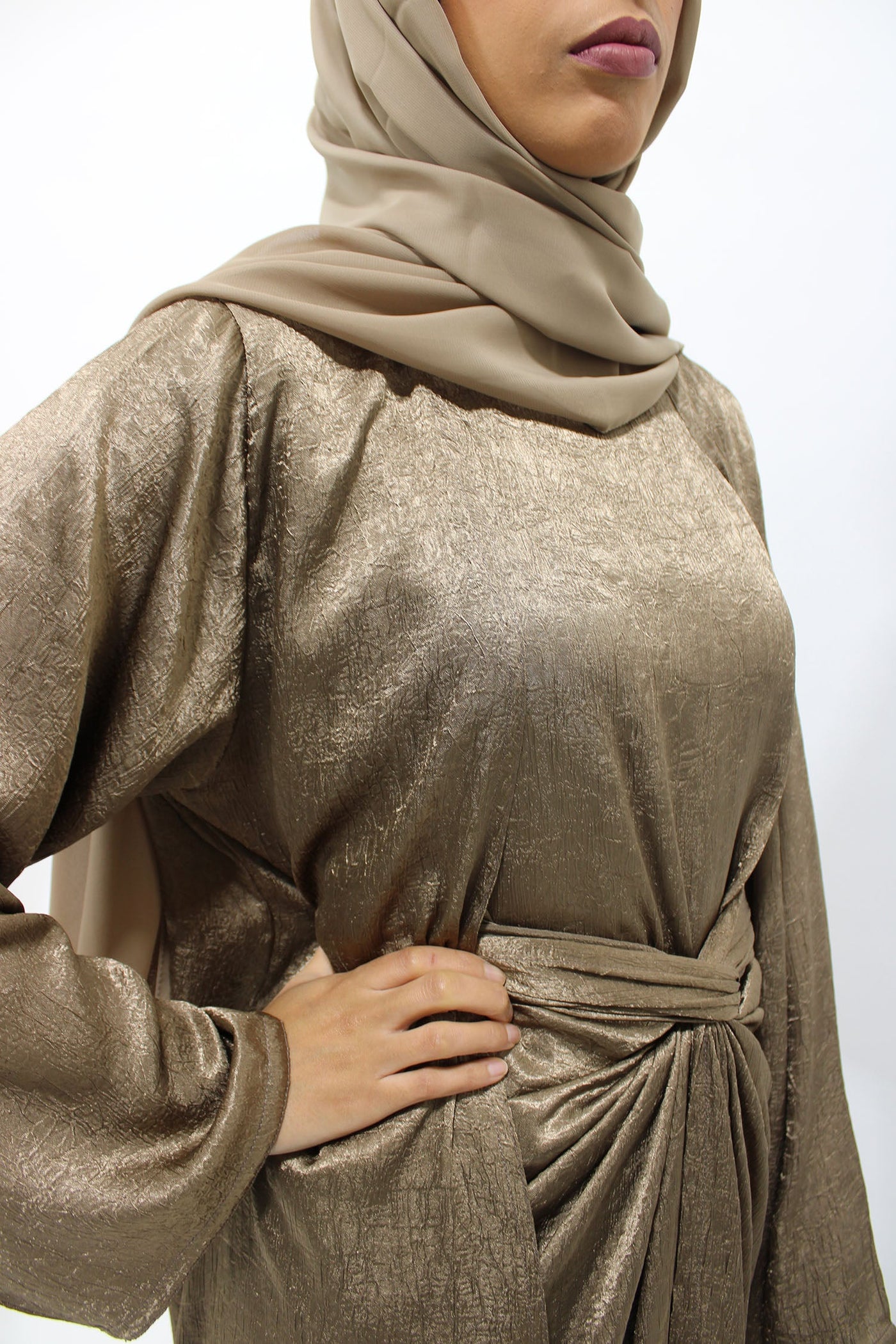
Why a Kimono Abaya Can Feel Effortless One Day and Far Too Open the Next
An open abaya can look beautifully settled while you are standing in front of a mirror. Then you walk outside, reach for a door, lift a bag onto your shoulder or turn into a gust of wind, and the whole shape behaves differently. That is the small reality behind a kimono abaya: the openness that gives it movement and elegance is also the part that needs the most thought.
The answer is not to make every open layer behave like a closed abaya. If that is what you want, there are garments designed for exactly that. A kimono-style abaya has its own appeal because the front can move, the sleeves often have a generous line and the outer layer can change the proportions of a simple dress underneath. The more useful question is whether that open shape still gives you the coverage, ease and steadiness you expected once you are actually living in it.
That depends on more than the outer robe. The inner layer matters. Front overlap matters. Sleeve openings matter. Hem length matters. A fastening that looks almost invisible can make the difference between an outfit you keep adjusting and one you forget about once you leave the house. Even embellishment changes the way the garment hangs, because embroidery, sequins or a heavier border can pull on a panel that looked weightless in a product photograph.
So this is about reading the whole outfit as one system. We will look at what people usually mean by a kimono abaya, how to build secure coverage underneath it, what to test while moving, how long and maxi lengths change the silhouette, and how simple, floral, embroidered, cape and occasion versions behave. If you want the wider picture of abaya shapes, fabrics and fit, the complete abaya guide gives you the broader foundation. Here, the focus stays on one particular tension: enjoying the grace of an open layer without spending the day trying to keep it in place.
The open front is the beauty of a kimono abaya, and also its responsibility
In modest-fashion shops, the term kimono abaya is usually used for an abaya whose outer shape borrows the visual idea of a loose, robe-like layer with an open or partially open front and generous sleeves. You may also see names such as kimono style abaya, abaya kimono or kimono style abayas. Retail terminology is not perfectly standard, so two garments sold under the same label can behave quite differently.
That distinction matters because the name alone cannot tell you how secure the garment will feel. One design may have broad front panels that overlap generously when you walk. Another may meet only at the centre and fall away with each stride. One may include a belt. Another may have hidden snaps. A third may be deliberately designed to remain completely open over a separate dress. All three can be called kimono-style abayas, but they need different styling decisions.
It is also worth keeping the terminology modest and accurate. A contemporary abaya described as “kimono style” is not the same garment as a traditional Japanese kimono, and there is no need to pretend the two are interchangeable. In this context, the word is functioning as a retail description for a certain loose, layered silhouette. If you have searched in French-language shops, phrases such as abaya et kimono or kimono et abaya may lead you to the same general family of open abaya layers, sets and robe-like designs.
The open front creates visual length because the two outer panels form vertical lines down the body. It can also make layering look deliberate rather than merely practical. A plain inner dress can become the quiet centre of the outfit while the outer abaya provides movement, texture or colour. That is why the style can feel so elegant without needing a complicated cut.
But openness changes what “coverage” means in practical terms. With a closed garment, the outer fabric itself is usually doing most of the work across the front. With an open abaya, the inner layer becomes visible by design. That means its neckline, sleeves, opacity, length and fit are not secondary details. They are part of the finished outfit.
This is where some purchases disappoint. A woman may choose a beautiful outer layer because the product image shows it hanging straight and calm, only to discover that the inner dress is shorter than expected, the front panels separate widely when she walks, or the sleeves expose much more of the forearm when she reaches forward. Nothing has necessarily “gone wrong” with the garment. The outfit simply needed to be judged as a moving layered look rather than as a still robe on a model.
Security, then, does not have to mean stiffness. It can come from sensible overlap, a dependable inner layer, a discreet closure at the point where you need it, and enough room that the garment falls back into place after movement. When those parts cooperate, the open front still looks open. You keep the fluidity that attracted you to the style in the first place, but you are not negotiating with it every few minutes.
Start with the inner layer, because that is what the open shape is trusting
If the outer abaya is designed to open, the inner layer is not an afterthought. It is the foundation. You should be able to take the outer panels in your hands, move them apart and still feel comfortable with what remains underneath. That simple test tells you far more than asking whether the outer layer “looks modest” while everything is perfectly arranged.
A long inner dress is the most straightforward option because it gives a continuous line from shoulder to hem. It can be especially useful when the outer abaya has wide sleeves, side openings or a front that moves freely. The inner dress does not need to be decorative. In fact, a simple, opaque base often lets an embroidered or floral outer layer look more considered because there is less visual competition underneath.
Fit deserves care here. An inner dress that is very close through the body can change the overall impression of an otherwise loose outer abaya whenever the front opens. If your own modesty preference is for a looser line, judge the inner dress on its own, not only under the robe. Walk in it, sit in it and look at the side view. Fabric that seems relaxed while standing may pull differently over the hips or knees once you move.
Length is equally important. A full-length outer layer over an inner dress that stops noticeably higher can create a broken hemline every time the front separates. That may be a deliberate styling choice for someone, but if your aim is a continuous maxi look, compare both garment lengths before leaving home. Shoes can alter that relationship as well, especially if one layer just grazes the floor and the other sits several centimetres higher.
Opacity should be checked independently. A dark colour is not proof of opacity, and a pale colour is not automatically sheer. Hold the fabric to strong natural light, then look again while it is being worn and gently stretched through movement. Sleeves can be made from a different textile from the body, and some inner dresses use lighter fabric because the designer assumes the outer layer will remain over them. If the abaya is meant to open, that assumption may not suit the way you plan to wear it.
You can also use separates underneath, but the same principle applies: the outfit should still make sense when the kimono layer moves. A loose top and a long skirt can work. Wide trousers with a sufficiently long top may work for your own styling preference. What matters is not copying one formula; it is knowing what will be visible from the front and sides and being content with it before the outer garment is added.
A three-piece set can simplify this because the designer may have coordinated the outer kimono, inner dress and belt as one look. Yet the words “three piece” do not guarantee that every component solves the same problem. Sometimes the third piece is a decorative tie rather than an extra coverage layer. Sometimes the inner slip has narrow straps or shorter sleeves because it was designed as a fashion base rather than a stand-alone modest dress. Read exactly what is included.
One useful home test is to dress in the inner layer first and spend ten minutes moving around before putting the abaya on. Reach for a high shelf. Sit on a chair. Bend to pick something up. Walk up and down a few stairs. If the base itself makes you uncomfortable, the outer layer is being asked to hide a problem rather than complete an outfit. A secure kimono abaya look begins underneath, where the movement of the front panels cannot undo it.
Do the movement test before you decide that the fit works
A mirror gives you one frame. Real life gives you hundreds. The most revealing fitting room for an open abaya is movement: walking at your normal speed, turning, sitting, using stairs, carrying something and reaching with both arms. These are ordinary actions, but they show where the fabric wants to travel when you are no longer arranging it.
Begin with a normal stride. Do not take tiny careful steps because you are testing a new garment. Watch how far the front panels separate and whether they fall back naturally after each step. If the opening climbs or swings outward much more than you expected, look at where the panels begin, how much fabric there is across the front and whether a fastening would help. Sometimes a belt placed too high can actually make the lower panels open more widely.
Next, sit without smoothing every layer first. A long kimono abaya may spread beautifully when you arrange it, yet slide from the knees or pull open across the lap during ordinary sitting. Notice where the outer panels land. If you want them to stay over the legs, you may need more overlap, a lower fastening or an inner dress that you are completely happy to have visible.
Stairs reveal another set of issues. A very long outer hem can catch under the heel or require one hand to lift it, while a wide sleeve may brush a rail. You should know in advance whether the garment expects more management than your day allows. That is especially relevant if you will be carrying a child, luggage, shopping or a work bag and cannot devote a free hand to arranging the abaya every few steps.
Reaching forward is one of the best sleeve tests. Kimono-inspired sleeves can be broad and elegant, but the opening may travel back toward the elbow as the arm rises. If you prefer full wrist coverage, check what happens when you reach for a door handle, pass something across a table or place a bag in an overhead space. A long-sleeved inner top or dress can quietly solve this without changing the outer silhouette.
Then look at the side view. Open abayas can reveal more at the side than they do from the front, particularly if the outer panels are cut straight and the inner garment is fitted. Turn your body rather than simply twisting your head toward the mirror. A phone video can be useful because it captures the garment while you walk naturally instead of holding a pose.
Wind is harder to recreate indoors, but you can still learn something by walking briskly or standing near a gentle fan. You do not need to create a dramatic test. You only want to know whether the panels are so light that the smallest air movement throws them behind you. If they are, the answer may be an inner layer you trust fully, a discreet closure, or choosing that particular abaya for calmer settings rather than assuming it will behave the same everywhere.
The test is not designed to make you suspicious of open clothing. It does the opposite. Once you know how the garment moves, you stop worrying about imagined problems. You can decide where you want a fastening, whether the sleeves need an underlayer, whether the hem needs shortening and how the inner dress should fit. Then the outfit becomes predictable, which is what makes it comfortable to wear outside the mirror.
A little fastening can create security without flattening the silhouette
People sometimes assume that securing an open abaya means belting it tightly or closing it from neckline to hem. It does not. Often the most effective change is much smaller: one discreet point of control where the garment naturally wants to separate.
A concealed snap near the upper chest can keep the two front panels from drifting apart while leaving the lower half free to move. A hook-and-eye can do a similar job if it is positioned where the fabric is not under strain. Some designs come with a small internal tie that prevents the front from sliding without being visible from outside. The right option depends on the construction and on how much of the inner layer you actually want to show.
Placement matters more than adding as many closures as possible. If a fastening sits too high, the panels may pull diagonally across the chest. If it sits at the waist on a very fluid robe, it can create a single tension point and make the fabric fan open below. Pin the garment temporarily at different heights at home and move around before committing to an alteration. You are looking for the point where the panels remain calm without losing their natural drop.
A belt gives a different effect. Worn loosely, it can bring the outer layer slightly inward while preserving a robe-like line. Worn tightly, it changes the silhouette more significantly and may define the waist in a way you did not intend. There is no need to treat a belt as compulsory simply because it arrived with the abaya. Try it, remove it and compare the movement both ways.
If you like the look of a fully open front, keep it. Security can come entirely from the inner dress and sleeve layers. The important thing is that the choice is deliberate. An outfit feels very different when the open front is exposing exactly what you planned to show rather than revealing a base garment you were relying on the outer robe to cover.
Alterations should also respect the fabric. A heavy snap can drag down a very lightweight panel. Repeated pinning can damage delicate material. Decorative edges may make it difficult to place a closure invisibly. If the abaya is embellished or made from a fabric that marks easily, ask someone experienced with that textile to add the fastening rather than experimenting on the finished garment.
The best closure is usually the one you stop noticing. It should let you move with less adjustment while leaving the kimono character intact. If the garment starts to look strained, pulled or overly cinched, the fastening is doing too much. The point is not to fight the open design. It is to give the design one or two quiet anchors so it can move without taking over your attention.
Long and maxi lengths need to be judged as two moving hems, not one
A long kimono abaya can create one of the most graceful versions of this silhouette because the outer panels draw the eye vertically and move behind the wearer as she walks. A maxi kimono abaya can feel similarly elegant, but “long” and “maxi” are retail descriptions rather than reliable measurements. Your height, shoes and the length of the inner garment decide what the finished line actually looks like.
Start by comparing the outer and inner hems while standing in the shoes you are likely to wear. If the outer abaya is slightly longer, it can frame the inner dress neatly. If it is much longer, you may spend the day lifting the robe while the inner layer remains clear of the ground. If the inner dress is longer, it can appear below the outer layer in a way that either looks intentionally layered or simply mismatched, depending on the fabrics and colours.
Walking changes the relationship. The outer panels can sweep backward while the inner dress stays closer to the legs. On stairs, the front edge of a kimono long abaya may drop forward just as your foot rises. This is why a hem that looks dramatic in a photograph can become awkward in everyday use. You want enough length for the line you like, but not so much that you have to monitor every step.
Check the back hem as well. Some open abayas have a little more length at the back or appear longer there because the front panels part as you walk. If the back catches under your shoe, shortening only the front will not solve the problem. Let a tailor see the garment on you with the intended footwear so the whole circumference can be assessed.
Proportion around the ankle matters visually too. If the outer layer ends several inches above a maxi inner dress, the outfit can look like two separate lengths competing. Sometimes that is a strong intentional look, especially when the fabrics contrast. If you want a quieter, continuous line, keep the hems closer. Neither is universally “right”; what matters is choosing rather than discovering the effect after you are outside.
Long sleeves should also be considered alongside the long hem. Very wide cuffs plus a sweeping skirt can create a lot of moving fabric. That can be lovely for an occasion, but for errands, work or travel you may prefer a cleaner cuff or a sleeve you can control more easily. A garment can still read as a kimono abaya without every proportion being maximised.
Try not to buy length based on model photography alone. If garment measurements are available, compare them with an abaya you already know. Measure from a consistent shoulder point and note the shoes you usually wear. A few minutes with a tape measure can tell you more than the word “maxi”, because the secure version of a long open abaya is the one that lets you walk naturally rather than shortening your stride to protect the hem.
A simple kimono abaya has nowhere to hide a poor cut
A plain or simple kimono abaya can look almost effortless. There may be no embroidery, no contrast trim and no obvious decoration. That simplicity puts more pressure on the cut. If the shoulder line is awkward, the front panels twist or the hem is uneven, there is nothing else for the eye to focus on.
This makes plain designs especially useful for learning what you actually like. Look at how the neckline lies. Do the fronts fall straight, or do they roll outward? Does the fabric collapse nicely from the shoulder, or does it cling to the inner dress? Do the sleeves hang evenly when your arms are relaxed? A simple design turns construction into the main feature.
Weight matters. Very light fabric can create airy movement, but it may also blow open more easily and reveal the outline or colour of the inner layer whenever it lifts. A heavier fabric may hang more steadily, yet feel warmer or less fluid. There is no universal best fabric weight. Think about the setting and how much movement you enjoy.
Colour relationships become more visible in simple styles as well. A tonal inner dress can make the outfit read almost like one continuous garment. A contrasting base emphasises the open front and makes the kimono structure more obvious. If you prefer the open shape to look quieter, keep the inner and outer shades close enough that the front separation does not become the first thing people notice.
Minimal designs can also be very forgiving across different occasions because there is less visual information tying them to one setting. The same outer abaya may work over a restrained base for daytime and over a more polished inner dress for an evening visit. That versatility is useful, but only if the garment itself moves well. Do not let “simple” become shorthand for “anything will do”.
One of the strongest checks is to wear the abaya without a belt or accessories and see whether you still like it. If the front falls well, the sleeves sit properly and the proportions feel calm, you have a good foundation. Styling can then add something. If the garment only looks right after aggressive pinning, cinching and arranging, the simplicity is creating more work than it appears to.
A well-cut plain kimono abaya feels quiet because the lines are doing their job. You should not need embroidery to distract from a twisting front, or a belt to rescue panels that refuse to hang. When the construction is right, simplicity makes the open shape clearer and often easier to secure.
Embroidery, flowers and rose details change how the panels fall
An embroidered kimono abaya can be striking because the decoration has room to travel down a large sleeve, frame the front edge or sit across the back without needing a fitted silhouette. But embroidery adds more than visual detail. It can add weight and stiffness in specific areas, which changes how the outer layer moves.
Imagine two otherwise similar front panels. One is plain and light from top to bottom. The other has dense embroidery running along the edge. The decorated panel may hang more firmly and resist blowing open, which can be useful. It may also pull forward, curl at the border or swing more heavily as you walk. You need to see the finished garment move rather than assuming embellishment is purely decorative.
Floral designs deserve the same practical reading. A floral kimono abaya may use printed flowers, woven motifs, appliqué or embroidery. A print adds almost no physical weight, while raised flowers can change the drape considerably. If the design is concentrated on one side, look for visual and physical balance. If it sits around the cuffs, check whether it catches on handbag hardware or jewellery.
Rose designs are often simply one direction within floral styling. Searches for an abaya kimono rose or kimono abaya rose may refer to a pink or rose-coloured garment, a rose motif, or both. Product names are not always precise. Look at the photographs and fabric description rather than assuming the word “rose” tells you whether you are choosing colour, pattern or embroidery.
With any decorated open abaya, the inner layer should usually give the eye somewhere to rest. If the outer panels are heavily embroidered and the inner dress also has a strong print, both layers can compete whenever the robe opens. A simpler base lets the decoration frame the body instead of filling every visible surface.
Placement affects modest styling too. Embroidery that runs down the vertical edges can emphasise the opening. That can look elegant, but it means the inner dress becomes an even more visible part of the design. Embroidery clustered at the shoulders or cuffs keeps the centre quieter. Neither is inherently better; it depends on what you want the eye to notice.
Check the reverse side of dense embroidery if you can. Threads, knots or backing can rub against the inner dress, particularly if the outer fabric is unlined. Raised work can also snag delicate chiffon or satin bases. If you plan to wear the abaya frequently, choose an inner layer that will tolerate contact rather than saving a fragile dress for underneath and hoping the two fabrics never catch.
Care becomes more specific once decoration is involved. Do not assume every embroidered or floral abaya can be washed or pressed like a plain one. Follow the garment’s own care instructions. If the embellishment is delicate, storage matters as much as washing; crowded hangers can crush raised flowers or catch sequins. This is one reason to decide how often you expect to wear the garment before choosing very elaborate work.
The secure version of an embellished kimono abaya is not necessarily the least decorated one. It is the one whose decoration has been considered as part of the construction. The border should not drag the neckline out of place, the cuffs should not become difficult to use, and the open front should still settle after movement. Beauty works better when the garment is not fighting its own details.
Sequins and soirée styling need restraint at the opening
An abaya kimono soirée or kimono abaya chic usually points toward a dressier version of the open silhouette: perhaps more sheen, decorative edging, embroidery, sequins or a coordinated inner layer. The open front can suit an evening look beautifully because it lets the inner dress become part of the composition. That also makes secure layering more important, not less.
A sequin abaya kimono can carry more physical weight than a plain robe, especially if sequins cover broad areas rather than a narrow border. That weight may help the panels hang, but it can also pull at the shoulders or make the sleeves tiring over several hours. Try the garment for long enough to notice whether the decoration feels heavier after ten or fifteen minutes than it did when you first put it on.
Sequins near the front opening can catch against each other as the panels cross. They can also catch a delicate inner fabric. Rub the two layers together gently with your hands before committing to the combination. If you hear or feel snagging, use a smoother base or keep the embellished abaya for an outfit where the inner dress is less vulnerable.
For an evening setting, it is easy to assume that more detail will make the outfit more special. Often the open silhouette already gives you enough drama. A strong border, an embroidered sleeve or a refined inner dress may be sufficient. If the hijab, bag, shoes, belt and outer layer are all competing with the same level of sparkle, the kimono shape can disappear under decoration.
Security is particularly useful in social settings because you are likely to be greeting people, sitting at tables, moving between rooms and carrying a bag or coat. If you know the front swings open much more than you like, add the discreet closure before the event rather than relying on careful posture all evening. You should be able to turn toward someone without first arranging the robe.
It is fine for a dressier kimono abaya to be less practical than your everyday one. Occasion clothing can ask for a little more care. The limit is when the garment requires constant supervision. A beautiful outer layer should still let you eat, sit, walk and greet people without every movement becoming a styling task.
Keep the boundary clear too: choosing an embellished kimono abaya is about how this open construction behaves in a smarter setting. It does not mean every party, Eid, wedding or formal occasion needs the same advice. Those occasions have their own needs. Here, the useful lesson is narrower: the more visual weight you add to an open front, the more carefully you should check how that weight changes the fall, the inner layer and the places where fabric can catch.
Cape-style kimono shapes need a different sleeve test
A cape kimono abaya can sit somewhere between a traditional wide-sleeved robe and a cape-like outer layer. The arm may emerge through a slit or opening rather than a conventional sleeve seam, or the garment may use very broad panels that create a cape impression when the arms are lowered. It is a beautiful shape, but the movement test changes.
Instead of looking only at cuff width, check what happens to the side of the body when you lift your arms. Some cape cuts rise as one large panel, which can expose more of the inner layer at the side. That is not necessarily a problem if the base is designed for it. It simply means the inner sleeves and side coverage are doing more work than they would under a standard abaya sleeve.
Carry a bag during the fitting. A shoulder strap can pull a cape panel backward, while a cross-body strap can flatten or distort the front. A small handheld bag may suit the shape better for some outings, but you should not have to redesign your life around one garment. If you normally carry a large tote, test the abaya with that tote.
Coats are another practical question. A very wide cape construction may not sit comfortably under a fitted outer coat. If you live somewhere that requires another layer for part of the year, try the combination rather than assuming the widths will cooperate. This article is not about winter abayas, but ordinary British weather still makes outerwear compatibility worth checking.
When a cape kimono falls well, it can create generous coverage with very little visual fuss. The trick is understanding where the arm opening changes the garment. Look from the front, side and back while reaching. If the base layer remains exactly what you are happy to show, the dramatic sleeve shape becomes much easier to enjoy.
Three-piece kimono abaya sets are only convenient when every piece earns its place
The phrase abaya kimono 3 pieces can describe several arrangements. A common idea is an open outer kimono, a long inner dress and a belt or tie. Another set may include an outer abaya, separate top and skirt. Retailers may count pieces differently, so never assume the photograph tells you exactly what arrives.
Read the list of included items. Does the inner dress have sleeves? Is the belt detachable? Is the inner layer full length? Are the colours identical or intentionally tonal? Does the outer abaya close anywhere, or is the belt the only way to bring it together? These questions matter because the set may have been photographed in a way that hides the practical differences.
Then judge each piece alone. If the inner dress would make you uncomfortable without the outer robe, recognise that before buying. You may still love the set and intend always to wear the pieces together, but that should be a conscious decision. An open front will reveal more of the inner dress every time you move, so it needs to meet the standards you are relying on it to carry.
The belt can be useful, but it should not be treated as structural unless the garment was designed that way. A narrow tie can shift, loosen or create bunching at the back. Try sitting with it fastened. Try wearing the outer layer without it. If the whole outfit stops working the moment the belt moves, you may want a discreet internal closure as well.
Colour matching is another advantage of a set, but small shade differences are normal when pieces use different fabrics. A matte inner dress and a satin-finish outer layer can reflect light differently even if they were dyed to coordinate. Look at the set in daylight and indoor light. A slight tonal difference can look intentional; an unexpected mismatch is easier to judge before the return period is gone.
Three pieces can also create more care work. Check whether all components have the same care instructions. A decorated outer layer may need gentler treatment than the plain inner dress. If a belt has embellishment, do not throw it into a wash simply because the inner layer can be washed that way.
A good set saves decisions because the pieces already cooperate. A poor set simply bundles three garments together. The useful question is not “Do I get three pieces?” but “Do these three pieces make the open kimono shape easier to wear?” If the inner dress gives dependable coverage, the outer layer hangs properly and the belt is optional rather than desperate, the set has done its job.
Shopping online means looking for evidence the studio photograph cannot give you
Studio photography is designed to show a garment at its most attractive. The model is positioned, the fabric is arranged, the lighting is controlled and the strongest angle is usually shown first. None of that is dishonest by itself, but an open abaya needs more evidence than a beautiful front view.
Look for side and back photographs. A front panel that seems generous from one angle may be narrow when seen in profile. A back view can show whether the outer layer has enough width across the shoulders and hips to fall cleanly. A walking video is especially useful because you can see how quickly the panels separate and whether they settle again.
Find the actual garment length if it is provided. Compare it with your own abaya rather than only with the model’s height, because shoulder position, body proportions and shoes all affect where the hem finishes. Sleeve length and sleeve opening are equally useful measurements for a kimono cut.
Read the closure description carefully. Words such as “open abaya” usually tell you something important, but do not assume there are no snaps just because the styling photograph shows the robe open. Conversely, do not assume a visible belt means there is also an internal fastening. If the listing is unclear and the detail matters to you, ask before ordering.
Check what the inner garment is doing in the photographs. Is it part of the product, or simply styling? If a listing says “abaya only”, the dress underneath may not be included. If it is sold as a set, inspect the description for the exact pieces. This is particularly important with embroidered and occasion kimono abayas, where a coordinated inner dress can make the photograph look like one garment even though it is separate.
Fabric description helps, but treat it as a starting point rather than a guarantee of behaviour. Two garments described with the same broad fabric name can differ in weight, opacity and drape. Video, close-up photographs, lining information and customer measurements where legitimately available can add context. If opacity is essential and the listing does not show it clearly, build that uncertainty into your decision.
Returns matter because fit is difficult to prove from a screen. Read the current policy before ordering and keep a copy of the relevant listing details. If you need an alteration, make sure you are keeping the garment before changing it. Hemming, adding snaps or adjusting sleeves can affect your ability to return an item.
Do not be distracted by a long product name. “Muslim kimono abaya”, “kimono abaya dress”, “abaya model kimono” and similar labels may all be retailer ways of describing the same general silhouette. The useful information sits underneath the name: Is it open? What is included? How long is it? How wide are the front panels? What are the sleeves like? Is there a closure? Is the base layer opaque? Those answers tell you how the garment will behave.
If the listing cannot answer the points that matter to you, walking away is a reasonable choice. You do not need to gamble because the photograph is lovely. A secure open abaya is easier to buy when the seller gives enough construction information for you to imagine the garment moving, not just hanging.
If you sew or alter one, put security into the pattern before you put it into the styling
Some searches for patron abaya kimono are looking for a sewing pattern rather than a finished garment. If you are making your own or altering an existing open abaya, you have an advantage: you can build the behaviour you want into the cut instead of trying to correct everything afterwards.
Front overlap is the obvious starting point. Decide how much of the inner dress you want visible while standing and while walking. A paper pattern can look generous when the two fronts are laid flat, but seam allowances, facings and the way fabric rolls at the edge can reduce the effective overlap. Make a test version or pin the garment in inexpensive fabric before cutting anything precious.
Shoulder fit controls more than people expect. If the shoulder or upper body is too narrow, the front panels can be pulled outward and refuse to hang vertically. If it is excessively wide, the neckline may shift and the sleeves may drop lower than intended. A loose kimono silhouette still needs enough structure at the upper body to keep the fronts where you designed them.
Think about the sleeve opening as a coverage decision. A very wide sleeve gives dramatic movement, but it also exposes more of the inner sleeve when the arm lifts. If that is part of the plan, excellent. If you want the outer sleeve itself to remain closer to the wrist, reduce the opening or shape the cuff rather than relying on styling to control it later.
Facings and edge finishes matter because an open front is always visible. A poorly stabilised edge can roll outward, ripple or stretch. That affects both appearance and security. Choose the finish according to the fabric and your skill level. If the textile is slippery, delicate or heavily embellished, practise on scraps before applying heat, interfacing or stitching to the main garment.
Place closure points during a fitting, not from a generic measurement chart. Bodies differ, and the most useful snap or tie position depends on where the fabric wants to separate on you. Pin the closure temporarily, walk, sit and reach, then adjust. One well-placed fastening can be more effective than several added because a pattern told you where they “should” go.
Hem sweep should support your stride. If the outer abaya is very narrow at the bottom, closing it more securely at the top may restrict movement or force the fronts apart lower down. If it is very wide, the extra sweep can be graceful but needs careful length control. The pattern should make room for the way you walk rather than asking you to change your gait.
If you are taking a ready-made abaya to a tailor, bring the inner dress and shoes you intend to use. Explain how open you want the front to remain and show where it feels insecure in motion. “Make it more closed” is less useful than demonstrating that the panel flies back at the chest, the sleeve exposes the forearm or the hem catches on stairs. Specific behaviour leads to a better alteration.
The goal of sewing security into the garment is freedom from last-minute fixes. Pins, brooches and belts can still be styling choices, but they should not be the only thing preventing a design problem. When the pattern understands the open shape, the finished kimono abaya moves with far less negotiation.
Your bag, coat and ordinary belongings can change the silhouette more than accessories do
It is easy to style a kimono abaya in isolation and then add real life afterwards. A handbag goes over the shoulder, a coat appears because it is raining, a child wants to be carried, shopping fills one hand, and suddenly the open panels are being pulled in directions they never experienced in the mirror.
Shoulder bags are particularly revealing. The strap can trap one side of the abaya while the other side continues moving freely, making the front look uneven and opening one panel more than the other. Try the bag on both shoulders. If one side consistently drags, a shorter handle, cross-body position under the outer layer, or handheld bag may work better depending on the outfit and your preference.
Cross-body bags placed over the abaya can cut diagonally across the front and define the body more than you expected. They may also push the robe open where the strap crosses. Wearing the bag underneath the outer layer can preserve the silhouette, but then you need easy access. There is no single correct choice; the point is to see the effect before you are halfway through a journey.
Coats can compress wide sleeves. A normal sleeve may fit comfortably over a simple kimono cut but struggle over a very broad or cape-like version. If you are buying for year-round use in Britain, check the outermost layer too. The abaya can be beautiful indoors and still be a poor choice for a day when you have to wrestle it into a fitted coat.
Backpacks create their own pattern. Two straps can pull the shoulder seams backward and encourage the front panels to sit farther apart. If you travel or commute with a backpack, test it. The elegant open shape should not exist only for days when you carry nothing.
Children, luggage and shopping matter because they occupy your hands. If the abaya needs one hand at the front whenever the wind changes, it may not be the practical option for those particular outings. That does not make the garment a bad purchase. It simply helps you match different versions to different parts of your life.
A good everyday kimono abaya recovers after interference. You take off the bag, release the coat or put the shopping down, and the panels settle back without a full rearrangement. That ability to recover is one of the best signs that the cut, inner layer and fastening plan are working together.
Everyday styling works best when the outer layer is allowed to be the interesting part
For an ordinary day, the easiest formula is often the least complicated: a dependable long inner layer, a kimono abaya that moves well, practical footwear and a hijab that does not compete with the robe. This gives the open front somewhere calm to land visually and physically.
If the outer abaya is plain, the inner dress can carry a little texture or a gentle tonal difference. If the outer layer is floral or embroidered, keep the base quieter. This is not a rule about colour; it is about giving the eye a hierarchy. The outfit feels more settled when one layer leads and the other supports it.
At work or during a long visit, think about sitting. A belt that looks polished while standing may become uncomfortable at a desk or table. Try tying it more loosely or removing it. A hidden snap can keep the upper front secure while the lower panels remain open enough for comfortable sitting. You do not need the same closure arrangement for every setting.
For errands, pockets can matter more than embellishment. If the kimono abaya has pockets, check whether using them pulls the front backward or makes the fabric sag. If it has none, consider where your phone and keys will go. An outfit is easier to wear when small practical needs have been solved before you step outside.
For travel, choose the version that survives being seated for longer periods and carried through busy spaces. Very wide sleeves can catch. A trailing hem can become tiring. Heavy embroidery can press under a seat belt or bag strap. A simpler long kimono abaya with a secure inner dress may preserve the look you like while asking much less from you.
For a family meal or evening visit, you can add more texture without rebuilding the whole outfit. Change the inner dress, use a more refined hijab fabric, or choose the embroidered outer layer instead of the plain one. The principle stays the same: the open garment should remain secure enough that you can participate in the evening rather than managing it.
One of the pleasures of this silhouette is that it can make a familiar base dress feel different. That can be more useful than collecting many complete outfits. But versatility only works when the base garments genuinely cooperate. If every outer abaya needs a unique inner dress because lengths, sleeves and closures never match, the wardrobe becomes more complicated rather than less.
Build around two or three base layers you already trust. Then judge new kimono abayas against them. Does the hem relationship work? Do the colours sit well? Are the inner sleeves right for the cuff? Does the neckline remain comfortable? A wardrobe becomes easier when new pieces have to pass an existing real-life test instead of creating a fresh set of problems.
Modesty feels calmer when you decide your non-negotiables before styling begins
There is no benefit in pretending every Muslim woman will make identical clothing choices. Personal practice, scholarly guidance, family context and individual comfort can differ. What helps in a practical article is being clear about the garment and encouraging you to know what you need from it.
Before choosing an open abaya, write down the parts you do not want to negotiate. Perhaps you need an opaque inner layer from neck to ankle. Perhaps you want full sleeves underneath any wide outer cuff. Perhaps you do not want the waist defined by a belt. Perhaps the front can be completely open as long as the base dress is loose. Your list may be different from another woman’s, and that is exactly why it should be decided before the product photograph starts persuading you.
Then separate those non-negotiables from preferences. Colour can often change. Embroidery can be lighter or heavier. A belt can be removed. A hem can sometimes be shortened. But if the entire construction depends on a fitted inner dress and that does not suit you, no amount of styling enthusiasm will turn it into the right outfit.
This approach also makes shopping less emotional. Instead of asking, “Can I make this work somehow?”, you can ask direct questions. Is the inner dress included and appropriate for me? Do the sleeves cover the way I need? Is the front overlap sufficient? Can a discreet fastening be added? Does the hem work with my height? If the answer is no on a point that matters deeply to you, you have useful information rather than a styling failure.
Prayer is another area where it helps to distinguish an outfit from a garment chosen specifically for salah. An open kimono layer over a suitable base may work within some women’s practical routines, but do not assume a fashion abaya automatically answers every prayer-clothing need. If you are choosing something specifically for salah, keep that function at the centre and assess the prayer garment on its own coverage and movement rather than treating it as an afterthought to the outfit.
The quieter benefit of knowing your own requirements is that you stop overcorrecting in public. You are less likely to spend the day tugging a panel closed because you already decided what can show underneath it. You are less likely to keep tightening a belt because you chose a closure that actually works. You are less likely to worry about a wide sleeve because the inner sleeve was part of the plan.
That sense of security does not come from making the garment motionless. Clothes move because people move. It comes from knowing that the outfit still makes sense when it does. A kimono abaya can open, swing and settle without becoming a source of anxiety when the layers underneath and the construction around them have been chosen deliberately.
There is a difference between graceful movement and fabric that controls your day
Movement is one of the reasons women are drawn to this shape. A long front panel lifting slightly as you turn can look graceful. A wide sleeve falling back as you raise your hand can show the architecture of the garment. The problem begins when every movement requires a correction.
Notice how often you touch the abaya during a home trial. Do you keep pulling the fronts together? Are you repeatedly lifting the sleeve back over your wrist? Do you have to straighten the shoulder after carrying a bag? Are you stepping on the hem? You do not need to count obsessively. The pattern will become obvious.
If one issue repeats, solve that issue rather than layering fixes everywhere. Front movement may need a snap. Wrist exposure may need an inner sleeve. Hem trouble may need shortening. A sliding shoulder may indicate that the cut or bag combination is wrong. A clear problem usually has a clearer solution than a collection of pins and belts added because the outfit feels generally insecure.
Fabric can also create false alarms. A very light panel may flutter but still return to position immediately. That can be perfectly comfortable when the inner layer is secure. A heavier panel may move less but pull steadily to one side because of decoration or an uneven bag. Security is not simply “less movement”. It is predictable movement that you are comfortable with.
Static can make layers cling. A smooth outer fabric may attach itself to the inner dress, especially in dry indoor environments, and the elegant separate panels suddenly behave like one crumpled layer. Follow the care guidance for both garments and test the combination before an important outing. Sometimes changing the inner fabric solves more than changing the abaya.
Friction can do the opposite. A textured outer layer over a textured inner dress may resist sliding, causing one garment to drag the other as you walk. The look may appear fine for a photograph but feel stiff in motion. Pairing fabrics is therefore partly visual and partly mechanical.
You should be able to forget the garment for stretches of time. That is a surprisingly good standard. A secure kimono abaya still catches light, moves around the legs and shows its open construction, but it does not keep asking for your hands. When you can carry a conversation, walk through a shop or sit through a meal without thinking about the front panels, the styling has moved from attractive to genuinely wearable.
Use one practical table to judge the whole outfit before you leave home
| Part of the outfit | What can change once you move | What to check at home |
|---|---|---|
| Inner dress or base layer | The open front reveals more of its fit, opacity and length. | Walk, sit and turn in the base layer before adding the outer abaya. |
| Front panels | They may separate, twist or blow backward. | Take a normal stride, sit without arranging the robe and test one discreet fastening point if needed. |
| Wide sleeves | The cuff can travel toward the elbow when the arm rises. | Reach forward and overhead with the inner sleeve you intend to wear. |
| Long or maxi hem | The front can catch on stairs while the back can sit under the heel. | Wear your real shoes and walk on level ground and steps. |
| Belt or tie | It can loosen, bunch the back or make the lower panels fan open. | Sit, stand and walk both with and without it. |
| Embroidery or sequins | Added weight can pull edges and raised details can catch the inner fabric. | Check panel balance, sleeve comfort and friction between the two layers. |
| Bag or coat | Straps and fitted sleeves can drag the kimono shape out of place. | Put on the actual bag and outerwear you use in real life. |
This kind of check is useful because it keeps the decision specific. You are not asking whether the abaya is “good” in some abstract sense. You are asking what each moving part does in the outfit you intend to wear. A garment can fail one row and still be worth keeping if the solution is simple. It can also look spectacular and still be wrong for your life if several rows require constant management.
Choose the kimono abaya that settles back into place
The best open abaya is not the one that never moves. That would miss the character of the style. It is the one that moves and then settles. The front parts when you walk and returns without help. The sleeve opens as you reach and the inner layer quietly keeps the coverage you wanted. The hem has enough sweep to look graceful but not enough excess to control your stride.
That is why security begins before accessories. It begins with a reliable inner dress, enough ease, sensible length and a front construction you understand. A snap, tie or loose belt can refine those things, but it cannot replace them. Embroidery, flowers, sequins and cape sleeves can all make the garment more expressive, provided they do not make the open shape harder to live in.
If you are shopping, look past the first photograph and ask for evidence of movement, measurements, included pieces and closures. If you already own the abaya, wear it at home with the exact inner layer, bag and shoes you plan to use. The ten minutes you spend testing it are far more valuable than an hour spent trying to imagine whether it will behave outside.
You can also stop worrying about making an open abaya look permanently closed. That is not its job. Let it keep the vertical lines, the layered effect and the movement that made you choose it. Your job is simply to make sure that when it opens, what is underneath is exactly what you meant to be there.
If you are ready to compare those details against real silhouettes, you can shop related styles after you have decided what you need from the inner layer, sleeves, length and opening. That makes the collection easier to read because you are judging each abaya against your own practical requirements rather than only against the first photograph.
A kimono abaya feels most elegant when you are no longer performing elegance for the garment. You are walking normally, sitting normally, carrying what you need and letting the fabric follow. If the shape still feels secure in those ordinary moments, the open front has done what it was supposed to do: add grace to your outfit without taking peace away from your day.