Fabric Care Guide for Abayas, Hijabs and Modest Wear
Bismillah. I have learned that caring for modest clothing is rarely only about keeping fabric looking new. An abaya may be the garment a sister reaches for before work, a khimar may be the piece that helps her leave home without overthinking, and a prayer dress may wait quietly beside the place where she prays. When those garments shrink, fade, snag or hold an odour, the loss can feel more personal than a damaged ordinary top. Good fabric care protects money, confidence, routine and the small sense of ease a dependable wardrobe gives.
I also know how confusing laundry advice can become. One label says gentle wash, another says dry clean, and an online video insists that every abaya should be hand washed in cold water. Fabric names are not always used consistently, trims may need gentler treatment than the main cloth, and a garment sold in two colours may behave differently because dark dye, pale lining or metallic print changes the safest method. That is why I will never give one dramatic rule for every modest garment.
My first rule is always the same: read the sewn care label and follow the most cautious instruction attached to the actual garment. The label is more important than a general article, a familiar fabric name or the routine that worked for another piece. This guide helps you understand the decisions around that label. It explains washing, drying, steaming, stain care, storage and repair for abayas, hijabs, khimars, jilbabs and prayer wear, while keeping the garment-specific instruction in first place.
I have written this in the first person because fabric care is learned through attention. I notice what happens when a long hem stays damp, when a jersey scarf is stretched over a hanger, when satin is pressed too hot, or when beads strike the drum of a washing machine. I do not mean that every garment will react identically. I mean that careful habits allow us to see risk before damage becomes permanent.
This is practical clothing guidance, not chemical, medical or professional textile-cleaning advice. Persistent skin reactions, mould exposure, hazardous stains and specialist conservation belong with the appropriate professional. When a label requires professional cleaning, choose a cleaner who understands delicate and embellished garments. My role here is to help you ask better questions and care more calmly.
The first rule of fabric care: read the label before doing anything
A care label is not decorative paperwork. It is the closest thing the garment has to a set of operating instructions. The symbols communicate the most severe washing, bleaching, drying, ironing and professional-cleaning treatments that should not cause irreversible damage when the item is cared for correctly. That wording matters. A label may permit a treatment without promising that every colour, embellishment or careless machine load will remain perfect.
I read the entire label before the first wash. I look for fibre content, wash temperature, cycle, bleach restriction, drying method, ironing temperature and professional-cleaning symbol. I also check whether the garment has a separate label for a detachable belt, scarf, slip, embellishment or lining. In a three-piece set, the three pieces may not share the same safest method.
When the written product description and sewn label disagree, I pause. I photograph both and ask the retailer before washing. Washing first and questioning later can remove the evidence needed to assess a genuine description or manufacturing problem.
A missing or unreadable label requires caution. I do not guess from appearance alone. Polyester satin can look like silk, viscose can resemble cotton, and trade names such as nida or Medina silk may describe different compositions across suppliers. I test an unseen area, begin with the least aggressive reasonable method, or consult a professional cleaner when the garment is valuable or complex.
How I read the main laundry symbols
The wash tub relates to washing. A number usually indicates the maximum temperature, while lines beneath the tub indicate gentler mechanical action. A hand in the tub means hand wash. A crossed-out tub means do not wash. I do not turn a maximum temperature into a target. When the label permits 30 degrees, a cooler suitable wash may still be sensible, but the detergent and machine must work effectively at that setting.
The triangle relates to bleaching. A crossed-out triangle means do not bleach. Because bleach instructions can distinguish chlorine from non-chlorine products, I check the exact symbol rather than assuming an oxygen stain remover is harmless. Delicate dye, metallic print, elastane and embellishment can all react badly.
The square covers drying. A circle inside the square refers to tumble drying, while other marks indicate natural drying methods such as line drying, drip drying or drying flat. The dots inside a tumble-dry symbol relate to heat. A crossed-out tumble-dry symbol is not a suggestion to use the lowest setting. It means keep the garment out of the dryer.
The iron symbol gives the maximum pressing temperature. Dots indicate heat level. A crossed-out iron means do not iron. Some labels also restrict steam. I never use the highest heat simply because an iron heats faster. Shine marks, melted fibres and flattened texture can appear before the whole garment looks scorched.
The circle relates to professional textile care. Letters and bars inside or beneath it guide the cleaner. When I take a garment for professional cleaning, I show the label and point out stains, loose embellishment and any previous colour change. I do not assume that the word dry clean means every solvent and process is suitable.
Make a care record before the first wash
For an important garment, I create a simple care record. I photograph the front, back, label, embellishment and any existing mark. I note the purchase date, fabric description, colour and whether the item includes separate pieces. This takes a few minutes and prevents uncertainty later.
After the first wash, I record the method and result. Did the hem change length? Did the colour release into the water? Did the face opening stretch? Did the satin develop water marks? A short factual note becomes far more useful than relying on memory six months later.
I especially recommend this for black abayas, pale occasion pieces, coordinated sets and garments shared between sisters or family members. A care record helps everyone use the same safe method. It also stops a successful routine for one garment being copied automatically onto another that only looks similar.
The record is not an attempt to make laundry clinical. It gives me confidence. Once I know that a garment washes well in a mesh bag on the labelled gentle cycle and dries correctly on a wide hanger, I do not need to feel anxious each time.
Know the whole garment, not only the main fabric
A garment may combine polyester body fabric, cotton lace, elastane cuffs, metallic thread, plastic beads, glue, elastic, interfacing and a different lining. The most delicate component often determines the safest method. A robust body cloth does not protect a glued crystal from heat or a loose bead from machine action.
I inspect zips, poppers, hooks, buttons, ties, embroidery, sequins, stones, lace edges and foil print. I turn the item inside out and look at the backing. Dense embroidery can become heavy when wet. Beadwork may be attached by thread, glue or both. An applique may have an adhesive layer that dislikes heat.
In a set, I ask whether the pieces can be washed together. A dark abaya and pale scarf may transfer colour. A heavy robe may twist a delicate khimar. A belt with metal hardware may strike and snag the other pieces. Coordinated colour does not mean coordinated care.
When one trim appears unstable, I repair it before washing. A loose bead or open seam does not become safer in water. Small preparation protects the surrounding fabric from a much larger tear.
Sort laundry by more than colour
Colour sorting is useful, but I also sort by weight, texture, soil level and construction. I do not wash a chiffon hijab with towels, denim or clothing covered in rough zips. The heavy items create abrasion and can pull delicate edges. I keep heavily soiled outdoor hems away from lightly worn scarves that sit against the face.
Dark colours, pale colours and strong new dyes usually need separation, especially for early washes. I am particularly cautious with black, burgundy, navy, deep green and vivid print. A colour-catcher sheet may show dye release, but it does not replace sensible sorting or guarantee that transfer cannot occur.
I separate lint producers from smooth dark fabrics. Towels and fleece can leave fibres across black abayas and jersey hijabs. I also avoid crowding the drum. A long modest garment needs enough water and room to move without twisting around several other pieces.
When in doubt, I make the load smaller. Fabric care is not improved by forcing one more abaya into a machine that is already full.
Prepare every garment before washing
I empty pockets, remove detachable belts and close the fastenings that the label or construction suggests should be closed. Zips are usually closed so their teeth do not catch. Hooks and hook-and-loop tape need securing so they cannot attack delicate fabric. Buttons may be left less stressed depending on the design, but loose buttons should be repaired first.
I loosen knots and ties. A wet knot can tighten and crease permanently. I unroll cuffs and inspect underarms, neckline, makeup areas and hems for stains. Pretreating only the marked area can be gentler than repeating a whole wash.
I turn many dark, printed or embellished garments inside out to reduce surface abrasion, but I still follow the label. I place delicate scarves, lace sleeves and small items into separate mesh bags. The bag should be large enough for the item to move. A tightly packed mesh bag becomes a compressed bundle that rinses poorly.
I remove pins and magnets completely. A hidden pin can damage the garment, machine and the person handling laundry. Magnets can attach themselves to metal parts or trap fabric. They belong in a separate closed container.
Choose detergent with restraint
More detergent does not mean cleaner clothing. Excess product can remain in long, full garments, leave stiffness, hold odour and irritate skin. I use the amount recommended for the load size, water hardness and soil level, then reduce unnecessary product rather than adding fragrance to cover residue.
Liquid detergent can dissolve easily in cooler washes, while powder can be effective for certain soils and white laundry. Biological detergent contains enzymes that can help with protein and food stains, but it may not suit every delicate fibre or sensitive wearer. Non-biological detergent removes that enzyme question but is not automatically fragrance-free or universally gentler.
For wool and silk, I use a product specifically suitable for the fibre when the label permits washing. Ordinary enzyme detergent can damage protein fibres. For sensitive skin, I look beyond the word gentle and check fragrance, dye and ingredient information.
I never mix cleaning chemicals casually. Bleach, acids, ammonia-containing products and other agents can create hazardous reactions. When a stain needs chemistry beyond a mild labelled treatment, I stop and seek professional advice.
Fabric conditioner is not always kindness
Fabric conditioner can make some garments feel softer and reduce static, but it also coats fibres. That coating can affect absorbency, breathability, stretch recovery and the performance of some technical or prayer garments. It can leave fragrance close to the face and may contribute to residue.
I do not add conditioner automatically. I read the label and consider the garment. A jersey hijab that has lost grip may become more slippery. A towel-like fabric loses absorbency. Elastane and performance finishes may not respond well.
When static is the problem, I first check over-drying, fabric combinations and indoor humidity. A smoother base layer, correct drying and a light anti-static method approved for the fabric can be more targeted than coating every item in the load.
Softness should come from correct washing and rinsing before it comes from a heavily perfumed final product.
Water temperature, cycle and spin are separate decisions
A low temperature can protect colour and reduce heat stress, but temperature is only one part of the wash. A long aggressive cycle and high spin can still distort a delicate garment. I match all three settings to the label: temperature, mechanical action and spin.
Gentle or delicate cycles usually use different drum movement and spin, but machine programmes vary. I read the machine manual rather than assuming every setting with a flower icon behaves the same. For a very long abaya, I prefer a lower spin that reduces twisting, provided the garment can still be lifted and dried safely.
Cold water is not a magic shield. Some detergents work poorly when water is extremely cold, and oily soil may remain. The garment label, soil and detergent instructions need to agree. I aim for effective cleaning with the least aggressive suitable treatment.
When a garment has been exposed to a health-related contaminant, ordinary fashion advice may not be enough. I follow healthcare or public-health guidance that is appropriate to the situation and compatible with the garment, or use professional cleaning.
Hand washing without stretching or rough handling
Hand washing is not automatically gentler. A garment can be damaged by hot water, concentrated detergent, rubbing, wringing or being lifted by one wet shoulder. I prepare a clean basin, dissolve the correct product fully and support the garment throughout.
I lower the item into water and press it gently rather than scrubbing fabric against itself. Stained areas receive targeted treatment approved for the fibre. I keep the wash time reasonable because prolonged soaking can release dye, weaken adhesives and distort some finishes.
To rinse, I drain and refill with water at a similar temperature. Sudden temperature change can shock some fibres. I press water through the cloth without twisting. A large abaya may need several rinses because folds can trap detergent.
When the garment is heavy, I gather and support the whole piece before lifting. I never hang a dripping delicate garment from a narrow point. A clean towel can absorb water before the correct drying method begins.
Machine washing long modest garments safely
A washing machine can be perfectly suitable when the care label allows it. I use a clean drum, the correct programme and enough space for the garment to move. Long ties and belts are removed or secured. Delicate pieces are separated into appropriately sized mesh bags.
I do not wash several full abayas together simply because their colours match. The combined wet weight can increase twisting and strain. One or two garments in a balanced load may wash and rinse better than a tightly packed modest-wear load.
When the machine finishes, I remove garments promptly. Leaving long fabrics compressed in a damp drum deepens creases and can create stale odour. I inspect the item before drying. A stain that remains should not be exposed to heat until I have assessed it again.
The machine is a tool, not an enemy. Damage usually comes from the wrong programme, crowding, incompatible items, unsecured hardware or ignoring the label.
How I wash everyday abayas
For a washable everyday abaya, I begin by checking the hem, cuffs, underarms, pockets and neckline. These areas collect the most soil. I close zips, secure fastenings, remove the belt and turn the garment inside out when the label and decoration allow.
I wash dark abayas with similar dark, smooth garments on the labelled cycle. I avoid towels and rough denim. A mild detergent and sensible load size help the abaya rinse clean. I do not assume every black abaya can share the same method because nida, crepe, jersey, satin and blended fabrics behave differently.
After washing, I reshape shoulder seams, cuffs and front edges. I check that pockets have not turned outward and that a zip lies flat. The correct drying method then matters as much as the wash. A well-washed abaya can still stretch on the wrong hanger or fade in harsh sun.
Everyday care should be sustainable enough to repeat. When a garment requires a routine that the wearer cannot realistically maintain, that is useful information for future buying.
Open abayas and layered pieces
An open abaya has front edges, fastenings and often a separate inner dress or belt. I care for each piece according to its own label. A black outer and pale inner dress may need separate first washes. Matching pieces do not always have identical fibre content.
I secure poppers and protect decorative buttons. I inspect the front opening because friction from bags and repeated fastening can weaken it. When the garment has satin or chiffon lining, I prevent rough outer fabric from abrading the lining during washing.
Drying needs enough support to keep the front edges even. I align seams while damp and avoid hanging one side under the weight of a belt. When the inner and outer layers dry at different speeds, I keep them separated until both are completely dry.
I store sets together only after every layer is dry. Trapped moisture between an inner dress and outer abaya can create odour and mildew.
Closed and overhead abayas
A closed abaya often looks simple, but the overhead opening, neckline, cuffs and long uninterrupted body need care. I check for makeup, skincare and deodorant transfer before washing. These marks can become more visible after heat.
When lifting a wet overhead garment, I support the body rather than pulling from the neckline. Hanging the full wet weight from a small opening can stretch the shape. A wide hanger or supported drying method is safer when the label allows hanging.
I reshape any gathered shoulder, elastic cuff or sleeve panel while damp. Twisted side seams can make the whole abaya hang unevenly. Correcting them before drying is easier than pressing them later.
A simple garment still deserves a construction check. Simplicity in appearance does not mean the neckline or elastic is indestructible.
Black abayas and colour preservation
Black clothing reveals fading, detergent marks and lint quickly. I wash black abayas inside out when suitable, with similar dark colours and the lowest labelled effective temperature. I avoid prolonged direct sun and do not over-dry.
Fading can come from abrasion as well as heat. A rough load repeatedly rubs the surface. Overusing detergent can leave pale streaks, while insufficient rinsing leaves residue in folds. I address the cause instead of trying to restore colour with an untested home dye.
When black dye releases in an early wash, I keep the garment separate and follow the label. I do not assume vinegar or salt will permanently set every modern dye. Fibre, dye class and manufacturing process are too varied for one kitchen remedy.
A faded abaya may still be structurally useful. I decide whether it can serve as home outerwear, a backup or a garment for alteration rather than treating cosmetic change as immediate waste.
White, cream and pale abayas
Pale garments show soil, yellowing and colour transfer. I separate them from dark and strongly dyed items. I inspect underarms, neckline, cuffs and hem before washing because heat can set marks that were barely visible.
Bleach is never my automatic answer. I use only a bleaching method permitted by the exact care symbol and compatible with the fibre, lining and trims. Chlorine can weaken fibres, yellow certain synthetics and damage elastane or decorative thread.
I dry pale garments away from dirty rails, rusty hangers and surfaces that can transfer marks. Direct sunlight may help some white cotton items when the label permits, but it can also yellow, fade or weaken other fibres and embellishments. The garment decides.
Storage must be clean and breathable. I avoid long contact with coloured tissue, cardboard acids or plastic that can trap moisture.
Satin abayas and the difference between fibre and finish
Satin is a weave or surface effect, not one fibre. Polyester satin, viscose satin and silk satin do not share one care routine. I read composition first. The smooth face can snag, develop water marks, show pressure and become shiny under heat.
I keep satin away from rough zips, jewellery and overloaded drums. When machine washing is permitted, I use a mesh bag large enough for movement and a gentle cycle. When hand washing is required, I avoid rubbing the glossy face against itself.
I remove satin promptly, support it while wet and dry it according to the label. I do not clip a visible edge with a harsh peg. For pressing, I work on the reverse with low suitable heat and a pressing cloth, or use careful steaming when permitted.
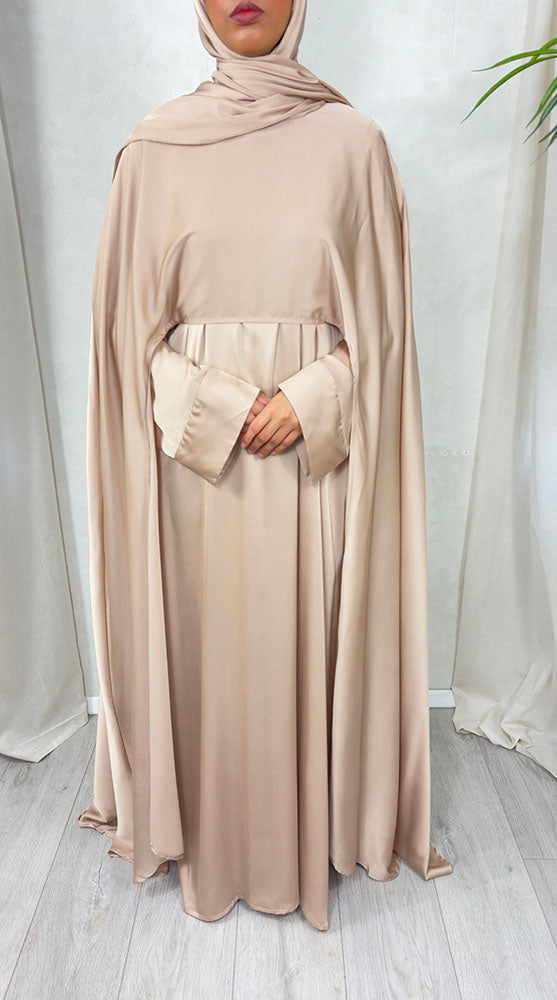
The warm beige satin set below is a useful visual reminder that a flowing finish can hide several separate pieces and seams. Each component should be checked before one routine is applied to the set.

Chiffon abayas and chiffon-lined garments
Chiffon is light and fluid, but its fibre content and density vary. It can snag, fray, become transparent when wet and distort through rough handling. A chiffon outer layer may also be attached to a satin lining that dries differently.
I protect chiffon from hooks, zips and jewellery. I use the labelled hand wash or delicate method and avoid wringing. A mesh bag helps only when the garment is folded loosely enough to rinse. A tightly packed layered abaya can leave detergent trapped between fabrics.
I support the garment while wet and align the outer and lining so one does not pull the other. I keep clips away from visible delicate edges. Pressing is cautious because synthetic chiffon can react quickly to heat.
A satin-chiffon lined abaya should be treated as a combined construction. The gentlest requirement among the outer, lining, trim and fastenings governs the process.
Crepe and nida abayas
Crepe and nida are common modest-wear terms, but they can refer to fabrics with different fibres, weights and finishes. I never treat the name as a complete care instruction. Some polyester crepes are machine washable, while a delicate viscose blend or embellished nida may require another method.
The textured surface of crepe can hide minor creasing and also catch lint. I wash it with smooth items and avoid heavy friction. I watch for shrinkage, especially where fibre content includes viscose or another moisture-sensitive component.
Nida often has a soft, fluid fall. Excess heat can flatten finish or create shine. I prefer the lowest appropriate pressing method and test an unseen area. Steaming may be useful when the label allows it, but the steamer should not spit water onto the cloth.
Because suppliers use these names differently, my most honest advice is to read the label and product description together, then care for the actual composition and construction.
Jersey and stretch abayas
Jersey is knitted and stretches. That comfort comes with the risk of distortion, pilling and loss of recovery. I avoid high heat, rough loads and hanging heavy wet jersey from narrow shoulders.
I close fastenings and turn the garment inside out when appropriate. A gentle cycle and mild product may be suitable when labelled. I reduce friction by keeping it away from towels, hook-and-loop tape and rough embellishment.
After washing, I reshape the garment without pulling. Some jersey abayas dry better flat or supported across a rack, while others can hang from a wide hanger. The label and wet weight decide. I never stretch the hem to make it appear longer.
Pilling is usually a friction issue, not dirt. Gentler washing, smoother layers and careful bag choice help more than repeated aggressive shaving.
Linen and linen-blend abayas
Linen is strong in many uses and can still shrink, crease deeply or lose a finish through the wrong treatment. A linen blend may behave differently from pure linen because viscose, cotton or synthetic fibres alter drape and recovery.
I wash according to the label with enough room for the garment to move. Overcrowding creates severe creases. I remove it promptly, shake gently and reshape seams. I accept some natural creasing rather than pressing every line with excessive heat.
When ironing is allowed, slightly damp linen often responds well, but I protect dark surfaces from shine and decorative areas from direct contact. A lined linen abaya needs the lining aligned before drying.
I do not assume linen belongs in strong sun. Colour, finish and trim can fade even when the fibre itself feels robust.
Velvet and pile fabrics
Velvet has a raised pile that can be crushed by pressure, heat and careless storage. Fibre content varies, and many velvet garments require professional cleaning. I do not wash or press velvet based on a generic home-care shortcut.
I hang it with space, avoid hard clips and do not place an iron directly on the pile. When steaming is permitted, I work from the reverse or at a safe distance and allow the pile to lift without pressing it flat.
Stains need prompt professional attention because rubbing damages the surface. I tell the cleaner what caused the mark and whether any home treatment has already been attempted.
Velvet occasion wear should be aired after use and stored only when fully dry. A breathable garment bag protects the surface from dust and contact.
Embroidered, beaded and embellished abayas
Embellishment turns one garment into several care problems at once. Thread may bleed, beads may crack, stones may be glued, and the backing may shrink differently from the body fabric. I inspect every decorative area before washing.
Loose threads, stones or beads are repaired first. I turn the garment inside out, protect it in a suitable bag and use hand washing or professional cleaning when the label requires it. I never let heavy wet beadwork hang from a narrow shoulder.
I do not iron directly over embroidery, sequins, crystals or applique. Heat can melt, flatten or loosen them. A pressing cloth and reverse-side work may be suitable, but only within the label’s limit.
The embroidered garment below shows why decorative surface care must be planned separately from the main fabric. The safest routine is governed by the most vulnerable attachment, not the strongest cloth.

Foil, metallic print and coated finishes
Foil and metallic finishes sit on or within the fabric surface. Friction, heat, strong chemicals and repeated folding can crack or dull them. I treat the printed face as a delicate trim even when the base fabric is washable.
I turn the garment inside out, avoid abrasive loads and use the exact labelled cycle. I do not soak for long periods or scrub the foil. Pressing is from the reverse at a safe temperature, with no direct iron contact on the coated area.
I store coated garments without sharp folds through the print. A padded hanger or loose fold can reduce cracking. Tissue used between layers should be clean, colourfast and appropriate for textile storage.
When a coating begins to lift, repeated heat will not restore it. I stop and seek a repair or professional assessment rather than sealing it with an untested adhesive.
How I wash everyday hijabs
Hijabs sit close to the face and collect skincare, makeup, hair products, sweat and outdoor dust. I wash them often enough to keep them fresh, but I do not treat every scarf as a towel. Delicate edges, fine weaves and colour deserve gentler handling.
I remove every pin and magnet, loosen knots and separate scarves by colour and fabric. Small scarves can disappear into sleeves or twist around long garments, so I use roomy mesh bags. I avoid washing a light chiffon scarf with a heavy abaya merely because they are the same shade.
I use a suitable mild detergent and rinse thoroughly. Residue near the forehead and neck can feel uncomfortable. I do not cover incomplete rinsing with scent. Clean fabric should smell neutral or lightly of the product used, not heavily perfumed.
After washing, I reshape edges and allow the scarf to dry fully. I do not store it in a drawer while one corner remains damp.
Jersey hijabs
Jersey hijabs are easy to wear because they stretch and grip, but their knit structure can pill, curl and lose recovery. I wash them inside out or in a mesh bag when appropriate and keep them away from rough items.
Heat is a common enemy. High washing or drying temperatures can affect elastane and shrink certain blends. I follow the label, use a gentle cycle and avoid stretching the scarf while wet. Hanging a soaked jersey scarf from one narrow end can make it longer and narrower.
I often dry jersey flat or supported, depending on weight. Once dry, I fold it without pulling the edges. A quick steam may be suitable when the label allows it, but many jersey scarves need no pressing.
The navy jersey hijab below shows a smooth everyday knit. Its simple appearance still depends on preserving stretch, colour and edge shape.

Chiffon hijabs
Chiffon hijabs are light and can be delicate. I protect them from jewellery, exposed zips, hook-and-loop tape and rough machine drums. The edges deserve particular attention because a pulled rolled hem can continue to unravel.
When the label permits machine washing, I use a separate mesh bag and a gentle load. Hand washing should involve pressing, not rubbing. I never wring chiffon. The scarf can be rolled in a clean towel to remove water before air drying.
I avoid harsh pegs on visible edges. A smooth hanger, clean rail or flat drying surface can work according to the fabric. I steam cautiously and prevent droplets from landing on a surface that water-marks.
Chiffon can look opaque when folded and sheer when opened. Care preserves the weave, but it cannot change the original density. A damaged or stretched scarf should be reassessed for coverage.
Modal and viscose hijabs
Modal and viscose scarves often feel soft, breathable and fluid. They can also become weaker or more vulnerable to stretching when wet, depending on construction. I support them rather than pulling from one corner.
Cold or cool labelled washing, mild detergent and gentle movement are common safe principles, but the exact label decides. I do not soak deeply dyed viscose without checking colour release. Twisted fringe is straightened gently while damp.
I reshape the scarf to its original dimensions and dry it flat or supported when wet weight is significant. High heat can shrink or distort. When ironing is allowed, I use a suitable low or medium setting with care on the reverse.
A modal scarf that has changed shape may sometimes be gently reshaped while damp, but force can damage it. I work gradually and stop when fibres resist.
Cotton hijabs
Cotton hijabs can be breathable and washable, but cotton is not one uniform fabric. Voile, gauze, poplin, jersey and woven textured cotton have different density, shrinkage and crease behaviour.
I wash according to the label, separate strong colours and allow for possible shrinkage. I do not use high heat merely because cotton is a natural fibre. Decorative edges, elastane and dye may be less heat tolerant than the cotton itself.
I reshape a square scarf carefully so the corners remain true. Woven cotton can be ironed when allowed, but I avoid creating shine on dark colours. Textured scarves do not need every crease flattened.
Cotton absorbs moisture and can take longer to dry than a light synthetic chiffon. I ensure the whole folded edge is dry before storage.
Satin and silk hijabs
A satin hijab may be polyester, silk or another fibre. A silk hijab may have a satin weave or a different finish. I read both fibre content and care label before deciding whether washing is appropriate.
Silk usually needs a product suitable for protein fibres and very gentle handling. Water, perspiration and perfume can mark it. Some silk scarves require professional cleaning. Polyester satin may be more washable, but the glossy surface still snags and shines under pressure.
I do not attach sharp pins repeatedly in the same place. I protect the surface from makeup and bag hardware. When pressing is allowed, I work on the reverse with low suitable heat and a clean pressing cloth.
I store smooth scarves loosely folded or rolled so hard creases do not become permanent. Acid-free tissue may be suitable for valuable pieces, but everyday scarves need only clean, dry, breathable storage.
Crinkle and pleated hijabs
Crinkle and permanent-pleat effects can be part of the fabric finish. Aggressive ironing can remove the texture the scarf was designed to have. I check whether the label says not to iron or recommends a low setting.
I wash with minimal agitation and do not stretch the scarf flat while wet. Some crinkle scarves should be gently twisted or scrunched only according to manufacturer guidance. I do not invent a texture-restoring method from another brand.
Drying flat in the intended shape or loosely hanging may preserve the finish. A steamer can relax more than unwanted creases, so I test a hidden corner before treating the whole scarf.
Storage should not compress the texture beneath heavy garments. I give crinkle scarves enough room to keep their surface.
Hijab undercaps
Undercaps collect scalp oil, sweat and hair product. They need regular washing, often more frequently than the outer scarf. I separate light and dark colours and close any hook-and-loop fastening.
Stretch undercaps are vulnerable to high heat and fabric conditioner. I use a mesh bag to prevent them wrapping around other garments and dry them without pulling. Tie-back caps are washed with ties loosened and straightened afterward.
Silk-lined or satin-lined undercaps may combine two materials. I follow the gentlest instruction and prevent rough friction on the smooth lining. A cap that has become tight, distorted or rough should not be forced because pressure around the head can cause discomfort.
Clean undercaps support both skin comfort and scarf longevity. They are not invisible items that can be ignored.
How I care for khimars
Khimars combine a face opening, long front and back panels, ties or elastic, and sometimes several layers. The face area collects skincare, while the lower edges meet bags, coats and outdoor surfaces. I inspect both before washing.
I loosen ties, remove pins and secure any detachable niqab panel separately. A long khimar can twist around a machine agitator or other garments, so I use the labelled gentle method and enough space. Layered chiffon pieces may need separate bags or hand washing.
I support the face opening while wet and reshape it before drying. Hanging the full wet weight from a narrow elastic opening can stretch it. Ties are aligned so they do not dry in tight curls or knots.
The complete khimar guide explains construction and fit in more depth. Here, my care rule is to protect the head structure as carefully as the flowing panels.
Single-layer and multi-layer khimars
A single-layer khimar usually dries more quickly and is easier to rinse. A multi-layer khimar can trap detergent and take longer to dry where layers overlap. I separate and spread layers during rinsing and drying.
I check whether layers are stitched only at the head or along other seams. Pulling one layer while wet can strain those attachment points. I never hang a heavy layered garment from a single narrow tie.
For chiffon layers, I align the hems and let air circulate between them. I do not press all layers together at high heat. Each layer should be treated gently and allowed to dry before storage.
When a khimar includes a detachable niqab, I label or store the pieces together after they are fully dry. The face veil may need more frequent washing than the khimar body.
How I wash one-piece jilbabs
A one-piece jilbab may carry the full weight of the body fabric through the head opening and upper structure. That makes wet handling especially important. I inspect the face opening, ties, cuffs, hand loops and hem before washing.
I use the exact labelled method and prevent the long body from twisting with other garments. In a machine, a large mesh bag may help only when it allows sufficient movement and rinsing. Hand washing requires full support during lifting.
I reshape the head opening, sleeves and length while damp. I avoid hanging a heavy wet jilbab solely from its head section. A wide support or flat drying arrangement may be needed.
The complete jilbab guide explains one-piece and two-piece construction. Care begins with understanding which part bears weight.
How I wash two-piece jilbabs
A two-piece jilbab usually includes an upper covering and skirt. I check whether both pieces share fabric and colour. The skirt waistband, elastic or drawstring may need different attention from the upper section.
I may wash the pieces separately when one is more soiled, heavier or more delicate. This prevents a heavy skirt from twisting a light khimar-style top. I secure drawstrings and inspect elastic before washing.
I reshape the waistband without overstretching and dry the pieces according to their own labels. I do not store the set until both are dry, especially around gathered waist seams.
After care, I keep the pieces together so the set remains useful. A lost skirt or upper piece turns a practical garment into wardrobe confusion.
Prayer dresses need simple, hygienic care
A prayer dress is often used indoors, but that does not mean it stays automatically clean. It can collect floor dust, skincare, hair product, perspiration and moisture from recent wudu. I wash it according to frequency, visible soil, odour and the label.
I keep prayer wear separate from heavily soiled outdoor laundry. I inspect the face opening, sleeves, hem and any elastic. Because the garment supports a repeated worship routine, I plan washing so a clean alternative is available.
Prayer dresses are one-piece or two-piece garments for prayer at home or another suitable private prayer setting. They are not outdoor fashion outfits and do not need styling accessories. Their care should preserve simplicity and readiness.
The complete prayer wear guide covers choosing and fitting these garments. Here, I focus on keeping them clean, comfortable and dependable.
One-piece prayer dresses
A one-piece prayer dress combines the head covering and body. I check the attached seam because the wet body weight can pull on it. I loosen face ties, protect lace edges and remove any pins before washing.
Jersey prayer dresses need stretch protection and low heat. Woven cotton blends may crease more and take longer to dry. Floral print can release colour in early washes. The care label settles the method.
I support the garment when removing it from water and reshape the attached hijab. A wide hanger may work for a lighter dress, while a heavy wet jersey style may need supported or flat drying.
The soft green jersey prayer dress below shows how an attached hijab and full body must be treated as one construction. The seam between them deserves particular support.

Two-piece prayer dresses
A two-piece prayer dress has a skirt and upper covering. The pieces may soil at different rates. The face area may need washing before the skirt, while the skirt hem may collect more floor dust.
I follow each label and avoid forcing both pieces into one wash for convenience. Elastic waistbands are protected from high heat and excessive stretching. The upper piece is reshaped around the face and shoulders.
I store the pieces together after drying. A breathable bag or shared hanger can help, provided the skirt weight does not distort the upper garment.
A second prayer set allows the routine to continue while one dries, but the wardrobe does not need many duplicates. One clean backup is often enough.
Children's prayer wear and girls' modest garments
Children’s garments need practical, frequent care, but decoration and stretch can still be delicate. I check for food, felt-tip pen, paint and outdoor soil before washing. I close fastenings and remove accessories.
I use products suitable for the child and garment, rinse well and avoid heavy fragrance when sensitivity is a concern. Drawstrings, loose beads and damaged fastenings are checked for safety before the garment is returned.
Size changes matter. A prayer dress that has become too short or restrictive should not be stretched through washing in the hope of restoring fit. Reassign, alter or replace it appropriately.
Care can be taught gently. A child can learn to place the garment in a basket, keep it off the floor and tell an adult when a stain appears.
Polyester is a fibre family, not one easy-care promise
Many modest garments contain polyester because it can hold colour, drape, dry quickly and resist some creasing. Polyester fabrics still vary enormously. Chiffon, crepe, satin, jersey and nida-like textiles may all be polyester yet need different handling because construction and finish change performance.
High heat can melt, shine or permanently crease synthetic fibres. Oil-based stains can cling. Static may increase through over-drying. I follow the label, use moderate mechanical action and avoid assuming that synthetic means indestructible.
Polyester often air dries efficiently, which can reduce tumble-dryer use. I shake and reshape it promptly to reduce pressing. When ironing is allowed, low heat and a pressing cloth protect the surface.
The safest care decision comes from fibre plus fabric structure plus garment construction, never fibre alone.
Silk and protein fibres
Silk is a protein fibre with beautiful drape and sensitivity to enzymes, alkali, abrasion, sunlight and heat. Some silk garments are washable with specialist products, while others require professional cleaning. I follow the label without experimenting on a valuable piece.
I keep perfume, deodorant and perspiration from sitting untreated. I blot moisture and seek prompt appropriate care. I do not rub water marks or use ordinary biological detergent.
Wet silk can be vulnerable. I support it, avoid wringing and dry away from strong sun. Pressing is at the labelled low setting, usually on the reverse with protection.
When fibre identification is uncertain, I do not call a shiny garment silk because a seller used the word silky. Composition matters.
Wool and wool-blend modest wear
Wool may appear in winter coats, shawls, cardigans and blended outer garments. Heat, agitation and unsuitable detergent can cause felting and shrinkage. I use the wool programme or hand method only when the label permits and choose a wool-suitable product.
I support wool when wet and reshape it to measurements. Many knitted pieces dry flat. Hanging a soaked wool cardigan or shawl can stretch shoulders and length.
Moths are attracted to residues and natural fibres. I clean wool before storage and use a clean, dry, breathable system. Pest prevention should be safe for the household and kept away from children and pets.
A wool blend may include polyester, acrylic or other fibres, but the wool component still deserves careful treatment.
Cotton, linen and plant-based fibres
Cotton and linen absorb water and can become heavy. They may shrink, crease or lose colour. Viscose and modal are regenerated cellulose fibres with different wet strength and drape, so I do not treat every plant-derived material identically.
I use the care label’s temperature and cycle, allow enough drum space and reshape promptly. High heat is not automatically appropriate. Dark cotton can fade, pale cotton can yellow, and decorative thread may react differently from the base.
Natural creasing is not damage. I choose whether pressing is necessary for the garment and occasion. Over-ironing shortens my patience and can shorten fabric life.
Care should preserve function rather than chase a factory-flat appearance after every wear.
Drying is part of cleaning, not an afterthought
A garment is not safely cared for when the wash is finished. Drying controls shape, odour, colour, creasing and fibre stress. I read the drying symbol before water touches the item so I already know where it will go.
I prepare a clean drying space with enough airflow. I remove garments promptly, shake them gently and reshape seams, cuffs, openings and hems. I do not leave wet modest wear crumpled in a basket while deciding what to do.
The best drying method depends on wet weight and construction. A light polyester scarf may hang easily. A heavy jersey jilbab may stretch. A wool shawl may need flat drying. A beaded abaya may need support across several points.
Drying fully matters. Moisture hides in waistbands, layered khimars, cuffs, embroidery and thick seams. I check those areas before storage.
Air drying on a hanger
Hanging is convenient for many abayas and long garments when the label allows it. I choose a wide, smooth hanger that supports the shoulders. Wire hangers can create points, rust marks or distortion.
I align the garment so one side does not carry more weight. I close or arrange the front enough to keep edges straight. A detachable belt dries separately. For long hems, I make sure they do not touch a dirty floor or radiator.
A very wet, heavy garment may need towel pressing or temporary support before hanging. I do not ask a narrow shoulder seam to hold several kilograms of water. Embellished shoulders deserve even more care.
Air must circulate around the front and back. Packing wet abayas tightly on a rail slows drying and encourages odour.
Drying flat or supported
Flat drying protects garments that stretch under wet weight. I use a clean mesh rack, dry towels or another breathable surface suitable for the item. I spread the garment to its natural shape without pulling.
I change a saturated towel so moisture does not remain trapped. I turn the item when appropriate and ensure thick areas receive airflow. A long garment may need folding across a large rack rather than lying in a heap.
Flat drying requires space, which is not always easy in a small home. I plan the wash for a day when the surface can remain undisturbed. I do not place a damp garment on wood, coloured upholstery or a bed that can transfer dye or trap moisture.
The method is slower but worthwhile for heavy jersey, wool blends and pieces whose shoulders distort easily.
Using a tumble dryer only when the label permits
A tumble dryer adds heat and mechanical action. It can shrink, set stains, damage elastic, crack coatings, dull embellishment and create static. I use it only when the exact symbol permits it, at the indicated heat level.
I do not place a garment marked do not tumble dry into the machine for five minutes as a harmless shortcut. Damage can begin quickly. I also avoid mixing long modest garments with heavy towels that increase impact and tangling.
When tumble drying is allowed, I remove the item promptly and avoid over-drying. Slight residual moisture may make reshaping easier, but the garment must finish drying fully before storage.
Dryer balls and accessories should be compatible with delicate fabric and trims. I do not add them automatically to a load containing beads, foil or fine chiffon.
Drying away from harsh direct sunlight
Sunlight can help outdoor drying, but strong ultraviolet exposure fades colour and can weaken some fibres. I dry dark abayas, vivid scarves and delicate finishes in shade or indirect light unless the label and product guidance support another method.
I turn suitable dark garments inside out and avoid leaving them outdoors after they are dry. One side of a garment hanging near a bright window can fade more than the other.
Pale cotton may sometimes benefit from sun, but a pale garment can contain synthetic lining, elastic or embroidery that reacts differently. I care for the whole construction.
Clean air and shade are often a better combination than intense sun and speed.
Drying modest wear in a British home
British weather means indoor drying is often unavoidable. I ventilate the room, leave space between garments and use an extractor or dehumidifier safely when available. I do not cover radiators with long fabrics.
Drying directly on a radiator can create heat damage, hard creases, yellowing and uneven shrinkage. It also traps moisture in the room. I keep garments at a safe distance from heat sources and follow appliance guidance.
A heated airer may be useful when used according to its instructions and the garment label. I spread weight evenly and avoid direct prolonged heat on elastic, foil, glue and delicate surfaces.
When condensation appears on windows, airflow needs attention. Clothes should not make the home persistently damp. Mould risk is a household-health issue, not simply a wardrobe inconvenience.
Drying after wudu splashes or light rain
Not every damp mark requires a full wash. When a clean garment receives water, I hang it with airflow and allow it to dry fully. I smooth the affected area so a hard water line does not set where possible.
Rain can carry dirt from coats, public transport and pavements. I inspect the hem and outer surface. A lightly damp clean area may only need drying, while a splashed muddy hem needs appropriate cleaning.
I do not fold a damp prayer dress after wudu because it feels only slightly wet. Moisture around the face opening and cuffs can create odour. I leave it open until dry.
A small habit of airing prevents many larger laundry problems.
Reshaping while damp
Damp fabric is often easier to guide back into shape. I align side seams, straighten hems, smooth collars and restore face openings without stretching. I compare with the care record when a garment has important dimensions.
Elastic should be laid naturally, not pulled to its maximum. Pleats are placed in their intended direction. Ties are straightened and separated. I reshape sleeves so cuffs do not dry twisted.
I do not force a shrunken garment back to size without understanding the fibre. Gentle blocking may work for some knits, while pulling can break seams or distort permanently.
Reshaping is patient work. It is not an opportunity to change the size through wet stretching.
When a garment dries with deep creases
I first check the label before applying heat. Some creases release through hanging in a humid room, careful steaming or a low iron. Others are set because the garment dried twisted or was overloaded.
I re-dampen only when the fabric permits it. A fine mist can help certain washable fabrics, but it can water-mark satin or silk. I test an unseen area.
I work section by section and support the garment. Pressing harder is not the answer to every crease. Excess heat can turn a temporary wrinkle into permanent shine or melting.
Prevention is easier: remove promptly, shake, reshape and give the garment enough room to dry.
Ironing begins with the label and a clean soleplate
An iron transfers heat and pressure directly. I check the symbol, clean the soleplate and ensure the ironing board cover will not transfer colour or residue. A dirty iron can ruin a pale garment in one stroke.
I sort garments by temperature so I do not move carelessly from high-heat cotton to low-heat synthetic fabric. I begin low and increase only within the permitted range. I never test maximum heat on a visible area.
I work on the reverse where possible and use a clean pressing cloth for dark, smooth, printed or delicate surfaces. I keep the iron moving and avoid crushing seams or texture.
After pressing, I let the garment cool and dry before folding or wearing. Warm fabric can crease again or trap steam.
Steaming with control
Steaming can relax creases with less direct pressure, but it is still heat and moisture. I check whether the label permits it and test the fabric. Steam can cause water spots, soften adhesives or distort certain finishes.
I hang the garment securely, keep hands away from the steam path and move from top to bottom. I maintain the distance recommended by the steamer and do not press the hot head into delicate fabric unless the device and material allow it.
A steamer that spits mineral-rich water can mark satin and dark cloth. I maintain the appliance according to its instructions and use the correct water. I never add perfume or fabric product to the steamer tank unless the manufacturer specifically permits it.
The garment needs time to cool and dry after steaming. I do not place it immediately into a closed wardrobe.
Using a pressing cloth
A pressing cloth creates a protective layer between iron and garment. I use clean white cotton or another appropriate cloth that will not transfer colour or texture. It should be large enough to cover the area being worked.
The cloth reduces direct shine, protects prints and prevents the iron from catching embellishment. It does not make high heat safe. The garment’s temperature limit still applies.
For moisture-sensitive satin, I use a dry pressing cloth unless the method specifically requires dampness. For embroidery, I may place a soft towel beneath the work so the raised stitches are not flattened.
I check the result after each small section. Protection works best with attention, not speed.
Avoiding shine marks on dark abayas
Shine appears when heat and pressure flatten or damage the surface. Dark crepe, polyester and suiting-like fabrics show it clearly. I press on the reverse, use a cloth and avoid bearing down with the iron.
Seams and pocket edges are vulnerable because pressure concentrates there. I use lighter contact and a padded surface. Steam held at a distance may be better when the label permits.
Once synthetic fabric becomes shiny through heat, home remedies can make it worse. I stop rather than repeatedly treating the area. A professional may assess whether texture can be improved.
Preventing shine is one reason I do not iron every garment simply because it has been washed.
Pressing satin, chiffon and smooth finishes
Smooth fabrics reveal water, heat and pressure. I work on the reverse at the lowest effective labelled temperature. I do not spray water directly onto satin unless I know it is safe.
Chiffon receives minimal heat. The fabric can melt or distort before it looks dramatically damaged. I move quickly, use protection and often prefer careful steaming.
I keep seams, foil, beads and glue away from direct contact. A set may have a satin body and chiffon cape, so I adjust method rather than pressing the whole garment at one setting.
I let smooth fabric hang after treatment so it can settle without acquiring new folds.
Preserving pleats, crinkle and texture
Some texture is designed into the fabric. I do not iron a crinkle scarf flat or press permanent pleats across their direction. I look for product-specific care guidance.
For pleats, I align each fold and use low controlled heat only when permitted. I avoid stretching the waistband or upper seam while the pleats are warm.
Crinkle garments may be stored loosely twisted or flat depending on manufacturer instructions. I do not copy a method from another fabric with a similar appearance.
Texture deserves the same respect as colour. Care should preserve design rather than erase it.
Pressing embroidery and embellished areas
I place raised embroidery face down on a soft clean towel and work from the reverse when permitted. This prevents the iron from flattening stitches. I use a cloth and low suitable heat.
Beads, sequins and crystals are kept away from direct heat. Plastic can melt, metal can become dangerously hot and glue can soften. Steaming from a distance may still affect adhesive, so I test cautiously.
I do not press a loose embellishment into place. Heat is not a reliable repair method. I secure it properly or use a specialist.
After pressing, I inspect the backing and allow the area to cool flat before hanging.
Travel steaming and hotel shortcuts
A travel steamer is useful only when I know the garment and appliance. I test at home before packing. Hotel water, unstable hangers and small rooms create new risks.
Hanging a garment in a steamy bathroom can relax light creases, but it can also leave fabric damp. I keep it away from splashes and allow proper ventilation. I do not treat this as cleaning.
I avoid using hotel irons directly on delicate clothing without checking and cleaning the soleplate. A pressing cloth from a clean white cotton item adds protection.
Packing carefully reduces the need for emergency heat. I would rather roll or fold thoughtfully than repair a scorch mark away from home.
The first response to a stain
The first moments matter. I stop, identify the stain if possible and blot rather than rub. Rubbing can drive pigment deeper, spread oil and damage the surface. I work from the outside of the mark toward the centre.
I check the care label before adding water or product. Some stains need cold water, some need a solvent handled professionally, and some delicate fabrics water-mark. I test any treatment on an unseen area and keep the garment away from heat until the stain is gone.
I record what caused the stain and what I used. When professional cleaning becomes necessary, that information helps the cleaner. Hiding a home treatment can lead to an unexpected chemical reaction or make assessment harder.
A fresh stain is urgent, but urgency does not justify pouring several products together. Calm, minimal treatment is safer than a cupboard full of guesses.
Oil and greasy food stains
Oil spreads beyond the visible centre. I blot excess with clean absorbent material and avoid rubbing. For a washable robust fabric, an approved small amount of suitable detergent may help break down grease, but the garment label and fibre matter.
Powder absorbents are often suggested online, yet they can lodge in texture, discolour delicate fabric or react with finishes. I use them only when suitable and remove them gently. Satin, silk, velvet and embellished pieces deserve professional assessment when the garment is valuable.
I do not apply high heat until the stain is resolved. Drying and ironing can make oily shadows harder to remove. I inspect the area in daylight after washing.
When oil reaches a lining and outer layer, both need attention. Treating only the visible face can leave a ring beneath.
Foundation, lipstick and makeup
Makeup combines pigments, waxes, oils and silicones. I avoid smearing it across the scarf or neckline. I lift loose product gently, blot and use a treatment compatible with the fabric.
Micellar water or makeup remover may work on skin, but it is not automatically safe for every textile. It can contain oil, surfactant, fragrance or colour. I test first and rinse according to the garment care.
For frequent transfer, prevention is kinder. I let skincare and makeup settle before dressing, protect the neckline while applying products and wash undercaps regularly. A scarf that rubs hard against the face may also need a different fit.
I do not scrub the rolled edge of chiffon. A small mark is better than a frayed edge created by panic.
Perfume, deodorant and skincare marks
Perfume can contain alcohol, oils and colour that mark delicate fabric. I apply fragrance before dressing and allow it to dry rather than spraying directly onto satin, chiffon or embellished garments.
Deodorant can leave white or yellow marks and may build up with detergent. I blot fresh transfer and treat according to fibre and product. Strong rubbing across dark fabric creates shine.
Skincare oils can darken hijab edges. Regular gentle washing prevents layers of residue. I use fragrance-free or low-residue products when skin sensitivity is involved, but personal medical advice belongs with a clinician.
Prevention is not about becoming afraid of products. It is about giving them time to absorb and keeping direct spray away from the garment.
Tea, coffee and juice
For a washable garment, I blot quickly and use cool water where the label permits. I work from the back of the stain so liquid moves out rather than deeper into the cloth. Hot water can set some components.
Milk, sugar and flavouring change the stain. A milky coffee is not only a tannin mark. I tell a cleaner exactly what was spilled. Dried sugar can feel stiff and attract further soil.
Pale fabric needs patience because repeated spot treatment can create a ring. I feather the rinse and wash the whole garment when appropriate.
I never place a still-marked garment into a dryer. Heat may turn a manageable spill into a permanent shadow.
Mud and wet pavement marks
With mud, I often allow the thick surface soil to dry before gently removing it, provided the fabric and stain are suitable. Rubbing wet mud spreads it. I then treat the remaining mark according to the care label.
Outdoor hems may contain grit that abrades fabric in a machine. I shake or brush loose particles outside and rinse carefully. I keep muddy abayas away from face-worn scarves.
Salt and road residue can leave pale edges on winter garments. I use a suitable damp treatment and avoid harsh scrubbing. Coats may require specialist cleaning.
A repeatedly muddy hem is also a fit problem. Shortening the garment or changing footwear may protect it more effectively than stronger washing.
Blood and other biological stains
Blood is a protein stain and usually responds poorly to heat. I use cool water when the label permits and act promptly. I protect myself with appropriate hygiene measures, especially when the blood is not my own.
Enzyme products may help on compatible washable fibres, but they are not suitable for silk and wool. I check both detergent and garment instructions.
For unknown bodily fluids, illness-related contamination or hazardous material, I follow healthcare or professional guidance rather than relying on ordinary fashion advice. The garment may need a process beyond its usual care.
I keep contaminated items separate and clean the laundry environment appropriately.
Ink, paint and craft stains
Ink formulas vary. Water-based pen, permanent marker and printer ink do not share one treatment. I identify the product before applying solvent. Rubbing can spread a small line into a large cloud.
Paint may be water-based, oil-based or fabric paint. Once dry, some paint cannot be removed without damaging the textile. I lift surface material carefully and seek product-specific guidance.
Solvents can dissolve dye, adhesive and synthetic fibres. I do not use hairspray, acetone or alcohol as universal remedies. Valuable or delicate garments go to a professional.
For children’s prayer wear and craft days, an apron or separate garment is the most reliable stain treatment.
Colour transfer and dye bleeding
When colour transfers, I separate the affected garments immediately and do not dry them with heat. I check labels and use a colour-run treatment only when compatible with every fibre and trim.
I do not apply chlorine bleach to solve transfer unless the care symbol permits it. Bleach can create a second, worse problem. Pale synthetic fabrics may yellow, and embroidery can change colour.
A new dark garment that continues to release significant dye deserves retailer advice. I document the wash method and result. I do not wash it repeatedly with other clothing while hoping the problem disappears.
Prevention is simple: separate strong new colours, avoid long soaking and follow temperature instructions.
Water marks and tide lines
Water can leave a ring on satin, silk, viscose and finished fabrics because moisture moves soil or finish to the edge. I avoid treating only the centre repeatedly. A whole-panel clean or professional process may be needed.
I blot rather than rub and let the area dry naturally while I assess it. Direct heat can set the line. Distilled water is sometimes used for mineral-sensitive fabric, but I do not apply it without confirming suitability.
When steaming, I keep the appliance from spitting droplets. When wearing, I protect delicate occasion garments from rain with an appropriate outer layer.
A tide line is a reminder that even clean water interacts with finish and dye.
Odour is a clue, not something to cover
Odour can come from perspiration, detergent residue, incomplete drying, storage, cooking, smoke, mildew or the garment’s manufacturing finish. I identify the source before adding fragrance.
A clean wash with correct detergent and complete rinsing solves residue better than perfume. Airing can refresh lightly worn outerwear. A persistent musty smell may mean moisture remains in seams or storage.
I avoid spraying fragrance directly onto fabric to hide odour. It can stain and create a stronger mixture rather than cleanliness.
When odour returns immediately after washing, I inspect the machine, drying space, wardrobe and garment. The source may not be the fabric alone.
Perspiration and underarm care
Perspiration contains water, salts and other compounds that interact with deodorant and dye. I air garments after wear and treat underarms before residue builds. Dark fabric can develop pale marks, while light fabric can yellow.
A washable underlayer can protect an abaya and reduce frequent full washing. It must be breathable and comfortable. Dress shields may help certain garments when fitted correctly.
I do not iron over a perspiration mark. Heat can set it. I use a fibre-safe treatment and rinse thoroughly.
For strong or changing body odour, clothing care may help but cannot replace medical advice when health is a concern.
Mildew and mould
Mildew indicates moisture and requires attention to both garment and environment. I move the item away from clean clothing and avoid shaking mould spores through the home. Significant growth, valuable garments or health vulnerability call for professional advice.
I follow the garment label and an appropriate mould-removal process, but some staining or fibre damage may be permanent. I do not mix bleach with other chemicals or assume it is safe for coloured fabric.
The wardrobe, wall, laundry basket and drying space also need assessment. Returning a cleaned garment to a damp cupboard repeats the problem.
Persistent household mould is a health and property issue. Fabric care alone cannot solve it.
Smoke and cooking odours
Light cooking odour may leave through airing in clean moving air. Heavy grease and smoke settle into fibres and may need washing or professional cleaning. I keep occasion garments away from kitchens where possible.
I do not hang clothing above a radiator with scented spray. Heat and fragrance can set or mask the problem. A clean breathable space is better.
Smoke from fire or hazardous exposure needs professional assessment. Soot can be oily and toxic. I do not shake or home-wash a contaminated garment without guidance.
For everyday cooking, an apron and controlled sleeves protect both clothing and safety.
Airing between wears
Not every outer garment needs a full wash after a short clean wear. Airing reduces moisture and allows odour assessment. I hang the item in a clean ventilated place away from direct sun.
I empty pockets, loosen belts and check the hem. I do not return a garment to a crowded wardrobe while it is warm or damp from the body.
Airing is not a substitute for washing when the garment is soiled, smells, has touched an unhygienic surface or sits close to the skin repeatedly. It is one part of a sensible care rhythm.
Washing less aggressively can extend life, but only when cleanliness remains honest.
How often should abayas be washed?
There is no universal number. Frequency depends on underlayers, weather, journey, skin contact, odour, visible soil, fabric and storage. An abaya worn over clean clothes for a short indoor visit differs from one worn through rain, public transport and a full workday.
I inspect neckline, underarms, cuffs and hem after wear. I air the garment and wash when evidence says it needs washing. Over-washing increases abrasion and colour loss, while under-washing allows residue and odour to build.
A small rotation allows each garment to air and avoids rushed drying. The answer is not necessarily more garments, but enough to maintain the routine.
Care should respond to real use rather than a rigid online schedule.
How often should hijabs and undercaps be washed?
Hijabs and undercaps have more direct skin and hair contact. Undercaps often need washing after one or a few wears depending on sweat, product and comfort. Hijabs vary by fabric, styling and wear time.
I wash a scarf sooner when makeup, skincare, perspiration or outdoor dirt is present. I do not wait for a strong smell. Pale forehead edges and stiff folds are signs of buildup.
A rotation prevents constant washing of one favourite. I keep the most dependable scarves in enough number to wash, dry and wear without using a damp item.
Sensitive skin may benefit from fragrance-free products and thorough rinsing, but persistent irritation needs professional care.
How often should prayer wear be washed?
Prayer wear should be clean and comfortable. Frequency depends on use, underclothes, floor contact, perspiration, household conditions and any visible soil. I check the face opening, cuffs, knees and hem.
A garment used by one woman in a clean home may not need washing after every prayer. A shared mosque garment or a piece used in a dusty setting needs another level of hygiene.
I keep a clean backup so washing never feels like a threat to the prayer routine. I dry the garment completely and store it in an accessible clean place.
Religious questions about purity belong with qualified guidance. My care advice is to keep the garment honestly clean and ready.
Daily storage for abayas
After airing, I hang suitable abayas on wide smooth hangers with enough space. I close or align front edges, remove heavy belts and keep beaded pieces from rubbing against neighbouring garments.
I do not leave garments inside thin dry-cleaning plastic for long-term storage. Plastic can trap moisture and does not provide the breathable protection a wardrobe needs. A breathable garment bag is better for dust-sensitive pieces.
Dark clothing stays away from bright windows. Pale clothing stays away from coloured wood, rust and unstable cardboard. The wardrobe itself should be clean and dry.
The most-worn abayas belong where I can reach them without crushing occasion pieces.
Folding hijabs so edges stay useful
I fold hijabs only when they are fully dry. I align edges without pulling and avoid hard creases through delicate satin or foil print. Rolled storage may suit certain smooth scarves.
Jersey can be folded loosely without stretching. Chiffon needs protection from rough drawer hardware and jewellery. Crinkle scarves need enough room to preserve texture.
I separate pins and magnets from fabric. A pin left inside a folded scarf is a safety hazard and can rust or tear the weave.
A simple colour or fabric organisation saves handling. The less I rummage through delicate scarves, the fewer snags I create.
Storing khimars, jilbabs and prayer garments
Long head coverings and jilbabs need support around the face opening and shoulders. I hang lighter pieces or fold heavier ones according to construction. I do not suspend a heavy garment from elastic.
Two-piece sets are stored together after both pieces are dry. I label breathable bags when several colours look similar. A prayer dress remains near the prayer space rather than buried beneath seasonal clothing.
Face-worn sections should not touch footwear or dirty floors. I keep clean fabric enclosed enough to protect it while allowing airflow.
Storage should make the next use easy. A complicated system that is not maintained will not protect the garment.
Breathable garment bags and seasonal storage
For seasonal storage, I wash or clean garments first. Food, perfume, skin oil and perspiration attract pests and can oxidise into stains. I repair loose seams before they are hidden for months.
I use breathable, clean bags and store in a cool dry place. I avoid vacuum compression for structured, beaded or crease-sensitive garments. I do not place strong moth products directly against fabric.
I check stored garments periodically for damp, pests and colour change. A sealed cupboard is not a guarantee. Air and inspection are part of care.
When the season returns, I air and inspect before wearing rather than pressing blindly.
Moths and fabric pests
Natural fibres, residue and dark undisturbed spaces attract certain pests. I keep wardrobes clean, vacuum corners and store only clean dry clothing. I inspect small holes, webbing and larvae rather than assuming wear caused every mark.
Pest treatments must be used according to instructions and household safety. Cedar and herbal products may deter in limited ways but are not guaranteed solutions. Strong chemicals can affect people, pets and fabric.
An infestation may require professional pest control. I isolate affected garments and follow appropriate cleaning guidance.
Prevention is regular use, cleanliness, airflow and inspection, not a wardrobe filled with overpowering scent.
Packing modest wear for travel
I plan complete outfits and choose fabrics that recover from folding. I clean and dry everything before packing. Scarves go into smooth pouches, embellishment is protected and heavy shoes remain separated.
I fold abayas along natural seams and place tissue or a clean layer where satin or beads may rub. I pack one dependable outfit, scarf and prayer garment in hand luggage.
On arrival, I unpack promptly and hang or air garments. I do not leave damp travel clothing sealed in a suitcase.
Travel care begins with taking fewer pieces that work well together. Overpacking increases crushing and makes clean and worn clothing harder to separate.
A modest travel laundry kit
My small kit contains a mesh bag, mild travel detergent in secure packaging, stain cloth, breathable pouch for worn scarves and a few safe fastenings. I do not carry a chemistry set.
I check accommodation before planning hand washing. A sink may be unsuitable or unclean, and there may be no safe drying space. Professional laundry can be better for a complex garment.
I keep product labels and avoid decanting unknown liquids into unmarked containers. Spills inside luggage can damage every garment.
A kit should solve likely problems without creating weight and leakage.
Repair before damage spreads
A loose hem, open seam or weak button can become a larger tear in the wash. I inspect garments during care rather than waiting until they fail while being worn. A small repair is usually faster, cheaper and kinder to the fabric.
I use matching thread, appropriate needle and stitches that suit the construction. Heavy embellishment and fine chiffon may need a specialist. I do not pull a seam tightly to hide damage because tension simply moves the problem.
Repairs are also a record of use. A cuff that repeatedly opens may be under strain or poorly designed. A hem that always tears may be too long. Fixing the cause protects the next repair.
Care is not only cleaning. It is noticing what the garment is asking for before it becomes unusable.
Loose beads, sequins and crystals
I save spare beads and threads supplied with a garment. When one loosens, I stop wearing and washing the piece until it is secured. A loose bead can catch another area, and a missing stitch may release a whole line.
Threaded embellishment can often be repaired from the reverse with careful knotting. Glued stones need a compatible textile adhesive and accurate placement, which may be better handled professionally. Household superglue can harden, stain and damage fabric.
I compare the repair with surrounding tension. Pulling one bead too firmly puckers the cloth. I protect the repaired area during washing and review it after each wear.
When many attachments are failing, the issue may be construction or adhesive age rather than one isolated accident.
Snags and pulled threads
A snag should not be cut immediately. The visible loop may be connected to the weave, and cutting can create a hole. I lay the garment flat, reduce tension and gently work the thread toward the reverse when possible.
A fine snag tool or needle may help, but delicate chiffon, satin and loose weaves need skill. I do not drag a pulled thread across the surface. When the weave has distorted widely, a textile repair specialist is safer.
I identify the cause. Jewellery, bag hardware, rough chairs and hook-and-loop tape create repeat damage. Removing the cause is part of the repair.
After correcting a snag, I steam or press only if the label permits. Heat cannot replace the missing structure.
Pilling and surface fuzz
Pilling forms when fibres rub, tangle and collect on the surface. It appears on jersey, knitwear and areas of repeated friction. Washing inside out and separating rough items can reduce it, but fibre type and garment construction also matter.
A fabric shaver can improve a robust surface when used lightly on a flat garment. I test first, keep away from seams and never use it on chiffon, lace, loose knit or embroidery. Scissors are risky because the fabric can lift into the blades.
I also look at where pilling occurs. A cross-body bag, coat lining or rough chair may be the source. Changing that contact can protect both repaired and new garments.
Pilling is cosmetic until removal damages the fabric. I value restraint.
Stretched elastic and tired cuffs
Elastic loses recovery through heat, age, chemical exposure and repeated stretching. A loose prayer-dress face opening, skirt waistband or cuff may be repairable by replacing the elastic.
I measure a comfortable comparable garment rather than simply shortening the old elastic. The new elastic should secure without pressure. I note how it is enclosed so the seam can be reopened neatly.
High heat and fabric conditioner can shorten elastic life. After repair, I adjust the care routine. A replacement that receives the same damaging treatment will fail again.
When elastic is integrated into a complex face opening or decorative cuff, a skilled tailor can preserve shape more accurately.
Broken zips, poppers and hooks
A sticking zip should be inspected for trapped fabric, bent teeth or slider damage. I do not force it because one hard pull can tear the surrounding seam. A tailor can replace the slider or zip when needed.
Poppers need secure backing. If the fabric is thinning around them, simply pressing harder worsens the tear. Reinforcement may be required. Hooks should be covered or closed during washing so they do not snag.
I check metal for rust or discolouration before storing pale garments. Hardware replacement is often possible and can extend the life of an otherwise excellent abaya.
Fastenings are small, but they control whether the garment remains practical.
Faded black and uneven colour
When black fades evenly, I first decide whether the garment is still useful. A softer black may remain a dependable everyday piece. When fading is patchy, I look for detergent residue, sun exposure, abrasion or chemical marks.
I rewash residue only according to the label. I do not rub pale streaks aggressively. Dyeing at home is a separate textile process and may not suit polyester, mixed fibres, stitching, trims or embellishment.
A professional dye service may assess suitable natural fibres, but exact colour and thread matching are not guaranteed. I do not promise that black can always be restored.
Future prevention includes correct sorting, gentle washing, complete rinsing and shade drying.
Shrinkage after washing
Shrinkage can come from heat, agitation, fibre relaxation or a finish changing. I compare with the pre-wash record and check whether the label was followed. I do not blame the wearer’s body when the garment has physically changed.
Some knitted or plant-based garments may be gently reshaped while damp, but force can distort seams. Felting and heat-set shrinkage may be irreversible. A tailor may recover function by altering a hem, cuff or side seam when spare fabric exists.
I document unexpected significant shrinkage and contact the retailer when the labelled method was followed. Photographs and measurements help.
The lesson belongs in future buying: fibre, preshrink information and care method matter alongside size.
A garment that has stretched longer
Stretching often comes from hanging wet weight, overloading pockets or storing knitwear on a narrow hanger. I wash and reshape according to the label, then dry flat or supported if appropriate.
I do not use high heat to shrink the garment back. That can create uneven change and damage elastane. A professional alteration may correct length more reliably.
Shoulders and face openings deserve attention because distortion there affects the whole silhouette. Switching storage method prevents repeat stretching.
A long garment is not improved by uncontrolled extra length. Safe proportion is part of care.
Static cling
Static increases with dry air, synthetic fibres, friction and over-drying. I first reduce excessive dryer use, consider the base layer and allow indoor humidity to remain safe and comfortable.
A cotton-rich or smoother slip may reduce friction. Lightly damp hands or an approved anti-static product can help temporarily. I test sprays for marks and fragrance sensitivity.
Fabric conditioner is one option for some garments, but not every fibre or finish benefits. I do not coat technical, absorbent or stretch fabric automatically.
Static is often a system issue between two fabrics. Changing one layer may solve more than treating the outer garment repeatedly.
Wrinkles that return immediately
Wrinkles can return because the garment is still damp, the fibre lacks recovery, storage is crowded or the cut folds at one pressure point. I identify the source before repeating heat.
I let pressed garments cool fully and hang with space. I avoid wearing them immediately beneath a tight coat. For travel, I fold along seams and unpack promptly.
Some linen, viscose and soft cotton will crease through ordinary movement. I accept that natural behaviour rather than pressing several times a day.
Presentable does not mean motionless. A garment can look cared for and still show that a human body has sat, walked and prayed in it.
When lining twists or hangs below the outer layer
Lining can shrink, stretch or rotate differently from the outer fabric. I align the layers while damp and check the attachment seams. A twisted lining may need a tailor rather than repeated pressing.
When the lining becomes longer, hemming may restore balance. When it becomes shorter and pulls the outer layer, more complex adjustment is needed. I do not cut without understanding how the layers are joined.
Washing layered garments with excessive spin or heat can worsen the mismatch. Future care should use the gentlest labelled method and support both layers during drying.
A beautiful outer fabric cannot compensate for a lining that restricts movement. Repairing the inside matters.
When a face opening loses shape
Khimars, jilbabs and prayer dresses depend on the face opening. Stretch, heat, elastic failure and hanging wet weight can make it gape or tighten. I compare it with the original shape and inspect seams.
Elastic can sometimes be replaced. A tie may be shortened or repositioned. A stretched fabric edge may need reinforcement, but adding tight elastic without testing can create pain.
I do not store a heavy garment hanging from this opening. I reshape it after every wash and let the body weight rest elsewhere.
The face opening is both a fit and comfort feature. A repair must preserve visibility, breathing and ease.
When professional cleaning is the wiser choice
I choose professional care for garments labelled dry clean only, valuable silk, velvet, heavy beadwork, complex tailoring, stubborn stains and damage that could worsen through home treatment.
I look for a cleaner experienced with delicate fashion, occasion wear or modest garments. I show every label and point out stains, loose trims, colour concerns and separate pieces. I ask whether embellishment is protected and whether responsibility for risk is clear.
I remove detachable accessories only when instructed and keep a record of what was handed over. On return, I inspect the garment before leaving or as soon as possible.
Professional cleaning is not proof of luxury. It is simply the correct tool when the garment exceeds safe home care.
Questions I ask a dry cleaner
- Experience: Have you cleaned this fibre, finish or type of embellishment before?
- Stain plan: What treatment is proposed for the identified stain?
- Colour: How will dye transfer or fading risk be assessed?
- Decoration: How will beads, crystals, embroidery or foil be protected?
- Pressing: How will shine and pile crushing be avoided?
- Pieces: Should the belt, scarf, slip or detachable panel be cleaned together?
- Risk: What limitations or possible changes should I understand?
- Packaging: When should the temporary plastic cover be removed after collection?
A careful cleaner may still explain that a stain cannot be removed safely. I prefer an honest limitation to aggressive treatment that destroys the garment.
Care before the first wear
I inspect a new garment in daylight. I check seams, fastenings, spare beads, labels, dye transfer and strong manufacturing odour. I try it on with clean skin and underlayers while tags remain attached.
Whether to wash before first wear depends on the garment, label, finish and personal sensitivity. Some washable everyday pieces benefit from a first wash, while an occasion garment, silk or structured piece may not. I do not make first washing a universal rule.
I test a dark inner seam with a clean damp white cloth only when appropriate and without damaging return eligibility. I ask the retailer when dye transfer is a concern.
The first wear should begin with knowledge of how the garment will later be cleaned. Care is part of purchase, not an issue discovered after a spill.
Care after an occasion
After Eid, a wedding or another event, I do not hang the outfit untouched and forget it. I inspect food marks, perfume, makeup, hem soil and loose embellishment while I still remember what happened.
I air the garment and arrange the correct cleaning promptly. Invisible sugary drinks and perspiration can darken over time. A small loose bead is easier to secure before storage.
I clean accessories separately and return spare trims to a labelled pouch. I store the whole outfit only when every layer is dry.
Occasion care protects the next moment. It prevents a sister discovering damage on the morning she hoped to wear the garment again.
Care during Ramadan and Eid
Ramadan changes wear patterns. Prayer garments may be used more often, mosque clothing may travel in bags, and iftar can bring food stains late at night. I create a simple rotation rather than allowing every useful piece to become damp or unwashed at once.
I keep a breathable pouch for mosque prayer wear and empty it after returning. I wash face-worn pieces regularly and prepare Eid clothing several days early so repairs and pressing are not rushed.
Strong cooking odours can settle into nearby occasion garments. I keep them covered and away from the kitchen. Perfume and makeup are applied before dressing with enough time to dry.
The care plan should protect worship and rest. Laundry perfection is not the purpose of the month.
Care after travel, Umrah or Hajj
Travel clothing can contain sweat, dust, sunscreen, food, luggage dirt and unfamiliar water residue. I separate clean from worn pieces before unpacking and do not leave a closed suitcase for days.
Pilgrimage garments and worship-related questions require qualified guidance, while cleaning follows fibre, label and actual soil. I inspect hems, seams and fastenings. Heavy contamination or health concerns may need specialist treatment.
I wash in manageable loads and dry fully. I do not rush every garment through the same hot cycle because the suitcase smells travelled.
I record what performed well. A scarf that dried quickly or a prayer garment that remained easy to care for earns a place in future packing.
Fabric care for disability and limited mobility
Laundry systems should fit the person’s body and support. Large wet garments are heavy. Lifting, bending, reaching overhead and handling hot irons may be unsafe for someone with limited strength, pain or balance.
I reduce load size, use accessible baskets, choose lighter garments and set drying rails at a manageable height. Front-loading appliances, laundry trolleys, long-handled tools or support from another person may help.
Easy-care clothing can be a meaningful accessibility feature. Machine-washable fabric, low-crease finishes and separate lightweight pieces may serve better than one heavy garment, provided the product remains comfortable and suitable.
Adaptation is good care. No sister needs to prove devotion by handling laundry in a way that harms her.
Sensory needs, fragrance and laundry products
Fragrance, stiff residue, scratchy seams and static can make a clean garment unbearable. I choose products based on the wearer, not on an idea that laundry must smell strong to be clean.
Fragrance-free does not always mean free from every potential irritant, so I read ingredient information and rinse thoroughly. I wash new fabric before extended wear when suitable, especially if finishing odour is strong.
I avoid mixing scented products and do not use essential oils directly on clothing or in appliances unless specifically approved. Oils can stain and may affect health.
A sensory-safe care routine may use fewer products, predictable textures and garments that dry without becoming stiff.
Shared housing, laundrettes and communal machines
In shared facilities, I inspect the drum for residue, dye, pet hair and objects. I clean the lint filter where permitted and follow site rules. I use a laundry bag to transport clean items separately from worn ones.
I do not leave delicate modest wear unattended longer than necessary. Another person may remove it, place it on an unclean surface or change the dryer setting. I set a timer.
A laundrette machine may have unfamiliar programme names. I read instructions and choose a smaller test load rather than guessing with an expensive garment.
When privacy matters, I fold and pack garments promptly in a clean area. Care includes protecting the wearer’s comfort in a public laundry space.
Fabric care in a small home
A small home can still support good care with planning. I wash fewer long garments at once, use vertical hanging space safely and choose a drying day when airflow is possible.
I keep wet laundry away from beds, soft furnishings and cooking areas. A folding rack can be stored when not in use. A dehumidifier may help when used safely and maintained according to instructions.
I do not buy more clothing than the space can air and store properly. A smaller wardrobe with room around each garment often lasts better than a crowded collection.
Space is part of garment care. The wardrobe should match the home, not fight it.
A simple weekly care rhythm
I divide care into small tasks. After wear, I air and inspect. On one chosen day, I wash face-worn pieces and undercaps. On another, I handle abayas or prayer wear that need more drying space. Repairs are kept in a visible small basket.
I check weather and indoor drying capacity before starting. I do not wash every long garment on a wet evening when there is nowhere safe for it to dry.
I keep one clean dependable outfit and prayer setup available. This removes the pressure to use damp clothing or ignore a needed wash.
A rhythm is more effective than an occasional exhausting laundry rescue.
A modest-wear care kit
- Mesh bags: several sizes for scarves, undercaps and delicate garments
- Mild detergent: appropriate for the fabrics regularly owned
- Wool or silk wash: only when those fibres and labels permit washing
- White cloths: for blotting, testing and use as pressing cloths
- Wide hangers: smooth and strong enough for long garments
- Drying rack: with clean surfaces and enough airflow
- Small repair kit: matching threads, needles, spare buttons and supplied beads
- Labelled pouches: for belts, scarves, spare trims and travel
- Notebook or phone record: care method, measurements and results
- Clean steamer or iron: maintained and used only within garment instructions
The kit does not need every specialist product. I add tools only when they solve a recurring need.
Buying modest clothing with future care in mind
Before buying, I ask how the garment will be washed, dried, pressed and stored. A beautiful abaya that requires professional cleaning after every ordinary wear may not suit the buyer’s budget or routine.
I look at fibre content, construction, lining, embellishment, colour, weight and whether separate pieces share a care method. I consider the drying space at home. A heavy layered garment needs somewhere to dry without stretching.
Care cost belongs inside value. Delivery price is not the final cost when alterations, specialist cleaning or delicate storage are required.
I still choose special garments when their role justifies the care. The decision should be informed rather than discovered after purchase.
Reading product pages for care information
A strong product page states composition where known, opacity, lining, stretch, included pieces and care instructions. It does not rely only on words such as premium, luxury or easy care.
I compare the online description with the sewn label after delivery. I keep screenshots or order details for an important purchase. When a product uses a trade name, I ask what the fibre actually is.
Photographs help me see embellishment, layers, texture and fastenings, but they cannot show shrinkage or wash behaviour. Reviews are useful when the reviewer names the exact colour, method and result.
The hijab fabrics guide gives deeper scarf-specific fabric context, while this pillar remains the broad care owner across the wardrobe.
Quality and care are connected but not interchangeable
Good construction can make a garment easier to maintain. Secure seams, colourfast dye, protected embellishment and accurate labels matter. Careful washing cannot turn weak stitching into quality.
At the same time, an excellent garment can be damaged by the wrong treatment. Price does not make satin heatproof or elastic immune to a dryer. I respect both construction and care.
When damage appears, I examine whether it came from wear, care, fit or a fault. Honest diagnosis prevents unfair blame and improves future decisions.
The garment, retailer and wearer each have a role. Clear information is the bridge between them.
Knowing when to retire or reassign a garment
I retire a garment when it no longer provides safe function, cannot be cleaned hygienically, has irreparable transparency, dangerous fastenings or damage that worsens with wear. I do not keep it in active rotation because of guilt.
A faded but sound abaya may be reassigned to home use or alteration. A stretched scarf may become a cleaning cloth only when that is appropriate and respectful. An occasion garment can sometimes be redesigned.
Donation is for clean, usable clothing that another person can wear with dignity. I do not donate my disposal problem. Face-worn items may have specific hygiene expectations.
Textile recycling options vary locally. I check current facilities rather than placing unsuitable fabric into a general recycling bin.
The emotional side of caring for a modest wardrobe
Some garments hold memory. A first abaya, an Eid dress, a prayer garment from a loved one or the scarf worn during a significant step can feel difficult to wash, alter or release. I respect that attachment.
Care can become a way of honouring the memory without expecting the garment to remain untouched forever. I clean it appropriately, store it honestly and decide whether it is a wearable piece or a keepsake. Those are different roles.
I also resist perfectionism. A small repaired seam and a gentle crease do not make a garment unworthy. Clothing serves a living woman. It will show evidence of prayer, work, weather and repeated use.
The aim is not to preserve every fibre forever. It is to use what we own with gratitude, skill and proportion.
What years of modest-fashion care have taught me
I have learned that the care label is more trustworthy than confidence. A person can sound certain and still be describing a different fibre, dye or finish. Humility prevents damage.
I have learned that most laundry problems begin before the wash. Overlong hems, rough bags, loose beads, tight storage and delayed stain treatment create damage that detergent cannot solve.
I have learned that a small rotation cared for well gives more peace than a large wardrobe in permanent repair. The garments that serve most faithfully are often the ones whose care fits the household.
Most of all, I have learned that fabric care should feel like stewardship, not fear. We pay attention because the clothes support our lives. We do not turn every crease into a moral failure.
The complete fabric-care checklist
- Read: Check the full care label, fibre content and instructions for every separate piece.
- Inspect: Find stains, loose seams, weak buttons, snags and unstable embellishment.
- Sort: Separate by colour, weight, texture, soil and care method.
- Prepare: Empty pockets, remove accessories, secure fastenings and loosen ties.
- Protect: Turn suitable garments inside out and use correctly sized mesh bags.
- Measure: Use the right detergent amount for load, water and soil.
- Wash: Match temperature, cycle and spin to the label.
- Support: Lift wet long garments without pulling from one seam or opening.
- Reshape: Align seams, hems, cuffs, face openings and layers while damp.
- Dry: Use the labelled method with airflow and no unnecessary heat.
- Press: Check the symbol, test first and protect dark or delicate surfaces.
- Treat: Blot stains promptly and avoid mixing chemicals.
- Air: Let lightly worn clothing release moisture before storage.
- Store: Keep garments clean, dry, breathable and protected from light and pests.
- Repair: Resolve loose seams, beads, elastic and fastenings before the next wash.
- Record: Note methods, changes and successful routines.
- Review: Reassign, alter, donate or retire garments honestly.
- Ask: Use a professional cleaner or appropriate expert when risk exceeds home care.
I use this checklist as a calm sequence, not as a test of perfection. Each step protects the next.
Frequently asked questions about fabric care for modest wear
Should I hand wash every abaya?
Not every abaya needs hand washing. I begin with the sewn care label because washable polyester crepe, jersey and some everyday blends may be suitable for a labelled gentle machine cycle, while silk, velvet, heavy beadwork or complex construction may require hand washing or professional care. Hand washing can still damage fabric when water is too hot, detergent is concentrated or the garment is wrung. I choose the least aggressive method that will clean the actual garment effectively, and I support the wet weight throughout. A universal hand-wash rule sounds cautious, but it can be less accurate than following the garment’s tested instructions.
Can I wash an abaya in a washing machine?
Yes, when the care label permits machine washing. I close or secure fastenings, remove belts and pins, check stains, turn the garment inside out when suitable and keep it away from towels, denim and rough hardware. I use the labelled temperature and cycle, avoid crowding the drum and choose a spin that will not twist a long garment excessively. I remove the abaya promptly and reshape it before drying. Machine washing is not careless by definition. It becomes risky when the programme, load or construction is ignored.
What temperature should I use for modest clothing?
The correct maximum temperature is shown on the care label. Many delicate or dark modest garments use cool or 30-degree care, but I do not apply that number blindly to every item. Wool, silk, cotton, polyester, embellishment and hygiene needs differ. Temperature also works together with detergent, cycle and spin. A cool wash with unsuitable detergent or aggressive motion can still fail. I use the lowest suitable labelled treatment that cleans the garment effectively, and I seek specialist guidance when contamination or health circumstances require more than ordinary fashion care.
Can I wash black abayas with other black clothes?
I wash black abayas only with compatible dark garments, not simply anything black. Towels, denim, fleece and clothing with exposed zips can create lint, abrasion and snagging. A new dark garment may also release dye. I sort by weight, texture, soil and care method as well as colour. A smooth dark blouse may be compatible, while a black towel is not. I leave enough room in the machine for the long garment to rinse and move without twisting.
How do I stop a black abaya fading?
I reduce fading by following the label, washing only when needed, sorting correctly, turning the garment inside out when suitable, using an appropriate detergent and avoiding unnecessary heat, friction and direct sun. I rinse thoroughly because residue can create pale streaks. I also look beyond laundry. Rough bags, coat linings and repeated rubbing can fade high-contact areas. No routine prevents all change forever, but careful washing and storage slow it. I do not rely on salt or vinegar as universal dye-setting solutions because modern dyes and fibres vary.
Can I use fabric conditioner on abayas and hijabs?
Sometimes, but I do not use it automatically. Fabric conditioner coats fibres and can change absorbency, grip, stretch recovery and static behaviour. It may make a jersey hijab more slippery, affect elastane or leave fragrance close to sensitive skin. I check the garment and product instructions. When softness or static is the issue, I first correct detergent residue, over-drying, fabric combinations and indoor humidity. A targeted solution is often better than adding conditioner to every modest-wear load.
Should I wash a new abaya before wearing it?
It depends on the label, fabric, finish, sensitivity and return conditions. A washable everyday garment may benefit from a careful first wash, especially when it has a strong production odour, while silk, structured occasion wear, heavy embellishment or dry-clean-only pieces should not be washed by habit. I inspect the garment, read the label and ask the retailer when uncertain. I also avoid washing before completing fit and quality checks because washing may affect return eligibility.
How often should an abaya be washed?
I do not use a fixed number of wears. I inspect the neckline, underarms, cuffs and hem, consider the weather, journey, underlayers and time worn, then decide. A short indoor wear over clean clothing differs from a rainy commute on public transport. Airing can refresh a lightly worn outer garment, but it does not replace washing when there is visible soil, odour or hygiene concern. A small rotation helps garments air and dry without encouraging overconsumption.
How often should hijabs be washed?
Hijabs usually need more frequent washing than outer garments because they sit near skin, hair, makeup and skincare. I wash them when there is transfer, perspiration, odour or visible soil rather than waiting for a rigid schedule. Undercaps may need washing after one or a few wears depending on heat and product use. I rotate dependable scarves so each can be washed and dried fully. Fragrance is not a substitute for a clean scarf.
How do I wash a chiffon hijab without ruining it?
I remove pins and magnets, place the scarf away from rough items and follow its care label. When machine washing is allowed, I use a roomy mesh bag and gentle compatible load. For hand washing, I press the water through rather than rubbing or wringing. I roll the scarf in a clean towel to remove excess moisture and dry it without harsh clips on the rolled edge. I steam or iron only within the label’s heat limit because synthetic chiffon can react quickly.
How do I wash a jersey hijab?
I protect jersey from heat, rough loads and stretching. I remove fastenings, place it in a mesh bag when helpful, use the labelled gentle method and avoid washing with towels or hook-and-loop tape. I reshape it after washing and dry it flat or supported when wet weight could stretch it. High heat can affect elastane and recovery. A jersey scarf rarely needs strong ironing, and careful folding keeps the edge from being pulled out of shape.
Can I put hijabs in the tumble dryer?
Only when the exact care symbol permits tumble drying. Many chiffon, modal, satin, silk and stretch hijabs are better air dried because heat and tumbling can shrink, distort, pill or create static. Even when tumble drying is allowed, I use the indicated heat and remove the scarf promptly. I do not place a do-not-tumble-dry scarf in for a few minutes as a shortcut. Air drying is often quick for scarves and gives me more control over shape.
How should I wash an undercap?
I remove pins, loosen ties and secure hook-and-loop fastenings. I wash undercaps by colour and fabric, often in a mesh bag so they do not wrap around other garments. Stretch caps need protection from high heat and excessive conditioner. Silk-lined or satin-lined designs require the gentlest treatment among the combined materials. I reshape them and dry without pulling. Because undercaps collect scalp oil and sweat, regular washing and thorough rinsing support comfort.
How do I care for a khimar face opening?
I avoid hanging a heavy wet khimar from its face opening. After washing, I support the garment, reshape the opening and arrange ties or elastic without stretching. Makeup and skincare marks are treated gently before they build up. I store heavy khimars folded or supported according to construction. When elastic loses recovery or a seam changes shape, I repair it rather than tying painfully tight. The opening should remain secure, comfortable and clear around the face.
Can a one-piece jilbab go in a washing machine?
It can when the sewn label permits it and the machine can handle the garment without crowding. I secure ties and cuffs, protect delicate areas and keep the long body away from incompatible heavy items. A one-piece jilbab may carry significant wet weight through its head structure, so careful removal and drying are essential. I do not hang the soaked garment by the face opening. When the fabric or construction is too heavy or delicate, hand washing or professional care may be safer.
How do I wash a two-piece jilbab?
I treat the upper covering and skirt as separate garments even when they match. I check both labels, waistband, elastic, ties and soil level. A heavy skirt can twist a light upper piece, so separate washing may be better. I reshape the skirt waist and face opening after washing, dry both pieces fully and store them together. Coordinated colour does not guarantee identical fibre or care requirements.
How often should I wash a prayer dress?
I wash prayer wear according to use, skin contact, floor conditions, visible soil, odour and fabric. A dedicated home garment worn over clean clothes may not need washing after every prayer, but the face opening, cuffs, knees and hem should be checked. I air it and let wudu moisture dry before storage. Keeping one clean backup allows the routine to continue while another set is washed and dried. Questions about ritual purity belong with qualified religious guidance.
Can I use bleach on white prayer wear?
Only when the care symbol permits the exact type of bleach and every component is compatible. White fabric can still contain elastane, synthetic fibre, coloured stitching, lace or print that bleach damages. Chlorine may weaken fibres or cause yellowing. I begin with the gentlest suitable cleaning and targeted stain care. I never mix bleach with other cleaning chemicals. When a white garment has complex decoration or unexplained yellowing, professional advice is safer.
How do I dry a heavy jersey prayer dress?
I support the wet garment so the attached hijab and shoulders do not carry the full body weight. After pressing excess water out with towels where appropriate, I reshape the dress and use flat or well-supported drying according to the label. I spread folds so air reaches thick seams and ensure the face opening is not stretched. I keep it away from direct radiator heat and store only when completely dry.
Is steaming safer than ironing?
Steaming can reduce direct pressure and may be gentler for some crepe, chiffon and flowing garments, but it is still heat and moisture. It can water-mark satin, soften adhesives, affect pleats or damage a fabric that forbids steam. I check the label, test an unseen area and use a clean maintained steamer at the correct distance. Ironing may be more controlled for a washable cotton piece. The safer method depends on the exact garment, not on a universal preference.
How do I iron a black abaya without making it shiny?
I work on the reverse with the lowest effective labelled temperature and a clean pressing cloth. I avoid pressing hard over seams, pockets and edges where pressure concentrates. I keep the iron moving and let the garment cool before hanging. For some fabrics, distant steam is better than direct ironing. Once synthetic cloth develops a heat shine, repeated home treatment may worsen it, so prevention matters.
Can I steam embroidered or beaded abayas?
Only with caution and when the label permits it. Steam can loosen glue, heat metal, distort thread and create water marks. I keep the steamer away from direct contact, test a hidden area and support heavy decoration. I never press a hot head onto crystals or sequins. Valuable, heavily embellished garments may be safer with a professional who understands their construction.
How do I remove makeup from a hijab?
I lift loose product and blot rather than rub. Because foundation and lipstick combine pigment, oil and wax, I use a fabric-compatible treatment and test an unseen area. Makeup remover designed for skin is not automatically textile-safe. I avoid scrubbing fine chiffon edges and do not apply heat until the mark is gone. Prevention helps: allow skincare to settle, use a clean undercap and protect the scarf while applying makeup.
How do I remove perfume marks from an abaya?
I stop spraying perfume directly onto clothing. For a fresh mark, I blot and follow the garment’s stain and wash instructions. Perfume can contain alcohol, oil and colour, and delicate satin or silk may water-mark during home treatment. I test any method and seek professional cleaning for valuable pieces. Applying fragrance before dressing and allowing it to dry is safer than trying to remove a set perfume ring.
What should I do when an abaya hem gets muddy?
I let thick mud dry when that is suitable, then gently remove loose soil before washing. Rubbing wet mud spreads it and grit can abrade the machine load. I treat the remaining mark according to fibre and label, keeping the muddy garment away from face-worn scarves. I also address the cause. A hem that repeatedly touches wet pavement may need alteration or different footwear rather than stronger cleaning.
How do I remove a stain from satin?
I identify the stain and check whether the satin is polyester, silk, viscose or another fibre. I blot, avoid rubbing and test any treatment on an unseen area. Satin can develop water rings, shine and surface damage. I keep it away from heat until the stain is resolved. Valuable silk satin, complex lining or an old set stain is a strong reason to use a professional cleaner rather than several home remedies.
Can vinegar be used on every garment?
No. Vinegar is often recommended online for odour, dye or residue, but acidity can affect certain dyes, finishes, elastane, metals, adhesives and machine components. It also does not permanently set every modern dye. I use only a method compatible with the garment and appliance instructions. A targeted approved product or correct rinsing may solve the real issue more safely.
Why does my abaya smell after washing?
Common causes include too much detergent, poor rinsing, an overloaded machine, slow drying, hidden moisture in seams, a dirty washer or damp storage. I smell the garment only after it is completely dry and inspect the machine and drying area. I rewash appropriately rather than covering odour with perfume. A persistent musty smell may indicate mildew or a household damp problem that requires wider attention.
How do I stop static in an abaya?
I reduce over-drying, assess the base layer and consider indoor dryness. Synthetic fabrics rubbing together create static, so changing one layer can help. An approved anti-static treatment may be used after testing. Fabric conditioner is suitable for some garments but can affect grip, stretch and finishes, so I do not add it automatically. Static is often a relationship between fabrics rather than a defect in one abaya.
How should I store abayas?
I air them after wear and store only when clean and dry. Suitable abayas hang on wide smooth hangers with space, belts removed and embellishment protected. Heavy knit or delicate pieces may need folding or extra support. I keep them away from direct sun, damp walls and long-term thin plastic covers. Breathable garment bags help occasion wear, while everyday pieces should remain accessible without crowding.
How should I store hijabs?
I fold or roll hijabs only when fully dry. I keep pins and magnets in a separate closed container and protect chiffon, satin and silk from rough drawer hardware. Jersey is folded loosely without stretching, and crinkle scarves are not compressed flat. Organising by fabric or colour reduces handling and snags. Clean, breathable storage is more important than an elaborate display.
Can I store clothes in vacuum bags?
Vacuum bags may save space, but I avoid them for embellished, structured, velvet, satin, silk, pleated or crease-sensitive garments. Compression can crush decoration, set folds and trap unnoticed moisture. Some robust washable basics may tolerate short-term compression when completely clean and dry, but I still follow garment guidance. Breathable storage is safer for long-term modest-wear care.
What causes tiny holes in stored clothes?
Holes may come from moth larvae, other fabric pests, rough storage, old snags or weakened fibres. I inspect for larvae, webbing, residue and the location of damage. I clean the wardrobe, isolate affected items and store only clean garments. Pest products must be used safely and according to instructions. A significant infestation may need professional pest control, not simply a scented cedar block.
How do I fix a snag in chiffon?
I do not cut the loop. I lay the scarf flat, reduce tension and gently work the pulled thread toward the reverse with a fine snag tool or needle when I have the skill. Wide distortion, fraying or a snag near the rolled edge may need professional repair. I also remove the cause, such as rough jewellery or hook-and-loop tape. Cutting can turn a pulled thread into a hole.
Can I use a fabric shaver on jersey?
A fabric shaver can remove pilling from a robust jersey surface when used very lightly on a flat garment. I test first, keep away from seams and do not press into the cloth. I never use it on chiffon, lace, loose knits, embroidery or very thin stretch fabric. Reducing friction in washing and wear is more important than shaving repeatedly.
What should I do if an abaya shrinks?
I compare it with pre-wash measurements and check whether the label was followed. Some knitted or plant-based garments may be gently reshaped while damp, but force can distort seams. Heat-set shrinkage and wool felting may be permanent. A tailor may recover function by adjusting length or seams. I document unexpected significant shrinkage and contact the retailer when the prescribed method was used.
Why has my khimar face opening stretched?
Common causes include hanging the wet garment from the opening, heat, elastic fatigue and pulling during wear or storage. I reshape it after washing, support the body weight and inspect the seam or elastic. Replacement elastic or careful tailoring may help. I do not solve a loose opening by tying painfully tight. The repair must preserve comfort, visibility and secure fit.
When should I use a professional dry cleaner?
I use professional care when the label requires it, the garment is silk or velvet, embellishment is heavy, tailoring is complex, a stain is stubborn or home treatment could cause greater loss. I choose a cleaner experienced with delicate and embellished clothing, show every label and explain the stain and any previous treatment. An honest cleaner may say that complete removal is unsafe, which is better than aggressive damage.
Should dry-cleaning plastic stay on an abaya?
Thin plastic from the cleaner is usually transport protection, not long-term storage. I remove it when the garment is home and aired, then use a clean breathable garment bag when dust protection is needed. Plastic can trap moisture, hold chemical odour and contribute to yellowing or mildew in poor conditions. I keep the cleaner’s ticket or care note separately.
How can I make modest clothing last longer?
I buy with care in mind, follow labels, treat stains promptly, wash only when needed, sort by texture and weight, avoid unnecessary heat, support wet garments, repair early and store clean and dry. I also address fit problems such as dragging hems and rough bag contact. Longevity is not one special product. It is a sequence of small informed habits.
A practical care path for the wardrobe you already own
I would not begin by buying special laundry products for every possible fabric. I would begin with the garments already doing the work. Place the everyday abaya, most-used hijab, prayer dress, khimar or jilbab in front of you and read each label. Write the method in plain language. This one can use the gentle machine cycle. This one needs flat drying. This one must never meet an iron. That small map is more useful than a cupboard of products whose purpose is unclear.
Next, look for the repeated weak point. Perhaps black abayas collect lint because they are washed with towels. Perhaps chiffon scarves snag because hook-and-loop fastenings remain open. Perhaps prayer wear smells damp because it is folded after wudu. Correct one system before searching for another solution. Most damage is not a mystery once the routine is observed honestly.
Then create enough rotation for drying, not for display. A second dependable prayer garment, a few reliable scarves and a small number of everyday outer pieces can protect the wardrobe from rushed care. I do not recommend buying duplicates until the first garment has been washed, dried and worn enough to prove itself.
Finally, keep care visible. A repair basket hidden at the back of a cupboard becomes a graveyard. A care label photographed on the phone, a mesh bag beside the laundry basket and a wide hanger near the drying space turn good intention into an ordinary habit.
How fabric care connects the complete Amani's guide system
Fabric care belongs after understanding the garment. The complete abaya guide helps a sister compare styles, fit and fabric before she buys. The complete hijab guide explains scarf construction and undercaps. The jilbab, khimar and prayer-wear guides explain how their pieces sit and move. This care pillar protects those decisions after the garment enters the wardrobe.
I have kept the boundaries deliberate. This guide does not repeat every style comparison from the other pillars. It asks what happens after wear: how the fabric is sorted, washed, dried, pressed, repaired and stored. That broad aftercare journey is its own subject and deserves one dependable home.
For shopping, the live Abayas collection, Hijabs collection, Khimars collection, Jilbabs collection and Prayer Wear collection should be approached with care in mind. I read each individual product page because collection membership does not make every fabric identical.
The most useful purchase is not simply beautiful at delivery. It remains suitable after the first wash, realistic in the home and strong enough for the role it was chosen to serve.
A seven-day fabric-care reset
Day one: read and photograph
Read the labels of the five garments used most often. Photograph them and write the safest wash, dry and press method. Remove any piece with a missing label from automatic laundry until its composition and construction are understood.
Day two: inspect and repair
Check hems, cuffs, face openings, elastic, buttons, zips, beads and seams. Complete small repairs or place the garment with a tailor. Do not wash a problem that water and movement can enlarge.
Day three: clean the laundry environment
Inspect the machine drum, detergent drawer, filter, baskets, drying rack, iron and wardrobe. Care products and equipment can transfer residue, rust, lint and odour. Follow appliance instructions rather than using aggressive homemade mixtures.
Day four: separate the wardrobe
Create clear groups for everyday dark abayas, delicate scarves, prayer wear, embellished occasion clothing and items requiring professional care. Sorting begins before laundry day. A dedicated small basket for face-worn items prevents them being mixed with muddy outerwear.
Day five: wash one proven load
Choose a simple compatible load and follow the labels exactly. Measure detergent, leave drum space, remove promptly and record the result. A successful small load builds a routine more effectively than washing every neglected item at once.
Day six: improve drying and storage
Give garments enough air, replace narrow or rough hangers and remove long-term dry-cleaning plastic. Check for damp walls, direct sunlight and overcrowding. Store the clean garments only when every seam is dry.
Day seven: plan what genuinely needs replacing
After care and repair, identify the real gap. A worn everyday hijab, failed elastic or irreparable transparent garment may need replacement. A piece that only needed washing or hemming does not. This reset turns care into evidence and keeps buying proportional.
My final care principles
- The label leads: General advice never outranks the sewn instruction on the garment.
- The whole construction matters: Fibre, weave, lining, elastic, hardware and embellishment must be considered together.
- Gentle does not mean ineffective: Clothing still needs to be cleaned, rinsed and dried properly.
- Heat is never casual: Washing, drying, ironing and steaming temperatures can create irreversible change.
- Wet weight needs support: Long modest garments should not hang from one fragile seam or face opening.
- Stains need calm speed: Blot, identify, test and avoid chemical mixtures.
- Odour needs a cause: Residue, damp, storage and the machine should be checked before fragrance is added.
- Repair belongs before washing: Loose details become larger problems through movement.
- Storage begins with cleanliness: No garment should enter long-term storage with moisture, food or perspiration.
- Care must fit the household: A realistic method protects clothing better than an ideal routine nobody can maintain.
- Professional help is wisdom: Valuable or complex garments do not need to become home experiments.
- Perfection is not the purpose: A cared-for garment may still crease, fade gently and show honest use.
A final word from one sister to another
Sister, I know fabric care can look small beside the larger questions of faith, modesty and identity. Yet the small things often hold the routine together. A prayer dress that is clean and ready removes hesitation. A hijab that no longer causes irritation makes the morning gentler. An abaya whose hem has been repaired can return to work instead of becoming another expensive regret.
I also know that care advice can become another place where women feel judged. One person says you wash too often, another says not often enough, and a perfect laundry room appears online as though every home has the same space, time and body. I do not believe good care begins with shame. It begins with looking honestly at the garment, the household and the woman doing the work.
Use the label. Use the gentlest effective method. Ask when you do not know. Repair what can be repaired and release what can no longer serve safely. Let a small wardrobe be enough when it is enough. Let a special garment receive specialist care without feeling extravagant. Let an ordinary crease remain ordinary.
The clothes are here to support worship, work, family, confidence and daily movement. They are not here to demand endless anxiety. When I say care for them well, I mean honour the money, labour and purpose they carry while remembering that fabric is still fabric. It can be washed, repaired, adapted and eventually replaced. Your worth is never hanging from the condition of a hem.
May this guide help you keep the garments you rely on clean, comfortable and useful for longer. May it also give you permission to stop guessing. Read, test, observe and choose with calm. That is the standard I would use for my own modest wardrobe and the standard I mean when I offer care guidance to another sister.
When a care question needs its own focused guide
Some fabric-care problems are easier to solve when the garment, fabric or fit issue is looked at on its own rather than treated as generic laundry. If you are working with a structured everyday outfit, the iron co khaki pants guide looks at how fabric, movement and modest fit behave through normal wear.
For the bigger routine of cleaning a mixed wardrobe, the how to wash and care for abayas hijabs and modest wear guide gives a practical path through washing, drying and handling different modest garments without assuming one treatment suits every piece.
Silk needs more caution than a generic delicate label suggests. The prayer gown silk guide focuses on the way smooth fabric, drape and prayer movement affect both wear and aftercare.
And when the problem is not washing at all but a garment changing through fit, length or proportion, the fabric care sizing length and fit guide helps separate a genuine sizing problem from stretching, shrinkage or a cut that was never quite right for the wearer.