How to explain your ideas when ordering a custom abaya
A custom abaya can solve a very specific wardrobe problem: sleeves that are always too short, a neckline that never sits comfortably, or a length that works with one pair of shoes but trails behind another. The useful starting point is that problem, not a photograph of a garment you hope a tailor can recreate.
Ordering online means turning what you can feel when you try something on into information another person can use. Good photographs help, but a clear measurement method, an agreed fabric and a written description of the fit matter just as much. Before paying, make sure both sides understand what is being made and which details are still open to discussion.
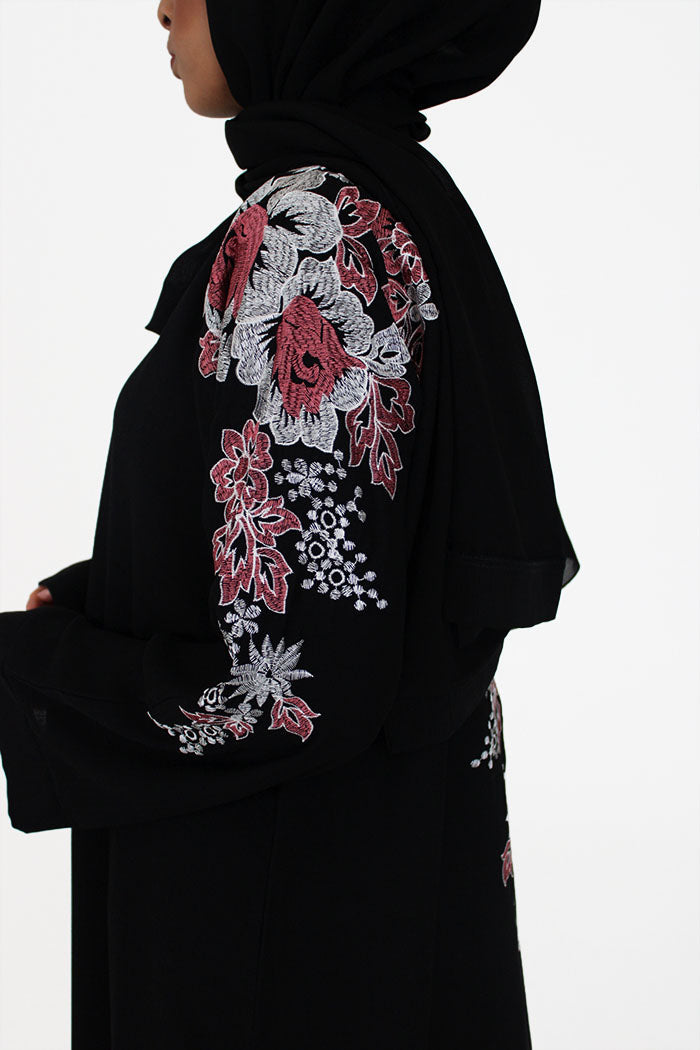
The featured ready-made abaya illustrates decorative placement. The commissioning advice below concerns the arrangements you agree with your chosen maker; it is not an offer of a bespoke service from Amani’s.
Decide what “custom” means for this order
Ask the maker to describe the service rather than relying on the word alone. One business may shorten an existing style; another may adjust a standard pattern to your measurements. A more extensive commission may involve developing a new shape and arranging fittings. These are different amounts of work, and they do not necessarily include the same opportunities to change your mind.
Write down the changes you actually need. “The usual size is comfortable through the body, but I need a longer sleeve” is more useful than “I want a perfect fit”. A simple alteration to an established design might answer the first request. Combining a new collar, a different sleeve, concealed pockets and an unfamiliar fabric is a more involved project.
It also helps to name the garment accurately. Is this a closed dress, an open outer layer or a coordinated set? Our guide to different abaya cuts and styles can help you describe the outline before you discuss individual details.
Measure from an agreed starting point
Get the maker’s measurement instructions first. A shoulder measurement taken across a garment is not interchangeable with a measurement taken around the body. Likewise, a finished sleeve measured from the shoulder seam cannot be compared directly with a sleeve measured from the centre of the neck.
For Amani’s abaya sizing, the familiar numbers such as 52, 54 and 56 refer to length in inches from the shoulder towards the feet. They are not the wearer’s total height. When commissioning elsewhere, confirm the maker’s own convention and the exact start and end points they require. Do not estimate an abaya length by subtracting a fixed number of inches from your height.
Stand naturally in the footwear you expect to wear. Ask someone to help with a long vertical measurement so you are not bending forward to reach the tape. The intended hem might be different for an everyday walking outfit and a garment reserved for an indoor occasion. Explain that preference rather than leaving the maker to infer it.
A favourite abaya is a useful second reference. Lay it flat without stretching it and photograph the tape at the requested points. Record its finished length, sleeve length and body width, then explain what you would retain or change. Keep these garment measurements separate from your body measurements in the message.
Never add an unexplained allowance to a measurement. Give the actual measurement using the agreed method, then describe the ease you want. Otherwise, both you and the maker may add extra room, or neither of you may allow enough. Ask the maker to confirm the proposed finished measurements before production begins.
Describe movement, not just appearance
An abaya can look loose while still restricting the upper arms. It can also have generous sleeves that become awkward at a desk or sink. Think through a few movements from your own day: reaching forward, sitting down, putting on a coat and carrying a shoulder bag.
Tell the maker where you need space and where you prefer a neater finish. For example: “I would like room through the upper arm, with a wrist opening that does not fall over my hands.” That request describes a function without demanding a particular cuff construction.
Check the neckline and head opening, too. A pullover style must go on and come off comfortably. An open-front design needs enough overlap or suitable fastening if you expect it to remain closed. Photographs rarely show how these points behave during dressing or movement.
There is no need to choose a cut according to a rigid body-shape rule. The relevant questions are where the garment fits, how it hangs and what you want covered. A comparison garment that already works for you is usually a better starting point than a label such as “pear-shaped” or “petite”.
Choose the actual fabric, not just the colour name
Request the fibre composition, a description of the weight and information about lining. A photograph of a flowing garment does not establish whether the fabric will feel light, warm, smooth or slightly textured. Ask for a short video showing the chosen cloth moving, and obtain a physical swatch where practical.
Colour names can be particularly unhelpful. One maker’s stone might be another’s warm grey. Use a reference to explain the colour family, but do not assume that a screen image can guarantee an exact match. Where colour is essential, such as coordinating with an outfit already owned, compare a physical sample in the lighting in which the garments will be worn.
Discuss the whole outfit. A sheer outer fabric may be suitable over an opaque dress, but that does not make it suitable as a single layer. Ask whether the lining covers the sleeves as well as the body and whether it changes the intended drape. A beautiful outer fabric can feel quite different when paired with a firm lining.
Care is part of the fabric decision. A garment needing specialist cleaning may suit an occasional outfit but not a piece you intend to wear several times a week. Agree on the finished garment’s care requirements, including its trim, rather than choosing by the fabric name alone.
Turn the details into a short design brief
Put the final choices in one message or document. Include the agreed style, fabric, colour, measurements, lining, closure, sleeve finish and intended hem. Number your photographs and label the feature you are referencing in each one. A useful instruction might be: “Photograph two shows the pocket position only; keep the straight sleeve from photograph one.”
Separate essentials from preferences. Perhaps the length and concealed zip are essential, while the exact button shape is flexible. This gives the maker room to propose a sensible solution without changing something that matters to you.
For embroidery or embellishment, confirm placement and scale. “Small detail at the wrist” leaves considerable room for interpretation. Ask how far the decoration extends, whether it appears on both sleeves and whether it is visible on the back. A simple marked-up sketch can prevent an expensive misunderstanding.
Settle what is included. An outfit photograph may show a scarf, inner dress or belt that is not part of the commission. List every component you expect to receive, including whether a belt is removable and whether pockets are present on one or both sides.
Agree on the practical arrangements before paying
Ask for the total price, what it covers and the stages of payment. Check the available payment methods directly with the maker; cash on delivery is not a universal feature of custom orders. Retain the invoice and the final agreed specification together.
For an occasion, distinguish the production deadline from the delivery date you need. Leave room in your own plan for trying the garment on and arranging any agreed adjustments. Ask what happens if the fabric becomes unavailable, rather than assuming that a substitute will be identical.
Read the maker’s stated cancellation, adjustment and return arrangements. This is not the point to guess which rules apply to a personalised order. Get the relevant terms in writing, and ask a direct question where the wording is unclear. In particular, establish how an error against the agreed specification would be handled and what changes would count as a new request.
A written brief you can adapt
Keep the final specification separate from the conversation in which you explored ideas. A single dated message gives both you and the maker something definite to check. Fill in the details you have actually agreed; leave an unresolved choice clearly marked as a question rather than allowing a guessed answer to become an instruction.
Garment and purpose: “One closed everyday abaya for work and travel. I prefer a loose straight body, a manageable wrist opening and no decoration at the shoulder where my bag strap rests.” Describe your own use rather than copying this example unchanged.
Measurements: list the maker’s requested body measurements and the comparison garment’s finished measurements in separate sections. Include the unit and measuring route beside each figure. Add a note about which measurements the maker will use to determine ease; do not silently mix your own allowances into the figures.
Materials and components: record the exact fabric reference, agreed colour, lining coverage, closure, pockets and supplied extras. Identify any sample you approved. If there are reference photographs, label the feature being requested in each so an image of a sleeve does not become approval of an entire copied design.
Delivery and adjustments: record the agreed price and payment stages, the date you need the garment, the maker’s stated dispatch arrangements and the process for raising a discrepancy. Ask the maker to confirm this version of the brief before production. An unanswered message is not the same as a confirmed specification.
If either party proposes a change later, write down what changes, what stays the same and any effect on the price or timing. Request confirmation before assuming a substitute cloth or fastening is equivalent. This keeps the original discussion from becoming a collection of conflicting instructions scattered across messages.
On arrival, check the garment against that final agreed version, not against an earlier idea you later changed. Where there is a difference, describe it with a measurement or clear photograph. Where the specification is met but you would now prefer a different feature, explain that as a new preference rather than presenting it as the same issue.
Try it on systematically when it arrives
Begin with the agreed outfit and shoes, not whatever happens to be nearby. Check the specification, then wear the abaya long enough to sit, walk and move your arms. Look at the front, sides and back. A pocket that appears neat while empty may pull differently with a small everyday item inside.
Keep any tags attached and avoid washing, wearing outdoors or altering the garment until you have checked the maker’s process for reporting an issue. Photograph the relevant measurement using the same method agreed at the start. “The finished sleeve measures this against the specified length” gives a much clearer basis for discussion than a photograph taken from an uncertain angle.
For the broader fit questions that apply to ready-made pieces as well, see our abaya sizing and fabric guide. A successful custom order is not the one with the longest list of decorative choices. It is the one where the finished garment answers the needs you described, and the details have been agreed clearly enough for that result to be checked.