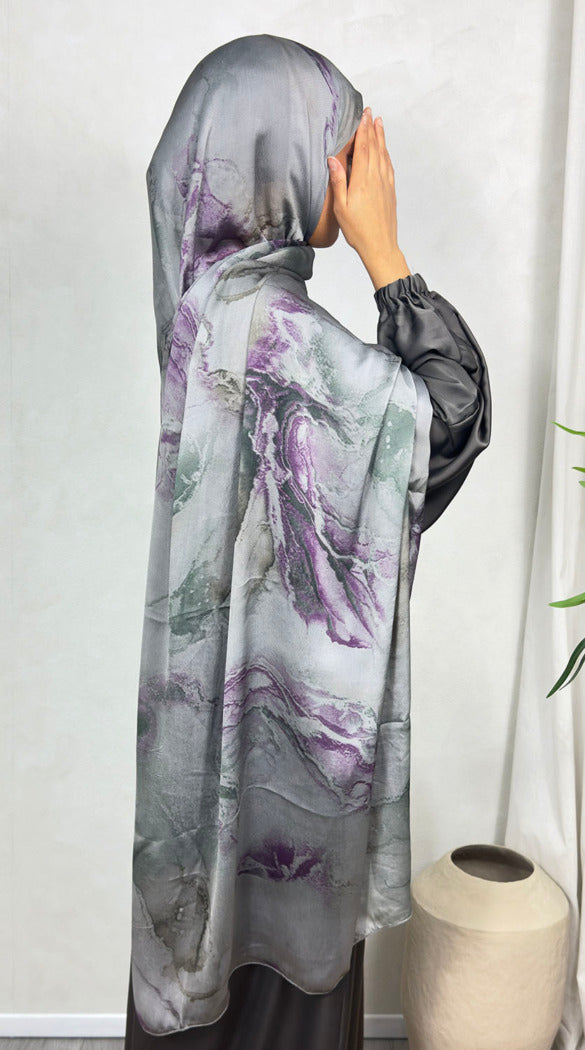
What Makes a Jilbab Style Idea Work in Real Life Once the Shape Has to Move, Sit and Layer Properly?
A jilbab can look lovely in a photograph and strangely unresolved five minutes after you put it on. Nothing is necessarily wrong with the garment. The colour may suit you, the detail may be beautiful and the coverage may be exactly what you wanted. Yet the whole look can still feel as if several ideas arrived at once and none of them agreed on what the jilbab was meant to be.
That is the part of jilbab styling I find most interesting. Style is not simply a list of decorations you can add. It is the relationship between the garment's line, the amount of visual volume, the way the fabric falls, the position of detail and the way your eye travels from the head and shoulders to the hem. A small change in one place can make the rest feel calmer. A second decorative idea can make a previously elegant jilbab look busy. A sleeve with a strong shape can make extra embellishment unnecessary. A very plain garment can look distinctive because its proportions are so clear.
So this is not a page of poses to copy. It is a way to look at style ideas and decide which ones actually belong on the jilbab in front of you. The aim is not to make modest clothing visually timid. A jilbab can feel soft, striking, feminine, modern, playful, formal or beautifully minimal. The point is that its character should come from decisions that work together rather than from detail being added until the garment looks fashionable enough.
If you are still deciding what kind of jilbab construction suits you, the complete jilbab guide is the better place to compare the broader garment families first. Here, I am staying with the visual question: once you have a jilbab, how do you make its shape and styling feel intentional without asking every part of the outfit to compete for attention?
Style starts with the silhouette you can still read from across the room
Before looking at embroidery, cuffs, scarf arrangement or accessories, stand far enough from the mirror that small details disappear. What remains is the silhouette. You see the width through the shoulders, the amount of volume through the body, the line of the sleeves and the way the hem meets the floor. That outline is the visual foundation of the jilbab, and every later styling decision either supports it or interrupts it.
A very fluid jilbab often looks strongest when the eye can follow one continuous fall of fabric. If you add a highly structured bag, a stiff outer layer, a bulky shoulder detail and a complicated head arrangement, the fluidity can disappear even though the garment itself has not changed. A more architectural jilbab, by contrast, may already have a strong sleeve shape or defined panel. It can carry a little more visual weight because the structure gives the eye somewhere clear to settle.
This is why two women can use the same styling idea and get completely different results. The idea is not floating separately from the garment. It lands on a particular silhouette. A neat cuff detail on a narrow, controlled sleeve may look beautifully deliberate. The same detail on an extremely wide sleeve might vanish in the volume or make the wrist area feel heavy. A decorative border that looks balanced on a straight fall can distort when it sits on deep gathers.
Try describing the outline in one sentence before you style it: long and fluid, wide and dramatic, softly gathered, straight and minimal, or perhaps generous through the body with quiet sleeves. The description does not have to be technically perfect. It simply gives you a visual truth to protect. If the next styling idea contradicts that truth, you can ask whether the contrast is interesting or merely distracting.
There is also something freeing about beginning here. You do not need a new detail every time you want the jilbab to feel different. Sometimes letting the silhouette show clearly is the styling. A clean fall, an uncluttered upper line and a hem that moves well can look more finished than an outfit with five visible ideas.
Decide what the eye should notice first
Most coherent outfits have a first point of attention. It might be the sweep of the garment, a beautiful sleeve, a line of embroidery, an unusual cuff, a gentle drape around the shoulders or simply the way a plain jilbab falls. Problems begin when every element is trying to become that first point at the same time.
Imagine a jilbab with embroidered sleeves. If the embroidery is already expressive, a heavily detailed bag, bright contrasting layers and an elaborate head arrangement may all compete with it. None of those things is wrong on its own, but together they can flatten the effect because the eye does not know where to rest. Reducing one or two elements often makes the embroidery look more luxurious, not less.
The reverse is useful too. If the jilbab is very plain, you may decide that the sleeve line is the feature, or perhaps a quietly shaped bag provides the only contrast. You do not have to compensate for plainness by filling every empty space. Empty visual space is part of composition. It allows a modest garment to feel calm and gives a deliberate detail more importance.
A good practical question is: if someone remembered one visual thing about this outfit, what would I want it to be? The answer can be as simple as “the long soft line” or “the embroidered cuffs”. Once you know that, other decisions become easier. The supporting pieces do not need to disappear, but they should not shout over the main idea.
This approach also keeps personal taste at the centre. One woman loves delicate feminine detail. Another feels most herself in a spare, almost architectural look. A third likes a little drama at the sleeve or hem. There is no need to force everyone into the same aesthetic. The useful principle is hierarchy, not sameness. Give your favourite idea room to be seen.
A beautiful detail needs somewhere to live
Decoration looks most convincing when it appears to belong to the structure of the garment. That can mean embroidery following a cuff, a narrow trim echoing a vertical seam, or a small motif placed where the fabric naturally lies flat enough for it to be read. Detail becomes awkward when it is scattered without regard for the way the jilbab folds and moves.
Think about the difference between placing decoration on a calm area and placing it on an area that is already doing a lot. Deep gathers create their own rhythm. A wide sleeve creates changing folds every time the arm moves. If intricate motifs sit directly over those areas, they may bend, disappear and reappear in a way that makes the design feel restless. A quieter panel can give the same decoration a clearer frame.
Scale matters as well. Tiny repeated embellishment can look fussy across a very large garment if there is no break. One larger, thoughtfully placed feature may feel more confident. Equally, an oversized decorative band can overwhelm a delicate silhouette. Hold the garment at a distance and ask whether the detail reads as part of the whole or as something pasted on afterwards.
Placement can also affect how the garment feels on your body. Heavy beadwork at a wide cuff changes the way the sleeve hangs. Dense embroidery at the hem can add stiffness or weight. That does not mean you should avoid those details, only that style has a physical consequence. If the detail changes the garment's movement, include that change in your judgement rather than evaluating the decoration in isolation.
The most elegant decorative choices often have a kind of restraint to them. You notice that someone decided where the detail should stop. That stopping point is important. It protects the garment from becoming visually crowded and allows the modest silhouette to remain legible.
Sleeves can change the whole mood without changing the rest of the jilbab
Sleeves carry more character than we sometimes give them credit for. A straight sleeve feels different from a softly widening one. A gathered cuff feels different from a clean wrist line. A layered or flared sleeve can make a jilbab feel romantic, while a simple controlled sleeve can make the same body shape feel much more minimal.
Because sleeves move constantly, they attract attention naturally. That makes them a useful place for one expressive idea, but it also means they do not need much help. If the sleeve already has volume, a dramatic cuff, dense trim and several bracelets may create too many moving points. If you like a decorative cuff, consider keeping the rest of the sleeve quiet so the detail appears deliberate each time your hand moves.
Practicality belongs in the styling decision too. A sleeve that looks graceful with the arm held down needs to make sense when you reach, carry a bag or sit at a table. If a styling idea requires you to keep rearranging the sleeve, it has not fully succeeded. The best visual choices still work when the garment behaves like clothing rather than a photograph.
You can use the sleeve to balance the body of the jilbab. A very full body may look calmer with a sleeve that has some control at the wrist. A straighter body can sometimes take a little more sleeve expression. This is not a fixed formula. It is a balancing tool. Look at how much volume exists in the entire outline rather than treating each section separately.
If you are drawn to “fancy” jilbab ideas, sleeves are a good place to test what fancy actually means to you. It may be embroidery. It may be a beautiful shape. It may simply be a soft layered edge. Defining the word for yourself prevents you from adding every possible decorative sign at once.
Volume should look deliberate, not accidental
Generous fabric is part of the visual language of many jilbabs, but volume can appear either graceful or confused depending on where it gathers. The difference is often not the amount of fabric. It is whether the eye can understand where that fabric is meant to fall.
Start at the upper body. If there is fullness at the shoulders, check whether it drops cleanly or bunches because of a bag strap, underlayer or outer garment. Then look at the sides. Do the folds fall in long lines, or do they collect around one hip because something underneath is catching them? Finally, look at the hem. A full jilbab needs enough room to move without the bottom becoming a heap of unrelated folds.
Styling can exaggerate accidental volume. A cross-body strap can divide a wide front panel and make fabric balloon on either side. A bulky shoulder bag can lift one side. A thick layer under the upper body can make a naturally soft shape look stiff. Before deciding that the jilbab is “too big”, remove the extra pieces and see what its own volume looks like.
Deliberate volume also benefits from calm detail. If the garment already has a dramatic width, you may not need a dramatic print and dramatic sleeve at the same time. Letting one kind of scale dominate can make the whole outfit feel stronger. A large silhouette with tiny, scattered decoration can sometimes look visually noisy because the scales are fighting. A large silhouette with a single controlled detail often looks more resolved.
There is no requirement for every jilbab to look narrow or streamlined. The point is not to reduce fabric until it resembles another garment. It is to respect the volume you chose and style around it so the shape reads as generous by design rather than as fabric that has simply accumulated.
“Cute” works better through proportion than through piling on decoration
The word “cute” can sound too vague to be useful, yet many women know exactly what they mean by it. They are not necessarily looking for childish detail. Often they mean a jilbab that feels soft, approachable, feminine and a little playful. The quickest way to lose that feeling is to assume it requires bows, frills, prints, embroidery and matching accessories all at once.
Proportion can create softness more quietly. A gently rounded sleeve, a neat cuff, a subtle gathered line or a small repeated motif can give the garment warmth without overwhelming its modest shape. So can the relationship between the head area and the body. If the upper line is clean and the fabric falls softly from it, the whole jilbab can feel light even when the colour is deep or the garment is plain.
Scale is especially important with playful details. A tiny motif repeated over a large area can begin to look busy. A slightly larger motif with more space around it may feel calmer. Likewise, a delicate trim can be charming when it has a clear stopping point, but less convincing when it travels around every edge simply because it can.
It helps to separate “sweet” from “small”. You do not need to make the silhouette visually smaller to make it feel feminine. A full, generous jilbab can still have softness through drape, rhythm and detail placement. In fact, the contrast between a strong modest silhouette and one restrained delicate feature can be beautiful.
If you are building a cute jilbab look, try removing one decorative element before you leave the mirror. If the outfit becomes clearer and the remaining detail feels more noticeable, you have probably found the right edit. The charm is still there, but it has room around it.
Embroidery is strongest when it follows the garment instead of fighting it
Embroidery can completely change the character of a jilbab. A narrow line at the cuff may make a plain garment feel special. A border at the lower edge can add formality. A motif placed on a stable panel can create a focal point. What makes embroidery feel expensive or thoughtful is not simply how much of it exists. It is how convincingly it belongs to the shape beneath it.
Look at direction first. Vertical embroidery can reinforce length. A horizontal border can emphasise width. Curved motifs can soften a straight garment. Repeated motifs can create rhythm. None of those effects is automatically good or bad, but they should be chosen knowingly. If a very wide jilbab already feels expansive, a broad horizontal band may make that quality even stronger. If that is not the effect you want, a narrower or more vertical placement may sit more naturally.
Then look at density. Dense embroidery has visual weight even if the thread itself is light. A large area of dense stitching can become the dominant feature of the outfit, which means other pieces may need to become quieter. Sparse embroidery behaves differently. It can act almost like punctuation, giving the eye a few deliberate stops without changing the whole mood.
Movement matters too. Embroidery across a heavily folded area can be difficult to read. It may look wonderful when the fabric is spread flat and fragmented when worn. That is one reason cuffs, borders and calmer panels often work so well. They give the stitching a predictable surface.
Finally, inspect the back and inside of any embroidered area you own. Styling is not only about the front view. Heavy threads, backing or beading can affect comfort and drape. Beautiful work is easiest to enjoy when the construction still lets the jilbab move as a jilbab.
Prints and motifs need breathing room
A printed jilbab arrives with its own visual activity already built in. That makes styling simpler in one sense because the garment supplies the interest, but it also makes restraint more important. If the print is busy, every added contrast becomes another voice in the same conversation.
Start by identifying the scale of the print. Large motifs need physical room to be seen. On a garment with many gathers, part of each motif may disappear into folds, which can make a very large print look broken. Small prints survive folds more easily, but a dense small print can create a lot of texture from a distance. Step back from the mirror and judge the overall effect rather than inspecting one flower or shape close up.
Spacing changes mood as much as the motif itself. A print with plenty of background space often feels calmer than one where every centimetre is filled. That calm can make a full silhouette feel lighter. A dense print can feel rich and energetic, but it may already be doing enough. In that case, simple sleeves and a quiet upper line can help.
If you are combining another visible layer, avoid the trap of trying to match every small colour or shape in the print. The eye does not need literal repetition to understand that pieces belong together. Sometimes repeating the visual mood is more effective than repeating a shade. Soft print, soft line. Crisp motif, clean accessories. Large-scale print, fewer competing details.
A printed jilbab should not need to apologise for being a print. Let it be the feature. The moment you stop trying to decorate around it, the shape often becomes easier to see again.
Modern styling is often about subtraction
“Modern” is one of those words that can become meaningless if it is treated as a collection of fashionable signs. A garment does not become modern because it has the latest sleeve, the current bag shape, a particular drape and whatever detail happened to appear repeatedly online that month. Often the most contemporary-looking outfits are the ones where unnecessary information has been removed.
Subtraction can mean choosing one clean sleeve instead of three layers of cuff detail. It can mean allowing an unusual silhouette to carry the outfit without embroidery. It can mean keeping the head and shoulder area uncluttered so a strong body shape is visible. It can also mean refusing to add a contrast just because the outfit seems “too plain” in the mirror.
This does not make modern synonymous with minimal. You can have a highly decorative modern jilbab. The distinction is that the decoration feels edited. There is a reason for where it begins and ends. The scale makes sense. The silhouette remains readable. You feel that someone decided what was enough.
Try taking a photograph of the outfit from several metres away. Your phone will flatten small detail and reveal the big relationships. If the upper half looks crowded while the lower half looks empty, perhaps one element can move or disappear. If the whole outfit looks like one block, perhaps a single controlled detail would help. If the silhouette already feels strong, you may discover that nothing else is needed.
A modern jilbab style should still feel like your clothing, not like a costume assembled from references. The best update is often the one that makes the garment easier to read and easier for you to wear.
A plain jilbab can be more distinctive than a busy one
Plain is not the absence of style. Plain makes proportion visible. When there is no print or heavy decoration to distract the eye, you notice the length of the sleeve, the width of the body, the fall from the shoulders, the rhythm of the folds and the quality of the hem movement. That can make a simple jilbab surprisingly expressive.
The temptation with a plain garment is to keep asking what you should add. Try asking the opposite question first: what is already good about this shape? Perhaps the sleeve is beautiful. Perhaps the fabric forms long vertical folds. Perhaps the head section creates a clean frame. Perhaps the generous body has a graceful swing. Once you identify that strength, you can protect it.
Small styling choices become more visible on a plain base, so they deserve care. A bag strap that cuts awkwardly across the front may stand out more. A bulky cuff underneath may distort the sleeve. An uneven hem may be more noticeable. This is not a disadvantage. It simply means the success of the look comes from line and finish rather than decoration.
Plain jilbabs are also useful for understanding your own taste. If you repeatedly feel happiest in a clean silhouette with one small point of detail, that is information. You do not need to chase every new design. If you keep wanting more texture, volume or embroidery, that is information too. Personal style becomes clearer when you can separate what you genuinely enjoy from what is merely visually loud.
There is a confidence in allowing a modest garment to be simple. The garment is not unfinished because it has room to breathe. Sometimes that room is exactly what makes it memorable.
Dress-like lines can work, but the jilbab should still read as one coherent garment
Some jilbabs have lines that feel closer to a flowing dress in the way the skirt moves, the way panels fall or the way sleeves are shaped. That can be beautiful, but the most successful versions still feel visually coherent. The styling should not split the garment into an upper “outfit” and a lower “dress” that seem unrelated.
A strong waist-like visual break, for example, can change how the entire garment is read. Even without a belt, a contrasting panel, dense band of decoration or cross-body strap can create a horizontal division. If the jilbab was designed to fall in one long modest line, that break may work against the shape. Sometimes moving a bag, reducing contrast or choosing a quieter placement restores the intended length.
Panels can do the opposite. A well-positioned vertical panel can emphasise the long fall and make a dress-like jilbab feel elegant without needing extra detail. The same is true of pleats or seams that guide the eye downwards. These features are already style. They do not necessarily need to be decorated as well.
Be careful with labels too. A product may be described with words such as dress, gown, maxi or jilbab depending on the seller, language or audience. For your own styling, look at the actual garment in front of you. Where does the fabric begin to widen? How is the upper body covered? What do the sleeves do? What happens in movement? The physical answer is more useful than trying to style according to a label.
If the garment feels graceful because of its long dress-like movement, let that movement remain visible. Your styling can support the quality you already liked instead of turning it into something else.
The head and shoulder line can become crowded surprisingly quickly
The upper part of a jilbab occupies a small visual area but carries a lot of information. There may be an integrated head section, an additional scarf arrangement, folds around the shoulders, a coat collar, a bag strap and perhaps decorative sleeve detail entering the same frame. A look can become crowded there long before the rest of the jilbab feels busy.
Stand in front of the mirror and look only from the top of the head to the upper chest. Are there several edges crossing one another? Do layers bunch at the shoulders? Is a strap pulling one side higher? Does a decorative feature start immediately below an already complex head arrangement? If so, the solution may simply be to clear one line.
A clean shoulder fall gives the rest of the garment a stronger beginning. It lets volume below look intentional rather than like fabric emerging from a knot of layers. This is particularly important with very full jilbabs, because the eye needs a stable place from which to understand the width.
You do not need to flatten every fold. Soft fabric naturally moves and gathers. The goal is not a rigid surface but a legible one. If several pieces are present, give them separate jobs. Let the head covering sit securely. Let the shoulder line fall. Let the bag sit where it does not distort both. Once each element stops interfering with the next, the styling looks calmer.
This is also where trying to reproduce an image exactly can fail. The model may be standing still with the shoulders arranged for a photograph. Your version has to survive turning, carrying, sitting and walking. The upper line that stays calm in real life is more valuable than the one that only looks perfect for a second.
Length and hem movement are part of the aesthetic
We often talk about length as a measurement problem, but length changes style too. A jilbab that finishes cleanly and moves just above the point where it catches underfoot has a different visual rhythm from one that pools heavily. A slightly shorter practical fall creates a different impression from a long sweeping line. Both can look intentional when the proportion suits the garment and the wearer's needs.
Watch the hem while you walk rather than only while you stand. Does it move as one broad line? Do certain panels kick forward? Does one side appear longer because a bag or shoulder position is pulling the garment? Does the back catch? The hem is the final line of the silhouette, so uneven movement can make the whole look feel less settled.
Decoration at the hem amplifies this. A border draws the eye directly to the lower edge. If the length is difficult to manage or the fabric folds unevenly, that border may emphasise the problem. A plain hem is more forgiving. If you love a detailed border, it is worth checking how it behaves on stairs, in a normal stride and when sitting.
Footwear can change the visual relationship too, even when very little of it is visible. Sole height alters where the hem sits. A pair you wear frequently should be part of the home test. The point is not to coordinate every shoe with every jilbab, but to avoid judging length in bare feet and then discovering that the garment behaves differently in real life.
When the hem moves well, the entire jilbab looks more graceful because the eye receives a clean ending. That final few centimetres can matter as much as a much more obvious decorative feature.
Everyday style and occasion style need different kinds of visual strength
An everyday jilbab usually has to survive more competing objects: coat, tote, backpack, shopping bag, umbrella, pram, lanyard or whatever belongs to your routine. An occasion outfit may be worn in a more controlled setting, with fewer practical layers and more room for a decorative feature. The same styling decision can therefore look calm in one context and overloaded in another.
For everyday wear, I like to think in terms of durable visual choices. A sleeve shape that still looks good after a coat comes off. A motif that does not depend on perfect draping. A silhouette that remains clear with a bag. A detail that does not require constant arranging. These are not boring choices. They are designs that survive contact with life.
For an occasion, you may choose a stronger cuff, richer embroidery or a more dramatic fall because the jilbab will not be carrying the same practical burden. Even then, the principle of hierarchy still helps. If the sleeve is the feature, let it be the feature. If the hem has beautiful work, give it enough visual quiet above. Occasion styling can be special without every surface becoming special at once.
It is also useful to consider photographs realistically. Occasion clothes are often photographed more, which can tempt us to judge them only from the front. Look at the side and back too. Turn, sit and walk. A coherent jilbab should not lose its shape the moment you stop facing the mirror.
Style gets more satisfying when you stop asking whether an outfit is “dressy enough” and start asking whether the level of detail suits the way you will actually wear it.
A style idea should survive sitting, walking and carrying a bag
The quickest test for a style idea is movement. Put the outfit on, then stop posing. Sit in a normal chair. Stand up. Walk quickly. Reach for something. Carry the bag you genuinely use. If the visual effect depends on you holding the garment in one particular position, you have learned something important.
Cross-body bags are especially revealing because the strap creates a strong diagonal line across a garment that may have been designed around long vertical or softly widening lines. Sometimes the contrast looks sharp and intentional. Sometimes it divides the jilbab awkwardly and gathers fabric underneath. A shoulder bag changes the upper line differently, while a backpack can pull the garment backwards.
Rather than declaring one bag type correct, judge the result. Does the strap interrupt the main feature? Does it crush embroidery? Does it pull a sleeve or shoulder out of balance? Does removing the bag instantly restore the silhouette? If yes, you may simply need a different carrying position for that jilbab.
Sitting reveals another issue: where volume collects. A very full garment may spread beautifully when standing and bunch around the lap when seated. If decorative panels or trims are placed there, they may twist. This does not mean the garment has failed. It means the styled look needs to accept what the fabric does in ordinary positions.
The strongest jilbab style ideas are not fragile. They do not require you to manage the garment every few minutes to preserve an image. They continue to make sense while you are doing the things you wore the jilbab to do.
Use inspiration photographs for questions, not instructions
A photograph can be useful without becoming a template. Instead of asking “How do I make mine look exactly like this?”, ask what the image is actually showing you. Is the effect coming from sleeve volume? A long uninterrupted line? Sparse embroidery? A clean head and shoulder area? A particular proportion between upper and lower volume? Once you identify the principle, you can decide whether it suits your own jilbab.
Photographs hide a lot. You cannot always see how much fabric was clipped or arranged out of view. You may not know the model's height, the garment size, the weight of the material or whether the pose was held for three seconds. A still image also removes the biggest test of a jilbab: movement.
This is why copying several visible details at once often disappoints. You reproduce the cuff, add a similar bag, arrange the upper section in the same direction and wonder why the outfit feels different. The original effect may have come mainly from the garment's proportions. Your jilbab may have a different width or fall, so the copied details are now sitting on a different foundation.
Use images to expand your visual vocabulary. Notice what you respond to. Save the concept in your mind rather than the exact arrangement. “I like the quiet sleeves with the fuller body” is more transferable than “I need that exact sleeve”. “I like how the embroidery has space around it” teaches you more than copying the motif.
Inspiration becomes genuinely useful when it helps you see your own clothes more clearly. It should give you better questions, not make you feel that your jilbab is wrong because it does not reproduce someone else's photograph.
Build a style vocabulary that is more useful than “nice” or “trendy”
It is difficult to develop personal style if every successful outfit is simply “nice” and every unsuccessful one is “not quite right”. More precise words help. Try describing a jilbab as fluid, crisp, soft, architectural, romantic, minimal, playful, formal, grounded, airy, graphic or delicate. You do not need to become a fashion critic. You are just giving yourself language for what you already see.
Once you have two or three words, test whether the details agree with them. A fluid, quiet jilbab might not need a very rigid accessory across the front. A graphic jilbab can sometimes carry a sharper cuff. A romantic jilbab may benefit from soft repeated curves rather than a hard block of trim. A minimal garment might look strongest with absolutely nothing added.
Words also make shopping less impulsive. If you know that you consistently enjoy long, fluid silhouettes with one restrained detail, a heavily decorated design may be beautiful without being right for your wardrobe. Recognising that difference is useful. Admiration does not have to become a purchase.
Your vocabulary can change over time. You may move from very decorative jilbabs towards quieter ones, or rediscover embroidery after years of plain pieces. Personal style is not a contract. The point is to notice what you genuinely enjoy now rather than borrowing a trend label and hoping it explains your taste.
This language is particularly helpful when two jilbabs are both attractive but one feels more like you. You can articulate why. That clarity makes styling faster because you are no longer adding random details in the hope that the outfit will suddenly become personal.
Ignore old year labels and look at the proportion underneath
Style images often arrive with dates attached to them: a look from several years ago, a “new” design that is no longer new, or a trend described as if it belongs to one season forever. Dates can make perfectly wearable ideas feel obsolete for no good reason. Proportion is a better judge.
Ask whether the silhouette still looks balanced. Does the sleeve relate well to the body? Is the decoration placed thoughtfully? Does the length work? Is the upper line clear? If those relationships are strong, the garment does not suddenly become visually incoherent because a caption once included a year.
Some details do become closely associated with a moment in fashion, and you may simply stop enjoying them. That is fine. But distinguish “I no longer like this” from “I am not allowed to like this because it is old”. The first is personal taste. The second can send you into constant replacement even when your clothes still feel beautiful and useful.
You can often refresh an older jilbab by editing the surrounding styling rather than altering the garment. Remove a decorative layer that once felt necessary. Change the bag position. Let a strong sleeve stand on its own. Simplify the upper area. The same jilbab can look more current because the composition is calmer.
Good proportion has a longer life than a trend label. If the shape still makes sense and the garment still serves you, it deserves to be judged on what it is now.
The one-strong-decision method stops a look becoming overworked
On mornings when nothing seems to look right, I use a very simple edit: choose one strong decision and make the rest support it. The decision might be “wide sleeves”, “embroidered cuffs”, “a very clean silhouette”, “a soft full fall” or “a graphic print”. It does not matter which. What matters is that the outfit has a centre.
Once you choose it, look for anything that competes. If the strong decision is embroidery, perhaps the bag should not cover it. If the decision is dramatic sleeve volume, perhaps the upper section can stay quiet. If the decision is minimalism, perhaps the urge to add a decorative accessory is simply nervousness about empty space. If the decision is a print, another visible pattern may be unnecessary.
This method is useful because it does not prescribe a specific aesthetic. A maximalist can still use it. Her one strong decision may be a rich embroidered panel, supported by several related details. A minimalist can use the same method with a clean fall. The principle is coherence, not austerity.
It also prevents the common sequence where you dislike one small thing, add something to fix it, then add another thing to balance the new addition. Soon the original problem is buried under three solutions. Returning to one strong decision strips the outfit back to its purpose.
Before leaving the mirror, say the decision out loud or in your head. If you cannot tell what it is because five elements are equally loud, remove or quieten one. The result often looks more confident immediately.
A four-question mirror edit is enough
You do not need a complicated styling checklist. Four questions can reveal most of what matters. First: can I still see the main silhouette? Second: where does my eye land first? Third: is any detail fighting the movement or fold of the garment? Fourth: will this still look coherent when I stop standing still?
The first question protects the jilbab's shape. If straps, layers or details have broken the outline into confusing sections, reset them. The second checks visual hierarchy. If your eye jumps between four equally strong areas, decide which one should lead. The third catches decoration that sits awkwardly across gathers, sleeves or hems. The fourth brings real life back into the room.
Do the edit quickly. Styling can become less useful when you stare at the outfit for twenty minutes and begin inventing problems. Walk away from the mirror, return and look once. The first thing you notice is often more informative than a long inspection.
If something feels wrong but you cannot name it, remove an accessory or extra visible layer and look again. If the jilbab suddenly makes sense, the added piece was interrupting the composition. If it still feels wrong, the issue may be the garment's own proportion or simply that the design is not to your taste.
There is no prize for forcing yourself to like a style because it is popular. A mirror edit should help you make the jilbab feel more like your clothing, not grade you against somebody else's idea of fashion.
Buying style is easier when you can separate design from styling
A product page can show a jilbab arranged beautifully, but the styled photograph may include choices that are not part of the garment itself. Before you fall in love with the whole image, identify what you are actually buying. Is the feature you like the sleeve construction, the embroidery, the width, the print or the way the model's layers have been arranged?
This distinction saves disappointment. You may discover that the garment is much plainer than the photograph suggested, which is not a problem if you liked the silhouette. Or you may realise that the detail you loved is an accessory rather than part of the jilbab. Read the description and inspect multiple images instead of assuming the complete styled scene comes with the item.
Pay particular attention to views that show the garment without dramatic movement. A twirl can make volume look beautiful but hide where the fabric actually begins to widen. A close crop can highlight embroidery while hiding the whole proportion. A front view may not show the back fall. The more angles you can see, the easier it is to judge the design rather than the pose.
Once you know what the garment itself contributes, you can ask whether it belongs with what you already wear. A jilbab with very expressive sleeves may not need the detailed outer pieces you normally use. A plain full jilbab may be exactly the base your wardrobe is missing. Buy the design you want to live with, not only the photograph you enjoyed looking at.
When you want to compare the current collection after doing that thinking, you can shop related styles and judge each live product by its own description and images. Stock, colours and specific designs change, while the proportion questions in this guide remain useful.
Style should make the jilbab easier to recognise as yours, not harder to wear
There is a practical kindness in knowing when an outfit is finished. You have chosen the jilbab, settled the shape, made one or two styling decisions and checked that everything moves. At that point, more editing may not improve it. It may simply make you more aware of yourself.
Personal style is partly repetition. You discover that you like a certain sleeve width, that you repeatedly prefer calm upper lines, that embroidery works for you when it is concentrated rather than scattered, or that plain jilbabs make you feel most at ease. Those preferences become recognisable because you let them repeat. You do not need to reinvent your modest clothing every morning to prove you have style.
There is also room for contradiction. You can usually prefer minimal pieces and occasionally love a richly detailed one. You can enjoy soft feminine lines one day and a stronger graphic silhouette another. Coherence happens within the outfit, not by locking your entire wardrobe into one personality.
The useful test is whether the style lets you move on with the day. If the sleeve detail keeps catching, the bag keeps destroying the line, the head area needs constant arranging or the hem only looks right when you stand carefully, the visual idea is asking too much. Change it. A modest outfit can be expressive without becoming demanding.
When the shape makes sense, style feels less like decoration and more like recognition. You look in the mirror and the garment reads clearly. Then you stop looking at it.
Frequently asked questions about jilbab style ideas
What makes a jilbab style look balanced rather than busy?
A balanced jilbab usually has a clear visual hierarchy. Let the silhouette lead, then choose one main detail such as sleeves, embroidery, print or a clean minimal line. If several features compete equally, remove or quieten one and check the outfit again from a distance.
How can I make a plain jilbab look stylish without adding lots of accessories?
Start with the garment's own strengths. Notice the sleeve shape, fall, volume and hem movement. A plain jilbab can look distinctive through proportion alone. If you add anything, choose one controlled detail that supports the silhouette rather than trying to fill every empty area.
What should I look for in embroidered jilbab designs?
Look at placement, scale and density as well as the embroidery itself. Work that follows a cuff, border or calm panel often reads more clearly than dense stitching across heavy gathers. Also check whether the embroidery changes the weight, stiffness or movement of the garment.
Are wide sleeves always more stylish on a jilbab?
No. Wide sleeves create a particular mood and add visual volume, but they are not automatically better. The sleeve should relate well to the body of the jilbab and still work when you reach, sit and carry things. A simple controlled sleeve can be equally elegant.
How do I make a cute jilbab look feminine without making it childish?
Use proportion and restrained detail rather than piling on decorative signs. A soft sleeve line, neat cuff, subtle motif or gentle gathered shape can feel feminine and playful. Give the detail enough empty space around it so the garment still looks composed.
Can a printed jilbab still look minimal?
Yes, if the print is allowed to be the main feature. Keep the surrounding lines calm, avoid competing patterns and notice the scale and spacing of the motif. A print with generous background space can feel particularly clean even on a full silhouette.
How can I tell if a jilbab style idea will work in real life?
Move in it. Sit, stand, walk quickly, reach and carry the bag you normally use. Watch what happens to sleeves, folds, straps and the hem. A strong style idea should still look coherent when the garment is behaving like clothing rather than being held for a photograph.
Do older jilbab styles automatically look dated?
No. Look at proportion before the date attached to an image. If the silhouette is balanced, the detail is well placed and the garment still suits you, it can remain visually strong. Sometimes simplifying the surrounding styling is enough to make an older piece feel fresh.
How should I choose between a detailed jilbab and a simple one?
Think about what you repeatedly enjoy wearing and what the rest of your wardrobe already does. A detailed jilbab may provide the focal point by itself. A simple one gives more attention to silhouette and can be easier to style in different ways. Choose the design you will enjoy living in.
What is the easiest way to edit a jilbab outfit before leaving home?
Ask four questions: can you still read the silhouette, where does your eye land first, is any detail fighting the folds or movement, and will the look survive ordinary activity? If one element disrupts more than one answer, remove or reposition it first.
The strongest style idea is the one the jilbab can carry naturally
A jilbab does not need to be visually quiet to be coherent, and it does not need to be heavily decorated to feel special. It needs its decisions to belong together. Start with the silhouette. Decide what should lead. Give embroidery or print enough room to be understood. Let sleeves contribute without turning every moving edge into a feature. Respect the hem. Keep the head and shoulder area clear enough that the body of the garment still has a beginning.
Most importantly, test the result in ordinary movement. The outfit should make sense when you sit, walk, carry a bag and turn away from the mirror. That is where style stops being an image and becomes clothing.
You may discover that your most beautiful jilbab is the plain one with exceptional proportion. Or the embroidered one where the work is concentrated at the cuffs. Or the full, playful one with one soft detail and nothing else competing. There is no single correct aesthetic. The common thread is intention you can actually see.
When shape and detail agree, the jilbab feels settled. You do not have to keep adding to it, explaining it or correcting it. It already knows what it is.