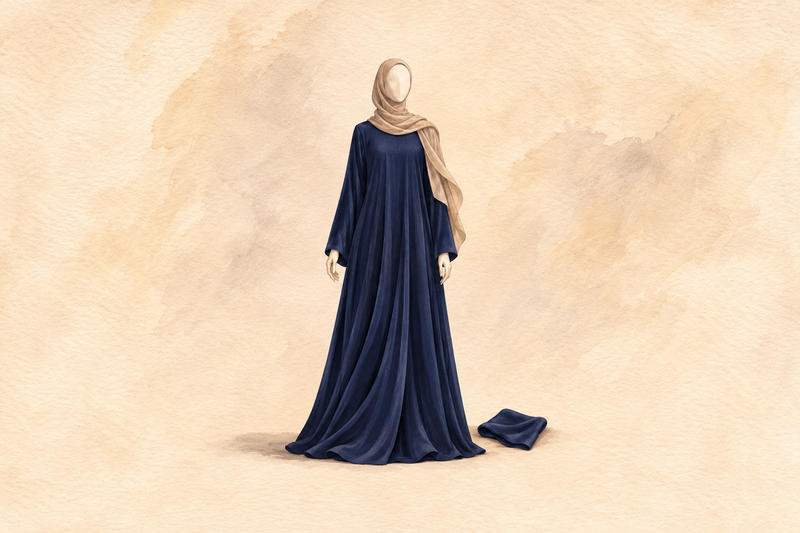
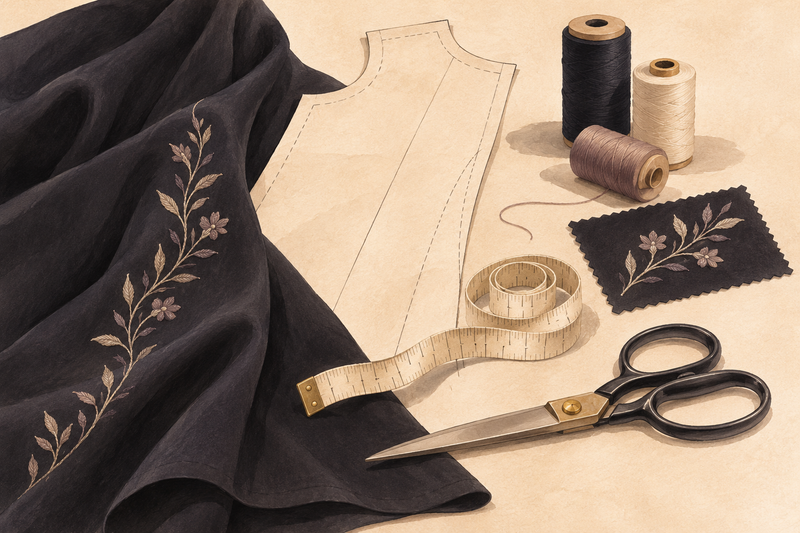
How Do You Choose a Patterned Abaya So Print Scale, Placement, Fabric and Hijab Pairing Stay Wearable Across More Than One Outfit?
A patterned abaya makes the most sense when it gives your wardrobe something useful that your plain pieces do not: easy visual interest, a ready-made outfit for particular occasions, or a change of mood without asking you to build a complicated look. The question is less about whether prints are “in” and more about whether the piece will earn its place in the way you actually dress. If you are still working out which cuts, fabrics and proportions suit you, our complete abaya guide gives you the broader foundation. Once those basics are clear, deciding whether a print belongs in your rotation becomes much simpler.
For some wardrobes, one thoughtfully chosen print becomes the abaya reached for whenever plain black, navy or brown feels a little too predictable. For others, pattern adds noise to a collection that already has plenty of colour, texture and detail. Neither approach is more stylish. A useful wardrobe is one in which each piece has a reason to be there, works with what you own and feels comfortable enough to wear repeatedly.
The short answer: choose pattern when it solves a wardrobe need
A patterned abaya is worth considering when you can name the job it will do before you buy it. Perhaps you need an effortless option for lunches, family visits or gatherings where you want to look considered without moving into heavily embellished occasionwear. Perhaps your everyday rotation is made almost entirely of solids and you want one garment that changes the feel of your outfits. Or perhaps you regularly wear neutral hijabs and simple shoes, so a printed outer layer gives you interest without requiring extra accessories.
That is a stronger reason than buying a print simply because it catches your eye for a moment. A beautiful design can still become wardrobe clutter if you have no setting in which you feel comfortable wearing it. The useful question is: “Can I picture at least three real occasions in the next few months when I would choose this over the abayas I already own?” If the answer comes easily, the piece has a plausible role. If you have to invent a different lifestyle to justify it, leave it.
It also helps to distinguish between liking a pattern and liking yourself in a pattern. You may admire large florals, geometric repeats or high-contrast motifs on a hanger yet prefer quieter clothing once dressed. There is no contradiction in that. Shopping well often means separating appreciation from ownership.
Start with the job you want the abaya to do
Before looking at print type, decide where the abaya sits in your wardrobe. An everyday piece has different demands from an occasional one. For regular wear, ease usually matters most: comfortable fabric, a print that does not feel too precious, colours that work with several hijabs, and a shape that survives ordinary days. For a special gathering, you may accept a more expressive motif, softer drape or a colour combination that works with only one or two accessories because you are not asking the garment to carry the same weekly workload.
Think in practical categories rather than vague labels such as “nice” or “dressy”. Is it for school runs and errands? Office or university days? Weekend visits? Travel? Eid lunches? Dinner invitations? A modest holiday capsule? Once the use is specific, the design choices become easier to judge. A small, low-contrast repeat may disappear into an everyday wardrobe more naturally than a sweeping botanical print. A bolder design may be exactly right when the aim is to make one garment feel complete without adding jewellery or extra layers.
There is also value in knowing what you do not need. If you already own several embroidered, colour-blocked or textured abayas, another visually active piece may compete for the same role. A new patterned abaya should ideally expand your options rather than create a slightly different version of a problem you have already solved.
Pattern makes particular sense when most of your wardrobe is plain
A solid-colour wardrobe creates natural space for one or two prints. If your staples are black, stone, taupe, chocolate, navy, olive or other easy neutrals, a print can act as a controlled point of difference while still working with the same shoes, bags and scarves. You do not need to reinvent your styling system around it.
This is one reason pattern can be surprisingly useful in a capsule wardrobe. People sometimes assume a capsule must contain only plain garments because solids combine easily. That is sensible when every piece needs to mix with every other piece, but an abaya is already a complete outer garment. It does not need to coordinate with multiple tops and skirts in the same way a separates-based capsule does. If the colours inside the print echo the neutrals you already wear, one patterned piece can create variety without adding many new items.
For example, imagine a wardrobe built around black, cream and muted olive. A print using those same three shades can feel distinctive while still accepting a black, cream or olive hijab. The print does the visual work, but the rest of your wardrobe remains useful. Compare that with a design containing five bright colours you never otherwise wear. It may be striking, but it could force you to buy or reserve accessories specifically for it.
The simplest test is to look at the pattern's background colour and two main motif colours. Can you already find suitable hijabs and footwear in your wardrobe? If yes, the piece is likely to integrate more easily.
It also works when you want one-step visual interest
Some women enjoy layers, accessories and detailed styling; others want to get dressed quickly and still feel put together. Pattern can serve the second group particularly well. A thoughtfully printed abaya can carry the visual interest of an outfit on its own, leaving the hijab, bag and shoes simple.
This does not mean the garment needs to be loud. A tonal print can create depth from a distance and reveal more detail up close. Soft abstract marks, narrow stripes, small botanical repeats or restrained geometric patterns can all make a single-piece outfit feel intentional without becoming the first thing everyone notices.
This can be useful on days when you do not want to think about matching multiple elements. Choose one colour from the pattern for the hijab, keep footwear neutral, and stop there. The result is often easier than styling an embellished solid garment because print creates interest without relying on beads, sequins, metallic trims or decorative hardware that may require more careful handling.
If simplicity is the goal, avoid buying a patterned abaya that only looks complete after extra styling. When the print, cut and fabric already work together, accessories should be optional rather than necessary.
When pattern is practical rather than purely decorative
Pattern has practical qualities too. Small or medium repeats can be forgiving during a long day because minor creasing is often less visually obvious than it is on a very smooth, pale solid fabric. A multi-tonal print may also feel less vulnerable to the tiny marks that make some people anxious about wearing light-coloured plain garments outside the house. That does not make print stain-proof, of course; fabric composition, colour and care still matter. It simply means visual texture can make ordinary wear feel a little less precious.
For travel, a printed piece can be useful when luggage space is limited. One abaya that looks different from your plain travel staples can make a small packing list feel less repetitive. The best travel print is usually one that coordinates with the same hijabs and shoes you were already taking, rather than one that demands its own accessories.
Pattern can also help you enjoy lighter shades if you usually avoid a large uninterrupted area of cream, beige or pastel. A darker motif breaking up the base colour may make the garment feel more wearable. Conversely, a light motif over a dark base can soften an otherwise very dark look without moving away from familiar colours.
These advantages are small, but that is exactly the point: a good wardrobe piece often wins through several modest practical benefits rather than one dramatic feature.
Choose the scale of the pattern for the way you like to dress
Print scale changes the whole character of an abaya. Small repeats tend to read as texture from a distance and can be easier to treat almost like a solid. Medium patterns are more visible while still feeling flexible. Large motifs create a stronger focal point and usually make the garment feel more expressive.
There is no universal rule saying one scale is more flattering or more modest than another. What matters is the effect you are comfortable with and how the pattern behaves across the garment's cut. A very large motif can look different once divided by seams, pleats or panels. A tiny busy repeat can become visually dense over a full-length garment even though the sample looked subtle in a close-up product image.
When shopping online, do not judge scale from a fabric photograph alone. Look for full-length images on a person or mannequin. Compare the motif to recognisable features such as a sleeve, cuff or shoulder width. This helps you understand whether the print will read as quiet texture or as the main statement of the outfit.
If this is your first patterned abaya and you are unsure, a low-contrast small-to-medium motif is often easier to integrate because it gives you some variation without changing your styling habits completely. If you already know that you enjoy expressive clothing, a larger motif may be the better purchase because it gives you the effect you actually want rather than a watered-down compromise.
Colour matters more than the name of the print
“Floral”, “geometric”, “abstract” and “stripe” are broad categories. Two floral abayas can behave completely differently in a wardrobe depending on their colour contrast. A black-and-stone botanical motif may work like a neutral; a coral, turquoise and yellow floral may become a dedicated occasion piece. The colour relationship is often more important than the motif label.
Start with the base. A dark base usually makes a pattern feel grounded, while a pale base can feel lighter and more seasonal. Then look at contrast. If the motif is only a little lighter or darker than the background, the overall effect is calmer. Strong contrast makes each shape easier to see and gives the garment more presence.
Next, identify the colours you would actually repeat near your face. You do not have to match your hijab exactly to a motif. In fact, exact matching can sometimes make the outfit feel overly coordinated. A related neutral, a softer version of one print colour or the background shade can be easier. The aim is to let the pieces belong together without making every colour announce that it was deliberately matched.
Finally, consider seasonality realistically. You can wear dark florals in summer and pale patterns in winter if the fabric works, but some colour stories naturally make you want to reach for them only at certain times. That is fine if you are buying an occasional piece. For a high-use wardrobe, choose a palette you would happily wear across more of the year.
Fabric and drape can make or break the print
Pattern is printed or woven onto a fabric, and the fabric still determines comfort, movement and how polished the finished garment looks. A beautiful motif cannot rescue a material that feels wrong for your climate, routine or preferences.
Soft, fluid fabrics allow motifs to move with the garment, which can make abstract or botanical designs feel gentle. More structured fabrics hold straighter lines and can make geometric patterns look crisp. Very shiny surfaces can intensify colour and contrast under light, while matte fabrics generally keep a print quieter. None of these effects is automatically better; they simply change what you see.
Opacity deserves the same attention you would give it in a plain abaya. A busy print can visually disguise the fact that a fabric is thin in a product photograph, so check the material description, lining information and close-up images rather than assuming the motif provides physical coverage. If you prefer not to rely on a slip or underlayer, choose accordingly.
Also inspect print placement. On some designs, the motif is continuous; on others it is placed at the hem, sleeves or front panels. Border prints can be elegant, but they depend more heavily on good alignment at seams. If placement is important to you, product photographs showing the exact garment construction are valuable.
Think about the cut before you fall for the motif
A common shopping mistake is giving a print a free pass on fit. Because the eye is drawn to the design, it is easy to overlook sleeve length, overall length, shoulder construction or how much ease the garment has through the body. Those details will matter every time you wear it.
Use the same fit standards you apply to a plain abaya. Check the garment measurements, not just the model's size. Think about whether you want a straight cut, A-line shape, batwing volume, open style or closed design. Consider what you normally wear underneath and whether the stated dimensions leave enough room for comfortable movement.
Pattern can also emphasise construction lines. Vertical stripes make crooked seams easy to spot. Large motifs may be cut in half at a centre opening. Strong checks or grids expose mismatched panels. If precision matters to the design, zoom in on product images and look at how the pattern meets at obvious seams.
Do not let a special print persuade you into a silhouette you already know you avoid. The most useful patterned abaya is still an abaya you enjoy moving, sitting, walking and spending time in.
How to style a patterned abaya without making the outfit feel busy
The easiest approach is to let one element lead. If the abaya is the visual focus, keep the pieces around it quieter. A plain hijab, simple footwear and an uncomplicated bag are often enough. This is not a rule against accessories; it is a way to give yourself a dependable starting point.
For hijab colour, try one of four approaches. First, repeat the background colour for a seamless look. Second, pick the quietest neutral inside the motif. Third, choose a nearby neutral that is not in the print at all, such as warm stone with a brown-and-cream pattern. Fourth, for a more expressive outfit, lift one less dominant colour from the pattern. The last option works best when the rest of the look stays simple.
Texture can substitute for colour matching. A plain crinkle, chiffon, jersey or matte scarf in a single shade can feel intentional because its surface contrasts gently with the printed garment. If both the hijab and abaya have strong patterns, they compete unless you are deliberately comfortable with print mixing.
Shoes and bags do not need to match each other. They simply need not introduce another unrelated story. Black, tan, brown, cream and other neutrals already present in your wardrobe usually do the job. The more colours the abaya contains, the less you need to add.
For everyday wear, look for a print you can stop noticing
An everyday pattern should become easy to live with. That may sound unromantic, but it is a useful test. After the first few wears, you want to reach for the garment because it is comfortable and simple, not because you are still working out how to “pull it off”.
Low-to-medium contrast designs are particularly good at this because they give variation without demanding constant attention. Repeated motifs tend to feel more predictable than one large placement print. Colours already present in your daily wardrobe reduce the number of decisions required at the wardrobe door.
Also ask whether the print suits the environments you spend time in. A design that feels perfect for relaxed weekends may feel too expressive for a conservative workplace, while a very restrained print may not give you enough change for social occasions. Your answer is personal because “everyday” means different things in different lives.
Durability matters too. If the piece is intended for regular wear, check care instructions before buying. A garment that needs a level of maintenance you rarely have time for will not become a true staple, however practical the print seems on paper.
For gatherings and occasions, pattern can replace heavier decoration
There is a useful middle ground between a plain everyday abaya and one covered in embellishment. Pattern can occupy it. A refined motif, richer colour combination or carefully placed border can make an outfit feel special while keeping the surface free from beads or sequins.
This can suit family lunches, dinners, Eid visits and other gatherings where you want a little more presence without choosing formal occasionwear. The fabric and cut still determine how elevated the piece feels. A flowing material, considered sleeve shape or graceful panel can make a print feel polished even when the motif itself is simple.
For events where photographs matter to you, consider how the print reads from a distance. Extremely tiny, high-contrast patterns can sometimes create a visually busy effect in photographs, while very large motifs may dominate. Medium-scale or tonal designs are often easier, but the right choice is the one that reflects how you want the outfit to feel.
If you are buying for one specific event, resist making that event the only test. Ask whether the abaya can be worn again with a different hijab or bag. Repeat wear is easier when the garment feels special without being tied to one exact styling formula.
Pattern can be useful for travel and small wardrobes
Travel wardrobes benefit from pieces that create variety without multiplying accessories. Suppose you are taking three abayas: two plain neutrals and one print. If all three work with the same two hijabs and one pair of comfortable shoes, you have changed the feel of the rotation without expanding your packing list much.
A patterned abaya can also make repeated holiday photographs feel less uniform if that matters to you, while still keeping dressing simple. Choose fabric for the actual destination first: temperature, humidity, layering needs and care facilities matter more than the motif.
In a genuinely small wardrobe, every new piece needs a high compatibility score. Pattern does not automatically reduce versatility; an awkward palette does. A black-and-taupe print may coordinate more easily than a plain abaya in a bright colour you own nothing else to support. Judge the individual garment rather than treating all prints as difficult and all solids as practical.
Before packing or buying, lay out the hijabs you would use with it. If two or three easy combinations appear immediately, the garment is doing useful work.
One patterned piece may be enough
You do not need a collection of prints for pattern to have a place in your wardrobe. In fact, one well-chosen patterned abaya can create more value than several that all compete for the same “something different” role.
This is especially true if your natural style leans plain. Buying one design lets you enjoy variety without turning your wardrobe away from what you genuinely wear. Notice how often you reach for it over a season. If it becomes a favourite, you have learned that print has a stronger role in your style than you thought. If it remains an occasional choice, that is useful information too; you probably do not need another.
Think of it as a percentage of the wardrobe rather than a new category to collect. If nine out of ten of your abayas are plain and that feels right, the tenth can be different without requiring the rest to follow.
When a patterned abaya probably does not make sense
There are several good reasons to skip one. First, if you repeatedly admire prints but never wear the patterned clothes you already own, trust the evidence of your wardrobe. Your taste as a viewer may simply be broader than your taste as a wearer.
Second, skip the purchase if the colours require a new scarf, new shoes and a new bag before you can make one outfit. That turns one garment into a chain of extra spending and often signals poor compatibility with what you own.
Third, be cautious if the design duplicates an existing role. If you already have an embroidered statement abaya, a colour-blocked occasion piece and a textured kimono-style layer, ask whether another visually active garment will actually be chosen.
Fourth, do not compromise on fabric or fit because the print feels rare. A motif can create urgency: “I may never see this exact design again.” But if the sleeves are wrong, the fabric is unsuitable or the length is impractical, rarity does not make it a good wardrobe decision.
Finally, skip it if you feel you would need confidence you do not currently want to spend. Clothing should support your day, not turn every outing into a styling challenge. A quiet wardrobe is not a missed opportunity; it can be a very clear personal style.
A practical checklist before you buy
When a patterned abaya has caught your attention, run through a short check before checking out:
- Role: Can you name the real situations in which you would wear it?
- Compatibility: Do you already own at least two hijabs that work with the palette?
- Fit: Have you checked garment measurements, length and sleeve dimensions rather than relying only on the size label?
- Fabric: Does the material suit the climate, frequency of wear and amount of care you are willing to give it?
- Opacity: Is the construction suitable for how you prefer to layer?
- Print scale: Have you seen enough full-length imagery to understand how large and strong the motif looks on the whole garment?
- Repeat wear: Can you imagine styling it in at least two slightly different ways?
- Wardrobe gap: Does it add something useful rather than duplicate another statement piece?
If most answers are easy, the purchase is probably grounded in your real wardrobe. If you keep making exceptions — “I will buy a scarf later”, “the length might be fine”, “I could wear it somewhere” — the print may be doing too much persuasive work.
A simple way to decide between two prints
If you are comparing two patterned abayas, do not ask only which one is prettier. Score each one against the life it has to fit into. Which works with more scarves you already own? Which fabric would you choose on a long day? Which one suits more of the places you actually go? Which cut is closest to your proven favourites? Which pattern still appeals when you imagine wearing it for the tenth time rather than the first?
Then look for the option with fewer conditions attached. One design may be beautiful “if” you find the right hijab, “if” the occasion comes up and “if” you are happy to hand-wash it. The other may simply work. In a functional wardrobe, the piece with fewer ifs often wins.
This method is particularly helpful online because product photography is designed to make every item feel like the main event. Your wardrobe has to judge it in a less flattering environment: beside the things you already own, within your actual routine.
How to make a print feel like your style, not a costume
Personal style is built through repetition. If your usual look is clean, restrained and neutral, you do not need to abandon that language when you add pattern. Choose a design with familiar colours, pair it with your normal hijab style and wear the same type of shoes and bag you usually prefer. The new element is the motif; everything else can remain recognisably yours.
If your style is already expressive, you can choose a bolder pattern without feeling disguised by it. You may enjoy richer contrast, larger motifs or an unusual colour combination because those elements continue a pattern already present in your wardrobe.
The goal is not to make the abaya look as dramatic as it did in a campaign image. The goal is to make it live comfortably among your things. When you can imagine hanging it beside your existing favourites without it looking like it belongs to another person, you are close to a good choice.
Look beyond the first impression when shopping online
Online shopping compresses a garment into a few carefully chosen images. With pattern, that can hide useful information. Zoom out as well as in. A close-up tells you about the motif; a full-length image tells you about balance. Side and back photographs show whether the print continues all the way around or appears only on selected panels.
Read the fabric composition and care information. Check whether the product description identifies lining, closures, pockets and cuff details. Compare listed garment measurements with an abaya you already own and like. If there is a size chart, identify whether it gives body measurements or actual garment measurements; they are not the same thing.
Colour can vary between screens and lighting conditions, so do not build a purchase around an exact digital shade match. If coordination depends on the print being precisely a certain beige, green or blue, allow for some variation. A palette that works with nearby tones is more forgiving.
Finally, check the returns policy before choosing a print you have never worn before. Pattern is highly visual, and sometimes the only way to know whether its scale feels right is to see the full garment in person.
What a good patterned abaya adds to a wardrobe
The best one adds choice without adding confusion. It gives you a different mood while still working with your established basics. It may become the piece you choose when you want to look a little more considered, the travel option that breaks up a small capsule, or the gathering abaya that feels special without heavy decoration.
It should also make sense when nobody else sees the styling effort behind it. You should not need a perfect bag, a newly purchased scarf or a particular event to make the garment feel justified. Those extras can be enjoyable, but they should not be structural supports holding up the purchase.
A strong wardrobe contains enough sameness to be easy and enough difference to keep it personal. Pattern can provide some of that difference, but it only earns its place when the garment itself meets the same standards as your plain favourites: comfortable cut, suitable fabric, useful colour, manageable care and real opportunities for repeat wear.
Frequently asked questions about patterned abayas
Are patterned abayas hard to style?
They do not have to be. The easiest method is to let the abaya be the main visual element and keep the hijab, shoes and bag simple. Choose a scarf in the background colour, a quiet neutral from the motif or a nearby neutral you already wear. A print becomes difficult mainly when its palette does not connect with the rest of your wardrobe.
What pattern is easiest for a first patterned abaya?
A small-to-medium, low-contrast repeat is often an easy starting point because it gives the garment interest without changing your styling habits too sharply. More important than the motif category is the palette: colours already present in your hijab and footwear collection will make almost any print easier to wear.
Can a patterned abaya work for everyday wear?
Yes, if the fabric, cut, care needs and colour palette suit your routine. For frequent wear, look for a print that feels easy rather than precious, coordinates with several plain hijabs and works in the settings you visit most. A quieter repeat can function almost like a textured solid while still giving your rotation variety.
How do I keep a patterned abaya looking balanced?
Use one clear focal point. If the abaya contains a noticeable print, avoid feeling obliged to add more pattern, heavy accessories or several competing colours. A plain hijab and simple accessories usually give the motif room to breathe. Balance is less about strict rules and more about deciding what you want the eye to notice first.
Should my hijab colour match the pattern exactly?
No. Exact matching is optional. You can repeat the base colour, choose a quieter shade from the motif, use a softer or deeper version of one print colour, or select a neutral that simply sits well beside the palette. Near-matches are often easier to reuse across your wardrobe than a scarf bought for one exact shade.
Is one patterned abaya enough for a capsule wardrobe?
For many wardrobes, yes. One print can provide a useful change of mood among plain staples, especially when it works with the same hijabs, shoes and bags. Wear it for a while before adding another. Your real reach frequency will tell you whether pattern deserves a larger place in your capsule or whether one piece is exactly enough.
So, when does a patterned abaya make sense?
It makes sense when the print supports your wardrobe rather than asking your wardrobe to reorganise itself around the print. That usually means the garment has a clear role, works with colours you already own, meets your usual standards for fit and fabric, and can be worn more than once without requiring a completely new styling plan.
Choose one because it gives you useful variety, simplifies a certain kind of outfit or fills a genuine gap between plain everyday pieces and more formal options. Skip it when you are buying only the excitement of the first impression, compromising on fit, or creating a chain of extra purchases to make the colours work.
If you keep that distinction in mind, a patterned abaya can be one of the most efficient ways to add personality to a modest wardrobe: one garment, one clear visual idea and plenty of room to keep everything around it simple. And if you want to compare that decision with the wider questions of cut, fabric, sizing and styling, return to the complete abaya guide as your broader reference.