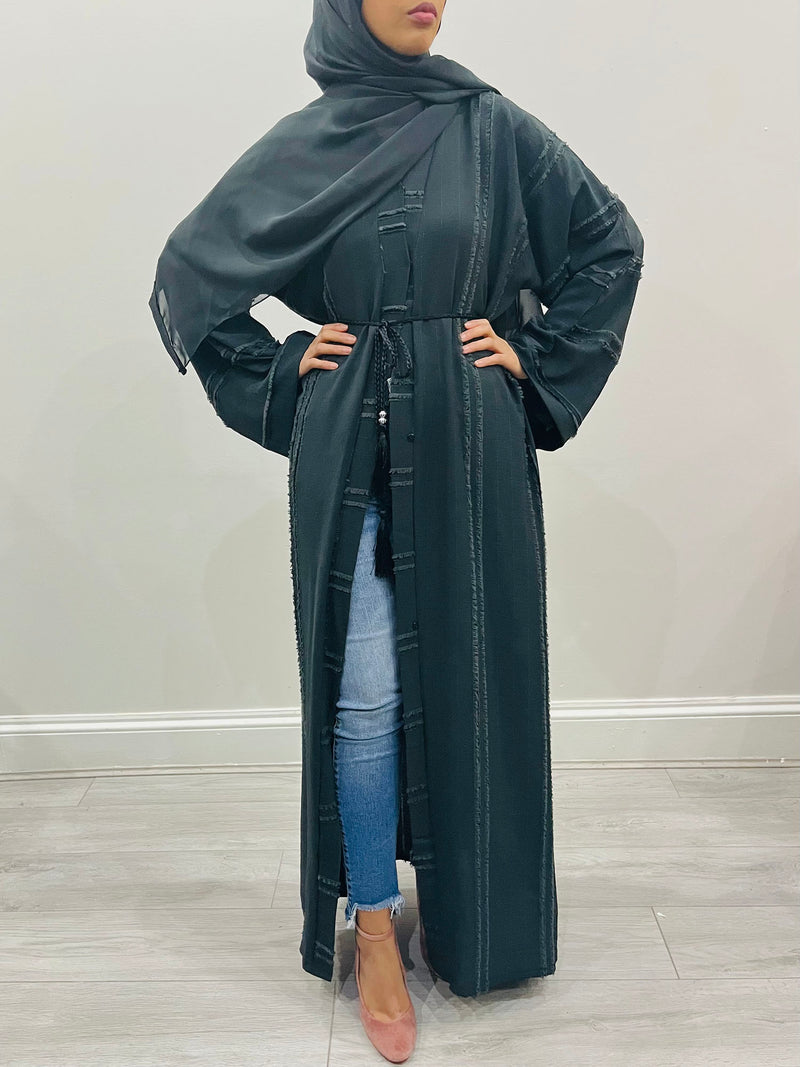
The Nude Open Abaya Looked Simple Until I Had to Decide What Went Under It
Bismillah. The first time I seriously considered a nude open abaya, I thought the colour would make everything easier. It looked soft, quiet and neutral in the photograph. I imagined slipping it over almost anything, adding a familiar hijab and leaving the house without the heavy feeling that sometimes comes with planning an occasion outfit. Then I noticed the front was open, the inner dress in the photograph was not always included, and the word nude seemed to mean a different colour on every page.
The simple garment had suddenly become several decisions. Was the shade blush, beige, pink-brown, almond or taupe? Would a cream base make it look warmer? Would black create too much contrast? Would a satin inner cling beneath it? Could the sleeves remain covered when I raised my hands? I was not struggling because I lacked style. I was trying to understand a clothing system that the product title had compressed into three words.
I also became uncomfortable with the idea that nude was one universal colour. It is not. Product pages often use the word for a family of soft neutrals, yet human skin is infinitely wider than one blush-beige swatch. So I treat nude as a broad shade label, not a standard that any sister must match. The useful question is not whether the garment is truly nude. It is what undertone it carries, how opaque it is, what sits underneath and whether the complete outfit supports the wearer.
This guide answers those questions with practical evidence. We will look at open-front construction, full inner dresses, trouser sets, satin, linen blends, chiffon layers, black piping, hijab colours, fit, prayer movement, UK weather and care. I will also turn awkward product wording into real garment guidance, not robotic prose. May Allah place barakah in what we choose, protect our budgets from pressure and let softness in our clothing come with security rather than constant adjustment.
Nude is a colour family, not one human skin tone
The word nude has a complicated job in fashion. It may describe pale beige, pink-beige, blush, sand, almond, mushroom, taupe or a deeper brown neutral. That variety is not a problem when the listing shows the shade honestly. The problem begins when one narrow colour is treated as though it represents everyone. I refuse that assumption. A sister does not need the fabric to disappear against her skin for the outfit to look tonal, refined or complete.
I begin with observable language: light or deep, warm or cool, pink, yellow, grey, peach or brown. Those descriptions help me choose a hijab and inner layer far more reliably than the single word nude. They also keep the conversation respectful. The garment is a colour; the woman is not a swatch that must coordinate with it.
Blush nude, beige nude and taupe nude behave differently
A blush nude carries pink or rose. Beige nude carries more yellow, oat or sand. Taupe nude combines brown with grey and sometimes mauve. A dark nude may sit close to cocoa, rosewood or muted brown. Each family changes the way black, cream, white, chocolate, olive and grey appear beside it.
I place the abaya near true white and black first. White reveals whether the shade is creamy or grey. Black reveals how much pink or brown is present. Then I compare a warm beige and a cool taupe scarf. This simple test usually tells me more than the product name and helps prevent the disappointing moment when a soft pink garment arrives after I had planned a camel-toned outfit.
Natural light is the first honest colour test
Studio lighting can make a warm nude look cream, flatten a blush undertone or brighten a deep rosewood into pale pink. Phone processing may also smooth shadows until fabric texture disappears. I compare every available image and pay attention to white backgrounds, black piping, skin and metal details because they provide rough colour references.
After delivery, I keep tags attached and look near a window, in a hallway and outdoors. I place the likely inner garment and hijab beside the abaya. The aim is not to become obsessive. It is to prevent one edited photograph from deciding an entire outfit. A five-minute daylight check can protect the return option and save several unnecessary purchases.
An open abaya is an outer layer before it is a complete outfit
An open abaya frames whatever sits beneath it. Even when it has press studs, a belt or generous overlap, movement can reveal the inner layer. Wind, stairs, a shoulder bag and sitting all change the front. I therefore plan the base as though it will be visible from neckline to hem.
This does not mean the outfit has to become complicated. A full inner dress can create one clean column. A coordinated top and wide trouser set can work when each piece provides the coverage intended. The essential point is that the outer is not asked to hide an incomplete base. Once the inner outfit stands confidently on its own, the open abaya becomes graceful rather than stressful.
The inner garment has to be complete without the outer
I ask whether I could remove the open layer in a private women-only space without discovering that the base was never a real outfit. The answer may be a long-sleeve maxi dress, an opaque inner abaya, a high-neck column dress or a coordinated modest set. Sleeveless slips can work beneath secure sleeves, but the complete system must still cover according to the sister's needs.
The neckline, armholes, side slits and length matter. A base that looks polished from the front may become too low at the back or narrow through the stride. I test it separately before adding the outer. This order makes it easier to identify which garment causes a problem instead of blaming the entire combination.
A nude under abaya layer should disappear only when that is the intention
A nude under abaya choice often means an inner dress or slip chosen to sit beneath a pale outer. Sometimes the goal is for the base to blend quietly. Sometimes the inner is meant to be visible and create a tonal centre. These are different jobs, and one garment may not perform both.
For invisible support, I favour smooth seams, enough length and a tone that does not create a sharp line beneath the outer. For a visible base, I look at neckline, sleeve treatment, fabric quality and whether it remains dignified when the panels open. Calling both pieces nude does not guarantee they match. Undertone and texture still decide the result.
Cream beneath nude creates light but can expose undertone differences
Cream is often the easiest base beneath a warm nude outer. It brightens the centre and keeps the outfit soft. Yet a yellow cream can make blush nude look pinker, while a cool ivory can make warm beige nude appear orange. I compare them side by side rather than assuming every pale neutral belongs together.
The hijab can bridge the difference. Taupe, cocoa, mushroom or muted rose may connect the two shades more naturally than another near-match. A tonal outfit does not require perfect sameness. It requires a clear relationship, with enough difference that the layers look intentional rather than accidentally mismatched.
Black beneath nude gives the strongest frame
Black under a pale open abaya creates immediate structure. It also proves whether the outer is sheer, because dark contrast shows through weak areas. I check sleeves, back and side panels in daylight before relying on the combination. If the outer is transparent, black may turn a soft nude into a greyed or uneven shade.
When the fabric is sufficiently opaque, black can be practical for work, travel and repeat wear. A black inner dress, black shoe and nude outer may need only a taupe, black or muted rose hijab. I avoid adding too many glossy black accessories when the abaya is satin. One dark column is usually enough definition.
Chocolate beneath nude feels warmer and less severe
Chocolate, cocoa and espresso give nude depth without the sharpness of black. They work especially well with warm beige, almond, rosewood and deeper nude shades. A chocolate inner dress can make the outer colour look softer and more expensive because the contrast stays within an earthy family.
I repeat the brown once through the hijab, shoe or bag, then stop. Several slightly different browns can turn a simple palette muddy. The most successful version usually has a clear light outer, one deep base and one middle shade near the face.
A tonal nude base needs deliberate distance
A matching nude inner and outer can create a long, serene line. Exact matching across satin, crepe, jersey and chiffon is difficult because each surface reflects light differently. I choose a base that is visibly lighter, deeper, pinker or browner rather than chasing a match that exists only under one lamp.
Texture can provide the distinction. Smooth satin beneath a linen-blend bisht, matte crepe beneath chiffon or a plain column beneath pleated satin all create depth. If both colour and texture are almost identical, the set should be designed together. Separate near-matches often reveal their differences as soon as the wearer moves.
A trouser set under an open abaya changes the movement
Some open-abaya sets use trousers and a long-sleeve top instead of a full inner dress. This can make walking, travel and sitting easier, particularly when the pieces are designed as one coordinated outfit. I still inspect top length, trouser width, waistband bulk and what becomes visible through the open front.
The outer layer should not be used to hide trousers that feel too narrow or a top that ends too high. Wide or straight trousers need enough ease through movement, and the top should support the coverage the wearer expects. A four-piece set can be practical, but the number of pieces does not automatically prove modest construction.
A sleeveless slip can reduce heat but needs sleeve security
A sleeveless inner dress reduces bulk beneath an open abaya and can feel cooler during an occasion. It works only when the outer sleeves remain reliable and the front does not expose the armhole. Wide split sleeves, cape openings or a layer that slips from the shoulder may require a long-sleeve base instead.
I raise my arms, reach forward and test wudu movement. If the outer shifts, a fitted inner sleeve or lightweight long-sleeve dress may provide more ease than spending the day pulling fabric back into place. Cooling the outfit should not create a new coverage worry.
High necklines make an open front easier to trust
The neckline of the inner garment stays visible whenever the open panels move. A high round neck, modest crew neck or carefully finished raised neckline can create a clean centre. A low scoop or loose stretch neckline may require another layer, which adds heat and complexity.
I also consider the hijab. A long scarf can cover the neckline, but it should not be the only reason the base is complete. Hijabs move, especially beneath coats and bags. A dependable inner neckline lets the scarf drape naturally rather than perform emergency coverage.
The nude open abaya should not rely on a tight belt
Belts are often photographed around open abayas because they create shape and hold the panels together. I ask whether the garment still hangs well when the belt is removed or tied loosely. If the only secure version pulls firmly at the waist, the design may not support the silhouette a sister wants.
A belt can control excess fabric, connect the set or make an occasion layer feel more formal. It should remain optional where possible. I test sitting, breathing and prayer movement with and without it. The strongest garment preserves choice instead of demanding one shaped arrangement.
Press studs help, but spacing matters more than their presence
A row of concealed press studs can turn an open abaya into a more secure layer. Widely spaced studs may still gape between points, particularly across the bust, hips or stride. I inspect how the front lies when the garment is fastened and whether the fabric pulls.
Studs also change the colour relationship. Fastened nude over black becomes a pale outer with occasional dark glimpses, while worn open it creates a strong central column. I want both versions to look intentional if versatility is part of the purchase. Hardware should support movement, not merely appear in the feature list.
Cape construction needs its own movement test
A cape abaya may have arm openings, a separate inner dress and a flowing outer panel that begins at the shoulder. The result can feel elegant because the outer moves independently. It can also lift in wind, slide toward the back or reveal the arms more than a standard sleeve.
I check where the hands emerge, whether the cape fastens, how the inner sleeves are constructed and whether a bag can be carried without twisting the panel. A three-piece nude cape set can be a complete occasion solution when every component is understood. The dramatic layer should not hide uncertainty about the practical one.
Bisht shapes bring width from the shoulder
A bisht-style nude outer usually falls broadly from the shoulders with generous volume through the body and sleeves. This can create beautiful coverage and air, especially in a textured linen blend. The same width may become difficult beneath a fitted coat or beside a large shoulder bag.
I inspect sleeve control, inner elastics, embellishment placement and the amount of open front. Hand detail near the sleeve can make the garment special without covering the whole surface. For a nikkah or intimate gathering, that restraint may be exactly what allows the soft colour to feel dignified rather than overly styled.
Double layers create depth and require clear component language
A nude double-layer open abaya may combine a dense Neda base with a lighter chiffon overlayer. The layers can improve opacity and create movement, while black piping or embellishment defines the edges. I confirm whether both layers are attached, whether an inner dress is included and which pieces arrive with the garment.
The word double-layer can sound like complete coverage, but it may refer only to the outer itself. If the front remains open, a separate base is still required. Component clarity matters more than the number in the title.
Black piping makes a pale neutral easier to read
Black piping outlines cuffs, front edges and hems, giving nude a precise frame. It can also connect immediately with a black inner dress and black hijab. Because the contrast is already strong, I keep additional accessories simple.
I inspect whether piping is sewn, embellished or foil-based and how it will respond to cleaning and friction. A shoulder bag may rub the front edge repeatedly. Beautiful definition should remain after more than one event, so construction and care matter as much as the first photograph.
Pleated satin carries light through every fold
Pleated satin turns nude into a changing colour. Each fold creates a highlight and shadow, so blush can deepen toward rosewood and beige can flash champagne. The vertical texture can look graceful, but it may catch, crush or reveal tension if the garment is too narrow.
I check whether the inner slip is included. A pleated pink-nude open style may include a belt and hijab but still require the wearer to supply the inner dress. That single fact changes the true cost and the first-wear plan. I never assume the photographed base arrives in the parcel.
Armani satin is a fabric label, not proof of fibre
Armani satin is commonly used as a trade description for a smooth, softly reflective fabric. It does not mean the garment is made by the Armani fashion house, nor does it prove silk content. I read the fibre composition and care instructions instead of attaching quality claims to the name alone.
In nude shades, the finish can make a simple set feel occasion-ready. I still check static, seam quality, lining and temperature. A complete matching set may reduce colour decisions, but the fabric must remain comfortable through prayer, travel, food and several hours of sitting.
Linen blends make nude feel earthy rather than glossy
A linen-blend nude bisht can move the colour away from champagne and toward sand, almond or clay. Texture gives the neutral character, which means the outfit needs less shine elsewhere. Cream, cocoa, olive and muted gold can support it without turning the look into an occasion formula.
I verify the blend because pure linen and polyester-rich linen-look fabrics behave differently. Creasing, breathability, opacity and care depend on composition and weave. A natural-looking surface does not automatically mean natural fibre, and a linen blend is not automatically cool in every setting.
Chiffon needs an opaque plan beneath it
Chiffon brings softness and movement, but pale chiffon is usually transparent. A double layer may reduce sheerness without making it fully opaque. I check the body, sleeves and the area where layers separate in wind.
A smooth inner dress often creates the cleanest result. Black provides strong contrast, cream keeps the palette light and tonal nude feels seamless when the undertones agree. The base should be chosen before the event, not discovered through a last-minute panic after the outer arrives.
Neda can steady a fluid nude design
Neda-style fabric is often valued for a smooth, weighted drape. In a nude garment it can provide the steadiness that chiffon or cape panels need. I still examine density, fibre information, heat and the way it behaves around the hips and upper arms.
A fabric name cannot replace measurements. If the Neda layer is narrow, its weight may increase pulling. If it is wide and well cut, it can help a pale neutral fall cleanly and resist the floatiness that makes some open styles difficult outdoors.
Opacity should be checked with the intended base
A pale open layer can look opaque over a matching studio dress and sheer over black. Neither test alone tells the whole story. I wear the base I intend to use, stand near a window, turn my back to the light and move.
I inspect the sleeves because the body may be double-layered while the arms remain single. I also watch the side and back where fabric can stretch. Opacity is not a fixed property of colour. It is a relationship between weave, light, fit and what sits underneath.
A darker base can change the visible nude shade
When black, navy or chocolate sits beneath a thin nude outer, the colour may deepen or cool. A blush layer can become mauve, and warm beige can look grey-brown. This can be beautiful when intentional, but disappointing when the sister expected the product-page colour.
I photograph the combination in daylight before an important event. If the outer changes too much, I try a tonal or cream base. The inner layer is part of the colour decision, not merely a hidden modesty solution.
Fit has to release through the bust, hip and upper arm
Open does not mean automatically loose. A jacket can pull at the shoulder, a cape can narrow through the arm opening and a lining can cling beneath a wide outer. I compare garment measurements with an abaya that already fits well.
I sit, reach and walk with the intended base. If the outer keeps sliding backward or the front panels separate because the shoulders are tight, sizing or construction needs attention. Pale satin makes tension visible through shine, so enough ease protects both modesty and the clean look the colour promises.
Length should work with the inner dress, not fight it
The outer and inner hems do not have to be identical, but their relationship should look deliberate. A slightly shorter outer can reveal the base as a border. A longer outer can frame it. An accidental inch of contrasting fabric may look unfinished.
I measure both with the shoes I plan to wear. Nude hems show rain and pavement marks quickly, so dragging length is not luxurious. It is difficult and sometimes unsafe. Alteration may be possible, but pleats, piping, chiffon edges and embellishment can complicate shortening.
Sleeves decide whether the outfit survives wudu and eating
Wide or cape sleeves can fall into water and food. Embellished cuffs may catch. Narrow inner sleeves may bunch beneath the outer. I raise the sleeve, wash the hands and reach across a table during the try-on.
Elastic, buttons, zips or inner loops can improve control. When no closure exists, I may use a smooth sleeve layer beneath. A beautiful cuff earns its place when it remains manageable after the hands begin moving.
The shoulder bag test reveals hidden problems
A cross-body or shoulder strap can pull open panels across the body, crush pleats and rub hand embellishment. A cape may twist toward one side. I wear the actual bag during the home test instead of assuming it will sit as it did in the product photograph.
For delicate occasion styles, a smooth handheld bag may be kinder. For everyday wear, the abaya should tolerate the practical bag the sister needs. Styling that works only with empty hands may not serve a real journey.
Hijab colour begins with undertone and desired contrast
I do not look for one universally best hijab colour. I decide whether I want tonal softness, warm depth or clear structure. Cream and ivory lift. Taupe and mushroom bridge. Chocolate grounds. Black defines. Muted rose connects with blush nude. Olive adds an earthy contrast.
The scarf sits nearest the face, so I test it there in daylight. A shade that coordinates perfectly with the abaya may still make the wearer feel drained. The outfit should support the sister, not demand that she adjust herself to a palette.
Cream hijabs make blush nude look clearer
Cream can separate a blush-nude abaya from the face and prevent the outfit becoming one field of pink-beige. I choose ivory for cooler blush and warm cream for peachier nude, then check that the contrast is visible.
A cream inner dress and cream hijab can create a bright centre under an open layer. I use cocoa or black through the shoe or bag if the palette needs grounding. One darker anchor is often enough.
Taupe hijabs bridge pink and brown undertones
Taupe is useful when the garment sits between blush, beige and brown. A rosy taupe can echo pink nude; mushroom can calm yellow beige; grey taupe can cool a shiny champagne finish.
I avoid choosing a scarf that is almost identical but slightly wrong. A clearer tonal step looks more intentional. Texture also helps, especially a matte modal or jersey beside satin.
Chocolate hijabs give nude emotional and visual depth
Chocolate can make a pale nude outer feel grounded and less fragile. It works particularly well for autumn, evening gatherings and sisters who do not want the sharp contrast of black.
I repeat the brown through the base or shoe, not every accessory. A chocolate hijab, cream inner and nude outer can create three clear levels of depth without becoming complicated.
Black hijabs turn the outfit into a graphic frame
A black hijab with black innerwear and nude outer panels creates a strong vertical frame. This can make a blush or beige garment feel modern rather than delicate. It also connects easily to a black coat and practical shoes.
The combination may become heavy if the nude is very dark or the fabric already has black piping. I decide whether the black detail should lead or merely support. Matte textures usually keep the contrast calmer than several glossy surfaces.
Muted rose and mauve need restraint
Muted rose can echo blush nude without becoming sweet. Mauve works well with cooler taupe-nude or greyed pink. I keep the saturation low and compare the scarf against the garment, because two pinks with different undertones can clash more than a deliberate brown or black contrast.
For an occasion outfit, one rose note may be enough. Pearls, gold hardware or a reflective bag should not all compete with the same soft palette.
Olive and sage make nude feel earthy
Olive works naturally with almond, beige and brown nude. Sage can soften pink-beige without repeating it. These combinations feel especially useful in daylight and transitional seasons.
I keep the rest of the outfit neutral and let the green appear once near the face. Several different greens can make the palette look themed. One controlled colour is more versatile.
Navy gives pale nude a clean professional edge
Navy is a strong alternative to black for work, study and travel. It gives definition without making the outfit feel severe. A navy inner dress beneath a warm nude outer may also reveal whether the fabric is sufficiently opaque.
I use pearl grey, taupe or ivory for the hijab if the full navy frame feels too cool. The colour should support the setting and the wearer, not follow a rigid rule.
Shoes should serve the hem and route
Nude shoes are not required. Cream, taupe, chocolate, black, olive and restrained metallics can all work. The best pair depends on walking distance, weather and hem length.
In British rain, grip and a manageable hem matter more than exact matching. A low heel may suit a wedding, while clean flats or trainers can make a matte open layer practical for daytime. Comfort changes how the whole garment moves.
A bag can either protect or damage a soft neutral
Dark denim dye, rough leather, metal chains and heavily coloured straps can mark pale fabric. I test new bags with a clean cloth and watch where the strap rubs.
The bag must also hold what the day requires. A tiny clutch may look elegant but fail during a long family event. Practicality is not an interruption to premium styling. It is part of whether the outfit remains calm.
Makeup transfer belongs in the plan
Foundation, sunscreen and lip products show quickly on pale collars, hijabs and inner necklines. I finish skincare and makeup before dressing and allow products to settle.
If a mark appears, I follow the fabric care label and blot rather than rub. Satin and chiffon can develop water rings or shiny patches from aggressive treatment. Prevention is easier than panic, but a small stain is not a moral failure.
Public transport makes pale occasion wear meet real surfaces
A nude open abaya worn across London may touch train seats, barriers, café chairs and wet pavements before reaching the event. I choose the role with that journey in mind. A delicate pleated satin may need a protective coat, while a textured linen blend may handle travel more calmly.
I do not let fear keep every pale garment in the wardrobe. I plan the route, manage the hem and accept that clothing enters life. The useful question is whether the fabric can recover, not whether the sister can remain perfectly untouched.
A coat has to accommodate open sleeves and capes
A fitted coat can crush a cape, trap wide sleeves and pull an open abaya backward. I try the complete winter layer before assuming the outfit is ready.
A roomy long coat or suitable outer may work better. Smooth thermals add warmth without bulk. The nude garment can remain special indoors while the coat protects it through wind and rain.
Warm weather requires fewer breathable layers
A pale colour looks summery, but multiple polyester layers can still trap heat. I read fibre, lining and the number of pieces. A four-piece set may offer styling flexibility yet feel warmer than a single breathable base and open outer.
I choose the lightest opaque system that meets the coverage needed. Shade, hydration and timing remain important. Modesty should not become a contest in silent discomfort.
For work, I favour quiet construction over shine
A nude open abaya can work professionally when the shade is controlled, the front sits reliably and the base is a complete outfit. Matte crepe, Neda or a low-shine textured fabric usually feels easier beneath office lighting than high-gloss satin.
I choose secure cuffs, pockets where available and practical shoes. Taupe, navy, chocolate and black can give the pale outer enough structure. The goal is to focus on work rather than checking the belt or front every few minutes.
For the masjid, I test sujood before leaving home
I bend, sit and move into sujood with the intended inner layer. I watch the neckline, arm openings, front panels and hem. A belt may loosen, a cape may shift and a sleeveless base may become visible through wide sleeves.
A separate prayer garment may still be the simplest option, especially when the nude outer is an occasion layer. Clothing cannot create khushu, but preparation can remove practical interruptions and let the heart arrive more calmly.
For Eid, a matched set can reduce morning decisions
A three-piece nude set with inner abaya, cape and scarf can make Eid dressing calmer because the colours and proportions have already been considered together. I still confirm every included piece and check the complete set in daylight.
Eid includes prayer, family, food, travel and children. The garment should participate in the day. A soft neutral can feel joyful without needing several metallic accessories or a fragile shoe.
For weddings, nude can read bridal, guest-like or understated
Pale blush, champagne and ivory-nude can look bridal under certain lighting. That may be welcome for a bride or nikkah, but a guest may prefer deeper rosewood, taupe, black piping or a stronger hijab contrast.
I photograph the outfit with flash because satin can become much lighter. I also test sitting, eating and prayer. Event clothing is not successful only because it looks beautiful during the first ten minutes.
For the sister returning to lighter colours, nude can feel exposed
A sister who has relied on black may feel unusually visible in blush or beige, even when the garment is loose and opaque. I do not tell her that confidence means ignoring the feeling. I give her evidence.
A deeper nude, black inner dress, familiar hijab and secure closed base can make the first wear easier. Confidence may come through repetition. She does not have to choose the palest option or prove anything through colour.
For the revert, the system should reduce new decisions
A revert may already be learning prayer, community and a new modest wardrobe. A complicated open set with uncertain components can add pressure.
I favour one complete base, one dependable outer and a scarf she knows how to wear. The outfit should support her journey rather than test whether she looks experienced enough. Ease can be an act of mercy.
For the mother, washable care may matter more than a perfect tonal set
Children, food, school runs and carrying bags make pale clothing meet ordinary life quickly. A mother may love nude and still decide that dry-clean-only pleated satin does not suit her current routine.
A washable matte layer with controlled sleeves may bring more joy because it can be worn. Wisdom is not the absence of style. It is choosing the version of beauty that can live beside responsibility.
Product pages can show several different nude constructions
Product pages can demonstrate why nude cannot be treated as one product type. A coordinated satin cape, a trouser set, an embellished linen-blend bisht, a pleated pink-nude open layer or a double-layer design with black piping can all sit inside the same broad neutral family. They may share a colour language, but their inner pieces, fabrics and intended occasions differ.
Product pages should be checked for the latest sizes, availability, exact components and care because those details can change. This article remains useful by teaching the decision rather than freezing stock. A nude label can connect different garments, but construction decides how each one should be worn.
I separate adult abayas from jilbabs, prayer sets and dresses
The same nude colour label can appear on an abaya and khimar set, maxi dresses, children's abayas and adult open layers. Colour does not erase garment type. A two-piece jilbab or prayer set serves a different dressing need from a satin occasion jacket.
I keep audience, construction and purpose clear. A sister looking for an adult open abaya should not be redirected toward a child's set or told that a prayer garment is the same as a wedding layer. Accurate boundaries protect trust.
Nude colour needs a real shade explanation
When a product is described as a nude colour abaya, the useful question is what that shade actually looks like on the garment and how it differs from beige, blush or taupe. I answer with undertone, depth and daylight checks instead of pretending one label names one regulated shade.
The same colour label can appear pink on satin and brown on linen blend. Fabric surface changes what the eye sees. The safest choice comes from photographs, composition and the return-friendly home test.
Awkward product wording should still lead to useful guidance
Some product wording can place the colour after the garment or shorten the description until it feels unnatural. I do not let that shape the article. The underlying need is still human: she wants a nude abaya and needs to know whether it is open, opaque, complete and suitable for her life.
Good guidance should answer the person, not imitate a product title. I keep the language natural and bring the decision back to shade, fabric, inner layers, fit and care.
The colour wording should never create a false garment category
A label may combine the garment and colour in an awkward order, but that does not create a second article or a made-up category. The same sister is comparing shade, fabric, inner layers, fit and care.
Keeping the guidance together prevents repetition and gives one clear destination. The wording changes; the decision journey does not.
Nude abaya is broader than nude open abaya
A nude abaya may be closed, open, cape-style, bisht, pleated, double-layered or part of a coordinated set. This guide stays more specific because the open front changes what must be worn underneath.
I still explain the broader family so the reader can recognise when a closed nude garment would serve her better. If managing a visible inner outfit feels stressful, a closed opaque design may create far more ease.
I calculate the real cost of the complete outfit
The outer price may not include an inner dress, long-sleeve base, alteration, special hijab, professional cleaning or return postage. I add the likely costs before deciding that the garment is affordable.
A more expensive complete set can offer better value than a cheaper outer that demands several new purchases. The reverse can also be true when the sister already owns dependable inner layers. Value depends on the wardrobe, not the product price alone.
Returns are part of responsible online shopping
I keep tags, packaging and the return deadline intact until shade, opacity, fit and movement have been tested. I avoid fragrance and makeup during the first try-on.
Returning a garment that does not match the evidence is not wasteful indecision. Keeping an unworn outer because the colour felt special may create more waste. A calm return protects both budget and wardrobe.
Care starts with fibre, finish and embellishment
Nude garments may be satin, chiffon, Neda, crepe, linen blend or mixed constructions. One care method cannot suit all of them. I follow the label, separate colours until dye behaviour is known and avoid unnecessary heat.
Pleats, foil, black piping, beads and hand embellishment need particular care around friction and steaming. A beautiful neutral should not be damaged by a generic cleaning routine.
Stains need patient treatment
Pale fabric shows foundation, oil, tea and water rings quickly. I blot rather than rub and test any treatment on a hidden area. Rubbing can spread the mark or create shine.
When the fibre or embellishment is uncertain, professional advice may be safer. The goal is not to attack the stain. It is to remove it without creating a larger damaged area.
Storage should protect shape as well as colour
A heavy cape or embellished bisht needs a hanger that supports the shoulders. Pleated satin should not be crushed tightly between garments. Long hems should not rest on the floor.
I store the abaya dry, away from direct sunlight and dark fabrics that may transfer dye. The matching scarf, belt and inner pieces should remain labelled together so the set does not become incomplete inside the wardrobe.
Alteration is useful when one precise detail fails
A slightly long hem, impractical cuff or missing closure may be worth altering when the fabric and fit are otherwise strong. I inspect pleats, piping, layers and embellishment before cutting.
Alteration should solve one defined problem. It should not rescue transparency, a fundamentally narrow cut or an outfit whose care will never suit the wearer. A small change can extend value; a reconstruction usually signals the wrong starting point.
My practical nude open abaya checklist
Before checkout, I name the role, identify the actual undertone, confirm every included component, read fibre and care, inspect opacity, compare garment measurements, test sleeve and closure construction, plan the full inner outfit, build three hijab combinations and understand the return terms.
For broader help with silhouettes, fabrics, sizing and modest construction, I use the complete abaya guide as the main reference. This page stays focused on nude shade language, open layering, visible inner outfits, pale-fabric behaviour and care.
A simple decision table can expose the missing piece
I use a table when a beautiful product page has made the outfit feel more complete than it is. The missing element is often obvious once the outer, base, hijab and practical risk are separated.
The table does not replace the product details. It helps me ask the correct question before I buy.
Nude open abaya layering decision table
| Outer construction | Base I would test | Main question |
|---|---|---|
| Three-piece cape set | Included inner abaya | Are the sleeves and cape openings secure through movement? |
| Four-piece trouser set | Included top and wide trousers | Does the visible base remain modest without the jacket? |
| Pleated satin open layer | Own tonal, cream or black inner dress | Is the inner slip included, and does static change the drape? |
| Linen-blend bisht | Smooth cream, cocoa or tonal column | Can the shoulder width work with the intended bag and coat? |
| Double-layer chiffon and Neda | Complete opaque innerwear | Does double-layer describe the outer only, or a full set? |
| Black-piped nude outer | Black, cocoa or cream base | Should the contrast frame the outfit strongly or softly? |
How I decide whether the nude open abaya belongs in the wardrobe
My final question is not whether the colour looks soft. I ask whether this exact garment serves the life it is entering. Is the base already owned? Does the shade work with familiar hijabs? Can the sister move, pray, travel and care for it without constant adjustment?
When the evidence supports the choice, I can explore the abaya collection with clearer eyes. Individual product pages should be used for the latest sizes, prices, included pieces and availability. This guide provides the questions that remain useful when stock changes.
A final reflection on softness without disappearance
The word nude can suggest invisibility, but a sister does not need to disappear to dress softly. A pale open abaya can carry warmth, presence and dignity when the colour is described honestly and the layers are secure.
I hope the guide leaves you with less pressure and better evidence. Understand the shade, build the base, test the movement and choose with niyyah and tawakkul. May Allah place barakah in what you own, ease in your preparation and protection in every modest decision.
Frequently asked questions about nude open abayas
What should I wear under a nude open abaya?
I start with a complete opaque inner outfit: a full-length inner dress, a high-neck maxi dress or a coordinated modest set. Cream keeps the palette light, black gives strong definition, chocolate adds warmth and tonal nude creates a long line when the undertones agree. The base should remain suitable when the outer panels move.
What hijab colour goes with a nude open abaya?
Cream, ivory, taupe, mushroom, chocolate, black, muted rose, olive and navy can all work. I begin with the abaya undertone and decide whether the outfit needs tonal softness, warmth or strong contrast. I test the scarf beside the face in daylight because the best garment match may not be the most comfortable face frame.
Is nude the same colour as beige?
Not always. Nude is a broad product label that may describe blush, pink-beige, almond, taupe, sand or deeper brown neutrals. Beige usually sits more clearly in a yellow, oat or sand family, although product labels overlap. I judge the actual photographs, undertone and fabric rather than relying on the name alone.
Is an inner dress included with every nude open abaya?
No. Some coordinated sets include an inner abaya, top and trousers, or other matching pieces, while many open layers require you to supply the base. I read the exact component list and do not assume that the dress shown in the photograph arrives with the outer, belt or hijab.
How do I know whether a nude open abaya is see-through?
I inspect sleeves, back and side panels in daylight with the intended base, then sit, reach and walk. A dark inner layer can reveal transparency that a matching studio base hides. Fabric density, lining, fit and light all affect opacity, so the pale colour and double-layer wording are not enough evidence.
Can I wear black under a nude open abaya?
Yes. Black creates a strong, clean frame and can make a blush or beige nude look modern. It also tests opacity clearly. I usually connect the black base with a hijab, shoe or piping detail, then keep the remaining accessories restrained so the contrast feels intentional rather than heavy.
Can a nude open abaya be worn for work?
Yes, when the construction is quiet and reliable. I look for a complete professional base, secure front, controlled cuffs, enough ease for sitting and practical footwear. Matte crepe, Neda or low-shine textured fabric often feels easier under office lighting than glossy occasion satin.
How should a nude open abaya fit?
It should release through the shoulders, bust, hips and upper arms without pulling the front panels apart. I compare garment measurements with an abaya that already fits, then test sitting, reaching and walking with the intended inner layer. A wide outer can still have a narrow lining or arm opening.
How do I care for a pale nude abaya?
I follow the exact care label, treat stains gently, avoid unnecessary heat and store the garment dry away from direct sunlight and dark dye transfer. Satin, pleats, chiffon, piping and hand embellishment need different handling. I blot marks rather than rub and test treatments on a hidden area.
Where should I check the latest nude abayas at Amani's?
I use the Amani's Abayas collection and individual product pages for the latest colours, sizes, prices, included pieces, care and availability. Product details can change. This guide remains the decision framework for shade, layering, opacity, fit, movement and styling.