When your long prayer hijab won’t stay put
A long prayer hijab should be easy to reach for and straightforward to put on. Yet length alone does not tell you whether it will work. A scarf can fall well below the chest while leaving the side of the neck awkward to cover; an overhead style can look generous but have an opening that moves whenever you turn your head.
The useful question is how the head section, shoulders and lower drape work together on you. Choose enough fabric for the coverage you follow, with a shape that stays comfortable through the movements of prayer. There is no need to make the arrangement elaborate or to keep a garment that distracts you simply because it is described as prayer wear.
Start with the clothing you will wear underneath. A long head covering is one part of the outfit, not an automatic replacement for suitable sleeves or a full-length lower garment. Checking the whole combination is more helpful than judging the hijab on a hanger.
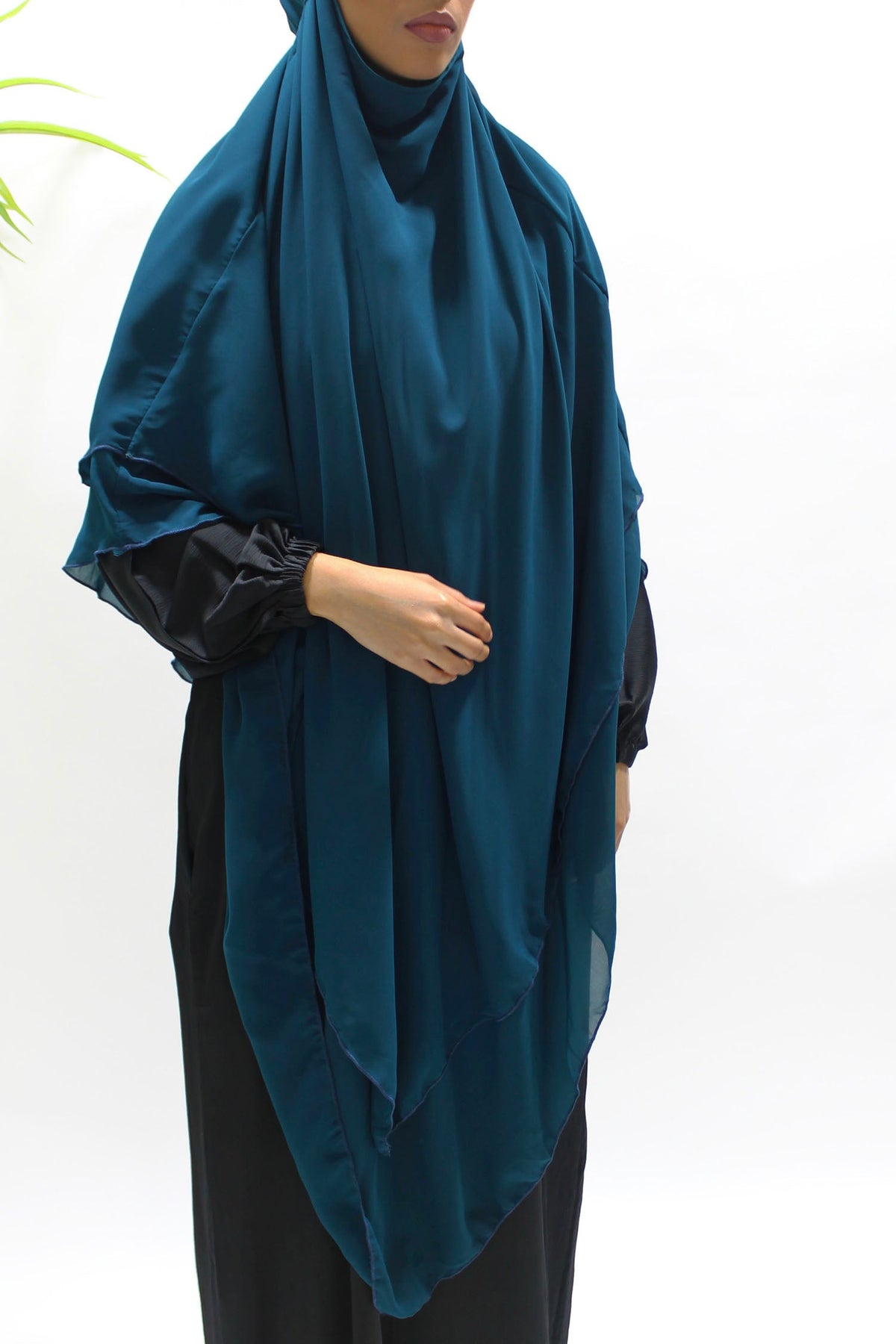
The long teal khimar illustrates an overhead design. Assess your complete prayer outfit and the coverage you follow before choosing a length.
Work out which kind of garment you are looking at
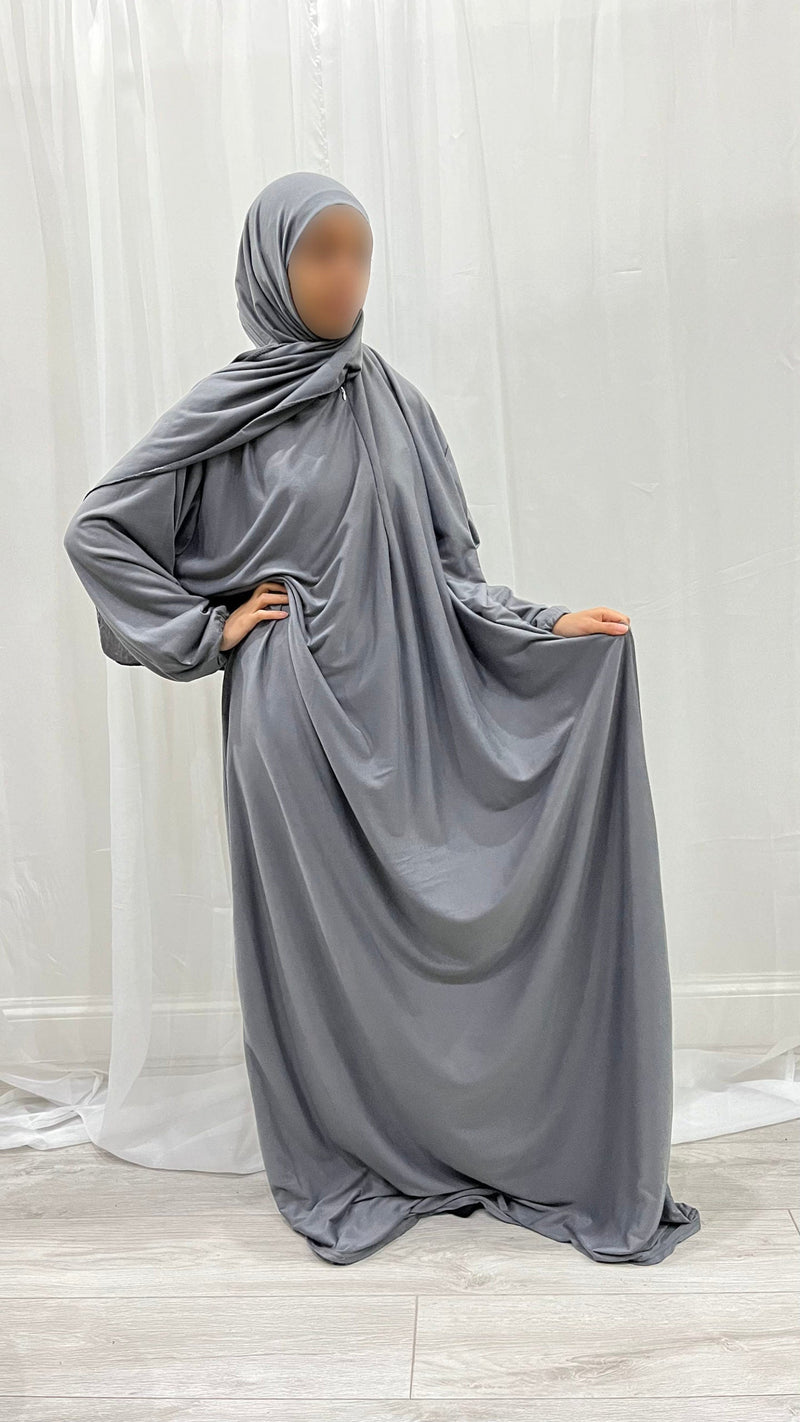
Product names can leave important details unstated. One listing may describe a large rectangular scarf as a prayer hijab. Another may show a shaped overhead covering, while a third includes a head section attached to a complete dress. Read the component list and look at the construction rather than assuming the same name means the same item.
A rectangular scarf gives you freedom to arrange the front and sides, but the finished coverage depends on its dimensions and the way you wrap it. A shaped overhead design offers a more defined outline, but its opening and proportions need to suit you. An attached covering cannot be assessed independently of the dress it pulls against.
Look for a front view, a back view and a clear picture of the opening. If there are ties, ask where they fasten and how they affect the fit. If there is a seam beneath the chin, check whether its position is fixed or adjustable.
For a fuller comparison of the outfit itself, use the prayer-wear guide. Here, the focus is the longer head covering and the practical details that make it easy to use.
Begin with your actual routine
A garment kept ready at home has a different practical role from one carried to work or packed for a journey. Think about where you will put it on, whether a mirror is available and how much room you have to store it. These questions can make one construction more convenient than another.
For home use, you might prefer a familiar overhead style that is easy to identify and arrange. For a bag, packed size and the ability to unfold it without untangling several pieces may matter more. Neither use demands a particular colour or decorative finish.
Consider whether the garment will be worn over a different scarf. That can change the feel around the face and neck. Try the exact combination instead of assuming that an item which feels comfortable on its own will be equally comfortable over several existing layers.
Also consider how you change afterwards. A covering that catches on glasses or fastenings every time it comes off may not be the easiest choice for a routine involving repeated changes. Dressing and removal are part of the fit.
Fit the face opening before assessing the length
Put the covering on without pulling the lower drape into position immediately. First check where the opening rests around your face. It should allow the arrangement you prefer without pressing, slipping into your eyes or needing constant tension from the back.
Look down and turn your head gently to either side. Does the opening remain settled? Does the chin section move as you speak? Does a seam that seemed unobtrusive at first start to press? These observations give you better information than the size of the lower panel.
Where there are adjustable ties, use them according to the garment’s design. Adjust both sides calmly and check the result again. Ties are not a reason to make an unsuitable opening uncomfortably tight. A different cut can be a better solution.
With a fixed opening, ask for the relevant measurements before buying if you have had recurring fit problems. A seller’s description of a generous garment may refer to its body drape rather than the face section. Be specific about which part you need to understand.
If you wear glasses, try taking them off and putting them back on with the covering arranged. Make room for the frame arms without using them to hold the whole garment together. Persistent discomfort should not be treated as something you need to get used to.
Check the neck and shoulder area from more than one angle
Once the opening is comfortable, arrange the front and shoulders as intended. Look at the sides and back as well as straight ahead. A scarf can appear complete in a mirror while moving away from an area you wanted covered when you reach.
For a wrapped scarf, notice where the two ends cross and whether the crossing remains secure through movement. Avoid depending on one loose end to stay in precisely the same place. The arrangement should be repeatable without constant attention.
For a shaped covering, check how the shoulders sit beneath it. A broad drape may still rise when the head turns if the upper section is restrictive. Pulling the lower edge down does not necessarily solve a fit problem higher up.
Try the neckline of the clothing beneath as part of this check. A high collar can create bulk; a lower neckline may require a more deliberate arrangement. Choose the combination that provides the coverage you follow without crowding the neck.
There is no virtue in making the fabric feel tight. The garment should support your routine, not become a test of how much pressure or restricted movement you can ignore.
Make the length measurement comparable
Ask where the seller begins the measurement. A length taken from the top of a shaped covering differs from one taken from a shoulder point or from the edge of a flat scarf. Write down the method with the number so you are not comparing different routes.
Front and back lengths may also differ. A longer rear panel does not establish the amount of fabric available across the chest. Ask for both where the design uses distinct proportions, and check any side points that could behave differently.
Measure a covering you already find comfortable using the same method. Record what you like about it and what you would change. You might want the same opening with a longer front, or a similar front length with less fabric at the sides.
Do not apply a dress-length convention to a separate head covering. Likewise, do not use a measurement from the top of the head as though it were an abaya’s shoulder-to-feet length. The starting point and the garment type must agree.
Longer is not automatically better. You need enough material for its intended role, but extra fabric that gathers beneath your hands or knees may make the arrangement less convenient. Assess the result on you rather than treating the largest measurement as the safest choice.
A calm movement check before the first use
Choose a private, suitable space and wear the complete outfit. Arrange the covering once, then move through the positions you use in prayer at a comfortable pace. Notice what happens before smoothing the fabric back into place.
Check the opening and neck area when bowing. Look for a lower panel pulling the head section forward, or a scarf end sliding away from where you intended it to stay. Identify the moving part rather than tightening everything.
When kneeling and moving into prostration, notice the front drape and where the fabric settles around your arms. Check that an edge is not becoming trapped in a way that pulls on the head covering as you change position.
Reassess the back and sides afterwards. The useful question is whether the outfit continues to meet the coverage requirements you follow during movement, not only at the start. A garment that needs frequent rescue may need a different arrangement or construction.
This is a clothing-fit check, not a ruling about worship. Religious requirements and their application should be discussed with a trusted qualified person where you need guidance. A retailer’s label cannot make that judgement for every wearer.
Choose fabric with the full arrangement in mind
Look at the particular cloth’s weight, opacity, surface and amount of stretch. The same broad material description can appear on coverings that feel quite different. Ask for the composition and examine the finished garment rather than choosing from a fabric name alone.
A thin scarf may need more than one layer to give the coverage you want. A heavier covering may provide the desired opacity in one layer but feel substantial around the head and shoulders. Compare complete arrangements, not one loose corner of fabric against another.
If the material stretches, check it at rest and in the places where it is under tension. Do not use stretch to compensate for an opening that is too small. Enough ease should come from a suitable size and shape.
Check the inside of hems and seams, especially around the face and beneath the chin. A soft outer surface does not tell you whether a bulky join will feel comfortable. If possible, try the actual item rather than relying on a description of softness.
Our hijab fabric guide helps distinguish the wider options. For prayer use, choose the cloth that works in your arrangement and care routine, without expecting a material to provide a particular spiritual experience.
Try a long rectangular scarf without unnecessary wrapping
Start with enough width and length for your chosen coverage. Place the scarf over your head using a familiar arrangement, then distribute the fabric deliberately between the front, sides and back. Do not use most of the length around the head before discovering that too little remains for the drape you wanted.
Arrange the face opening comfortably and use a suitable fastening method for the fabric where needed. Keep sharp or hard fittings away from places where they press, and never hold loose pins in your mouth while getting dressed.
Bring the available fabric into the front and shoulder arrangement you prefer. Check it in movement before adding another decorative fold. A straightforward drape is often easier to assess than a style with several overlapping sections that can shift independently.
If the scarf repeatedly needs more layers than you find comfortable, reconsider its dimensions, opacity or surface. Buying the same unsuitable shape in a different colour will not necessarily solve that problem. A shaped prayer covering may be an option to compare, not a compulsory next step.
Try an overhead covering on its own terms
Locate the front and back before putting it on. Check any label, seam or distinctive cut that helps identify the orientation. A garment that is easy to arrange becomes more useful when you can reproduce that process without studying it each time.
Use its opening and fastening as intended. Let the main drape fall before adjusting the lower edges. If the front seems unexpectedly short, first check that the garment is not reversed or caught on clothing underneath.
Where a head tie is included, settle the covering without force and reassess the face opening. If a more secure-feeling tie creates pressure elsewhere, loosen it and investigate the fit rather than accepting the trade-off.
Try removal as well as dressing. It should be possible to take the garment off without pulling it against glasses, jewellery or another scarf’s fastenings. Keep the routine straightforward enough to repeat when you are away from your usual mirror.
Make an attached hijab and dress work together
With an attached design, movement in the dress can affect the covering. Put on the full garment and check the neckline and head section before gathering or adjusting the skirt. Notice whether the dress’s weight pulls the covering backwards or forwards.
Check the sleeves and upper back with your arms moving. A restrictive body section can make the head covering seem unstable even when its opening is otherwise suitable. Treat that as a whole-garment fit question.
Confirm the measuring convention for the dress separately from the dimensions of its attached covering. A single label such as free size does not describe every body proportion. Use the specific product information and your own fitting rather than assuming all attached designs are alike.
If one component works but the other does not, a separate covering and dress may be easier to fit. A one-piece garment can be convenient, but it is not inherently better than two suitable pieces that cooperate well.
Keep the lower garment in the comparison
A long hijab can cover part of the upper body while still leaving other clothing responsible for sleeves, lower-body coverage and the hem. Assess those pieces independently before adding the head covering.
Check the overlap between the covering and clothing beneath while reaching and changing position. A tunic and skirt, an abaya and scarf, or a complete prayer dress each create different joins. Do not rely on the covering to conceal an unresolved gap that appears whenever you move.
Look at any fastenings beneath the drape. A prominent button, zip pull or brooch can catch the covering or create pressure against the body. A smoother base may be more comfortable than adding extra fabric to hide the point of contact.
The outfit should feel manageable without a belt, bag or carefully held posture keeping the layers in place. Those accessories may belong to other parts of your day, but they should not be the hidden structure holding a prayer arrangement together.
Put together a useful home setup
Choose a clean, accessible place for the garment rather than a location where it becomes tangled with jewellery or rough fastenings. Keep the pieces you use together easy to identify, while storing each appropriately for its construction.
Check after use whether the covering needs care or is ready to be put away. Make sure it is fully dry before enclosing it. A simple routine is more useful than a large collection of similar garments that are difficult to find or maintain.
If you keep a second covering, give it a clear role. It might be the alternative while the first is being cleaned, or the one suited to a different layer underneath. There is no requirement to buy a separate colour for every outfit or occasion.
For a shared household, keep personal preferences clear. A covering that fits one person’s face opening may not fit another’s, even when both appreciate a generous drape. Let each person assess their own comfort rather than treating a large size as universally suitable.
Pack one complete arrangement for time away
Try the travelling outfit before packing. Include the separate head covering, appropriate clothing and any fastening you actually need. A long scarf tucked into a bag is not a complete plan if it depends on an inner garment you have left at home.
Fold or store the covering in a way suited to its care instructions, with sharp accessories secured separately. Keep it away from shoes, leaking toiletries and exposed zip teeth. Choose a pouch or compartment that is easy to recognise rather than making access a search through the whole bag.
Practise putting it on without your usual mirror where that reflects how you will use it. The aim is familiarity, not an elaborate new technique. A design you already understand can be more practical than one bought solely because it packs small.
For a workplace, visit or community setting, check the actual facilities and arrangements directly. Do not assume that every location has storage, spare garments or the same private space. Keep clothing advice separate from promises about facilities you have not confirmed.
Adjust for warmth without making fabric promises
Consider the whole outfit when conditions are warm: head covering, any cap, clothing underneath and the room itself. A product described as light can still become substantial when wrapped in several layers.
Compare a simpler arrangement that retains your required coverage. You might prefer one suitable opaque layer to repeated folds of a sheer scarf, or a different cut with a more comfortable opening. The right change depends on the garment, not a universal rule about cotton, jersey or chiffon.
For cooler conditions, test the covering with the warmer clothing you plan to wear. A high collar and a close chin section can feel crowded together. Adjust the combination rather than tightening the scarf to make it stay above a bulky neckline.
Do not treat a covering as a medical solution for heat or cold. Choose suitable clothing for the conditions and seek appropriate health guidance when needed. Its role is to be a comfortable, usable part of your outfit.
Choose colour and decoration for your own preferences
A plain covering can make it easier to notice its shape and to keep a simple routine. A pattern or a colour you enjoy may be equally practical when the garment’s construction suits you. Neither preference measures a person’s sincerity or devotion.
Look at where decoration is placed. A raised trim close to the face or a heavy border at the front may behave differently from a small detail on a shoulder. Test the real garment rather than assuming an occasion label makes it appropriate for every use.
If you also wear the covering as part of everyday clothing, try it with your bag and outer layer. The broad drape may need room beneath a coat or may sit differently over its collar. Keep prayer use and outdoor use as separate practical checks.
You do not owe anybody a performance of a particular style. Choose an arrangement you can wear comfortably and respectfully, and leave room for other women to make different choices without inferring their beliefs from their clothes.
Choose a routine before choosing another scarf
Consider three different jobs for a long prayer hijab. One stays beside your prayer clothes at home. Another travels in a work bag. A third is part of an outfit worn to a gathering where you will also pray. They may be served by the same garment, but they need not be.
For the home option, take packing out of the decision for a moment. Put the covering on over the clothes you normally wear indoors. Check the face opening, the side drape and the part of your clothing visible below it. A conveniently placed scarf is useful only when the rest of that familiar outfit also provides the coverage you need.
For the bag option, begin with the fully checked combination and pack every component it actually needs. Unpack it and get dressed again. You are checking a sequence, not only how small the fabric folds. A covering that needs an undercap you have left at home is not a complete portable arrangement.
For the gathering, decide whether you will use your occasion scarf or change into a separate covering. Try any change with the neckline and sleeves already on. A head covering that feels easy over home clothes may meet a stiff collar or raised decoration in this outfit. Choose the arrangement that works without pressing the layers together or repeatedly moving them out of the way.
Write the result in one sentence: “This is the covering I keep with these prayer clothes,” or “This is the complete set I pack.” The detail is deliberately ordinary. You do not need the longest garment available; you need a reliable place for the garment and the pieces that make it usable. Where a combination is unsuitable, change that combination rather than tightening the face opening to make every part stay still.
Questions that make an online purchase clearer
Ask for the face-opening measurement and how it was taken. For an adjustable design, ask which part adjusts and which proportions remain fixed. A tie may change the opening without changing the length available at the shoulders.
Request front and back lengths with the starting points identified. Ask whether the pictured garment includes a separate lower piece, undercap or inner covering. Do not count accessories in a styled image as part of the order without confirmation.
Check fibre composition, lining, care information and the construction beneath the chin. Where a seam or opening is hard to see, a close photograph is more useful than a reassurance that the garment is suitable for everyone.
Keep the answers with the order. On arrival, compare the item using the same measuring method and try it under the seller’s stated conditions before washing or altering it. A specific discrepancy is easier to discuss than a general statement that it looks different.
A short comparison can prevent a repeat purchase
Consider two hypothetical coverings. The first has a very long back but a front that moves away when the wearer reaches. The second is slightly shorter overall but has a shape that stays settled across the shoulders. The largest length on the listing does not automatically identify the more useful garment.
Now consider two sizes of the same design. The larger one may add drape but make the face opening too loose. A different construction could be a better answer than repeatedly going up a size. Length, opening and body coverage need to be assessed together.
Keep a record of the measurements and shape that work for you. Include a practical note such as “comfortable over this neckline” or “easier to put on without a mirror”. These details are more useful for the next purchase than remembering only the colour.
When a garment does not work, note the reason before returning or passing it on appropriately. “Opening shifted when bowing” is a clearer finding than “not long enough” if the length was never the actual problem.
When the drape slips, find the moving part
Before adding another fastening, identify whether the whole covering is moving or only a loose end. If the face opening travels backwards with the lower drape, look at what is pulling behind it: fabric caught under a collar, an unsuitable tie arrangement or the weight of an attached garment. Releasing that catch may be more useful than fastening the front more tightly.
If the opening stays comfortable but a front corner moves away, review the available width and the way that corner is arranged. A scarf that leaves very little material after wrapping around the head may not have enough remaining fabric for the front shape you want. Compare a simpler wrap before deciding you need a longer scarf.
If the covering shifts only over one particular outfit, examine the contact points. Raised buttons, a thick hood or a textured collar can make the same covering behave differently. Try it over a familiar smooth neckline while keeping the other parts unchanged. The result helps you identify a clothing combination rather than blaming the head covering automatically.
If the edges become caught beneath your hands or knees, pause and rearrange the fabric before continuing the fitting. Check whether the garment has been put on in the intended orientation and whether its lengths suit you. Do not remove a section or cut a new opening as an immediate fix.
Finally, distinguish a minor arrangement problem from a persistent fit problem. A corner that needed placing correctly once is different from an opening that repeatedly presses or slips. You should not have to remember a long set of adjustments every time you use the garment. Where the design never settles comfortably, another shape may be the kinder and simpler choice.
Care for the actual item
Read its label before washing, drying or pressing. A covering’s main fabric, lining, elastic, ties and decoration may affect the permitted treatment. Do not copy the method used for another garment simply because both are prayer hijabs.
Remove detachable accessories as directed and inspect frequently handled seams. Keep ties arranged so they do not become knotted during storage. Avoid pulling a loose thread or stretching an opening to correct a shape you do not understand.
Allow the garment to dry fully before putting it back into a bag or cupboard. Choose support appropriate to its weight and construction. The fabric-care guide is a wider reference for organising the routine without guessing at treatments.
Before an important outing, check that the garment is ready rather than discovering a loose fastening while changing. Care should make the piece dependable, not turn it into something too delicate to use.
Choose the covering that asks less of your attention
The most useful long prayer hijab is not necessarily the longest, newest or most decorated. It is the one whose opening, shape and drape work with your clothing and remain comfortable through your own movements.
Fit the upper section first, compare lengths using the right method and practise the complete arrangement before relying on it. Once those details are settled, the garment can become an ordinary, dependable part of your routine rather than something you keep adjusting.