Finding a plus-size abaya that fits
Finding a plus-size abaya is not simply a matter of choosing the largest number in a dropdown. You need enough room in the places that matter to you, a length that works with your shoes and a cut that hangs as intended when you sit, walk and reach. A generous body width does not help much if the upper sleeves are restrictive or the fastening pulls across the chest.
For shoppers in the UK, the most useful starting point is a clear description of the garment and its measurements. Size labels, photographs and the words “loose fit” are only part of the information. This guide explains how to compare options, ask better questions and build an outfit around an abaya that fits your life—not around the idea that your body needs to be disguised.
Define the fit you want before searching
Think about the abaya you would like to reach for on an ordinary day. Would it be a closed garment worn over a light base, an open outer layer over a dress, or part of a coordinated set? Those choices change the space you need and the measurements that deserve attention.
Describe the fit in practical terms. You might want room to lift your arms without the whole garment rising, a neckline that stays where you place it, or a sleeve that fits beneath your winter coat. “Loose everywhere” is less informative than knowing where you need ease and where you prefer a neater finish.
Separate fit from styling preference. Wanting a straight outline, a flared skirt or a defined waist is a matter of taste. It does not mean one option is inherently correct for a larger body. The useful question is whether the particular garment offers the shape and movement you want.
Make a short note of the problems you are trying to avoid. Perhaps previous abayas have caught at the hips when sitting, slipped off the shoulders or had cuffs that covered your hands. That note becomes a focused shopping brief and prevents a beautiful photograph from distracting you from an important requirement.
Length and body size are separate decisions
Check exactly what each size option describes. Some abaya ranges use numbers for garment length, while others use letter sizes or dress-size equivalents for the body fit. A number that represents length cannot tell you whether the chest, hips or upper arms will be comfortable.
Ask where the length is measured from and whether it is a finished-garment measurement. A shoulder-to-hem length is different from the wearer’s full height. Do not assume that a particular length belongs to a particular body size, or use a fixed subtraction from height without checking the seller’s method.
Try the intended footwear when assessing length. An everyday abaya should work for the walking and movement you expect to do, not only while you stand still. If you regularly change between shoes with different soles or heels, check both rather than planning around only the taller pair.
Plus-size shoppers can be short, tall or somewhere in between. A range that provides more width but only one length may still require alteration. That is worth knowing before you order, especially if embroidery, a shaped hem or a border makes shortening more complicated.
Our abaya sizing and length guide explains why the right hem length is only one part of a comfortable fit. Keep it separate from the question of how much room the garment provides through the body.
Use a well-fitting garment as a reference
A familiar abaya can tell you more than an unfamiliar size chart, provided you compare measurements taken in the same way. Choose a garment that gives you the amount of ease you like, not one that merely fastens or happens to have the closest label.
Lay it flat without stretching the fabric. Record the finished length and the widths or circumferences requested by the seller. Photograph the tape at each point so you can explain the method if you need help. Keep flat measurements clearly labelled as flat measurements.
Note what the reference garment does not solve. It may be comfortable through the hips but too short in the sleeve, or the correct length with a neckline you would prefer to change. Write those differences alongside the measurements rather than treating the reference as perfect in every respect.
Body measurements can be useful too, but they are not interchangeable with finished-garment measurements. A chart may tell you which body measurements a size is intended to fit, or it may list the dimensions of the garment itself. Ask which it is before comparing numbers.
Do not add an unexplained allowance to your measurements. Give the actual measurement using the agreed method, then describe the ease you prefer. Otherwise, you and the seller may both add extra room, or you may compare a measurement with allowance against one without it.
The measurements worth asking for
Chest and upper back
Check enough room across the chest and upper back for the clothing you plan to wear underneath. A buttoned or zipped front should not need to be pulled into place to close. Look at the garment after reaching forward, because tension may be easier to notice then than in a standing photograph.
For an open abaya, ask about the front coverage as well as the overall width. You may want the panels to meet, overlap or remain open. Those are different requirements, and a garment designed as an open layer may not provide the overlap you expect simply because it is described as generous.
Hip room and seated ease
Assess the part of the abaya that passes over your hips and thighs when seated. A straight cut may hang comfortably while standing yet feel different on a chair. Compare with a garment you have worn for long periods rather than estimating from the widest point alone.
Pockets can affect this area. Check where they sit and how they behave with the small items you normally carry. A pocket that pulls or gapes may be a construction or positioning issue, not a reason to accept a less comfortable body size.
Upper arm, armhole and sleeve
Ask about upper-arm room when this has been a recurring fit problem. A wide cuff does not establish that the upper sleeve is roomy. Likewise, a dropped shoulder or a broad sleeve shape does not guarantee comfortable movement in every design.
Check sleeve length using the seller’s starting point. Some measurements begin at a shoulder seam; others may use a different reference where the garment has an integrated or dropped sleeve. Compare like with like, and consider whether the cuff should sit at the wrist or further over the hand according to your preference.
Shoulders, neckline and dressing opening
A garment can be wide enough through the body and still sit awkwardly at the shoulders. Check whether the neckline stays in a comfortable position and whether the shoulder area moves as intended. Going up a size may add width while making this part too loose.
For a pullover design, establish how you put it on. The head opening, zip or other fastening needs to work comfortably with your dressing routine. This matters particularly when the fabric has little give or the neckline is decorated.
Compare cuts without assigning them to body types
A straight abaya
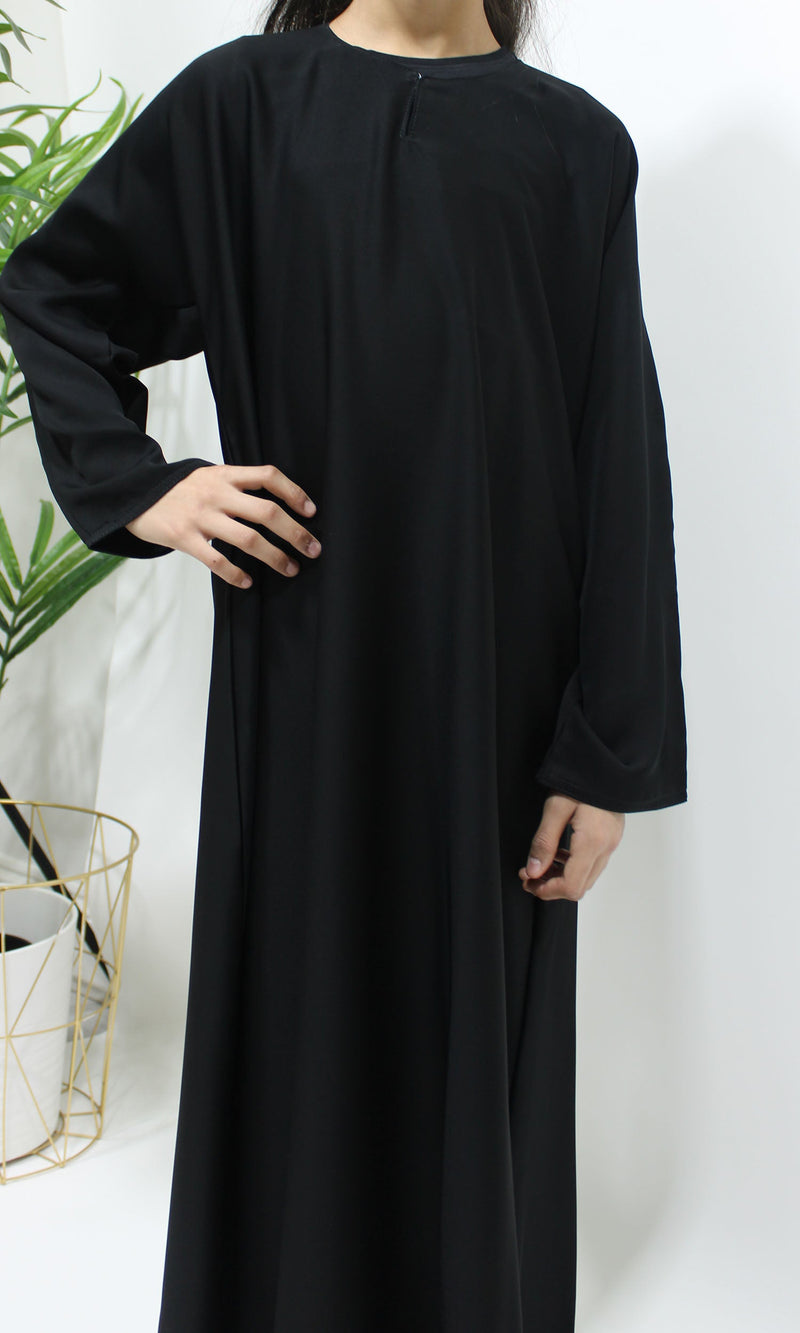
A straight cut can give a simple outline and work well with restrained detailing. Its suitability depends on the actual measurements through the chest, hips and sleeves. Do not assume “straight” means close-fitting, or that a larger size automatically provides the ease you want.
Try it seated and while taking an ordinary stride. If it catches at one point, identify where. A different cut may answer the problem more effectively than adding width everywhere. The aim is a garment that moves with you, not one that merely looks spacious on a hanger.
A flared or A-line abaya
A flared shape offers a different distribution of fabric, with more room lower down. Check where that flare begins. A garment can be full at the hem while remaining fitted through the chest or upper arms, so the overall silhouette is not enough information.
Consider the weight and width of the skirt for your routine. You may enjoy a generous sweep for an occasion but prefer less fabric when commuting or using stairs. That is a practical preference, not a rule about what a plus-size wearer should choose.
A wrap-style abaya
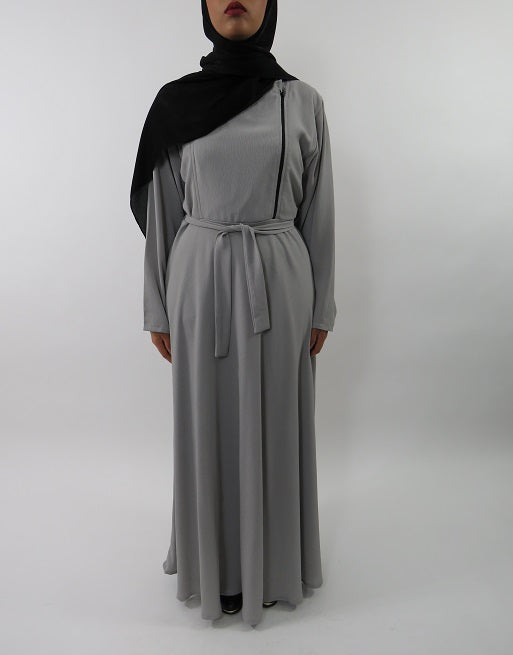
A wrap can offer some adjustability, but the usable range depends on the overlap and fastening positions. Check the front when you sit and walk. A tie that closes comfortably while standing does not necessarily mean the panels retain the coverage you want in movement.
Look at where the tie sits and whether you like the shape it creates. You do not have to define the waist to make an outfit feel finished. If you prefer a looser outline, choose a design that supports that preference rather than leaving a wrap insufficiently secured.
An open kimono-style layer
An open layer can be useful over a dress or trouser outfit, but evaluate the inner outfit independently. It should provide the coverage you want when the outer panels move apart. The outer garment adds shape or detail; it should not have to be held closed throughout the day.
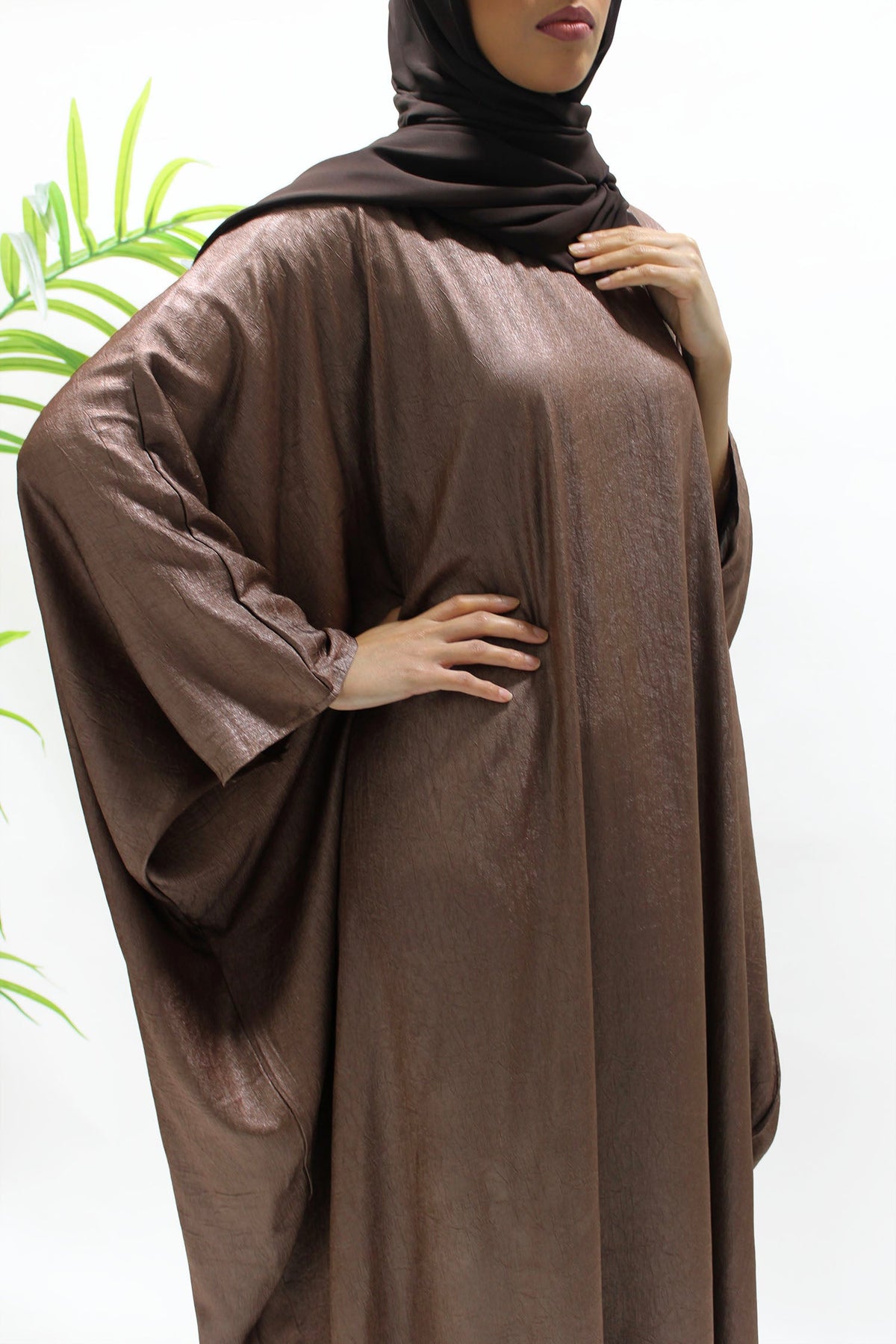
Check the sleeve shape with your coat and bag. A broad integrated sleeve can look beautiful but may need different outerwear from a more conventional sleeve. Our guide to abaya cuts and design features can help you compare those constructions.
A coordinated set
Confirm every component included in the set. A photograph may show an inner dress, outer abaya, scarf and belt, while the listing includes only some of them. Ask whether the components share one size or can be selected separately.
Different pieces may need different amounts of ease. An inner dress that fits comfortably is not proof that the outer sleeves will fit over it. Try the full set and each component individually so you know where any limitation comes from.
Fabric changes the fit you experience
Read the composition and look for information about the actual fabric’s weight, texture and stretch. A product name such as crepe, satin or jersey does not answer every question about how the finished garment will feel. Ask for more detail when the listing relies mainly on words such as “premium” or “luxurious”.
Check opacity in the arrangement you intend to wear. A lining may cover the body but not the sleeves, or it may end above the outer hem. Do not assume that a dark colour or a substantial-looking photograph guarantees the coverage you want.
Where the fabric stretches, assess the garment at rest and in movement. Stretch can make dressing easier, but it should not be used to compensate for a cut that is too close for your preference. Look at whether the cloth becomes strained or reveals more detail when you sit.
Where the fabric has little give, enough room needs to come from the pattern and measurements. The shoulder, armhole and fastening become especially important. A smooth drape does not mean the garment will accommodate every movement without sufficient ease.
Consider the inner layer and outerwear together. A fabric that moves freely over one dress may catch against another texture. Try the abaya with the garments you genuinely plan to wear rather than judging it over a very different fitting-room base.
Finding useful UK shopping options
Search for the feature or fit requirement you need alongside “plus-size abaya”, rather than relying on that category alone. Terms such as finished measurements, separate length options, upper-arm measurements, open-front or custom length can help you identify listings with more relevant information.
A useful online shop should make it possible to understand what is being sold. Look for clear photographs, a size chart with an explained method, component details and a way to ask questions. More photographs are not automatically better if they all show the same posed front view.
Check whether “UK” describes the business location, the stock location or simply the market being served. Read the actual delivery information for your order rather than assuming a particular dispatch time from the website’s name. For an event, allow yourself time to try the garment on and deal with any problem through the seller’s stated process.
For an in-person appointment or shop visit, ask about the relevant sizes and styles before travelling. Confirm whether you can try on the garment and whether the available sample reflects the fabric and construction you would receive. This avoids spending time on a visit that cannot answer your fit questions.
A made-to-measure service may be worth exploring where standard ranges repeatedly miss an important requirement. Clarify what the service changes: length only, an existing pattern adjusted to measurements, or a more extensive commission. A custom label is not itself a promise of unlimited fittings or alterations.
This approach does not depend on a fixed list of supposedly best retailers. Stock, services and size ranges can change. A repeatable method for assessing the current listing is more useful than an unverified directory or a recommendation based only on the largest size shown.
A worked comparison: why a wider chest does not settle the choice
Imagine that you have measured an abaya you wear comfortably and are comparing it with two listings. The following figures are fictional and show how to read a comparison; they are not Amani’s product measurements, a size recommendation or a substitute for measuring your own garment. All figures are in centimetres, and all widths use the same flat-measuring method.
| Finished garment measurement | Your reference | Option A | Option B |
|---|---|---|---|
| Chest width, flat | 70 | 72 | 70 |
| Hip width at the agreed point, flat | 78 | 75 | 79 |
| Upper-sleeve width at the agreed point, flat | 27 | 24 | 28 |
| Sleeve length using the same starting point | 60 | 60 | 60 |
| Shoulder-to-hem length | 145 | 145 | 147 |
Option A looks more generous if you read only the chest measurement. Yet it is three centimetres narrower across the measured hip area and upper sleeve than the reference garment. For someone whose existing abaya already provides just the room they enjoy in those places, those differences deserve attention. The larger chest figure does not cancel them out.
Option B looks closer to the reference through the chest, with slightly more width at the other measured points. Its length is different, though. You would still need to check the neckline, shoulder construction, hem shape and the effect of that extra length with your intended footwear. This is a reason to investigate Option B, not a conclusion that it will fit.
The comparison only makes sense if the methods genuinely match. A seller might measure the hip at a fixed distance below the shoulder while you measured at the widest point. A dropped sleeve measured from the neck cannot be compared directly with one measured from a conventional shoulder seam. Resolve those differences before using the figures to choose a size.
Fabric and lining can also change the result. A reference garment with stretch and an unlined body will not behave exactly like a rigid, fully lined option with similar dimensions. Tell the seller about that difference rather than assuming the numbers alone establish the same ease. Ask for the lining measurement where it may be the part limiting movement.
Keep units visible in your notes. If one chart uses inches and another uses centimetres, convert the measurements consistently before comparing them. Do not compare the printed numbers alone. Leave the original figure and unit beside any conversion so you can trace an unexpected result back to the information supplied.
A small comparison like this is useful even when you decide against both options. It identifies the missing information and the proportions you need. That is better than repeatedly ordering a larger label and discovering that the same sleeve or hip problem remains.
Use reviews to refine questions, not to predict your body’s fit
A review can point out something worth checking, but it cannot replace measurements taken for your intended use. Someone describing an abaya as roomy may prefer less ease than you do, have different proportions or wear a thinner layer underneath. Another person may dislike a generous sleeve that you would welcome. Neither account settles what the garment will be like on you.
Look for the detail behind the judgement. A comment about the sleeve opening can prompt a request for its measurement. A report that the hem was too long can remind you to check the starting point and footwear. An observation about the lining is a reason to ask which parts are lined and how much room those sections provide. Turn the information into a question you can answer, rather than a promise that you will have the same experience.
Check which option the review concerns where that information is supplied. A different length, fabric or construction may not give the same result. When several products share a page or a review collection, establish that the comment describes the item you are considering. Do not assume that a reassuring review of one design covers every garment sold by the same business.
Photographs can be helpful, but do not infer a reviewer’s measurements from their appearance. Compare visible construction, such as a cuff or fastening, and rely on stated measurements where available. You do not need to find a photograph of a body that looks like yours to ask for the information needed to make a sound choice.
After your own purchase, a useful review can describe the garment rather than assess who should wear it. You might explain the measuring method you used, the sleeve movement you noticed or whether the supplied components matched the listing. Share personal measurements only to the extent you are comfortable doing so. Clear observations help another reader ask better questions without presenting your fit as a universal standard.
Send one clear message instead of guessing
Gather the unanswered questions into a short message before ordering. Name the exact style and size you are considering, describe your intended use and ask for the measurements that matter to you. Keep body and garment measurements separate so the seller can interpret them correctly.
For example: “I am comparing this abaya with a garment I already wear comfortably. Could you confirm the finished chest width measured flat, the upper-arm measurement and the shoulder-to-hem length for this option?” Add a second question about any unusual sleeve or fastening rather than assuming a standard construction.
If you plan to wear the abaya open, explain whether you want the panels to meet when relaxed. If you plan to wear it closed, ask about the fastening and overlap. A seller may otherwise answer a different fit question from the one you intended.
Keep the answer with the order information. This is useful when trying on the garment and discussing a discrepancy, but it also helps you recognise which measurements and cuts work well for future purchases. Your own fit record becomes more reliable with each clearly documented comparison.
Try it on in a way that reveals problems early
Use the intended inner outfit and footwear. Begin with the garment hanging naturally, then close any fastenings without pulling the fabric into place. Look at the front, sides and back before adjusting the scarf or adding accessories.
Sit on an ordinary chair, reach forward, lift your arms to a comfortable height and walk at your normal pace. Notice whether the neckline shifts, the sleeve pulls or the front opens more than you expected. Check the result after moving, before smoothing the garment back into a posed position.
Try your usual bag and coat. A strap may change how the shoulder sits, while a coat can reveal sleeve bulk that was not obvious indoors. The full outfit should work together without requiring you to hold or continually rearrange the abaya.
Inspect construction separately from fit. Look for secure seams, working fastenings, a lining that is not twisted and pockets positioned as described. A larger size will not solve a faulty zip or a poorly attached trim.
Follow the seller’s stated process if there is an issue. Before washing, wearing outdoors or altering the garment, check how they ask you to report a problem. Use clear photographs and measurements taken by the agreed method rather than relying on an image from an uncertain angle.
Three practical outfit approaches
Everyday: a closed abaya and a familiar scarf
Choose a closed abaya that gives you comfortable movement without depending on a belt to control excess fabric. Add a scarf you already know how to secure and shoes that work with the hem. This makes the fit of the abaya the main decision rather than introducing several unfamiliar pieces at once.
If you carry essentials in the pockets, test them with those items. For a longer day, consider whether the cuffs and fastening suit the places you will visit and the tasks you will do. An everyday outfit earns its place through repeated use, not through how many styling options a description promises.
Work: an open layer over a complete inner outfit
Try an open abaya over a long dress or a tunic-and-trouser combination that already provides the coverage you want. Check the outer sleeve with the inner sleeve and make sure the panels fall comfortably while seated.
Choose the scarf arrangement around the neckline and any jacket or coat, rather than automatically adding more fabric at the chest. The outfit can be plain or colourful according to your taste and workplace expectations. A larger body does not require an all-black palette or a particular vertical line.
Occasion: detail placed where you enjoy it
For an occasion, decide whether the main interest comes from colour, fabric, embroidery or shape. One clear choice can make the outfit feel intentional without requiring every element to be decorative.
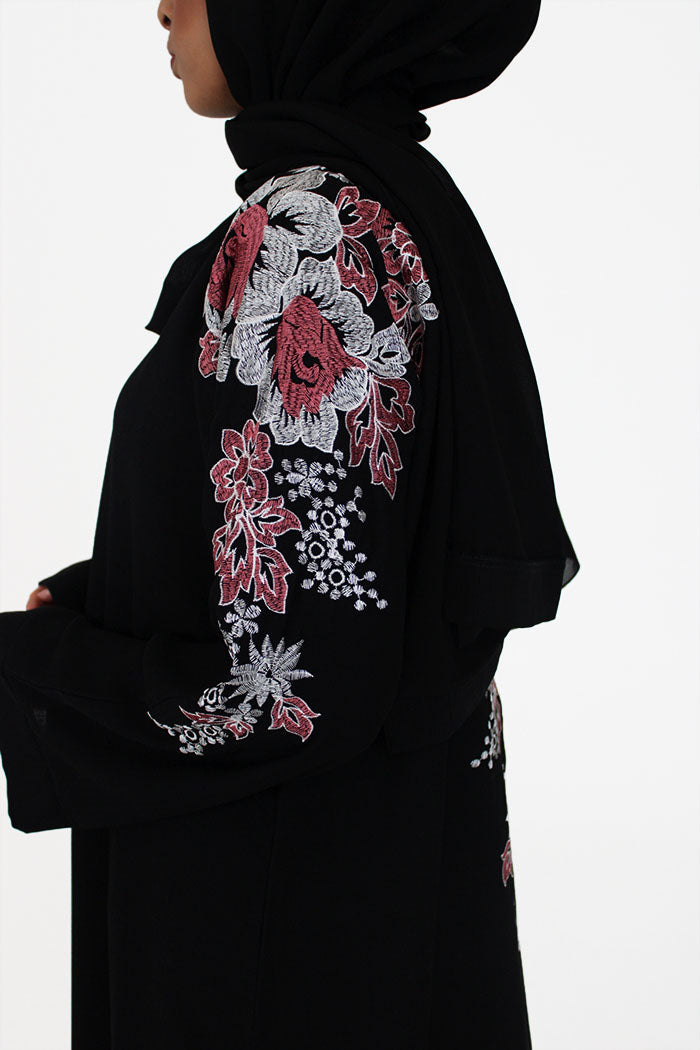
Check the weight and placement of embellishment. A heavily decorated cuff may behave differently from a plain sleeve, and an ornate front can affect how an open layer hangs. Try the outfit for sitting and walking as well as standing photographs, particularly when the event lasts several hours.
Use accessories to express taste, not to correct your body
A belt is optional. It may be part of the design or a styling choice you enjoy, but it is not a requirement for making a plus-size abaya look finished. Try the garment as intended before adding one, and check whether a belt changes the coverage or movement in a way you want.
Scarf colour can bring together the abaya, inner outfit and outerwear. It does not have to match the abaya exactly, and you do not need to avoid prints. Start with one relationship you like, such as a scarf picking up a colour in embroidery, then assess the complete outfit.
Choose bag straps and jewellery with the fabric in mind. A decorative strap or textured bracelet may catch on an embroidered area. Where that happens, change the accessory relationship rather than accepting damage as the price of a styled outfit.
There is no universal rule that larger accessories suit larger bodies or that small details must be avoided. Scale is part of the look you prefer. Try the actual pieces together and keep the ones that feel comfortable and intentional to you.
When an alteration is sensible—and when it is not
Ask a competent alteration professional to assess the actual garment before assuming a change is straightforward. Shortening a plain hem may be a different task from shortening a bordered or heavily embroidered abaya. Sleeve alterations can also affect cuffs, decoration and the balance of the garment.
Do not buy a restrictive garment on the assumption that it can always be let out. Available seam allowance, lining and construction vary. A tailor needs to inspect those details before giving a reliable opinion about what is possible.
Likewise, making an oversized garment smaller is not always simply removing fabric at the sides. The shoulders, armholes and neckline may also need attention. Compare the total work and likely result with choosing a different cut that fits better from the start.
If only one measurement regularly causes difficulty, keep a record of it and look for ranges or services that address it directly. This can be more efficient than repeatedly buying the wrong proportion and hoping an alteration will transform the whole garment.
Build a small, dependable fit record
After wearing an abaya successfully, record its finished measurements, fabric description and the inner layers that work with it. Add a note about its role: everyday walking, office wear or an occasional outfit. A photograph of the complete combination can be helpful, but the practical observations are what make the record useful.
Record limitations honestly. Perhaps the garment is comfortable indoors but its wide sleeves do not fit beneath your usual coat. That does not make it a failed purchase; it tells you where it belongs in your wardrobe and what to look for in the next piece.
Review the record before buying a similar abaya. Ask whether the new one fills a genuine gap in length, fabric, colour or use. A dependable wardrobe can include variety without requiring every purchase to start the fit process from nothing.
For the wider relationship between cut, fabric and styling, our complete abaya guide provides further context. The most useful plus-size abaya is not the one that promises to transform your body. It is the one whose measurements, construction and design let you get on with your day while wearing something you genuinely like.