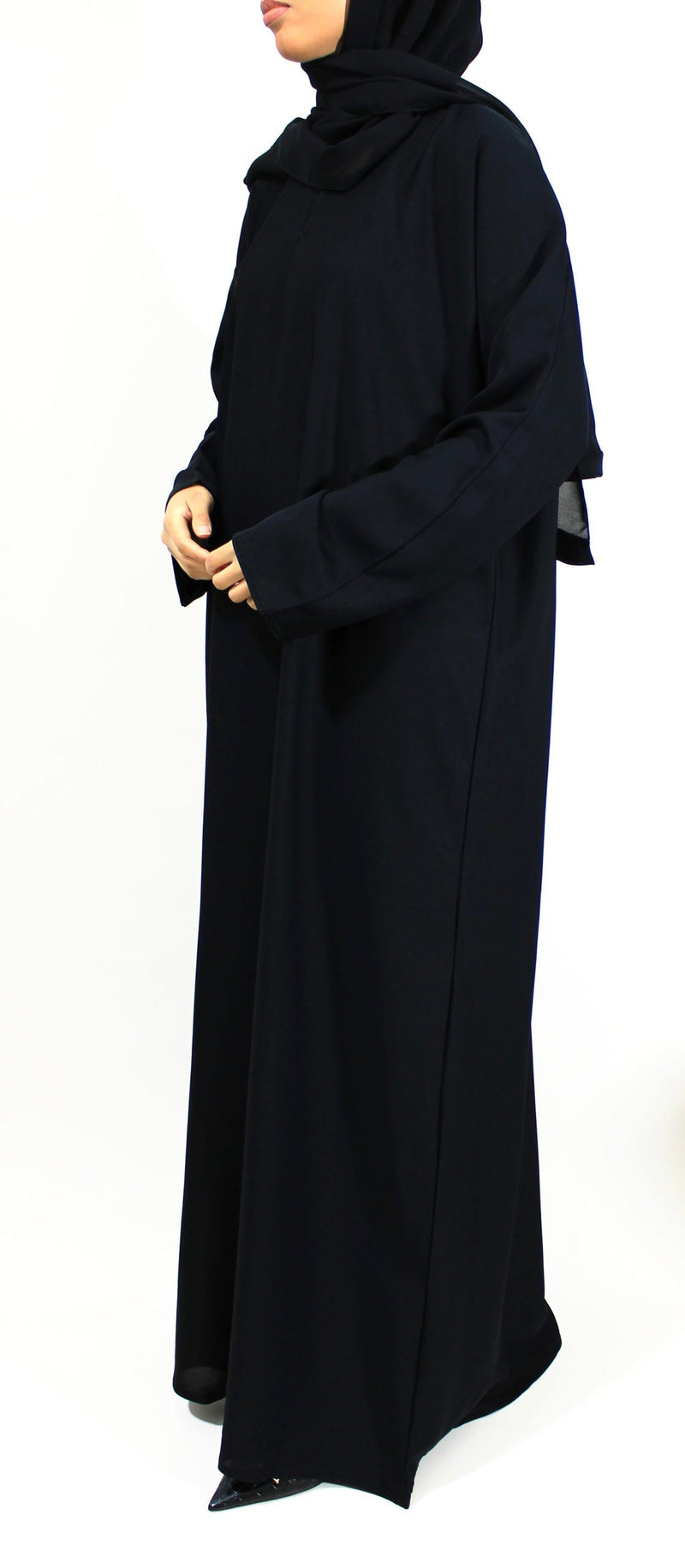
The Lovely Thing About a Jilbab Cape Is the Movement — Until the Fabric Starts Feeling Like Too Much
A cape can be one of the prettiest things a jilbab can do. Fabric falls from the shoulders in one broad sweep, the upper body looks calm rather than busy, and even an ordinary walk can give the garment a soft, floating movement. Then you reach for a shelf, lift a bag onto your shoulder, hold a child’s hand, bend to fasten a shoe or get caught by a sharp British gust — and the silhouette you admired in the mirror suddenly behaves very differently.
That difference is the reason a jilbab cape deserves a more thoughtful look than a front-facing product photograph can give it. The cape itself may provide generous visual coverage while your arms are relaxed, yet the real modesty of the outfit also depends on what sits underneath it, where the cape finishes, how the arm openings are cut, whether the fabric turns sheer against daylight, and how much the whole construction shifts when you move.
None of this means the cape shape is a poor choice. It can be wonderfully practical, comfortable and graceful when the construction suits your needs. The point is simply that grace and coverage are not measured in the same pose. One is easy to see when a garment hangs still. The other has to survive a normal day.
If you are still getting familiar with the wider differences between one-piece, two-piece and other jilbab shapes, the complete jilbab guide gives useful context. Here, though, we are staying with one very specific question: how do you judge a cape-style jilbab properly, so the beautiful drape you wanted does not hide a coverage problem you only discover after wearing it outside?
The graceful part is obvious; the coverage work is quieter
Most of us notice the cape first because it is the most visually distinctive part of the garment. It softens the shoulder line, creates width without needing obvious seams through the upper body, and can make the whole outfit look composed with very little styling. That clean sweep is precisely why photographs of cape jilbabs can be so persuasive. There is less visual interruption, so your eye reads one long, fluid shape.
Coverage, however, is often being created by several pieces of the design at once. The cape may cover the chest and upper back. An under-sleeve or inner dress may cover the arms. A gathered wrist may stop a sleeve from sliding. A full lower section may provide width for walking. A head opening, tie or integrated headpiece may determine how securely the upper portion stays where it was intended. When those parts work together, the garment feels effortless. When one is weak, the cape can still look beautiful while standing still.
That is why I would never judge a jilbab cape only by asking, “Does the cape look wide enough?” Width is useful, but it is only one part of the answer. I would also want to know what happens under that width. If the cape lifts as the arms rise, what remains over the chest and sides? If the front slips back slightly, is there an opaque layer beneath it? If the fabric separates at an arm opening, how much of the sleeve is visible? If the cape catches wind from behind, does the under-layer still give you the coverage you expected?
This is a kinder way to shop, too. It takes the pressure off trying to decide whether a particular silhouette is inherently “modest enough” from a photograph. Instead, you look at construction, movement and your own coverage standard. Two garments can both be sold under the same cape name and behave very differently because their patterns are different.
Think in layers of responsibility
A useful mental picture is to give each part of the garment a job. The cape provides broad upper-body drape. The sleeves or inner layer protect arm coverage when the cape moves. The lower garment gives walking room without needing to cling. The head or neck construction keeps the garment secure. You may prefer a design where the cape does most of those jobs, or one where an inner layer carries more of the responsibility. Either can work. What matters is knowing which part is meant to protect you when another part moves.
That becomes especially important when a product description uses a graceful word such as “flowing” or “butterfly” without showing the engineering underneath. Flow is an appearance. Coverage is a performance. Before buying, you need enough information to judge both.
“Cape jilbab” can describe more than one construction
The phrase sounds precise, but in modest-fashion shops it can cover several related designs. One cape may be a broad upper layer attached to a full-length underdress. Another may form the top portion of a two-piece set. Some cape sections are closed at the sides; others have defined openings for the forearms or hands. Some sit like a poncho over sleeves. Others are cut almost like a khimar-length overlay joined to the main garment. Naming varies between makers, so the label alone cannot tell you exactly what you are buying.
That variation is not a problem once you know to expect it. It simply changes the questions you ask. A woman who wants maximum ease for feeding a baby, carrying shopping or working at a desk may care a lot about independent sleeves and hand access. Someone who loves a very uninterrupted drape may prefer a cape with fewer visible openings. A sister who relies on the jilbab as her main outdoor layer through a windy commute may pay closer attention to how securely the cape joins the garment and how much inner coverage remains when it lifts.
This is also why comparing two cape jilbabs by measurements alone can be misleading. A 90-centimetre cape measured from a certain point on one pattern may sit completely differently from the same measurement on another because the shoulder slope, head opening, gathering and side depth change where the edge lands on your body. Measurements matter, but construction gives those numbers meaning.
Look for photographs that reveal the pattern, not only the pose
A useful product page shows more than a model facing the camera with her arms down. Side and back photographs tell you where the cape finishes. A slightly raised arm can show whether there is a separate sleeve. A close-up can reveal whether the cape is attached at the wrist, open along the side or layered over another piece. If the listing includes a short movement video, watch the garment rather than the model: where does the hem of the cape travel when she turns, and does the inner layer remain calm underneath?
If those details are not visible, it is reasonable to ask before buying. “Does this have full sleeves under the cape?” is a better question than “Is it modest?” because the first has a concrete answer. So does “Where does the cape finish at the side?” or “Are the arm openings closed, slit or wrist-attached?” Specific questions give you information you can compare with your own needs.
Your arms change the garment more than the mirror does
Stand in front of a mirror with your arms resting naturally and almost any generous cape will look at its most covering. The fabric falls vertically. Gravity is helping. The front panels sit in their intended place. That is useful to see, but it is also the least demanding position you will put the garment through all day.
Now imagine reaching to tap a card reader, pushing a buggy, lifting a suitcase into a rack, opening a heavy door, carrying two grocery bags or holding an umbrella against the wind. Your elbows move away from your body. Your shoulders rotate. Fabric that was hanging straight now travels sideways and upwards. If the cape is connected to the wrists, the whole edge may rise with the arm. If it has loose openings, the arm may emerge beneath it. If it is very light, movement can make the layer billow far more than you expected.
This is not a flaw unique to cape jilbabs. Every loose garment moves. What makes the cape worth testing carefully is the amount of visual coverage concentrated in a mobile upper layer. When that layer shifts, the change can be larger than it would be with a conventional sleeve-and-bodice construction.
Raise, reach, carry, turn
Before removing tags, give yourself a small movement routine at home. Raise both hands as though reaching for a high cupboard. Stretch one arm forward as if holding a bus rail. Reach across your body as if fastening a seat belt. Carry a moderately weighted tote on one shoulder. Turn to look behind you. Bend enough to pick up something from a chair. You are not trying to perform acrobatics; you are recreating the ordinary movements that reveal how the garment behaves.
Watch four places: the chest, the side of the torso, the upper arm and the lower back. If the cape lifts, does another opaque layer remain underneath? Does the material pull tightly across an area that was loose before? Does a slit gape wider than you expected? Does a bag strap pin the cape to one side and expose the opposite side? These observations are far more useful than repeatedly adjusting the fabric until it looks perfect again.
One practical rule helps: test the garment before you learn how to compensate for it. If you immediately hold the cape closed with one hand, tuck it under a bag strap or keep your elbows close because you sense it shifting, you may hide the very behaviour you need to evaluate. First see what the construction does naturally. Then decide whether any simple adjustment is genuinely comfortable for daily life.
Where the cape ends matters more than how dramatic it looks
A cape can be extremely wide and still finish at an awkward point. Length across the front, sides and back determines what stays covered when the upper layer lifts or swings. A front edge that reaches well below the chest may look reassuring, but if the side curves sharply upwards toward the elbow, the side view may be quite different once the arm moves.
There is no single universally correct cape length I can give you, because bodies and constructions vary and people follow different modesty understandings. What you can assess objectively is whether the edge gives you the protection you intended in all directions. Look at yourself from the side, not only the front. Turn your back to the mirror. Raise one elbow. Sit down. If the cape is asymmetrical, notice which part becomes shortest when it is pulled by movement.
Your height changes the visual result as well. On a petite frame, a fixed cape may fall much lower relative to the torso. On a taller frame, the same piece can sit higher. Bust projection, shoulder width and posture also affect the path fabric takes before it reaches its edge. That is why a model’s height and garment size, when provided, can be useful context but cannot replace your own try-on.
Front coverage and side coverage are separate checks
Front photographs can create a false sense of certainty because the cape often overlaps generously at the centre. The side is where many designs reveal their real construction. If there is a hand opening, wrist connection or curved cut, see how far that opening travels towards the body. If an under-sleeve is intended to be visible, check whether it is roomy and opaque enough for your standard rather than treating it as an afterthought.
The back deserves the same attention. A lightweight cape can catch on a backpack, handbag or coat underneath and ride higher than its natural hanging position. Long hair tucked beneath a scarf, a bulky scarf knot or a hooded underlayer can also alter the fall across the shoulders. The point is not to eliminate every shift. It is to know whether the garment still works when those normal shifts happen.
Fabric changes the coverage equation before colour even enters it
The same pattern can feel almost like a different garment when cut in a different fabric. A softly weighted cloth tends to fall back into place after movement. A very light cloth may float beautifully but respond more dramatically to air and static. A crisp fabric can hold volume away from the body but may also create folds that stand rather than drop. A fluid stretch fabric can be comfortable while following contours more closely when pulled.
For a cape, those behaviours matter because so much of the silhouette depends on drape. You are not merely choosing “soft” versus “structured”. You are choosing how quickly the layer settles, how easily it is displaced, whether it grips the layer beneath, and whether the weight of the cloth helps it stay down.
Opacity deserves its own check. Dark fabric can appear opaque indoors and become more revealing when daylight shines through a single layer. Pale fabric can be perfectly opaque if it is dense enough, while a darker but very fine weave may show more than expected. Colour alone is not a reliable test. Hold a section away from the body in strong natural light and place your hand or a contrasting layer behind it. If the cape is meant to be backed by an underdress everywhere it matters, verify that the layers actually overlap in motion.
Static can quietly ruin a generous cut
A cape does not need to be narrow to show more shape than you intended. Static can make a broad layer cling to the underdress or to tights and trousers beneath it. Dry indoor heating in winter, synthetic layers and friction from coats can all contribute. The result is a garment that has plenty of fabric but no longer hangs away from the body in the way you expected.
The answer is not necessarily to reject synthetic fabrics. Many are practical, durable and easy to care for. It is simply worth testing the complete outfit rather than evaluating the cape on a hanger. If the layers consistently grab each other, a smoother compatible under-layer may help. Always follow the garment’s care label, and avoid home treatments that could stain, alter the finish or damage delicate fabric.
Weight is useful until it becomes tiring
Extra weight can help a cape settle, particularly outside, but heavier is not automatically better. A dense cape attached around the head, shoulders or wrists can feel tiring over a long day. If the garment pulls backwards, creates pressure at ties or makes you keep readjusting the head area, the beautiful drape has come at a practical cost.
Try to separate “substantial enough to hang well” from “heavy enough to become work”. If you wear the jilbab for commuting, travel or long periods outside the home, comfort is part of whether the coverage remains reliable. A garment you constantly lift, tug and rearrange is less settled in real life than one you can largely forget about.
The under-layer is often doing more of the modesty work than you think
A cape naturally attracts attention because it is visible. The layer beneath it can look almost boring by comparison, yet that quiet piece often determines whether the whole outfit still feels secure when you move. If the cape rises with your hands, a full sleeve underneath protects the arm. If the front shifts in wind, an opaque underdress prevents a sudden gap from becoming a coverage problem. If the cape clings, a sufficiently roomy lower layer can stop the outfit from relying on the cape alone for looseness.
That is why I would inspect the inner construction with the same care as the outer drape. Is it attached or separate? Does it have full-length sleeves? Are the sleeves roomy through the upper arm as well as the wrist? Does the underdress remain opaque under strong light? Is the neckline or upper chest secure beneath the cape? Can the pieces separate during movement? If the cape is sold alone, what type of base garment is it designed to sit over?
A separate under-layer can be useful because it gives you flexibility. You can choose a fabric that suits the weather, replace a worn base without replacing the cape, and adjust sizing between layers. The trade-off is that two separate pieces can shift independently. An attached layer tends to move more as one unit but gives you less freedom to change the combination. Neither approach is automatically superior; they solve different practical problems.
Do not let the under-layer become skin-tight just because it is “hidden”
It is easy to think that anything beneath a wide cape does not matter because nobody is meant to see it. But the under-layer is precisely what may become visible when the cape moves. If it is very fitted through the arms, chest, waist or hips, the outfit can change character the moment the upper layer lifts.
Choose the under-layer according to the coverage standard you actually want when it is visible, not according to the best-case assumption that it will never show. That may mean a roomy full-length dress, an integrated loose sleeve system or another opaque base appropriate to the exact cape design. The safest choice is the one you would still feel comfortable wearing if several inches more of it appeared during a gust of wind or a big reach.
Fit starts at the shoulders, even when the garment looks beautifully oversized
“Loose” can sound as though fit no longer matters, but a cape proves the opposite. Its drape originates around the head, neck and shoulders, so small fit differences there can change the entire fall of the garment. If the opening sits too far back, the cape may creep backwards through the day. If the shoulder area is strained, folds may pull diagonally across the upper body. If the construction is far too large, the cape may rotate, slide or place the wrist points lower than intended.
You are looking for ease without instability. The fabric should have room to fall rather than stretch across the body, but the anchor points should still sit where the pattern expects them to sit. This is why sizing up automatically is not always the best route to more coverage. Sometimes a larger size gives welcome length and width; sometimes it moves openings and attachment points into awkward positions. Check the size chart and the design rather than assuming more fabric always means a better result.
Shoulder width is particularly worth noticing on cape designs with wrist attachments. If the distance from the centre or shoulder area to the wrist is too short for your reach, raising your arm can pull the whole cape sharply upwards. If it is too long, excess fabric around the hand may interfere with tasks. A separate full sleeve underneath can reduce the coverage consequence, but it will not fix an uncomfortable reach.
Sit before deciding the fit is right
Standing makes many loose garments look ideal. Sitting changes where fabric pools and where tension appears. Sit on a normal dining chair with your feet on the floor. Then sit as you would on public transport, perhaps with a handbag on your lap. Notice whether the cape falls forward into your hands, pulls backwards at the neck, or spreads so widely that it becomes difficult to manage beside another person.
If you drive, you also need freedom around the shoulders and arms without so much loose fabric near the controls that it becomes distracting. The exact solution will depend on the garment, but the principle is simple: a jilbab that works only when standing still is not properly fitted for a day that includes sitting.
The five-minute movement test tells you more than twenty posed photographs
Once you know the weak points to watch, you can test a cape very quickly. I like the idea of doing this in a deliberate sequence because it stops you judging by feeling alone. A garment can “feel covered” because the front looks generous, while one side opening is quietly travelling much higher than expected.
| Movement | What to watch | Why it matters |
|---|---|---|
| Raise both arms overhead | Cape hem, chest, side openings, sleeve exposure | Shows the maximum upward travel caused by your reach. |
| Reach one arm forward | Opposite shoulder, back and side drape | Recreates doors, handrails, shelves and carrying. |
| Cross one arm over the body | Diagonal pulling and front overlap | Shows whether the cape rotates or opens across the front. |
| Sit and stand | Neck position, pooling, lower width | Reveals tension and excess fabric hidden in a standing pose. |
| Carry a shoulder bag | Trapped fabric and opposite-side lift | A strap can pin one section and change the whole drape. |
| Walk briskly and turn | Opacity, cling, swing and recovery | Shows how quickly the fabric settles after real movement. |
You do not need every cape to remain visually identical through all six movements. Fabric is supposed to move. The question is whether the garment continues to meet your own coverage expectations without constant manual correction.
Pay attention to recovery as well. After you raise your arms, does the cape fall back into position by itself, or does it stay caught behind the shoulder? After a turn, does the front overlap settle again? A garment that self-corrects is much easier to live in than one that needs a tug after every movement.
Test with the layers you will really wear
A fitting-room test over a thin top can be misleading if you will normally wear the cape over a full underdress, knitwear or an abaya. Added layers change friction, bulk and shoulder shape. In winter, a cardigan beneath the jilbab can make the cape sit higher. A textured underdress may grip a smooth cape. A thick scarf can alter the neckline and make the upper layer slide backwards.
If possible, recreate your normal outfit before making the final decision. You are not trying to make shopping complicated. You are removing the surprise from the first proper wear.
A British day can find every weak point in a cape
UK weather is an excellent garment tester because it rarely respects a product photograph. A still cape in a warm room may meet drizzle, crosswinds, damp pavements, train platforms, overheated shops and a coat all within a few hours. Each condition changes the way fabric behaves.
Wind is the obvious one. A broad cape offers a lot of surface area, so a gust can lift or press it more than a narrow sleeve would. If the under-layer is complete and the openings are sensible, this can be no more than a momentary inconvenience. If you were relying on the cape alone to cover a fitted layer beneath it, the same gust can make you uncomfortable very quickly.
Rain adds weight to some fabrics and makes others cling. A wet hem can pull differently from a dry one. Long capes may also brush against damp surfaces more easily, particularly when sitting on public transport or walking near puddles. You do not need to avoid a graceful length; you simply need to know whether you can manage it without spending the day holding fabric off the ground.
Coats change the equation again
A coat over a cape compresses the width that made the garment attractive in the first place. A coat under it adds bulk and may distort the shoulder line. There is no universal answer because cape proportions and outerwear vary enormously, but it is worth deciding how you expect to use the jilbab through colder months.
If you mainly travel by car and move between indoor spaces, you may not need the same winter layering as someone waiting for buses in January. If the cape is intended to be your outermost layer, check whether its fabric and construction feel manageable in wind and light rain rather than assuming “full length” automatically means weather-ready. If you plan to add a coat, test the two garments together and make sure you can still move your arms safely and comfortably.
Bag straps are small but powerful
A cross-body strap can carve a line through an otherwise loose cape. A shoulder bag can hold one side down while the other side moves freely. A backpack can pull the cape backwards and create bunching beneath the straps. These are ordinary practical issues, not reasons to abandon the style.
If you use the same type of bag most days, include it in your fitting test. Sometimes carrying a handbag by hand preserves the drape better. Sometimes a small shoulder bag works perfectly because the cape has enough stable under-coverage. The useful answer comes from your real routine, not from a styling rule.
Prayer, travel and long days deserve their own trial run
Some sisters want a jilbab that can stay on through a journey to the masjid, prayer and the trip home. Others will change layers. If you hope to pray in the garment, test the movements privately before relying on it. Make sure the cape does not pull tightly when you bend, slide forward in a way that distracts you, or trap your hands when you need to adjust your position. Religious requirements can involve details beyond garment styling, so if you need a ruling for your circumstances, ask a trusted qualified scholar rather than treating a clothing article as a fatwa.
Travel brings a different set of pressures. Airport security, luggage, escalators, long seats and crowded spaces all reward a garment that is secure without constant adjustment. Very sweeping capes can be beautiful but may need more management around trolley wheels and narrow seats. A slightly calmer drape with reliable under-sleeves may serve you better on a travel day even if another design photographs more dramatically.
Long days also expose neck and head tension. If a cape is anchored through a tie or integrated head section, wear it around the house for enough time to notice pressure. Something that feels fine for five minutes can become irritating after several hours. Comfort matters because discomfort changes behaviour: you loosen ties, pull fabric forward, shift the headpiece or repeatedly touch the garment. A secure design should not require you to endure pain to keep it in place.
Buying online means interrogating the construction, not admiring the name
A product title can tell you that a jilbab has a cape. It cannot tell you whether that cape will solve the problem you actually care about. Before buying online, translate the beautiful photographs into a short list of practical facts.
- What exactly is included? Cape only, cape with underdress, one-piece construction, or a multi-piece set?
- Are there full sleeves beneath the cape? If yes, how roomy are they and how do the wrists finish?
- How are the arm openings constructed? Open side, slit, wrist attachment, or fully closed layer?
- What are the relevant lengths? Ask where measurements begin and whether cape length is given front, back or side.
- Is the fabric described as opaque? Then still test it in strong light when it arrives, because lighting and colour can affect perception.
- How does the fabric behave? Look for information about weight, stretch and texture rather than relying on words such as “luxury”.
- What is the return policy? A movement-dependent garment is difficult to judge until you can try it properly.
Model information can help if the retailer provides it, especially height and the size worn. Use it as a reference point, not a promise. Two women of the same height can have different torso length, shoulder width and proportions, so a cape can finish at a different place on each of them.
Measurements are most useful when you compare them with a garment you already understand. If you own a khimar, poncho, cape abaya or previous jilbab whose upper coverage you like, measure where it falls at the front, side and back. You then have a concrete benchmark instead of trying to imagine what a number means on your body.
A word about product photography
Photography is designed to show a garment attractively. That does not make it dishonest, but it does mean the pose may be doing some of the work. Arms close to the body keep a cape low. Hands placed together stop the sides spreading. A slight forward angle can make the front look longer. Dark studio backgrounds can hide transparency. You are allowed to enjoy the image and still ask what happens outside the pose.
If every photograph shows exactly the same stance, ask for more information rather than filling the gaps with hope. A good buying decision is often made from the unglamorous details: sleeve construction, side length, fabric density and how the pieces connect.
Styling should support the cape instead of forcing it to behave
One attraction of a jilbab cape is that it already creates a strong silhouette, so it rarely needs much visual styling. The practical styling choices are the ones that help the fabric sit as intended: a scarf arrangement that does not create a large knot under the cape, an under-layer that moves smoothly with it, footwear that suits the total length, and a bag that does not constantly drag the upper layer out of place.
If the cape has an integrated head covering, learn where the ties or fastening are meant to sit before tightening them. Pulling harder is not always the answer to slipping. Sometimes the garment is being pushed backwards by bulk underneath. Sometimes the size or pattern simply does not suit your head and shoulder proportions. Comfortably secure is better than painfully tight.
Pins can be useful in some styling situations, but I would be cautious about using random pinning to “repair” a structural coverage issue. Gathering a large amount of fabric at the chest can change the drape elsewhere, and pinning through delicate cloth can damage it. If the cape only feels wearable after a complicated set of emergency fixes, that is information about the garment, not a personal failure to style it correctly.
Let the fabric have room to fall
Bulky pockets, thick jumpers and large scarf folds under a light cape can create peaks and ridges that the outer layer then catches on. If you want a smooth, generous fall, keep the layers beneath proportionate to the fabric. That does not mean freezing for the sake of appearance. In cold weather, choose warmth intelligently and accept that a winter outfit may look more substantial than a summer one.
The goal is not to preserve a perfect fashion image all day. It is to create an outfit that remains calm enough that you are not thinking about your clothes every few minutes.
A cape jilbab is a strong choice when you value drape and have the right support underneath
After all these checks, it would be easy to make the style sound more complicated than it is. A well-designed cape jilbab can be remarkably easy to wear. The upper layer can soften the outline without needing a separate open abaya. The broad drape can feel less restrictive across the shoulders than a tailored garment. The silhouette is already complete, so you may need fewer styling decisions before leaving the house.
It can be especially appealing if you dislike visible shaping through the upper body and prefer fabric to fall away in one continuous plane. Some women also appreciate how a cape can give visual quietness to an outfit: no busy lapels, belts or fitted shoulder seams, just a generous sweep of cloth.
The style works best when that visual simplicity is backed by good construction. Full under-sleeves, adequate side coverage, an opaque inner layer, sensible attachment points and a cape that recovers after movement make the beauty feel reliable rather than fragile.
It may be less convenient if your day is very hands-on
If you spend much of your day lifting children, working with your hands, handling equipment or moving rapidly between tasks, a very wide cape may demand more management than you enjoy. That does not mean you cannot wear one. It simply makes hand access, sleeve design and fabric weight more important.
A narrower, more anchored cape can sometimes be more useful than the most dramatic version. In this category, the “prettiest” design on a hanger is not always the one you will love after six hours. The best one is the cape whose movement matches your movement.
Care protects drape, and drape is part of how the coverage works
Care advice begins with the sewn-in label, because fabric names used in retail do not always tell you the full fibre composition or finish. Follow the temperature, washing and drying instructions provided for the garment. A cape that shrinks unevenly, loses its surface finish or develops heavy creases may no longer hang as the maker intended.
Storage matters too. Very lightweight capes can crease sharply if packed under heavy garments. Heavier ones can stretch if hung from unsuitable points for long periods. If the manufacturer recommends folding, fold it loosely along natural seams. If it is safe to hang, use enough support that the weight is not concentrated on one narrow area.
When ironing or steaming, check the label and use the appropriate setting. High heat can damage some synthetic fibres, coatings or delicate textures. Test an inconspicuous area first if you are unsure. The objective is not a perfectly pressed fashion finish; it is to restore the fabric’s natural fall without harming it.
Recheck opacity as garments age
Fabric can wear at friction points, particularly around wrists, shoulders, hems and areas repeatedly caught by bags. Seams can loosen. Elastic can relax. A cape you trusted when new still deserves an occasional inspection in strong light. This is basic garment maintenance, but it matters more when the outer layer is carrying a large share of the coverage.
Small repairs made early are usually easier than waiting for a seam to open further. If a wrist connection, tie or side seam is structural to the way the cape stays in place, treat damage there as more than a cosmetic issue.
Modesty cannot be reduced to the outline of one garment
A cape can create a beautifully loose silhouette, but silhouette alone does not answer every modesty question. Fabric transparency, movement, what is visible underneath, how the garment sits at the head and neck, and the standards you follow all matter. Muslim women also come from different scholarly traditions and personal circumstances, so a clothing article should not pretend to settle religious questions that properly belong with qualified scholarship.
What we can do very well is separate the practical facts from the assumptions. We can see whether an arm becomes exposed. We can test whether a fabric turns translucent in sunlight. We can observe whether a layer clings. We can measure where a cape ends. We can identify whether the underdress is roomy or fitted. Those facts give you better material for your own decision.
There is something freeing about that. You do not need to panic because a cape moves; movement is normal. You do not need to convince yourself a design works because it looked modest in one photograph. You can simply test it, calmly, against the way you actually live and the coverage you are trying to maintain.
Compare the garment, not the label, when you are ready to choose
If you are shopping after reading this, start by deciding which jobs you need the jilbab to do. Do you want a single easy outdoor layer? Do you need generous arm movement for the school run? Will you commute in wind? Do you expect to wear it through long masjid visits or travel? Do you prefer an integrated underdress, or do you want to choose your own base layer? Those answers narrow the field much faster than searching for the most dramatic cape.
Then compare construction. A graceful cape with reliable sleeves and a calm under-layer may suit you perfectly. Another cape may be more voluminous but less secure at the sides. A third may be wonderfully light for warm weather yet too flighty for your daily route. These are trade-offs, not verdicts.
You can browse shop related styles with those questions in mind. Treat the collection as a place to compare shapes rather than assuming every garment called a cape will behave identically. If a detail is not clear on a product page, ask before ordering rather than trying to infer it from the name.
The decision I would make last
Colour, trim and the exact “wow” of the drape can come last. They matter because clothing can be beautiful and still be practical, but they are easiest to appreciate once the foundation works. First establish coverage in motion, under-layer security, comfortable fit and manageable fabric. Then choose the version that makes you smile when you put it on.
That order protects you from the most frustrating kind of purchase: the garment that is gorgeous enough to keep but awkward enough that you never quite reach for it.
Frequently asked questions about jilbab capes
Does a jilbab cape give more coverage than a normal jilbab?
It can give very generous upper-body drape, but “more” depends on the construction rather than the cape label alone. A wide cape may cover the chest, shoulders and back beautifully while your arms are down, yet rise when you reach. Check what remains underneath: full sleeves, an opaque underdress and sensible side openings can make the coverage much more dependable. Compare the garment in motion rather than judging only by how much fabric you can see from the front.
What should I wear underneath a jilbab cape?
Wear an under-layer that still meets your intended coverage if part of it becomes visible. Depending on the design, that might be the loose underdress supplied with the cape, an integrated full-sleeve layer or another roomy opaque base garment that works with the pattern. Avoid assuming a very fitted layer is harmless because the cape will “always” hide it. Test the complete outfit with raised arms, side movement and strong light so you know how the layers behave together.
How do I know whether a cape jilbab is too short?
Do not judge the centre-front length alone. Look at where the cape finishes at the sides and back, then repeat the check while raising an arm, reaching forward and sitting. A cape may look long from the front but curve much higher near a hand opening. Your height, shoulder width and proportions also change where a fixed measurement lands. The useful question is whether the shortest moving edge still gives the coverage you personally expect.
Are lightweight cape jilbabs too sheer?
Lightweight does not automatically mean sheer, and dark does not automatically mean opaque. Density, weave, fibre and finish all affect how much light passes through a fabric. When the garment arrives, check a single layer in strong natural light with your hand or a contrasting fabric behind it. Then check the full layered outfit. If the cape depends on an underdress for opacity, make sure those layers continue to overlap when you walk and lift your arms.
Can I carry a cross-body bag over a jilbab cape?
You can, but a cross-body strap may press the cape against the body and create a line through an otherwise loose silhouette. It can also anchor one section while the rest of the cape moves. If that does not suit the look or coverage you want, try a hand-carried or shoulder option and compare. There is no need for a universal bag rule; test the bag you actually use and see whether the cape remains comfortable and settles naturally afterwards.
Why does my jilbab cape keep slipping backwards?
Several things can contribute: a head or neck opening that does not suit your proportions, scarf bulk underneath, a heavy cape pulling from the back, a smooth under-layer, or ties that are positioned incorrectly. Tightening everything harder can create discomfort without solving the cause. First simplify the layers and place the garment according to its intended construction. If it still migrates backwards during ordinary movement, the size or pattern may simply be a poor match for you.
Is a very wide cape always better for modest coverage?
No. Width is useful only when the rest of the construction supports it. A huge cape with high side openings, no loose sleeves underneath or fabric that clings can be less reliable than a calmer cape with thoughtful under-coverage. Extra width can also become harder to manage around bags, children, travel and wind. Look for enough room to fall away from the body, then judge the arm openings, under-layer, opacity and movement as part of the same decision.
How should I test a jilbab cape before removing the tags?
Wear the full outfit you expect to use underneath it and spend a few minutes moving normally. Raise both arms, reach forward, cross an arm over your body, sit, stand, walk briskly, turn and carry your usual bag. Check the chest, sides, upper arms and back after each movement. Test opacity in daylight and notice whether the cape returns to its position without constant tugging. Keep the garment clean and follow the retailer’s return conditions while testing.
Can I wear a cape jilbab in windy UK weather?
Many women can, but wind makes construction more important because a broad upper layer catches more air. A reliable full-sleeve or underdress layer means a lifted cape is mainly a fabric-management issue rather than an unexpected exposure. Check whether the fabric is so light that you spend the whole journey holding it down, and test how it behaves with your normal coat or bag. Your commute and tolerance for adjustment matter as much as the style itself.
Is a jilbab cape suitable for prayer?
That depends on the exact garment and the religious requirements you follow. From a practical clothing perspective, test whether it stays secure through standing, bowing, prostration and sitting, and whether the fabric pulls, slips or exposes an area you intended to keep covered. If you need a ruling about whether a particular outfit fulfils prayer requirements, ask a trusted qualified scholar who can consider the garment and your circumstances rather than relying on a general fashion article.
The cape should make your day quieter, not make you guard the fabric
A jilbab cape earns its place in your wardrobe when the grace you see in the mirror survives the ordinary things you do after leaving it. The broad drape can be lovely. The softness around the shoulders can feel calm and unforced. The silhouette can give exactly the kind of generous upper-body coverage you were hoping for. But the strongest version of that beauty is the one supported by sensible sleeves, an opaque under-layer, secure anchor points and fabric that settles after you move.
You do not need a perfect, motionless garment. No loose clothing behaves that way. You need one whose changes are predictable and whose underlying construction still works when a bus arrives, the wind catches you, a child asks to be lifted or you reach for something above your head.
So when you try one on, enjoy the mirror for a moment. Then raise your arms. Turn sideways. Sit down. Put on your usual bag. Stand by the window and check the light. Those few unglamorous minutes will tell you whether the cape is simply graceful in a photograph or genuinely graceful to live in.