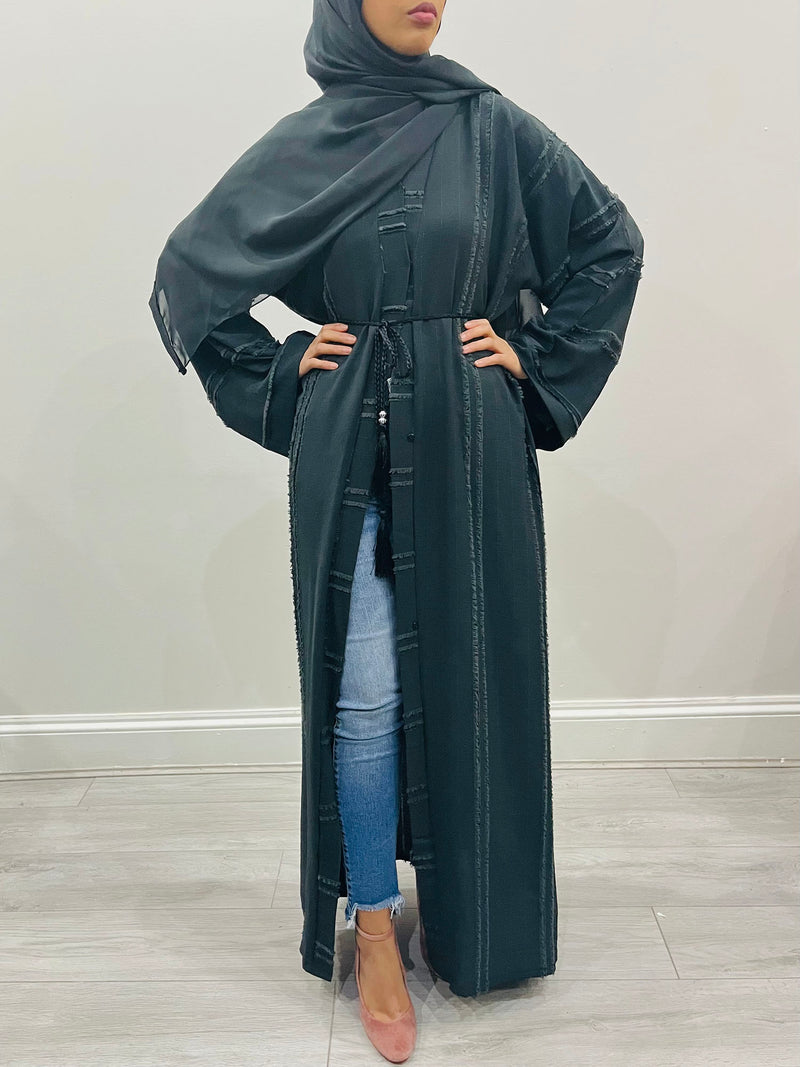
A Petite Abaya Can Be the Right Length and Still Be the Wrong Fit
Bismillah. A sister can order the length everyone told her to buy, stand in front of the mirror and still feel that something is not right. The hem may sit beautifully above her shoes, but the shoulders may pull, the sleeves may rise, or the body may follow her shape more closely than she wanted. Another sister may choose a roomy abaya and realise the fabric gathers under her feet, catches on stairs or makes her feel swallowed rather than settled.
This is why abaya sizing needs more care than one number. Length, body ease, sleeve reach, shoulder fall, fabric, lining, stride and prayer movement all work together. A good size is not a judgement on the body. It is evidence that the garment has enough space, length and structure to serve the woman wearing it.
I treat sizing as a calm process: first understand what the label is measuring, then compare it with a garment that already works, then test the abaya in real movement. The goal is not to chase a perfect label. The goal is to choose an abaya that gives coverage, dignity and ease without asking you to spend the day adjusting yourself.
Length and fit are two different decisions
A length decision asks where the hem finishes. A fit decision asks whether the garment releases comfortably through the shoulders, bust, back, hips, arms and lower body. Both matter, but they are not the same. A 56 inch abaya may be the right height choice and still feel narrow across the upper arm. A loose butterfly cut may feel generous through the body and still be too long on wet pavements.
I separate these decisions before trusting any label. First I ask whether the hem clears the floor safely in the shoes I plan to wear. Then I ask whether the garment gives enough room for sitting, walking, reaching, sujood, a coat and an inner layer. Only when both answers are calm does the size begin to make sense.
The size label is a clue, not the decision
An abaya size label can mean different things depending on the seller, the country, the cut and the product. Sometimes a number mainly describes garment length. Sometimes a lettered size describes body range. Sometimes a loose style is sold across one body width and several lengths. None of these systems can replace the actual finished measurements.
The safest approach is to ask what the label is attached to. Is it length, body width, height range, a UK style body size or a store specific scale. When that is clear, the label becomes useful. When it is unclear, the label should not be used as proof that the garment will fit.
Abaya sizing should begin with a trusted garment
The most useful abaya size guide is often already in the wardrobe. I lay down one abaya that feels comfortable after real wear, not only after a first try-on. I measure shoulder to hem, pit to pit, hip width, sleeve length, cuff, shoulder and lower hem width. I also note the fabric, whether it has stretch, whether it is lined and whether it is open or closed.
That trusted garment becomes a personal reference. A new product can then be compared with something already proven on the body. This is stronger than guessing from height alone, and kinder than asking the body to fit a chart that may not describe the garment clearly.
Body measurements and garment measurements must stay separate
Body measurements describe the person. Garment measurements describe the finished clothing. The difference between them is the ease, which is the space that lets the fabric fall away instead of pulling. Confusing these two types of numbers can make a sister choose a garment that technically closes but does not move modestly or comfortably.
If a chart gives body measurements, I still need to know how much ease the garment adds. If a chart gives finished garment measurements, I compare them with my body and with a trusted abaya. Both types can help, but only when they are read correctly.
Ease is the space that lets modest clothing work
Ease does not mean careless looseness. It means enough room for the garment to serve the body in motion. A modest fit needs space at the bust, hip, back, upper arm and lower body, but it also needs control so the garment does not drag, twist, gape or overwhelm the wearer.
Too little ease can make fabric pull or cling. Too much ease can make sleeves fall into food, hems catch under shoes or open panels move unpredictably. The right amount depends on fabric, lining, cut, layers and personal comfort. It is practical, not moral.
Measure shoulder to hem with real footwear in mind
Abaya length should be measured from the point the seller uses, often near the shoulder, down to the place the hem should finish. I do this with the shoes that will actually be worn. Trainers, flats, sandals and heels change the safe length, and a special occasion pair should not decide an everyday garment unless that is truly how it will be worn.
The aim is useful clearance. Some sisters prefer the hem at the ankle, some at the top of the foot, and some longer for indoor events. The right length is the one that gives the desired coverage while still allowing stairs, travel, wet pavements and prayer movement without constant lifting.
How Long Should a Long Abaya Jacket Be?
A long abaya jacket should be long enough to give the layered look and coverage you want, but not so long that the hem drags, catches under a shoe or has to be lifted every few steps. There is no single correct inch measurement for every wearer. The useful starting point is the jacket’s role. If it is an extra open layer over a separate full-length abaya or dress, it can finish a little higher because the underlayer is already providing full-length coverage. If the jacket itself is intended to behave like the main full-length outer abaya, the hem will usually need to sit much closer to the shoe line while still clearing the floor safely.
Measure a long abaya jacket from the same shoulder point used by the seller, wearing the footwear and inner layers you actually plan to use. Then check the front, back and side points rather than trusting the centre-front hem alone. Walk at a normal pace, climb a step, sit down and turn. A dipped back, curved front or wide side panel can hang lower once the garment moves, and a coat-style fabric can feel heavier than a soft everyday abaya.
Proportion matters as much as the number. On a petite frame, a jacket that reaches the floor may overwhelm the line of the outfit even when it technically fits. On a taller frame, a length that looks generous on a product model may finish noticeably higher. If a long jacket abaya is deliberately shorter than the inner dress, the difference should look intentional rather than like a near-miss of only a centimetre or two.
A practical rule is to choose the longest length that still lets you move naturally in the setting where you will wear it. If you can walk, use stairs, sit and step into a car without standing on the hem or constantly gathering it in your hand, the length is working. If the jacket repeatedly touches the ground or changes your stride, it is too long for everyday use, however elegant it looks while standing still.
A long abaya is not automatically a safer abaya
A longer hem can feel reassuring because it offers more visual coverage, but length becomes a problem when it creates tripping, dirt, dragging or fear of movement. A floor skimming abaya may look graceful indoors and become difficult on a rainy pavement or while stepping into a car.
I check the front, back, sides and any curved hem. Open front corners, winged panels and dipped backs can sit lower than the centre front. A practical length protects coverage and safety together. It should not make a sister move carefully all day just to keep the garment under control.
Numbers such as 52, 54, 56, 58, 60 and 62 need context
In many abaya systems, numbers such as 52, 54, 56, 58, 60 and 62 point toward finished length in inches. That can help narrow the choice, but it does not prove bust, hip, sleeve, shoulder or width. Two abayas with the same length number can fit very differently if one is straight, one is A-line and one is butterfly cut.
I never treat a length number as a complete size. I confirm the actual measuring method, the body width, sleeve length, lower width, lining and fabric. A 54 may work beautifully in one garment and fail in another if the width, shoulder or sleeve has changed.
Shorter length numbers still need body fit checks
A shorter length such as 44, 46, 48 or 50 may help a petite wearer, but it does not prove that the shoulder, sleeve and width have been scaled for her. Some garments are simply shortened at the hem while pockets, waist details, side points or embroidery remain placed for a taller frame.
This matters because a petite abaya can be the right length and still feel wrong. The hem may clear the floor, yet the sleeves may cover the hands, the shoulders may drop too far or the body may carry more fabric than the wearer can comfortably manage.
Longer length numbers can answer height but not width
A longer option such as 60, 62, 64 or 66 may be useful for tall wearers or for a style meant to sit lower. It still does not prove that the garment has more bust room, hip room, sleeve reach or stride width. Tall fit and plus size fit can overlap, but they are different questions.
I check long lengths with extra care because added fabric can create new movement issues. The hem must survive stairs, cars, travel, prayer and outdoor weather. Extra length should never turn dignity into a daily safety problem.
Height can guide the first choice but not finish it
Height charts can be useful when they are tied to a product's own measurements. They can suggest whether a sister should begin by considering 52, 54, 56 or another length. But height alone cannot account for torso length, shoulder slope, preferred footwear, posture, pregnancy, wheelchair use or how much clearance she likes at the foot.
Two sisters of the same height may need different abaya lengths. One may have a longer torso, one may wear thicker shoes, one may prefer more ankle clearance and one may want a longer indoor occasion hem. Measurement is kinder than forcing one height into one answer.
Fitted and slim cuts need more measurement proof
A fitted abaya, slim fit abaya or close cut style should still provide dignified ease. The shape may be neater, but the garment must not pull across the bust, cling at the hip, restrict the stride or make the wearer feel watched by the fabric. Neatness is not the same as narrowness.
I check these cuts with even more care because small changes are easier to see. Satin, jersey and metallic finishes can show strain quickly, while matte crepe may hide more until the wearer sits or reaches. A closer style is only successful when it remains calm in motion.
Height examples such as 5 foot 2 still need measurements
A sister who is 5 foot 2, 5 foot 4, 5 foot 5 or 5 foot 6 may use height as a starting point, but the answer still depends on shoulder to hem, footwear, torso length, preferred clearance and garment cut. Height does not tell the whole story.
This is why a simple height note should lead into measuring, not replace it. A 54 length option may be graceful on one wearer and awkward on another if their shoes, posture, shoulders or outdoor routine differ.
Petite fit is more than removing fabric from the bottom
A petite abaya needs proportion as well as length. I check shoulder drop, sleeve length, pocket placement, belt position, embroidery placement, side panels and the amount of fabric around the body. If those details remain drafted for a taller frame, hemming alone may not make the garment feel calm.
For petite wearers, the question is not whether the body is too small for the garment. The question is whether the garment has been built with the right scale. A good petite fit lets her walk, sit, pray and travel without lifting the hem or fighting heavy side fabric all day.
A small body size does not always mean a petite length
Small and petite are often treated as if they mean the same thing, but they do not. Small usually points toward body width. Petite usually points toward height or proportion. A small abaya can still be long, and a petite abaya can still come in more than one body width.
I check both choices separately. If a sister needs less length but not less body ease, she should not be pushed into a narrower garment. If she needs a smaller body width but a standard length, a petite label may not solve her fit.
Tall fit needs sleeve reach, not only extra hem
A tall abaya should give enough finished length, but sleeve reach, underarm depth, shoulder balance and stride matter just as much. Extending the bottom without adjusting the upper body can leave cuffs short, side slits high or design details sitting in the wrong place.
I look for actual finished measurements rather than trusting a photograph on a tall model. Model height only helps when the worn size, shoe height and garment length are shown. Without those details, it is only a visual clue.
Taller sisters still need lower width and sitting checks
A long abaya can become narrow in motion if the lower body has not been drafted with enough stride. The issue may not appear while standing still. It appears when walking quickly, climbing stairs, stepping into transport or moving into prayer.
I test the longest natural step I would take in real life. I also sit and check whether the front rises too much or the hips feel restricted. A tall garment should not make the wearer shorten every movement to protect the fit.
Plus size guidance must stay practical and respectful
A plus size abaya should not be discussed as though the body needs hiding more than anyone else's. The useful question is whether the garment provides enough ease through shoulders, upper arms, bust, back, hips, lining and lower body. If it pulls, the pattern or size has not provided enough room. The body has not failed.
I compare finished garment measurements with present body measurements and every intended layer. I check seated comfort, side views, sleeve movement and whether closures sit without strain. A larger label is only helpful when the whole pattern has been graded thoughtfully.
A generous outer cannot rescue a narrow inner layer
Open abaya sets often include an outer piece and an inner dress. The outer may look beautifully loose, but if the inner dress is narrow, short, sleeveless or cut close through the hip, the set may not feel modest or comfortable in movement.
I measure the inner dress as its own garment. Then I test the two layers together. Wind, sitting, a belt and a shoulder bag can all open the front or shift the panels. The outer and inner need to support each other, not hide each other's problems.
Maternity fit should serve the body that exists today
A maternity abaya needs room where the body is changing, especially through bust, abdomen, hip and front length. Pregnancy can make a previously correct hem rise at the front because fabric travels outward before it falls down. A longer length alone may not fix a front panel that lacks enough width.
I use current measurements and think about the remaining months of wear without pretending the body will stay still. If nursing access may matter later, I check openings and closures before buying. Postpartum fit should also be kind. It should support comfort and routine, not create pressure to return to an older size by a certain date.
One size and free size still need evidence
One size and free size can be helpful in wide, flowing garments, but neither term proves that every body will be comfortable. The wearer still needs length, body width, sleeve length, cuff placement, underarm depth, neckline size and lower width.
I look for maximum finished measurements and any stated height range. I also ask whether the style may overwhelm a petite wearer, rise too short on a tall wearer, or feel narrow at the upper arm even if the body is wide. Loose is not the same as measured.
UK dress sizes need a separate abaya length check
UK dress sizes usually speak about body measurement ranges within a store's own system. Abaya length numbers often speak about shoulder to hem. A product may offer UK body sizes and separate length options, or it may combine everything into one chart. I never convert UK 12 or UK 16 into an abaya length without the product's own chart.
The useful order is simple: confirm the body size range, confirm the finished garment width, then confirm the finished length. A familiar dress size can help start the comparison, but it should not replace bust, hip, sleeve, shoulder and hem checks.
The abaya size chart has to say what it is measuring
An abaya size chart is only useful when it tells the reader whether the numbers are body measurements or finished garment measurements. It should also show units, length, bust or width, sleeve, shoulder where relevant, and any difference between open, closed, lined or wide cuts.
If the chart is unclear, I do not build certainty from it. I look for a measuring diagram, product notes, model details and the return policy. When those are missing, asking before ordering is wiser than trusting a table that does not explain itself.
Pit to pit numbers must be handled carefully
A flat pit to pit figure usually describes half the garment width across the chest. To compare it with a full bust circumference, it normally needs to be doubled. Even then, I check whether the fabric was laid flat naturally or stretched during measuring.
This is where mistakes happen. A number may look generous or narrow until the measurement method is understood. I keep inches and centimetres in one system during the comparison, because small conversion errors can become noticeable at the bust, cuff or hem.
Bust ease, hip ease and back width are separate checks
One generous measurement does not prove the whole abaya has ease. A garment may have enough bust space and still pull across the back. It may clear the hips while standing and feel close while sitting. It may look loose from the front but twist from the side.
I check the widest points separately and then test them together. Reaching forward reveals back width. Sitting reveals hip and thigh ease. Walking reveals lower body width. These checks keep the decision practical instead of relying on one comforting number.
Shoulders decide where the whole abaya hangs
Shoulder fit changes the neckline, sleeve drop and effective length. If the shoulder is too narrow, the garment may pull backward and steal length from the front. If it is too wide, sleeves and details may sit low, and the abaya may shift under a coat or bag.
Different cuts handle shoulders differently. A raglan sleeve, batwing, drop shoulder, kimono sleeve and structured shoulder cannot be judged by one rule. I compare the garment with a trusted abaya and check how the neckline settles after movement.
Sleeve length can change the whole fit
A sleeve may cover the wrist while the arm hangs down and rise sharply when reaching. That matters for daily use, wudu, carrying bags, driving, eating and prayer. Sleeve length should be checked with the arm moving, not only in a still mirror view.
I also measure cuff width and upper arm ease. A sleeve can be long enough and still feel restrictive. It can be wide enough and still fall into tasks. The best sleeve supports coverage and usefulness at the same time.
Upper arm and cuff comfort matter for wudu
For wudu, the sleeve has to move without pain, panic or unnecessary exposure. Elastic, zips, buttons or loose cuffs can help when designed well. A tight upper arm or narrow cuff can make the whole garment difficult even if the body fit seems correct.
I test the sleeve with the inner layer I plan to wear. If a coat will go over the abaya, I test that too. A sleeve that feels manageable at home can become uncomfortable when layered under winter outerwear.
Sitting tells the truth about hip fit
Sitting changes the shape and space the garment needs. A closed abaya can seem loose while standing and become close across the lap on a chair. A lining can narrow more than the outer layer. A front opening can gape when the body bends.
I sit normally, without arranging the fabric for a photograph. Then I check the front, side and back. If the garment only works when I hold it carefully, it has not passed the fit test for daily life.
Stride width matters in a closed abaya
A closed abaya must allow a natural step. If the lower width is narrow, the wearer may shorten her stride, pull at the side seams or rely on slits that reveal the inner layer. This is especially important for stairs, travel, work and prayer.
I take a real step, not a tiny mirror step. I climb a stair if possible. If the hem width or lining width stops movement, the garment may need a different cut, not simply a different length.
Open abayas need front overlap checks
An open abaya can feel easier because it is not closed around the whole body, but the front panels still need enough overlap for movement. A belt can make a still photograph look secure while walking reveals a much smaller overlap.
I check each front panel, the inner garment and the closure. Wind, a cross body bag, sitting and stairs can all change how the outer moves. An open abaya fits properly when the outer and inner remain dignified together.
Wrap abayas need secure overlap and tie comfort
A wrap style needs more than a beautiful tie. It needs enough overlap at the bust, hip and lower body so the front does not open when sitting or walking. The tie should hold without digging, twisting or forcing the wearer to keep retightening it.
I test the wrap after a few minutes of movement. Some fabrics slip, some ties loosen and some panels shift under a bag. A wrap abaya should feel secure without making the sister think about the fastening all day.
Butterfly and Farasha cuts need sleeve span checks
Butterfly and Farasha styles can feel wonderfully roomy, but width through the body is not the only measurement. Cuff position, sleeve span, neckline stability, side length and underarm depth all matter. Raising the arms can shorten the side dramatically.
A wide cut may overwhelm a petite frame or feel short on taller arms. I measure cuff to cuff, side point to floor and neckline behaviour. The beauty of the shape should remain graceful when the wearer moves, not only when she stands still.
Jilbabs and prayer garments are different categories
A jilbab has its own coverage structure and may not follow the same fit rules as an abaya dress. A prayer garment is for home or private prayer use and should not be treated as an ordinary outdoor abaya or occasion outfit. The looseness of one category does not automatically define the fit of another.
This boundary protects the buyer from choosing the wrong garment for the wrong setting. If a sister wants outdoor wear, she needs outdoor evidence: movement, fabric, length, layering, weather and practical daily use. If she wants private prayer wear, the purpose is different.
Fabric changes how the same size feels
The same finished width can behave differently in satin, crepe, jersey, chiffon, georgette, nidha style fabric or cotton blends. Jersey may stretch and follow the body. Satin may show pulling through shine. Crepe may fall away more calmly. Chiffon may need a lining or inner layer to carry coverage.
I never judge measurements without fabric. Numbers describe space, but fabric decides how that space behaves. A garment with stretch is not automatically more modest or more comfortable, and a woven fabric is not automatically restrictive. Construction decides.
Lining can make a generous outer feel narrow
A lined abaya contains a second layer that must fit too. If the lining is narrow through the hips, bust, shoulders or lower body, the outer fabric cannot move freely. The wearer may feel the tightness even when the outside looks loose.
I measure the lining at its narrowest points and check its length against the outer hem. A lining that stops too high can change opacity. A lining that hangs too low can disturb the finish. It is part of the fit, not a hidden detail.
Opacity and fit should be checked together
Opacity is affected by fabric density, colour, stretch, lining, sunlight, flash, underlayers and movement. A garment that is too close may reveal more because the fabric stretches or catches light. A garment that is too wide may shift or open unexpectedly.
I check opacity while standing, walking, sitting and lifting the arms. I also check under bright light and with the inner layer I will actually wear. A still photograph cannot prove opacity for real life.
Product photographs are only clues
A model may be standing on a platform, wearing heels, holding a side panel, arranging the hem or wearing a sample chosen for styling. A beautiful photograph helps show the mood of the garment, but it should not replace measurements.
A video is more useful when it shows walking, turning, sitting or arms raised. A slow pose can still hide narrow stride, sleeve rise and back pull. I look for evidence that resembles the way the garment will be used.
Model height helps only when the worn size is shown
Model height can help estimate length, but only when the worn size, footwear and garment length are known. Without those details, the same photograph can mislead two buyers in opposite directions.
I use model information as background, not as the final answer. My own shoulder to hem measurement, trusted garment reference and preferred clearance are more reliable.
Returns are part of sizing safely
Online sizing needs a return plan. I keep tags, packaging and the return deadline until the garment has passed length, body, sleeve, lining, daylight, sitting, walking, prayer, coat and bag checks. If sale terms differ, I read them before ordering.
A return is not failure. It is protection against a garment that looked right on the chart but did not serve the body in motion. The best buying process leaves room for evidence after the parcel arrives.
Alterations can help, but they cannot solve every issue
Hemming and sleeve shortening can be useful, but borders, curved hems, embroidery, pockets, lining, cuffs and delicate fabric can make alteration more complex. A tailor may need to see the garment before it is safe to decide.
Alteration also affects return eligibility. I seek advice before removing tags or cutting anything. Tailoring can adjust length and some details, but it cannot create missing width, correct poor opacity or rebuild a pattern that was unsuitable from the beginning.
Care can change fit after the first wear
Washing, steaming, pressing and storage can affect how a garment hangs. Some fabrics relax, some crease, some shrink when care is mishandled, and some linings behave differently from the outer. I follow the care label and avoid inventing rules for a fabric I have not verified.
This is why I prefer measuring a trusted abaya after it has already been worn and cared for. It reflects real wardrobe life, not only the promise of a new garment on arrival day.
Work, study and travel need longer tests
A work or study abaya must survive sitting, commuting, typing, lifting a bag and wearing a coat. A five minute try-on cannot show whether the shoulders will ache, the sleeves will annoy, or the hem will catch after several hours.
For travel, I check cars, stairs, luggage and long sitting. A size that feels fine in the bedroom may feel different after a train journey or a busy day. The right fit should reduce worry, not create a new routine of constant adjustment.
Worship is a complete movement check
Prayer movement tests the abaya from every direction. Raising the hands, bowing, sitting and moving into sujood can change neckline, sleeve, back, hip and hem behaviour. I test with the actual inner layer and hijab plan where appropriate.
Clothing cannot create khushu, but a dependable fit can remove avoidable interruption. A garment should support worship and daily life without forcing the wearer to monitor fabric every few seconds.
Coats, bags and British weather change the fit
A winter coat can compress sleeves, raise the hem and change how the shoulders sit. A cross body bag can pull open panels across the body. Rain and pavements can turn a graceful longer hem into a practical problem.
I test the abaya with the items I will actually use. If the garment only works without a coat, without a bag and on dry indoor floors, I treat it as a limited setting garment rather than an everyday size success.
Accessibility and sensory comfort belong in the fit decision
A technically correct size can still fail if it is difficult to put on, painful to fasten or uncomfortable against the skin. Limited shoulder mobility, wheelchair use, sensory sensitivity, medical changes and fatigue can all change what a good fit needs to provide.
I include entry, exit, seated length, wheel clearance, seam comfort, label irritation and cuff weight in the decision where relevant. Fit should serve the life of the wearer, not only the measuring table.
Buying for someone else needs wardrobe evidence
A gift size is safest when it comes from a garment the recipient already wears comfortably. Height, age or a guessed dress size can be too broad. A trusted abaya measurement gives length, width, sleeve and style preference without turning the gift into a gamble.
If asking is possible, I ask. If it needs to remain a surprise, I choose a returnable option and avoid heavy alteration risk. A thoughtful gift protects dignity by making exchange easy if the size is not right.
A personal fit note reduces repeated guessing
I keep a small note with the measurements that work: best shoulder to hem length, pit to pit, hip width, sleeve length, cuff width, shoulder and lower hem. I also record what failed, such as sleeves too narrow, hem too long in flats or lining too close when sitting.
This note becomes calmer over time. Instead of starting again with every product, the sister can compare the new garment with her own evidence. The number becomes a tool, not a source of stress.
The right abaya measurements include the quiet details
Abaya measurements should not stop at one chest figure and one length figure. The quiet details often decide the day: shoulder width, upper arm room, cuff width, underarm depth, lower hem width, lining width, front overlap and sleeve length. These numbers explain why two garments can share the same label and feel completely different.
I look for the measurements that match the way the abaya will be used. If the wearer carries children, commutes, prays at work, wears long sleeves underneath or needs a coat over the top, small areas of missing ease become obvious quickly. A detailed chart protects the sister before she has to learn the problem by wearing it.
An abaya length guide should include real surfaces
An abaya length guide is only useful when it considers where the hem will actually go. Bedroom carpet, masjid flooring, stairs, buses, cars, wet pavements and wedding halls all ask different things from the same garment. A length that feels perfect indoors may feel tiring outside if it drags or needs constant lifting.
I choose the hem position for the real setting. For everyday wear, I prefer enough clearance to walk without worry. For a formal indoor event, a longer line may be acceptable if I know the shoes, floor and travel plan. The length has to answer the day, not only the chart.
When I ask what size abaya should I buy, I start with movement
The question what size abaya should I buy cannot be answered by a label alone. I begin with movement because movement shows whether the garment will serve the body kindly. I sit, walk, raise my arms, reach forward, carry a bag and check whether the fabric stays calm.
Then I return to the numbers. If the measurements looked correct but the movement feels restricted, the size is not truly successful. If the garment moves beautifully but the hem is unsafe, the length still needs adjusting. A good answer brings both parts together.
Belts can change the feel of fit
A belt can make an abaya feel neater, but it can also change how fabric falls. It may pull an open front out of line, reduce hip ease, raise the front hem or make a generous garment feel more shaped than the sister wanted.
I test the abaya both with and without the belt. If the garment only feels secure when tied tightly, the size or closure may not be doing enough work on its own. If the belt is optional, I treat it as styling, not as the foundation of fit.
Closures reveal strain before the mirror does
Buttons, snaps, zips and ties often show whether a garment has enough room. A button that pulls, a snap that pops, a zip that waves or a front panel that separates during sitting is giving useful evidence. It does not say anything unkind about the body. It says the closure and size are not cooperating.
I check closures across the bust, waist, hip and lower body, especially on open and wrap styles. The garment should remain settled without needing to be held shut. Modest confidence becomes easier when the closure does not ask for constant attention.
Layering changes the real size
An abaya tried over a thin top may feel different over a winter jumper, nursing layer, slip dress, jeans, work outfit or thermal base. The planned inner layer should be part of the sizing decision from the beginning.
I measure and test with the thickest layer I realistically expect to wear. If the abaya is only comfortable over one very light layer, I name it as a lighter season garment. That is better than discovering the limit on the first cold morning.
Seasonal fabric weight changes fit expectations
A heavier abaya can hang straighter and feel more controlled, but it may also feel warmer and less forgiving during long indoor wear. A lighter abaya can move beautifully, but it may need more lining, more opacity checks and more attention to wind.
Sizing should respect the season. A winter abaya may need room for inner layers. A summer abaya may need careful opacity without relying on tight underlayers. The correct size is shaped by weather as well as measurements.
If the chart is missing measurements, do not guess silently
Some product pages give only a label, a height suggestion or a general body size. When the chart is incomplete, I do not pretend the missing details are safe. I look for product photographs, descriptions, fabric notes, return terms and any customer service route that can confirm finished measurements.
If the garment is expensive, delicate, final sale or difficult to alter, missing measurements matter even more. Guessing may work once, but a careful sizing habit should not depend on luck.
Choosing between two close sizes needs priorities
When two sizes seem possible, I decide which risk is easier to manage. A slightly longer hem may be altered if the fabric and return terms allow it. Missing hip or upper arm ease is often harder to fix. A neckline that gapes may need a different cut rather than a different length.
I also consider the garment role. For a daily abaya, comfort and repeat wear matter most. For an occasion abaya, I may accept a less casual sleeve if the prayer, sitting and travel checks still pass. The better size is the one that matches the life of the garment.
If the length is right but the fit is not, believe the fit
A sister may want to keep a garment because the hem finally sits where she hoped. But if the shoulders pull, the sleeves rise, the lining narrows or the hips feel restricted when sitting, the correct length has not made the whole garment correct.
This is especially important for petite wearers, tall wearers and anyone who has struggled to find a length that feels right. Relief over the hem is real, but the rest of the garment still has to support movement, worship and daily confidence.
If the fit is right but the length is not, check alteration risk
Sometimes the body fit is beautiful and only the hem feels wrong. Before deciding to alter, I check whether the hem has embroidery, piping, lace, panels, curves or a lining that must be changed as well. I also check whether alteration will remove return rights.
If the work is simple, a tailor may be able to make the garment more useful. If the work is complex, a different length may be wiser. The goal is not to rescue every garment. The goal is to choose the option that brings the least stress after purchase.
Before checkout, protect the decision
Before paying, I want to know the garment role, the finished length, the body width, the sleeve, the fabric, the lining, the return terms and whether the abaya will be worn open, closed, wrapped, layered or under a coat. This is not overthinking. It is how online modest shopping becomes calmer.
A good checkout decision lets a sister receive the parcel with a plan. She knows what to test first, what to compare it with and when to stop trying to convince herself. That kind of clarity is part of dignity.
My practical abaya sizing checklist
I use the same order whenever the chart feels confusing. Measure a trusted garment. Separate length from body fit. Confirm whether the chart gives body figures or finished garment figures. Check shoulder, bust, back, hip, sleeve, cuff, lower width, lining and inner layers. Then test shoes, sitting, walking, stairs, coat, bag, wudu and sujood.
- Measure a trusted abaya after normal wear and care.
- Separate shoulder to hem length from body ease.
- Confirm whether the chart gives body figures or finished garment figures.
- Check bust, hip, back, shoulder, sleeve, cuff, lower width and lining.
- Test shoes, stairs, sitting, walking, reaching, coat, bag, wudu and sujood.
- Keep tags attached until the garment has passed real movement checks.
For broader help with cuts, fabrics and garment categories, I use the complete abaya guide as the wider foundation. Then I return to the specific measurements of the abaya in front of me.
The abaya sizing decision table
This table keeps common labels from pretending to be complete answers. I use it to identify what still needs checking before I trust the size.
The individual product measurements remain the final evidence for the garment being bought.
| Label or detail | What it may describe | What still needs checking |
|---|---|---|
| 52, 54, 56 and similar numbers | Often garment length in inches | Seller method, body width, sleeve, hem shape and shoes |
| UK dress size | Body range within one store | Finished garment ease and separate length option |
| Petite | Shorter or more scaled proportion | Sleeves, shoulders, pockets, side points and width |
| Tall | Longer body and sometimes sleeves | Actual length, stride width and upper body balance |
| Plus size | Extended body range | Shoulder, armhole, bust, back, hip, lining and seated ease |
| One size or free size | One garment meant for a range | Maximum measurements, neckline, cuff, length and layers |
| Maternity | Room for pregnancy or nursing access | Current measurements, front hem rise, fabric and future use |
When to compare current Amani's abayas
Once the length, ease, sleeve and movement needs are clear, I compare current options in the live Amani's abaya collection. Product pages are where changing details belong, such as available sizes, colours, fabric notes, included pieces, prices and stock.
I use this guide before choosing from the collection. It helps me read the product page with less guesswork, ask better questions and avoid treating one familiar label as proof that every cut will behave the same way.
A size that feels calm should be repeatable
The best abaya fit is not only the one that looks right for a few minutes. It is the one a sister can repeat without building her whole day around the garment. She should be able to leave the house, pray, eat, sit, travel and return home without feeling that the size kept asking for attention.
That is why I value small evidence over big promises. A calm shoulder, enough sleeve, a safe hem, a lining that moves, and a return option can matter more than a beautiful label. Repetition proves comfort.
A final reflection on sizing with dignity
The purpose of abaya sizing is not to make a woman feel measured as a person. It is to help the garment serve her with coverage, ease and calm. If an abaya pulls, drags, rises, twists or restricts, the useful conclusion is that the cut or size is not right for the life it is entering.
Measure with patience. Compare with evidence. Keep the return option open. Then choose with niyyah and tawakkul. May Allah make our clothing a support for dignity, worship and ordinary movement, and protect our hearts from turning a size label into a judgement it was never meant to be.
Frequently asked questions about abaya sizing
How do I choose the right abaya size?
Separate length from body fit. Measure a trusted abaya from shoulder to hem, pit to pit, hip, sleeve, cuff and lower width, then compare those finished garment measurements with the new product. Confirm whether the chart gives body or garment figures and include room for the layers you plan to wear.
Do abaya size numbers mean inches?
In many abaya systems, numbers such as 52, 54 and 56 are used as approximate garment lengths in inches, but this is not universal. A store may use its own height bands or size system. Always read the specific product chart before treating the number as length.
Can I choose an abaya using only my height?
Height can help you start, but it cannot finish the choice. Torso length, shoulder slope, shoe height, preferred hem clearance, bust, hips, sleeves, lining and garment cut all matter. Measure shoulder to hem and compare the result with an abaya that already works.
What is the difference between petite and small abaya sizing?
Petite usually relates to shorter height or scaled proportion, while small usually relates to body width. A small abaya can still be long, and a petite abaya may still offer several body widths. Check length, shoulder, sleeve and finished garment ease separately.
How should a plus size abaya fit?
It should release comfortably through shoulders, upper arms, bust, back, hips and lower body while seated, walking and praying. Compare present body measurements with finished garment measurements, include inner layers and check the lining. A larger label only helps when the whole garment has enough ease.
What should I check in a tall abaya?
Check the actual shoulder to hem length, sleeve reach, side and back hem points, lower width, shoulder balance and stride. Tall does not automatically mean wider, and a long number does not prove body ease. Test shoes, stairs, sitting and prayer before removing tags.
How do UK dress sizes work with abaya lengths?
UK dress sizes normally describe body range, while many abaya numbers describe garment length. Some products let you choose both, and others use one combined chart. Do not convert a UK dress size into an abaya length without the product's own measurements.
What does one size mean for an abaya?
One size means one garment is intended to fit a stated range. It does not mean every body will be comfortable. Check maximum finished bust, hip, upper arm, sleeve span, neckline, cuff and length, then decide whether enough ease remains for your layers and movement.
Can an abaya be altered if the size is wrong?
Sometimes length or sleeves can be altered, but borders, pockets, cuffs, lining, curved hems, side openings and embroidery can make changes difficult. Alteration cannot create missing width or opacity. Ask a tailor before cutting anything and before the return window closes.
Where should I check current Amani's abaya sizes?
Check the current Amani's product page for the specific abaya you are considering, because sizes, lengths, fabric notes, included pieces and availability can change. Use this guide to compare those details with a trusted garment and to test whether the size will work in real movement.