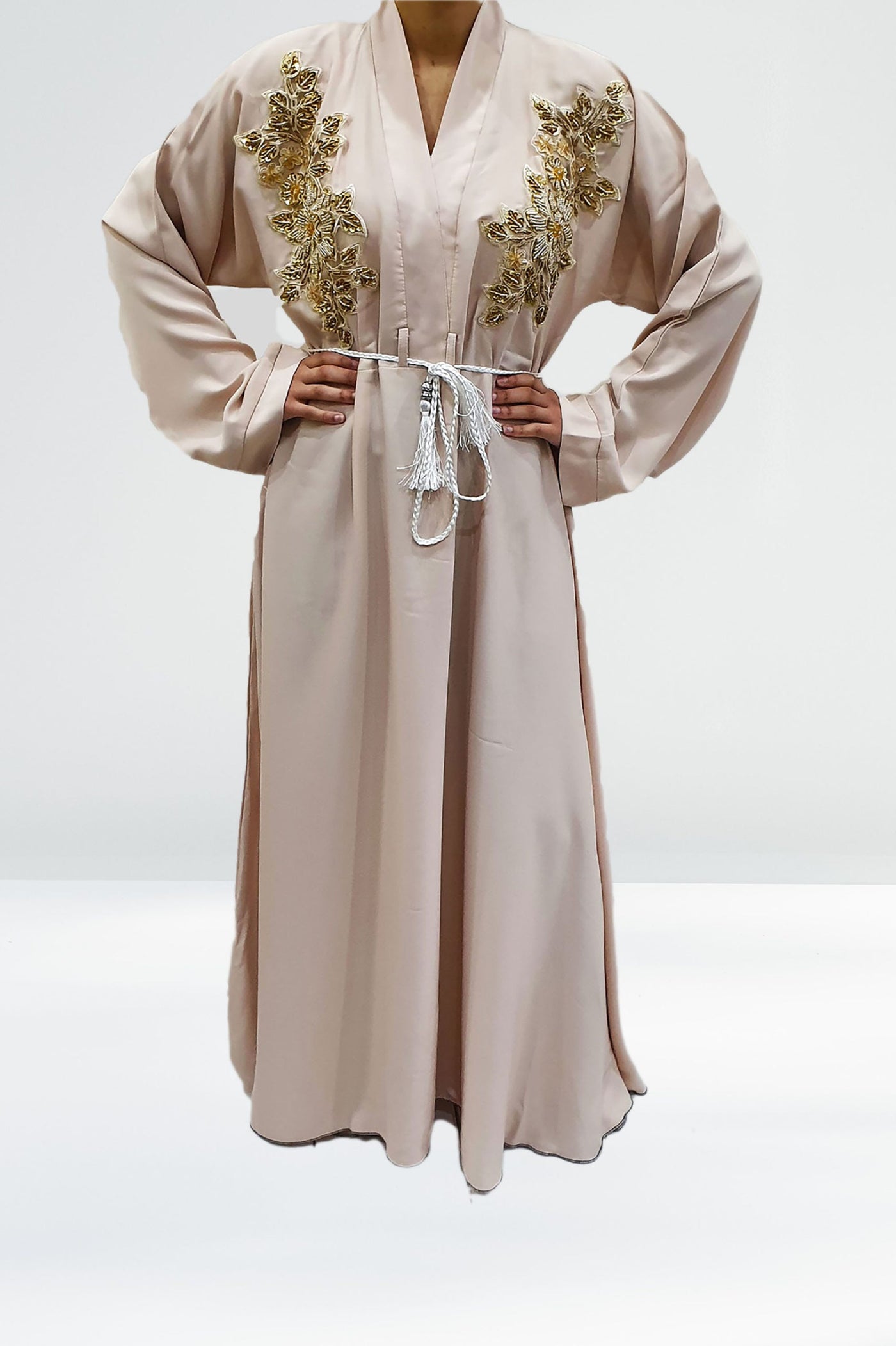
Nikah Dresses With Hijab Should Make You Feel Bridal From the First Look to the Last Photo
A nikah outfit can look completely right from the front and somehow unfinished the moment you turn sideways. The dress has a beautiful neckline, the hijab is pinned neatly, the colour is exactly what you imagined—and then a photograph from behind shows that the scarf hides the row of buttons you loved, the shoulder detail sits underneath a thick fold, or the two fabrics look like slightly different shades of ivory under daylight. None of this means the outfit is wrong. It means a dress and hijab cannot really be chosen as two separate things when they are going to be seen as one bridal look.
That is the quieter challenge behind choosing a nikah dress with hijab. You are not only deciding whether the dress is modest enough, formal enough or flattering enough. You are deciding how the whole upper silhouette works: where the scarf ends and the dress begins, what the eye sees first, how the profile looks, what remains visible from the back, how the fabrics respond to light, and whether the outfit still feels bridal once you are sitting beside family rather than standing perfectly still in a fitting room.
For some women, “bridal” means soft white layers and a veil. For others it means colour, embroidery, a beautifully cut abaya-style dress, a family piece of jewellery or a simple gown that feels more special because everything around it has been chosen with care. Hijab does not make that bridal feeling harder to achieve. It simply changes the composition. The strongest looks usually come from accepting that from the beginning.
If you want a broader foundation on scarf fabrics, shapes and practical styling before you make the wedding-specific decisions, our complete hijab guide can help. Here, the focus is narrower: how the dress and hijab meet, and how to make that meeting look deliberate from the front, side and back.
Turkish Bride Hijab: What Should You Check First?
Start with the complete outfit rather than the scarf in isolation. A Turkish bride hijab look can feel polished and beautifully considered, but the useful first check is whether the face frame, coverage, dress neckline, veil and any headpiece still work together once everything is on. Use the exact dress and scarf you intend to wear if possible. A fold that looks elegant with an everyday top can sit very differently over bridal embroidery, a high collar or structured shoulders.
Check the front first. The scarf should meet the neckline cleanly without a visible gap, awkward bunching or decorative work pushing through the fabric. Then turn sideways and look at the crown, jawline and shoulders. If there is a veil or headpiece, make sure its attachment does not add pressure or create more volume than you wanted. Finally, photograph the back without arranging the layers specially for the camera. You need to know where the scarf and veil fall naturally and which dress details they cover.
Fabric deserves a practical test as well as a visual one. Wear the combination long enough to notice slipping, snagging, heat or repeated adjusting. Take photographs in daylight and ordinary indoor light so that differences in white, ivory or cream, as well as shine and opacity, do not surprise you later. If the scarf is close to beadwork, crystals or textured lace, turn your head and move your shoulders to check that it does not catch.
Turkish hijab bride inspiration can look especially smooth in a still photograph, so test the look while moving rather than judging one perfect pose. Sit down, stand up, walk, turn your head, hold a bouquet-sized object and see what you keep touching. If you repeatedly pull the scarf back into place or rearrange the front, change the construction before the day rather than planning to manage it constantly.
The first decision is therefore not whether the scarf looks “bridal” on its own. It is whether the whole dress-and-hijab composition feels secure, comfortable and intentional from the front, side and back. Once that works, details such as jewellery, veil length and extra embellishment become much easier to judge.
Bridal does not depend on showing more of the dress
There can be an unspoken fear when choosing a nikah look with hijab: that if the scarf covers the neck, chest or shoulders, too much of the “bridal” part of the dress will disappear. That fear often leads women to start fighting their own coverage. They choose a neckline because it photographs beautifully on the model, then spend the fitting trying to keep the scarf away from it. They love an embellished bodice, then worry that chest coverage hides the beadwork. They buy a dramatic back, then realise most of it sits underneath the hijab or veil.
A better way to think about it is to ask where the bridal detail needs to live once you know how you want to wear your scarf. If you prefer generous chest coverage, a heavily embellished chest panel may not be the detail you will enjoy most. Beautiful cuffs, a textured skirt, a shaped sleeve, embroidery at the hem, delicate shoulder work positioned beyond the scarf, or a fabric with an elegant drape may give the dress more presence without asking the hijab to move out of the way.
If your hijab normally sits closer to the neck and shoulders, you may have more visible space across the bodice, but the same principle still applies. The dress should not need every decorative feature to remain fully visible in order to look complete. A bridal garment is not a catalogue page where every element must be displayed at once.
There is also something deeply calming about not trying to compensate for coverage. You do not need extra sparkle because your hair is covered. You do not need a larger crown because the scarf is simple. You do not need to expose a neckline to prove that the dress is special. Bridal presence can come from fabric, proportion, craftsmanship, colour, movement and the way the entire look belongs together.
When that is understood early, the fitting becomes much easier. Instead of asking, “How can I show this detail despite the hijab?” you can ask, “Does this dress still look beautiful with the hijab exactly where I want it?” That is a much more useful standard because it respects the actual outfit you will wear.
Choose the neckline with the scarf already in the room
The neckline is one of the most important meeting points between a nikah dress and hijab, even when it is almost completely covered. It determines where the dress begins visually, whether there is bulk under the scarf, whether decorative work competes with the drape and whether the upper body feels clean or crowded.
A high plain neckline can be wonderfully easy because it gives the scarf a quiet background. If the fabric is smooth and the collar lies flat, the hijab can fall over it without catching. A higher embellished neckline can also work, but check whether beads, pearls or raised embroidery sit directly underneath the scarf. Delicate chiffon or satin-like fabrics may snag, and repeated friction through a long day can make both layers sit less neatly.
Round and jewel necklines often disappear partially under hijab, which is not a problem if the bodice design still makes sense. A V-shaped decorative panel may be less successful if the scarf covers the top half and leaves only an unexplained point of beading. Similarly, a neckline designed to frame exposed collarbones may lose its intended proportion once covered. That does not make the dress unsuitable, but it means you should assess the covered version rather than relying on the original styling.
Cape necklines and attached shoulder drapes need particular attention. A scarf worn over a cape can create several layers at the same height. Worn underneath, it may sit beautifully, but only if the cape still gives the coverage and finish you want around the chest. Try both arrangements before assuming one is correct.
Bring the actual scarf—or at least a scarf with the same weight and drape—to the dress fitting. A neckline that looks elegant with bare shoulders or a tiny styling scarf may look completely different beneath your normal coverage. You want to see the real relationship while alterations can still be made.
The front view needs one clear place for the eye to rest
From the front, a nikah outfit can become visually busy very quickly. There may be the face frame, hijab folds, a headpiece, veil edges, dress embroidery, a bouquet, jewellery, sleeve detail and perhaps a decorative belt all competing within the same photograph. Each piece may be beautiful alone. Together, they can make the bride disappear into detail.
Stand several steps away from the mirror and notice what you see first. If your eye jumps from crown to scarf border to heavily beaded neckline to jewelled belt, there may be too many focal points. If it goes naturally to the face and then takes in the dress, the composition is probably calmer.
This is where a simple hijab can be powerful beside an ornate dress. The scarf becomes a quiet frame rather than another decorated surface. Equally, if the dress is deliberately minimal, a more refined scarf texture, softly structured drape or elegant headpiece can give the upper look enough ceremony.
Chest coverage affects this front composition too. A long scarf panel over a heavily detailed bodice can create a sudden plain block in the middle of the outfit. That may look lovely if the colours blend, or it may make the dress seem divided. Sometimes a softer tonal scarf reduces that divide. Sometimes shifting the drape slightly to one side allows the design to remain visible while preserving the coverage you want. Sometimes the best solution is choosing a dress whose interest sits elsewhere.
Take full-length photographs, not only close-ups of the face. A hijab style can look refined in a portrait and unexpectedly bulky once you see how much space it occupies against the dress. The front view is about the whole vertical line from head to hem.
Your profile tells you whether the volume is really working
The side view often reveals things the front mirror hides. A headpiece may sit higher than expected. The scarf may build more volume behind the jaw. A shoulder ruffle may project beneath the hijab. A cape may push the scarf forward and make the upper body look heavier. None of these issues is obvious when you are facing yourself straight on.
Take a true profile photograph with your arms relaxed. Look at the relationship between the back of the head, the shoulders and the dress silhouette. If the hijab has a lot of crown volume and the dress has strong shoulder structure, the two shapes may compete. Reducing one can make the other look more intentional.
This is especially useful with puff sleeves, structured shoulders and cape-style dresses. Those elements already create width or height around the upper body. A hijab with a similarly large silhouette can make the top half feel visually dense even if every piece is individually elegant.
On the other hand, a very flat scarf can sometimes look too small beside a dramatic dress. A little softness at the back or a veil can bring the proportions together. The aim is not a fixed amount of volume; it is a relationship that suits your face, body, dress and personal style.
Profile photographs also show whether scarf tails or veil layers are sitting where you expected. A long tail falling directly over a sculpted sleeve can hide its shape from the side. A shorter or differently placed drape may keep the dress line clearer without changing the coverage at the front.
Do not judge the profile while holding yourself unnaturally straight. Turn to speak to someone, look slightly down and sit. Your nikah day will contain those movements. The look should remain coherent when your posture becomes human again.
The back of the dress deserves to be planned, not discovered in photographs
Bridal dresses often save some of their prettiest work for the back: covered buttons, embroidery, lace panels, pleats, a cape, a train, a bow or a beautifully shaped seam. Hijab and veils can cover much of that area. If the back detail is one of the reasons you love the dress, find out before buying how much will actually remain visible.
Put on the scarf exactly as you intend to wear it and have someone photograph you from behind. Do not arrange the scarf specifically for the picture. Let it fall naturally. You may discover that a long central tail covers every button, while moving the tail slightly to one side reveals the design without affecting coverage. You may find that a veil makes the covered buttons invisible anyway, in which case the back detail may be less important during the ceremony but more relevant after the veil comes off.
Back necklines also matter even if they are covered. A dress with a low or open back may require a separate modesty panel, high underlayer or alteration before it works with your preferred hijab coverage. Do not rely on the scarf itself as the only solution to a dress opening you do not want exposed. Scarves move when you sit, hug people and turn. The garment underneath should provide the security you need independently.
If there is a cape, check where the hijab sits in relation to it. Two central layers can merge into one heavy vertical panel. Sometimes placing the scarf under the cape gives a cleaner finish. Sometimes the cape fabric is sheer and the scarf needs to sit above it. The correct answer depends on the actual pieces.
A back view is also where tiny colour differences between scarf, dress and veil can become obvious because larger areas of fabric overlap. That is useful information. You are not looking for laboratory-level colour matching; you are checking whether the relationship looks deliberate.
A dress silhouette changes the job the hijab needs to do
The same hijab style can look completely different over an A-line gown, a column dress, an abaya-inspired cut or a layered flowing silhouette. The scarf does not exist in isolation above the shoulders; it is part of the overall proportion.
An A-line dress gradually widens from the upper body, so the top can often carry a little softness without becoming heavy. A very narrow column dress creates a longer, straighter line; a huge scarf drape at the shoulders can interrupt that line more strongly. A generous abaya-style dress may already have wide sleeves and significant movement, so the hijab can either echo that softness or provide a calmer counterpoint.
Layered dresses with chiffon, organza or tulle often create visual movement around the skirt. Adding several similarly floating layers around the head can feel romantic, but it can also make the whole outfit seem busy in motion. If the skirt already provides the drama, the scarf may not need to do the same.
Empire seams and raised waistlines change where the eye reads the body proportions. A long chest drape can extend visually into that seam and make the upper section appear shorter. A slightly more controlled drape may preserve the intended dress proportions. With a natural waist or belted dress, the same longer scarf may look beautifully elongated.
There is no silhouette that is automatically the “best” nikah dress for hijab. What matters is seeing the dress with the scarf at full length. If you only assess the top half, you may miss how much the hijab changes the visual weight of the overall shape.
Dress Akad Hijab: How Can You Keep the Layers Comfortable?
Comfort starts by deciding what each layer is doing. In an akad dress hijab outfit, one layer might provide opacity, another the dress silhouette, and the hijab or veil the final coverage and bridal finish. Problems usually begin when several pieces are all trying to do the same job. A lined dress that is already opaque may not need a thick slip, heavy underscarf and wide scarf folds at the shoulders. Keep the lightest combination that gives the coverage and finish you want.
Pay particular attention to the places where layers meet: neckline, shoulders, underarms, waist and wrists. Raised beadwork under a scarf can rub; two high collars can feel tight; a bulky slip seam can show through a fluid skirt; stacked sleeve layers can restrict your arms. Put the complete outfit on and sit down for ten minutes before deciding it feels comfortable. Then turn your head, raise your arms, reach forward and walk. If a layer twists, pulls or needs constant adjustment in a quiet room, it is unlikely to improve once the day becomes busier.
Heat matters too. Choose breathable underlayers where possible and let decorative layers stay lighter, especially if the ceremony is indoors or in warm weather. A soft, smooth undercap can reduce friction beneath the hijab, while fewer folds around the neck can prevent the scarf from feeling heavy. If you are wearing a veil, make sure its attachment is not adding pressure to the same point as your undercap or pins.
Finally, test the outfit after it has been worn for a while, not only when every fold is freshly arranged. Sit, stand, take a few photographs and notice what you keep touching. If you are repeatedly pulling at the scarf, lifting the dress away from your body or rearranging an inner layer, simplify before the nikah. The most comfortable dress akad hijab combination is not necessarily the one with the fewest pieces; it is the one where every piece has a clear purpose and the layers can move together without making you manage them all day.
Fabric harmony matters more than fabric matching
One of the easiest ways to make a nikah dress and hijab feel like one outfit is to think about how the fabrics behave beside each other. They do not have to be identical. In fact, using exactly the same type of shine and texture everywhere can sometimes make the look flatter rather than richer.
A matte crepe dress can sit beautifully with a softer chiffon scarf because the two surfaces are quiet but not identical. A satin dress may work with a matte hijab that lets the gown carry the shine. A lace dress can look more refined with a simple smooth scarf rather than another heavily textured fabric near the face. A very plain dress can take a subtle satin-like scarf if you want light to sit higher in the look.
Think about friction as well as appearance. A smooth scarf over a slippery satin shoulder may migrate more than it does over crepe. A textured scarf can grip raised lace or beadwork and catch. A delicate chiffon tail resting repeatedly against crystals may snag. The fabric relationship has to survive movement, not just look convincing in a still picture.
Photography changes the relationship again. Highly reflective fabrics can appear much brighter under flash and strong directional lighting. If the dress and scarf both have a strong sheen, the face may be surrounded by bright highlights. That might be exactly the luminous result you want, or it might feel too reflective. Trial photographs will tell you more than fabric names.
| Dress surface | Hijab direction that can work well | What to check together |
|---|---|---|
| Matte crepe or similar finish | Matte, lightly textured or softly luminous scarf | Whether the scarf looks too casual or adds just enough contrast |
| Satin or high-lustre fabric | Matte chiffon, crepe or restrained satin-like scarf | Flash reflection, slippage and whether shine is concentrated in the right place |
| Detailed lace | Smoother, simpler scarf | Snagging, visual crowding and how much lace remains visible near the neckline |
| Beaded or crystal bodice | Fabric with a clean drape and limited surface texture | Whether scarf edges catch on embellishment or hide the design awkwardly |
| Plain fluid dress | A scarf with subtle texture or sheen if you want more ceremony near the face | Whether the added finish still looks cohesive from full length |
| Layered chiffon or organza dress | Controlled scarf drape that does not add unnecessary floating layers | Movement from the side and back, especially if a veil is added |
Use the table as a way to test relationships, not as a rulebook. Two garments with the same fabric label can behave very differently. The actual dress and actual scarf always have the final say.
White, ivory and cream can become surprisingly complicated together
Pale bridal colours look simple until several versions sit side by side. A dress may be called ivory but lean almost white. A scarf labelled cream may look warm and buttery beside it. A veil may have a cooler grey cast. Under indoor lighting everything seems close; outside, the differences become more obvious.
This does not mean every layer has to match exactly. An intentional tonal bridal palette can be more beautiful than a near-match that is trying to pretend it is identical. The important thing is to see the pieces together before the day and decide whether the difference looks chosen.
Place the scarf directly against the dress, then step back. Check daylight, ordinary room light and whatever lighting is likely for photographs if you can. Take a phone picture without filters. Some cameras exaggerate differences, but that can still show you where the undertones are going in opposite directions.
If the dress is warm ivory, a stark blue-white scarf may separate sharply around the face. If the dress is cool white, a yellow-toned cream scarf may read much darker than expected. A soft pearl, stone, champagne or blush tone can sometimes work deliberately, but only if it suits your skin and the rest of the outfit.
For coloured nikah dresses, the principle is the same. You may choose a scarf in the exact dress colour, a quieter shade within the same family, or a neutral that gives the face more definition. The bridal quality does not depend on white. It depends on the outfit looking considered.
The scarf should not erase the craftsmanship you paid for
If a dress has embroidery, hand-applied embellishment, covered buttons, pleating or an unusual collar, work out where those features sit in relation to the hijab before committing to the garment. A decorative detail hidden by choice is fine. Paying for detail you expected to enjoy and then discovering none of it is visible can feel disappointing.
Shoulder embroidery is a common example. A chest-length scarf may cover the inner half while leaving the outer shoulder visible, which can create a lovely framed effect. A wider triangular drape may cover almost all of it. Neither result is wrong, but the designer’s photograph may not show the version you will actually wear.
Raised beadwork needs practical thought too. If the scarf lies directly over it, the fabric may sit unevenly or catch. A smoother panel beneath the hijab can sometimes be introduced through alteration. Alternatively, choosing a dress whose embellishment begins lower down can keep the scarf area calmer.
Long covered buttons at the back are another detail that often disappears under a veil. If you love them, plan a few gown-only photographs after the veil comes off, or adjust the scarf tails so some of the line remains visible. If you do not care whether they show, you can stop worrying about them entirely.
The point is not to display every inch of decoration. It is to know what you are buying in the context of your finished outfit. Bridal styling becomes much less frustrating when expectations match reality.
A veil changes the back view more than the front
For a bride in hijab, a veil can create an immediate ceremonial feeling without changing the basic scarf coverage. Visually, its biggest impact is often behind you: it extends the line of the body, softens the outline of the shoulders and creates movement in photographs. That is why veil length, width and transparency should be considered with the back of the dress, not only with the face.
A very wide veil over a wide dress can create a beautiful cloud of fabric, but it can also hide almost all of the gown’s back design. A narrow veil may reveal more craftsmanship while giving a cleaner line. A long veil can visually extend a simple dress; with a full train, it adds another long element that needs enough space to lie properly.
Transparency matters because the veil may either reveal or blur the dress underneath. Fine tulle can allow embroidery and buttons to remain visible. Dense appliqué or a heavily bordered veil may cover them. If the veil itself has lace, pearls or embroidery, check whether those details overlap the dress decoration in a pleasing way rather than creating two patterns on top of each other.
From the side, a veil also changes the height and shape behind the head. If it is attached high, it can add crown volume. Attached lower, it may fall more vertically. Look at the profile with the dress because the veil becomes part of the silhouette.
This article is not asking the veil to secure the hijab or define your coverage. The base scarf should make sense on its own. Think of the veil as a bridal layer added to an already complete dress-and-hijab composition. That makes it easier to remove later without the whole look losing its identity.
A headpiece should belong to the dress, not merely to the word “bride”
Tiaras, pearl bands, decorative pins and crowns can look wonderful over hijab, but they add another line, another material and another point of light near the face. The question is not whether a headpiece is bridal enough. It is whether it belongs to this particular dress.
If the gown has pearls, a restrained pearl headband can create repetition without looking random. If the dress has warm gold embroidery, cool silver crystals may feel disconnected unless there is another silver element tying them in. If the gown is extremely ornate, a simpler headpiece may stop the upper half from becoming crowded.
Consider scale from full length. A tiny delicate piece may disappear against a wide, dramatic gown. A tall crown can dominate a slim minimal dress. Photograph the complete outfit before deciding that a headpiece looks “too small” based on a close mirror alone.
The back of the headpiece matters too. Combs, bands and decorative ends may be visible beneath a veil or through sheer fabric. Make sure the finished back looks intentional. You do not want a beautiful front view and a cluster of attachment points appearing in every photograph from behind.
And if the outfit looks complete without a headpiece, that is useful information. The dress, hijab and perhaps veil may already create enough bridal identity. You do not have to keep adding until the outfit fits somebody else’s idea of a bride.
Sleeves, hands and cuffs will be in more photographs than you expect
Nikah photographs naturally focus on hands: signing, holding a bouquet, showing rings, greeting family, touching the edge of a veil, holding a spouse’s hand. That makes sleeves and cuffs more important than they may seem during a dress fitting.
If the dress has wide cuffs, test them while signing on a table. Fabric that falls over the hand can cover jewellery or drag through ink, food and drinks later. A fitted cuff can look beautifully neat, but check that it allows enough movement and does not become uncomfortable after several hours.
Embellished cuffs can carry bridal detail when the hijab covers more of the bodice. Pearls, embroidery or beading at the wrist remain visible in close photographs without competing with the face. The practical question is whether the decoration catches on bouquet ribbons, lace gloves if you wear them, or the scarf when you lift your hands.
Sleeve volume should also be judged beside chest drape. A very wide scarf falling over very full sleeves can create a broad block of fabric across the upper body. If the sleeves are the feature you love most, a slightly narrower front hijab drape may allow them to read more clearly.
Try the dress while carrying something. Hold a book as a stand-in for documents. Sit at a table. Reach forward. Bridal clothes are still clothes, and the details look more graceful when your hands can move naturally.
Seated photographs can change the proportions of the whole look
A nikah is not lived entirely standing up. You may sit for the ceremony, family photographs, a meal or quiet moments with relatives. Long dresses spread differently when seated, scarf drapes fall forward, veils gather behind the chair and waistlines shift. If you only test the outfit standing, you are seeing half of it.
Sit on a firm chair in the complete look. Let the skirt settle without arranging it for a photograph. Notice where the scarf ends relative to your lap. A long chest drape that looked balanced while standing may bunch into the waist. A shorter drape may lift slightly and expose more of the bodice than expected. Adjust the construction if necessary rather than planning to keep fixing it with your hands.
If the dress has a belt, structured waist or fitted midsection, check whether the hijab visually ends at the same point. Several horizontal lines stacked together—the scarf edge, belt, bouquet and seated lap—can make the torso look compressed. Moving one of those lines can restore proportion.
Veils need space behind the chair. If the fabric is long, have someone show you how it will be arranged so you do not sit on it and pull the attachment backwards. In a smaller venue, an extremely long veil may spend most of its time folded around furniture. That may still be worth it for you, but it should be a conscious trade-off.
Take one photograph at normal seated eye level rather than from above. It will show you how guests across the room are likely to see the outfit. Bridal styling works best when it survives ordinary viewpoints as well as the planned portrait.
The venue changes how much dress your outfit can comfortably carry
A nikah in a mosque, a family home, a small private room or a large wedding venue can all feel completely different in scale. The dress does not need to match the building, but the amount of fabric and decoration you enjoy may depend on how much space the day gives you.
In a smaller setting, a very wide skirt, long train and enormous veil can be beautiful but require constant management around chairs and people. A more fluid dress with refined detailing may feel equally bridal while allowing easier movement. In a larger hall, a simple outfit can still look striking, especially if the silhouette is clean and the fabric moves well.
Think about the route through the day rather than only the ceremony room. Will you climb stairs? Travel by car? Walk outdoors? Remove shoes in a prayer space? Sit closely with family? Move between rooms? The dress and hijab should make those transitions possible without turning every doorway into an event.
This is not about reducing the importance of the occasion. It is about letting the clothes belong to the occasion you are actually having. A nikah can be deeply precious without theatrical scale, and a grand celebration can still suit a restrained outfit. Your clothing does not need to prove the significance of the commitment.
A fitting should include front, profile and back photographs every time
Bridal fittings often happen under flattering lights, with a dressmaker adjusting the garment and everyone looking mainly at the front. For a nikah dress with hijab, make the fitting more useful by documenting the whole look systematically.
Take the front photograph from normal eye level
Stand naturally with your arms relaxed. Include your full body. Look at where the scarf ends, where the dress detail begins, how the neckline sits underneath and whether the face remains the main focal point.
Turn to a true profile
Do not twist your shoulders back towards the camera. A real profile shows head volume, veil height, shoulder width, sleeve projection and the way the scarf falls behind the jaw. It is one of the best views for spotting too much volume in one area.
Photograph the back before anybody arranges it
You need to know what the fabric does naturally. Look at scarf tails, veil transparency, buttons, cape layers and train. Then, if you want a more styled back for formal photographs, you can decide how much arranging is realistic.
Sit and stand again
After sitting for several minutes, take the same three views. Creases, shifted folds and altered waistlines reveal whether the outfit remains coherent once it has actually been worn.
Change the light
Daylight near a window, ordinary indoor light and a quick phone flash can expose colour and shine differences. You are not trying to predict every photograph. You are checking that nothing becomes a completely different outfit under another light source.
Keep these images. When you compare two dresses, the side and back photographs may make the decision clearer than another hour staring at the front mirror.
Shopping online means you need to study the parts the model is not showing
Buying a nikah dress or hijab online can work well, but occasion photography is designed to show garments at their best. A model may stand at an angle that makes the sleeve look narrower, hold a bouquet over a simple bodice, or never show the back without a veil. You have to look for the information behind the pose.
Read garment measurements rather than relying only on your usual size. Check the finished length, bust or chest width, sleeve length and any waist or hip measurement that matters to the cut. If the dress has a train, find out whether the listed length includes it. If an underdress, cape, belt or veil appears in the photographs, confirm whether it is included.
Zoom into the neckline and shoulder area because that is where the hijab will interact most. Look for raised stones, rough lace edges, exposed zips and decorative pieces that might catch. Study the back. If there is only one rear photograph, enlarge it and work out where your scarf or veil would fall.
For the hijab, compare the product description with the styling you need. A fabric that is beautifully fluid may still require more careful layering. A larger scarf gives more material for chest coverage but also more fabric to place around the shoulders. Colour names are approximate language, not universal standards, so compare the actual item to the dress when it arrives.
Keep return conditions in mind and test without damaging or altering the item while you are still deciding. The most important test is not whether you can recreate the model’s pose. It is whether the garment works with your own scarf, coverage, body and bridal plans.
If the dress is already settled and you are now comparing scarf colours, sizes and finishes, you can shop related styles with the dress beside you rather than trying to remember its shade from a photograph. Treat the live product details as the source for what is actually available, then judge each scarf by how it works with your own garment rather than by whether it is marketed as bridal.
Build the dress and hijab together before you add the accessories
Accessories are much easier once the two largest decisions already work together. If the dress and hijab need a crown, necklace, brooch and elaborate veil just to feel connected, the foundation may not be settled yet.
Start with the dress, scarf and the underlayers required for your preferred coverage. Look at the whole silhouette. Once that feels complete, add one thing at a time. A veil may be enough. If not, try the headpiece. Then jewellery. Then bouquet. At each step, ask whether the new element improves the outfit or simply makes it busier.
Jewellery near the neck often disappears beneath hijab. That is not a reason to alter your scarf unless you genuinely want the jewellery visible. Rings, bracelets and a meaningful brooch can carry personal significance without changing the upper coverage. If a necklace is sentimental, you may still wear it beneath the dress or scarf even if nobody sees it.
Flowers also influence the front view. A large bouquet covers part of the dress and may sit directly beneath a long chest drape. Hold something of similar size during the fitting. You may decide that a simpler scarf front looks better once the bouquet is present.
The bridal look should become clearer as you add accessories, not less readable. If you reach a point where you cannot tell which detail you love because everything is competing, remove something and look again.
Prayer practicality can stay simple and personal
Depending on the timing of your nikah and celebration, you may need to pray while dressed. That deserves a little practical thought, but it does not need to become a styling crisis or a place for an article to give religious rulings it is not qualified to give.
Consider the clothing itself. Can you move comfortably in the dress for the positions of salah according to the way you pray? Does the skirt give enough room? Are sleeves and coverage secure? If the dress is very elaborate, would you prefer to use a separate prayer garment to protect it and simplify the moment? Either approach can be planned in advance.
If you need to make wudu after getting ready, think about sleeves, makeup and the order of accessories. Tight beaded cuffs can make washing the arms awkward. A removable outer veil may be easier to take off before prayer while leaving the hijab itself complete. If you have questions about the religious validity of a particular arrangement, ask a trusted knowledgeable scholar for guidance relevant to you.
What matters here is reducing clothing stress. A quiet prayer should not become the moment when three people have to dismantle the outfit because nobody checked whether the sleeves could move. Rehearsing the practical side once is enough to make the day gentler.
When the dress comes off the hanger, movement decides whether it still feels bridal
Occasion dresses are often judged in stillness because that is how we first meet them: hanging beautifully, standing on a model, or posed in a mirror. A nikah day is full of movement. You walk into rooms, turn towards voices, sit close to family, lean for photographs, lift the skirt on steps and perhaps move from one venue to another.
Watch how the skirt moves around your feet. A very light outer layer can float beautifully but tangle with a long scarf tail. A stiff skirt can hold its shape but make seated photographs feel more formal. A train can look exquisite from behind and need a designated person to manage it. None of these are reasons to reject a dress. They are simply part of its personality.
The hijab moves too. A chest drape may swing when you turn. A veil can lag behind the body. A scarf tail can settle differently after a hug. The goal is not to make every layer motionless. It is to make sure movement does not break the composition or expose something you meant to keep covered.
Record a short video of yourself walking towards and away from the camera. Then turn slowly. This often reveals more than twenty posed photographs. You will see whether the dress and hijab move as one outfit or whether one seems to be fighting the other.
There is a difference between a matched outfit and a coherent one
A matched outfit repeats obvious elements: same colour, same pearl, same lace, same metallic tone. A coherent outfit can do that, but it does not have to. Coherence is broader. It is when the pieces share a mood, proportion and level of formality even if they are not identical.
You might wear an ivory crepe dress with a soft pearl chiffon hijab, a plain veil and gold jewellery. Nothing exactly matches, yet the warmth and softness may make the outfit feel complete. Another bride may wear a white satin dress with a matte white scarf and no veil, letting contrast in texture create definition. A coloured embroidered dress may work best with a quiet neutral hijab that does not repeat any exact thread colour.
This is useful when you cannot find the “perfect match”. Stop searching for identical swatches and ask whether the two pieces look as though they belong to the same woman on the same day. If they do, the relationship may already be strong enough.
Coherence also protects individuality. You do not have to buy a pre-designed bridal hijab set if it does not suit how you normally cover. You can build the look from pieces that make sense for you and let the connection come from thoughtful styling rather than uniformity.
Detachable layers should have a clear before-and-after look
Some nikah dresses include a detachable cape, overskirt, train, sleeve layer or shoulder piece. These can be brilliant for creating two versions of the same outfit: a more ceremonial silhouette for the nikah itself and a lighter one for the meal or family photographs afterwards. With hijab, though, detachable layers need to be judged as part of the upper composition, not simply as extras attached to the dress.
A cape is the clearest example. When it begins at the neckline or shoulders, it occupies the same visual space as a chest-covering scarf and possibly a veil. Put all three on together before deciding you love them as a set. If the cape pushes the hijab forward, hides the dress completely or creates several transparent layers over one another, the result may be busier than the individual pieces suggested.
Then remove the cape and look again. Does the hijab still relate to the dress beneath it, or was the cape doing all the work of connecting them? A strong detachable design should leave you with two complete outfits rather than one complete outfit and one version that suddenly looks unfinished.
Overskirts change the lower silhouette more than the hijab, but they can alter overall proportion. A narrow dress with a dramatic detachable overskirt may support a little more presence at the head while the overskirt is on. Remove it and the same large veil or headpiece can suddenly look heavier against the straighter base dress. Take full-length photographs of both versions before choosing accessories.
Detachable sleeves and shoulder pieces deserve a movement test. Make sure the scarf does not catch the join or expose fastenings when you turn. If the piece is removed later, check that the sleeve underneath still looks occasion-ready beside the cuffs and hands that will appear in photographs.
The practical advantage of detachable layers is flexibility, but only when the transitions are simple. Practise taking the piece off without disturbing your scarf, veil or makeup. Decide who will help and where the removed piece will go. A beautiful overskirt folded over the nearest chair quickly stops looking luxurious if nobody planned to carry it.
Two silhouettes can make the day feel varied without a complete outfit change. The important thing is that your hijab belongs naturally to both.
A final twenty-minute rehearsal tells you more than another inspiration folder
Once the dress and hijab are chosen, stop browsing for a while and wear the complete outfit. Give it twenty ordinary minutes. Not twenty minutes posing. Sit, walk, speak, drink something, hold a bag, turn your head and let the fabric settle.
Notice what you keep touching. If your hand goes to the scarf every two minutes, something is probably shifting. If you repeatedly lift the sleeve, the cuff may be too long. If you keep pulling the front of the dress down, the bodice may be riding up. If you cannot sit without arranging three layers first, decide whether that is acceptable for the day you are planning.
Then look again from every angle. The fitting photographs matter more now because the clothes have warmed, creased and moved. The outfit you see after twenty minutes is closer to the one you will wear halfway through the nikah than the untouched version in the first mirror photograph.
If one problem appears, solve that problem rather than redesigning everything. Shorten a scarf tail. Move a fastening. Alter the sleeve. Change the veil attachment. Choose a less slippery scarf. Small corrections often protect an outfit you already love.
Once the practical issues are resolved and you recognise yourself in the result, let the decision settle. Bridal preparation can become endless because there will always be another dress, another scarf fold and another photograph online. You are allowed to stop when your own outfit is doing its job beautifully.
Frequently asked questions about nikah dresses with hijab
How do I make a nikah dress with hijab look bridal rather than everyday?
Build the bridal feeling through the whole composition rather than asking the hijab alone to make the outfit special. Fabric quality, a refined dress silhouette, intentional colour, beautiful cuffs, embroidery, a veil, a headpiece or a softly finished scarf can all contribute. Keep the coverage you actually want, then decide where the occasion detail should live. A coordinated dress and hijab usually looks more bridal than several decorative elements competing at once.
Should my hijab exactly match my nikah dress?
No. Exact matching can look seamless, but white, ivory and cream fabrics often have different undertones and finishes. An almost-match can sometimes look more accidental than a deliberate tonal difference. Compare the actual scarf beside the dress in daylight and indoor light, then photograph them together. Choose the colour relationship that suits your face and makes the complete outfit look intentional.
Which dress necklines work well with hijab for a nikah?
High, round and cleanly finished necklines are often straightforward because they sit quietly beneath a scarf, but many neckline shapes can work once coverage is considered. Pay attention to raised embellishment, low backs, cape layers and decorative panels that may be partly hidden. The useful test is the real dress with your real hijab position, not the neckline on the model without a scarf.
How can I keep dress details visible with chest-covering hijab?
Choose detail that sits beyond the area your scarf naturally covers, such as cuffs, sleeves, outer shoulders, skirt embroidery, hem work or fabric texture. If the bodice is already chosen, experiment with the shape and direction of the chest drape without reducing the coverage you want. Sometimes a tonal scarf makes the covered section blend more naturally; sometimes the best answer is accepting that a particular detail will be quieter.
Can I wear a veil with a nikah dress and hijab?
Yes, if you like the look. Treat the veil as an additional bridal layer over an already complete dress-and-hijab combination. Check its width, transparency, length and placement from the side and back because it can hide buttons, embroidery or a train. Rehearse movement and sitting, and make sure the outfit still looks complete if you plan to remove the veil later.
What should I check from the back before my nikah?
Photograph the outfit from behind with the scarf and veil falling naturally. Check whether scarf tails hide dress buttons or embroidery, whether a low back needs a secure modesty layer, how transparent the veil is over the dress, and whether different pale fabrics show obvious undertone differences. Also look at the headpiece attachments and the way the dress hem or train sits once all layers are together.
What hijab fabric looks good with a satin nikah dress?
A matte chiffon, crepe or other restrained finish can create elegant contrast beside a shiny satin dress, while a softer satin-like scarf can work if you want a more luminous result. The exact fabric matters more than the label. Test slippage, flash reflection, creasing and how the scarf moves over the dress. If both surfaces are highly reflective, check photographs to make sure the shine does not overwhelm the face.
Can a coloured nikah dress still look bridal with hijab?
Absolutely. Bridal identity is not limited to white. A coloured dress can feel unmistakably ceremonial through its cut, fabric, embroidery, accessories and the way the hijab completes it. The scarf can match the dress, sit within the same colour family or provide a calm neutral. Choose the combination that looks deliberate and suits you rather than forcing a traditional pale palette you do not want.
How should I test a nikah dress and hijab before the day?
Wear the full combination for at least twenty minutes and take front, profile and back photographs. Sit, stand, walk, turn, reach forward and hold something similar to your bouquet or documents. Check neckline bulk, scarf movement, sleeve comfort, colour under different light, veil placement and whether the outfit still looks balanced after you have been seated. A short walking video is particularly useful for seeing how the layers interact.
Where should I start if I am buying the dress and hijab online?
Start with measurements and the actual construction of the dress, then study neckline, shoulder and back photographs carefully. Confirm what pieces are included and read fabric and care details. For the hijab, choose the size, opacity and drape you need rather than relying only on colour names. When the pieces arrive, compare them together while return options are still open and test the complete look before making alterations.
From every angle, the outfit should still look like your decision
The front photograph matters, of course. It is the view you will probably study most while getting ready. But the side photograph where you are listening to someone, the back view as you walk into the room, the seated moment beside family and the unplanned picture taken while you are laughing are all part of the same day. A bridal look that only works from one angle asks too much from the bride.
Your nikah dress and hijab do not need to match perfectly, display every embellishment or copy a reference image to feel complete. They need to cooperate. The neckline needs to accept the scarf. The scarf should respect the dress proportions. The fabrics should make sense together in light and movement. The back should look considered even when nobody has just arranged it for a photograph.
You can choose a veil or leave it out. You can wear white, ivory, colour, matte crepe, satin, lace or something beautifully simple. You can prefer generous chest coverage or a more compact scarf shape. Those choices do not decide whether you look bridal. The care with which they meet each other does.
Perhaps that is the most useful thing to stop worrying about: you do not have to “make up for” hijab in a bridal outfit. It is already part of the silhouette. Once the dress is chosen with that truth in mind, the whole process becomes less about hiding compromises and more about creating one look that belongs to you.
When you can turn to the side, walk away from the mirror, sit down, come back into frame and still think, “Yes, that is how I wanted to look on my nikah,” the outfit has done enough.