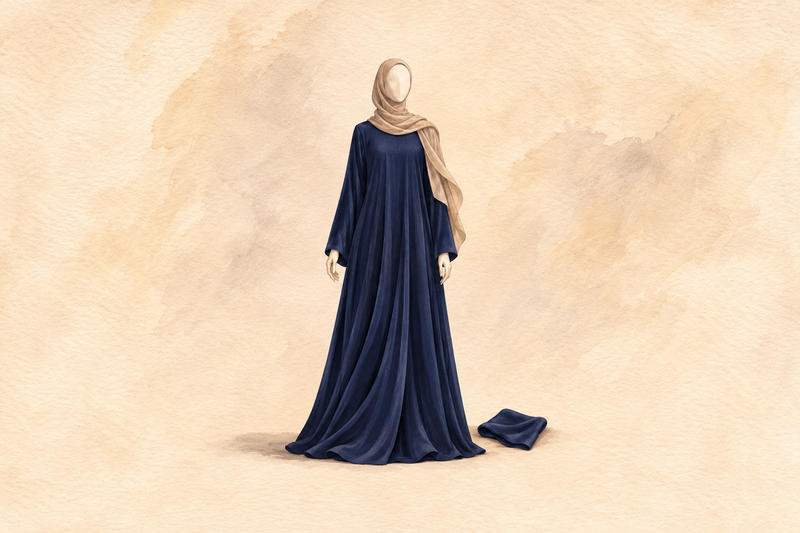
How Do You Style an Ombré Abaya So the Colour Fade Stays Visible and Balanced Without Letting the Hijab or Accessories Compete?
An ombré abaya already has a built-in focal point: the colour changes as the eye moves across the garment. The easiest way to style it well is not to compete with that movement. Let the gradient do the visual work, then choose the hijab, shoes, bag and layers to support one part of the colour story rather than trying to match every shade at once. That gives the whole outfit a calmer, more intentional finish.
A useful starting rule is to look at the two ends of the gradient. Ask which shade feels dominant, which shade feels softer, and whether the transition is warm, cool or neutral. You can then either repeat one end of the gradient in your accessories, choose a neutral that sits comfortably beside both, or add one restrained contrast if the abaya is otherwise simple. If you are still deciding how the garment itself should fit into your wardrobe, our complete abaya guide explains the wider questions of cut, fabric, sizing and modest styling.
The best styling choice also depends on where the colour sits. A darker hem behaves differently from a darker shoulder; a pale centre panel draws the eye differently from a side-to-side fade. That is why a good outfit begins with the actual gradient in front of you, not with a generic rule about what “goes with” an ombre abaya.
Start by reading the colour story of the abaya
Before choosing anything else, lay the abaya out or put it on in natural light and identify its visual anchors. Most ombré designs have a clear starting shade and finishing shade, but some pass through a third tone or change intensity gradually enough that one colour seems to melt into another. The aim is not to name every tiny variation. It is to work out what the eye notices first.
If the top is deep navy and the hem softens into powder blue, navy is usually the stronger anchor. A navy hijab can therefore make the outfit feel composed and grounded, while a pale blue hijab creates a lighter, more delicate finish. If the abaya moves from chocolate brown into beige, either endpoint can work, but the mood changes: brown tends to make the look richer and more autumnal, while beige keeps it softer and more understated.
Then notice the undertone. Two colours can have the same general name but feel very different beside each other. A dusty rose with a mauve undertone may sit beautifully with taupe, mushroom or muted plum, while a coral-leaning pink may look fresher with cream, warm stone or soft tan. You do not need technical colour theory to see this. Hold the scarf or accessory beside the abaya and ask whether it looks as though it belongs to the same atmosphere.
Finally, decide whether you want the gradient to feel subtle or dramatic. If the transition itself is already strong, quieter accessories usually make the styling look more polished. If the ombré is extremely soft and tonal, you have more freedom to introduce texture, a slightly deeper accessory or a small contrast without making the outfit feel crowded.
Choose the hijab by repeating, calming or contrasting
The hijab has the greatest effect on how an ombré abaya reads because it sits close to the face and often touches the upper part of the garment. There are three reliable approaches: repeat one shade from the gradient, use a quiet neutral, or introduce a controlled contrast.
Repeat one shade from the gradient
This is usually the easiest option. Choose a hijab close to either the darkest or lightest colour in the abaya. It does not have to be an exact dye match. In fact, a slightly softer tonal relationship can look more natural than forcing two fabrics to appear identical. A charcoal-to-silver abaya can work with a charcoal hijab, dove grey, soft pewter or even an off-white if the overall look needs lifting.
Use a quiet neutral
Neutrals are especially helpful when the abaya moves through several colours. Cream, stone, taupe, soft grey, espresso, black and muted beige can give the eye somewhere to rest. The best neutral is the one that shares the temperature of the gradient. Warm terracotta-to-peach shades usually sit more comfortably with cream or camel than with icy grey, while blue-to-lilac gradients often feel cleaner with cool grey, navy or soft white.
Add a controlled contrast
A contrast works best when it is deliberate and limited. If the abaya fades from forest green into sage, a muted burgundy or deep plum hijab can create a richer look, but the bag and shoes should then stay quiet. Contrast becomes messy when every accessory introduces another unrelated colour. One contrasting element is a styling choice; four competing elements can make the gradient disappear into visual noise.
Also think about fabric. If the abaya has a glossy or satin-like finish, a matte hijab can balance the shine. If the abaya is matte crepe, a lightly textured scarf can add dimension without needing more colour.
Let the direction of the ombré guide your styling
Where the light and dark areas sit changes the balance of the whole outfit. A gradient is not just colour; it is also visual weight. Darker areas tend to feel heavier and more grounding, while lighter areas can feel more open and airy.
Dark at the top, lighter at the hem
When the shoulders and upper body are the darkest point, a hijab in that deeper shade often creates a smooth, uninterrupted line. The lower half can then feel lighter and more fluid. Shoes in a mid-tone or neutral usually work better than shoes that are much darker than everything else, unless you deliberately want a stronger base.
Light at the top, darker at the hem
This arrangement already has natural grounding because the deepest colour sits near the floor. A lighter hijab can keep the upper half fresh, while a darker bag or shoe can echo the hem. If you choose a dark hijab as well, check the look in a full-length mirror; sometimes the outfit becomes visually heavy at both ends and the lighter centre feels disconnected.
Side-to-side or diagonal fades
Asymmetrical ombré designs have more movement, so accessories usually benefit from simplicity. Pick one shade from the garment and repeat it once rather than trying to mirror the direction of the fade. A clean handbag, plain scarf and simple shoe allow the diagonal or side sweep to remain the feature.
Multi-colour gradients
If the abaya moves through three or more distinct colours, treat the least dominant shades as accents rather than invitations to add more. Choose one anchor colour and one neutral. That two-colour discipline is often what makes a complex gradient look wearable rather than costume-like.
Balance the silhouette before adding accessories
Colour can make an outfit look busy even when the cut is simple, so silhouette matters. If the ombré effect is bold, a clean flowing line is often enough. Before adding a belt, statement bag, layered outerwear or large jewellery, look at how the abaya falls on its own.
A wide, flowing abaya with a strong gradient usually needs fewer additions than a very simple straight-cut design. Volume creates movement, and the colour transition adds another layer of movement. When both are already present, extra details can make the outfit feel overworked. A smaller bag, plain hijab and restrained footwear may be all that is needed.
If the abaya is more structured, you can use accessories to soften it. A draped hijab, rounded bag or shoe with a gentle shape can prevent the overall look from becoming too sharp. Conversely, if the abaya is very soft and floaty, a more structured handbag can add definition.
Some abayas are supplied with a tie belt or can be worn with one. If you choose to use it, consider what it does to the gradient. A belt placed across the point where two colours meet can create a strong horizontal break. That may be attractive if the transition is subtle, but it can interrupt a beautifully gradual fade. Try the abaya both ways and decide whether the gradient looks better uninterrupted.
Hem length matters too. The most polished styling will still feel awkward if the hem catches under the shoe or drags excessively. Choose footwear height with the actual finished length in mind, especially if the abaya is intended for an occasion where you will be walking, climbing stairs or standing for long periods.
Keep shoes connected to the outfit without forcing a match
Shoes do not need to match the abaya exactly. They need to make sense with the overall palette and the setting. The easiest method is to choose a neutral close to the deepest shade, the lightest shade or the general temperature of the gradient.
For a black-to-grey ombré, black shoes are an obvious grounding choice, but charcoal, pewter or soft stone can feel lighter. For a beige-to-brown gradient, tan, chocolate, nude-to-you tones or warm metallics may all work depending on the occasion. For a blue-to-turquoise gradient, navy is often easier to integrate than trying to find the exact turquoise of the hem.
Think about visual weight as well as colour. A very heavy, chunky shoe can dominate a delicate chiffon or softly draped abaya. A minimal flat, neat trainer, refined loafer or simple heel often keeps the garment as the main feature. In colder weather, an ankle boot can work well when its colour connects to the darkest section of the abaya and the hem length allows it to sit cleanly.
For everyday wear, comfort should be part of the styling decision rather than an afterthought. If the outfit looks elegant only when paired with shoes you cannot comfortably walk in, it is not a practical outfit. A clean flat or supportive low heel in a well-chosen neutral will often look more confident than an elaborate shoe that changes how you move.
Choose a bag that supports one part of the gradient
The bag is a good place to repeat an endpoint colour because it is visually separate from the abaya. If your gradient moves from burgundy into blush, a burgundy bag can deepen the outfit, while a cream or blush bag can make it feel softer. Both can work; they simply create different emphasis.
When the abaya already contains a dramatic fade, simple bag shapes tend to be easier. A clean crossbody, structured top-handle bag, understated tote or small clutch gives the colour room to breathe. Large logos, several colours, heavy chains and busy prints can all compete with the gradient, especially if the hijab and shoes are also doing something noticeable.
Texture can add interest without adding another colour. A smooth leather-look bag beside matte crepe gives a little contrast. A soft suede-like or woven texture can warm up a simple neutral outfit. For an occasion look, a discreet metallic or beaded clutch can work if the ombré itself is not already heavily embellished.
A useful test is to remove the bag from the outfit and then add it back. If the look becomes clearer when the bag is removed, the bag may be trying too hard. If it gives the outfit a final sense of balance, it is probably doing its job.
Use jewellery and embellishment with restraint
An ombré abaya can look beautifully finished with very little jewellery. If the neckline, cuffs or fabric already have embellishment, treat that decoration as part of the accessory story. Adding a statement necklace, large earrings, stacked bracelets and a decorative bag on top of it can quickly make the outfit feel crowded.
If you wear visible jewellery, choose the metal by looking at the undertone rather than following a rigid rule. Warm gradients such as rust, chocolate, olive, peach and cream often sit naturally with gold-toned pieces. Cooler blues, greys, lilacs and icy pinks can work beautifully with silver-toned pieces. Mixed metal can also work when the outfit is otherwise simple.
For a very plain ombré abaya, one small detail can be enough: a neat watch, delicate ring, simple brooch or understated pin. The point is not to make every element minimal; it is to decide what you want the eye to notice first. If the answer is the gradient, supporting details should stay in the second line of attention.
Think about fabric because colour behaves differently on different surfaces
The same gradient can look completely different on crepe, chiffon, satin-like fabric or a softly textured weave. Matte materials absorb light and usually make colour transitions feel quieter. Shiny surfaces reflect light, which can make the gradient appear brighter and more changeable as you move.
With a satin-like ombré, you may not need metallic accessories at all because the fabric already brings luminosity. Matte shoes and a matte hijab can give the outfit balance. With a matte crepe gradient, a small amount of shine in a bag clasp, shoe detail or scarf texture can lift the look without overpowering it.
Sheer or semi-sheer outer layers need extra attention. Check the abaya in daylight and under indoor lighting, because a colour that looks opaque against a dark background may reveal more when the light is behind it. If an underslip or lining is required, choose one that does not distort the gradient. A very dark underlayer beneath a pale section may make the fade look patchy, while a tone close to the garment's overall base can preserve the intended colour.
Texture also changes how closely colours need to match. A matte chiffon hijab beside a glossy abaya can look intentionally tonal even when the shades are not identical, because the different surfaces naturally alter the colour. That gives you more freedom than trying to match two shiny fabrics exactly.
Style an ombré abaya for everyday wear
Everyday styling is where simplicity becomes most useful. You want an outfit that looks considered without requiring a long matching process each morning. The easiest formula is the abaya, one plain hijab, one neutral shoe and a practical bag that repeats either the darkest colour or a wardrobe neutral.
For example, a sage-to-cream ombré can work with a stone hijab, off-white trainers or flats and a taupe crossbody. A navy-to-sky-blue gradient can work with a navy hijab, white or grey footwear and a simple navy tote. A black-to-mocha gradient can be paired with a black hijab and warm brown bag, allowing the colour transition in the abaya to become the only statement.
If you commute, study, work or spend much of the day moving around, test the outfit for movement. Make sure the bag strap does not pull awkwardly across any embellishment, the footwear works with the hem, and the hijab fabric remains comfortable for the length of time you will wear it. Practical details are not separate from good styling; they are what allow the outfit to look composed after several hours rather than only in the mirror at home.
You can also create a small “support wardrobe” for colourful abayas: two or three neutral hijabs, one dark everyday bag, one light everyday bag and footwear in colours that repeat across your wardrobe. That makes a new gradient easier to wear because you are not starting from zero each time.
Make the look occasion-ready without covering the gradient in extras
For an Eid gathering, dinner, wedding guest outfit or another special event, the temptation is often to add more because the occasion feels more formal. With an ombré abaya, formality can come from fabric, finish and coordination rather than from piling on decoration.
Start by choosing the mood. For a refined tonal look, take the deepest shade of the gradient into the hijab and bag, then choose a shoe in a related neutral or metallic. For a softer look, use the lightest shade near the face and keep the accessories pale. For a more dramatic look, choose one contrasting hijab or clutch and let everything else stay quiet.
If the abaya has beadwork, embroidery, crystals or decorative cuffs, use those details as your guide. A small metallic clue in the embellishment can tell you whether a gold- or silver-toned accessory feels more coherent. If the abaya is completely plain, you have more room for a textured clutch or refined jewellery.
Photography is another practical consideration. Strong gradients can look more pronounced in flash photography than they do in soft room light. Before an event, take a quick full-length photo in the lighting you are likely to encounter. This is not about chasing a perfect image; it is a useful way to spot whether a hijab is reading far brighter, darker or more contrasting than it seemed in the mirror.
Use seasonal layers without hiding the effect
Ombré is not limited to one season, but the way you layer it should change with the weather. In cooler months, the challenge is keeping warm without covering the most interesting part of the garment. A long coat in a neutral close to the darkest shade can work well if it is worn open where practical, while a shorter outer layer may interrupt the vertical line and hide the transition.
If you need a coat for the full journey, choose function first. The abaya does not have to remain fully visible outdoors for the styling to be successful. Once the coat is removed, the gradient can become the focus again. A scarf, bag or boot that connects to the abaya palette can keep the outfit coherent while the coat is on.
In warmer weather, lighter accessories help the gradient breathe. Soft neutrals, minimal footwear and breathable scarf fabrics can prevent a pastel ombré from feeling heavy. If the abaya is dark at the top and light at the hem, a pale bag can reinforce that airy effect. If it is pale at the top and darker below, a darker bag can create balance without requiring a heavy overall palette.
Seasonal colour does not have to be literal. You do not need rust in autumn or pastel in spring. The fabric weight, accessory texture and layering choices can make the same gradient feel appropriate across different times of year.
Work with bold gradients rather than trying to tame them completely
Some ombré abayas are intentionally dramatic: black into vivid red, emerald into turquoise, purple into fuchsia, or several saturated tones across one garment. In that case, pretending the outfit is neutral can make the accessories feel disconnected. The better approach is to acknowledge the boldness and organise everything around it.
Choose the strongest colour you are happy to repeat and make that the anchor. If the abaya moves from black to red, a black hijab and black shoes create a clear frame. If it moves from emerald to turquoise, deep green or navy may provide enough grounding without adding another bright colour. If several vivid tones are present, a dark neutral often gives the eye a boundary.
Avoid trying to find a printed scarf that contains every shade. It can work occasionally, but it also multiplies the visual information near the face. A plain scarf usually makes the gradient look more intentional. The same principle applies to patterned bags and multicoloured shoes.
Bold does not mean careless. A strong colour story looks most sophisticated when the rest of the outfit shows discipline. You can enjoy the drama of the garment while keeping the finishing choices clear and purposeful.
Keep pastel and neutral gradients from looking washed out
Soft ombré can sometimes lose definition when every accessory is equally pale. If the abaya moves through cream, blush, powder blue, sage or pale grey, you may need one slightly deeper element to give the outfit structure.
That element could be the hijab, bag or shoes. A blush-to-cream abaya with a warm taupe hijab gains more definition without becoming dark. A pale grey-to-white gradient with a charcoal bag creates a clean anchor. A sage-to-ivory abaya with an olive or deep taupe shoe can feel more complete than an outfit where every item is nearly white.
The opposite problem is choosing an anchor that is too harsh. Pure black can look striking with pastels, but it may dominate if there is no dark tone elsewhere in the garment. If you want depth without that jump, try espresso, slate, navy, mushroom or a muted colour taken from the gradient.
Texture is especially useful with quiet colour. A pleated scarf, softly grained bag or subtle metallic detail can provide interest without introducing another hue. This is one reason pastel ombré can be surprisingly versatile: once the colour is gentle, texture can do some of the work that colour would otherwise have to do.
Create repeatable outfit formulas
Good styling becomes easier when you have a few formulas rather than making every outfit a new puzzle. The following combinations can be adapted to almost any gradient.
Formula one: deepest shade + neutral
Wear a hijab close to the deepest colour in the abaya, neutral shoes and a bag that repeats the same dark anchor. This is dependable for everyday wear and works especially well when the gradient is light at the hem.
Formula two: lightest shade + soft metallic
Choose a hijab near the lightest colour, then add understated metallic or neutral shoes and a simple bag. This can make an occasion outfit feel luminous without adding another strong colour.
Formula three: tonal middle shade
If the gradient passes through a clear middle tone, use that for the hijab. It often connects both ends of the abaya naturally and can look less obvious than matching the darkest or palest shade.
Formula four: neutral frame
Use the same neutral family for hijab, shoes and bag while the abaya carries all the colour. Black, cream, taupe, grey or navy can work as the frame depending on the gradient.
Formula five: one contrast, everything else quiet
Choose one contrasting hijab or bag, then keep the remaining accessories neutral. This gives a simple ombré more personality without turning the outfit into a collection of competing accents.
Formula six: texture instead of extra colour
Keep the whole palette tonal, but vary the surfaces: matte scarf, smooth bag, softly polished shoe. This works particularly well when you want an elegant outfit that feels detailed up close but calm from a distance.
Common styling mistakes and how to fix them
Trying to match every shade
An ombré can contain many small colour variations. Chasing an exact match for each one makes shopping harder and can produce an outfit that feels over-coordinated. Fix it by choosing one anchor shade and one supporting neutral.
Adding too many focal points
A bold scarf, statement bag, decorative shoe and embellished abaya can all be beautiful individually, but together they may compete. Decide which one or two elements should lead. With a strong gradient, the abaya will often be one of them already.
Ignoring undertone
A beige accessory can look wrong beside another beige if one is pink-based and the other very yellow. Compare colours beside each other in daylight rather than relying on the colour name on a product page.
Forgetting the underlayer
If the outer fabric is light or semi-sheer, a strongly contrasting slip can alter the appearance of the gradient. Check the full outfit, not only the abaya on a hanger.
Choosing accessories before checking the gradient placement
A dark bag may be perfect beside a light upper section but disappear into a dark lower section. Put the whole outfit on and see where each accessory actually sits.
Making the look impractical
An outfit can be visually perfect but frustrating to wear if the bag catches, the hem drags, the shoes hurt or the scarf needs constant adjustment. Good styling includes comfort, movement and the reality of the day ahead.
A five-minute way to style your ombré abaya
When you do not want to overthink it, use this short sequence. First, identify the darkest and lightest shades in the garment. Second, choose a plain hijab in one of those shades or in a neutral that sits naturally between them. Third, pick shoes for the setting and hem length before worrying about perfect colour matching. Fourth, choose a bag that repeats either the hijab, the shoe or one endpoint of the gradient. Fifth, remove one extra detail if the finished look feels busy.
This process works because it gives every item a role. The abaya provides the colour movement. The hijab establishes the frame near the face. The shoes ground the outfit. The bag either connects or quietly accents. Once those jobs are clear, there is less pressure to keep adding.
It is also worth saving a quick photo of combinations that worked. Over time, you will see which neutrals repeatedly suit your wardrobe, which hijab shades make different gradients easier to wear, and which bags work across several outfits. Styling then becomes faster because you are building on your own real wardrobe rather than beginning with abstract rules each time.
How to shop for an ombré abaya with styling in mind
If you are choosing a new ombré abaya rather than styling one you already own, think ahead to the accessories you have. A gradient can look beautiful in isolation but still be difficult to wear if neither endpoint connects to anything in your wardrobe. That does not mean you should only buy neutral colours; it means you should know what will support the piece.
Look at product photography for the full-length effect, not only close-up details. Check where the gradient begins, how quickly it changes and whether the colour appears symmetrical. If there are photographs in more than one type of lighting, compare them. Screens vary, and colour names such as “rose”, “mauve”, “sage” or “teal” can cover a wide range.
Consider the fabric and whether it changes the intensity of the colour. A glossy finish can make saturated tones appear brighter, while a textured matte fabric may soften them. If the abaya is open, think about what underdress colour will sit behind it. If it is closed, consider whether the cuffs, neckline or sleeves introduce another colour that needs to be included in the styling plan.
A practical question is: can you immediately name two hijabs and one pair of shoes you already own that could work with it? If yes, the abaya is likely to enter your wardrobe easily. If not, decide whether you are happy to build a new colour story around it. That small pause can turn a beautiful purchase into a genuinely wearable one.
When a matching set works — and when it is better to break it up
Some ombré abayas are sold or styled with a matching hijab. A coordinated set can look elegant because the colour transition is already designed to sit together. It is especially useful when the gradient contains an unusual shade that would be difficult to match independently.
However, matching does not have to mean wearing every supplied piece every time. If a matching scarf makes the colour around the face feel too intense, replace it with a neutral. If the set feels too formal for everyday wear, a plain matte hijab and simple shoes can make the same abaya feel more relaxed. One garment can support several levels of formality.
There is also a difference between matching and disappearing. If the hijab is exactly the same colour as the upper part of the abaya, the outfit may create a very smooth line, which can be beautiful. If you want more definition near the face, choose a shade a little lighter or darker while staying in the same family.
The best test is whether the set helps the gradient look intentional. If it does, keep it. If it makes the colour feel overwhelming, breaking the set with a neutral is not a failure to match; it is simply a different styling decision.
What makes the finished outfit look intentional?
An intentional outfit usually has repetition, hierarchy and breathing room. Repetition means one or two colours appear more than once. Hierarchy means the eye can tell what the main feature is. Breathing room means there are calm elements between the stronger ones.
With an ombré abaya, repetition might be as simple as a navy hijab and navy bag echoing the dark top of a blue gradient. Hierarchy might mean the abaya is the statement while the shoes remain plain. Breathing room might come from a soft neutral scarf beside a very vivid multicolour fade.
None of this requires expensive accessories or a large wardrobe. In fact, the most useful pieces are often the quiet ones: a well-shaped neutral bag, comfortable footwear, a few plain hijabs in shades you genuinely wear, and underlayers that work with your abayas. Those pieces allow a distinctive garment to look different from one outing to the next without needing an entirely new set of accessories each time.
The final question is simple: does the outfit feel like one thought? If the answer is yes, the colours do not have to be exact and every detail does not have to match. Coherence is more convincing than perfection.
Frequently asked questions about styling an ombré abaya
What colour hijab should I wear with an ombré abaya?
Start with one of the two main shades in the gradient, especially the colour nearest the neckline, or choose a neutral that shares the same warm or cool undertone. If the abaya is already very colourful, a plain hijab usually keeps the look balanced. Exact colour matching is not necessary.
Should my shoes match the darkest or lightest part of the abaya?
Either can work. Shoes close to the darkest shade usually ground the outfit, while shoes connected to the lightest shade can make it feel softer. Let the occasion, hem length and comfort guide the final choice. A neutral shoe is often easier than trying to reproduce an exact gradient colour.
Can I wear a contrasting hijab with an ombré abaya?
Yes, especially when the gradient is tonal or simple. Keep the contrast controlled by making the hijab the one deliberate accent and keeping the bag and shoes quieter. A contrast tends to look more intentional when its undertone sits comfortably beside the colours already present in the abaya.
How do I style a bold multi-colour ombré abaya?
Choose one dominant shade as the anchor and add one neutral. A plain hijab, simple footwear and an understated bag usually give a vivid gradient enough room to stand out. Avoid feeling that every colour in the abaya has to reappear somewhere else in the outfit.
Can an ombré abaya be worn for an occasion?
Yes. For a more formal finish, focus on fabric, clean coordination and a small number of refined details rather than adding many statement pieces. A tonal hijab, neat clutch, elegant footwear and restrained jewellery can make the gradient feel occasion-ready without covering its effect.
What bag works best with an ombré abaya?
A bag that repeats one endpoint of the gradient or uses a quiet neutral is usually the easiest choice. Simple shapes work particularly well with strong colour transitions. If the abaya is very plain, texture or a subtle metallic detail can add interest without introducing another competing colour.
How can I make a pastel ombré abaya look less washed out?
Add one slightly deeper anchor, such as a taupe, olive, charcoal, navy or mushroom hijab, bag or shoe depending on the colours in the abaya. The aim is to give the outfit definition without overwhelming the pale gradient. Texture can also add depth without making the palette darker.
Do all my accessories need to match an ombré abaya?
No. A more natural approach is to repeat one colour once or twice and let the remaining accessories act as supporting neutrals. The outfit should feel connected, not perfectly colour-matched. If every item is competing for attention, removing one accent often makes the whole look stronger.
A simple final rule
Style the gradient first and the accessories second. Once you know which part of the ombré you want to emphasise, the rest becomes much easier. Repeat one shade, add a neutral, choose practical footwear, and stop before every piece begins asking for attention. That approach keeps the outfit modest, wearable and visually calm while still allowing the colour transition to feel special.
An ombre abaya does not need a complicated formula to look polished. It needs a clear colour anchor, a balanced silhouette and accessories that know when to support rather than compete. When those choices are in place, the gradient can do what it was designed to do: create depth, movement and a beautiful sense of transition.