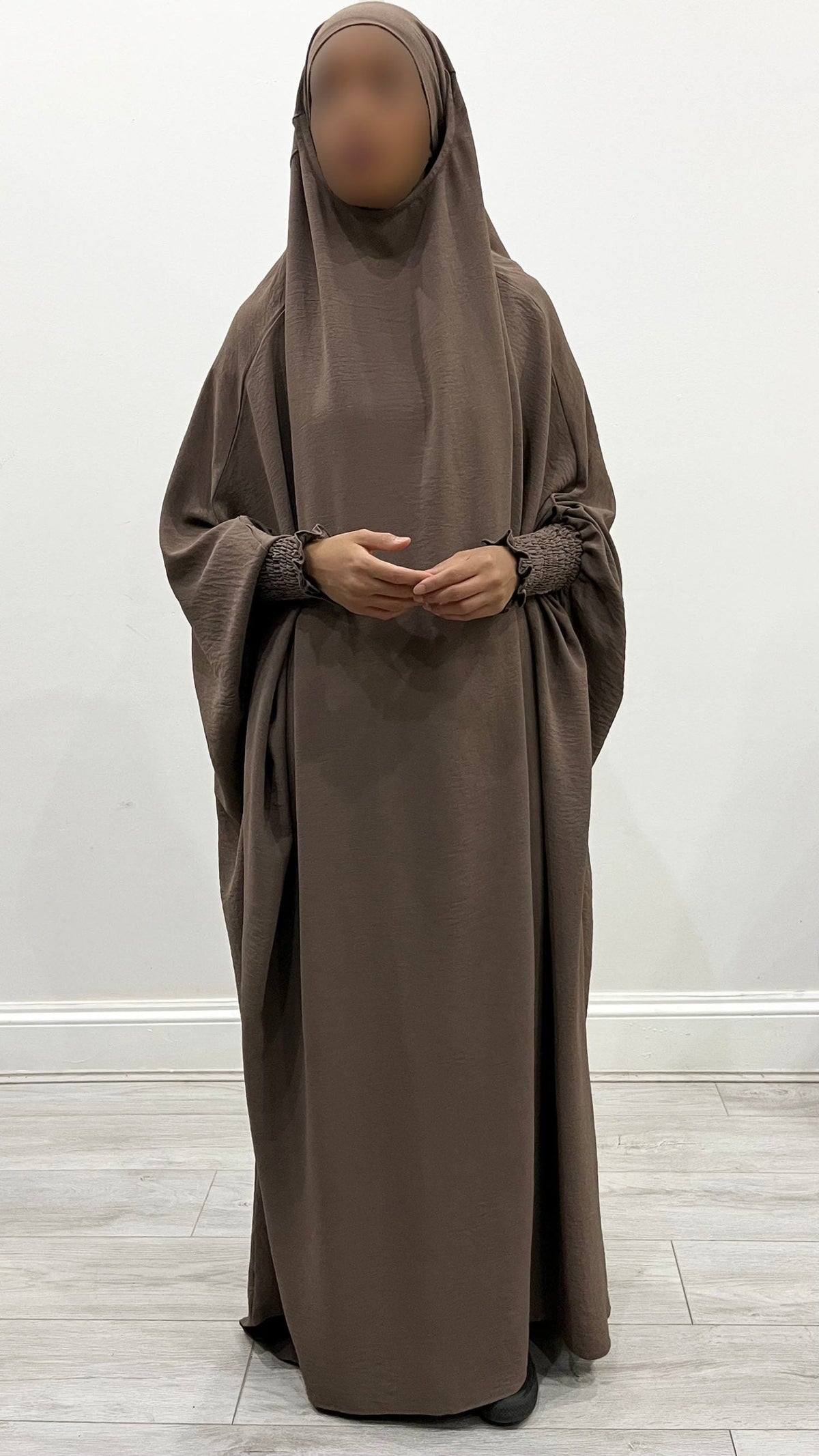
How Can You Style Amani's One Piece Ruched Cuffs Full Jilbab in Dark Taupe?
Amani's One Piece Ruched Cuffs Full Jilbab in Dark Taupe brings together an overhead shape, gathered wrists and a warm neutral colour. If you are considering it for everyday outings, work or a family occasion, the useful question is how those details fit into your existing wardrobe. A long garment can look complete on a hanger while still needing the right shoes, coat and bag to work comfortably through a day.
The starting point is its construction. This jilbab incorporates the head covering into the garment and secures with two straps behind the head. You do not need to build the outfit around a separate matching scarf. Instead, give attention to the frame around your face, the fall over your clothes and the accessories that sit beside the dark taupe. The ruched cuffs provide a second point of detail, so an elaborate wrist accessory is optional rather than essential.
Below are practical ways to style the Dark Taupe One Piece Ruched Cuffs Full Jilbab, including three complete outfit approaches and the fitting checks that make each one usable.
What are you choosing with this particular jilbab?
The current design is a one-piece overhead jilbab in soft crepe, with an integrated head covering, ties behind the head and ruched cuffs. Its appeal lies in connected coverage: the upper and lower sections belong to the same garment. That changes the dressing process compared with an open abaya and separate hijab, where you arrange the outer layer, inner outfit and scarf independently.

Begin by spreading the garment enough to identify the head opening and sleeves. Put it on without pulling from the gathered cuffs, then settle the fabric over your shoulders before adjusting the ties. If you tie first while the body is still bunched at the back, you may mistake an unevenly arranged garment for an uncomfortable fit. Let the lower fabric fall, release anything caught beneath it and adjust the head covering afterwards.
The straps should secure the position you find comfortable; they should not have to compensate for a body or sleeve that feels too small. Turn your head in each direction and look down. If movement repeatedly pulls the opening out of place, pause and check whether the garment is caught on an underlayer or whether the overall fit needs reconsidering. Tightening indefinitely rarely gives a pleasant result.
The cuffs are worth trying in the situations that matter to you. Rest your hands on a desk, hold your bag and reach forward. Check that the gathers sit where you want them without pressing uncomfortably or swallowing your hands. Their appearance is part of the design, but their usefulness depends on how the sleeve length and wrist opening fit you.
For a broader comparison of silhouette and movement, the guide to choosing a one-piece jilbab by its cut explores the underlying fit questions. Here, the styling focus stays on this dark taupe colourway, its integrated head covering and its gathered wrists.
How do you build a colour palette around dark taupe?
Dark taupe offers a different starting point from either crisp black or pale beige. Treat the garment itself as the reference when choosing accessories: the colour on your screen may look different beside an actual coat or handbag. Bring the pieces together in daylight before deciding that two neutrals match. A combination can be attractive without being identical, but an almost-match deserves a second look.
Cream and dark taupe for clear, gentle contrast
A cream bag or light coat introduces a visible contrast without adding another strong colour. This is particularly useful if you like the warmth of taupe but find an entirely brown outfit too uniform. Keep the cream concentrated in one main piece, then choose footwear that relates to either the bag or the jilbab. You do not need cream shoes, cream outerwear and a cream bag together.
For example, dark taupe with a cream tote and dark brown flat shoes creates three distinct surfaces. The tote lightens the middle of the outfit, while the darker shoes give the hem a clear finish. If a cream coat is the main feature instead, a darker bag can prevent all the accessories from merging into the coat.
Chocolate and dark taupe for a closer tonal outfit
Chocolate accessories offer a quieter change. Choose a brown that is visibly deeper than the jilbab so the difference looks deliberate. A smooth chocolate bag beside the folds of crepe can be enough detail for a simple daily outfit. Add brown boots or loafers if you already own them; there is no need to replace useful black footwear merely to follow a colour formula.
When several browns look slightly wrong together, remove one before buying another. A bag, coat and shoes in three unrelated browns can be harder to organise than a taupe jilbab with one brown accessory and black footwear. Fewer colours often make it easier to see what the outfit needs.
Black for definition, burgundy for a richer accent
Black gives dark taupe a more defined outline. A black coat, shoes and modestly sized bag can support a work outfit while the jilbab remains the warmer central colour. Look at the complete outfit from a little distance: if the black coat dominates, leave it open where practical so the taupe remains visible.
Burgundy is another option for a bag or shoe when you want a noticeable accent. Try it beside the actual fabric rather than expecting every wine-red shade to work equally well. Keep the rest of the outfit restrained. A burgundy bag with simple dark shoes is easier to judge than burgundy repeated at several points with additional metallic details.
Choose metal finishes by the accessories you already wear
Gold-toned and silver-toned hardware can both be considered. Hold the accessory beside the jilbab and see which combination you prefer; taupe does not impose a rule that you must wear one metal. Existing bag clasps and shoe buckles already contribute shine, so take them into account before adding jewellery. Sometimes the bag hardware supplies all the polish an outfit needs.
How can you wear it for ordinary outings?
For errands, a café visit or an afternoon with family, start with the clothes you will actually wear beneath the jilbab. Smooth trousers and a comfortable top may sit differently from a thick sweatshirt with a bulky hood. Try the whole combination before choosing accessories, particularly if you plan to put the jilbab over clothes you are already wearing at home.
A straightforward outfit is the dark taupe jilbab, dark brown flats and a cream tote. Choose shoes you already find comfortable for the route, rather than selecting a pair solely because its colour is ideal. The hem should clear your steps with those shoes. If you need to keep gathering the front to walk normally, the length needs attention before the outfit becomes an everyday option.
The tote is useful visually because it introduces one light area without asking you to add a second scarf over the integrated head covering. Check its handles against the cuffs: can you carry it without bunching the sleeve around your hand? Put in the items you normally take out, as an empty bag can sit quite differently from a loaded one.
For a hands-free alternative, try a bag with a strap position that feels comfortable over the jilbab. Look at the fabric beneath the strap and turn sideways. If the bag pulls the garment into a line you dislike, change the strap length or use a different carrying position. The aim is to make the bag serve the outfit and the day, rather than keep correcting the fabric around it.
In cooler weather, replace the light tote with a darker bag if your coat is already pale. A cream coat, taupe jilbab and chocolate footwear give enough variation on their own. Try sitting with the coat on and standing again; a coat that looks generous while open may grip the sleeves or trap the jilbab when fastened.
Keep this outfit repeatable. If it takes three unfamiliar accessories to feel finished, try your usual bag and shoes first. The garment's colour and gathered cuffs already provide character. An everyday version should fit the amount of preparation you realistically want to give it.
What makes the dark taupe jilbab work for work or meetings?
Start with your actual workplace expectations. An office, community meeting, classroom and creative studio may each call for a different level of formality. Dark taupe can be arranged into a restrained outfit, but the colour alone does not decide whether a garment fits the setting. Check the overall shape, your work tasks and any relevant dress requirements.
One practical combination is the jilbab with a black structured handbag and plain black loafers or other suitable closed shoes. The repeated black creates a clear relationship between the accessories while the taupe remains the main colour. A bag with enough room for your essentials is more useful than a very rigid miniature bag chosen only for its appearance.
At a desk, pay particular attention to the cuffs. Type a few lines, reach for a notebook and rest your forearms on the surface. If the gathers collect beneath your wrists, adjust the sleeve position and see whether it stays comfortable. A watch can be worn above or below the cuff according to fit, but it should not hold the gathered fabric in an uncomfortable bundle.
Try a blazer over the complete outfit before choosing it as your outer layer. A fitted jacket may not have enough space for a flowing jilbab underneath, especially through the upper arms. If you want that more structured outline, try a jacket with sufficient room for layering and test it while seated. Do not assume that a blazer will improve the outfit merely because it looks formal on its own.
A longer, generously cut coat may be the more workable outer layer for a commute. Check that its sleeves accommodate the jilbab's fabric and that the front does not pull when you carry your work bag. If you remove the coat indoors, the taupe-and-black outfit should still look complete without it.
For meetings with a lot of sitting, assess the garment after being seated for a few minutes. Look at how it settles over the lap and whether the head covering still feels comfortable when you lean forward to write. This tells you more than a standing mirror check. An outfit for work earns its place by allowing you to concentrate on the meeting once you arrive.
How can you dress it for dinner or a family occasion?
For a more dressed-up version, change one or two accessories before adding layers. A burgundy clutch or small handbag can create a clear accent against dark taupe. Pair it with simple dark shoes, or with a metallic detail you already enjoy wearing. The result can feel occasion-ready without requiring a decorative scarf to cover the jilbab's existing head section.
A family dinner example would be the jilbab, a small burgundy bag and black flats with a restrained buckle. If you prefer heels, try them with the garment before the event, especially if the same jilbab is usually worn with flats. Check the resulting length and how easily you move between sitting, standing and walking. The correct shoe is the one that works with the outfit and the venue.
For a celebration where you want a lighter finish, consider a cream evening bag with a subtle metal clasp. Keep the footwear simple so the pale bag becomes the deliberate focal point. A beaded or heavily embellished bag can be attractive, but check that its edges do not catch against the gathered cuffs or fabric as you carry it.
A necklace is optional. On a garment with an integrated head covering, the necklace's position may be partly hidden or may rest on a fold that moves. Try it on the actual outfit rather than assuming it will sit as it would over a plain neckline. If it keeps disappearing into the drape, let the bag or footwear supply the detail instead.
The same applies to a brooch. Avoid improvising a fastening by piercing an area that carries the garment's weight. If you want an ornament, consider whether it can sit securely without changing the fit or pulling at the fabric. You should be able to remove it without leaving the jilbab dependent on that placement.
For a wedding or other formal invitation, consider the host's expectations and your own preferred degree of dressiness. A dark taupe jilbab can form a restrained outfit, but it is not automatically the right answer for every event. Lay out the complete look, including outerwear and bag, and decide whether it feels appropriate before making additional purchases.
Which fitting checks matter before you keep it?
Use the current product information and measurements for the option you are considering. Do not translate a length number into a guaranteed height match, and do not assume that a roomy appearance in a photograph tells you how it will fit over your own clothes. If a measurement you need is missing, ask for it before relying on a guess.
- Settle the upper section first. Arrange the garment over your usual base layers, then adjust the head ties. Check that the opening is comfortable around your face and that turning your head does not create a persistent pull.
- Check the shoulders and upper arms. Reach forward as you would to pick up a bag. Notice whether the body of the jilbab lifts sharply or whether an underlayer is catching beneath it.
- Test the cuffs with both hands. Put on your watch if you wear one. Open and close your hands, rest your wrists on a table and check the sleeve length without continually pushing it back.
- Sit in your usual way. Look at the fabric across your lap and at the sides. There should be enough room for the coverage and movement you want, rather than a fit that works only while standing.
- Walk in the intended shoes. Turn, step forward and check the hem. Include a careful step up where you can do so comfortably; an attractive standing length may be awkward on stairs.
- Add the real bag and outerwear. Repeat the movements with the accessories you plan to use. A coat sleeve, bag strap or bulky layer can change an otherwise satisfactory fit.
Check coverage in the lighting where you will wear it, using the underlayers you actually plan to keep. The name “full jilbab” describes the garment style; it does not replace your own assessment of fit and coverage. If you intend to use it for prayer, try the movements you normally make and check your preferred coverage throughout.
If one area is uncomfortable, identify the cause before simply choosing a larger size. Extra length does not necessarily solve a tight wrist opening, and a looser upper section may change how the head covering sits. Ask about the relevant measurement or compare a different cut. The most useful fit is balanced across the garment.
How should you plan layers without making the outfit cumbersome?
Build from the temperature and setting, then try the layers together. A thin base outfit for a heated building will not behave like a chunky winter outfit for an outdoor journey. The product's description of soft crepe does not establish how warm you personally will feel in every setting.
Bulky collars and hoods deserve attention because they occupy the same upper area as the integrated covering. If a hood sits in a lump at the back, try a flatter base layer rather than pulling the jilbab tightly over it. Similarly, a thick waistband or large trouser pockets can affect how the outer fabric falls. Check whether a simpler base outfit gives a more comfortable result.
When trying outerwear, leave enough room through the sleeves for the cuffs and the fabric above them. Pulling a narrow coat sleeve over gathered material can create a ridge that you then have to rearrange every time you take the coat off. A coat that accommodates the jilbab easily is more useful than one whose colour is perfect but whose sleeves are too close.
What if the colour or proportions feel different once you put it on?
With this design, dark taupe sits around your face as well as through the body of the garment. That makes it worth judging the colour while wearing it, rather than holding only a sleeve against a handbag. Stand in the light you normally use to get dressed, then look again near a window. Decide whether you enjoy the overall effect before building accessories around it.
If the outfit feels too similar from top to bottom, begin with the items that are separate from the jilbab. A lighter bag or a visibly darker coat can introduce contrast without changing the head arrangement. This preserves the convenience of the one-piece design. Adding another scarf may be a personal preference, but it should not be necessary merely to make a purchase you dislike feel acceptable.
If the jilbab feels visually heavier than expected, inspect the outfit without the bag and coat. A bulky shoulder bag or short, close-fitting jacket can change where the eye notices the garment's volume. Try a simpler bag or a more generously cut outer layer and compare the result. Compare the shoulder, waist and hem together, then keep the combination that feels comfortable and looks balanced to you.
If the cuffs seem lost, check whether the sleeves are too long or are caught inside another layer. The gathers should be visible as part of the sleeve rather than continually covered by excess fabric. If the cuffs dominate instead, remove the bracelet or watch temporarily. That small change can show whether the issue is the garment itself or several details competing at the wrist.
Can one set of accessories cover more than one occasion?
Before shopping for extras, put your available shoes, bags and outerwear beside the jilbab. Choose one pair of shoes that works with the length and one bag that holds what you need. These are the foundation. Then identify the single change that would make the outfit more suitable for another setting.
For example, black loafers and a black handbag may already be suitable for work and a daytime family visit. For dinner, you might keep the shoes and exchange the handbag for a burgundy clutch. If the shoes remain comfortable and the jilbab still hangs as intended, you have a second outfit without replacing the entire set of accessories.
Alternatively, a cream tote and brown flats may cover most casual outings. A darker, smaller bag can make that combination feel more considered for an evening visit, while a cream coat can remain your usual outer layer. There is no requirement to create a separate identity for every event. Reusing a good combination is a practical reason to choose a neutral garment.
Keep a photograph of a combination you like if that helps you remember it. Note which shoes worked with the hem and which bag stayed comfortable on the journey. These personal observations are more useful for the next outing than a long list of colours that might work in theory. They also make it easier to recognise when you already have what the jilbab needs.
How do you keep the cuffs and overall shape looking cared for?
Follow the care label on the garment. The terms “crepe” and “ruched cuffs” do not, by themselves, establish a washing temperature, drying method or safe ironing setting. If the label is missing or unclear, confirm the instructions before washing. Avoid carrying an old care instruction from another jilbab across to this one without checking.
When putting the garment away, inspect the cuffs and hem for anything that needs attention. Support the garment in storage rather than hanging it from its head ties or one sleeve. Keep the gathers clear of rough bag hardware and jewellery that could catch when you dress.
For a day away, pack the jilbab separately from exposed shoe fastenings and other rough items. Place the head section and ties so they are easy to identify when you unpack it. Let it settle before assessing any creases, then use only the finishing method permitted by the label. There is no need to assume that every travel crease requires heat.
Is this the right dark taupe jilbab for your wardrobe?
It is worth considering if you want a one-piece overhead garment, like the look of gathered cuffs and can picture dark taupe with accessories you already own. The strongest reason to choose it is a useful combination of construction, fit and colour, rather than the idea that everyone needs the same neutral.
Choose one of the outfits above as your starting point: cream and brown for daily outings, black accessories for work, or a burgundy accent for an occasion. Try the full outfit in movement, then adjust only the detail that needs attention. With the right fit and a clear purpose, the jilbab can remain the main piece while the rest of the outfit stays straightforward.