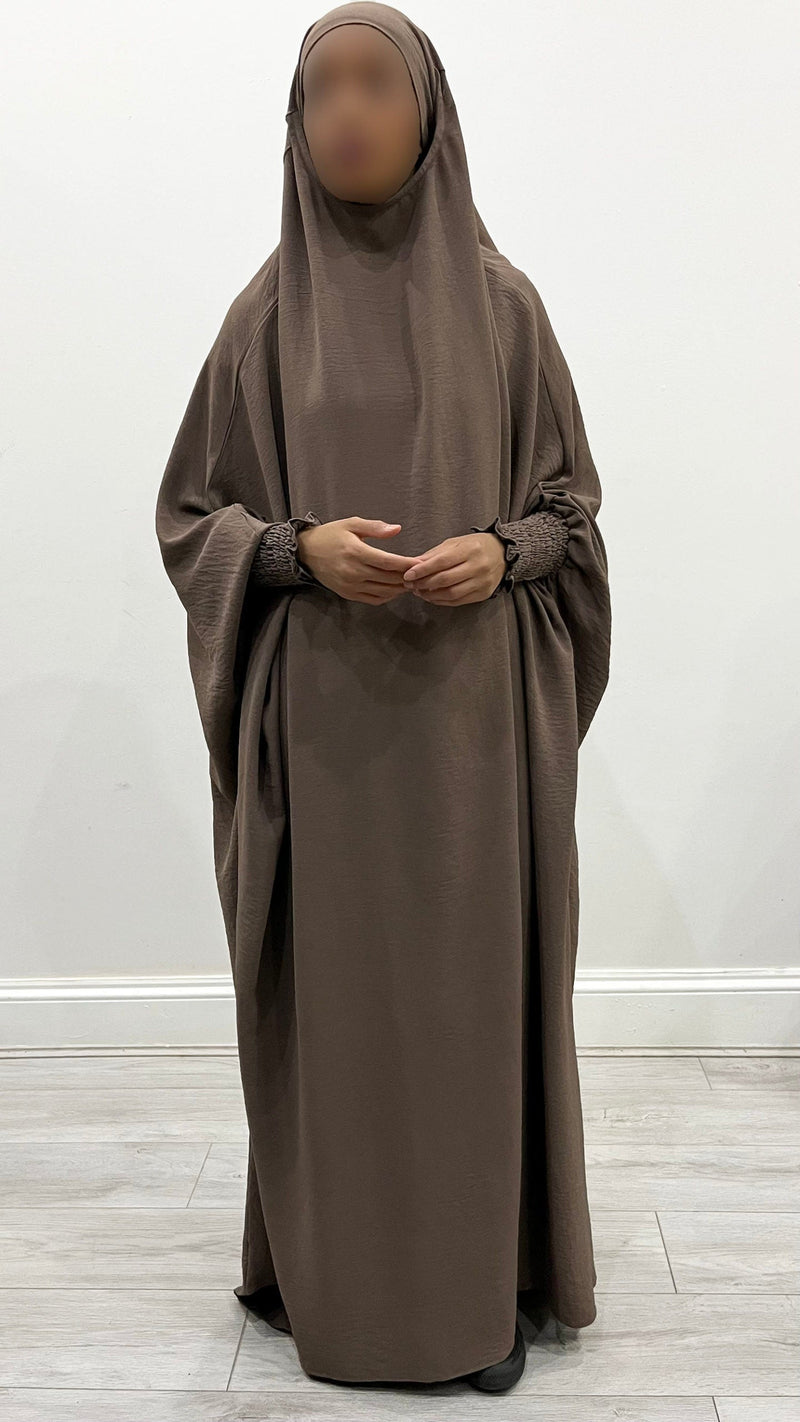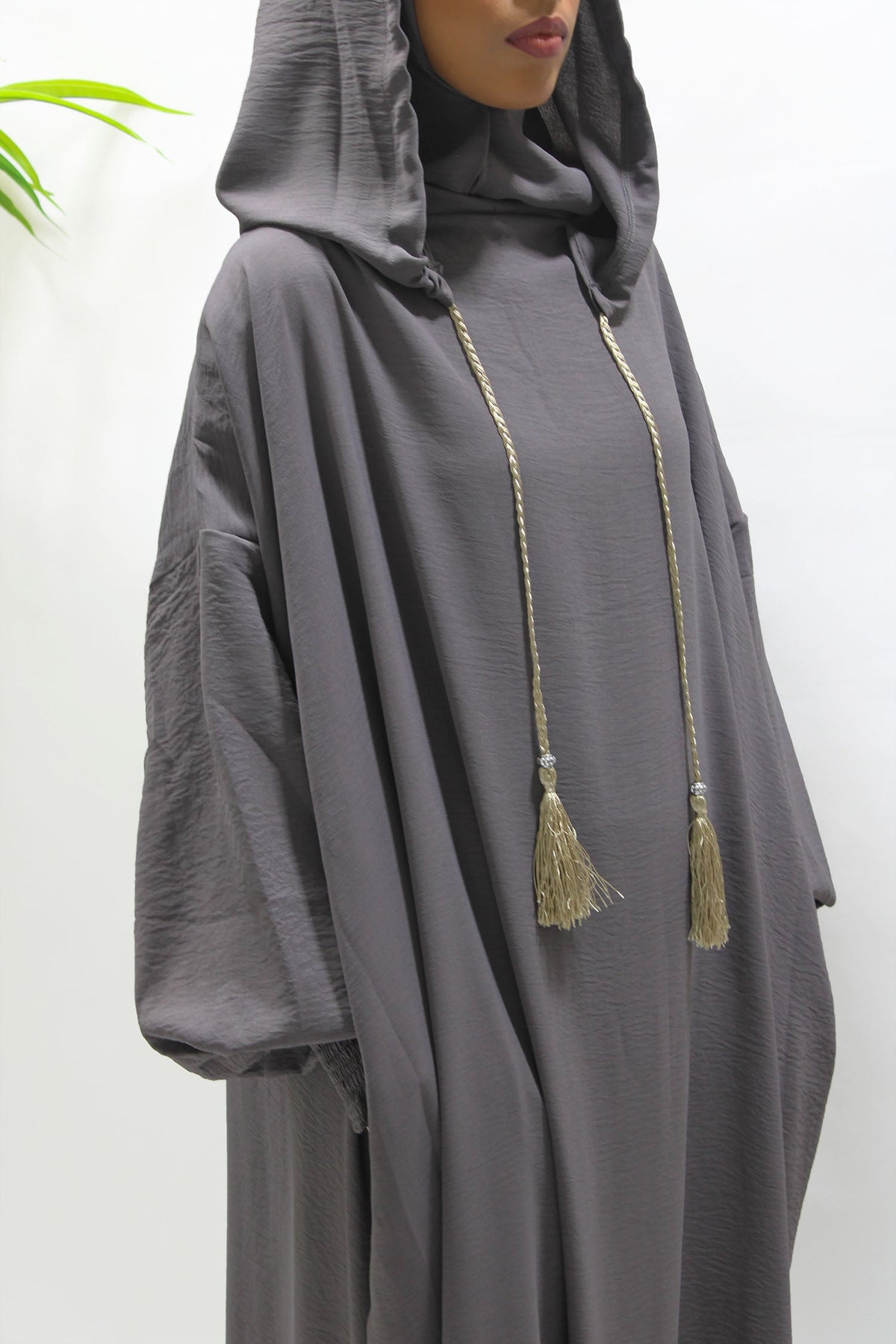
What Makes the Double-Hooded Prayer Abaya with Pockets in Moon Grey Practical?
The Double-Hooded Prayer Abaya with Pockets in Moon Grey brings several useful details into one garment: an attached double hood, a full-length body, elasticated ruched cuffs and two pockets. Its appeal is the possibility of a simpler getting-dressed routine. The important question is whether those details work comfortably together for you, over the clothes you normally wear and through the movements your day involves.
Moon grey also gives you an alternative to a dark prayer garment without requiring a complicated colour scheme. You can keep the outfit quiet with cream and charcoal, introduce navy for more definition, or use a small burgundy accessory when wearing the abaya to a gathering. The head covering is already part of the design, so a separate decorative scarf is a choice to assess rather than something you automatically need to add.
This guide takes Amani's Double Hooded Prayer Abaya With Pockets in Moon Grey through a realistic first fitting, several ways of wearing it and the small care and storage decisions that make a frequently used garment easier to keep ready.
What does this particular design include?
This one-piece abaya has a built-in double hood, elasticated ruched cuffs and two pockets, with the material described as Cey fabric. Check the garment label for the full fibre composition and care instructions. During the fitting, assess how the fabric feels over your usual clothes and in the setting where you plan to wear it.
The one-piece format means you can keep the body and head-covering sections together. That may be useful if your current routine involves looking for a separate scarf before each wear. The trade-off is that the hood and body need to suit you as a connected garment. A comfortable body length does not automatically establish a comfortable face opening, and the reverse is also true.
The ruched cuffs give the sleeves a gathered finish at the wrists. Check their comfort with your usual inner sleeves rather than judging them only on bare arms. The pockets provide places for suitable small belongings, but their presence does not tell you a carrying capacity or prove that every phone will fit comfortably.
Assess the Moon Grey fabric over the clothes you intend to wear beneath it, including in stronger daylight. Check the shoulders and knees where the cloth may sit closer during movement. Choose the complete layers that give you the coverage and comfort you want.
Begin with the clothes you really wear underneath
For the first fitting, choose an ordinary base outfit from your own routine. If you expect to put the abaya on over a long-sleeved top and loose trousers at home, use those. If you want it for an outing, use the dress or separates you would actually wear on that day. A carefully chosen showroom-style base can give a misleading impression of how convenient the garment will be later.
Lay the abaya out and identify the front, cuffs, hood sections and pocket openings before putting it on. Smooth any fabric caught inside itself, particularly around the hood and sleeves. You are giving the garment an ordinary starting position, rather than trying to create a special arrangement that only works while somebody holds it for you.
Once it is on, let the body settle from the shoulders. Keep the pockets empty and avoid adding a belt or bag at this stage. Notice the hem, the room through the upper back and the way the sleeves sit over your inner clothing. These are the basic relationships to establish before the smaller details can be judged fairly.
Then arrange the hood comfortably. If adjusting it seems to lift the body or draw fabric across the shoulders, reset the whole garment before making the face opening tighter. Sometimes a section is simply caught; sometimes the connected proportions do not suit the wearer. More tension is not a useful default answer to either situation.
Use your normal movements and any support you ordinarily need during the fitting. There is no value in attempting an unfamiliar position to prove that a garment works. The relevant question is how it behaves through your own routine.
Let the double hood settle without forcing the face opening
The double hood is the feature that distinguishes this abaya from a plain body garment worn with a separate scarf. During the first fitting, look at how its sections sit around the head, shoulders and chest. Follow the construction of the garment rather than assuming both parts are removable or intended to be rearranged in every possible way.
Start with the face opening resting comfortably, then turn your head gently in both directions and look down. Notice whether the fabric follows easily, slips away from the position you want or pulls at the neckline. A hood that looks neat in a front-facing photograph still needs to work when you look towards a doorway or speak to someone beside you.
The hood can be secured with a hijab pin if you prefer. Choose a suitable fastening and place it without drawing the fabric uncomfortably tight. Keep it clear of the skin and inspect the surrounding cloth afterwards. Begin with a comfortable face opening and shoulder fit, then use the fastening to maintain that arrangement.
Some wearers prefer an undercap; others may not need one for their chosen arrangement. Try the option you normally use, then assess comfort again. Extra layers can change the space around the head and neck. There is no need to add them simply because they appear in a familiar styling routine for a different scarf.
When the hood feels settled, leave it alone for a moment and move naturally. The useful result is an arrangement you can return to without a lengthy sequence of adjustments.
Check the hem for both prayer and ordinary walking
A full-length garment needs to suit more than an upright pose. Check where the hem falls with the footwear you expect to use outside, then assess it in your usual prayer setting. Removing shoes can change the relationship between the lower edge and the floor. Do not assume one brief fitting answers both uses.
Walk a few ordinary steps, turn and sit down. Where relevant to your own practice and ability, assess the movements you use for prayer too. Watch for cloth caught beneath a foot or gathered in a place that repeatedly needs clearing. The aim is comfortable coverage with manageable fabric, rather than the maximum possible length.
If the hem feels wrong, identify which part is responsible. The garment may be sitting too low at the shoulders, the hood may be pulling it into an unusual position, or the length may simply be unsuitable. Those are different problems. Adjusting the head section should not become a way of holding an overly long body off the floor.
Before choosing a size, use the current product measurements and their stated measuring route. Compare with a similar garment that already works for you, measured from the same point. A familiar size number is useful information, but it does not replace the actual dimensions of a different design.
For wider guidance on this fitting, see our prayer-abaya guide to coverage and movement. With this particular abaya, keep the connected hood, body length and gathered wrists in the same fitting so you can see how they work together.
Make the ruched cuffs part of the first trial
Put your hands forward and let your arms return to rest. Notice whether the cuffs stay where you want them without pressing uncomfortably. Check the inner sleeves too: a gathered outer cuff can feel different over a thin cotton sleeve, a bulky jumper cuff or bare skin.
If the inner sleeve bunches, smooth it before judging the outer cuff. You may prefer an inner top with a plainer wrist finish for this abaya. That is a useful wardrobe adjustment when it works with your needs; it does not mean every long-sleeved base must be replaced.
For washing before prayer, see whether the cuffs can be moved comfortably to the position you require and returned afterwards. Do not force the elastic beyond its comfortable range. If you prefer to remove the garment for that part of your routine, organise the outfit around that preference rather than treating one advertised convenience as compulsory.
After moving the sleeves, check their position again before settling the rest of the garment. A cuff caught higher on one arm can pull the adjacent fabric and make the whole abaya feel uneven. A simple reset is different from repeated discomfort: if the same problem returns, reconsider the fit or inner layer.
Use the two pockets for a defined purpose
Begin by deciding what you genuinely want within easy reach. A tissue, a card and a phone are different objects, and they will not necessarily behave the same way in a soft garment. Try a suitable item gently, without forcing the opening or using a heavy load to test the seams.
Look at the abaya with the item in place, then sit down. If one side pulls, the pocket mouth opens awkwardly or the object presses against you, move it to a suitable bag or another secure location. You do not need to fill both pockets to make the garment feel balanced.
For an outing that includes prayer, the journey and the prayer itself may call for different carrying arrangements. Choose a practical, appropriately secure place for belongings that you do not want in the garment. Keep the transfer simple and respect the arrangements of the setting you are visiting.
The pockets can still be useful when you leave them empty for part of the day. Their value is the option they give you, not a promise that this abaya replaces every bag. Keep any small item that might mark or catch the fabric appropriately contained. For more detail on depth, openings and carrying comfort, see our guide to useful abaya pockets.
A simple home-prayer arrangement
For home use, start with the base clothes you most often wear and keep the abaya in a convenient, clean place. Arrange the hood in the way that worked during your fitting, settle the cuffs and check the lower edge. Once that combination is familiar, there is little reason to add decorative accessories each time.
The most useful refinement may be storage rather than another garment. Give the abaya enough space that the hood and sleeves do not become tangled with other clothing. If you use an undercap or another personal item with it, keep that nearby in a suitable place. A repeatable arrangement is easier when the required pieces are actually available.
Try the outfit during an ordinary moment before relying on it when you are in a hurry. Notice whether you can put it on and take it off comfortably over your usual clothes. If jewellery, a collar or an inner sleeve repeatedly catches, address that contact rather than pulling the abaya past it.
Keep the role realistic. You may love the convenience of a one-piece garment at home while preferring separate pieces for another situation. It does not have to become your only prayer outfit to earn a useful place in the wardrobe.
A navy-and-grey outfit for a short visit
For a trip out, try the Moon Grey abaya with navy shoes and a navy or charcoal bag. Use the attached hood as the starting head-covering arrangement, with any underlayers you personally require. The darker accessories give the pale garment a clearer outline without asking it to compete with several new colours.
Choose a base outfit that remains comfortable for the whole outing, including any time when you remove the abaya. A long-sleeved top and trousers or a suitable dress can each work, depending on your own preferences. Check that pockets and waist details underneath do not create an awkward ridge or catch the outer fabric.
Put on the bag with its ordinary contents. A cross-body strap may change the hang of the abaya or meet the hood fabric at the shoulder. A different carrying position may work better, but choose it for genuine convenience. An outfit that looks neat only while the bag is held away from the body is not yet ready for the visit.
If you add a coat, assess the head and neck area again after fastening it. The connected hood needs room to sit comfortably beside the coat's collar. Remove the coat during the trial too, so you know whether the hood requires a small reset or is consistently disturbed by that particular outer layer.
A softer cream combination for a family gathering
Moon grey can look gentle beside cream accessories. Try familiar cream or soft taupe shoes, a simple bag and the abaya's own hood arrangement. Let the gathered cuffs and uninterrupted body provide the main visual detail. This is a useful direction when you want a coordinated outfit without a strong contrast.
Compare the actual cream and grey in ordinary light. A bright white bag may feel crisp; a warmer cream may look softer. Neither needs a universal rule about undertones. Choose the version that makes the outfit feel complete to you and works with the accessories you already own.
A family gathering may include sitting, serving food, taking off a coat and changing rooms. Include those ordinary actions in the fitting where relevant. Keep the sleeve and pocket areas clear of accessories that repeatedly catch, and use a bag large enough for the belongings you need rather than shifting the excess into the abaya.
For a dressier finish, add one detail you enjoy: a restrained metallic clasp on the bag, a ring or shoes with an interesting texture. There is no requirement for heels. Check the hem with the footwear you intend to keep wearing, especially if you expect to remove it indoors.
Introduce burgundy without rebuilding the outfit
If the grey-and-cream version feels too quiet, try a burgundy bag with the same shoes and base clothes. Changing a small accessory first makes it easier to see whether the stronger colour adds what you want. A deep red accent can create a clear focal point while leaving the abaya itself uncomplicated.
You can also use navy as the contrasting colour and keep the bag neutral. Avoid buying a whole set of matching accessories before you have tried one item beside the garment. Labels such as burgundy, wine and plum can describe quite different colours, and exact matching is not essential for a thoughtful outfit.
A separate scarf worn decoratively requires more consideration because the abaya already has a double hood. If you want that look, make a complete trial of the layers around the head, neck and chest. Keep it only if the arrangement remains comfortable and gives you the coverage you want without repeated adjustment.
It is perfectly reasonable to leave the additional scarf out and place the colour elsewhere. The built-in hood is part of the garment's character, not an unfinished space that always needs another accessory.
Give the attached hood room at the neckline
Your inner top's neckline can change how the double hood settles. A plain crew neck gives you one simple surface beneath it. A higher collar may add useful coverage for your preferences, but it also occupies more space. Try both if they are part of your wardrobe, keeping the rest of the outfit the same so the difference is easy to identify.
With a shirt underneath, smooth the collar into its intended position before arranging the hood. Check whether the collar points or upper buttons meet the fabric when you turn your head. If they catch repeatedly, compare a different base rather than pulling the hood forward each time. The most useful inner outfit is one you can wear comfortably before and after the abaya goes on.
If you wear glasses, put them on during this part of the fitting. Arrange the fabric around the sides in the way you find comfortable, then look down and turn naturally. You should be able to use your glasses normally without the hood pressing them into an awkward position. Make any adjustment while standing or sitting securely, with both hands free.
Finally, add your coat collar if the outfit includes one. Check the neckline as a complete arrangement: inner top, attached hood and outerwear. A small change to the inner collar or scarf volume may resolve the crowding. Once it feels comfortable, note the combination so it is easy to repeat for another outing.
Adapt the layers to the day rather than the fabric name
The Cey description does not tell you how warm the complete outfit will feel to you. Your base clothes, the room, the weather and the time spent wearing the garment all contribute. Begin with the layers you need for that particular day, then assess the whole combination.
For a cooler journey, try suitable outerwear over the abaya and check the shoulders, sleeves and hood together. A bulky jumper underneath and a narrow coat above may leave less room than either layer suggests on its own. If the combination feels crowded, change one layer rather than tightening the hood or cuffs to contain the excess cloth.
For a warmer setting, simplify optional layers where that still meets your needs. Recheck the garment's appearance over the new base rather than assuming a lighter outfit underneath produces the same coverage. Consider the real conditions in which you plan to wear it; there is no useful promise that one fabric name guarantees comfort in every season.
If an outfit works at home but feels awkward outdoors, identify the added factor. It may be the coat collar, bag strap, shoes or the way you carry belongings. That gives you a specific change to try instead of a vague judgement that the abaya is unsuitable for all ordinary wear.
Pack the complete arrangement for a day away
If you plan to take the abaya with you, first check that you are comfortable putting it on over the clothes you will be travelling in. A garment that works over homewear may feel different over a structured collar or jacket. Make that comparison before deciding how small the packed bundle needs to be.
Fold it in a way that respects its construction and keeps the hood and cuffs easy to identify when you unfold it. Avoid forcing it into a space that crushes everything together. You do not need a perfect retail-style fold; you need a practical arrangement you can repeat without pulling at the fabric.
Keep it in a suitable clean bag or compartment, separate from shoes, sharp objects and anything that might leak. Check that it is fully dry before packing. If it needs care after the journey, follow its label rather than assuming a travel steamer or hotel iron is appropriate for the fabric and elastic.
Pack any additional items you actually use with it, but resist adding a collection of hypothetical alternatives. A familiar undercap, if needed, and a settled base outfit are more useful than several scarves that have never been tried with the attached hood. Keep the routine compact through preparation, not by omitting something essential to you.
Care includes the hood, cuffs and pocket interiors
Read the care instructions on the finished garment before cleaning it. The fabric, elasticated cuffs and construction all belong in that decision. Do not select a wash temperature, drying method or pressing technique from the word Cey or from the colour alone.
GINETEX's care-symbol guide can help you interpret the label. If the information you need is missing, obtain product-specific guidance before experimenting. An apparently gentle method is not automatically permitted for every garment.
Empty both pockets and check their corners before care. Arrange the hood and sleeves as the instructions require, without tying sections together or stretching the cuffs to make the garment easier to handle. After cleaning, check that the thicker or folded areas are dry before returning the abaya to storage.
Inspect any area that has begun to pull, catch or come loose. Keep a repair question separate from a fit question: a damaged cuff needs appropriate attention, while an uncomfortable but intact cuff may indicate a different size or layering requirement. Do not repeatedly stretch the elastic in an attempt to solve either problem.
Decide whether the one-piece format suits your routine
Compare this abaya with the arrangement you currently use. If finding and coordinating a separate head covering is the part you want to simplify, the connected hood and body may be appealing. If you prefer to adjust or wash those pieces independently, a separate arrangement may remain useful alongside it.
Think about three real uses rather than every possible occasion. You might want a home-prayer garment, an outfit for a short visit and something to pack for a day away. The Moon Grey abaya only needs to work well for the roles you choose. A list of theoretical uses is less helpful than one combination you have tried comfortably.
Keep a brief note of the successful arrangement: base clothes, hood adjustment, footwear and the pocket or bag plan. That makes the next wear easier and gives you something specific to change when the season or outing changes.
The double hood, ruched cuffs and pockets are useful when they reduce the amount of clothing you need to manage. Let the first fitting establish their relationship, choose a simple palette around the Moon Grey colour, and keep the garment ready in the way your own routine needs.