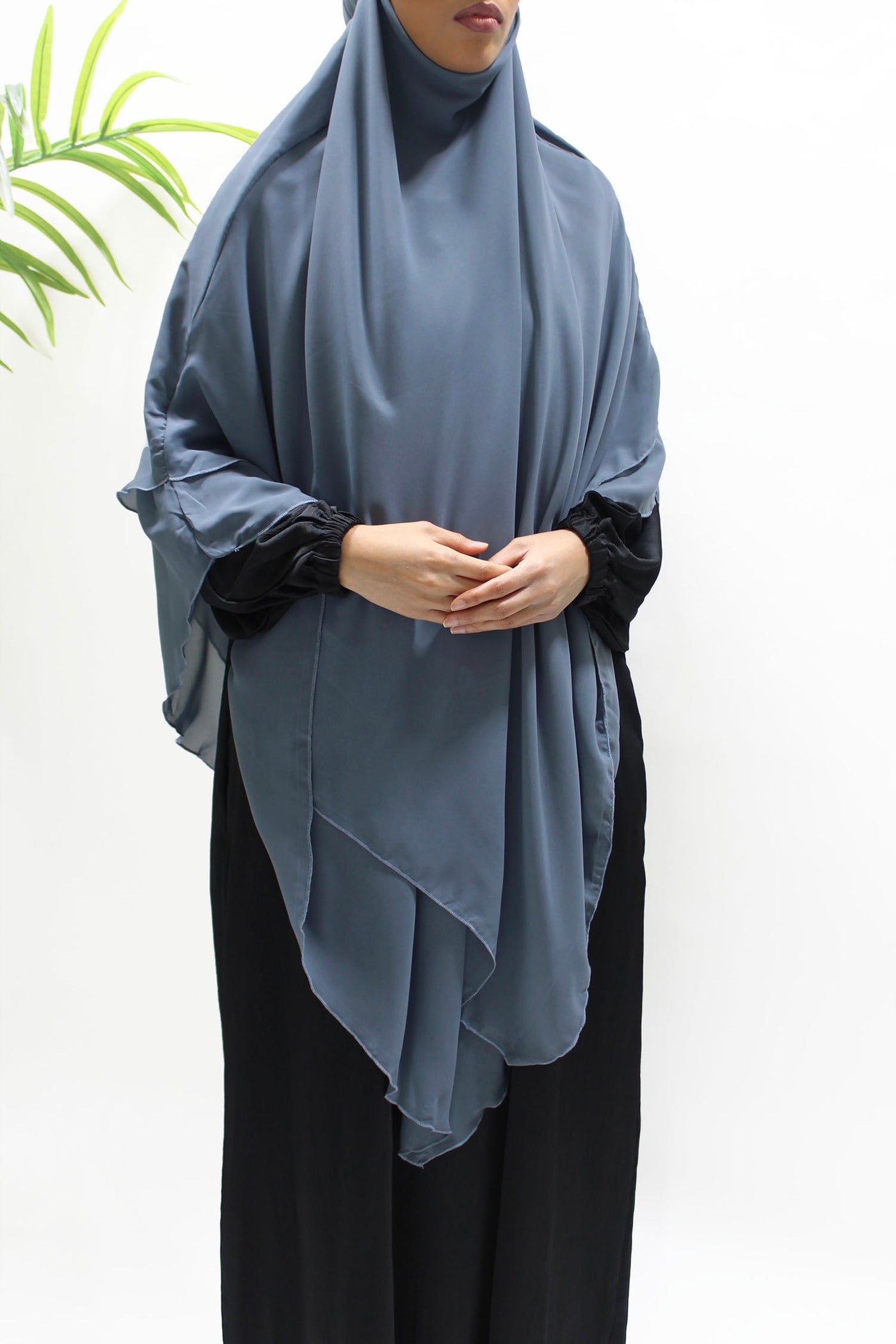
Complete Khimar Guide: Coverage, Styling and Buying Advice
Sister, choosing a khimar should feel clearer than comparing photographs and hoping the garment will behave the same way at home. A product can look beautifully flowing while the listing leaves out the details that decide whether you will actually wear it: the front and back length, the face opening, the fastening, the number of layers, the fabric weight, the amount of shoulder room and what happens when you walk into wind or put on a winter coat.
This complete khimar guide brings those decisions into one calm place. It explains what a khimar is in practical clothing language, how it differs from a scarf, jilbab, abaya and niqab, and how common shapes such as diamond, rounded, layered and umbrella cuts behave. It also covers measuring, face fit, coverage, fabrics, British seasons, everyday styling, work, the masjid, travel, online buying, quality, washing, storage and repairs.
Amani's uses the word khimar for a shaped head covering that falls over the shoulders, chest and back. Some khimars are short and light; others reach the waist, hips or lower. Some are single garments, while some are sold as part of a coordinated set with an abaya, skirt or niqab. The exact religious meaning and requirements attached to the word can be discussed differently across languages, communities and scholarly traditions, so this guide stays with observable garment facts rather than presenting a retailer's label as a ruling.
The aim is not to tell every woman that one length, colour or construction is best. It is to help you identify what a listing includes, how the garment fits around the head and upper body, and whether it suits the coverage, sensory comfort and routine you intend. A reliable khimar becomes easier to choose when the decision begins with your real day rather than a perfect studio pose.
You do not need a large collection before you understand your preferences. One carefully chosen khimar can teach you whether you prefer ties or a fixed opening, whether double chiffon feels light or fussy, whether a long point works with your bag, and how much coverage feels calm rather than difficult. Use that evidence to guide every later purchase.
Quick answer: what is a khimar?
In contemporary modest-fashion retail, a khimar is a shaped head covering that drapes over the head, shoulders, chest and back. Unlike a rectangular scarf that is wrapped into shape, a khimar is usually cut as a ready-made garment with a defined face opening or tie system. Its length and outline vary widely.
A khimar does not normally provide complete lower-body coverage by itself. It is worn with an abaya, loose dress, jilbab, skirt or another suitable body garment. Some products are sold as coordinated sets, but the listing should state whether you are buying the khimar alone or receiving additional pieces.
The word does not describe one universal pattern. A diamond khimar may have pointed front and back ends. An umbrella or rounded khimar may spread in a fuller curve. A layered khimar may combine two or more fabric panels. A short khimar may finish around the bust, while a long one can extend well below the waist.
For practical shopping, look beyond the title. Confirm the front, back and side drop; how the face opening adjusts; whether the fabric is single or double layer; and whether anything pictured is sold separately. Those facts tell you how the garment will work.
When your question concerns religious requirements or whether a particular garment meets a specific standard, ask a trusted qualified scholar who understands your practice. When your question concerns construction, length, fabric, fit, movement and care, this guide can help you assess the clothing.
A garment guide, not a religious ruling
Khimar is a word with religious and cultural importance, so commercial language needs care. A shop can describe where a garment falls, how opaque it is, whether it stays secure during movement and what pieces are included. A shop should not use a product description to judge a woman's faith or turn uncertainty into pressure.
Throughout this guide, words such as coverage, secure and generous refer to visible garment construction. They do not certify that one product satisfies every scholarly understanding or every personal circumstance. A product name is not a fatwa, and a length measurement cannot replace qualified guidance.
This boundary is also practical. When a khimar slips around the face, the solution may be a different tie, a better opening or another fabric. When a long point gets caught beneath a bag, the solution may be a shorter cut or a different way of carrying the bag. Clothing problems can be solved as clothing problems without making each adjustment a judgement about the wearer.
You may find that your family or community uses khimar more broadly or more narrowly than a retailer does. Instead of arguing with the label, examine the garment itself. Compare the construction with the coverage you intend and seek trusted scholarship where the question moves beyond clothing.
Amani's therefore keeps the distinction clear: this article explains products, measurements and use. Religious questions are directed to qualified scholars, while persistent pain, skin irritation, headaches or mobility concerns should be discussed with appropriate professionals.
What a khimar is—and what it is not
A khimar is not simply another name for every hijab scarf. In everyday retail language, a scarf is usually rectangular or square and needs folding or wrapping. A khimar is shaped to create ready-made drape over the upper body, although both can be worn as head coverings.
A khimar is not a complete body garment by itself. Even a very long khimar needs an appropriate lower garment. Photographs can crop out the abaya or skirt, so check the listing rather than assuming everything visible is included.
A khimar is not automatically a niqab. Many frame the face and leave it open. Some specialist sets include a separate niqab, and some designs can be arranged with one. The product page should state this explicitly.
A khimar is not automatically a prayer dress. It may be useful during prayer when worn with suitable clothing, but a dedicated one-piece or two-piece prayer dress is a separate garment system for prayer at home or in a private prayer space. It is not an outdoor fashion outfit and needs no accessories.
A khimar is not defined by black. It can be grey, navy, brown, green, mauve, pink, cream or another colour. Shade changes opacity, care and wardrobe compatibility; it does not decide the garment category.
A khimar is also not one size in any meaningful universal sense. Even when the body is loose, the face opening, front drop, back drop, shoulder span and total fabric weight affect comfort. Free size is a selling range, not a promise that every head, height and routine will be served.
Khimar, hijab, jilbab, abaya and niqab: practical differences
Modest-clothing terms overlap because some describe a principle, some a garment and some a particular area of coverage. Retail usage also varies. The following distinctions are practical descriptions rather than legal definitions.
Hijab or headscarf
Hijab is widely used in everyday English for a headscarf, although the word can carry a broader religious meaning. A rectangular or square scarf can be folded, pinned and wrapped in many ways. A khimar is usually pre-shaped and falls over more of the chest, shoulders and back without needing the same wrapping technique.
Jilbab
A jilbab is generally sold as a broader outer garment or coordinated outerwear system. It may cover the head and body in one connected piece, or combine an upper covering with a skirt. A khimar addresses the head and upper body and normally needs a separate lower garment.
Abaya
An abaya is a long loose dress or outer robe. It can be open or closed and usually needs a separate head covering. An abaya and khimar can be sold as a coordinated set, but each component remains identifiable.
Niqab
A niqab covers the face according to its construction, normally leaving the eyes visible. A khimar usually frames the face. Some Amani's sets include a khimar, abaya and separate niqab; each piece should be described rather than implied.
Prayer dress
A prayer dress can be one piece or two pieces and is intended for prayer at home or in another private prayer space. It is not an outdoor outfit. A khimar may help make existing clothing prayer-ready for some women, but it is not the same product category.
For a fuller comparison, read the live guide to the difference between abaya, jilbab, hijab, khimar, niqab and burqa.
The anatomy of a khimar
A khimar may look simple, but several pattern elements determine how it feels. The crown area sits over the head. The face opening or front edge frames the forehead, cheeks and jaw. The front drop covers the chest. The back drop falls over the shoulders and upper back. Side panels determine how much the garment spreads around the arms.
The grain and seam placement affect drape. A diamond cut often creates pointed front and back ends. A circular or umbrella cut creates a rounder perimeter. Layered designs may use shorter upper panels over longer lower panels, which increases opacity and movement.
Fastening can be built into the pattern. Tie-back straps allow adjustment behind the head. Elastic openings stretch into place. Fixed slip-on openings depend on careful sizing. Some designs combine a fixed front edge with ties.
Finishing matters at the face because it sits against sensitive skin. A narrow rolled hem can feel light and may ripple. Binding can create stability and extra thickness. Overlocking should be smooth enough not to scratch the jaw or neck.
A product listing should make these elements visible. A front photograph alone cannot show the back point, side width or fastening. Look for rear and profile images, close-ups and measurements before judging the design.
Face openings and head fit
The face opening is the closest-fitting part of most khimars, so it deserves the same attention as a waistband or shoe width. A body labelled free size can still be too tight around the forehead, loose at the jaw or uncomfortable over glasses.
Check the edge at the forehead, temples, cheeks and chin. It should stay in place without rubbing or pressing. Turn your head left and right, look down, smile and speak. If the opening shifts dramatically or pulls against the skin, adjustment may not be enough.
Hair arrangement changes the fit. A high bun can lift the back and shorten the front. A low, flat arrangement often allows the fabric to settle more evenly. The goal is comfort and stability, not forcing the head into a fashionable shape.
Undercaps are optional practical tools. A breathable undercap can control hair and reduce slipping; it can also add warmth and pressure. Test the khimar with the setup you genuinely intend to use.
Persistent headache, scalp pain, numbness or skin irritation should not be normalised. Loosen the garment, change the construction and seek appropriate professional advice if symptoms continue.
Tie-back khimars
Tie-back khimars use two straps that fasten behind the head. They allow the wearer to adjust the opening and can help a smooth fabric remain stable. Amani's current diamond chiffon khimars and coordinated sets use tie systems, making the construction familiar across several products.
The ties should be long enough to secure without creating a large knot and soft enough not to press. Test the knot with your usual hair arrangement, glasses and coat collar. A tie that feels fine for two minutes can become painful after an hour.
Do not pull the straps tighter to solve every issue. If the garment is dragged downward by heavy fabric or the face shape is fundamentally wrong, excessive tension transfers the problem to the head.
Check how the straps are stitched into the garment. The anchor points should be reinforced and lie flat. Loose stitching can fail because ties are repeatedly handled.
Tie-back styles suit women who want adjustability or whose face opening is difficult to fit in fixed designs. They may be less convenient for anyone with limited hand movement or sensitivity at the back of the head.
Slip-on and elastic khimars
A slip-on khimar is pulled over the head and settles into a fixed or gently elasticated opening. It can be extremely quick because no knot is required. The success of the design depends on the opening shape and recovery.
Elastic should stretch smoothly and return without twisting. A narrow strong band can press around the face; a softer enclosed elastic usually distributes pressure more evenly. Check whether the elastic is replaceable if it weakens.
Fixed openings need accurate dimensions. A size that fits the forehead may gape beneath the chin, or a neat jaw fit may feel tight over glasses. Customer reviews are useful only when they mention head fit and the exact product.
Slip-on styles can help women who dress one-handed or dislike ties, provided the garment can be pulled on without painful shoulder movement. Test removal as well as dressing.
The quickest design is not always the most secure in wind or long wear. Compare speed with comfort and stability rather than choosing by convenience alone.
Diamond khimars
A diamond khimar is cut to create pointed ends, commonly at the front and back. The shape can provide generous chest and back coverage without giving the same volume at every side. Amani's current standalone chiffon khimars and coordinated sets use long diamond-shaped designs.
The front point can fall neatly between the arms and may become inconvenient at a desk, near food preparation or beneath a cross-body bag. The back point can provide elegant length and may bunch under a coat.
Measure from the crown to each point rather than assuming one number describes the whole garment. The front, back and side drops can differ significantly.
A diamond shape often moves more predictably than a full circle because the longest fabric is concentrated. Wind can still lift light chiffon, so test the side panels and fastening.
This construction suits women who want pronounced front and back coverage with less fabric around the hands. It is a shape, not a guarantee of a particular fabric, opacity or religious standard.
Rounded, umbrella and butterfly khimars
Umbrella, rounded and butterfly are retail descriptions for fuller silhouettes. Fabric spreads more widely around the shoulders and upper body, often creating a curved hem or broad wings. Names are not standardised, so one shop's umbrella khimar may resemble another shop's butterfly cut.
Fuller sides can soften the shoulder and chest outline and make a simple abaya feel complete. They can also interact with bags, coats, door handles and wind. The most fabric is not automatically the most practical coverage.
Weight distribution matters. A light chiffon umbrella cut can feel airy and mobile. A dense jersey version can pull around the head because the pattern contains much more material.
When considering this shape, read Amani's live umbrella khimar guide for a closer look at how the fuller silhouette feels in everyday wear, how it can be styled with confidence and what to consider before choosing it.
Choose a broad cut when the side coverage solves a real need and the garment remains controllable in your environment. Avoid very loose fabric around machinery, open flames, moving equipment or tasks where safety rules require closer clothing.
Layered khimars
A layered khimar combines two or more panels. The layers may be the same length, staggered or shaped differently. Layering can improve opacity, create movement and add visual depth without embroidery.
Two-layer chiffon is a common example. Two fine layers can be more opaque than one while remaining lighter than a dense woven fabric. The layers can also separate in wind, cling through static or take longer to dry.
Check whether every layer is full length or whether only the upper section is doubled. A product title may say two layer while the lower point remains single. Close-up images and a clear description should answer this.
More layers mean more fabric around the head and shoulders. Test weight after fifteen minutes, not only at first touch. A long layered design can become tiring even when each individual fabric is light.
Layered khimars suit women who want chiffon drape with additional coverage. They should still be checked in daylight and movement, especially in pale shades.
Short, medium, long and extra-long khimars
Length labels are relative. One retailer's long khimar may be another retailer's medium. Use centimetres and measurement points rather than the name alone.
A short khimar may finish around the upper chest or bust. It is often easy at a desk, under a coat and during active tasks, but it may not provide the chest coverage some women expect from the category.
A medium khimar can extend across the chest and upper back while keeping the hands relatively free. This is often a practical everyday balance, although the result depends on height and body proportions.
A long khimar can reach the waist, hips or lower, offering broader coverage and a strong outerwear silhouette. It may require more control with bags, seating and wind.
Extra-long designs can extend towards the thighs or knees. They may work for the masjid, prayer or women who intentionally prefer extensive coverage, but they can be warmer and less suitable for tasks near equipment.
The correct length is the one that meets your intended coverage and allows safe movement. Long should not mean dragging, catching or constant lifting.
Front, back and side coverage
A single crown-to-tip number cannot describe the complete silhouette. Front drop affects chest coverage, back drop affects shoulder and upper-back coverage, and side drop determines how the garment behaves around the arms.
A long front point with short sides can cover the centre of the chest while exposing more of the side profile. A rounded cut may provide more even side coverage with a shorter central point. Compare photographs from several angles.
Body proportions change where the fabric finishes. A fuller bust can lift the front. Broad shoulders can reduce the side drop. A high hair arrangement can shorten the back. Measurements from a flat garment are useful but need to be interpreted on the body.
Raise each arm, reach forward, sit and bend. The khimar should settle without repeatedly sliding behind the shoulders or exposing the neckline of the garment beneath.
Coverage is therefore a movement relationship, not a fixed line in a standing photograph. Test the exact garment with the base clothing you plan to wear.

How to measure for a khimar
Khimar measurements can begin at the crown, forehead edge or another pattern point. Confirm the retailer's method before comparing two products. A 150-centimetre crown-to-tip diamond khimar cannot be compared directly with a 90-centimetre front drop measured from the forehead.
Use a flexible tape and the hair arrangement or undercap you normally expect to wear. Measure from the stated starting point to the place where you want the front, back and side fabric to finish. Record all three rather than one preferred length.
Measure a khimar you already trust when possible. Lay it flat without stretching and note crown-to-front, crown-to-back, side drop, face-opening depth and the length of the ties. This garment reference is more reliable than memory.
For a layered design, check the shortest and longest panel. For a curved hem, measure the centre and side. For an attached set, make sure the khimar length works with the neckline and proportions of the included abaya or skirt.
Save the numbers in your phone together with notes on fabric and fastening. Future shopping becomes calmer when you can reject an unsuitable listing before becoming attached to the colour.
Measuring front, back and side drop
Front drop is usually measured from the crown or top-front point to the lowest part at the chest. Back drop runs to the longest rear point. Side drop runs towards the arm or elbow. Retailers may use different starting points, so request clarification when a diagram is absent.
Stand naturally while someone you trust measures, or use a soft cord to mark the desired finish. Avoid pulling the tape tightly across the body because the khimar should drape rather than trace the shape.
If you have a fuller chest, add enough vertical allowance for the fabric to fall where intended. The same flat front length can finish higher on one body than another.
Consider tasks. A front drop that reaches the waist can fall onto a keyboard or into a sink. A long back point can bunch beneath a chair or backpack. Coverage and function need to be tested together.
Measurements reduce uncertainty; they do not replace trying the garment. Fabric stiffness, bias stretch and seam placement can change how the same number behaves.
Measuring and assessing the face opening
Many listings omit face-opening dimensions because ties are adjustable, but the pattern still has a minimum and maximum shape. Ask for the opening length or circumference when head fit is a concern.
Measure a khimar that fits well from the forehead edge around the visible face line to the chin area according to its construction. Do not measure skin tightly or copy a number from a rigid hat.
Tie-back openings need enough fabric to meet comfortably without deep folds around the jaw. Fixed openings need room for the widest point of the head during dressing as well as a neat resting fit.
Test the opening with glasses, hearing aids, earrings or medical devices you use. Remove decorative earrings if they catch the fabric. A khimar should not press equipment into the skin.
If a retailer provides only model images, ask a precise question rather than relying on appearance: Is the opening fixed or adjustable, and what is its unstretched measurement?
Glasses, hearing aids and other headwear
Glasses add width at the temples and can be pushed downward by a tight opening. Put the khimar on before or after the glasses according to the design, then check whether the arms sit naturally.
A tie should not cross or press a hearing aid. Turn your head, use the device controls and listen for fabric rubbing near the microphones. Soft, stable fabric is often quieter than crisp layers.
Some women wear protective, medical or professional headwear. The khimar must be compatible with the safety and hygiene requirements of the setting. Never compromise a required helmet or specialist device to preserve a particular drape.
Headphones and stethoscopes may require access around the neck or ears. A shorter or more adjustable khimar can be easier in professional environments.
The garment should adapt to necessary equipment. Repeated pain or interference means another construction is more suitable, not that the wearer should tolerate it.
Shoulder width and upper-body drape
A khimar is loose, but shoulder width changes the way it falls. On broader shoulders, side panels can finish higher and a narrow pattern may pull backwards. On narrower shoulders, a very full cut can gather heavily around the arms.
Look at the pattern span or compare the side drop on a model whose height and shoulder build are stated. Flat width is useful when the retailer provides it.
Raise the arms and reach forward. The front should not be dragged sharply backwards, and the face opening should not move because the shoulders are taking all the tension.
A coat, blazer or winter knit adds width. Test the khimar over the thickest realistic layer if it will be worn outside in Britain.
Balanced drape gives the intended coverage without creating a pool of fabric. More width is valuable only when it remains manageable.
Khimar fit for a fuller bust
A fuller bust can shorten the apparent front drop and make light fabric rest closer to the body. This is a normal fit consideration, not a problem with the wearer.
Choose enough front length and pattern width for the fabric to fall rather than stretch. A longer diamond point or rounded front can provide additional coverage. Very clingy jersey may need more ease than a woven chiffon or crepe.
Test the side view and movement. When the arms lift, the fabric should not pull tightly across the chest or expose the neckline beneath it.
A double layer can improve opacity but adds warmth and may follow the same contour if the cut is narrow. Pattern room matters alongside layer count.
The most flattering language here is practical: the garment should accommodate the body. A retailer's poor measurements or limited pattern range should never be treated as a judgement on a woman's shape.
Choosing a khimar for a petite frame
Petite fit involves more than choosing the shortest length. A very deep face opening, wide crown, low side panels and heavy volume can overwhelm a smaller frame even when the front point is acceptable.
Medium diamond or controlled rounded shapes are often easier for desks, public transport and daily errands. An extra-long khimar can still work when the fabric is light and the wearer intentionally wants that coverage.
Check whether the shortest layer falls in a useful place. A layered garment designed for a taller body can place a seam or edge awkwardly across the chest.
Tie-back adjustment can help a smaller head, but excessive gathering around the face suggests the base pattern is too large. Choose a more suitable opening rather than tightening painfully.
A professional can sometimes shorten a plain edge, although altering a curved, layered or rolled chiffon hem can change the balance. Buy the best proportion first.
Choosing a khimar for a tall frame
Tall women should use exact front, back and side drops rather than the label long. Model height is useful only when the worn product and hair arrangement are clear.
A khimar can appear long at the centre and finish high at the sides. Check shoulder and arm coverage as well as the longest point.
Extra-long diamond and umbrella shapes can preserve the intended proportion. The additional fabric should still work with coats, bags and seating.
A larger face opening does not necessarily come with a longer body. Do not size by head fit alone when the retailer offers several lengths.
Record the minimum measurements that create the result you prefer. This makes future colour and fabric choices much easier.
Plus-size and broad-shoulder khimars
A khimar does not have a conventional waist or hip size, but the pattern still needs enough circumference and shoulder span. A narrow upper-body cut can sit close, pull backwards or provide less side coverage than the product image suggests.
Look for flat width, side drop and movement photographs. A full central point does not prove that the sides provide enough room.
Choose fabric that falls away from the body without becoming excessively heavy. Dense jersey can feel secure and add weight; light chiffon can float and press against the body in wind. A medium crepe or layered chiffon may offer another balance.
Coordinated abaya-and-khimar sets need both pieces to fit independently. The khimar cannot correct an abaya that is narrow through the arms, bust or hips.
Inclusive fit means providing useful dimensions and options. When a free-size khimar does not give the promised drape, the limitation belongs to the product range.
Pregnancy, nursing and postpartum considerations
Pregnancy can change the front drop because the khimar rests over a different body profile. Recheck length rather than assuming an existing garment will finish in the same place.
A khimar can provide additional upper coverage during nursing, but it is not a nursing-access system by itself. The dress or abaya beneath needs a secure opening that can be used privately and closed reliably.
Postpartum sensitivity may make tight ties, undercaps and heavy fabric uncomfortable. Choose soft openings, low pressure and washable materials.
Temperature can change during pregnancy and postpartum. A double chiffon design may feel lighter than dense jersey, while any layered garment can become warm indoors.
Clothing guidance can help with access and comfort. Health questions should be discussed with appropriate healthcare professionals, and religious questions with qualified scholars.
Mobility and independent dressing
A pull-over khimar is easy only when the wearer can lift the arms and guide fabric over the head safely. Limited shoulder movement, pain, weakness or fatigue may make a wider opening or front-access design more suitable.
Tie-back styles require hand reach and coordination behind the head. Long soft ties can sometimes be brought forward and managed according to the design, but they should not be improvised in a way that changes security.
Wheelchair users should assess the khimar while seated. Check fabric near wheels, controls, armrests and transfer points. A long rear point can become trapped behind the body or chair.
Women using walking aids need clear hand access and fabric that does not wrap around equipment. Side length may matter more than front length.
Adaptation is not a lesser version of modest clothing. The best garment supports safe dressing, movement and removal with as much independence as possible.
Sensory comfort around the face, neck and shoulders
Khimars sit close to sensitive areas, so texture and sound deserve attention. Chiffon can feel crisp or scratchy at a rolled edge. Jersey can feel soft and warm. Crepe can be stable and textured. The fibre name alone does not predict comfort.
Layered fabric can create sound near the ears, especially in wind. Hearing-device users and anyone sensitive to rustling should test this.
Labels, overlocked seams, elastic and tie knots can irritate the neck. Inspect the inside, not only the outer drape.
Heat and pressure often appear gradually. Wear the khimar at home for twenty minutes with the intended undercap before removing tags.
A garment that looks elegant and creates sensory distress will not support regular use. Comfort is part of successful coverage, not a luxury.
The complete khimar movement test
Keep tags attached and wear the abaya, dress, skirt, undercap, glasses, coat and bag you realistically expect to use. Complete the test in privacy before deciding to keep the garment.
- Standing: check face fit, front, back and side drop, opacity and whether the layers settle evenly.
- Head movement: look left, right, up and down; confirm that the opening remains comfortable and the garment does not rotate.
- Reaching: raise each arm and both arms; check whether the front pulls backwards or the neckline beneath becomes visible.
- Walking: walk normally and briskly; observe side movement, static and whether a long point catches the hands.
- Sitting: sit at a chair and desk; check whether the front falls into the lap, keyboard or food area and whether the back bunches.
- Bending: bend safely to pick up a light object; check face opening, neckline and front stability.
- Prayer movement: where relevant to your intended use, test bowing, prostration and sitting as garment movements, while taking religious questions to qualified scholarship.
- Outerwear: put on the coat and carry the usual bag; check pressure, bunching and trapped fabric.
- Time: wear the complete combination for at least twenty minutes to reveal heat, headache, rubbing or weight.
A minor issue such as a long tie or static can sometimes be managed. A painful opening, unstable pattern or unsuitable length usually indicates a different style.
Do not perfume, wash, alter or wear the khimar outdoors until you understand the return conditions.

Understanding khimar fabric names
Fabric names on modest-fashion websites can describe fibre, weave, finish, trade name or marketing category. Two products called chiffon can differ in texture and density. A fabric described as silk may be polyester with a silky finish. Ask for composition and behaviour rather than relying on the front word.
Useful details include fibre percentages, layer count, stretch, weight, opacity by colour, surface texture, static tendency, drying time and care instructions. A movement video often reveals more than a polished close-up.
Words such as premium, buttery, luxury and flowing are impressions, not specifications. Translate them into practical questions: Is it matte or shiny? Does it stretch? Is the pale shade opaque? Does it need an undercap? Can it be machine washed?
The pattern changes the experience. A light fabric in a very full umbrella cut can contain more total weight than a denser fabric in a shorter diamond shape.
Choose the fabric you can wear and maintain. A beautiful textile with unrealistic care requirements is not a sensible everyday purchase.
Chiffon khimars
Chiffon is a light woven fabric known for airy movement and a fine surface. Most modest-fashion chiffon is synthetic, although composition varies. It can create an elegant khimar with little visual bulk.
Single chiffon is often semi-sheer, particularly in pale colours and bright light. The pattern may fold over itself to provide local coverage, but do not assume every area is doubled.
Chiffon can slip over smooth hair or undercaps. A tie-back design, textured undercap or carefully designed opening can improve stability without painful tension.
Wind is the central practical challenge. A long light front or side panel can lift, move across the face or press against the body. Test the exact shape outdoors in a private area.
Chiffon works well for women who value light drape and can manage its care. It may be less suitable for rough daily tasks, snag-prone bags or anyone who dislikes fabric movement.
Two-layer chiffon khimars
Amani's current standalone khimars use two layers of diamond chiffon and are approximately 150 centimetres from crown to tip according to their product descriptions. The construction combines a long pointed shape with tie-back adjustment.
Two layers can deepen colour, improve opacity and create a fuller fall. They also increase heat, drying time and the possibility of the layers separating in wind.
Check whether both layers extend across the complete garment. Inspect the edge and a bright window rather than assuming the title answers every opacity question.
Layer interaction affects static. Two synthetic sheets can cling to each other or shift independently. Gentle care and compatible base clothing help, but a narrow pattern cannot be fixed by anti-static methods.
This construction can suit prayer, the masjid, occasions and everyday wear when the long point and fabric movement fit the routine. It should be judged as a specific product, not a universal standard for khimars.
Jersey khimars
Jersey is knitted, giving it stretch and a soft, flexible feel. It can remain stable around the head and may need fewer pins or adjustments than smooth chiffon.
Light jersey can cling or become transparent under stretch. Medium-weight jersey often gives stronger opacity. Heavy jersey can pull at the ties, face opening and shoulders in a long pattern.
Stretch should support movement, not create the entire fit allowance. Fabric held under tension around the face can cause discomfort and lose recovery.
Jersey can feel warm in heated buildings and absorb more water than fine chiffon. Drying a full long khimar may take time.
Choose jersey when softness, stability and easy movement matter, and verify that the cut has enough room to preserve the intended drape.
Crepe and Neda-style khimars
Crepe describes a broad family of lightly textured woven fabrics. It can be fine and fluid or heavier and structured. A medium crepe often balances stable drape with movement.
Neda or nida are common retail names for smooth, soft abaya fabrics, usually synthetic. The spelling and exact composition vary. Amani's current khimar, abaya and niqab sets are described as premium soft Neda fabric.
These fabrics often feel less slippery than satin-like material and less floaty than chiffon. They can create a clean diamond point and work well in coordinated sets.
Weight should still be tested. A long Neda khimar combined with a full abaya and niqab creates more total fabric than a standalone scarf.
Ask about machine care, sheen and opacity in the exact colour. Trade names are not guarantees of identical behaviour.
Cotton and cotton-blend khimars
Cotton can feel familiar and absorb moisture, but its behaviour depends on structure. Cotton jersey stretches; cotton voile is light; poplin is crisp; interlock is denser. Fibre alone does not determine comfort.
A light woven cotton khimar can breathe well and may need another layer for opacity. Dense cotton can become heavy when wet and dry slowly in British winter.
Cotton blends can improve recovery and reduce creasing. Polyester may speed drying; elastane may add stretch. A blend is not automatically lower quality when it supports the intended use.
Shrinkage is possible with heat. Confirm care and whether measurements reflect the garment before washing.
Cotton-rich designs can suit casual everyday wear and sensory preferences, provided the edge and seams remain soft around the face.
Silky and satin-finish khimars
Silky and satin describe a smooth appearance or weave and do not prove that the fibre is natural silk. Most affordable modest-fashion versions are synthetic. Read the composition.
A smooth surface creates fluid, occasion-friendly drape and can slide over the head or undercap. The face construction needs enough stability so the wearer does not compensate with tight ties.
Shiny material reflects light and can show water marks, oil or snags. Pale colours may become transparent even when the surface looks rich.
Satin-finish khimars can be beautiful for gatherings and may be less forgiving for daily commuting, rough bag hardware or frequent washing.
Choose them knowingly for the setting and follow the label. Premium appearance should not replace practical information.
Linen and linen-blend khimars
Linen is less common in very fluid khimars but can offer airflow and a dry, natural texture. Pure linen creases readily and may sit more structurally around the shoulders.
Blends with viscose, cotton or synthetic fibres can soften the drape and reduce creasing. Percentages matter because a small linen content does not make the whole garment behave like linen.
A crisp fabric can stand away from the body and feel bulky beneath a coat. A softer blend can fall more closely. Both need sufficient opacity.
Natural creasing is part of linen's appearance. If you prefer a consistently smooth finish, another fabric may be easier.
Care should follow the specific label because heat can shrink fibres and alter the face opening.
Fabric weight and total garment volume
Fabric weight is usually considered per square metre, but the wearer feels the total amount of material. A very full light khimar can weigh more than a shorter medium fabric.
In a tie-back design, weight is transferred through the crown, face edge and straps. Long layered panels can create gradual pressure even when the first impression is airy.
Wear the garment for at least twenty minutes. Turn the head, sit and use the intended coat. A khimar that pulls backwards or creates a headache is not made comfortable by being labelled lightweight.
For travel or long days, compare packed volume and drying time as well as worn weight. Full layered chiffon can occupy more luggage than expected.
Balanced weight feels secure without requiring the head to support unnecessary fabric. Choose the amount that serves the intended coverage.
Drape, slip, static and recovery
Drape describes how fabric hangs. Slip describes how easily it moves against hair or another layer. Static can make it cling. Recovery describes whether it returns after stretching or crushing. These qualities often matter more than a trade name.
Fluid chiffon drapes softly and can blow. Jersey stays more readily and can cling. Crepe often grips slightly and can hold a clean line. Satin slides and reflects light.
Test static with the exact abaya or dress beneath the khimar. Dry indoor heating, synthetic layers and carpet can change the result.
An anti-static product may help when suitable for the fabric and used according to instructions. It cannot correct insufficient width or a face opening that does not fit.
After sitting or packing, observe whether the khimar recovers or stays deeply creased. Your tolerance for steaming should influence the choice.
Opacity in daylight and movement
Opacity changes with colour, stretch, layer count and light direction. Black and navy can appear denser than pale mauve in the same chiffon. A folded area can look opaque while a single side panel remains sheer.
Wear a contrasting undercap and upper garment, then stand near a bright window. Check the crown, sides, chest and back. Repeat while the fabric moves.
Phone flash is not a complete test, but strong backlighting can reveal issues hidden by soft room light. Assess the exact colour rather than relying on another shade's review.
Double layers improve coverage only where both layers overlap. Confirm the construction at the edges and side panels.
When an underlayer is recommended, decide whether that additional warmth and complexity fit your routine. A denser one-layer fabric may be easier for some women.
Heat, airflow and temperature
A khimar covers the head, neck, shoulders and chest, so temperature management matters. Light fabric is not automatically cool if the garment has several layers and a tight undercap.
Airflow comes from fibre, weave, pattern width and how the layers move. A full loose design can allow more air than a narrow light scarf held close to the neck.
Synthetic chiffon may dry quickly while holding less moisture. Cotton can absorb moisture and take longer to dry. Jersey can feel soft and warm. Personal sensory experience matters.
Indoor heat can be more challenging than outdoor temperature, especially on public transport, in classrooms and during long gatherings.
Build warmth through removable body layers and outerwear rather than choosing one khimar that is too heavy for every indoor space.
Khimars for a British spring
British spring moves between cold wind, rain and mild sun. A two-layer chiffon, medium crepe or light jersey can work when the opening remains secure and the body layers provide warmth.
Wind testing is essential. Long points and circular sides can lift. A stable tie and controlled cut are often more useful than adding pins throughout the fabric.
A raincoat hood should fit without dragging the khimar backwards. Test the hood, collar and ties together.
Pale spring colours need opacity checks and can show rain marks. Mid-tone grey, navy, mauve and green often balance colour with practicality.
Keep the hem clear of bag hardware and wet outerwear. Air the garment after a damp journey before folding.
Khimars for a British summer
Warm trains, direct sun and indoor spaces without cooling can make heavy head layers uncomfortable. Prioritise secure lightness, sufficient opacity and minimal unnecessary underlayers.
Two-layer chiffon can feel airy and still contains two synthetic layers. Test it in the warmest realistic setting. A soft light crepe or cotton blend may suit another wearer better.
Avoid tightening the opening to prevent slipping in heat. A better tie shape or breathable undercap is safer than pressure.
Light colours can reflect heat visually and may be more transparent. Test cream, pale grey, pink and mauve individually.
A shorter everyday khimar can be easier in summer while a long style remains available for the masjid or another defined use. A capsule can contain different functions without excess.
Khimars for a British autumn
Autumn adds wind, dampness and early layering. Medium fabrics and double chiffon can provide enough body to resist constant lifting while remaining comfortable indoors.
A long khimar can gather beneath a coat. Choose enough shoulder room and arrange the back without compressing the ties.
Earth tones, navy, grey, mauve and forest green integrate easily with coats and practical footwear, although colour remains personal.
Static may increase as heating starts. Re-test base layers that worked in summer.
Air the khimar after rain and remove surface marks according to the care label. Do not seal damp fabric in a bag.
Khimars for a British winter
Winter warmth should come mainly from body layers, a roomy coat and weather-appropriate accessories. A very heavy khimar can become uncomfortable indoors and slow to dry.
Test the complete outfit: thermal layer, abaya or dress, khimar, coat and hood. The coat should not force wide fabric into tight folds around the shoulders.
A tie-back knot can press beneath a high collar or hood. Adjust the outerwear rather than pulling the knot tighter.
Snow and rain can wet long front points when the wearer bends or handles bags. Choose a controllable length for the journey.
Rotate garments and let every layer dry fully. Direct high heat can damage synthetic fibres, elastic and rolled hems.

Choosing a khimar for everyday errands
An everyday khimar needs repeatable ease. It should be quick enough to put on during a normal morning, compatible with the bags and coats you use, and washable without turning weekly care into a project.
A medium or controlled long shape often keeps the hands free while providing meaningful chest and back coverage. Very long points can work when you know how to manage them around shopping, children and public transport.
Choose a colour you will not protect from ordinary life. A delicate pale khimar may suit gatherings and make you anxious on a rainy school run. A practical neutral should still feel like you.
Tie-back chiffon offers adjustment; jersey offers grip; crepe offers stable drape. The most convenient option is the one that stays comfortable after the journey begins.
Everyday style comes from a garment that remains clean, secure and calm in movement. It does not need extra accessories to justify its place.
Khimars for work and study
Work and study add desks, lanyards, equipment, commuting and long seated periods. The khimar should support concentration and meet the safety requirements of the environment.
At a desk, test whether the front point falls over the keyboard, notebook or food. A shorter front or a shape with controlled sides can be easier.
Near machinery, clinical equipment, laboratories, catering or open flames, loose fabric can create risk. Follow workplace rules and use purpose-designed modest clothing where necessary.
Choose a fabric that recovers after sitting and does not produce distracting static. A calm matte colour may integrate easily, but women do not need to erase every colour to look professional.
Where uniform or accommodation questions arise, use the appropriate workplace or institution process. This article provides garment guidance, not case-specific legal advice.
Khimars for the masjid and community spaces
A khimar can make a masjid visit simpler because the head and upper coverage are already arranged. The garment should stay secure during walking, sitting and prayer movement without spreading excessively into another person's space.
A long diamond or layered chiffon khimar can feel appropriate for a class or salah and should be tested for front movement during prostration. A broad umbrella cut may need more space.
Choose a familiar garment for a first visit rather than experimenting with a difficult opening. Comfort can help the wearer focus on the community experience.
Keep bags small and smooth. Chains, rough hardware and open zips can snag delicate fabric and make noise in a shared prayer area.
Questions about the religious suitability of a particular outfit belong with qualified scholarship. From a garment perspective, opacity, stability and movement should be checked before relying on it.
Khimars for travel
Travel requires sitting, changing temperatures, security checks, luggage and limited washing. A khimar that packs compactly, resists deep creasing and can dry within the available time is useful.
Tie-back designs allow adjustment after sleep or a long journey; the knot should remain comfortable against a headrest. A smooth slip-on opening may be faster and can shift more easily.
Keep long points away from escalators, doors, wheels and luggage handles. Controlled length is a safety choice.
A dark or mid-tone colour can disguise minor marks. Store delicate chiffon in a breathable pouch away from shoe hardware.
For religious travel, seek qualified guidance for worship and dress questions. Clothing advice can still help with breathability, secure movement and practical packing.
Can a khimar be used for prayer?
Many women use a khimar with loose, opaque clothing for prayer because it provides quick head, neck, chest and back coverage. Whether a specific combination meets religious requirements is a question for a qualified scholar.
From a garment perspective, test raising the hands, bowing, prostration and sitting. The face opening should remain stable, the front should not fold beneath the hands, and the back should not lift unexpectedly.
The lower garment remains essential. A khimar is not a complete body covering. It may be paired with an abaya, loose dress or skirt according to the wearer's practice.
A dedicated prayer dress is different. One-piece and two-piece prayer dresses are designed for prayer at home or in a private prayer space. They are not outdoor outfits and need no accessories.
Choose a separate prayer garment only when it makes the routine easier. Product marketing should not create a requirement that qualified scholarship has not established.
Styling a khimar with an abaya
A closed abaya creates a simple base for a khimar because the neckline and body are already covered by one garment. The khimar can then be chosen for head fit, length, fabric and colour.
Check how the front point lies over any zip, pleat or embroidery. Heavy decoration beneath chiffon can show through or catch the fabric.
An open abaya requires an appropriate inner garment. A long khimar adds upper coverage but does not close gaps lower down or correct a fitted inner layer.
Tonal combinations such as navy with deep blue, grey with charcoal or mauve with taupe create a calm finish. Contrast can also work when the outfit remains balanced.
Amani's live Khimars collection includes standalone chiffon designs and abaya-and-khimar sets. Read each listing because the collection contains different product systems.
Khimar sets and coordinated outfits
A khimar set can mean several things: khimar and abaya, khimar and skirt, khimar with niqab, or a broader three-piece outfit. The title should never be the only explanation.
Amani's current collection includes soft-crepe abaya-and-diamond-khimar sets, as well as Neda-fabric sets containing an abaya, khimar and separate niqab. The standalone two-layer chiffon products are different purchases.
Sets reduce colour matching and can create a reliable complete outfit. They also require every component to fit. A suitable khimar does not make a narrow abaya acceptable, and a good abaya does not fix an uncomfortable face opening.
Check whether pieces can be washed together. Matching colours do not guarantee identical fibres or dye behaviour.
Choose a set when the components solve a genuine wardrobe need, not because the number of pieces makes the product seem like better value.
Wearing a khimar with a jilbab
Some jilbab constructions already include an attached or coordinated upper covering, so adding a separate khimar may create unnecessary bulk. Other garments sold as jilbabs resemble loose abayas and are worn with a separate head covering.
Read the product components rather than combining labels. If the jilbab has an attached face opening or long cape, a second khimar can interfere with fit.
When a separate khimar is appropriate, test neckline coverage, shoulder layers and the complete weight around the head.
Colour matching is secondary to construction. Two dark pieces can still shift against each other or become too warm.
The broad jilbab and khimar categories overlap in retail language, but the garment system should remain understandable to the customer.
Colour in a khimar wardrobe
Black is practical and familiar, but it is not the only useful foundation. Navy, grey, brown, forest green, taupe and muted mauve can function as repeatable neutrals.
Because a khimar frames the face and covers a larger area than a narrow scarf, colour has a strong visual effect. Try the shade in natural light and compare it with your abayas and coats.
Opacity changes by colour. The pale mauve version of a fabric may need more careful testing than navy. Do not transfer one colour's review to the whole product.
Dye can bleed or transfer during early washes or rain. Follow the label and wash strong colours separately at first.
Build slowly. One deep neutral, one softer neutral and one colour you genuinely wear can serve more effectively than a full collection bought before the fit is tested.
Prints, embellishment and design detail
A khimar can be plain, printed, piped, pleated or embellished. Detail affects weight, snagging, care and the way the garment frames the face.
A border print can draw attention to the hem shape and should align properly across seams. Large prints may look different when the fabric gathers around the shoulders.
Beading near the forehead or ties can create pressure. Embellishment at the long point can pull light fabric downward.
A detail should survive the setting. An everyday khimar should not require the wearer to avoid ordinary coats, bags and chairs.
The article does not make religious rulings about individual prints or colours. Evaluate construction and seek qualified guidance where needed.
Bags, coats and outerwear with a khimar
A cross-body strap worn over a khimar can press the fabric against the body and trap a long point. Wearing the bag beneath the khimar may create a smoother silhouette when access remains safe.
Shoulder bags can pull one side backwards. Smooth straps and rounded hardware are gentler on chiffon than chains or exposed zips.
Coats need enough shoulder and neck room. A fitted collar can compress the tie knot, while a narrow sleeve can pull a broad khimar through the shoulders.
Test the hood. It should not drag the face opening backwards or force fabric over the eyes.
On public transport, keep loose points away from doors and moving mechanisms. Practical control is part of graceful dressing.
Building a small khimar capsule
A capsule begins with roles. List the occasions where a khimar would genuinely help: everyday errands, work or study, the masjid, travel, warm weather or a coordinated occasion set.
- Everyday: a dependable neutral with comfortable face fit and manageable length.
- Warm weather: a light but sufficiently opaque construction with minimal pressure.
- Masjid or prayer: a secure longer option tested through movement.
- Work or study: a controlled shape that stays clear of desks and equipment.
- Occasion or set: a refined fabric or coordinated colour only when it has a real setting.
One khimar can cover several roles. A navy two-layer chiffon design may serve everyday wear, travel and the masjid. A black khimar from a coordinated set may work with other abayas when the pieces are genuinely compatible.
Wear and wash the first purchase before repeating it in several colours. This reveals tie comfort, static, snagging and colour behaviour.
A capsule is not a rule. It is a way of ensuring that every garment has a purpose and enough use to justify its place.
How to assess a khimar online
A good online listing should allow you to understand the product without guessing. Photographs show the general silhouette; measurements and construction details decide whether it works.
- Product type: khimar alone, khimar and abaya, khimar and skirt, or a set including niqab.
- Shape: diamond, rounded, umbrella, layered or another clearly described cut.
- Measurements: front, back and side drop with starting points, plus face-opening information.
- Fastening: tie-back, elastic, fixed slip-on or another system.
- Fabric: composition, layer count, stretch, weight, opacity and texture.
- Model information: height and whether the garment was pinned or arranged for photography.
- Colour: plain-language description and any warning that pale shades need an underlayer.
- Care: washing, drying, steaming and ironing instructions.
- Returns: time limit, condition and responsibility for postage.
- Everything pictured: which items are included and which are styling pieces.
Look for front, back, side and close-up images. A movement video can show whether the layers separate or the fabric slips.
Read reviews for specific evidence: head fit, height, colour, opacity, heat and whether the product stayed secure. Praise without detail cannot replace measurements.
When information is missing, ask one precise question. A clear retailer should be able to explain the measurement method and included pieces.
Quality checks before keeping a khimar
Inspect the face edge, crown seams, tie anchors, layer joins and hem before removing tags. These areas receive the most handling or determine the drape.
Stitching should be secure and reasonably even. A rolled chiffon hem may be narrow, but it should not contain skipped sections or loose unraveling.
Pull ties gently without damaging the garment. Their anchor points should not open or pucker sharply.
Lay the khimar flat or hang it and compare the sides. Uneven cutting can make the garment rotate or create an unintended shorter panel.
Check fabric in daylight for snags, marks, dye variation and transparency. Photograph genuine faults promptly and follow the retailer's process.
Common khimar buying mistakes
Choosing colour before construction
A beautiful shade cannot fix an opening that hurts, sides that are too short or a fabric you dislike. Choose shape and fit first, then colour.
Assuming every khimar covers the same area
Lengths and side widths vary widely. A short rounded khimar and a long diamond khimar serve different preferences.
Treating a khimar as the whole outfit
The lower garment remains essential. Check the abaya, dress or skirt rather than expecting the khimar to solve every coverage concern.
Ignoring the measurement starting point
Crown-to-tip, forehead-to-hem and flat panel measurements cannot be compared directly.
Buying several colours before wearing one
Test the opening, ties, washing and real-day comfort first. Repeating a proven product is safer than repeating an assumption.
Using tightness to create security
Painful ties and undercaps are not a good fit solution. Choose a more stable opening or fabric.
Forgetting the coat and bag
The garment may work alone and fail beneath winter outerwear or a rough strap. Test the complete system.
Keeping a fundamental problem
Do not remove tags while hoping that a painful opening, unsuitable length or heavy pattern will become normal.
Solving common khimar problems
The khimar slips backwards
Check the opening, tie position, hair arrangement and undercap. A textured breathable undercap can help, but it should not be used to force an unsuitable pattern.
The ties cause a headache
Loosen them and assess whether the fabric weight is pulling. A lighter or fixed-opening design may suit you better.
The front falls into everything
Choose a shorter front point, use a controlled rounded shape or reserve the long khimar for settings where the length is practical. Avoid damaging clips.
The layers separate in wind
A stable fastening and careful outerwear can reduce movement. If the fabric remains difficult, choose a denser or less layered design.
The fabric clings to the abaya
Change the base fabric, address static and confirm that the khimar has enough width. Anti-static treatment cannot fix a narrow cut.
The pale colour looks sheer
Use an appropriate underlayer if that fits your routine, exchange for a deeper shade or choose a denser fabric.
The coat pulls the opening
The coat may be too tight at the shoulders or collar. Test a roomier outer layer instead of tightening the khimar.
The hem snags
Check bags, jewellery and rough surfaces. Repair small pulls carefully and choose more robust fabric for demanding daily use.
How to wash a khimar
Read the sewn care label before washing. Layered chiffon, jersey, crepe, elastic, ties and embellishment may have different tolerances, and the most delicate component determines the method.
Secure ties loosely and place delicate khimars in a mesh laundry bag when the label permits machine washing. Separate strong colours during early washes.
Use an appropriate amount of gentle detergent. Excess product can remain in layers and make fine fabric stiff.
Avoid high heat unless permitted. It can shrink natural fibres, weaken elastic, set creases and damage synthetic surfaces.
Support wet layered fabric when lifting it. Do not wring or twist. Ensure every layer and tie is fully dry before storage.
Drying, steaming and ironing
A wet long khimar can stretch if hung from a narrow point. Use a broad hanger, supported drying rack or flat method according to the label.
Separate layers gently and smooth the face opening, ties and hem while damp. This can reduce later creasing.
Steam can refresh chiffon and crepe, but droplets may mark smooth fabric. Test an unseen area and keep the steamer at a safe distance.
Iron only at the permitted temperature, ideally from the reverse with protection when appropriate. Do not press rolled edges flat.
Natural creasing is different from poor care. Preserve the fabric rather than using excessive heat to imitate a studio finish.
How to store khimars
Store khimars clean and completely dry in a place with airflow. Long delicate designs can be hung on broad, smooth hangers or folded with minimal pressure.
Keep tie straps untangled and avoid trapping them beneath heavy garments. Layered pieces should be aligned before folding.
Protect chiffon and satin-finish fabric from jewellery, rough zips and basket textures. Do not overcrowd the rail.
Store coordinated sets together or label their breathable bags so the khimar, abaya and optional niqab do not become separated.
Place everyday khimars where they are easy to reach. A useful garment buried behind occasion wear is less likely to support the routine.
Alterations and repairs
A loose seam, weakened tie or small hem fault can often be repaired before it spreads. Choose a professional familiar with delicate rolled hems and layered garments.
Shortening a straight or diamond point may be possible, but altering a curved umbrella hem can change the whole silhouette.
Do not cut or alter until the return period has passed and the garment has been fully tested. Washing before alteration should follow the retailer's policy and care instructions.
A face opening is more complex than a hem because shape, binding, ties and fabric tension interact. Another size or design may be more reliable.
Repair is worthwhile when the core fabric, fit and use are right. It is less sensible to reconstruct a garment with several fundamental problems.
Khimar cost, value and cost per wear
Price can reflect fabric, layer count, pattern complexity, finishing, labour, production scale and brand overhead. It does not guarantee that the opening fits or the length suits your day.
Estimate value through use. A dependable everyday khimar worn weekly can provide better value than a discounted occasion colour worn once.
Spend first on comfortable head fit, suitable coverage, fabric behaviour and secure stitching. Decoration and extra pieces are secondary.
A set is valuable when each component will be worn. Additional pieces do not create value when they duplicate garments you already avoid.
Buy one, wear it, wash it and record what works. Experience is the strongest protection against repeated shopping mistakes.

Choose your khimar step by step
Step 1: define the role
Name the main setting: everyday errands, work, study, the masjid, travel, warm weather, prayer support or a coordinated occasion outfit. One garment can serve several roles, but the primary role should decide the compromises.
Step 2: choose the product system
Decide whether you need a standalone khimar, an abaya-and-khimar set, a khimar-and-skirt set or a set that also includes a niqab. Confirm every included piece.
Step 3: select the shape
Choose diamond for pronounced front and back points, rounded or umbrella for fuller side coverage, layered for additional opacity and movement, or a shorter controlled cut for active daily tasks.
Step 4: set minimum measurements
Record front, back and side drop, plus the face-opening or fastening information you need. Use a trusted garment as the reference.
Step 5: choose fabric behaviour
Decide acceptable weight, layer count, opacity, slip, warmth, static, texture and care. Do not rely on a trade name without details.
Step 6: read the whole listing
Check model information, colour notes, care instructions, returns and everything pictured. Ask a precise question where information is missing.
Step 7: test privately
Keep tags attached and complete the movement, opacity, outerwear, bag and time tests. The khimar should remain comfortable beyond the first impression.
Step 8: record the result
Save the exact product, measurements and fabric observations. This personal evidence will improve every future decision.
A quick khimar decision map
You want the simplest ready-made chest coverage
Consider a medium or long shaped khimar with a secure opening. Choose tie-back for adjustability or a well-sized slip-on design for speed.
You want light, elegant movement
Consider chiffon, particularly a layered construction when opacity is needed. Test slipping, wind and snagging.
You dislike fabric sliding
Consider jersey, crepe or a textured opening. Confirm that stability does not come with excessive weight or cling.
You need hands free at a desk or active routine
Consider a shorter front or controlled diamond shape rather than the fullest long umbrella cut.
You want a coordinated full outfit
Consider an abaya-and-khimar set, checking the fit and care of both pieces separately.
You want an optional face covering within a set
Choose a listing that explicitly includes a separate niqab. Do not infer it from styling.
You overheat easily
Prioritise loose airflow, minimal tight layers and an opaque fabric that does not require several additions.
You need more side coverage
Compare rounded, umbrella or broad diamond cuts and test the garment with your shoulders, coat and bag.
The final khimar buying checklist
- Role: the exact setting the khimar must serve.
- Product system: standalone garment or every piece included in a set.
- Shape: diamond, rounded, umbrella, layered or another defined cut.
- Measurements: front, back and side drop with clear starting points.
- Face fit: opening, ties, elastic and compatibility with glasses or devices.
- Shoulder drape: enough width for movement and the intended base clothing.
- Opacity: checked in the exact colour, daylight and motion.
- Fabric: composition, weight, stretch, texture, slip, static and recovery.
- Layers: number, coverage area and effect on warmth and drying.
- Season: realistic for UK weather, indoor heat and the intended coat.
- Movement: stable during turning, reaching, sitting, bending and walking.
- Prayer movement: tested as a garment where this use is intended, with religious questions taken to qualified scholarship.
- Care: washing, drying and steaming that fit your routine.
- Quality: face edge, seams, ties, layers and hems inspected.
- Returns: understood before tags are removed or alterations made.
- Wardrobe fit: works with garments and outerwear you already own.
When the evidence is complete, allow yourself to decide. Endless comparison can create more uncertainty than it removes. You are not searching for a universal khimar; you are choosing a dependable garment for a defined role.
A practical khimar glossary
Khimar
A shaped head covering that drapes over the shoulders, chest and back in varying lengths. Religious definitions should be discussed with qualified scholarship.
Diamond khimar
A khimar cut with pointed front or back ends, often concentrating length at the centre.
Umbrella or rounded khimar
A fuller cut with a broad curved fall around the upper body. Retail names and patterns vary.
Layered khimar
A khimar made with two or more panels, which can improve opacity and add movement.
Front drop
The length from the retailer's stated upper point to the lowest front edge.
Back drop
The corresponding measurement to the longest rear edge.
Side drop
The length towards the arms or sides, which affects shoulder and side coverage.
Tie-back
Straps that fasten behind the head to adjust and secure the opening.
Face opening
The shaped edge or space that frames the face and determines close fit.
Drape
The way fabric hangs and moves.
Opacity
The extent to which light, colour or outlines can be seen through fabric.
Static
Electrical charge that makes fabric cling to itself, the body or another layer.
Recovery
The ability of fabric to return after stretching, pressure or creasing.
Free size
A single commercial size intended for a range of wearers. It is not a guarantee of universal fit.
Frequently asked questions about khimars
What is a khimar?
A khimar is commonly sold as a shaped head covering that falls over the shoulders, chest and back. Unlike a rectangular scarf that needs wrapping, it usually has a ready-made face opening or tie system. It can be short, medium, long, diamond-shaped, rounded, umbrella-cut or layered. A khimar normally needs a separate lower garment such as an abaya, loose dress or skirt. Some products are sold as coordinated sets, so check exactly what is included. Religious definitions and requirements can vary across scholarly traditions and communities; those questions should be taken to a trusted qualified scholar.
What is the difference between a khimar and a hijab scarf?
In everyday retail language, a hijab scarf is usually a rectangular or square piece that is folded and wrapped, while a khimar is pre-shaped to create built-in drape over the chest, shoulders and back. A scarf offers more styling variation and may need pins, magnets or careful folding. A khimar can be quicker and provide more consistent upper-body coverage. The word hijab can also have a broader religious meaning beyond a scarf, so this practical distinction is about garment construction rather than a complete religious definition.
What is the difference between a khimar and a jilbab?
A khimar generally covers the head and upper body and needs a separate lower garment. A jilbab is generally sold as a broader outer garment or coordinated system that covers more of the body; it may be one piece or combine an upper covering with a skirt. Retail language varies, and some abaya-and-khimar sets are grouped within jilbab collections. Inspect the components instead of relying on the title. A separate khimar may be unnecessary over a jilbab that already includes attached head and chest coverage.
Is a khimar the same as a niqab?
No. A khimar usually frames the face and covers the head, shoulders, chest and back. A niqab covers the face according to its design, normally leaving the eyes visible. Some specialist sets contain both a khimar and separate niqab, but the listing should say so. Do not assume a niqab is included because a model's face is cropped or covered in a photograph. Questions about wearing a face covering belong to the wearer and qualified scholarship; a retailer should describe the product accurately.
Does a khimar cover the whole body?
No. A khimar is an upper covering and normally needs an abaya, loose dress, skirt or another suitable lower garment. Very long designs can extend over the hips or thighs, but they do not replace the body garment. Product images can make a khimar and abaya look like one piece, especially when the colours match. Read the included-items section carefully. When buying a set, confirm whether the lower garment is an abaya or skirt and whether it is included in the price.
How long should a khimar be?
The useful length depends on your height, body proportions, intended coverage and routine. A short khimar may be convenient at work but provide less chest coverage. A medium length often balances coverage and hand access. A long or extra-long khimar can provide broader coverage and may be harder around desks, bags, coats and equipment. Compare exact front, back and side drops with a trusted garment. Confirm where the retailer starts each measurement, because crown-to-tip and forehead-to-hem figures cannot be compared directly.
What is a diamond khimar?
A diamond khimar is cut to form pointed ends, often at the front and back. The shape concentrates length where many women want chest and back coverage while using less fabric around the sides than a full circular cut. The front point can fall onto a desk or beneath a bag, and the back point can bunch under a coat, so movement testing remains important. Amani's current standalone two-layer chiffon khimars and several coordinated sets use long diamond-shaped constructions. Shape does not determine fabric, opacity or religious suitability by itself.
What is an umbrella khimar?
Umbrella khimar is a retail term usually used for a fuller, rounded or flared cut that spreads around the shoulders and upper body. The broad silhouette can provide generous side coverage and a soft drape. It also contains more material, which affects weight, wind behaviour, coats, bags and tasks near equipment. Names are not standardised, so compare the actual pattern rather than assuming every umbrella khimar is the same. Amani's live umbrella-khimar article explores that specific style in more emotional and styling depth.
Are two-layer khimars better than single-layer khimars?
They are not universally better. Two layers can improve opacity, deepen colour and create a fuller drape, especially in chiffon. They also add warmth, weight, drying time and the possibility of layers separating or creating static. A dense single layer may be easier for everyday wear, while a two-layer chiffon khimar may feel lighter and more elegant for another woman. Check where both layers extend, test the exact colour in daylight and choose according to the setting rather than assuming more layers always mean higher quality.
Which khimar fabric is best?
There is no single best fabric. Chiffon is light and fluid but can slip, snag or need layering. Jersey is soft and stable but can cling or feel heavy in long cuts. Crepe and Neda-style fabrics can give a clean, stable drape and vary in weight. Cotton can absorb moisture and may crease or dry slowly. Satin-finish fabrics look fluid and can slide or show marks. Choose by opacity, weight, texture, slip, static, temperature, recovery and care rather than a marketing name.
How do I stop a khimar from slipping?
First check whether the face opening and shape actually fit. Tie-back adjustment, a breathable textured undercap, a lower hair arrangement or a less slippery fabric can help. Do not solve every problem by tightening straps, because that can create headache and pressure. A khimar may slip because heavy panels pull backwards, the opening is too large or smooth layers move against each other. When the pattern is fundamentally unsuitable, another construction is a better solution than adding several pins or painful tension.
Can I wear a khimar with glasses?
Yes, but the face opening and ties need enough room at the temples. Put the khimar on with the glasses according to the design and check whether the arms are pushed downward or into the skin. Turn your head and wear the combination for at least twenty minutes. A tie knot or tight binding can create pressure that is not obvious at first. Women using hearing aids or other devices should also test fabric rubbing, controls and comfort. The garment should accommodate necessary equipment rather than forcing it into an uncomfortable position.
Can a khimar be worn for prayer?
Many women wear a khimar with loose, opaque clothing for prayer because it provides quick head and upper-body coverage. Whether a specific outfit meets religious requirements should be discussed with a qualified scholar. From a clothing perspective, test raising the hands, bowing, prostration and sitting. The face opening should stay secure and the front should not interfere with the hands. Remember that a khimar is not the lower body garment. A one-piece or two-piece prayer dress is a different product intended for prayer at home or in a private prayer space.
Can I wear a khimar for work or university?
A khimar can work in many offices, classes and campuses when its length, fabric and construction suit the tasks and any safety rules. A controlled front is easier at a keyboard or laboratory bench than an extra-long point. Very loose fabric may be hazardous near machinery, clinical equipment, catering, bicycles or open flames. Choose a stable opening, comfortable fabric and a colour that works with your wardrobe. Where a dress code or accommodation issue exists, use the appropriate workplace or institution process; this article does not provide case-specific legal advice.
What khimar is best for summer?
A summer khimar should provide enough opacity without requiring several hot layers. Light chiffon, a soft light crepe or a breathable cotton blend can work depending on the wearer. Two-layer chiffon can feel airy and still adds two synthetic layers, so test it in warm indoor spaces and on public transport. Choose a loose opening, minimal pressure and enough pattern width for airflow. Pale colours need careful transparency checks. The best option is one that remains secure and comfortable during the warmest realistic part of your day.
What khimar is best for winter?
Winter warmth is usually better created through base layers and a roomy coat than through one very heavy khimar. Choose a fabric with enough body for wind and a shape that layers without bunching. Test the tie knot beneath the collar and make sure the hood does not pull the face opening backwards. Long points should remain controllable in rain and on public transport. Dense jersey and heavier crepe can feel secure but may dry slowly when wet. A medium khimar that works indoors and beneath outerwear may be more useful than maximum weight.
What khimar works for a petite woman?
A petite woman should assess the whole proportion: face opening, crown width, front and side drop, layer placement and total fabric volume. A medium diamond or controlled rounded shape can be easier for daily tasks, while an extra-long khimar can still work when the wearer intentionally prefers that coverage. Tie-back adjustment helps only when the base opening is suitable; excessive gathering indicates poor proportion. Check whether the hem can be altered without disrupting layers or a curved edge, and prioritise safe movement rather than accepting overwhelming length.
What khimar works for a tall woman?
Tall women should use exact front, back and side drops rather than a label such as long. A product can have a long central point and still finish high over the shoulders. Extra-long diamond or umbrella shapes may preserve the intended proportion, provided the additional fabric works with coats, bags and desks. Model height helps only when the worn product is identified. Record the minimum measurements that work on your body and compare future listings with them instead of sizing by colour, model appearance or a vague free-size description.
What should I look for in a plus-size khimar?
Look for genuine width across the shoulders and upper body, not only a long central point. A fuller bust or broad shoulders can shorten the front and sides, so flat dimensions and movement images matter. Choose enough pattern ease for the fabric to fall rather than stretch or cling. Fabric weight also matters because a very full dense khimar can pull at the head. In a coordinated set, inspect the abaya or skirt sizing independently. A free-size pattern that does not provide the promised drape is a limitation of the product range, not the wearer.
How many khimars do I need?
There is no required number. Begin with the role that creates the clearest practical need. One dependable neutral khimar can help you learn preferred length, face opening and fabric. A second may provide washing rotation or a different season. A small capsule might include an everyday neutral, a lighter summer option and a longer masjid or prayer-support garment. One piece may serve several roles. Wear and wash each purchase before repeating it in several colours; this prevents a wardrobe that reproduces the same uncomfortable fit.
How do I wash and store a khimar?
Follow the sewn care label because chiffon, jersey, crepe, elastic, ties and embellishment have different needs. Secure ties, use a mesh bag where permitted and wash strong colours separately at first. Avoid excessive heat and support layered fabric when wet. Dry every layer fully before storing. Hang delicate long khimars on broad smooth hangers or fold them without heavy pressure. Keep ties untangled and protect fine fabric from rough zips and jewellery. Store everyday garments where they are accessible rather than crushed behind occasion wear.
Where can I buy khimars at Amani's?
Browse the live Amani's Khimars collection to compare standalone two-layer diamond chiffon khimars, coordinated abaya-and-khimar sets and sets that explicitly include a separate niqab. Do not assume every item in the collection contains the same pieces or fabric. Read the individual listing, confirm front and back length, check the fastening and compare the exact colour for opacity. Keep tags attached while you complete the movement, outerwear and comfort tests. Choose the product that solves a defined wardrobe need rather than selecting colour before construction.
Make your personal khimar brief
Before opening several product tabs, turn this guide into a short purchasing brief. Write the role, product system, shape, measurements, fastening, fabric behaviour, colour range, care limit and budget.
A useful brief might read: standalone everyday khimar, long diamond shape, tie-back opening, front and back drop comparable with my trusted grey khimar, two-layer chiffon or light matte crepe, opaque in navy, manageable under my raincoat and gentle enough for glasses.
Check the wardrobe first. The missing item may be a better undercap, a roomier coat or a repair rather than another khimar.
Remove any product that fails a non-negotiable measurement. Then compare fabric and care. Colour should come after the garment has earned its place through construction.
After several wears, update the brief with evidence. Record the exact opening, drop, fabric and tie style that worked. Your own experience becomes the strongest future guide.
A final word on choosing a khimar
Sister, the right khimar does not need to be the longest, fullest or most photographed. It needs to sit around your face without pain, give the upper coverage you intend, work with the garment beneath it and let you move through the real day without rebuilding it.
Keep the product system clear. A standalone khimar is an upper garment. An abaya-and-khimar set adds the body garment. A set with niqab should state that third piece. Similar colours do not make different components interchangeable.
Use measurements rather than labels. Test the exact shade in daylight. Put on the coat. Carry the bag. Turn, reach, sit, bend and walk. Let movement reveal what a front-facing image cannot.
Keep religious questions with trusted qualified scholars and garment questions with evidence. A shop can describe fabric and fit; it should not tell a woman what her faith is worth or use uncertainty to pressure her.
When you are ready, explore the Amani's Khimars collection with your personal brief in hand. Choose the garment that removes a genuine difficulty, care for it according to its fabric and let a small number of dependable pieces serve you well.
Focused khimar guides for colour, construction and occasion choices
Once the basic fit and coverage questions are settled, colour can change how a khimar works with the abayas and coats you already own. The black khimar guide, purple khimar guide, white khimar guide and pink khimar guide take those shade-specific decisions further.
If the question is about a more specialised garment shape rather than colour, the Khimar Sotra guide looks at how that construction changes drape, security and the way the layers sit through a real day.
For gatherings where you want the khimar to feel a little more special without becoming difficult to manage, the party khimar guide focuses on balancing occasion detail with comfortable face fit, movement and dependable coverage.