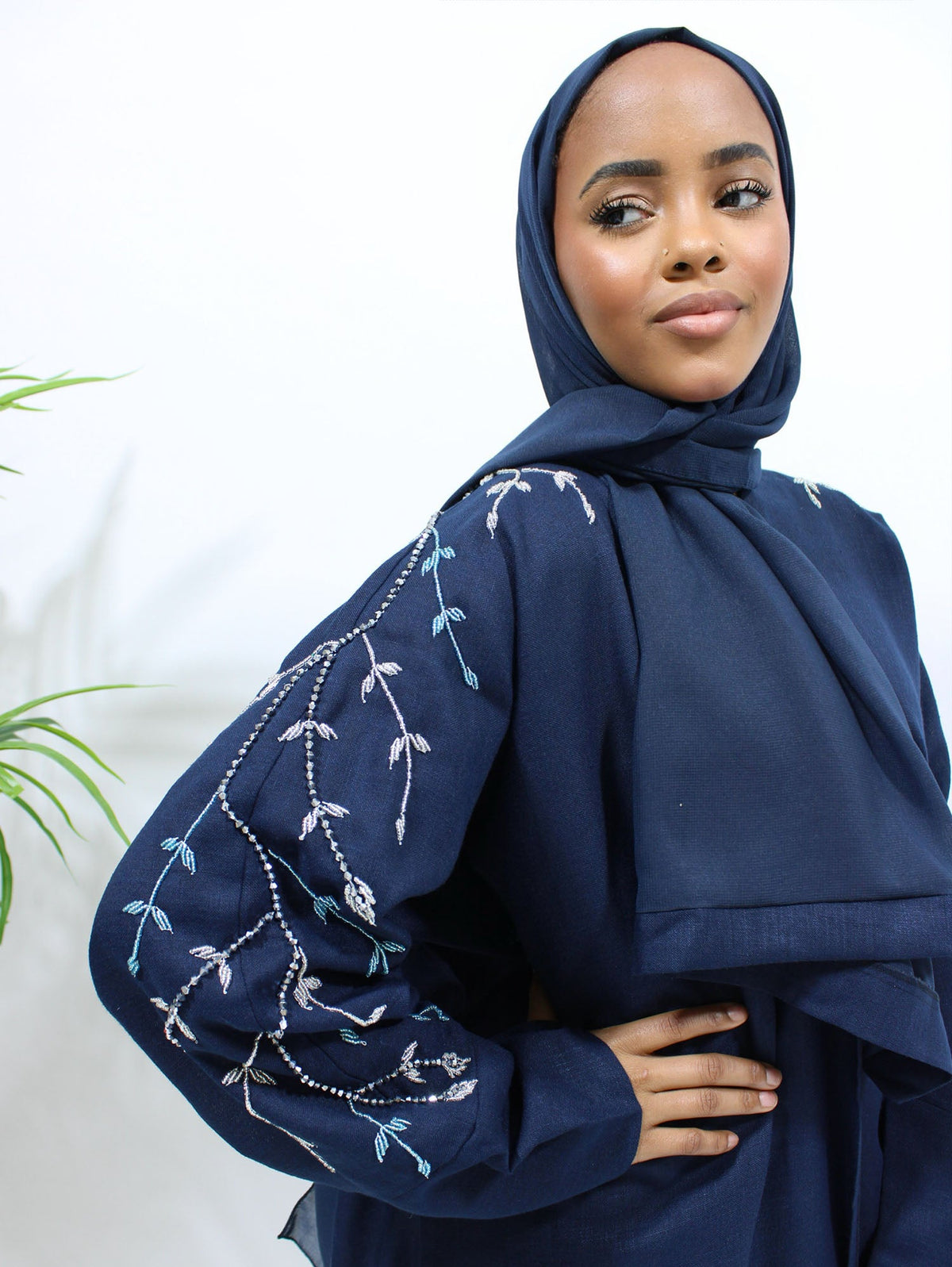
Choosing an abaya for warmer days
The lightest abaya on a product page is not always the easiest one to wear in summer. If its fabric needs several layers underneath, or its sleeves feel restrictive, the finished outfit may be less comfortable than a slightly more substantial garment with a simpler construction.
Look at the whole arrangement: outer fabric, lining, underlayers, scarf and fit. Each contributes to how the outfit feels. A useful summer abaya should give you the coverage you want without making you solve every part of the design by adding another garment.
Begin with your day, not a fabric slogan
A short walk to an indoor gathering, a long public-transport journey and several hours outdoors place different demands on clothing. Think about how much walking and standing are involved, whether you can remove an outer layer, and what you will need to carry.
Consider your own experience with clothes you already own. Which fabric feels comfortable after an hour rather than only during a brief try-on? Which neckline or sleeve arrangement becomes irritating? Those observations provide a better starting point than a promise that one material is perfect for everyone.
Keep weather and health guidance separate from fashion claims. An abaya cannot guarantee protection from overheating. In very hot conditions, clothing is only one part of looking after yourself; seek shade and follow appropriate local advice rather than relying on a garment described as “cooling”.
Compare cotton garments individually
Cotton is worth considering, but the fibre name does not tell you the weight, weave, thickness or lining of the finished abaya. A light cotton garment and a densely constructed one can feel quite different. Look for information about the actual cloth rather than treating all cotton as interchangeable.
Examine its coverage and how it hangs. A fabric that feels pleasant on your hand may become more revealing where it stretches across the shoulders or seat. Check whether the cut provides enough room and whether the lining adds more bulk than you expected.
Ask about care as well. Choose a routine you can manage during frequent summer wear. Do not assume that cotton automatically means a particular wash temperature, no shrinkage or immediate drying; the garment’s label and construction remain the guide.
Consider linen without expecting a crease-free finish
Linen can appeal when you like a more textured, relaxed surface. Decide whether that appearance suits the occasions you have in mind. If you want a very smooth, sharply finished look throughout the day, examine how the particular garment responds to sitting and movement before choosing it.
Do not confuse an open-looking weave with sufficient opacity. Hold the fabric against the planned underlayer and inspect the complete outfit in normal light. A loose weave may mean you need additional coverage, which changes the practical value of the garment for warm weather.
A linen blend is not automatically better or worse than pure linen. Read the composition, inspect the fabric and compare the feel. The proportions and construction matter more than an attractive blend name on its own.
Understand what rayon or viscose tells you
Rayon is a manufactured cellulosic fibre; viscose is one familiar type. That description identifies a fibre family, not a promise that every garment will feel cool, stay dry or behave like silk. The way the cloth is made and the way the abaya fits still need attention.
Try a fluid garment with your intended layers and check for cling during movement. Look at the care instructions before buying, especially when you expect frequent washing. A fabric you enjoy wearing may still require a more careful routine than another piece in your wardrobe.
For blends, read the actual fibre percentages rather than assuming a small amount of one fibre determines the entire garment. A cotton-viscose or linen-viscose label is a reason to investigate the cloth, not a complete assessment of its comfort.
Do not judge polyester by a single blanket rule
A polyester-containing fabric may be light or heavy, smooth or textured, densely constructed or more open. It would be misleading to describe every such abaya as identical, just as it would be misleading to guarantee comfort simply because a garment uses a natural fibre.
Compare the actual outer fabric and lining. Check how much material gathers around the body and whether the outfit requires additional layers. Claims such as quick-drying or moisture-managing should relate to the specific product, not be inferred from a fibre name.
When you cannot inspect a garment in person, clear composition, lining information, measurements and a realistic return process become particularly important. Avoid filling gaps in the description with assumptions based on a flattering photograph.
Check the lining before adding an underdress
Find out which parts are lined. A body lining may leave the sleeves sheer, while a partial lining may finish much higher than the outer hem. Look at the garment with your arms raised and while seated, not only with everything hanging straight.
Where an underdress is needed, choose it as part of the outfit rather than as an emergency addition. It should provide the necessary coverage without bunching at the waist, twisting beneath the abaya or creating a second awkward neckline.
For an open abaya, the inner outfit must work when the outer fronts separate. A sleeveless slip may be suitable beneath a fully covering outer sleeve for your intended use, but it is not a complete solution if you plan to remove that outer layer. Plan for the situations that will actually occur.
Choose ease without creating new problems
A cut with comfortable room through the body and arms is worth trying. Excessive fabric, however, can be inconvenient around a bag, a seat or a crowded journey. Look for useful ease rather than choosing the largest possible size.
Bell or kimono-style sleeves may feel spacious, but they also move differently from a narrower sleeve. Check their openings when you reach forward and raise your arms. A sleeve that exposes more than you intend may prompt another layer that you did not originally want.
Test the shoulder and upper-arm area carefully. A wide hem does not compensate for a tight armhole. The abaya style guide helps distinguish cuts so you can compare shape and movement rather than relying on a product’s summer label.
Think about colour without overpromising
Light colours can be an appealing part of a warm-weather wardrobe, and you may enjoy cream, pale blue or a softer pink. Choose them with the same attention to fabric and lining as a dark garment. A pale abaya that needs several extra layers may not give you the outfit you expected.
Dark clothing remains a personal style choice, but no colour removes the need to consider conditions and comfort. Do not interpret a dark, loose abaya as guaranteed sun protection or a white one as guaranteed relief from heat. Colour is only one feature of the finished clothing.
Subtle prints and small decorative details can bring interest without requiring heavy accessories. Look at where the detail sits: a little embroidery near the cuff creates a different practical demand from dense decoration across the whole body.
Keep the scarf arrangement manageable
A lightweight scarf is not necessarily comfortable if you wrap it repeatedly around the neck to make it stay in place. Try the arrangement you actually intend to wear. Check the fabric’s opacity, grip and size alongside its weight.
An undercap should fit comfortably rather than feeling tight in an attempt to prevent every movement. Avoid piling on accessories to correct a scarf that does not suit your routine. A different fabric, size or arrangement may be simpler.
The hijab fabric guide offers a way to compare those choices. Keep your own coverage preferences at the centre of the decision; an outfit suggestion should not assume you are willing to change them for a seasonal look.
Distinguish coverage from sun protection
A long garment covers an area of the body, but that alone does not establish a tested level of ultraviolet protection. Do not assume that lace, sheer panels or any fabric described as airy offers the same protection as suitable closely woven clothing.
The UK Health Security Agency’s hot-weather guidance recommends suitable loose clothing, shade, a wide-brimmed hat, sunglasses and sunscreen as part of sun protection. Treat these as practical health measures, not merely finishing accessories for a summer photograph.
Choose a hat and sunglasses that are suitable for the purpose and comfortable with your scarf. Check the arrangement rather than buying them only for their appearance. For personal medical concerns or heat-related symptoms, use appropriate healthcare advice rather than trying to solve the problem through a clothing purchase.
Try the scarf and bag together
Put the bag you intend to carry over the complete outfit, with its normal contents inside. A shoulder strap may press the scarf against the neck, while a crossbody strap can gather the abaya at one side. These small points of contact can matter more than an outfit's appearance when laid out on a bed.
Check that a long scarf end is not trapped beneath the strap each time you reach into the bag. Try a different strap position or a more manageable drape before adding extra fastenings. Keep an accessible place for your water bottle and essentials, so a simple summer outfit does not become awkward once you leave home.
Plan a summer outing as several settings, not one temperature
A summer day can include a journey, an outdoor gathering and a cooler indoor room. Dress for that sequence rather than trying to make one fabric label answer every situation. Note which parts of the day are fixed and where you can make practical adjustments, such as choosing a shaded meeting place or leaving an unnecessary outer layer behind.
Check whether the abaya’s lining is permanent. A removable layer can be packed separately when appropriate, but a sewn-in lining is part of the garment you will be wearing throughout. Do not plan around taking it out without understanding how the abaya is constructed and whether coverage would still meet your needs.
Think through the bag as well. Carrying several spare garments may make the outfit more cumbersome than a simpler arrangement. One useful additional layer for an indoor setting can be more manageable than a collection of pieces included for possibilities that are unlikely to arise.
Before a long outing, wear the planned combination during ordinary activity at home. This cannot reproduce every weather condition, but it can reveal an unnecessarily crowded neckline, a restrictive sleeve or an inner layer that needs constant adjustment.
Clothing is only one part of preparing for hot weather. Follow appropriate public-health advice and adapt plans to the conditions and your circumstances. No abaya choice should be treated as a reason to ignore discomfort or to remain in an unsuitable environment.
Try the complete outfit before committing to it
Wear the abaya with its intended layers, scarf, bag and shoes during a sensible indoor try-on. Sit down, walk and reach for something. Notice whether the fabric catches on the underlayer or the bag strap pulls the neckline.
Check the hem with the shoes you expect to use most. Amani’s numbered abaya lengths refer to shoulder-to-feet length in inches, not total standing height. A manageable hem matters on ordinary walking days, especially when you do not want to carry the fabric in one hand.
Finally, consider the care routine and how the garment fits into your existing wardrobe. One well-chosen abaya with reliable combinations is more useful than several seasonal purchases that each need a new set of layers. Summer dressing becomes easier when the outfit works as a whole, without asking one fibre or one colour to perform miracles.