Making a denim abaya part of your everyday wardrobe
A soft denim abaya can be an appealing everyday piece when you like the look of denim but do not want the stiffness of a heavy jacket. The question is whether the particular garment gives you the movement, coverage and weight you expect. “Soft” is a description to investigate, not a guarantee of comfort.
Some designs resemble a long shirt with a buttoned front. Others use a simpler closed shape, a loose outer-layer cut or a broad cape-like silhouette. These differences affect how the garment works far more than the idea that denim automatically makes an abaya casual, durable or easy to wear.
Start with the construction and your ordinary routine. Once those fit together, you can decide how much detail, colour contrast or accessorising you want.
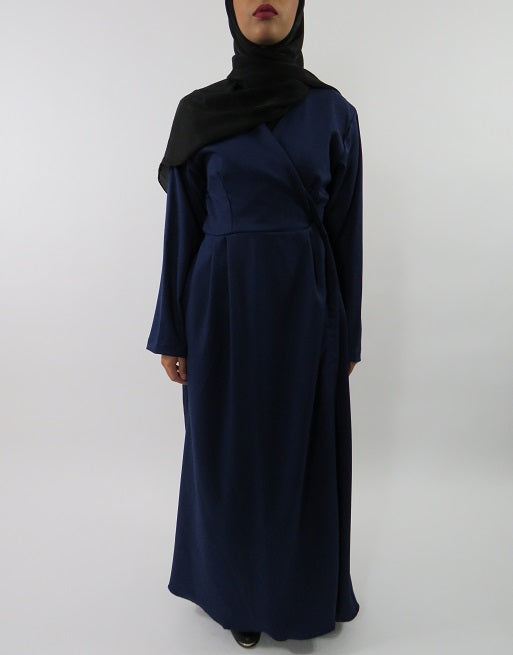
The photograph shows a blue wrap-around maxi jacket, not a denim abaya. Check the fibre description and construction of any denim garment you are considering.
Find out what the fabric description actually tells you
Ask for the fibre composition and look at the cloth in movement. A photograph may show a blue, denim-like surface without establishing its weight, softness or structure. Do not assume that every garment with a denim appearance will feel like the jeans or jacket you already own.
Look for a short video that shows the lower half moving as the wearer walks. Does the fabric fall in narrow folds, hold a broader outline or move as a more substantial panel? Those observations help you imagine the garment in use, although they cannot replace trying on the actual piece.
If the description mentions stretch, check how that feature is used in the finished garment. Stretch is not a reason to choose a close fit when you want a looser outline. The abaya should have the room you need without relying on the fabric being continuously extended across the body.
Inspect the material under ordinary lighting and gentle tension. Check the areas that become more stretched when you sit or raise your arms. A soft feel does not establish opacity, and a dark colour does not remove the need to check the actual garment.
Think about the full amount of fabric. A cloth that feels manageable in a short shirt may create a more substantial garment when used from shoulder to hem. Large pockets, multiple panels, heavy buttons and a belt can add to that overall feel.
Our abaya guide to fabric, sizing and styling offers a broader framework for comparing garments. Use it alongside the specific product information rather than treating the fabric name as the whole decision.
Choose the shape before the decorative details
A button-front shirt-style abaya
This shape gives you a visible line of fastenings and often a collar, cuffs or pockets. Check the front while standing and sitting. The buttons should not pull into gaps at the chest, waist or hips when the garment is worn as intended.
Look at where the fastening ends. Some designs leave an opening below the last button, which changes how the lower part behaves as you walk. Decide whether the outfit underneath provides the coverage you want through that opening.
A collar can give the garment a more structured appearance, but it also needs space beneath the hijab. Try the scarf with the collar in its intended position. If you repeatedly fold or flatten the collar to make the scarf sit comfortably, another neckline may be easier.
A closed, uncomplicated shape
A closed design can keep the front visually quieter. Check how you put it on, whether there is a zip or other opening, and whether the neckline is comfortable during dressing. A simple exterior does not mean the garment has no fit details to assess.
Pay attention to the shoulders and upper arms. A straight body can look roomy while the sleeve remains too narrow for reaching forward. Try the movements you use during your day, including putting on a coat or carrying a bag.
With fewer visible fastenings, the cloth and cut become more prominent. This can be useful when you want to vary the scarf or accessories without a strong button line, collar and pocket arrangement competing for attention.
An open outer-layer design
Try the base outfit first, without the abaya. It should provide the coverage you want when the front opens. Then add the denim layer and see how the pieces move together. A long outer garment does not make the outfit beneath irrelevant.
Check the inner seams, pocket bags and front edges. These can become visible when the garment opens. Look at whether the outer layer slides comfortably over the base or catches around the hips and sleeves.
Decide whether you will wear it open or use a fastening. A design photographed open may not have enough overlap to remain closed in the way you expect. Ask directly rather than assuming that a belt can solve every front-opening issue.
A broad or cape-like silhouette
A generous cut can create a distinctive outline, but more width is not automatically more freedom in every movement. Raise your arms and observe where the side fabric lifts. Check whether the hem or neckline shifts with it.
Try the garment with the bag and outer layer you would use. A wide sleeve or cape section may not fit easily inside an ordinary coat. This may be perfectly acceptable for the way you intend to wear it, but it should be a deliberate choice.
Assess length with the shoes you actually wear
Measure a well-fitting abaya and compare the finished measurements using the same method as the seller. At Amani’s, familiar abaya numbers such as 52, 54 and 56 refer to garment length in inches from the shoulder towards the feet, not the wearer’s total height. Other sellers may use different conventions, so check their own guide.
Stand naturally in the intended shoes. Look at the hem from the side and back as well as the front. Then walk, turn and sit. A substantial hem can behave differently from a very light one, particularly if the garment has a broad lower shape.
Do not choose extra length merely because it looks elegant in a still photograph. Consider steps, pavements, transport and the places you will sit. The garment should suit the amount of fabric you are comfortable managing.
If you alternate between noticeably different shoes, check whether the same length works with both. You may decide that one particular abaya belongs with a narrower range of footwear. That is more useful than repeatedly lifting the hem to make an unsuitable combination work.
For more detailed measurement questions, see our abaya length and fit guide. Keep finished garment measurements separate from body measurements, and do not add an unexplained allowance to either.
Look for comfort in movement, not only softness to the touch
Softness is one part of comfort. The garment also needs suitable room at the shoulders, upper arms, hips and knees. Reach forwards as though you are using a desk, then bend your elbows and lift your arms. Notice whether the whole garment moves with you or pulls from a particular point.
Sit for long enough to let the fabric settle. Check the front fastening, lap and lower side seams. A garment that looks loose while standing may gather across the thighs or pull at the buttons once seated.
Try the pockets with the small items you genuinely intend to carry. A phone may pull a soft pocket down or change the way the front hangs. You might prefer to use the bag for heavier objects and keep the pockets for lighter essentials.
Check the cuffs. Can you move your wrists comfortably? Do the sleeves stay clear of your hands when you need them to? If the cuffs fasten, make sure you can operate them without straining the seam or relying on another person for an ordinary task.
There is no need to select a silhouette according to a rigid body-type chart. Describe what you want from the garment: more room through the upper arm, a straighter front, a wider lower section or a simpler neckline. Those details are more useful than a promise that one design flatters everyone.
Build a casual outfit without adding unnecessary layers
For a closed denim abaya, begin with the underlayers needed for comfort and coverage, then add the hijab and shoes. Do not assume that an everyday outfit needs a second visible top, a cardigan and several accessories simply because denim is often styled casually.
A plain scarf can let the garment’s seams and pockets remain the main details. Try a soft neutral, a deeper blue or a colour you already wear regularly. The scarf does not need to match the denim exactly; a clear contrast can be easier than an uncertain near-match.
Choose shoes according to the route and hem. Trainers, flat shoes or another familiar style may work, but no category guarantees comfort. Try the actual pair with the abaya and check whether the lower edge catches or drags as you walk.
A practical bag can finish the outfit, provided the strap does not pull the shoulder or interfere with the scarf. Look at where the bag sits against pockets or a belt. Too many layers of hardware in one area can make an otherwise simple outfit feel crowded.
If you prefer an open denim abaya, keep the base visually coherent on its own. A long dress or a tunic-and-trouser combination can be a starting point. Check the base while seated and moving before using the outer layer to complete the look.
Make a more polished outfit by editing the details
For a smart casual setting, start with a design whose construction suits the occasion. A simple dark wash with restrained seams and pockets may create a different impression from a heavily distressed or highly detailed garment. This is an observation about the actual item, not a rule that all dark denim is formal.
Choose a scarf that sits neatly with the neckline. A collar, button placket and large scarf knot can create several competing shapes close together. You might prefer a quieter front drape or a collarless abaya if that is the arrangement you enjoy.
Accessories should support the outfit rather than try to transform it beyond recognition. A well-chosen bag, a simple piece of jewellery or a deliberate shoe choice may be enough. Heels and a clutch do not automatically make every denim garment suitable for a formal dress code.
Read the invitation or ask the host where the expectations are unclear. A denim abaya may be lovely for a family meal, a creative workplace or a relaxed celebration and still not be the right choice for a more formal event. You do not have to prove its versatility by wearing it everywhere.
For a work outfit, consider your particular role and environment. Test sitting, reaching, carrying equipment and removing outerwear. A garment that looks polished but makes ordinary tasks awkward is unlikely to become a useful regular choice.
Three outfit plans using one uncomplicated denim abaya
An everyday errand outfit
Imagine a closed, collarless blue denim abaya with enough room through the body. Pair it with a plain scarf in a colour already found in your wardrobe, comfortable shoes and a bag that sits clear of the side pockets. Keep the scarf ends contained enough for the journey.
Before leaving, check the pocket weight and the hem with the shoes on. If the phone drags one side down, move it to the bag rather than assuming the abaya fits unevenly. This small adjustment can change how the whole garment hangs.
A lunch outfit with a little more colour
Keep the same abaya and choose a scarf with one distinct colour or a modest-scale print. Repeat a small part of that colour in the bag or another accessory if you enjoy a connected palette. You do not need to match the shoes, scarf and bag exactly.
Let the abaya remain the uncomplicated base. If it already has prominent topstitching or buttons, choose accessories that do not compete with every detail. Try the scarf print at the scale it appears when folded, because a pattern that looks subtle laid flat may become concentrated near the face.
An indoor day with an additional outer layer for travel
Choose a coat that fits comfortably over the abaya sleeves and shoulders. Fasten it and reach forward. Check that the combined hems do not catch on each other or create an awkward step between the layers.
Remove the coat and confirm that the outfit beneath feels complete. If the denim abaya is open, the base should still provide the coverage you want. The outer layer is there for the journey, not to conceal a combination that only works while you remain wrapped up.
Use belts only when you want the effect
A belt can change the outline of a soft denim abaya, but it is optional. Try the garment without one first. You may prefer the uninterrupted fall of the fabric or find that the built-in shape already gives you the proportions you like.
If you add a belt, check where it sits while seated. A fixed waist loop may not align with your preferred position, and a belt pulled tightly can make the front fastening gape. Do not use it to force a garment into a fit that creates tension elsewhere.
Look at what happens above and below the belt. The fabric may gather at the back or pull the hem upward. A loosely placed belt can create a different result from a firmly fastened one. Choose according to comfort and the outline you want rather than a rule that every loose garment needs a defined waist.
For an open design, confirm that the belt does not become the only thing preventing an unwanted gap. The base outfit should still be suitable when the front shifts. A belt is a styling tool, not a substitute for adequate overlap or appropriate clothing underneath.
Adapt to the season by reassessing the whole outfit
In milder conditions, you may prefer a less substantial denim garment and fewer supporting layers. Check the actual weight and how the abaya feels during ordinary movement. Do not assume that every soft denim fabric is light or that softness guarantees breathability.
In colder conditions, assess the room available for a base layer and coat. A closely cut sleeve can become uncomfortable when you add a long-sleeved top beneath it. A heavier abaya may also require a roomier outer layer than the one you use with a light dress.
For wet weather, choose outerwear and footwear suited to the conditions rather than relying on the denim abaya as weather protection. Consider whether the hem is likely to contact damp ground and whether you can manage the garment comfortably during the journey.
The same piece may work across several seasons, but it does not have to work all year to be worthwhile. A garment used regularly during the conditions it suits can be more useful than one forced into every outfit through elaborate layering.
Keep a note of successful combinations. Record the base, scarf, shoes and coat that work together, along with any fit issue you noticed. This makes seasonal dressing more practical than trying to recreate an idealised outfit from memory.
Inspect decorative details and construction
Embroidery, contrast stitching, panels and unusual pockets can make a denim abaya distinctive. Check whether those details are positioned where you want them once the garment is worn. A motif near the hip may be hidden by a bag; a decorated cuff may be covered by the coat sleeve.
Look at seams and stress points rather than judging quality by price alone. Inspect the buttonholes, pocket corners, cuffs and areas where a belt or tie is attached. Ask for clearer photographs where a listing does not show them.
Check whether decorative openings or distressed areas affect the coverage you expect. Do not assume that every feature visible in a photograph is backed or lined. If the design includes lace or another contrasting fabric, inspect that section as part of the garment rather than treating it as a separate decorative detail.
Inside the abaya, look at the seam finishes and any lining. These affect the experience of putting it on and wearing it over other clothes. A neat exterior should not distract you from a rough or bulky area inside.
For a customised design, agree on the exact changes before production. A request for embroidery, different buttons or a new pocket position can alter more than the appearance. Ask how the change affects weight, care and the way the garment hangs. Do not assume that a retailer offers custom work unless the service is explicitly available.
Plan alterations before changing the garment
A promising abaya may need a shorter hem or a small sleeve adjustment, but establish what the change involves before assuming it will be straightforward. Look at the construction around the area to be altered. A plain lower edge is a different job from a hem with a border, a shaped opening or a distinctive line of stitching.
For length, try the abaya with the shoes and underlayers you intend to use. Ask the person doing the alteration to assess the garment while it is worn naturally. Do not pull the shoulders upwards or tighten a belt to create a temporary length that disappears once you move. Check the proposed position from the front, sides and back.
On a button-front design, consider the distance between the last fastening and the new hem. Shortening the lower section can change the proportion of the opening. It may also bring a side slit closer to the edge or make the pocket position look different in relation to the overall length. These changes are not necessarily problems, but they should be seen before the fabric is cut.
Sleeve alterations need similar attention. A cuff may contain a fastening, contrast stitching or decoration that you want retained. Ask whether the proposed method preserves that detail and whether it changes the width of the opening. Simply removing length from the most obvious point may not produce the finish you expect.
Keep the fit problem separate from the styling preference. “The sleeve covers my hand when I reach forward” gives the person altering it something to assess. “Make it more elegant” does not describe a measurable change. Explain where the garment catches or feels awkward, then agree on the proposed solution rather than asking for several changes at once without a clear purpose.
Before any alteration, check the seller’s stated process for returns or faults and decide whether you are keeping the item. Retain the original measurements and photographs for your own record. Do not alter a garment to correct a suspected manufacturing issue before discussing that issue with the seller through their stated process.
After the work, repeat the same movement checks used in the first fitting. Walk, sit, bend your elbows and put on the outer layer. Examine the new hem or cuff for an even, comfortable finish. A successful alteration should solve the identified problem without introducing another one, such as a narrower wrist opening or a front that no longer hangs evenly.
Sometimes the most sensible decision is not to alter. If the shoulders, armholes, front fastening and length all need major changes, another cut may be a better starting point. A useful wardrobe piece does not have to be rescued from an unsuitable design simply because you like its colour or fabric.
Care and colour deserve their own check
Follow the instructions for the finished garment. A denim label does not establish a single wash temperature, detergent choice or drying method. The fibre blend, colour treatment and any decoration may affect the care requirements.
Read any warning about colour transfer and handle the garment accordingly, especially when pairing it with pale scarves, bags or upholstery. Do not infer that a soft or pre-washed appearance means there is no transfer risk. Use the information supplied for the actual item.
Before cleaning, check pockets and fastenings and remove detachable accessories where appropriate. Avoid leaving a belt or brooch attached simply because it was part of the last outfit. Follow any instructions about washing the garment separately or with similar items.
Dry and reshape as directed. Do not use high heat to try to speed up the process or deliberately shrink an uncertain fit. An alteration or a different size is a more controlled way to address a fit problem than experimenting with care conditions.
After wear, inspect buttons, seams and hems. A small repair may help keep a useful garment in rotation, but the appropriate repair depends on the construction. Our modest-wear care guide can help you organise those checks without promising that every fabric will last for a particular number of years.
Do not confuse denim with an environmental guarantee
A denim abaya is not automatically a sustainable purchase because the fabric has a reputation for durability. Consider what is actually known about the garment, how it is made, how you will care for it and whether it fills a useful role in your wardrobe.
Ask for specific information behind environmental or production claims. A broad phrase such as eco-friendly tells you less than a clear explanation of the material or process being described. Do not assume that a natural-looking colour, a soft finish or a high price supplies that evidence.
From a wardrobe-planning perspective, focus on use. Can you name several occasions on which you would reach for this abaya? Does it work with shoes and scarves you already own? Is the care routine realistic for you? These questions help you avoid a purchase that remains unworn, without requiring a claim about a precise environmental saving.
Repairability can be part of the decision. A replaceable button or accessible hem may be useful, while a complex decorative feature may need specialist attention. Choose according to your priorities and the information available, rather than treating one fabric category as morally superior to every alternative.
Questions to settle before you order
Will soft denim feel like a flowing crepe abaya?
Not necessarily. Compare the actual drape, weight and construction. A denim garment may hold a different outline, and that difference can be part of its appeal. Ask for a movement video or try the piece rather than expecting it to behave like another fabric you know.
Is it suitable for a fuller or smaller frame?
Assess the finished measurements and the places where you need room. The label cannot answer the fit question for a whole group of people. Check the shoulders, upper arms, hips, fastening and length in relation to your own preferences and movement.
Can I wear a denim abaya as a coat?
An open design may function as an outer styling layer, but that does not establish weather protection or insulation. Check the garment’s intended use and the conditions. Keep the base outfit complete, and use appropriate outerwear where the journey requires it.
How do I know whether a design is too detailed for me?
Try it with the scarf, bag and shoes you already use. If you feel the need to replace every supporting piece to make the outfit comfortable visually or practically, a simpler design may be more useful. You do not need to dislike a garment to decide that it does not belong in your wardrobe.
Should I size up for a relaxed look?
Compare measurements first. A larger size may add room where you need it, but it can also change the shoulder, sleeve and neckline positions. A cut designed with the right amount of ease may be better than choosing a larger version of a shape that does not suit your needs.
A soft denim abaya works best when its everyday usefulness is visible in the details: a comfortable shoulder, a dependable fastening, a manageable hem and a scarf arrangement that sits naturally with the neckline. Choose those features first. The styling can then be as simple or expressive as you like, without asking the garment to live up to unsupported promises about fashion, comfort or versatility.