How Do You Choose an Islamic Prayer Dress So Head Coverage, Sleeves, Hem Length and Fabric Stay Secure Through Ruku and Sujood?
Choosing a prayer dress should make salah easier, not turn it into another complicated clothing decision. For many Muslim women, a dedicated prayer dress is simply a practical home garment: something kept clean and ready so that, when the prayer time comes in, you can cover quickly over ordinary home clothes and focus on worship rather than searching for separate pieces.
This guide is about that dedicated home-prayer use. It is not an occasion dress, an outdoor abaya or a fashion outfit for events. If you want the wider context around prayer clothing, coverage and practical preparation, our complete prayer wear guide for muslim women gives the broader picture. Here, the question is narrower: how do you choose a prayer dress that gives reliable coverage, feels comfortable through the movements of salah and is easy enough to reach for every day?
A garment sold as a “prayer dress” is not valuable merely because of its label. What matters is whether the clothing you pray in fulfils the requirements you follow and lets you stand, bow and prostrate without avoidable distraction. A purpose-made dress can be helpful because it gathers those practical needs into one or two pieces. The best choice is therefore not necessarily the prettiest or most elaborate design. It is the one that quietly does its job.
Start with the purpose: reliable coverage for salah at home
Before looking at fabric names, colours or decorative details, decide what you need the garment to solve. Perhaps you usually wear a short-sleeved top and trousers at home and want one loose layer that can go straight over them. Perhaps you already dress modestly indoors but need a head covering that stays secure during prayer. Perhaps you want a set kept beside your prayer mat so you do not have to assemble an outfit when you are tired, busy or waking for Fajr.
That practical purpose should shape the purchase. A woman who wants a thirty-second throw-on layer may prefer a one-piece design with an attached head covering. Someone who is tall, pregnant or between sizes may find a two-piece set easier because the skirt and khimar can be adjusted separately. A woman who often prays in a warm upstairs room may care more about breathability than someone whose home is cool for much of the year.
Think of the prayer dress as a tool for consistency. It should remove small obstacles. If it constantly slips, feels transparent, catches under your knees, overheats you or needs careful arranging before every rak'ah, the design may be creating more work than it saves.
Know that “prayer dress” can describe more than one construction
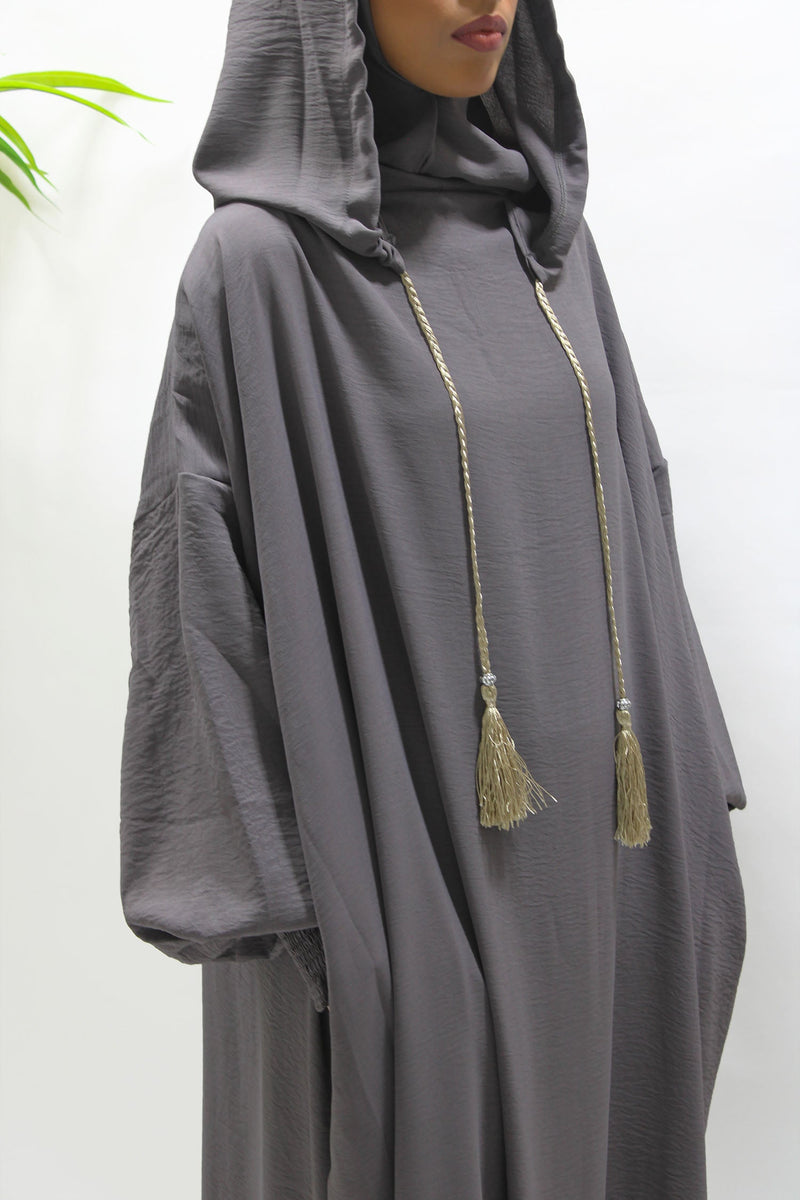
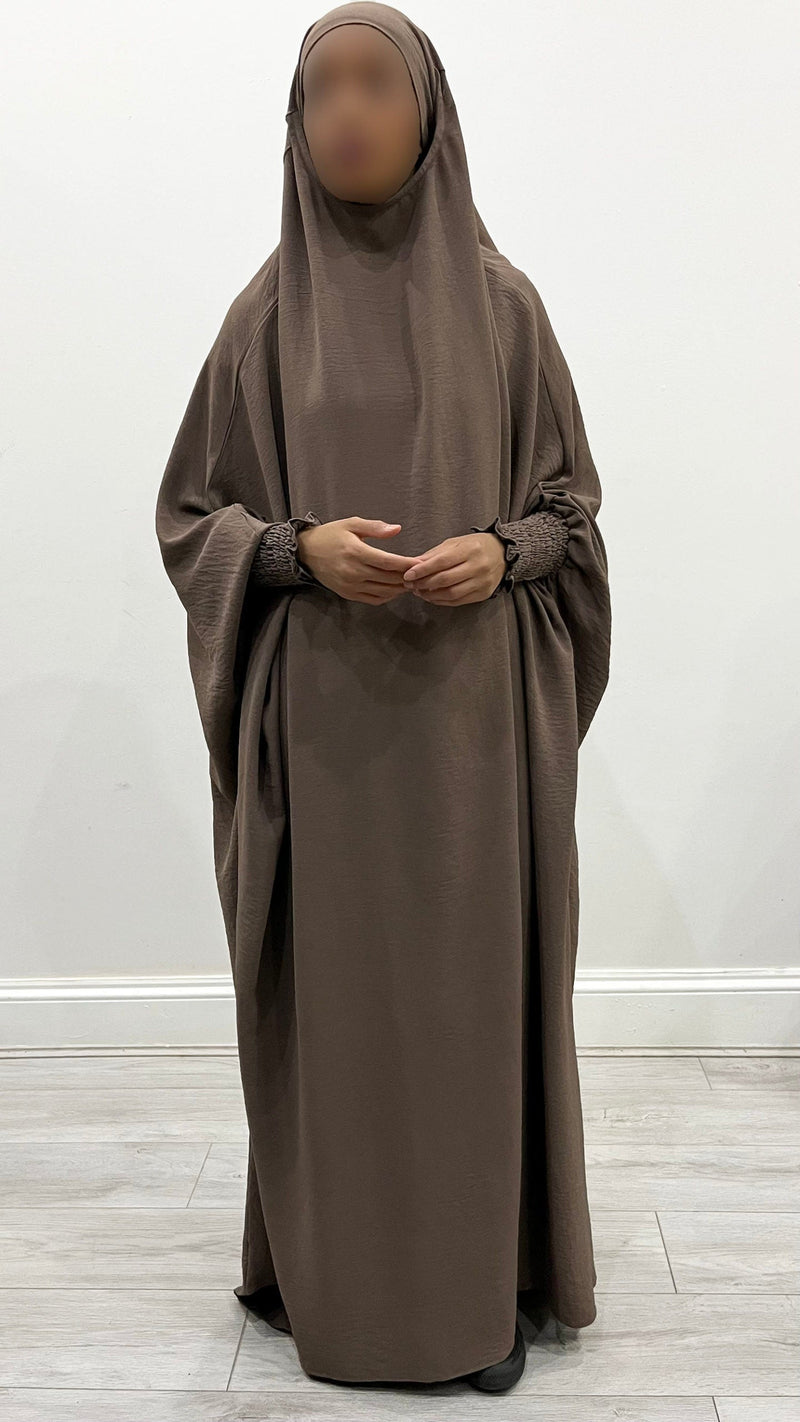
Islamic prayer dresses are sold in several forms, and the category name does not tell you exactly what you are getting. Some are long one-piece garments with an integrated head covering. Some resemble a loose dress supplied with a separate khimar. Others are two-piece sets with a long skirt and a generous top or head covering. You may also see elasticated face openings, tie-back head pieces, chin coverage, wrist elastication, zip details or simple pull-over shapes.
None of those details automatically makes one set better than another. Construction matters because it affects how securely the garment stays in place on your particular body. A face opening that is comfortable on one woman can feel too tight or too loose on another. An elasticated skirt that sits perfectly on one waist may ride up on another. A very wide sleeve can feel beautifully free while standing but slide far back on the arm when the hands are raised.
So read beyond the product name. Look for photographs of the full garment, close-ups of the head opening and cuffs, and clear information about what is included. If the listing shows a two-piece set, make sure both pieces are actually part of the purchase rather than styling accessories.
One-piece or two-piece: choose the system you will actually use
A one-piece prayer dress has a simple advantage: speed. There is less to remember and fewer separate components to misplace. If the head covering is attached, you can often put the whole garment on in one movement, adjust the face opening and begin. This can be especially convenient for Fajr, for short gaps between tasks or for women who want one item permanently kept in a prayer corner.
The trade-off is that one-piece sizing has to work in several places at once. The total length, sleeve length, head opening and body width are all linked. If you are very petite or tall, a generic “one size” design may be harder to fit neatly. An attached head covering can also pull against the shoulders if the proportions are wrong.
A two-piece set offers more flexibility. A long skirt can sit higher or lower at the waist, and a separate khimar can be positioned independently. If you are nursing, pregnant or experiencing body-size changes, separating the pieces can make adjustment easier. On the other hand, you need to make sure the overlap between pieces remains secure throughout movement and that the waistband does not shift.
Choose the construction that makes your actual routine easier. A theoretically perfect set that stays folded because it is awkward to put on is less useful than a simpler garment you reach for five times a day.
Check the head covering before you judge anything else
For an adult Muslim woman, the head covering is an important part of prayer clothing. A prayer dress can look wonderfully loose through the body yet still be frustrating if the head section moves every time you bow. Pay close attention to how the head covering is formed and secured.
An elasticated face opening can be quick and convenient, but the elastic should be gentle enough not to press uncomfortably around the face. If it is too loose, hair or the sides of the neck may become exposed as you move. Tie-back designs can give more control, though they take a few extra seconds and may need retying after washing. A separate khimar can be very secure if it has enough depth and the face opening suits you.
If you wear glasses, consider whether the face opening can pass comfortably over the frames or whether you would need to remove them each time. If you keep your hair in a bun, think about whether the head section has enough room at the back without pulling the fabric forward. These details sound small until they become part of every prayer.
Look at the neckline, chin area and sides of the face
Online photographs often focus on the front view, but the neckline and chin area deserve a closer look. A wide opening can shift when you lower your head. A narrow opening may feel secure yet become uncomfortable during a longer prayer. Some designs include extra fabric beneath the chin; others rely on the shape of the khimar or attached hood.
Try to imagine the garment in motion rather than as a still photograph. When you go into ruku, does the head covering stay around the sides of the face? When you rise again, does the neckline return naturally or need pulling back into place? When you make sujud, is there enough fabric over the shoulders and chest that the head section does not tug backwards?
If the seller provides measurements for the face opening, compare them with a prayer khimar you already find comfortable. If no measurement is given, customer photographs or a direct question to the seller can be more useful than guessing.
Make sure the shoulders and arms have real movement room
Prayer involves repeated raising, folding and placing of the arms. A dress that feels loose while your arms hang at your sides can become restrictive when you lift them. Look for enough width across the shoulders and upper arms so the fabric does not pull tightly when you raise your hands or place them for sujud.
Raglan or dropped-shoulder shapes can feel forgiving because they reduce dependence on an exact shoulder seam. Traditional set-in sleeves can also work well when the garment has sufficient ease. What matters is not the construction label but the movement it allows.
If you already own an abaya or loose house dress that feels comfortable through salah, measure its upper-arm width and compare it with the prayer dress. This is especially useful if you have fuller upper arms or wear a long-sleeved layer underneath in winter.
Pay attention to cuffs because sleeves move during prayer
Very wide open sleeves can be airy, but they may slide back along the forearm when your hands are raised. Elasticated cuffs can help keep the sleeve in place, provided the elastic is not tight. A soft gathered cuff or gentle wrist band can offer a useful middle ground.
Check whether the seller shows the wrist opening clearly. If you dislike elastic, look for a sleeve that is naturally long enough and narrow enough at the wrist to remain stable. If you perform wudu shortly before putting the garment on, a cuff that is easy to pull up and then settle back down can also be practical.
The aim is not to create another point of anxiety. You simply want sleeves that stay where you expect them to stay so you are not repeatedly thinking about them while praying.
Judge the total length through standing, sitting and sujud
Length is one of the most important buying checks because a prayer dress moves differently from an ordinary maxi dress. A hem that sits perfectly at the ankle while you stand can ride higher when you kneel. A garment that is extremely long may give generous coverage but catch under your feet as you rise.
Use your own height as a starting point, but do not rely on height alone. Ask for the shoulder-to-hem length or the length from the top of the head covering where relevant. Compare it with a prayer garment you already own, or measure from shoulder to floor while wearing the sort of home clothing you normally have underneath.
Then think about movement. You need enough length for the dress to fall comfortably around you in sujud, but not so much that you are standing on the hem. If you are between lengths, a two-piece design can sometimes be easier because the skirt position gives a small amount of adjustment.
Decide how you will handle the feet before buying the hem length
There is a recognised scholarly difference over whether a woman’s feet must be covered in prayer. Some jurists require covering them, while recognised Hanafi positions and other scholarly opinions permit the feet to remain uncovered. Because this is a real fiqh difference, it is better to follow the school or trusted scholar you rely on rather than turning a shopping guide into a universal ruling.
That decision affects what you buy. If you follow the view that the feet should be covered, you may want a sufficiently long skirt or dress, or you may prefer to wear socks. If you follow a view that permits the feet to remain uncovered, you still need a hem that is practical and does not ride up excessively.
Make the religious decision first and the garment decision second. That is much easier than buying a borderline length and then trying to make it fit a practice you had not considered.
Opacity is more important than the colour name
A prayer dress can be loose and long yet still be unsuitable for your needs if the material becomes transparent under light. Product photography may be taken against a dark background or with careful lighting, so do not assume opacity from a studio image alone.
Pale shades deserve particular attention, but dark colours are not automatically opaque either. Weave, thickness and fibre all matter. If the listing says “lightweight”, ask whether the garment is see-through in daylight and whether it is lined. Remember that lining can add warmth, so the ideal solution may be a naturally opaque fabric rather than a very thin outer layer with a full second layer beneath it.
If you usually wear substantial home clothes under the prayer dress, a slightly lighter fabric may still work for you. If you want to throw it over short sleeves or light nightwear, you may prefer more dependable opacity. Your normal home routine should guide the choice.
Choose fabric for the temperature of your real home
Prayer dresses are often worn indoors several times every day, so climate matters more than trend. A fabric that feels luxurious for five minutes can become uncomfortable when the room is warm or the prayer is longer. Conversely, an ultra-light fabric may feel chilly in winter if you are praying soon after getting out of bed.
Breathable cotton blends and soft woven fabrics can suit warm homes, while slightly denser crepe-like fabrics can drape well without feeling flimsy. Jersey offers stretch and softness but can cling more closely depending on weight and cut. Polyester-based fabrics vary widely: some are light and fluid, others trap heat. Fibre name alone is not enough, so look at weight, drape and customer feedback too.
If you live somewhere with strong seasonal changes, you may eventually prefer two prayer garments: a lighter summer option and a slightly warmer winter one. There is no need to buy both at once. Start with the season you are actually in and learn what you enjoy wearing.
Think about what you normally wear underneath
A dedicated prayer dress is often chosen precisely because home clothing varies. On one day you may be in a long-sleeved dress; on another, pyjamas; on another, leggings and a T-shirt. The outer prayer garment should work over the realistic range of what you wear at home.
If you often wear bulky knitwear in winter, leave room through the sleeves and shoulders. If you use the prayer dress over lightweight sleepwear, prioritise opacity. If you usually wear a long-sleeved base layer already, you may care less about cuff design than someone who relies on the prayer dress itself to cover the arms.
Try not to shop for an imaginary routine. The garment should support the life you already have. That is what makes it genuinely useful rather than something that looks organised in a drawer but is rarely worn.
Look for looseness that remains loose during movement
A generous cut is useful, but “oversized” or “free size” in a description does not guarantee how the garment behaves. Fabric can pull across the bust, hips or knees as you bend even when the standing silhouette looks wide. Stretchy material can also follow the body more closely than a structured woven fabric.
Useful measurements include total width, chest width, hip width and sweep at the hem. For a skirt, check the waistband range and hip room. When measurements are missing, ask. A very wide body with narrow sleeves may still feel restrictive, while a beautifully wide skirt can be awkward if the top section is too short.
The practical test is simple: can you move from standing to ruku to sujud and back without the fabric pulling tightly or needing to be rearranged? That is the movement pattern the garment is for.
Quick put-on matters more than complicated styling
A home prayer dress should be easy to wear without pins, precise scarf shaping or multiple accessories. If a design needs several fastenings every time, ask whether that complexity brings you any real benefit.
Simple pull-on head coverings, attached khimars and elasticated waists can make the routine faster. At the same time, speed should not mean insecurity. An opening that is too loose may need constant adjustment; an over-tight elastic may save seconds but cause discomfort. The best design is the one you can put on quickly and then forget about.
Try to choose a system that works when you are tired. Fajr is a useful mental test: would you be happy to put this garment on in a dim room, half awake, without needing a mirror? If the answer is yes, the construction is probably suited to its purpose.
Pregnancy, nursing and postpartum changes need extra ease
If you are pregnant or recently postpartum, body measurements can change quickly. A prayer dress with generous body width, uncomplicated sleeves and a forgiving head section can be more comfortable than a fitted design. A two-piece set may allow the skirt to sit where it feels best as your waist changes.
For nursing mothers, remember that a dedicated prayer dress is worn for prayer, not as a nursing garment during salah. But easy on-and-off construction can still matter because you may be moving between feeding, caring for a baby and preparing to pray. Complicated buttons or decorative ties can become unnecessary friction.
Do not feel pressured to buy an entirely new wardrobe for a temporary stage. If an existing loose prayer set still covers comfortably, use it. If you do need a replacement, choose adaptability over a very exact fit.
Glasses, hearing devices and sensory comfort deserve consideration
Some women discover only after buying that a tight face opening catches on glasses or presses behind the ears. If you wear spectacles, hearing aids or another device around the head, check that the khimar or attached hood can be put on and removed without pulling uncomfortably.
Sensory comfort matters too. Scratchy labels near the neck, stiff elastic around the face and noisy synthetic fabric can be surprisingly distracting when repeated every day. If you are sensitive to texture, look for soft seams, covered elastic and a fabric you already know you tolerate well.
Comfort is not about luxury. It is about reducing avoidable distraction so the garment disappears from your attention once you begin praying.
Use a full movement test as soon as the garment arrives
Do not decide that a prayer dress fits after looking in the mirror for thirty seconds. While the garment is still returnable, perform the movements of salah in a clean space. Raise your hands, fold them, bow, stand again, kneel and make sujud. Notice what happens to the sleeves, neckline, face opening, hem and waistband.
Check the back as well as the front. Does the head covering pull backwards? Does the dress become tight across the hips? Does the skirt slide down or ride up? Are you stepping on the hem when you rise? Does fabric bunch under the knees in a way that feels uncomfortable?
This test tells you far more than the product photograph. If you need to keep adjusting the garment during a two-minute movement check, you are likely to notice the same issue every day.
Colour and pattern can be simple because the garment has a private job
For a home prayer dress, colour is mostly a matter of personal comfort and practical care. Some women love a calm neutral because it feels visually quiet. Others prefer a gentle print because marks are less obvious between washes. There is no need to turn the garment into an occasion piece.
Very pale colours can make opacity harder to judge, while very dark colours may show lint more readily. Busy embellishment can add weight, catch on things or make washing more complicated. None of those points makes a particular colour or design wrong; they simply affect day-to-day usefulness.
Choose something you feel comfortable keeping in regular rotation. If a beautiful design makes you reluctant to wash it often or worried about damaging embellishment, it may not be the best everyday prayer garment.
Washability is part of quality
A prayer dress that is used frequently needs straightforward care. Check the washing instructions before buying, especially if the garment includes elastic, lace, delicate trim or a contrasting print. Hand-wash-only care can be manageable for some people but burdensome for others.
Look for fabric that can survive repeated washing without becoming transparent, misshapen or rough. Elastic should recover rather than quickly stretching out. Seams around the face opening, cuffs and waistband deserve particular attention because those areas take repeated strain.
If you plan to keep one set in constant use, easy machine washing and reasonably quick drying can be more valuable than decorative detail. Practical care is part of what makes a prayer dress sustainable in your routine.
When buying online, measurements matter more than “one size”
Many prayer garments are sold as “one size”, “free size” or “one size fits most”. That can work because the designs are intentionally loose, but it does not mean every body or height will get the same result. Always look for actual measurements.
For a one-piece garment, useful figures include total length, chest or overall width, sleeve length and face-opening size. For a two-piece set, check khimar length, skirt length and waistband range. If the seller gives only model height, that is helpful context but not a substitute for measurements.
Compare the numbers with a loose garment you already own. If you are petite, ask whether the hem will trail. If you are tall, check whether the skirt or dress remains long enough through kneeling. If you have broad shoulders or fuller arms, make sure the generosity promised by “free size” extends to those areas too.
Check construction quality where the garment takes stress
You do not need couture finishing for a home prayer dress, but basic construction should be sound. Look at stitching around the face opening, shoulders, underarms, cuffs, waistband and hem. Those areas are handled or stretched repeatedly.
Loose threads are not always a major problem, but skipped stitches, puckered seams or very thin elastic can signal limited durability. If the garment uses a tie-back headpiece, check that the ties are securely attached. For two-piece skirts, the waistband should stretch smoothly without twisting inside its casing.
Good quality here means the garment keeps doing the same simple job after many wears and washes. That reliability is more important than whether it arrived in elaborate packaging.
Do not buy it just because it photographs beautifully
Prayer-wear photography can be lovely, but the image is not your final test. Long flowing fabric can look graceful when arranged for a photograph while being cumbersome in a small prayer space. A dramatic sleeve can look elegant while sliding back during takbir. A very long khimar can give generous coverage but feel heavy in a warm room.
Use photography to understand shape, then use specifications to judge function. Ask: How long is it? How wide are the sleeves? Is it lined? What is the fabric? How is the head opening secured? What comes in the set? Those answers tell you whether the design suits your prayer routine.
The right prayer dress often looks less exciting on a hanger than a highly styled garment. Its success is felt when you put it on, pray and realise you hardly thought about the clothing at all.
Consider whether you need a second prayer dress
One reliable prayer dress is enough for many women. A second can become useful if the first is frequently in the wash, if you divide time between two homes or if you want a lighter and heavier option for different seasons.
Do not buy duplicates simply because a set is offered in several colours. Live with the first garment for a while. Notice whether you like the face opening, length, fabric and cuff design. If it becomes a favourite, buying the same construction again may be more sensible than experimenting with another style.
You can also keep an older but serviceable set as the backup. The goal is ease, not accumulation.
Keep cleanliness practical without turning it into anxiety
A dedicated prayer garment is often easier to keep track of because it has one purpose and one storage place. Keep it somewhere clean, allow it to air if needed and wash it according to normal use. If something actually soils the garment, deal with it in the ordinary way.
Try not to let clothing checks become a source of constant doubt. The purpose of choosing well is to give you confidence in a garment that works, not to encourage repeated inspection of every fold. Once you know the set is clean, opaque, secure and suitable for your practice, let it serve you.
If you have a specific fiqh question about purity, awrah or what invalidates prayer, ask a trusted scholar rather than relying on a retailer description. Shopping guidance can help with construction and comfort, but it should not pretend to replace religious learning.
Choose in the right order: requirements first, convenience second, style third
A simple decision order can stop online shopping becoming confusing. First, make sure the garment gives the coverage you need according to the religious guidance you follow. Second, make sure it works physically: opaque fabric, secure head covering, enough length, loose movement room and comfortable sleeves. Third, think about convenience: washability, speed, storage and whether one-piece or two-piece suits you. Only then choose between colours, prints and small style details.
This order protects you from being persuaded by a lovely photograph and then trying to make the garment practical afterwards. It also means a plain set can become the better purchase when its measurements and construction are clearer.
When two options both meet the essentials, choose the one that fits your life. If you hate ironing, easy-care fabric matters. If your home is hot, breathability matters. If you are tall, verified length matters. If you wear glasses, the head opening matters. Your everyday reality is part of a good buying decision.
A practical checklist before you buy
- Confirm that the garment is intended as a dedicated home prayer layer and that its construction suits how you prepare for salah.
- Check whether it is one piece or two pieces and exactly what is included.
- Look at how the head covering is secured and whether the face opening is likely to suit you.
- Check neck, chin and side-of-face coverage in movement, not only in a front photograph.
- Confirm sleeve length, upper-arm room and cuff design.
- Compare the total garment length with your height and a prayer garment you already own.
- Decide how you follow the scholarly issue of foot coverage, then choose hem length or socks accordingly.
- Check fabric opacity, especially in pale colours and strong light.
- Choose a fabric weight that suits your home's temperature and what you normally wear underneath.
- Look for enough width to remain loose during ruku and sujud.
- Prefer a design that can be put on quickly without complicated styling.
- Check washing instructions and the durability of elastic, seams and trims.
- If the item is “one size”, ask for real measurements rather than relying on the label.
- Test the full movements of salah while the garment is still returnable.
If a product page answers those points clearly, you can judge the garment with much more confidence. If several essentials are missing, ask the seller before paying. A short sizing or fabric question is easier than trying to solve an unsuitable garment after it arrives.
What should the right Islamic prayer dress feel like?
The right prayer dress should feel almost uneventful. You put it on, it covers securely, you can move freely, and you stop thinking about it. The headpiece does not slide, the sleeves do not creep back, the hem does not trap your feet and the fabric does not make you anxious about transparency. It is comfortable enough for everyday repetition and simple enough that you do not delay getting ready.
That is why choosing well is less about finding one universal “best” prayer dress and more about matching a dependable construction to your body, home and practice. One woman may love a single pull-on garment; another may always prefer a skirt and khimar. One may want lightweight cotton for a warm flat; another may favour a denser fabric for a cool house. Both can be sensible choices when the essentials are covered.
Use religious guidance for the requirements, measurements for the fit and your daily routine for the practical details. Once those three agree, colour and style can remain what they should be here: a pleasant extra, not the thing carrying the decision.
Frequently asked questions about choosing an Islamic prayer dress
Do I need a special prayer dress to pray at home?
No special retail garment is required simply because it is sold as a prayer dress. What matters is that your clothing meets the requirements of salah according to the fiqh you follow. A dedicated prayer dress is useful because it gives you quick, reliable coverage over ordinary home clothes and can reduce the need to assemble several separate items before each prayer.
Is a one-piece or two-piece prayer dress better?
Neither is automatically better. A one-piece design is usually faster to put on and removes the risk of a gap between top and skirt. A two-piece set can be easier to adjust for height, body shape and changing size. Whichever you choose, test that the head covering, waist and hem remain secure through standing, ruku and sujud.
What fabric is best for a prayer dress?
Choose an opaque, comfortable fabric that suits the temperature of your home and can be washed regularly. Lightweight cotton blends and soft woven fabrics can work well in warmer rooms, while a slightly denser fabric may feel better in winter. Avoid assuming that “lightweight” means transparent or that a heavier fabric is automatically higher quality; weave, drape and opacity matter more.
How loose should a prayer dress be?
It should give you enough ease through the shoulders, bust, hips, knees and sleeves to move naturally without stretching tightly over the body. Test it through the movements of salah rather than judging it only while standing. If the fabric pulls in ruku, restricts your arms or clings strongly in sujud, a wider cut or different fabric will usually be more comfortable.
Does a woman have to cover her feet in prayer?
There is a recognised scholarly difference on this issue. Some jurists require the feet to be covered, while recognised opinions in the Hanafi tradition and elsewhere permit them to remain uncovered. Follow the school or trusted scholar you rely on. When buying a prayer dress, decide which practice you follow first, then choose the hem length or socks that support it comfortably.
What should I check when a prayer dress is sold as one size?
Ask for actual measurements even if the body is very loose. Check shoulder-to-hem length, sleeve length, overall width and, for two-piece sets, skirt length and waistband range. If possible, also check the face-opening size and khimar length. Compare those measurements with a loose garment you already own, because “one size” does not guarantee the same fit on every height and body proportion.