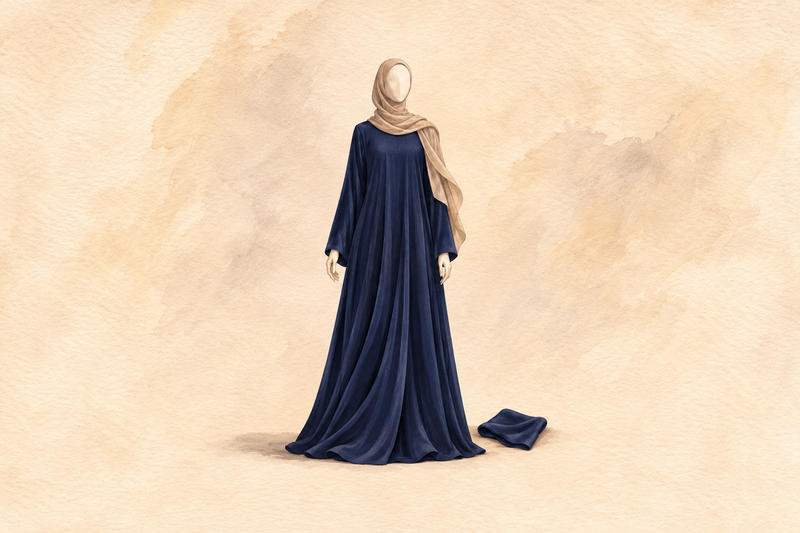
Abaya Factories in Ajman: What Should You Expect?
A useful visit to an abaya factory in Ajman begins with knowing what you want to see or buy. You might be choosing one garment, discussing a personal commission, exploring how an embellished design is made, or preparing a small collection. Tell the business which of those describes your enquiry before arranging the visit. The service it offers will shape the conversation.
Expect to ask about the actual fabric, the work involved and the route from your first idea to a finished abaya. A production setting can make those details easier to discuss, especially when you can compare a drawing, a material sample and a completed garment together. Agree what the appointment includes so there is time for the parts that matter to you.
This guide follows that visit from the first enquiry through the design discussion, workshop questions, fitting and collection. It helps you appreciate the work behind an abaya while choosing the garment and service that suit your needs.
What does the business mean by an abaya factory?
Start with a direct question: what work does this business carry out, and who does it serve? Manufacturing, personal tailoring, wholesale supply and retail shopping can lead to quite different experiences. Ask whether the appointment is with a production team, a designer, a salesperson or someone who coordinates work with another workshop.
Ajman Free Zone's official business activity list distinguishes garment manufacturing, tailoring services and clothing trade. Its description of ladies' Arabic gown manufacturing includes cutting, sewing and embroidery. Those categories provide useful context for your questions; ask the individual business to explain its own work and the services available for your enquiry.
Find out which stages take place at the address you plan to visit. A business might show finished samples in one location and arrange another part of the work elsewhere. Ask where your garment would be cut, sewn, decorated and fitted, and who would answer questions as it progresses. This helps you understand the proposed arrangement.
If you want one abaya, say so at the beginning. Ask whether individual purchases or commissions are available and whether you can try on finished garments. If you need several pieces, give the intended quantity and ask how the business organises designs, colours and sizes. A clear first enquiry makes the appointment more relevant for both sides.
Arrange a visit around a specific purpose
Contact the business before travelling and confirm that it accepts the kind of visit you have in mind. Ask for the address, the person you should meet and the agreed time. Explain whether you want to view a collection, discuss a commission or learn about the production process. Request confirmation of any fitting or consultation arrangements you need.
A showroom appointment and a workshop visit may involve different access. Ask which areas you will be able to see and whether a member of staff will accompany you. If your main interest is embroidery, mention that in advance so the team can tell you whether a relevant sample or demonstration can be included.
Plan enough time to look at the garments carefully. Comparing two fabrics, trying on a sample and discussing a change to a sleeve can take more attention than browsing photographs. Leave room in your own schedule to write down the decisions afterwards. A rushed visit makes it easier to forget which sample or colour you preferred.
Keep a small preparation list: your purpose, any essential garment requirements, a few labelled reference images and the questions you most want answered. Bring the shoes or underlayers that materially affect a fitting if the business has agreed one. You will have a more useful conversation when the team can connect the design with how you intend to wear it.
Look at the collection before choosing a design direction
Begin by viewing several completed garments that relate to your needs. A plain everyday abaya, an open layer and a heavily decorated occasion piece reveal different kinds of decisions. Look at the outline first, then the fabric, closures, sleeves and decoration. This order helps you see how the pieces work as garments rather than as isolated attractive details.
Ask which samples represent designs currently available and which are examples of earlier work. Find out whether a sample can be ordered as shown, adapted within agreed limits or used only to demonstrate a technique. Record the relevant style reference so a later message about the green abaya does not leave someone guessing between several designs.
Try to compare like with like. If one garment has a lining and the other does not, note that difference before deciding why their drape feels different. If one sample is a size you would not wear, separate your reaction to its proportions from your reaction to the design itself. Ask what a suitable fitting sample would be.
When a collection is described as exclusive, ask what that means for the piece you are considering. It might refer to a particular design, a limited material choice or an arrangement offered to certain buyers. Establish the relevant detail in the conversation. You can then judge the abaya on its design and suitability alongside the explanation you receive.
Follow the route from design to finished garment
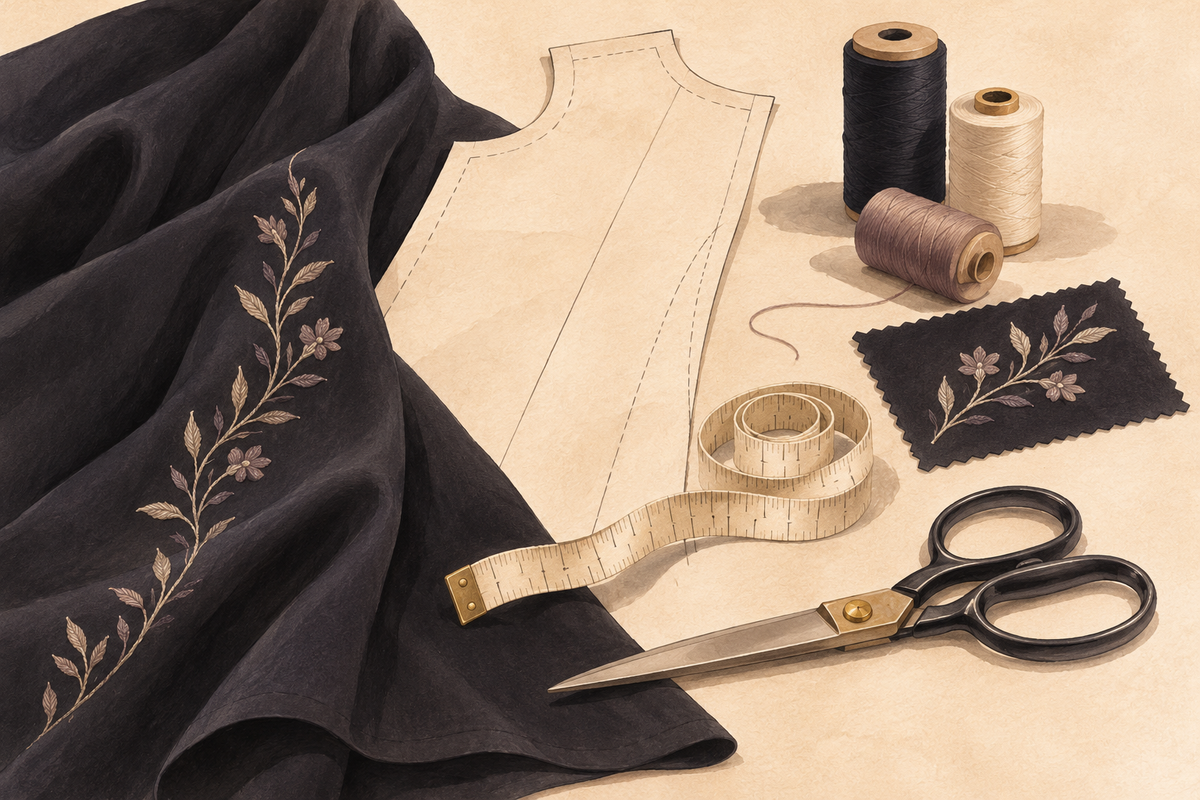
Ask the team to describe the stages your chosen design would pass through. A useful explanation connects the drawing or sample with the fabric choice, pattern, cutting, sewing, decoration and finishing. The sequence can vary with the design, so invite the maker to explain where the important decisions occur in this particular garment.
A pattern discussion can show why a seemingly small visual change affects other parts of the abaya. A fuller sleeve may need a different relationship with the shoulder or cuff. Changing the opening may alter how the front sits. Ask the maker to demonstrate the proposed effect with a drawing, pinned sample or comparable finished piece.
At the cutting stage, ask how the chosen fabric and any visible pattern will be arranged. If you want a motif placed at the hem or a border preserved along the opening, make that preference clear before the cloth is cut. Seeing the material laid out can help you understand what the proposed design will reveal and where the joins will sit.
For sewing and finishing, ask which details define the result you have chosen. That might be a clean front edge, a particular sleeve finish or the way an inner layer is attached. You do not need to prescribe the maker's technique. Describe the result you want to wear and ask how the proposed construction will achieve it.
If you see equipment during the visit, connect it with the garment rather than judging the workshop by the number of machines. Ask which process is used for your design and whether a sample shows that exact finish. The explanation should help you understand the work you are commissioning.
Examine the actual fabric in the proposed arrangement
Ask to see the fabric being proposed for your order, with its reference recorded. Handle it with permission and look at it both flat and loosely draped. Notice the surface, weight in the hand and way the folds fall. A small swatch is useful for colour, while a larger sample helps you judge the intended silhouette.
Ask for the fibre information and care requirements rather than inferring them from a description such as luxurious or soft. Keep those details connected with the sample you select. If a choice changes later, request the new information before approving it. Similar colours can come in fabrics that behave quite differently in the same cut.
Consider lining and underlayers at the same time. View a proposed outer fabric over the kind of base you will wear, and check the effect in suitable light. Ask whether the sleeves and body have the same lining arrangement. An open abaya worn over a complete outfit presents different decisions from a closed garment you plan to wear as the main layer.
For colour, compare physical samples together where possible. Put the proposed abaya cloth beside the scarf, trim or inner fabric that will accompany it. Look at the combination from a little distance as well as close up. You may prefer a coordinated difference in texture even when the colours are very close.
Before choosing, ask whether enough of the selected material is available for the agreed work. If you hope to order another garment later, discuss how a repeat would be handled. Keep the fabric reference and approval record so a future conversation begins with the actual choice rather than a photograph remembered from the first visit.
Understand embroidery, beadwork and other decorative choices
Decoration deserves a discussion of its own because placement can change the whole outfit. Ask to see the proposed motif at the intended scale. A close photograph of an embroidered flower may look striking while giving very little sense of how it will sit across a sleeve, opening or hem.
Place the sample against the area where the decoration will appear, or ask for a clear marked drawing. Decide whether it should be visible from the front only, continue around the cuff or repeat elsewhere. If a matching scarf is included, discuss whether it shares the motif or provides a plainer surface beside the abaya.
Ask how the decoration is produced and attached. Hand embroidery, machine embroidery and applied trim involve different decisions, and a single garment may use more than one method. Look at a relevant finished example and, where accessible, its reverse. Ask how the back of the decorative area will feel against the layers beneath it.
Think about contact during wear. A decorated shoulder may sit beneath a bag strap; an embellished cuff will move near your hands; a detailed front panel may fold when you sit. Explain those everyday uses to the maker and discuss placement accordingly. An attractive detail should have a comfortable place in the outfit you actually wear.
Ask about care before approving a combination of cloth and trim. Record the instructions for the finished garment, including its decoration. If the proposed detail would make upkeep inconvenient for your routine, consider a smaller area, another placement or a simpler version while the design is still open to discussion.
Use customisation to solve a real wardrobe need
Choose a clear purpose for a personal commission. Perhaps you need sleeves that sit comfortably at a desk, an open abaya that works over a particular dress, or an occasion garment with decoration concentrated at the hem. A useful custom choice answers that need through the cut and details.
Bring a familiar garment if it helps explain the fit, and say what you like about it. You might want its body width but a different wrist finish, or its length with a more generous sleeve. Keep those preferences separate so the maker can discuss them individually rather than assuming you want an exact copy of everything.
Ask which changes are available within an established design and which require further development. Adjusting the length, changing the cloth and creating a new sleeve shape may involve different work. Let the team explain how each change would affect the sample, fittings, timing and quoted price before you settle the design.
Use a few carefully chosen references. Identify the feature in each image: the front opening in one, the position of decoration in another, the overall fullness in a third. A large folder of unrelated outfits can leave your priorities unclear. A small set with precise notes gives the maker more useful information.
For a fuller explanation of preparing the written specification, see our guide to explaining your ideas when ordering a custom abaya. During a factory appointment, use the available samples and conversation to resolve the choices that are still uncertain before you finalise that brief.
Make a fitting part of the design conversation
Confirm what fitting opportunities are included and which sample or garment you will try. Wear the layers and shoes relevant to the intended outfit. Stand naturally and let the abaya settle before judging the length or shape. Check the front, sides and back, then move in the ways the garment needs to accommodate.
Describe what you notice in plain terms. The cuff falls over my hand when I reach forward gives the maker a concrete issue to examine. The front feels crowded over this inner dress identifies a relationship between the two garments. These observations are easier to work with than a broad request to make the abaya more flattering.
Ask how a proposed alteration affects neighbouring details. Shortening a sleeve may change the position of embroidery. Raising the hem may change the space beneath a border. Moving a pocket can affect its relationship with a seam. Discuss the complete result while there is still an opportunity to choose the best adjustment.
At the end of the fitting, repeat the agreed changes together and record them. Identify which decisions are final and whether another fitting is planned. If you will be leaving Ajman before completion, settle how the next stage will be reviewed and who will contact you with any questions.
Assess quality through the garment in front of you
Look at the inside as carefully as the decorated front. Examine the neckline, shoulders, sleeves, openings and hem in a consistent order. Ask about any detail you do not understand. A visible join may be an intended part of the construction; an unfinished area needs a different conversation. Establish which you are seeing.
Try closures in their normal use and check the alignment of the front. If the garment has pockets, put your hands into them and notice their position. With a set, place the included pieces together and check that they correspond to the arrangement you discussed. These practical observations give you useful questions to raise before collection.
Compare the sample with the agreed design rather than with a general idea of luxury. If you requested a quiet sleeve finish, inspect that finish. If decoration was meant to sit below the knee, look at its actual position on the wearer. Quality becomes easier to discuss when the expected result is clear.
Ask how the business checks completed work and how it handles a difference from the agreed specification. For an order of multiple pieces, use a separate process suited to that quantity. Our wholesale abaya quality control guide explains the relationship between a reference sample, inspection records and the delivered stock.
Ask useful questions about craftsmanship and provenance
A workshop conversation can deepen your appreciation of the garment. Ask the maker to explain a detail they consider characteristic of their work, then look for it in a sample. It could be the way an opening is finished, the placement of a motif or the relationship between a flowing body and a more contained sleeve.
If a design is presented as a traditional reference, ask which feature carries that reference and how the designer has interpreted it. A specific explanation gives you more to appreciate than treating every abaya from one place as the same expression of culture. Let the maker describe their own design choices and experience.
Ask before photographing staff, work areas or designs. Follow the access arrangements agreed for your visit, and allow people to continue their work. If you want to share something afterwards, check what may be shown and how the business or maker wishes to be credited. Those small courtesies support a more thoughtful exchange.
Keep the information you receive precise. If a particular part is hand embroidered, record that description for that part. If work takes place at more than one location, retain the explanation of those stages. The details of one garment are more informative than an assumption about every abaya made in Ajman.
Discuss environmental and working-practice claims specifically
If material sourcing or working practices influence your choice, raise those priorities early. Ask which information the business can provide about the fabric, production arrangement and claims attached to your garment. A clear question gives the team a chance to supply something you can examine before making your decision.
For a fabric described as recycled or certified, ask for the relevant reference and what it covers. Keep that information alongside the fabric sample details. If you are unsure how a document relates to the cloth being offered, ask the business to explain the connection. Avoid replacing that question with a judgement based on the fabric's appearance.
You can also discuss practical choices within your own order. Ask whether a design adjustment can use an available material, whether suitable leftover cloth can be included for a future repair, or whether the packaging can be simplified for your journey. Agree what is feasible without assuming that a smaller package establishes the garment's overall environmental impact.
Where a business describes support for artisans or employees, ask what that means in its own operation. Listen to the specific explanation and request further information when it matters to your decision. Appreciate the skill you can observe while keeping wider claims connected with the evidence supplied for them.
Understand the quote and the time needed
Request a written quote for the garment or order you have actually discussed. Check that it identifies the fabric, design, decoration, lining and included components. Ask whether fittings, agreed alterations, packaging and delivery are included. Comparing quotes is more useful when you understand the work each one covers.
Discuss which choices affect the cost. Ask for the difference between two proposed finishes if you are deciding where to spend your budget. You might prefer a well-considered plain garment over a more complicated design, or concentrate decoration in one area. Make that choice through the actual options and prices provided by the business.
Agree the stages of work and the dates attached to them. A design discussion, material approval, sample, fitting and collection can each need its own decision. If the abaya is for an occasion, explain when you need to have tried and approved the completed garment, including any time you want available for adjustments.
Ask how changes are handled after approval. A new fabric request or extra decoration can change the work involved. Confirm the updated price and timing before treating a suggestion as an agreed change. Keep the final version together with the quote, payment arrangements and the business's stated adjustment or cancellation terms.
Three ways to prepare for different kinds of visit
You want an everyday abaya for yourself
Begin with the parts of your present wardrobe that already work. Bring a reference for the length and describe the sleeve room, closure and pocket arrangement you prefer. During the visit, compare fabrics in a similar outline so you can judge how the material changes the result. Ask to see the inside finish and discuss care before choosing.
Keep the design decisions focused on everyday use. If your bag usually rests on one shoulder, consider where decoration would sit beneath it. If you wear a coat, try the proposed sleeve shape with a comparable outer layer. Leave with a clear understanding of what is being made, what you will try on and when the next decision is needed.
You are considering an embellished occasion piece
Bring the scarf, shoes or colour references that will materially affect the outfit. Ask to view the decoration at the proposed scale and discuss how it will appear while you sit as well as stand. Establish the intended lining, fastening and sleeve arrangement before choosing the final placement of the decorative work.
Explain the occasion date and your availability for fittings. Decide which elements are essential and which can be simplified if the design needs revision. Ask for the care information and the proposed way of packing the finished garment. The appointment should leave you with a coherent outfit plan and a clear sequence of approvals.
You are exploring a small collection
State the number of designs, intended quantities and size range at the first enquiry. Ask whether the business can support that scope and how sampling is organised. Use the visit to understand the available construction and decoration options, the communication process and which details must be settled before production is quoted.
Keep your first discussion manageable. A few defined designs allow more useful questions than a broad request for every possible style. Identify who will approve samples, who will supply missing information and how changes will be recorded. Arrange the separate quality and delivery planning appropriate to a collection before committing to the full order.
Compare two visits using the same priorities
If you are visiting more than one business, take the same short brief to each appointment. Otherwise, one conversation may concern a plain existing design while the next develops a lined garment with extensive embroidery. Write down those differences before comparing the proposals. The useful comparison begins with what each business is offering for your particular purpose.
Make a simple record after each visit: the design you discussed, material reference, service included, fitting arrangement, total quote and next step. Add one or two observations that matter to you, such as how clearly a sleeve alteration was explained or whether you tried a relevant sample. Keep impressions tied to something you actually saw or discussed.
Give unresolved points their own place. If one business still needs to confirm the cloth, leave that choice open in your comparison. If another has quoted for collection and you need delivery, ask for the missing detail. You can then compare complete proposals without silently filling the gaps yourself.
Choose according to your priorities. A straightforward design with a fitting arrangement you can attend may serve you better than a more elaborate proposal that is difficult to review. For a decorative commission, the relevant sample and the clarity of the proposed placement may carry more weight. Use the visit to identify the arrangement you understand and can follow through.
Continue the discussion remotely if your visit is brief
If you will be away from Ajman during the next stage, agree how communication will work before leaving. Identify the person who will send updates and which questions require your approval. Ask what can be shown through photographs or video and what would benefit from a physical sample or another fitting.
Request views that answer a specific question. An overall front and back view can show the placement of decoration, while a closer view may help explain a cuff finish. If a measurement is being checked, ask the maker to show the agreed measuring points. A short message explaining what you are reviewing makes the images easier to interpret.
When you respond, refer to the same design or sample reference and keep separate decisions separate. You may approve the motif placement while still asking about sleeve length. State that clearly so approval of one photograph does not become approval of every outstanding detail. Keep a dated record of the choices both sides confirm.
Agree how the finished garment will reach you and how you can raise a concern after receiving it. If the proposed process depends on a fitting you cannot attend, discuss an alternative before the work continues. A brief visit can still lead to a well-considered garment when the remaining stages are planned around your actual availability.
Finish the visit with a clear next step
Before leaving, review the choices you have made and the questions still open. Note the design and fabric references, agreed changes, relevant contact person and next appointment or response date. If you are still comparing options, say so and retain the information needed to make that comparison carefully.
At collection, check the finished garment with the agreed outfit and against the final specification. Discuss an unresolved detail before treating the order as complete. Ask for the care instructions and confirm how the garment should be supported or packed for your own journey. Keep the order information somewhere you can find it again.
The most rewarding factory visit gives you a clearer understanding of both the abaya and the work behind it. You should be able to explain why you chose its fabric, shape and details, how the next stage will happen, and what the finished result needs to do for you. That understanding makes the garment a more considered part of your wardrobe.